Просмотр новости
Найдите то, что Вас интересует
 Спутники
 РН
РН SpaceX
 Роскосмос
 NASA
NASA
СпутникиРНSpaceXРоскосмосNASABackground This paper introduces new types of spaces, namely metacompact J -spaces and strong metacompact J -spaces. These spaces represent a generalization of the concepts of metacompact spaces and J -spaces introduced by E. Michael. Methods The main objective of this work is to identify and prove the fundamental properties of metacompact J -spaces and strong metacompact J -spaces, as well as to explore the relationship between them. In addition, this work introduces a new class of functions, which are meta-perfect functions and boundary-meta-perfect functions. These functions play a significant role in establishing several fundamental properties of metacompact J -spaces, and their topological behavior under such functions is thoroughly examined. Results This work also provides illustrative examples that are presented to show that metacompact J -spaces and J -spaces do not coincide in general. Furthermore, we investigate the necessary and sufficient conditions under which metacompact J -spaces coincide with J -spaces. In addition, we establish several fundamental and important properties of metacompact J -spaces. Remember, we will denote metacompact J -space by MJ -space and strong metacompact J -spaces by strong MJ -space.

S. Saeed H and Aziz Hussain Al-Abdulla R. Some New Generalized Types of J-spaces and Metacompact spaces [version 1; peer review: 1 approved with reservations]. F1000Research 2026, 15:1203 (https://doi.org/10.12688/f1000research.183692.1)
Research Article
[version 1; peer review: 1 approved with reservations]
1 Mathematics, University of Al-Qadisiyah, Diwaniyah, Al-Qadisiyah Governorate, Iraq
Hasan S. Saeed
Roles: Conceptualization, Data Curation, Formal Analysis, Investigation, Methodology, Project Administration, Validation, Visualization, Writing – Original Draft Preparation, Writing – Review & Editing
Raad Aziz Hussain Al-Abdulla
Roles: Conceptualization, Data Curation, Formal Analysis, Investigation, Methodology, Project Administration, Supervision, Validation, Visualization, Writing – Original Draft Preparation, Writing – Review & Editing
OPEN PEER REVIEW
REVIEWER STATUS
This paper introduces new types of spaces, namely metacompact J -spaces and strong metacompact J -spaces. These spaces represent a generalization of the concepts of metacompact spaces and J -spaces introduced by E. Michael.
MethodsThe main objective of this work is to identify and prove the fundamental properties of metacompact J -spaces and strong metacompact J -spaces, as well as to explore the relationship between them. In addition, this work introduces a new class of functions, which are meta-perfect functions and boundary-meta-perfect functions. These functions play a significant role in establishing several fundamental properties of metacompact J -spaces, and their topological behavior under such functions is thoroughly examined.
ResultsThis work also provides illustrative examples that are presented to show that metacompact J -spaces and J -spaces do not coincide in general. Furthermore, we investigate the necessary and sufficient conditions under which metacompact J -spaces coincide with J -spaces. In addition, we establish several fundamental and important properties of metacompact J -spaces. Remember, we will denote metacompact J -space by MJ -space and strong metacompact J -spaces by strong MJ -space.
MJ-space, strong MJ-space, metacompact, meta-perfect function, boundary-meta-perfect function
Corresponding author: Hasan S. Saeed Competing interests: No competing interests were disclosed.
Grant information: The author(s) declared that no grants were involved in supporting this work.
Copyright: © 2026 S. Saeed H and Aziz Hussain Al-Abdulla R. This is an open access article distributed under the terms of the Creative Commons Attribution License, which permits unrestricted use, distribution, and reproduction in any medium, provided the original work is properly cited. How to cite: S. Saeed H and Aziz Hussain Al-Abdulla R. Some New Generalized Types of J-spaces and Metacompact spaces [version 1; peer review: 1 approved with reservations]. F1000Research 2026, 15:1203 (https://doi.org/10.12688/f1000research.183692.1) First published: 23 Jul 2026, 15:1203 (https://doi.org/10.12688/f1000research.183692.1) Latest published: 23 Jul 2026, 15:1203 (https://doi.org/10.12688/f1000research.183692.1)
The concept of generalized topological spaces has been and remains an important research area in topology, driven by the desire to expand classical topological concepts and make dealing with them more flexible.
In 2000, Michael was the first to introduce the concept of J -spaces,1 which generalizes the Jordan curve theory, which is a classic mathematical theory formulated by Camille Jordan in 1887.2 This theory states that any simple closed curve in a plane that does not intersect itself divides the plane into two different regions, an unbounded exterior region and a bounded interior region.
Michael introduced two main spaces, which are (X,τ) is a J -space when for each {K1,K2} is a cover of (X,τ) by closed sets such that K1∩K2 is compact, then either K1 or K2 is compact. (X,τ) is a strong J -space when for each compact L1⊂X , it is included in a compact L2⊂X so that X\L2 is connected.
Over the past few years, several authors have presented generalizations of J -spaces, exploring the relationship between J -spaces and these generalized spaces and the conditions under which they coincide or differ. For example, in 2007, Y.-Z. Gao presented the first generalization of J -spaces by using the concept of Lindelöf spaces, demonstrating that these spaces are distinct and exhibit interesting behaviors.3 In 2022, S. S. Mthethwa and A. Taherifar presented a study of J -spaces and other related types of spaces by using the concept of relatively connected subsets.4 In 2024, S. S. Mthethwa and A. Taherifar presented algebraic descriptions of J -spaces and C -normal spaces, introducing a new class of spaces known as JC -spaces by using the concept of a Z -connected ideal in C(X). 5
These works demonstrate that the study of J -spaces remains an active and evolving field, with new generalizations seeking to formulate broader classes of spaces while preserving fundamental topological features.
Based on this, this paper introduces and examines a new class of topological spaces, called MJ -spaces, as a generalization of J -spaces. The aim is to present a class of spaces that retains the key properties of J -spaces while exhibiting greater flexibility in handling topological properties. The relationships between J -spaces and their generalized forms are illustrated in Figure 1.
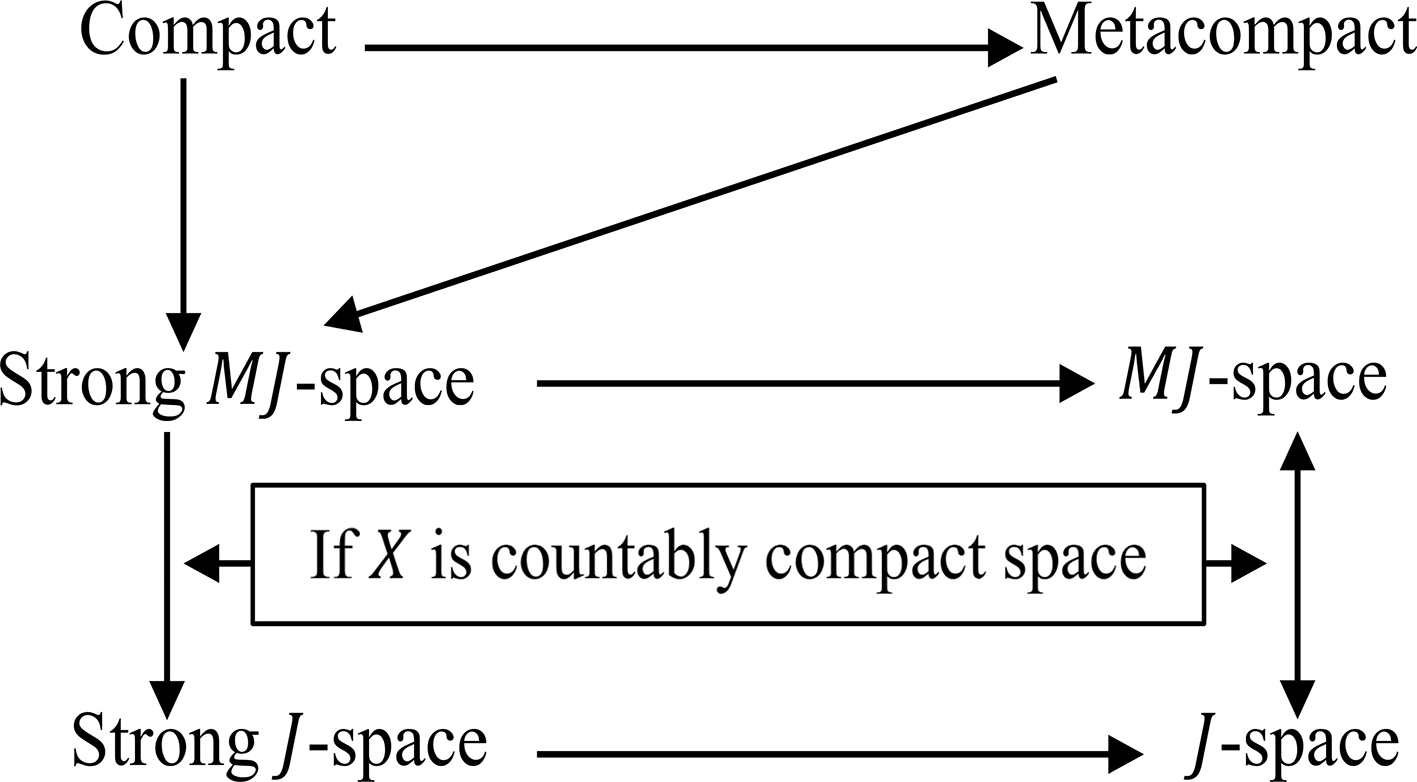
The paper is organized as follows. Section 1 provides definitions and preliminary concepts necessary for subsequent discussions. Section 2 defines MJ -spaces and identifies their fundamental properties. Section 3 explores the relationship between MJ -spaces and J -spaces, providing examples and counterexamples, and establishing the necessary and sufficient conditions for the congruence of the two. Section 4, titled “ MJ -spaces Functional Characterizations” introduces a new class of functions related to MJ -spaces. Section 5 concludes by mentioning the most important findings reached in the research paper.
This section contains definitions and results that will be necessary to prove the research results.
1The real numbers set ℝ with usual topology is not J -space.
6The space (X,τ) is called metacompact, if for each open cover of the space (X,τ) it has a point finite open refinement.
7Every compact space is metacompact.
8The usual topology on the real numbers set ℝ is metacompact space but it is not compact.
9The metacompact space (X,τ) , if it is countably compact, then it is compact.
10Let (X,τ) be a space, if (X,τ) is metacompact, and K⊂X , with K is a closed in (X,τ) , then K is metacompact.
11The disjoint union of metacompact spaces is metacompact.
12Let f:X⟶Y be a function, then f is called perfect, if f is a closed, continuous and for all h∈Y , so f−1(h) is compact.
1The function f:(X,τ)⟶(X⸍,τˊ) is called boundary-perfect, when f is a closed and for each xˊ∈Xˊ , so ∂(f−1(xˊ)) is compact.
8Let f:(X,τ)→(Xˊ,τˊ) be a continuous, closed and onto function. If (X,τ) is metacompact, then (Xˊ,τˊ) is so.
13The function f:(X,τ)→(Xˊ,τˊ) is known as metacompact-function, when the inverse image for any closed and metacompact set of (Xˊ,τˊ) is metacompact in (X,τ) .
14The function f:(X,τ)→(Xˊ,σ) , if it is a continuous, then f(X) is connected space for all X is connected.
10A function f:(X,τ)→(Xˊ,τˊ) is called monotone if all fibers f−1(xˊ) are connected.
10 Suppose that f:X→Y is a function, if f is monotone such that f is a clopen, so f−1(K) is connected for each connected subset K of Y .
1 The function f:(X,τ)→(Xˊ,τˊ) , if it is monotone, and {K1,K2} is either open or closed cover of (X,τ) , then f(K1∩K2)=f(K1)∩f(K2) .
A space (X,τ) is said to be MJ -space, if it is achieved for each {K1,K2} is a closed cover of (X,τ) with K1∩K2 metacompact, so either K1 or K2 is metacompact.
The space (X,τ) is said to be strong MJ -space, when it is achieved for all L1⊂X metacompact be included in a closed metacompact L2⊂X , with X\L2 is connected.
Every metacompact (compact) space is a strong MJ -space, and therefore MJ -space is as explained in Proposition (2.6). For example, the real numbers set ℝ with usual topology.
Suppose that (X,τ) is a strong MJ -space, the (X,τ) is an MJ -space.
Assume that (X,τ) is a strong MJ -space, and let {K1,K2} be a closed cover of (X,τ) and K1∩K2 metacompact, since (X,τ) is a strong MJ -space, thus there is metacompact and closed L⊂X , with K1∩K2⊂L and X\L is connected. Thus {K1∩(X\L),K2∩(X\L)} is a closed disjoint cover of X\L . However, X\L is connected, then X\L has to be content in K1∩(X\L) or in K2∩(X\L) . Consequently, we have (X\L)⊂K1 or (X\L)⊂K2 . By using the complement, we have K1c⊂L or K2c⊂L , but K1∩K2⊂L , so K1⊂L or K2⊂L . So K1 or K2 is metacompact by Theorem (1.6). Hence X is an MJ -space.
Generally speaking, the inverse of proposition (2.4) cannot be true. For example, we define the co-finite topology on ℕ , where ℕ represents the set of natural numbers, where the open sets are ℕ,∅ and any subset A of ℕ, such that the complement is finite. Where the only subsets metacompact of ℕ are the finite subsets. Consequently, assume that {K1,K2} is a closed cover ℕ with K1∩K2 metacompact, so it is necessary to have K1∩K2 as finite set, where the intersection in that space for any infinite sets has to be an infinite set, thus either K1 or K2 has to be finite, thus K1 or K2 is metacompact. So ℕ is an MJ -space. However, ℕ it cannot be a strong MJ -space, because each metacompact subset L⊂ℕ is finite set, and thus X\L is infinite and each infinite subset of ℕ it cannot be connected.
Every metacompact space (X,τ) is a strong MJ -space.
Assume that (X,τ) is metacompact space, in addition to L⊂X is metacompact, since (X,τ) is a closed metacompact with L⊂X , and since X\X=∅ which is connected. Consequently, (X,τ) is a strong MJ -space.
Every (X,τ) compact space, it is a strong MJ -space.
Taken from Proposition (2.6), because each compact space is metacompact space.
Every metacompact space (X,τ) is an MJ -space.
Resulting from the Proposition (2.6) and the Proposition (2.4).
In most cases the inverse of Corollary (2.8) cannot be true. For example, the topological space (ℝ,τ) , where ℝ is the real numbers set and τ is the particular point topology, such that τ={U⊆ℝ:0∈UorU=∅} , where each closed cover of ℝ has to be contained in ℝ . Assume that {ℝ,K} is a closed cover of ℝ such that ℝ∩K is metacompact, but ℝ∩K=K , so K is metacompact. Hence (ℝ,τ) is an MJ -space. But this space is not metacompact, since C={(−n,n):n∈ℕ} is set of all open sets in ℝ , which is a cover of ℝ , but C has no point finite open refinement.
Assume that B is a closed subset of (X,τ) , such that B is non-metacompact and if C⊂B is metacompact, then there is a closed subset D⊂B , such that D is non-metacompact with D∩C=∅ .
Assume that U is a cover of B by open sets, with U has no point finite subcover of B . Choose a finite U⊂U is cover of C . So D=B\∪U is a closed non–metacompact set in B with D∩C=∅ , because if D is metacompact, then by theorem (1.7) D∪C is metacompact, and thus B is metacompact and this is a contradiction.
For any space (X,τ) , the following properties are equivalent.
1. X is an MJ -space.
2. For all K⊂X , such that the boundary of K is metacompact, then K¯ or (X\K)¯ is metacompact.
3. If K1 and K2 are closed subset of X such that K1∩K2=∅ , and if ∂(K1) or ∂(K2) is metacompact, then K1 or K2 is metacompact.
(1) ⟹ (2): Let K⊂X with ∂(K) be metacompact, (where the symbol ∂(K) means the boundary of K ), since ∂(K)=K¯∩(X\K)¯ , in addition to {K¯,(X\K)¯} is a closed cover of (X,τ) with K¯∩(X\K)¯ is metacompact. Since X is an MJ -space, so K¯ or (X\K)¯ is metacompact.
(2) ⟹ (3): Assume that K1 and K2 are disjoint closed subsets of (X,τ) and also ∂(K1) is metacompact. Then by (2) we obtain K1¯ or (X\K1)¯ is metacompact. Since K1 is a closed subset, so K1=K1¯ . Then K1 or (X\K1)¯ is metacompact, and because K2 is a closed subset of (X\K1)¯ , thus K1 or K2 is metacompact, (in the same way if ∂(K2) is metacompact).
(3) ⟹ (1): Assume that {K1,K2} is a cover of X by closed sets, such that K1∩K2 is metacompact. Assume that K2 is non-metacompact, since K1∩K2⊂K2 is metacompact, then by lemma (2.10) there is a closed non-metacompact D⊂K2 such that D∩(K1∩K2)=∅ , it follows that D∩K1=∅ , so K1 and D are closed subsets disjoint of X , since ∂(K1) is metacompact and it is a closed subsets of K1∩K2 . So, by (3) K1 or D is metacompact, but D is non-metacompact. Therefore K1 is metacompact, (in the same way if K1 is non-metacompact).
The following properties are equivalent in topological space.
1. If L⊂X is metacompact, and if U represents open cover for X\L with disjoint members, so there exists U∈U with X\U is metacompact.
2. The same in (1), but using a card U=2 .
3. X is an MJ -space.
(1) ⟹ (2): Let L⊂X be metacompact, and U={U1,U2} is open cover of X\L with U1∩U2=∅ . By (1) there exists U∈U such that X\U is metacompact, since U contains only two open sets, so U must be either U1 or U2 , therefore X\U1 or X\U2 is metacompact.
(2) ⟹ (1): Assume that L⊂X is metacompact, and U is a disjoint open cover of X\L . For some U∈U , we will use three demarches to show that X\U is metacompact.
First, we will show that, when A is an open subset for X containing L , so U′={U∈U:U⊈A} is point finite, assume that it is not point finite, then U=U1∪U2 with U1∩U2=∅ and U1∩U′ and U2∩U′ both point infinite.
Assume that Z1=∪U1 and Z2=∪U2 , so Z1,Z2 are two open subsets of X with Z1∩Z2=∅ and X\L=Z1∪Z2 , so by (2) X\Z1 or X\Z2 is metacompact, but Z1⊆X\Z2 and Z2⊆X\Z1 since Z1 and Z2 are disjoint. It follows that Z1¯⊆X\Z2¯=X\Z2 and Z2¯⊆X\Z1¯=X\Z1 , so we obtain Z1¯ or Z2¯ is metacompact by Theorem (1.6). Suppose that Z1¯ is metacompact, then C=Z1¯\A is metacompact. Now let U1′=U1∩U′ , then U1′ covers C and each U∈U′ intersects C , so C is not metacompact since U1′ is disjoint and infinite, and this is a contradiction. Therefore U′ is point finite.
Second, it will be shown that, when U¯ is metacompact, for all U∈U , and thus X is metacompact. Assume that Z is set of point finite open subsets covers X , so Z is a point finite open cover of the space X , where is metacompact, thus Z contains a point finite subcover F covers L . Assume that A=∪F , by the first step we obtain a point finite family U′={U∈U:U⊈A} , so ⋃{U¯:U∈U′} is metacompact and because Z is an open cover of ⋃{U¯:U∈U′} , thus ⋃{U¯:U∈U′} is covered by some point finite E⊂Z . However, ⋃E⊂Z is point finite and covers X , so X is metacompact.
Finally, we will show that, X\U is metacompact for a few U∈U . If for any U∈U , then U¯ is metacompact, so X is metacompact through step (2) and because X\U is a closed set in X , then X\U is metacompact. Assume that there is U∘∈U with U∘¯ is non-metacompact. Assume that U∗=∪{U∈U:U≠U∘} , then {U∘,U∗} is an open disjoint cover for X\L , so X\U∘ or X\U∗ is metacompact, by (2). When X\U∗ is metacompact, and because U∘¯ is a closed set in X\U∗ , then U∘¯ is metacompact, and this is a contradiction, then X\U∗ is not metacompact, it follows that is X\U∘ is metacompact.
(2) ⟹ (3): Suppose that {K1,K2} is a cover of X by closed sets such that K1∩K2 is metacompact, so {X\K1,X\K2} is cover of X\(K1∩K2) by open sets, with X\K1∩X\K2=∅ . By (2) X\(X\K1) or X\(X\K2) is metacompact, that is K1 or K2 is metacompact. Hence X is an MJ -space.
(3) ⟹ (2): Let L⊂X be a metacompact, and assume that U={U1,U2} is a cover of X\L by open sets with U1∩U2=∅ , so {X\U1,X\U2} is cover of X by closed sets, with X\U1∩X\U2=X\(U1⋃U2) which is a closed set in L , since X\L⊂U1⋃U2 , then by Theorem (1.6) X\U1∩X\U2 is metacompact. But X is an MJ -space, thus X\U1 or X\U2 is metacompact.
Suppose that the closed cover {A1,A2} of a space (X,τ) with A1∩A2 is metacompact. Then (X,τ) is an (strong) MJ -space if and only if A1 and A2 are (strong) MJ -space and A1 or A2 is metacompact.
(1) MJ -space
Suppose that (X,τ) is an MJ -space, so A1 or A2 is metacompact from definition of MJ -space. Let A1 be a metacompact, so A1 is an MJ -space. To show that A2 is an MJ -space. Assume that {K1,K2} is a cover of (X,τ) by closed sets such that K1∩K2 is metacompact, therefore {K1,K2∪A1} is a cover of (X,τ) be closed sets such that K1∩(K2∪A1) is metacompact, so K1 or K2∪A1 is metacompact, since (X,τ) is an MJ -space. However, K2 is a closed subset of K2∪A1, then K1 or K2 is metacompact.
Suppose that A1 and X2 are MJ -space and let A2 be a metacompact, we must demonstrate that (X,τ) is an MJ -space. Suppose that {K,Kˊ} is a closed cover of (X,τ) such that K∩Kˊ is metacompact. Now let Ki=K∩Ai and Kˊi=Kˊ∩Ai (i=1,2), consequently {K1,Kˊ1} is a cover of A1 by closed sets, which is an MJ -space, such that K1∩Kˊ1 is metacompact, so K1 or Kˊ1 is metacompact. If K1 is metacompact, then K=K1∪K2 is metacompact since K2 is a closed subset of metacompact A2 . In the same manner, when Kˊ1 is metacompact, so is Kˊ.
(2) Strong MJ -space
Let (X,τ) be a strong MJ -space, from Proposition (2.4) (X,τ) is an MJ -space, so A1 or A2 is metacompact. Assume that A1 is metacompact, from Proposition (2.6) A1 is a strong MJ -space. Thus, it is still necessary to demonstrate that A2 is a strong MJ -space. Assume that L2⊂A2 is metacompact. Define L=L2∪A1 , thus L is metacompact subset of (X,τ) which is a strong MJ -space, then there is a closed metacompact set Lˊ in (X,τ) with L⊂Lˊ and X\Lˊ is connected. Assume that Lˊ2=Lˊ∩A2, so Lˊ2⊂A2 is metacompact since Lˊ2 is a closed set in metacompact set Lˊ . In addition to L2⊂Lˊ2 , where L2⊆L⊂Lˊ implies that L2∩A2⊂Lˊ∩A2 . Also note that A1⊂L⊂Lˊ which implies A2\Lˊ2=X\Lˊ , and hens A2\Lˊ2 is connected.
Let A1 and A2 be a strong MJ -space and assume that A1 is metacompact, and assume that L⊂X is metacompact. Define L2=(L∪A1)∩A2 , so L2 is metacompact, because it is a closed set in metacompact set L∪A1 , then L2 is metacompact set in the strong MJ -space A2 , thus there is a closed metacompact set Lˊ2 in A2 , with L2⊂Lˊ2 and A2\Lˊ2 is connected. And now let Lˊ=Lˊ2∪A1 , so Lˊ⊂X is a closed metacompact and L⊂Lˊ and X\Lˊ=A2\Lˊ2 is connected. Therefore (X,τ) is a strong MJ -space.
Assume that (X,τ) any space, and assume that K⊂X is a closed subset, with ∂(K) is metacompact. If X is an (strong) MJ -space, then is K .
Assume that K,(X\K)¯ is two closed subsets of X with X=K∪(X\K)¯ and K∩(X\K)¯=∂(K) which is metacompact. However, X is an (strong) MJ -space by hypothesis, from Theorem (2.13) K is an (strong) MJ -space.
Assume that X=A∪B , such that A (strong) MJ -space and B is open with B¯ is metacompact. Then (X,τ) is an (strong) MJ -space.
Assume that C=X\B , so C is a closed subset of A such that ∂(C) is metacompact, since ∂(C)=∂(B) is a closed set in B¯ which is metacompact by hypothesis. However, A is an (strong) MJ -space, from Corollary (2.14) which shows that C is a (strong) MJ -space. Thus {C,B¯} is a closed cover for (X,τ) with C∩B¯=∂(B) which is metacompact with C and B¯ are (strong) MJ -space, so X is an (strong) MJ -space by Theorem (2.13).
The following example shows that there is an MJ -space but it is not J -space.
By Proposition (1.1) the usual topology on the real numbers set ℝ is not J -space. Frome Example (1.4) ℝ is metacompact space, and thus by Corollary (2.8) ℝ is an MJ -space.
Suppose that (X,τ) is a space, if (X,τ) is countably compact, then (X,τ) is an MJ -space if and only if (X,τ) is J -space.
Assume that (X,τ) is an MJ -space, to show that (X,τ) is J -space, suppose that {K1,K2} is a cover of (X,τ) by closed sets, with K1∩K2 is compact, and so K1∩K2 is metacompact, since (X,τ) is an MJ -space, then K1 or K2 is metacompact, since K1 and K2 are closed subsets of (X,τ) , so both K1,K2 are countably compact, and thus K1 or K2 is compact, and then (X,τ) is J -space.
Assume that (X,τ) is a J -space, to prove that (X,τ) is an MJ -space, assume that {K1,K2} is a closed cover for (X,τ) such that K1∩K2 is metacompact, since K1∩K2 is a closed subset of (X,τ) , so K1∩K2 is countably compact, and thus K1∩K2 is compact, where (X,τ) is J -space, so K1 or K2 is compact, and thus K1 or K2 is metacompact, therefore (X,τ) is an MJ -space.
Let (X,τ) be a strong metacompact J -space, if (X,τ) is countably compact, then (X,τ) is a strong J -space.
Suppose that (X,τ) is a strong MJ -space, to show that (X,τ) is a strong J -space, and let L1 be a compact set in (X,τ) , this means L1 is metacompact subset of (X,τ) , and because (X,τ) is a strong MJ -space, thus there exists a closed metacompact set L2 in (X,τ) , with L1 contained in L2 and X\L2 is connected, sinse L2 is closed subset of (X,τ) , this leads to L2 is countably compact and metacompact, and thus L2 is compact subset of (X,τ) .
The function f:(X,τ)→(Xˊ,τ′) is said to be meta-perfect, if f is a closed and continuous, and f−1(B)⊂X is metacompact for all B⊂Xˊ is metacompact. This means f is meta-perfect if f is a continuous, closed and metacompact.
Suppose that X=[0,1]×[0,1] and Y=[0,1] are two topological spaces with usual topology, and let f:X→Y be a function such that f((x,y))=x , for all (x,y)∈X , since f is a closed and continuous, and for all B⊂Y is metacompact then f−1(B)=B×[0,1]⊂X which is metacompact, because of both B and [0,1] are metacompact, thus f is meta-perfect function.
It is noted that the concepts of meta-perfect function and perfect function, they are independent.
The closed function f:(X,τ)→(Y,τ′) is called boundary-meta-perfect if ∂(f−1(y)) is metacompact set in X for all y∈Y .
Suppose that X=[0,2] with usual topology and Y={a,b} with discrete topology are two topological spaces, and let f:X→Y be a function such that f(x)={a,if0≤x≤1b,if1<x≤2 , for all x∈X , since f−1(a)=[0,1] and f−1(b)=(1,2] , and since ∂(f−1(a))=[0,1]¯\int([0,1])=[0,1]\(0,1)={0,1} , and ∂(f−1(b))=(1,2]¯\int((1,2])=[1,2]\(1,2)={1,2} . Thus, both ∂(f−1(a)) and ∂(f−1(b)) are metacompact, because of both {0,1} and {1,2} are finite sets and thus metacompact, therefore f is boundary-meta-perfect function.
For each boundary perfect function f , then f is a boundary-meta-perfect, because each compact space is metacompact.
Assume that f:(X,τ)→(Y,τ′) is a meta-perfect function from (X,τ) onto (Y,τ′) , when (X,τ) is an MJ -space, then (Y,τ′) is so.
Assume that {K1,K2} is a closed cover of (Y,τ′) such that K1∩K2 is metacompact, so {f−1(K1),f−1(K2)} is a closed cover of X , where f is a continuous and f−1(K1)∩f−1(K2)=f−1(K1∩K2) . But f−1(K1∩K2) is metacompact since f is meta-perfect, so f−1(K1) or f−1(K2) . It follows that f(f−1(K1)) or f(f−1(K2)) is metacompact, since the function f is a continuous and by Theorem (1.10), then K1 or K2 is metacompact because f is onto. Therefore Y is an MJ -space.
Assume that f:(X,τ)→(Y,τ′) is meta-perfect and monotone function from space (X,τ) onto (Y,τ′) , when (Y,τ′) is an (strong) MJ -space, then (X,τ) is so.
1) Suppose that Y is an MJ -space, and let {K1,K2} be a closed cover for X such that K1∩K2 metacompact, so {f(K1),f(K2)} is a cover of Y by closed sets since f is a closed and continuous, and f(K1)∩f(K2)=f(K1∩K2) by Lemma (1.15). But f(K1∩K2) is metacompact by Theorem (1.10), so f(K1) or f(K2) is metacompact since Y is an MJ -space. Then f−1(f(K1)) or f−1(f(K2)) is metacompact, since f is meta-perfect, it follows by Theorem (1.6), that K1 or K2 is metacompact since K1 and K2 are closed subsets of f−1(f(K1)) and f−1(f(K2)) respectively. Hence X is an MJ -space.
2) Assume that Y is a strong MJ -space, and let L1⊂X be metacompact, because f is a continuous, onto and closed, then f(L1)⊂Y is metacompact, so there is a closed metacompact L2⊃f(L1) in Y , with Y\L2 is connected. Hence f−1(L2)⊂X since f is meta-perfect, and thus f−1(L2)⊃L1 , and f−1(Y\L2) is connected because f is monotone and closed. But X\f−1(L2)=f−1(Y\L2) , so X\f−1(L2) is connected. Therefore X is a strong MJ -space.
Suppose that f:(X,τ)→(Y,τ′) is a homeomorphism, if (X,τ) is an MJ -space, then (Y,τ′) is so, and vice versa.
Suppose that X is an MJ -space, it must be proven that Y is an MJ -space. Suppose that the function f:X→Y is a homeomorphism, and assume that K1 and K2 are two closed sets in Y , where Y=K1∪K2 and K1∩K2 metacompact, so {f−1(K1),f−1(K2)} is a closed cover of X , because f is a continuous, since f−1(K1)∩f−1(K2)=f−1(K1∩K2) which is metacompact since f−1 is a continuous and by Theorem (1.6). It follows by Definition of MJ -space, that f−1(K1) or f−1(K2) is metacompact. Again, by Theorem (1.6) we can obtain f(f−1(K1)) or f(f−1(K2)) is metacompact since f is a continuous, closed and onto, and thus we have K1 or K2 is metacompact since f is onto. Therefore Y is an MJ -space. Likewise, it can be proven that X is an MJ -space, if Y is an MJ -space.
The following properties are equivalent, for each space (X,τ) .
a) (X,τ) is an MJ -space.
b) For every subset K⊂X , if ∂(K) is metacompact, then K¯ or X\K¯ is metacompact.
(a)⟹(b) Clear, because {K¯,X\K¯} is a cover of X by closed sets and K¯∩X\K¯=∂(K) which is metacompact, since X is an MJ -space, thus K¯ or X\K¯ is metacompact.
(b)⟹(a) Let {K1,K2} be a closed cover of X with K1∩K2 metacompact, since ∂(K1)⊂K1∩K2 , then by Theorem (1.6) ∂(K1) is metacompact, so K1 or X\K1¯ is metacompact by (b). But K2=(K1∩K2)∪(X\K1¯) , so K1 or K2 is metacompact.
The following properties are equivalent, for every space (X,τ) .
a) X is an MJ -space.
b) For each f:X⟶Y is a boundary-meta-perfect function from the space X onto a non-metacompact space Y , it is meta-perfect.
(a)⟹(b) Assume that f:X⟶Y is a boundary-meta-perfect function from MJ -space X onto non-metacompact space Y , and y∈Y , where f is boundary meta-perfect, so ∂(f−1(y))⊂X is metacompact, thus by Proposition (4.10), either f−1(y) or (X\f−1(y))¯ is metacompact, but (X\f−1(y))¯ is non-metacompact since if (X\f−1(y))¯ is metacompact, since Y=f((X\f−1(y))¯)∪{y} which is metacompact, and this is a contradiction with the hypothesis, so f−1(y) is metacompact. Therefore f is meta-perfect.
(b)⟹(a) Suppose that if f is a boundary-meta-perfect function from X onto Y which is a non-metacompact, so f is meta-perfect. We need to show that X is an MJ -space, let K1 and K2 be a two closed sets in X , where X=K1∪K2 and K1∩K2 metacompact, and let Y=X∕K2 and f:X⟶Y be the quotient function and let y∘=f(K2) , so f is boundary-meta-perfect, since f is a closed and ∂(f−1(y)) is metacompact for every y∈Y , because if y=y∘ , so ∂(f−1(y)) is a closed set in K1∩K2 , and if y≠y∘ , thus ∂(f−1(y)) is set containing one element. And now if Y is not metacompact, so f is meta-perfect from hypothesis, and so K2=f−1(y∘) is metacompact. If Y is metacompact, thus f(K1) is metacompact since it is closed set in Y . However, f|K1:K1⟶f(K1) is meta-perfect, because f is a closed and its fibers are either is a set containing one element or equal to K1∩K2 , so K1=f−1(f(K1)) is metacompact. Therefor X is an MJ -space.
This work introduces and explores the concept of MJ -spaces as a new generalization of J -spaces. We arrive at several fundamental findings concerning the structure and behavior of this class. In particular, it is shown that every strong MJ -space is an MJ -space. Every metacompact (compact) space is a strong MJ -space, and thus it is an MJ -space. The concepts of MJ -space and J -space are equivalent when the space is countably.
Furthermore, a new class of functions is introduced, which is meta-perfect functions and boundary-meta-perfect functions, where it was proven that if f:(X,τ)→(Y,τ′) is a meta-perfect function from (X,τ) onto (Y,τ′) , if (X,τ) is an MJ -space, then (Y,τ′) is so. It was also proven that if f:(X,τ)→(Y,τ′) is a meta-perfect and monotone function from space (X,τ) onto (Y,τ′) , if (Y,τ′) is an (strong) MJ -space, then (X,τ) is so. In addition to proving that, if f:(X,τ)→(Y,τ′) is a homeomorphism, if (X,τ) is an MJ -space, then (Y,τ′) is so, and vice versa.
For future research, this study could be expanded to explore further generalizations of J -spaces using concepts such as countably metacompact spaces and others.
Not applicable. This study does not include human or animal participants.
No datasets were generated or analyzed during the current study. This work is a purely theoretical study in general topology. All results presented in the article are derived from mathematical definitions, propositions, and rigorous proofs contained within the manuscript. Therefore, no underlying data are associated with this article.
No extended data are associated with this article.
The author(s) declared that no grants were involved in supporting this work.
© 2026 S. Saeed H and Aziz Hussain Al-Abdulla R. This is an open access article distributed under the terms of the Creative Commons Attribution License, which permits unrestricted use, distribution, and reproduction in any medium, provided the original work is properly cited.
Current Reviewer Status: ?
Key to Reviewer Statuses VIEW HIDE
ApprovedThe paper is scientifically sound in its current form and only minor, if any, improvements are suggested
Approved with reservations A number of small changes, sometimes more significant revisions are required to address specific details and improve the papers academic merit.
Not approvedFundamental flaws in the paper seriously undermine the findings and conclusions
Version 1
VERSION 1
PUBLISHED 23 Jul 2026
Reviewer Report 31 Jul 2026
Mustafa Hadi, Department of Mathematics, University of Babylon, College of Education for Pure Sciences, Babylon Governorate, Iraq
Approved with Reservations
VIEWS 0
Is the work clearly and accurately presented and does it cite the current literature?
Yes
Is the study design appropriate and is the work technically sound?
Yes
Are sufficient details of methods and analysis provided to allow replication by others?
Yes
If applicable, is the statistical analysis and its interpretation appropriate?
Yes
Are all the source data underlying the results available to ensure full reproducibility?
No
Are the conclusions drawn adequately supported by the results?
No
Competing Interests: No competing interests were disclosed.
Reviewer Expertise: Fuzzy topological spaces, Ideal topological spaces, Proximity spaces, Proximity spaces , Topological group, Uniform spaces, Algebraic topology.
CloseOpen Peer Review
Alongside their report, reviewers assign a status to the article:
| Invited Reviewers | |
|---|---|
| 1 | |
| Version 1 23 Jul 26 | read |
Sign up for content alerts
Alongside their report, reviewers assign a status to the article:
Approved - the paper is scientifically sound in its current form and only minor, if any, improvements are suggested
Approved with reservations - A number of small changes, sometimes more significant revisions are required to address specific details and improve the papers academic merit.
Not approved - fundamental flaws in the paper seriously undermine the findings and conclusions