Просмотр новости
Найдите то, что Вас интересует
 Спутники
 РН
РН SpaceX
 Роскосмос
 NASA
NASA
СпутникиРНSpaceXРоскосмосNASABackground Let P denote the ring of the Pythagorean triples and Z(P) be its subset of zero divisors. It is well known that P is a commutative ring with identity ⟨ 3 , 4 , 5 ⟩ and is isomorphic to the ring ℤ 2 Method An enhanced understanding of the structure of P is assured by investigating its elements. Although the unit group of P is the Klein 4 group, there are infinitely many zero divisors of P and this paper explores the structure of the zero divisors of P . Although it is straightforward to identify the zero divisors of ℤ 2 , the identification of the zero divisors of P is quite laborious. Results In this paper, we have given a complete description of all the zero divisors of P . This is a significant contribution to the classification of Pythagorean triples which can be explored through the interplay between ring theoretic properties of P and graph theoretic properties of the zero divisor graph of P . Further, an extension of P has been constructed. The automorphisms of the extension ring have been investigated and its unit group characterized. Conclusion The findings on the zero divisors in P provide insights for further research, on the interplay between the theoretical properties of the ring P and the theoretical properties of the graph of Z ( P ) . Zero divisor graphs are ubiquitous models of both natural and man-made structures, and they find applications in communication networks, computer algorithms, and computational geometry. We have constructed an extension ring of P and established that its group of units R ∗ is isomorphic to ℤ 2 2 × ℤ h . Finally, we have determined its group of automorphisms, which may find applications in computer graphics, modeling, and designs.
A Pythagorean triple is a set of three positive integers ⟨α,β,γ⟩ , which satisfies the Pythagorean equation α2+β2=γ2. 10 Surprisingly, suitable operations turn the set of Pythagorean triples into a commutative ring with identity ⟨3,4,5⟩ , as demonstrated by the following construction due to Dawson.5 Let P={⟨α,β,γ⟩∈ℤ3:α2+β2=γ2} be the set of Pythagorean triples and φ:P⟶ℤ×ℤ be a bijection from P to ℤ×ℤ . We define the addition and multiplication on P , respectively, as follows:
⟨α1,β1,γ1⟩⊕⟨α2,β2,γ2⟩=φ−1(φ(⟨α1,β1,γ1⟩)+φ(⟨α2,β2,γ2⟩))
⟨α1,β1,γ1⟩⊙⟨α2,β2,γ2⟩=φ−1(φ(⟨α1,β1,γ1⟩)⋅φ(⟨α2,β2,γ2⟩)),
for ⟨α1,β1,γ1⟩ , and ⟨α2,β2,γ2⟩ in P . It can be verified that the two operations turn P into a commutative ring with identity ⟨3,4,5⟩ , referred to as the Pythagorean ring denoted by ⟨P,⊕,⊙⟩ . Dawson in5 discovered an isomorphism φ:P⟶ℤ×ℤ given by,
φ(⟨α,β,γ⟩)=(γ−β,d′(⟨α,β,γ⟩))
d′(⟨α,β,γ⟩)={αr′(γ−β),ifγ−βeven,γ−β≠0αr′(γ−β)−12ifγ−βoddβ,ifγ−β=0,
and r′ is defined as r′:ℤ+⟶ℤ+ by r′(a)=2β0p1β1p2β2…pmβm where a has prime factorization of
a=2α0p1α1p2α2…pmαm,βk=⌈αk2⌉,k=1,2,…,m and β0={0,ifaisodd⌈α0+12⌉,ais even. Clearly,the units in⟨P,⊕,⊙⟩ are ⟨3,4,5⟩,⟨−3,−4,−5⟩,⟨−1,0,1⟩ and ⟨1,0,−1⟩ which form the Klein 4 group. Even though the structure of the zero divisors in ℤ×ℤ is straightforward, the structure of the zero divisors of P is quite interesting. In this paper, we have described the structure of the zero divisors of P , since a better understanding of the structure of P requires a detailed description of its zero divisors. The study of zero divisors is significant, because it provides insights for the classification of the ring P and the interplay between the ring-theoretic properties of P and graph-theoretic properties of the zero-divisor graph of P . Further, we have constructed an extension of P and classified its group of units and group of automorphisms. Other researchers, including Anderson et al in,2 Grytczuk in8 and Wojtowicz in18 gave constructions of Pythagorean rings with new operations on Pn,n=0,1,2,… . In addition, Al Khabyah et al in11 and Gürsoy et al in,9 respectively discussed the spectrum and topological index of zero divisor graphs of commutative rings. Zero divisor graphs find applications in communication networks, computer algorithms and computational geometry. Graphs can be used to represent many real-world problems, and solutions to these problems can invoke the use of graph algorithms.6,16 Recent research has tended to focus on the spectral and structural refinements of zero-divisor graphs. Investigations on graph parameters, including metric dimensions, connectivity, thresholdness, and the novel variants of the graphs have also gained traction. In,1 the authors examined dominant metric dimension of Γ(R) for finite commutative rings and provided general boundsin terms of graph invariants including girth, clique number and diameter. In,3 the researchers established exact connectivity for graphs of finite local principal ideal rings and their products. In addition, they characterized the minimum cut sets and the minimal vertices. In,15 the authors determined the diameter and girth of ideal-based zero divisor graphs of finite commutative rings with identity. In addition, they classified all finite commutative nonlocal rings for which the ideal-based zero- divisor graph is perfect.
In,12 researchers investigated the interplay between the algebraic properties of commutative rings and the combinatorial properties of their corresponding signed zero divisor graphs. In,14 the authors determined new classes of threshold graphs and characterized all finite commutative rings with unity, of which zero divisor graphs are not threshold. Recently, Vika et al in17 proposed a new approach to associating a graph with commutative ring, by redefining adjacency of graph vertices. In their work, two distinct vertices u and v , in a unit- zero divisor graph are adjacent iff u+v is a unit and uv is a zero divisor in R . From the reviewed literature, it is evident that there are significant advances in understanding the zero- divisor graph parameters of commutative rings with identity. However, the characterization of these parameters has not been exhausted.
In this paper, we have used Dawson's construction to characterize the zero divisors of the Pythagorean ring P . The isomorphism between P and ℤ×ℤ implies that not every non-unit in P is a zero divisor. The ring P contains elements which are neither units nor zero divisors. The set Z(P) of the zero divisors in P does not form an ideal. However, some subsets of Z(P) form ideals of P . We have identified the ideal-forming subsets of Z(P) with complete description of the quotients P/I where I is an ideal-forming subset of P . The outline of the article is as follows: In Section 1, we introduce the article by giving the background of the Pythagorean ring, the research motivation and a review of relevant literature. In Section 2, we establish the structure of the zero divisors of the Pythagorean ring. In Section 3, we construct and investigate the quotient Pythagorean rings through the ideal-forming subsets of the Pythagorean ring P . In Section 4, we construct and explore an extension of the Pythagorean ring P through the P - module idealization approach. We conclude the work in Section 5, by summarizing the main findings and suggesting the future scope of the work.
In Section 3, we establish the structure of the zero divisors of the Pythagorean ring. In Section 4, we construct and investigate the quotient Pythagorean rings through the ideal-forming subsets of the Pythagorean ring P . In Section 5, we construct and explore an extension of the Pythagorean ring P through the P - module idealization approach. We conclude the work in Section 7, by summarizing the main findings and suggesting the future scope of the work.
The following key result summarizes all the zero divisors in the Pythagorean ring, P .
Let ⟨P,⊕,⊙⟩ be a Pythagorean ring. For distinct prime integers pi,1⩽i⩽m , the set of zero divisors of P including ⟨0,0,0⟩ is
Z(P)∪(0)=⟨μ,0,μ⟩ μ=0,1orℤ\2ℤ∋μ=p1…pm ∪{⟨0,μ,μ⟩}∪{⟨0,−μ,μ⟩}∪{⟨0,μ,−μ⟩} μ∈ℤ∪{±kpi,±k(1−p2i)2,±k(1+p2i)2foroddintegerkandoddprime integerp}
From Theorem 2.3 in,5 φ:P⟶ℤ×ℤ given by φ(⟨α,β,γ⟩)=(γ−β,d′(⟨α,β,γ⟩)) is bijective. Since Z(ℤ×ℤ)={(0,μ)|μ∈ℤ}∪{(μ,0)|μ∈ℤ} , it suffices to determine φ−1((0,μ)) and φ−1((μ,0)) . To determine φ−1((μ,0)) , we consider μ=γ−β and d′(⟨α,β,γ⟩)=0 from φ defined above. Using Definition 2.2 in,5 we consider the following two cases:
(i) αr′(γ−β)=0 if γ−β is even and γ−β≠0
(ii) αr′(γ−β)−12=0 if γ−β is odd.
Now, if γ−β is even and γ−β≠0 , then r′(γ−β) is even and non-zero, implying that α=0 . Consequently ⟨0,β,γ⟩∈P contingent upon β=−γ or γ=−β . If γ−β is odd, then r′(γ−β) is odd and αr′(γ−β)=1 in order that α=r′(γ−β) . Suppose α=γ−β=p1α1…pmαm for some αi>1 and pi is odd prime. With a constraining assumption, let α1=2 then αr′(γ−β)=p1>1 , a contradiction. Therefore α1=α2=α3=…=αm=1 .
Now, let α≠γ−β and αr′(γ−β)=1 . Then by definition of r′,γ−β is a prime multiple of α . Let p be an odd prime integer and i∈ℕ . If α is an even multiple of pi then γ−β is even. Now, let α=mpi where m=±k is odd, then
(mpi)2+β2=γ2⇒m2p2i=(γ−β)(γ+β)
So γ−β=mp2i,γ+β=m .
β=m−γ=m−β−mp2i⟹2β=m(1−p2i)⟹β=m(1−p2i)2
γ=m−β=m−m(1−p2i)2=m(1+p2i)2
⟨α,β,γ⟩=mpi,m(1−p2i)2,m(1+p2i)2,
where m=±k is odd.
Similarly, to determine φ−1((0,μ)) , we consider γ−β=0 and d′(⟨α,β,γ⟩)=μ . If γ−β=0 then d′(⟨α,β,γ⟩)=β . So, β=μ=γ so that α2=0 , implying that α=0 . Therefore φ−1((0,μ))=⟨0,μ,μ⟩ .
From Theorem 3.1, it is of interest to identify ideal forming subsets of P because of their natural role in the construction of new (quotient) rings. In the sequel, the subsets of Z(P)∪(0) shall be expressed as follows:
S(P)={⟨μ,0,μ⟩ μ=0,1orℤ\2ℤ∋μ=p1…pm};R1(P)={⟨0,−μ, μ⟩ μ∈ℤ};R2(P)={⟨0, μ,−μ⟩ μ∈ ℤ};T(P)={⟨0, μ, μ⟩ μ∈ℤ}
Q(P)={±kpi,±k(1−p2i)2,±k(1+p2i)2 kis anoddinteger,pis anoddprime integer}.
From the given expressions, it can easily be verified that R1(P),R2(P) and T(P) are ideals of P . It is well known that the union of any pair of ideals of a ring is not always an ideal. However, R1(P)∪R2(P) is an ideal.
Let Z(P) be the set of zero divisors of the Pythagorean ring ⟨P,⊕,⊙⟩ . Then Z(P) is not an ideal of ⟨P,⊕,⊙⟩ . For instance, if u∈T(P) and v∈S(P),u+v∉Z(P) .
The set I(P) of the units in the Pythagorean ring ⟨P,⊕,⊙⟩ is the Klein 4 -group.
Obviously, the unit group U(ℤ×ℤ)={(1,1),(−1,1),(−1,−1),(1,−1)} . Using Theorem 2.3 in,5 there exists an an isomorphism φ:P⟶ℤ×ℤ given by,
φ(⟨α,β,γ⟩)=(γ−β,d′(⟨α,β,γ⟩)).
So, by direct calculation, we obtain the units of P ,
I(P)=φ−1(U(ℤ×ℤ))={⟨3,4,5⟩,⟨−3,−4,−5⟩,⟨1,0,−1⟩,⟨−1,0,1⟩}
For all x∈I(P) , we have that: x⊙x=⟨3,4,5⟩ , where ⟨3,4,5⟩ is the identity element in I(P) . Furthermore,
I(P)={⟨1,0,−1⟩,⟨−3,−4,−5⟩,⟨−1,0,1⟩,⟨3,4,5⟩}={⟨1,0,−1⟩,⟨3,4,5⟩}×{⟨−3,−4,−5⟩,⟨3,4,5⟩}=C2×C2
Let P be the Pythagorean ring. There exists a ring isomorphism T(P)→(0)×ℤ .
Let μ∈ℤ and suppose that φ:T(P)→(0)×ℤ is defined by φ(⟨0,μ,μ⟩)=(0,μ) . Then
φ(⟨0,μ,μ⟩⊕⟨0,μ′,μ′⟩)=φ(φ−1(φ(⟨0,μ,μ⟩)+φ(⟨0,μ′,μ′⟩)))=φ(φ−1((0,μ)+(0,μ′)))=φ(φ−1(0,μ+μ′))=(0,μ+μ′)=(0,μ)+(0,μ′)=φ(⟨0,μ,μ⟩)+φ(⟨0,μ′,μ′⟩)
φ(⟨0,μ,μ⟩⊙⟨0,μ′,μ′⟩)=φ(φ−1(φ(⟨0,μ,μ⟩)⋅φ(⟨0,μ′,μ′⟩)))=φ(φ−1((0,μ)⋅(0,μ′)))=φ(φ−1(0,μ⋅μ′))=(0,μ⋅μ′)=(0,μ)⋅(0,μ′)=φ(⟨0,μ,μ⟩)⋅φ(⟨0,μ′,μ′⟩).
Kerφ={s∈T(P)|φ(s)=(0,0)}={⟨0,μ,μ⟩∈T(P)|φ(⟨0,μ,μ⟩)=(0,0)}={⟨0,μ,μ⟩∈T(P)|(0,μ)=(0,0)}={⟨0,0,0⟩}.
Thus φ is injective. It can be seen that φ is surjective because for any (0,μ)∈(0)×ℤ there exists ⟨0,μ,μ⟩∈T(P) so that φ(⟨0,μ,μ⟩)=(0,μ) . Therefore φ is an isomorphism.
Next, we describe the structure of the zero divisors of the Pythagorean ring P via the extended zero divisor graph of P denoted by Γ‾(P) and the extended zero divisor graph of P determined by equivalence classes and denoted by Γ‾E(P) .
7 Let P be a Pythagorean ring. The extended zero divisor graph of P is the simple graph with vertex set being the set of zero divisors of P and with ( a,b ) an edge if and only if a≠b and ambn=0 , (m,n=1,2,3…) , with am≠0 and bn≠0 .
For other definitions of standard theoretical concepts of graphs, refer to.6 We summarize the extended zero divisor graph of the Pythagorean ring P as follows:
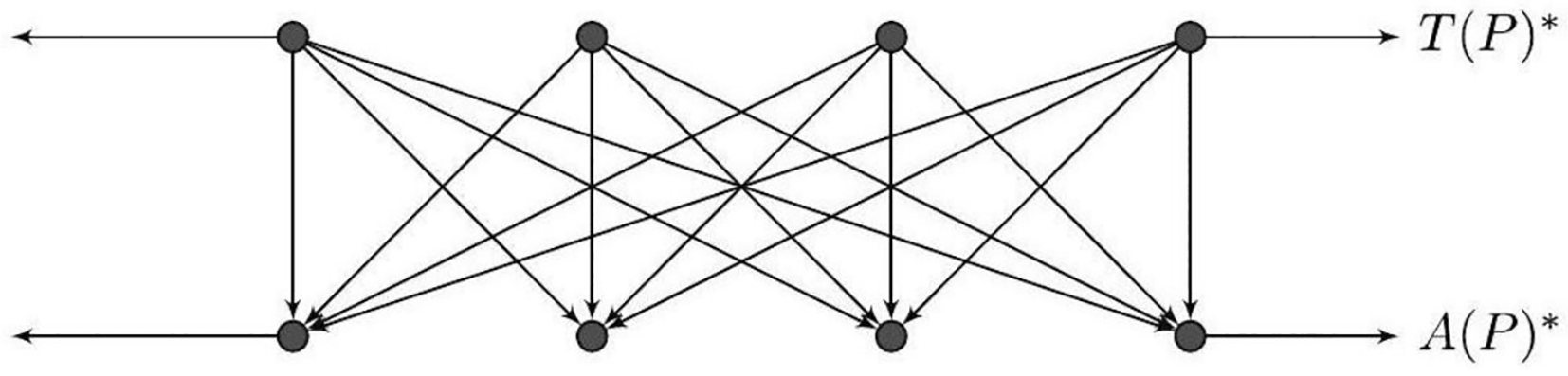
Let P be the Pythagorean ring. The extended zero divisor graph of P symbolized by Γ‾(P) is a complete bipartite graph K∞,∞ , diam(Γ‾(P))=2 and gr(Γ‾(P))=4 .
Let A(P)=S(P)∪R1(P)∪R2(P)∪Q(P) . Then Z(P)=T(P)∪A(P) and the vertex set Z(P)∗=(T(P)∪A(P))∗ . Since T(P)∗ and A(P)∗ are disjoint and no pair of vertices in either T(P)∗ or A(P)∗ are adjacent while every vertex in T(P)∗ is adjacent to all the other vertices in A(P)∗ and vice versa, Γ‾(P) is bipartite. The completeness and the diameter of the graph Γ‾(P) are obvious from Figure 1 below.
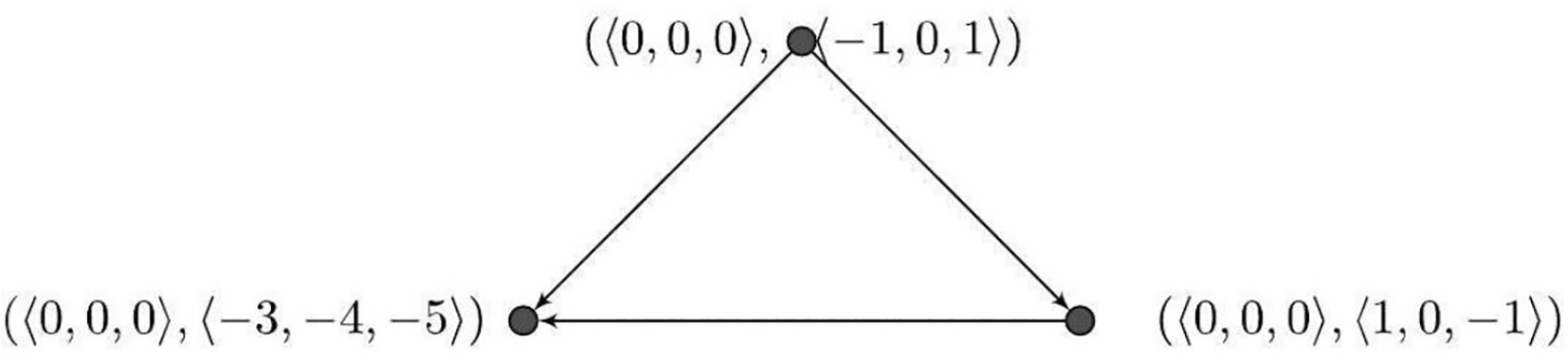
Finally, let x1,x2,x3,…∈T(P)∗ and y1,y2,y3,…∈A(P)∗ . Then, for distinct vertices xi and yj,i,j=1,2,3,… , the shortest cycle in Γ‾(P) is as referenced in Figure 2 below:
Let u∈P . The annihilator of u,Ann(u)={v∈P|u⊙v=⟨0,0,0⟩} .
It is well known that two vertices u,v∈Z(P)∗ are equivalent if AnnP(u)=AnnP(v) and an extended zero divisor graph determined by the equivalence classes in P is denoted by Γ‾E(P) .
Γ‾E(P) is a complete bipartite graph K1,1 of diam (Γ‾E(P))=1 and gr(Γ‾E(P))=∞ .
The result can easily be seen, from the fact that AnnP(T(P))=A(P) and AnnP(A(P))=T(P) . So Γ‾E(P) is A(P)∗ ____ T(P)∗
In the next section, we construct a new class of Pythagorean rings, by taking the quotients P/I , where I is an ideal of P .

Let a,b,c∈P and I⊆P is an ideal. We define addition and multiplication on P/I by:
(a⊕I)⊕(b⊕I)=(a⊕b)⊕I
(a⊕I)⊙(b⊕I)=(a⊙b)⊕I
P/T(P) is a commutative ring with identity ⟨3,4,5⟩⊕T(P) .
First, we show that addition and multiplication on P/T(P) are well defined. Let a,a′,b and b∈P such that
a⊕T(P)=a′⊕T(P)
b⊕T(P)=b′⊕T(P)
so that r=a′⊖a∈T(P) and s=b′⊖b∈T(P) where ⊖a denotes the additive inverse of a with respect to ⊕ defined above.
a′⊕b′=(r⊕a)⊕(s⊕b)=φ−1(φ(r)+φ(a))⊕φ−1(φ(s)+φ(b))=φ−1(φ(φ−1(φ(r)+φ(a)))+φ(φ−1(φ(s)+φ(b))))=φ−1(φ(r)+φ(a)+φ(s)+φ(b))∈(a⊕b)⊕T(P)
a′⊙b′=(r⊕a)⊙(s⊕b)=φ−1(φ(r)+φ(a))⊙φ−1(φ(s)+φ(b))=φ−1(φ(φ−1(φ(r)+φ(a)))⋅φ(φ−1(φ(s)+φ(b))))=φ−1((φ(r)+φ(a))⋅(φ(s)+φ(b)))=φ−1(φ(r)φ(s)+φ(r)φ(b)+φ(a)φ(s)+φ(a)φ(b))∈(a⊙b)⊕T(P)
Let a=⟨α,β,γ⟩∈P . From,5 the additive inverse
⊖(a⊕T(P))={⟨α,−β,−γ⟩⊕T(P)ifγ−βis even,γ−β≠0e,e2−f22f,e2+f22f⊕T(P)ifγ−βisodd⟨0,−β,−γ⟩⊕T(P)ifγ−β=0
where e=α−2r′(γ−β) and f=β−γ .
The commutativity of P implies that P/T(P) is commutative and for a,b,c∈P ,
(a⊕T(P))⊙((b⊕T(P))⊕(c⊕T(P)))=(a⊕T(P))⊙(b⊕T(P))⊕(a⊕T(P))⊙(c⊕T(P))
It is easy to verify the other axioms of a ring.
(⟨α,β,γ⟩⊕T(P))⊙(⟨3,4,5⟩⊕T(P))=(⟨α,β,γ⟩⊙⟨3,4,5⟩)⊕T(P)=φ−1((φ⟨α,β,γ⟩⋅φ⟨3,4,5⟩))⊕T(P)=φ−1((γ−β,d′(⟨α,β,γ⟩))⋅(1,1))⊕T(P)=φ−1(γ−β,d′(⟨α,β,γ⟩))⊕T(P)=⟨α,β,γ⟩⊕T(P)
So P/T(P) forms a commutative ring which has the identity ⟨3,4,5⟩⊕T(P) .
P/T(P) forms an integral domain.
Suppose on the contrary that P/T(P) has a zero divisor a⊕T(P) where a∈P . Then there exists a nonzero b⊕T(P)∈P/T(P) so that
(a⊕T(P))⊙(b⊕T(P))=0⊕T(P),a≠0,b≠0
Now (a⊙b)⊕T(P)=0⊙T(P) . Let a=⟨α,β,γ⟩ and b=⟨α′,β′,γ′⟩ . Since a⊙b∈T(P) , let a⊙b=⟨0,μ,μ⟩ . So
φ−1(φ(α)⋅φ(β))=⟨0,μ,μ⟩.
Applying φ on both sides, we have
φ(a)⋅φ(b)=φ(⟨0,μ,μ⟩)=(0,μ)⟹φ(⟨α,β,γ⟩)⋅φ(⟨α′,β′,γ′⟩)=(0,μ)⟹(γ−β,d′⟨α,β,γ⟩)⋅(γ′−β′,d′⟨α′,β′,γ′⟩)=(0,μ)⟹((γ−β)(γ′−β′),d′⟨α,β,γ⟩d′⟨α′,β′,γ′⟩)=(0,μ)
This implies that either γ−β=0 or γ′−β′=0 . Now, if γ−β=0 , then γ=β,α=0 , so that ⟨α,β,γ⟩=⟨0,β,β⟩ . Consequently, if γ′−β′=0 , then γ′=β′,α′=0 , so that ⟨α′,β′,γ′⟩=⟨0,β′,β′⟩ . In either case, a⊕T(P) or b⊕T(P) is a zero element in P/T(P) , a contradiction. Therefore, P/T(P) has no zero divisor. □
From the above result, it is clear that T(P) forms a prime ideal of P . But T(P) forms a principal ideal since it is generated by the triple ⟨0,1,1⟩ . Similarly, S(P)∪R1(P)∪R2(P)∪Q(P) is generated by ⟨1,0,1⟩ while R1(P)∪R2(P) is generated by ⟨0,−1,1⟩ .
The construction of new rings is of significant interest to any ring theorist. Different approaches have been used to construct new rings that satisfy certain properties. In this section, we construct and explore an extension of the Pythagorean ring P using the P -module idealization approach, so that the resultant extension ring is a unital commutative ring with an ideal forming subset of zero divisors.
Let P be the Pythagorean ring. Suppose U is a P -module generated by {u1,…,uh} and {σ1,…,σh} is a set of automorphisms of P such that R=P(+)U is an additive abelian group. On R , one defines multiplication by
(r0,∑i=1hri⊙ui)(r0′,∑i=1hri′⊙ui)=(r0⊙r0′,∑i=1h[r0⊙r0′⊕ri⊙(r0′)σi]⊙ui)
where σi is an automorphism of P .
It is easy to see that this multiplication turns R into a commutative ring with identity (⟨3,4,5⟩,0,…,0) . Indeed, R is an additive Abelian group, and it is elementary to show that multiplication is associative and distributive over addition. Identifying U with 0(+)U , we can think of U as a subset of R . Clearly P⊆R is a subring with identity ⟨3,4,5⟩ . Therefore, with the usual identifications, P and R have the same identity.
Now, from the given multiplication, the set of zero divisors Z(R)=0(+)U≅U and (Z(R))2=(0) (the product of any two zero divisors is zero).
The subset of zero divisors in the Pythagorean ring P is not an ideal while the set Z(R) is an ideal. Indeed, for any (r0,∑i=1hri⊙ui)∈R and (0,∑i=1hsi⊙ui)∈(0)(+)U ,
(r0,∑i=1hri⊙ui)(0,∑i=1hsi⊙ui)=(0,∑i=1hr0⊙si⊙ui)∈(0)(+)U.
In the sequel, R shall denote the ring given by the construction in this Section and the triple ⟨0,0,0⟩ shall simply be denoted by 0.
For a simple example of construction (4.1), we consider σi=IdP,u∈Z(P) such that R=P(+)U=P(+)P⊙u is an additive abelian group. On R , define the multiplication by
(r0,ri⊙u)(r0′,ri′⊙u)=(r0⊙r0′,[r0⊙ri′⊕ri⊙r0′]u).
This multiplication turns R into a ring with identity (⟨3,4,5⟩,⟨0,0,0⟩) . An example of a zero divisor of R is (⟨0,0,0⟩,⟨−1,0,1⟩) . See illustration in Figure 3 below:
From the construction in Section 5.1, R is an infinite ring with identity ( ⟨3,4,5⟩,0,…,0 ) and is commutative if and only if σi=idP . In this case, (r0)σi⊙ui=ui⊙r0 in equation (4.1). The infiniteness of R implies that it contains elements which are neither zero divisors nor units. Furthermore, the ring is generated by {⟨3,4,5⟩,u1,…,uh} and any element of R can be uniquely expressed as r0⊕u with r0∈P and u∈Z(R) , and therefore any element of R is of the form r0⊕∑i=1hri⊙ui for r0,ri∈P .
The group of units R∗≅ℤ22×ℤh .
It suffices to find the generators of R∗ . From the given multiplication, a unit in R is of the form (r0∗,∑i=1hri⊙ui) where r0∗ is a unit in P because
(r0∗,∑i=1hri⊙ui)(r0∗−1,∑i=1h⊖ri⊙r0∗−2⊙ui)=(r0∗r0∗−1,∑i=1h(⊖r0∗⊙ri⊙r0∗−2⊕ri⊙r0∗−1)⊙ui)=(⟨3,4,5⟩,0¯)
(r0∗,∑i=1hri⊙ui)−1=(r0∗−1,∑i=1h⊖ri⊙r0∗−2⊙ui).
Now consider A={⟨1,0,−1⟩,⟨3,4,5⟩},B={⟨−3,−4,−5⟩,⟨3,4,5⟩},D1={(⟨3,4,5⟩⊕u1)a1|a1=±1,±2,…,±∞},…,Dh={(⟨3,4,5⟩⊕uh)ah|ah=±1,±2,…,±∞} . We see that A,B,D1,…,Dh are all cyclic subgroups of the group R∗ and they are of the orders indicated in their definitions. Since R∗=A⋅B⋅D1⋅…⋅Dh and the intersection of any pair of the cyclic subgroups gives the identity group, the product of the h+2 subgroups A,B,D1,…,Dh is direct. So R∗=C22×C∞h≅ℤ22×ℤh . □
Let Aut(R) denote the group of automorphisms of R . We show that the ring P is invariant under any automorphism θ∈Aut(R) and then establish the necessary and sufficient conditions for a map ϕ to be an automorphism of R .
We refer to Lemma 3.1 in4 and Proposition 2 in13 and state the following result.
Let θ∈Aut(R) . Then θ(P) is a subring of R which is equal to P .
Obviously, θ(P) is a subring of R so that there exists a∈R∗ such that a⊙θ(P)⊙a−1=P . Now, consider the map ϕ:R→R given by ϕ(t)=a⊙θ(t)⊙a−1 for t∈R , then clearly ϕ is an automorphism of R which maps P to itself.
Now, for θ∈Aut(P) and z∈R∗ , we define
ϕθ(r0⊕∑i=1hri⊙ui)=r0θ⊕∑i=1hriθ⊙ui
πz(r0⊕∑i=1hri⊙ui)=z⊙(r0⊕∑i=1hriθ⊙ui)⊙z−1
where ui∈Z(R) . □
The next result summarizes the automorphisms of the rings of construction (4.1).
Let R be a ring of construction (4.1). Then ϕ∈Aut(R) if and only if
ϕ(r0⊕∑i=1hriθ⊙ui)=z⊙r0θ⊙z−1⊕∑i,j=1hz⊙riθ⊙z−1⊙ϕj(ui)
θ∈Aut(P),z∈R∗ and ri∈P,i=0,1,…,h .
The necessary condition is easy to establish, since for ϕ∈Aut(R) , there exists a z∈R∗ such that ϕ(P)=z⊙P⊙z−1 so that ϕ(s)=z⊙sθ⊙z−1 , for all s∈P . Since R=ϕ(P)(+)∑i=1hϕ(P)⊙ϕ(ui) and conjugation is an automorphism of R, we obtain that
R=P(+)∑i=1hP⊙z−1⊙ϕ(ui)⊙z=P(+)∑i=1hP⊙ϕ(ui)
To prove the sufficient condition, consider ϕ as defined in the Theorem and let a=r0⊕∑i=1hri⊙ui∈R . We show that π which sends r0⊕∑i=1hri⊙ui to r0θ⊕∑i,j=1hriθ⊙πj(ui) is an automorphism of R , where πj(ui)=z−1⊙ϕj(ui)⊙z .
Suppose b=r0′⊕∑i=1hri′⊙ui also belongs to R , then π sends r0′⊕∑i=1hri′⊙ui to r0′θ⊕∑i,j=1hri′θ⊙πj(ui) . So
π(a)π(b)=r0θ⊙r0′θ⊕∑i,j=1h(r0θ⊙ri′θ⊕riθ⊙(r0′θ)θj)⊙πj(ui)
π(ab)=π(r0⊙r0′⊕∑i=1h(r0⊙ri′⊕ri′⊙r0′)⊙ui)=(r0⊙r0′)θ⊕∑i=1h(r0⊙ri′⊕ri⊙r0θj)θ⊙πj(ui)
establishing that π(ab)=π(a)π(b) .
Since πz(r0∑i=1hri⊙ui)=z⊙(r0∑i=1hri⊙ui)⊙z−1 and πj(ui)=z−1⊙ϕj(ui)⊙z , it follows that
πzπ=πz(r0θ⊕∑i=1hriθ⊙πj(ui))=z⊙(r0θ⊕∑i=1hriθ⊙πj(ui))⊙z−1=z⊙r0θ⊙z−1⊕∑i,j=1hz⊙riθ⊙z−1⊙ϕj(ui)⊙z⊙z−1=z⊙r0θ⊙z−1⊕∑i,j=1hz⊙riθ⊙z−1⊙ϕj(ui)=ϕ
which is an automorphism of R . □
Let R be a ring of construction (4.1). Suppose θ is the identity automorphism of P,ϕj is the identity automorphism of R , for some j∈{1,…,h},z is a unit in R and ui is a zero divisor in R , then a map ϕ preserves the structure of R iff ϕ(z)=z⊙P⊙z−1⊕∑i=1hz⊙P⊙z−1⊙ui .
The following result summarizes this section.
Let R be a ring of construction (4.1). Then Z(R) is an ideal forming subset of R and (Z(R))2=(0) , the group of units R∗≅ℤ22×ℤh and any map ϕ is an automorphism of R if and only if
ϕ(r0⊕∑i=1hri⊙ui)=r0zθ⊕∑i,j=1hrizθ⊙ϕj(ui)
where r0,ri∈P,z∈R∗,ui∈Z(R),r0⊕∑i=1hri⊙ui∈R and θ∈Aut(R) .
This proof follows from Remark 5.1, the proof of Theorem 5.1, the proof of Theorem 5.2 and Remark 5.2.
The following results have been established results which identifies the zero divisors of a Pythagorean ring ⟨P,⊕,⊙⟩. For distinct prime integers pi,1⩽i⩽m , the set of zero divisors of P including ⟨0,0,0⟩ is
Z(P)∪(0)={⟨μ,0,μ⟩|μ=0,1orℤ\2ℤ∋μ=p1…pm}∪{{⟨0,μ,μ⟩}∪{⟨0,−μ,μ⟩}∪{⟨0,μ,−μ⟩}|μ∈ℤ}∪{±kpi,±k(1−p2i)2,±k(1+p2i)2foroddintegerkandoddprime integerp}
We have also constructed an extension ring of P and established that the group of units R∗ is isomorphic to ℤ22×ℤh .
It has also been determined in this research that if R be a ring then ϕ∈Aut(R) if and only if
ϕ(r0⊕∑i=1hriθ⊙ui)=z⊙r0θ⊙z−1⊕∑i,j=1hz⊙riθ⊙z−1⊙ϕj(ui)
θ∈Aut(P),z∈R∗ and ri∈P,i=0,1,…,h .
In this paper, the zero-divisors of the Pythagorean ring ⟨P,⊕,⊙⟩ have been completely characterized. The set Z(P) of the zero-divisors of P does not form an ideal. However, we have identified the ideal forming subsets of Z(P) with a complete description of the quotients P/I where I is an ideal forming subset of Z(P) . The findings on the zero divisors in P provide insights for further research, on the interplay between the theoretical properties of the ring P and the theoretical properties of the graph of Z(P) . Zero divisor graphs are ubiquitous models of both natural and man-made structures, and they find applications in communication networks, computer algorithms, and computational geometry. We have constructed an extension ring of P and established that its group of units R∗ is isomorphic to ℤ22×ℤh . Finally, we have determined its group of automorphisms, which may find applications in computer graphics, modeling, and designs. For future research, the ideal based zero divisor graphs and the novel graph variants of the unit-zero divisor graph of the ring of Construction (4.1), may be explored. Some interesting results may be obtained from the investigations.
Conceptualization, Investigation, Validation, Writing draft, Editing draft, Writing – Review & Editing.
This research did not involve human participants or animals and therefore did not require ethical approval.
No data was used to support this research as this article does not require data.
The authors Raymond Calvin Ochieng, Maurice Owino Oduor and Vitalis Onyango- Otieno appreciate Strathmore University for financially supporting this research.