Просмотр новости
Найдите то, что Вас интересует
 Спутники
 РН
РН SpaceX
 Роскосмос
 NASA
NASA
СпутникиРНSpaceXРоскосмосNASABackground Turiyam graphs widen neutrosophic graphs by incorporating a fourth component that represents the liberal state. This featres enables more effective modeling of complex and uncertain relationships. Although basic definitions of Turiyam graphs exist, specific families such as wheels, stars, trees, and forests have not yet been formally defined. The absence of these definitions limits the applicability of Turiyam graph. Methods In this study, we present the concepts of Turiyam wheels, stars, trees, and forests through the four-part Turiyam set framework. For each type, we expand standard graph definitions to incorporate truth, indeterminacy, falsity, and liberal values for both vertices and edges. The definitions are supported with illustrative examples for consistency and validity, and are compared to neutrosophic and fuzzy graphs. Results We introduced the new Turiyam concepts: the Turiyam wheel, Turiyam star, Turiyam tree, and Turiyam forest. We also provide their formal definitions. Examples show that these structures maintain the key properties of their classical versions while allowing for the representation of four-dimensional uncertainty. Conclusions The proposed definitions and concepts provide a strong foundation for further exploration of Turiyam graph theory. This includes ideas such as spanning trees, cycles, connectivity, and algorithmic uses. These concepts also allow for modeling real-world systems where truth, uncertainty, falsehood, and neutrality coexist. This approach extends the application of Turiyam graph in network science and intelligent systems.
Graph theory studies networks of nodes and arcs, concentrating on paths, structures, and properties of the networks.1 Its ability to visually represent real-world connections makes it a critical tool in many disciplines.2–4 For example, within the field of artificial intelligence, graph neural networks which are deeply rooted in graph theory are experiencing rapid growth.5–8
A key strength of graph theory lies in the classification of graphs into types based on shared properties. Such classifications help in crafting more effective computational methods, make it easier to solve problems, and clarify how complex different computing tasks are.9–11 The practical applications and manageability of these graph classes have contributed to their prominence in research.
Fuzzy, intuitionistic fuzzy and neutrosophic graphs have been studied to model real-world uncertainty. A fuzzy graph assigns a membership degree in the interval [0,1] to every vertex and edge, there by expressive uncertainty. This structure serves as a graphical representation of a fuzzy set.12–14 Fuzzy graphs have been applied in areas such as social networks, decision making, and transportation.15,16 The concepts of fuzzy path,17–19 fuzzy tree,20,21 and fuzzy forest17,22 are also studied.
Later, neutrosophic and single-valued neutrosophic graphs (SVNG) were developed as extensions of fuzzy and intuitionistic fuzzy graphs (IFG), based on neutrosophic set theory, by incorporating degrees of truth, indeterminacy, and falsity.23–25 The definitions of neutrosophic path,26–28 tree,27,29 and forest27 have been introduced, building on earlier fuzzy graph concepts for modeling uncertainty.
However, real-world problems often involve high levels of uncertainty, vagueness and indeterminacy. Turiyam sets30 extend neutrosophic sets by adding a fourth component or liberal. Ganati et al.31 introduced Cartesian products and relations for Turiyam sets then defined Turiyam graphs32,33 with complete, strong, and constant types, and studied basic parameters (degree, order, size). Erana et al.34 explored domination and paired domination of turiyam graph in the (T, I, F, L) framework.
However, a clear gap remains: no existing study explicitly defines Turiyam Trees, Forests, Wheels, and Star Graphs. This study addresses this gap with illustrative examples.
We present fundamental graph concepts here, related to fuzzy, intuitionistic fuzzy, and neutrosophic graphs. In this study, ∨ and ∧ represents maximum and minimum operator, respectively.
In this section, some basic concepts of Fuzzy Graphs are reviewed.
16: A fuzzy graph G=(V,σ,μ) is a triple consisting of a non-empty set V (a set of vertices) together with a pair of functions: σ:V→[0,1] , a mapping that gives a membership degree for every vertex v∈V and μ:V×V→[0,1] is a fuzzy relation that captures the connection strength for every vertex pair, such that μ(u,v)≤min{σ(u),σ(v)}∀(u,v)∈(u,v)∈V×V.
35: The strength of path P is the weight of the weakest edge. That means S(P)=min{μ(u1,ui+1)} .
35: Let G=(V,σ,μ) be a fuzzy graph, and uandv are vertices in G. The strength of connectedness between uandv is the maximum strength of all paths b/n uandv . Denoted by CONNG(u,v)orμ∞(u,v) .
This section we revised some basic foundation of IFG.
36: Let G=(A,B) be an IFG and x,y∈V⊆G . Then,
The ⱷ2− strength of connectedness between 𝑥 and 𝑦 is ⱷ2∞(x,y)=sup{ⱷ2k(x,y)/k=1,2,….n} where, ⱷ2k(x,y)=min{ⱷ2(x,v1),ⱷ2(v1,v2),………..,ⱷ2(vn−1,y)} .
The γ2− strength of connectedness between 𝑥 and 𝑦 is.
γ2∞((x,y)=Inf{γ2k(x,y)/k=1,2,….n}
where ,γ2k(x,y)=max{γ2(x,v1),γ2(v1,v2),………..,γ2(vn−1,y)} .
37: Let G=(A,B) be a connected IFG. Then
i. G is an intuitionistic fuzzy tree if there exists an intuitionistic fuzzy spanning sub graph H=(A,C) of G such that H is a tree and for every edges ( x,y ) ∉H , ⱷ2(x,y)<ⱷC∞(x,y) , γ2(x,y)>γC∞(x,y) .
ii. G is an intuitionistic fuzzy forest if there exists an intuitionistic fuzzy spanning sub graph H=(A,C) of G such that H is a forest and for every edges ( x,y ) ∉H , ⱷ2(x,y)<ⱷC∞(x,y) , γ2(x,y)>γC∞(x,y) .
ⱷ2andγ2 are the Membership and Non Membership functions of G, ⱷcandγc are those of the sub graph H.
This section reviews star, tree, and forest in neutrosophic graphs.
23: A neutrosophic graph (NG) on X(≠ϕ) is a pair G~=(ϑ,ξ ) where ϑ:X→]0−,1+[ is Neutrosophic set in X and ξ:V×V→]0−,1+[ is Neutrosophic relation on X such that ∀u, x ∈ X :
ξt(ux)≤ϑt(u)∧ϑt(x),ξi(ux)≤ϑi(u)∧ϑi(x)andξf(ux)≤ϑf(u)∨ϑf(x)with0−≤ξt(ux)+ξi(ux)+ξf(ux)≤3+
ϑ and ξ are neutrosophic vertex and edge set of G~ , respectively.
23: Let G~=(ϑ,ξ ) be a SVNG. The T, I and F - strength of connectedness between xandy in ϑ is given as follows:
Tξ∞(xy)=sup{Tξk(xy):k=1,2,….n}where,Tξk(xy)=min{Tξ(x,v1),TB(v1,v2),…….,Tξ(vn−1,y)}.
Iξ∞(xy)=Inf{Iξk(xy):k=1,2,….n}where,Iξk(xy)=max{Iξ(x,v1),IB(v1,v2),…….,Iξ(vn−1,y)}
• Fξ∞(xy)=Inf{Fξk(xy):k=1,2,….n} , such that
Fξk(xy)= max{Fξ(x,v1),FB(v1,v2),…….,Fξ(vn−1,y)} . Where x,v1,v2,………….vn−1,y∈ϑ.
23: A NG, Sn=(V,E) is said to be a neutrosophic star graph if: V={v0,v1,v2,………,vn} with v0 being the central vertex and E={e=(v0vi/1≤i≤n} the edges incident to the central vertex v₀ that connects it to the remaining vertices vi for i=1,2,……..,n .
27–29: Let G~=(ϑ,ξ ) a connected SVNG, G~ is said to be:
i. A SVN-tree if it has a SVN spanning sub graph H=(ϑ,B) which is a tree, where for each edges ( x,y ) ∉H , satisfying Tξ(x,y)<TB∞(x,y) , and Iξ(x,y)>IB∞(x,y) and Fξ(x,y)>FB∞(x,y).
ii. A SVN forest if 𝐺 has SVN spanning sub graph H=(ϑ,B) which is a forest such that, for all ( x,y ) ∉H , satisfying Tξ(x,y)<TB∞(x,y) , and Iξ(x,y)>IB∞(x,y) and Fξ(x,y)>FB∞(x,y) .
This section reviews the Turiyam graph and certain types of Turiyam graphs, namely, complete, strong, and bipartite. The definitions (def. 12, def. 13) were adapted from.32
A Turiyam graph TG~=(ϑ,ξ ) of graph G=(V,E) is graph whose vertices and edges must satisfy the following:
i. ϑt,ϑi,ϑf,ϑl:V→[0,1] signifies the truth value ϑt(a) , the indeterminacy value ϑi(a) , the falsity value ϑf(a) and liberal value ϑl(a) of a∈V respectively, with 0≤ϑt+ϑi+ϑf+ϑl≤4,∀a∈V and
ii. ξt,ξi,ξf,ξl:E⊆V×V→[0,1] denotes the truth, indeterminacy, falsity and liberal value of uv∈E , respectively such that:
ξt(uv)≤ϑt(u)∧ϑt(v),ξi(uv)≤ϑi(u)∧ϑi(v),ξf(uv)≤ϑf(u)˅ϑf(v) and ξl((uv)≤ϑl(u)∧ϑl(v),∀u,v∈V such that 0≤ξt(uv)+ξi(uv)+ξf(uv)+ξl(uv)≤4,∀(uv)∈E.
In TG~ =(ϑ,ξ ), ϑ represents the Turiyam vertex set and ξ is the Turiyam edge set of TG~
Let TG~ =(ϑ,ξ ), be a Turiyam graph. Then, a path P(xxn) in TG~ is a sequence of distinct vertices x,x1,x2,x3……..xn such that ξt(xn−1,xn) > 0, ξi(xn−1,xn) > 0, ξf(xn−1,xn) > 0, and ξl(xn−1,xn) > 0, for 0 ≤ 𝑖 ≤ 𝑛. In this case, 𝑛 ≥ 0 is called the length of path 𝑝. The successive pairs (xn−1,xn) , 0 ≤ 𝑖 ≤ 𝑛, are edges of the path p.
In the following section, we present the certain families of Turiyam graph with some illustrations.
This section presents the results of the study, providing the concepts of Turiyam Wheel, and Star graphs. Additionally, Turiyam Tree, and Forest are also introduced supported with illustrative examples.
A Turiyam Star Graph S1,n=(ϑ,ξ) is a Turiyam Graph where ϑ={v0,v1,v2,………,vn} , with v0 being the central vertex and ξ={e=(v0vi:1≤i≤n} .
Consider the turiyam star graph below in Fig 1.
Let TG~=(ϑ,ξ ) be a Turiyam graph. A Turiyam wheel graph, denoted Wn , is obtained by adding a single central vertex and connecting it to every vertex of a cycle graph.
Consider the turiyam Wheel graph W3 with u0= (0.5, 0.6, 0.8, 0.2), u1=(0.5,0.9,0.3,0.2) , u2=(0.5,0.6,0.8,0.4),u3=(0.9,0.3,0.4,0.5) in Fig 2.
A Turiyam spanning subgraph of a Turiyam graph G is a subgraph H that satisfies the following conditions: the vertex set of H equals the vertex set of G, the edge set of H is contained within the edge set of G, and for every edge (x, y) ∈ E(H) the T, I, F, and L degrees in H satisfy the inequality below:
Tξ(x,y)≥ TE(x,y) , IE(x,y)≤ IE(x,y) , Fξ(x,y)≤ FE(x,y) , Lξ(x,y)≤ LE(x,y)
where Tξ,Iξ,Fξ,andLξ are the truth, indeterminacy, falsity and liberal functions of the graph G, and TE,IE,FE,andLE are the truth, indeterminacy, falsity and liberal functions of the sub graph H.
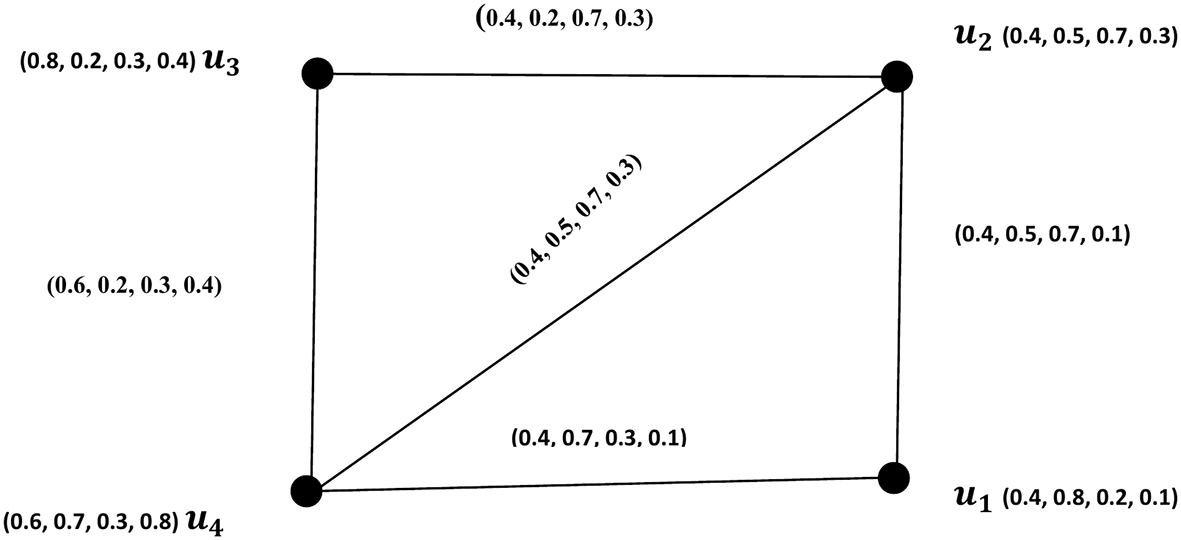
Consider the below turiyam graph with v1 = (0.4, 0.8, 0.2, 0.1), v2 = (0.4, 0.5, 0.7, 0.3), v3 = (0.8, 0.2, 0.3, 0.4) and v4 = (0.6, 0.7, 0.3, 0.8) in Fig 3 and its spanning subgraph H in Fig 4.
Let TG~=(ϑ,ξ ) be Turiyam Graph on the crisp graph G∗=(V,E) the T, I, F and L- strength of connectedness between x and y in V is given as follows:
Tξ∞(xy)=sup{Tξk(xy):k=1,2,….n},andTξk(x,y)=min{Tξ(x,v1),Tξ(v1,v2),…….,Tξ(vn−1,y)}.
Iξ∞(xy)=Inf{Iξk(xy):k=1,2,….n},andIξk(x,y)=max{Iξ(x,v1),Iξ(v1,v2),…….,Iξ(vn−1,y)}.
Fξ∞(xy)=Inf{FBk(xy):k=1,2,….n},andFBk(x,y)=max{Fξ(x,v1),Fξ(v1,v2),…….,Fξ(vn−1,y)}}.
• Lξ∞(xy)=Inf{Lξk(xy):k=1,2,….n} , and Lξk(x,y)=max{Lξ(x,v1),Lξ(v1,v2),…….Lξ(vn−1,y)} .Where x,v1,.,..vn−1,y∈V
Consider the following turiyam graph in in Fig 5.
Consider path between u2andu4 as in Table 1
Therefore, CONNG(u2,u4) is (0.4, 0.2, 0.7, 0.1).
A connected Turiyam Graph TG~=(ϑ,ξ ) is said to be:
i. A Turiyam -tree if it has a turiyam spanning sub graph H = (A, C) which is a tree, where for all edges xy not in H satisfying Tξ(x,y)<TC∞(x,y) , Iξ(x,y)>IC∞(x,y) Fξ(x,y)>FC∞(x,y) , and Lξ(x,y)>LC∞(x,y) .
ii. A Turiyam - forest if 𝐺 has Turiyam spanning sub graph 𝐻 = (𝐴, 𝐶) which is a forest such that, for all ( x,y ) ∉H , satisfying Tξ(x,y)<TC∞(x,y) , Iξ(x,y)>IC∞(x,y) ,
Fξ(x,y)>FC∞(x,y) , and Lξ(x,y)>LC∞(x,y) .
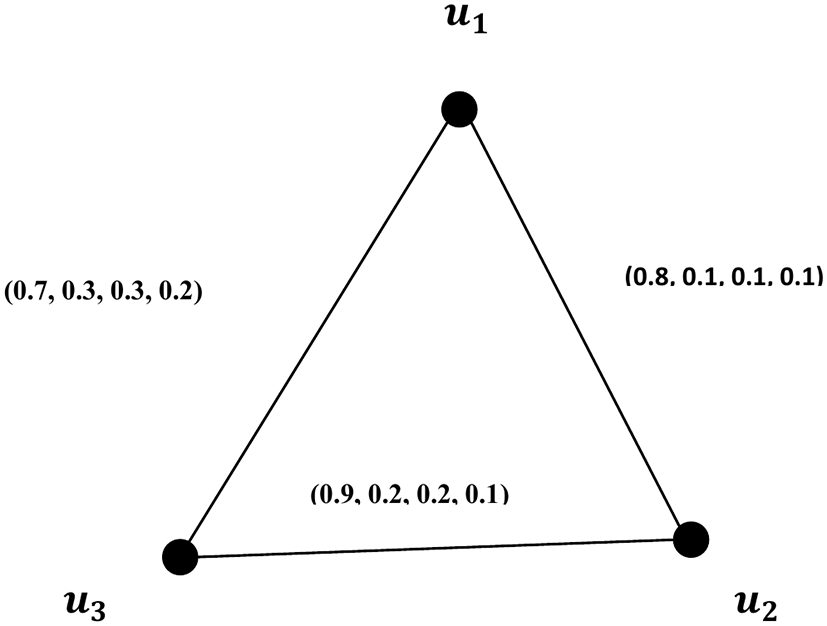
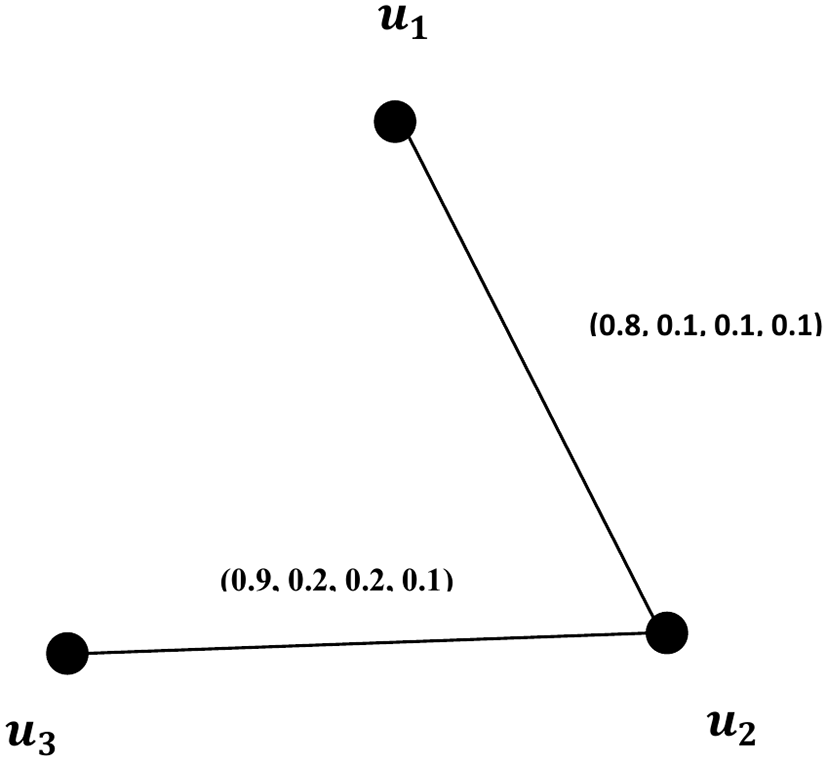
Consider the turiyam graph in Fig.6 and its Spanning sub graph H in Fig 7 as below.
Let u1u3 is edges in G but not in H, therefore check the conditions their strength of connectedness as in Table 2.
Tξ(u1u3)=0.7<TC∞(u1u3)=0.8,Iξ(u1u3)=0.3>IC∞(u1u3)=0.2
Fξ(u1u3)=0.3>FC∞(u1u3)=0.2,andLξ(u1u3)=0.2>LC∞(u1u3)=0.1.
All inequalities hold. Hence, H is clearly a sub graph of graph G and is tree. Therefore,
(G, H) satisfies the definition of a Turiyam-tree.
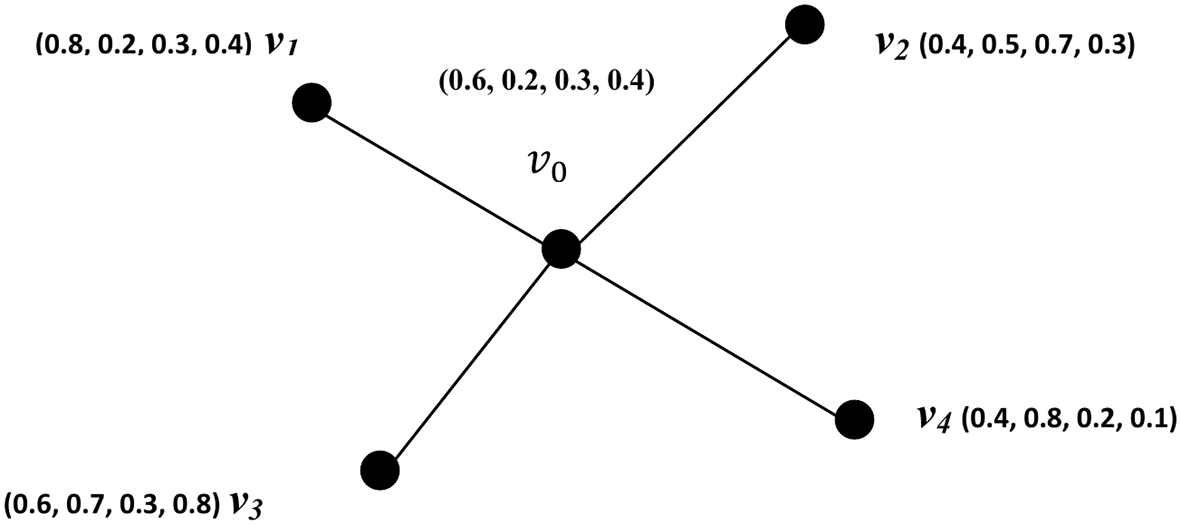
● Vertex — Edge vi : vertex label { x1,x2,x3,x4 }: 4-tupple values associated with the vertex/edge.
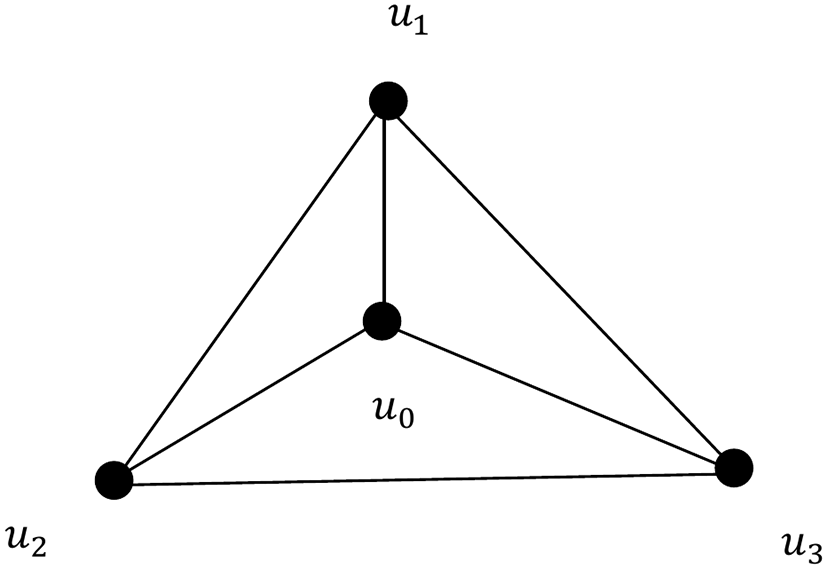
● Vertex — Edge ui : vertex label.
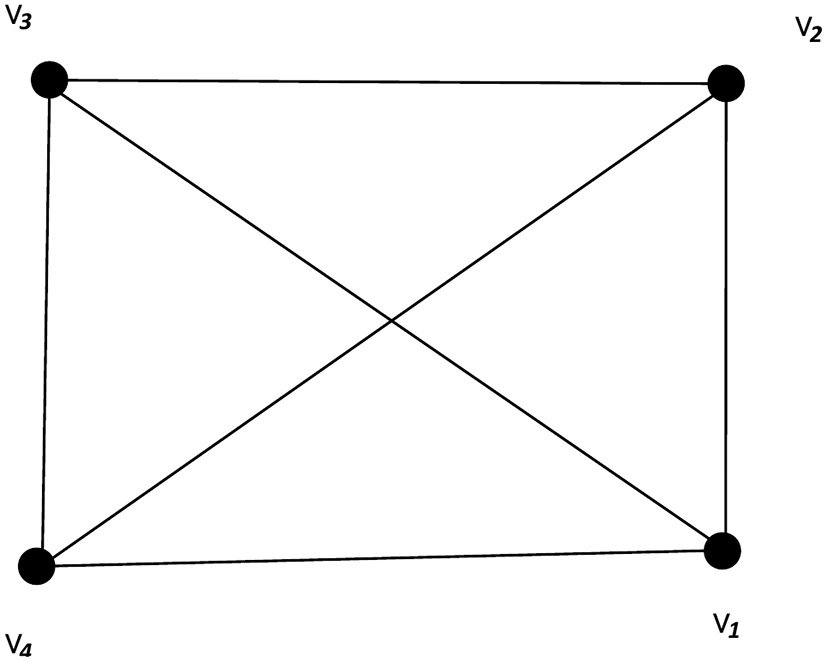
● Vertex — Edge ui : vertex label.
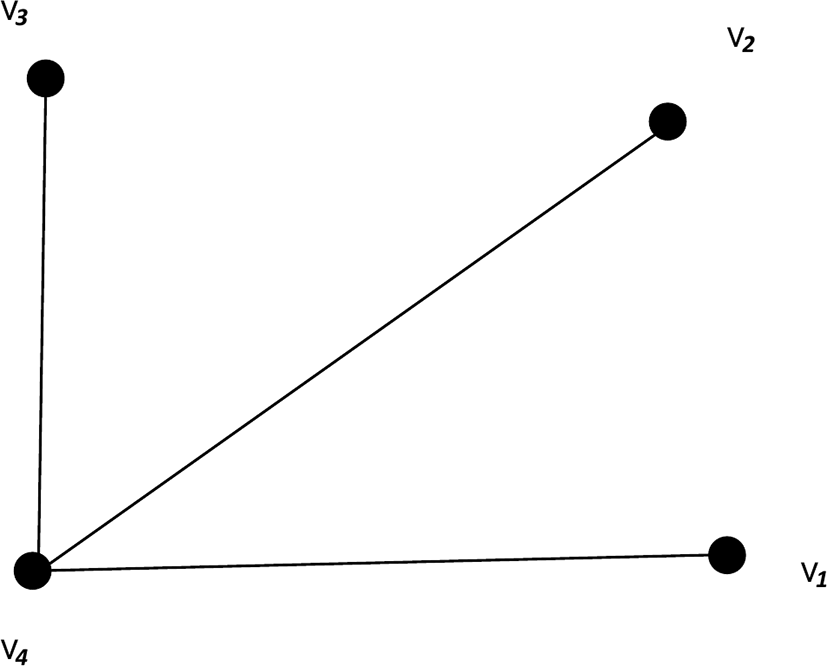
● Vertex — Edge vi : vertex label.
● Vertex — Edge ui : vertex label { x1,x2,x3,x4 }: 4-tupple values associated with the vertex/edge.
● Vertex — Edge ui : vertex label { x1,x2,x3,x4 }: 4-tupple values associated with the vertex/edge.
● Vertex — Edge ui : vertex label { x1,x2,x3,x4 }: 4-tupple values associated with the vertex/edge.