Просмотр новости
Найдите то, что Вас интересует
 Спутники
 РН
РН SpaceX
 Роскосмос
 NASA
NASA
СпутникиРНSpaceXРоскосмосNASABackground Corporate sustainability disclosures fail in two ways. Greenwashing, a deception by commission, overstates environmental performance, and greenhushing, a deception by omission, withholds genuine sustainability information to avoid scrutiny. Separate research communities study each other, and neither is routinely examined in the vocabulary of moral philosophy, so no shared standard defines what honest disclosure requires. The question is pressing as the European Union’s 2026 Omnibus package narrows mandatory reporting and a wider backlash makes firms wary of speaking at all. Methods An integrative literature review covering 2016 to 2026 synthesizes 88 sources whose bibliographic metadata were verified against the Crossref registry: 53 addressing greenwashing, 16 greenhushing, 4 both, and 15 foundational anchors in moral philosophy, methodology, and stakeholder or signalling theory; 52 are empirical studies. The corpus was first read descriptively in its own terms and then interpreted in parallel through three normative traditions: Kantian deontology, classical utilitarian consequentialism, and Aristotelian and contemporary virtue ethics. Results Greenwashing and greenhushing are two poles of a single disclosure-honesty spectrum, rather than separate problems. The corpus is unevenly covered, concentrated on decoupling and selective disclosure, and thin on greenhushing themes, and its empirical base is narrow: Chinese listed-firm data outnumber all other stated settings. Stronger disclosure regulations are associated with less greenhushing, and silence can lower firm-level crash risk while still imposing social costs. Conclusions This article develops the Normative Disclosure Ethics Framework (NDEF): adequate disclosure must be accurate, proportionate, and courageous. The three conditions are jointly necessary and non-substitutable, with accuracy functioning as a side constraint, proportionality optimized within it, and courage the disposition that sustains honesty once enforcement relaxes. Because regulation and silence move inversely, the deregulatory turn should shift the strategic temptation from overclaiming to silence, which a standard calibrated only to overclaiming would miss.
Corporate communication about sustainability fails in two opposite directions, and the ethics of disclosure must maintain both in view. Firms overstate their environmental credentials, which has long been studied as greenwashing (Delmas & Burbano, 2011; Lyon & Maxwell, 2011). On the other hand, a newer and less examined practice has appeared: firms that genuinely perform well say little or nothing about it, a behavior called greenhushing or green under-communication (Font et al., 2017; South Pole, 2022). The first failure inflated the signal. Second, it is suppressed. Either way, the information investors, regulators, consumers, and citizens use to steer capital and attention toward decarbonization is distorted. Studying the two, as the literature mostly has, hides what they share: a single question about what a firm owes the public when it speaks, or declines to speak, about its environmental conduct.
This article answers this question by treating greenwashing and greenhushing as two poles of a single disclosure-honesty spectrum and subjecting the whole spectrum to normative evaluation. Reframing is important because the two practices usually belong to different research communities. Greenwashing involves marketing, strategy, and environmental economics, where it is modeled as a problem of misleading positive claims (Lyon & Maxwell, 2011; Bowen, 2014). Greenhushing has been picked up more recently in tourism studies, marketing, and institutional analysis, where it is modeled as strategic silence (Font et al., 2017; Hilton, 2025a). No account yet places both on one axis of honesty and asks where adequate disclosure ends and inadequate disclosure begins, using tools of moral philosophy instead of those of corporate strategy.
The policy moment makes this question urgent. By mid-2026, the European Union reversed roughly a decade of expanding mandatory sustainability disclosure. Its Omnibus simplification package, adopted by the Council in February 2026, sharply narrows the scope of the Corporate Sustainability Reporting Directive and cuts the number of required data points (Council of the European Union, 2026). A broader political backlash against environmental, social, and governance reporting has, at the same time, made some firms wary of drawing attention to their climate commitments. As mandatory disclosure shrinks and reputational risk increases, temptation moves from overclaiming silence. A framework that speaks to both ends of the spectrum is therefore worth more than one tuned only to the overclaiming end that defined the previous regulatory decade.
This argument proceeds in three steps. The first is an integrative literature review (Torraco, 2016; Snyder, 2019) of the greenwashing and greenhushing literature from 2016 to 2026, mapping how each practice has been conceptualized and where normative analysis runs thin. The second reads the synthesized corpus through three normative traditions: Kantian deontology, utilitarian consequentialism, and virtue ethics. The product is a two-by-three matrix, with each tradition returning a verdict on each pole. The third move shows that the traditions, for all their famous disagreements, converge in condemning both poles, and builds a positive framework on that convergence. In the resulting Normative Disclosure Ethics Framework, adequate disclosure must be accurate, proportionate, and courageous, and none of the three can stand in for another.
Three contributions follow. The first is conceptual: the article unifies two studies that have developed apart by showing that greenwashing and greenhushing are species of a single genus, the betrayal of disclosure honesty. The second is methodological and normative: The article applies three ethical traditions in parallel to corporate disclosure and argues that their convergence is itself a finding rather than a coincidence. The third is the framework. However, this article is careful not to overstate its novelty. Economic and institutional analyses that treat greenwash and greenhush together already exist (Hilton, 2025a, 2025b), the empirical literature has long recognized that disclosure can err through both exaggeration and undue modesty (Kim & Lyon, 2015), and systematic reviews of each practice have been published (Dias et al., 2025; Montgomery et al., 2024; Zioło et al., 2024). What has not been done and what this article offers is a normative synthesis of the spectrum that yields a defensible decision framework. The remainder of the article develops this claim and tests it against the objections raised by a philosophically trained reader.
Greenwashing and greenhushing occupy opposite ends of a continuum. That is, the organizing claim, and it needs defense, not assertion. Greenwashing is the selective release of favorable environmental information together with the suppression or distortion of unfavorable information, so that the audience forms a better impression of the firm than the facts warrant; the practice runs from outright to technically true half-truths (Delmas & Burbano, 2011; Lyon & Maxwell, 2011; de Jong et al., 2020). Greenhushing is the opposite move: a firm with something true and favorable to report says nothing or reports only the legal minimum to avoid scrutiny or controversy (Font et al., 2017; South Pole, 2022). The two images are mirror images. Greenwashing manipulates by saying too much that is not warranted; greenhushing manipulates by saying too little that is.
The idea that disclosure can fail in two directions is not new to the empirical literature, and naming the precedent sharpens its contribution instead of weakening it. Kim and Lyon (2015) separate greenwash, the exaggeration of performance, from brownwash, the undue modesty of firms that understate it, and show that both distort the disclosure environment. In a global study, Marquis et al. (2016) found that firms disclose selectively to manage scrutiny. Fabrizio and Kim (2019) documented reluctant disclosure as a recognizable posture. The present article adds normative. It asks not when firms exaggerate or fall silent but whether each is wrong, why, and what an adequate disclosure between the two would look like.
Both poles share one defect: each breaks the duty of veracity in the relationship between the firm and the public, and each opens the same gap between what the firm knows about its conduct and what its audience can know. Information economics makes the parallel exact. In signalling terms, greenwashing is a pooling strategy, a low-quality firm mimicking the signal of a high-quality firm; greenhushing is the choice of a high-quality firm not to separate itself from the pool (Spence, 1973; Hilton, 2025b). In both cases, the disclosure channel fails to carry the information that would allow stakeholders to distinguish genuine performance from its absence. The harm reaches past the individual deceived party to the integrity of the channel itself, on which every stakeholder depends (Freeman, 1984).
Framing the two practices as a spectrum yields an immediate analytic payoff: it locates the ethically adequate disclosure not at one end but in the middle region, and it shows that a firm can fail by moving in either direction. In this sense, the article speaks of a zone of adequacy between overclaiming and silence. The metaphor of a spectrum should not be read as implying a single quantitative dimension, along which more disclosure is always better up to a point and worse thereafter. Rather, the spectrum is defined by the relation between what is communicated and what is true and material: greenwashing asserts more favorable content than truth supports, greenhushing communicates less material content than the public is owed, and adequate disclosure matches communication to warranted, material truth. These two practices are also historically entangled with the evolution of disclosure regulations, as shown in Figure 1. The section developing the Normative Disclosure Ethics Framework (NDEF) argues that the boundaries of the adequate zone are fixed by three operating together, rather than one criterion. Before that, the article specifies the method by which the spectrum was reconstructed from the literature because the legitimacy of the framework depends on whether it was drawn from the literature or imposed upon it.
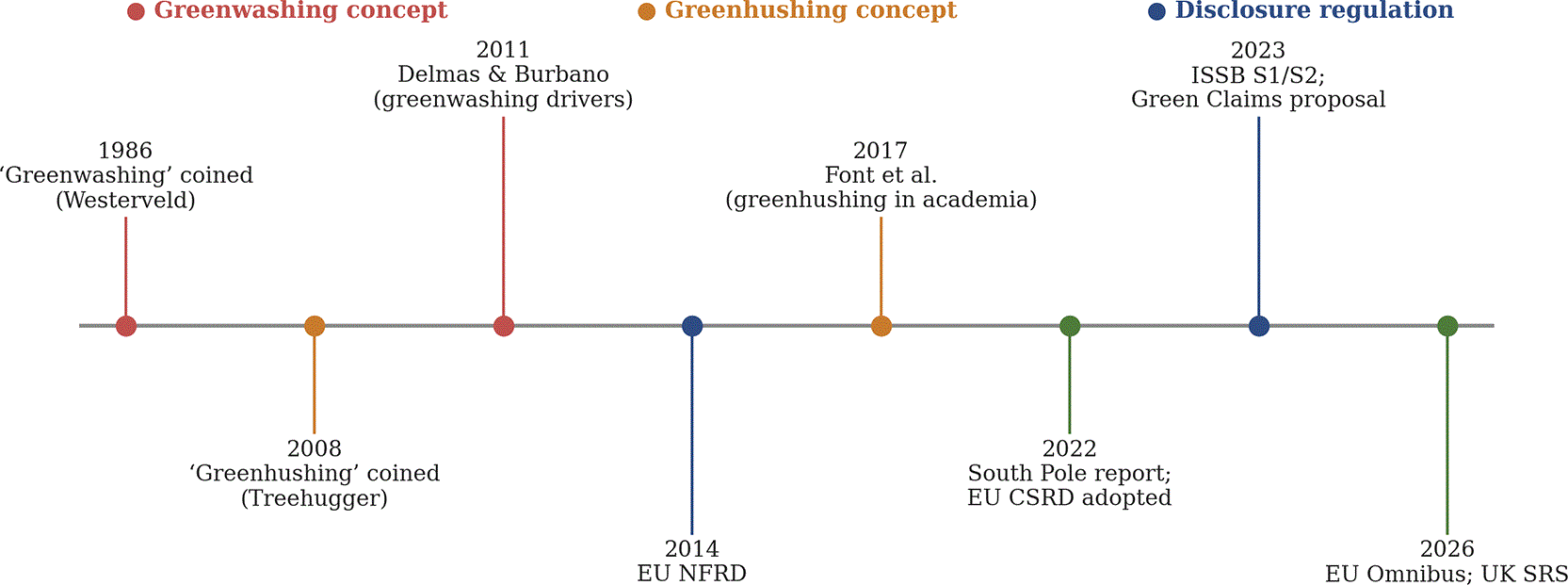
Note. The figure marks the emergence of the greenwashing and greenhushing concepts alongside major EU and global disclosure-regulation milestones. Regulatory items are current as of June 2026 and should be re-verified before submission.
This is a structured integrative literature review. An integrative review gathers work across boundaries and recombines it into a new account rather than summarizing a single field, which suits a question that sits across law, accounting, finance, and management. Parmar et al. (2010) model this kind of synthesis for stakeholder theory. The output is conceptual: a framework and set of propositions. The method is, therefore, an argument built from prior evidence, and its credibility rests on a transparent and reproducible procedure for selecting and coding the evidence described in this section. Screening and reporting followed the principles of the Preferred Reporting Items for Systematic Reviews and Meta-Analyses Statement for Transparent Evidence Synthesis.
The study is an integrative literature review, not a protocol-driven PRISMA systematic review, and this choice shapes how the contribution should be judged. An integrative review fits when the goal is to build a new conceptual structure by synthesizing a body of work, not to estimate a pooled effect or catalog every study (Torraco, 2005, 2016; Snyder, 2019). The goal here is exactly this kind of construction: a normative framework drawn from scattered literature and philosophical traditions. Nevertheless, reporting follows the PRISMA 2020 statement wherever its items apply to a conceptual synthesis: the search log, screening decisions, and flow of sources are reported in full ( Figure 2), and a completed checklist accompanies the manuscript. Items that presuppose statistical pooling, such as effect measures, risk-of-bias summaries, and certainty assessments, are not applicable, since the synthesis is interpretive rather than quantitative and does not claim exhaustive coverage.
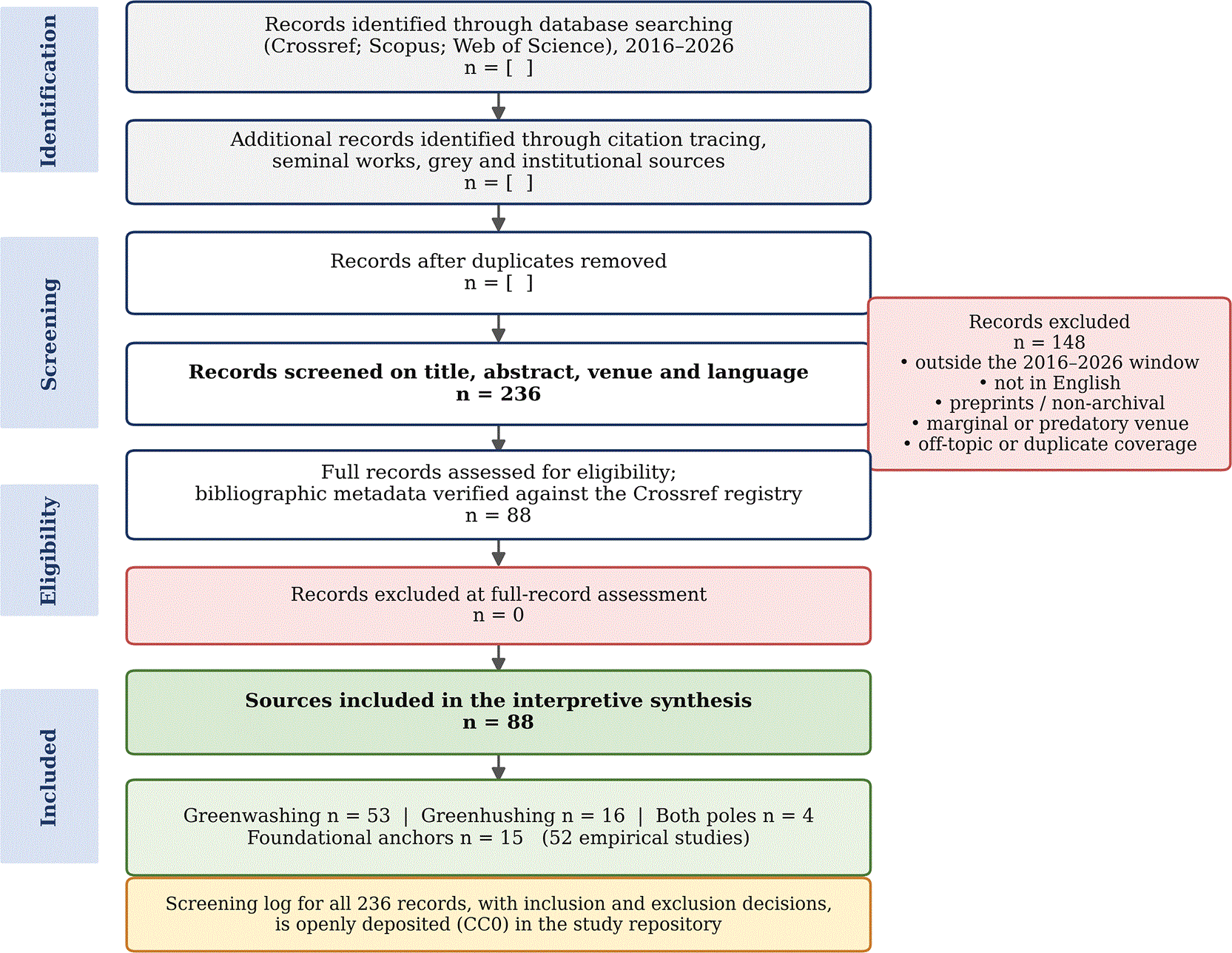
Note. The diagram follows the PRISMA 2020 flow structure, adapted for an integrative review (Torraco, 2016). Counts correspond to the openly deposited screening log: 236 records screened, 148 excluded with reasons, and 88 sources carried into the synthesis. Boxes shown as [] are completed from the final indexed search of Scopus and Web of Science, which is reserved for the final submission stage (see Limitations).
One methodological objection deserves a direct answer: Did the framework emerge inductively from the literature, or was it imposed on the literature from outside? The question matters because a framework merely projected onto the evidence proves nothing beyond its author’s assumptions. The procedure was built to keep the synthesis answerable to the texts and it ran in two passes. The first pass was descriptive in nature. It reads the greenwashing and greenhushing literature on their own terms, pulling out how each defines the practice, what harms each name, and what normative vocabulary, if any, each already uses. Tables 1A and 1B summarize the resulting map. Only in the second, interpretive pass did the three ethical traditions enter, and the matrix in the section on the three normative lenses records what each tradition says about the harm the first pass had already found. The convergence reported in the section developing the NDEF was not assumed; it emerged when the independently derived verdicts coincided. None of this removes the reviewer’s interpretive role, which an integrative review openly acknowledges (Torraco, 2016), but keeps the framework accountable to the corpus instead of decorative. Figure 2 shows the flow of identification and selection as a PRISMA-adapted diagram, and a completed PRISMA 2020 checklist accompanies the manuscript in the study’s public data repository.
The search window was 2016 to 2026, chosen to capture the decade in which greenhushing became an identifiable object of study, in which the sustainability disclosure regulation expanded and then contracted. Sources were identified through scholarly databases and citation tracing, with bibliographic metadata verified against the Crossref registry, and priority was given to peer-reviewed, English-language articles in established journals and seminal definitional and theoretical works outside the window (for example, Laufer, 2003; Reid & Toffel, 2009; Kim & Lyon, 2015) were admitted as anchors. Because the present environment did not permit direct querying of proprietary indexes, such as Scopus and Web of Science, the corpus reported here should be regarded as a defensible analytic sample assembled through open scholarly search and citation tracing, not as the output of an exhaustive indexed query. A formal, reproducible database search remains a task for the submission stage, and the limitations section treats this as a limitation.
One asymmetry in the corpus must be openly managed and not hidden. The greenwashing literature is extensive and mature, with several reviews and a settled vocabulary (Montgomery et al., 2024; Zioło et al., 2024; Bowen, 2014). The greenhushing literature is small and young, clustered after 2017, and especially after 2022, its empirical base has grown fast but is still thin, with one dedicated systematic review to date (Font et al., 2017; Dias et al., 2025; Hilton, 2025a). Treating the two as though their evidence were comparable would be misleading. Therefore, the review handles Greenhushing as an emerging corpus, admits it on a more inclusive standard, and leans on credible grey literature, chiefly the South Pole (2022) survey of more than 1,200 companies, to describe the practice. This reliance suits an emerging phenomenon, but it is also a limitation: Survey reports are not peer-reviewed and may carry their authors’ framing.
Reflexivity regarding philosophical sources matters as much. The three traditions are canonical in Western moral philosophy, and Western framing is a real limitation, not a neutral default; the limitations section returns to it. Within each tradition, the article works from primary texts and authoritative modern developments, especially virtue epistemology, for the treatment of courage and silence (Zagzebski, 1996; Roberts & Wood, 2007; Baehr, 2011). Throughout, traditions serve as analytic lenses with genuine philosophical content, not labels pinned after the fact onto conclusions reached on other grounds.
Before turning to the two studies, a brief profile of the corpus sets the scene and flags a limitation that recurs below. The 88 sources comprised 53 focused on greenwashing, 16 on greenhushing, 4 on both, and 15 foundational anchors from moral philosophy, methodology, and stakeholder or signalling theory; 52 were empirical studies (Extended data - Figure C2). Two features stand out. First, coverage is uneven across themes, concentrated on decoupling and selective disclosure, definitions, and consumer or employee responses, and thin on emerging greenhushing themes (Extended data - Figure C1). Second, and more consequential for interpretation, the empirical base is geographically narrow; of the studies that state a setting, more come from Chinese listed-firm data than from all other jurisdictions combined (Extended data - Figure C3). Table 1C lists the full profile. These features bound the generalizability of the empirical regularities discussed below, a point the Limitations section develops.
Regarding greenwashing, the field has settled on a working picture: strategic misrepresentation driven by identifiable pressures. This maturity provides normative work a firm base. The concept goes back to Laufer (2003), who cast greenwashing as a failure of social accountability, and later sharpened both its drivers and its forms. Delmas and Burbano (2011) sorted the drivers into external, organizational, and individual levels, showing that the practice is a predictable response to market and regulatory incentives and not an aberration. Lyon and Maxwell (2011) formalized the informational core, modeling greenwash as selective disclosure under the threat of audit. Siano et al. (2017) widened the taxonomy after the Volkswagen scandal to cover outright fabrication as well as selective emphasis. Bowen (2014) and Bowen and Aragon-Correa (2014) brought about symbolic corporate environmentalism, and a recent state-of-the-art review tracked the field’s growth and fragmentation (Zioło et al., 2024). Table 1A organizes the corpus according to the theme.
Research on the antecedents of greenwashing has grown rapidly, and much of it has been built on Chinese regulatory and disclosure data. One stream isolates regulations and policies. Evolutionary game and panel studies ask whether government rules deter greenwashing or merely displace it (Sun & Zhang, 2019; Zhao & Lee, 2024), and newer work ties climate policy, environmental centralization, and regulatory proximity to its intensity (Xu & Zhou, 2026; Luo & Li, 2026; Zhao, W., et al., 2026b). A second stream looks inside the firm at board characteristics, financial constraints, institutional complexity, and political connections (Chen & Dagestani, 2023; Xia et al., 2023; Testa et al., 2018; Chen et al., 2025; Kudłak, 2024). A third tracks the pull of digital infrastructure and public scrutiny, where government digitalization, social media attention, and online investor platforms reshape the incentive to misrepresent (Xu et al., 2024; Ren et al., 2024; Long et al., 2024).
The consequences run through markets, consumers, and employees, and evidence agrees that detection brings real costs. In markets, studies weigh how greenwashing is priced, whether it buys legitimacy, and what penalties follow exposure (Du, 2015; Berrone et al., 2017; Wu et al., 2020; Taddeo et al., 2026), with societal trust and market power shifting the results (Haidar, 2025; Liu, X., et al., 2025). For individuals, perceived greenwashing corrodes consumer trust and satisfaction, breeds skepticism (Nyilasy et al., 2014; Szabo & Webster, 2021; Ioannou et al., 2023; Rinaldi et al., 2026), and moves employees from an ethical voice to negative pro-environmental responses (Robertson et al., 2023; Xiang et al., 2024; Tao, 2025). One thread connects them: The cost lands on the credibility of all environmental claims, not only on the firm that lies.
The most important stream for this article is decoupling, legitimacy, and selective disclosure, because it bridges greenhushing. Marquis et al. (2016) showed that firms disclose selectively to manage scrutiny and that normative pressure constrains the practice; Kim and Lyon (2015) modeled the symmetric errors of exaggeration and undue modesty; Fabrizio and Kim (2019) documented reluctant disclosure outright. Decoupling between commitment and outcome, read by audiences as greenwashing, has been studied at the level of business groups and stakeholder legitimacy (Bothello et al., 2023; Lee & Raschke, 2023; Feix et al., 2026). The materials for a theory of silence are already here: a firm that discloses selectively to dodge scrutiny stands one step away from a firm that discloses nothing. What this literature supplies descriptively, the present article supplies normally.
The last stream concerns measurement and detection, and it matters because the accuracy condition defended in the section developing the NDEF assumes that claims can, in principle, be checked against performance. Researchers have built taxonomies, expert indices, and, lately, machine-learning classifiers to distinguish substantive environmental communication from symbolic (Siano et al., 2017; Abouarab et al., 2024; Zhao, Q., et al., 2026a), and have asked whether even award-winning or highly rated firms remain clear of greenwashing (Marrucci et al., 2025; Zhang et al., 2025). Across all of these, normative judgment remains implicit. The corpus treats greenwashing as harmful and worth deterring, yet its tools are descriptive and strategic; when ethics enter, it enters at the level of consequence, and the deontological and character dimensions go unexamined. That is, the gap that a normative synthesis can fill.
Greenhushing is an emerging field that has named a phenomenon faster than it theorized, although recent empirical work is closing the gap. The term entered scholarship with Font et al. (2017), who found tourism businesses that practiced sustainability but deliberately under-communicated it, and who called it moral muteness, not moral hypocrisy. It gained wider salience through practitioner research, especially the South Pole (2022) survey: roughly one in four of the climate-aware companies it studied had chosen not to publicize their science-based targets, and the report popularized the label green hushing. The first systematic review has since appeared in marketing (Dias et al., 2025), and an institutional account reads Greenhush as a response to institutional complexity and regulatory uncertainty (Hilton, 2025a). Table 1B organizes the corpus according to the theme.
A wave of recent empirical work, again leaning on Chinese data, has begun to pin down the antecedents and effects of corporate silence. Studies tie greenhushing to ESG underperformance, institutional-investor distraction, and peer imitation (Zhang et al., 2026a, 2026b; Liu et al., 2026). Its firm-level effects are not uniformly bad; greenhushing has been found to lower a firm’s stock price crash risk by raising market attention and cutting agency costs (Cheng et al., 2024), which sharpens the gap between private benefits and social costs. The regulatory evidence, in turn, cuts against a simple ‘rules breed silence’ story: China’s 2015 New Environmental Protection Law is associated with less greenhushing, especially among heavy polluters, and its authors read Chinese greenhushing as rooted in institutional fragility rather than strategic silence (Wang et al., 2026). Cross-cultural work compares drivers across East Asian economies (Tao, 2024). This evidence already shows that silence answers many of the same pressures as greenwashing, which is the reason for treating the two as poles of one phenomenon.
The second stream treats greenhushing as a strategic behavior and weighs its institutional and legal standing. Hilton (2025b) models greenhush and greenwash together as equilibria of a signalling game, where silence emerges once signalling costs outrun the benefits of disclosure. Villiers (2026), writing from law and governance, analyzes greenhushing as strategic silence and argues that it corrodes stakeholder engagement; sectoral studies follow it into banking and finance (De Novellis et al., 2025). These accounts land on the same point: Silence is neither neutral nor cautious. It is a calculated communicative choice with distributional consequences, which is why it invites an ethical evaluation.
The third stream asks how audiences react to silence and how it might be measured, which bears on the proportionality and courage conditions developed later. Investor experiments suggest that it is the assurance of ESG disclosure, more than greenhushing itself, that moves investors’ judgments (Sakchuenyos & Haji, 2025), and governance research asks whether board composition curbs the practice (Ma et al., 2026). In hospitality and services, studies have tested whether customers actually prefer silence to communication, and the mixed results warn against treating greenhushing as harmless discretion (Ettinger et al., 2021; Cavusoglu et al., 2026; Khan et al., 2025). Some researchers have measured the construct directly using a consumer-based Greenhushing attitude scale (Yakın et al., 2026). One feature recurs across the corpus: the language of muteness and silence points toward virtue-theoretic and epistemic categories without developing them. The raw materials for normative analysis are as follows: no one has assembled them.
Synthesizing the two corpora reveals a gap that neither field has filled: There is no systematic, philosophically grounded account of disclosure honesty that addresses overclaiming and silence within a single normative structure. Applications of ethical theory to greenwashing exist, but rigorous, peer-reviewed treatments tend to address one tradition at a time, and the explicit tri-framework discussions that do exist are largely confined to non-archival or practitioner outlets and do not extend to greenhushing. Existing integrative treatments of the two practices are descriptive and predictive rather than normative (Hilton, 2025a, 2025b; Kim & Lyon, 2015). No source identified in this review applies deontology, consequentialism, or virtue ethics in parallel to both poles of the disclosure spectrum and builds a positive framework from the results. Table 2 presents the present contributions to prior work. The remainder of the article occupies that gap, beginning with three lenses.
Read side by side, the two corpora reveal a further pattern: greenwashing and greenhushing answer a shared set of pressures, which strengthens the case of treating them as one phenomenon. Regulation, public scrutiny, investor attention, and reputational risk are antecedents of both sides. Tighter rules deter false claims in some studies (Sun & Zhang, 2019) and induce silence in others (Wang et al., 2026); Sharper public attention can curb exaggeration (Ren et al., 2024) or drive firms out of disclosure altogether (Liu et al., 2026). Under the same incentives, the same firm may swing toward either pole, depending on whether it fears exposure to overclaiming or backlash for claiming at all. A single normative standard should track this shared structure exactly, which is why a framework tuned to one pole alone will misfire as conditions shift.
This section reads both poles of the spectrum through three traditions in turn, and the structure is deliberately symmetrical, so that each tradition is asked the same question about each practice. The point is not to adjudicate among the traditions, but to record what each says, so that the convergence claimed in the section developing the NDEF can be assessed on the evidence of the verdicts themselves. Table 3 maps each tradition to the disclosure criterion it grounds, and Table 4 summarizes the six verdicts developed in the subsections.
The choices of these three traditions were not arbitrary. They are the three families of normative theory that a philosophically literate reviewer would expect any complete moral assessment to canvass, since each locates moral status in a different place, the act, its outcomes, and the agent, and between them, they exhaust the standard typology of normative ethics. The methodological point that follows is decisive in this argument. If a practice is condemned on only one of the three, the condemnation is contestable because it depends on accepting the disputed foundations of tradition. If condemned on all three, the verdict is robust to disagreement about foundations, which is the kind of overlapping consensus a normative argument addressed to a plural audience should seek. Therefore, the value of the exercise lies less in any single verdict than in whether the three coincide, and the section developing the NDEF shows that they do.
Kantian deontology condemns both poles because both treat the audience as mere means and rest on maxims that cannot be universalized. For Kant, the wrong of deception lies not in its consequences but in its form: to assert what one does not warrant, in pursuit of an end, the other would not freely endorse if informed, is to use the other’s rational agency as a tool (Kant, 1785/2012). Greenwashing is a textbook case. The maxim, advertise environmental virtue one does not possess when it is profitable, cannot be willed as a universal law without destroying the very practice of environmental claims it exploits, and manipulates stakeholders by design. Kant’s hard line of truthfulness, including his insistence that the duty not to lie holds even under pressure (Kant, 1797/1996), gives the deontological verdict on greenwashing its characteristic absoluteness.
Greenhushing is a more interesting deontological case, and the tradition has the resources to condemn it as well, although the argument runs through omission rather than assertion. Strategic silence does not need to involve a false statement, so a narrow reading might seem exempt it. The Kantian reply is that veracity is not merely a duty to avoid false assertions but a duty grounded in respect to others as rational agents who depend on warranted information to govern their own choices. When a firm possesses material environmental information that the public has a legitimate interest in, and withholds it precisely so that the public cannot scrutinize or act on it, the maxim of that silence, conceal material truth when disclosure invites accountability, fails universalization for the same reason the lie does: it depends on others generally not adopting it. Greenhushing is thus a culpable omission, a failure of the imperfect duty to make oneself answerable, shading into a violation of the duty not to manipulate when silence is strategically aimed at preventing informed response. In short, the deontological lens treats both poles as offenses against the same duty of veracity, differing only in whether the offense is committed or not.
Classical utilitarianism condemns both poles via another route. It does not ask about the form of the act, but about its effects on aggregate welfare, and the two practices do distinct but comparable social harm. For Bentham (1789/1996) and Mill (1863/1998), an act addresses its contribution to general happiness, and a disclosure regime addresses the welfare effects of the information environment it creates. However, greenwashing degrades the environment by misdirecting it. False positive signals attract capital, consumer spending, and political attention toward firms that have not earned them, wasting scarce decarbonization resources; once the deception surfaces, trust in all environmental claims falls, which raises the cost of credible signalling for genuine performers and weakens the market mechanism on which collective climate action partly relies on (Lyon & Maxwell, 2011; Spence, 1973). Empirical records support this mechanism, with documented trust erosion and financial penalties after exposure (Wu et al., 2020; Haidar, 2025; Taddeo et al., 2026).
Greenhushing does welfare harm that is easy to miss, precisely because no false claim is made, yet on consequentialist grounds, it can be severe. When firms with genuine science-based achievements keep them quiet, effective practice spreads more slowly; peers lose models to copy, benchmarks go unset, and the social learning that drives down the cost of green technology is lost (South Pole, 2022). Silence also thins the evidence base for ambitious policy, since regulators and investors underrate what is achievable when achievers say nothing. Because stronger disclosure regulations are associated with less greenhushing (Wang et al., 2026), the retreat from such regulations threatens to widen this welfare loss (Hilton, 2025b). Therefore, the consequentialist verdict is that greenhushing is a failure of knowledge diffusion with real opportunity costs for decarbonization, even though and partly because it does not lie. On this lens, both poles stand condemned to degrade the welfare-relevant information environment, one by polluting it and the other by starving it.
Virtue ethics condemns both poles by shifting attention from the act to the agent, and it supplies vocabulary that the other two lenses lack for the specific wrong of strategic silence. For Aristotle, truthfulness is itself a virtue, a means of self-presentation between boastful exaggeration and self-deprecating concealment, and it is exercised well only by an agent with phronesis–the practical wisdom to discern what should be said, to whom, and how (Aristotle, ca. 350 BCE/2000). Greenwashing is, in these terms, the vice of boastfulness compounded by a kind of hubris: it is the disposition to claim more than one is, and its persistence signals the absence of practical wisdom that would recognize the claim as both false and self-undermining.
Greenhushing maps onto the opposite vice, and contemporary virtue epistemology precisely names it. Deficiency at stake is a failure of intellectual or epistemic courage, a virtue that disposes an agent to communicate what should be communicated despite the risk of criticism or loss (Roberts & Wood, 2007; Baehr, 2011). Zagzebski (1996) integrated such intellectual virtues into a unified virtue theory in which courage in the epistemic domain is continuous with courage in the moral domain. On this account, the firm that conceals genuine achievement out of fear of activist criticism, regulatory attention, or political backlash exhibits epistemic cowardice, which makes it allows the prospect of difficult to silence its contribution to shared understanding. (The compact term is used here as a development of the courage-and-its-vices analysis in Roberts and Wood (2007) and Baehr (2011), rather than as a coinage of any single author.) The virtue lens thus completes the symmetry: greenwashing is the vice of excess in self-presentation, greenhushing the vice of deficiency, and adequate disclosure of the courageous, practically wise, mean between them.
The central claim is that the six verdicts in Table 4 form a convergence, not an arbitrary list, and that convergence licenses a positive framework. Three traditions disagree about the foundations of morality, whether rightness lies in the form of an act, its consequences, or the character it expresses. They still agree to condemn both poles of the disclosure spectrum. The Normative Disclosure Ethics Framework states the positive side of that agreement: Disclosure is ethically adequate only when it is accurate, proportionate, and courageous. Accuracy is the deontological condition: asserts nothing unwarranted and conceals nothing. Proportionality is a consequentialist condition that serves a welfare-relevant information environment instead of degrading it. Courage is the virtue condition: disclosure from a stable disposition to truthfulness, not because compulsion forces disclosure or fear to suppress it.
The framework’s sharpest and most contestable claim is that the three conditions are jointly necessary and non-substitutable: fail one and excelling at the others does not redeem the disclosure. This is what separates the framework from a checklist of nice properties, so it must survive the two objections that a philosophically trained reader raises first. One: The three conditions are really a single condition under the three names. Two: Non-substitutability makes no sense for the consequentialist condition since consequentialism is itself a doctrine of trade-offs. The next two subsections discuss these in turn, and the third section sets out the internal ordering. Figure 3 shows the framework as an intersection of these three conditions.
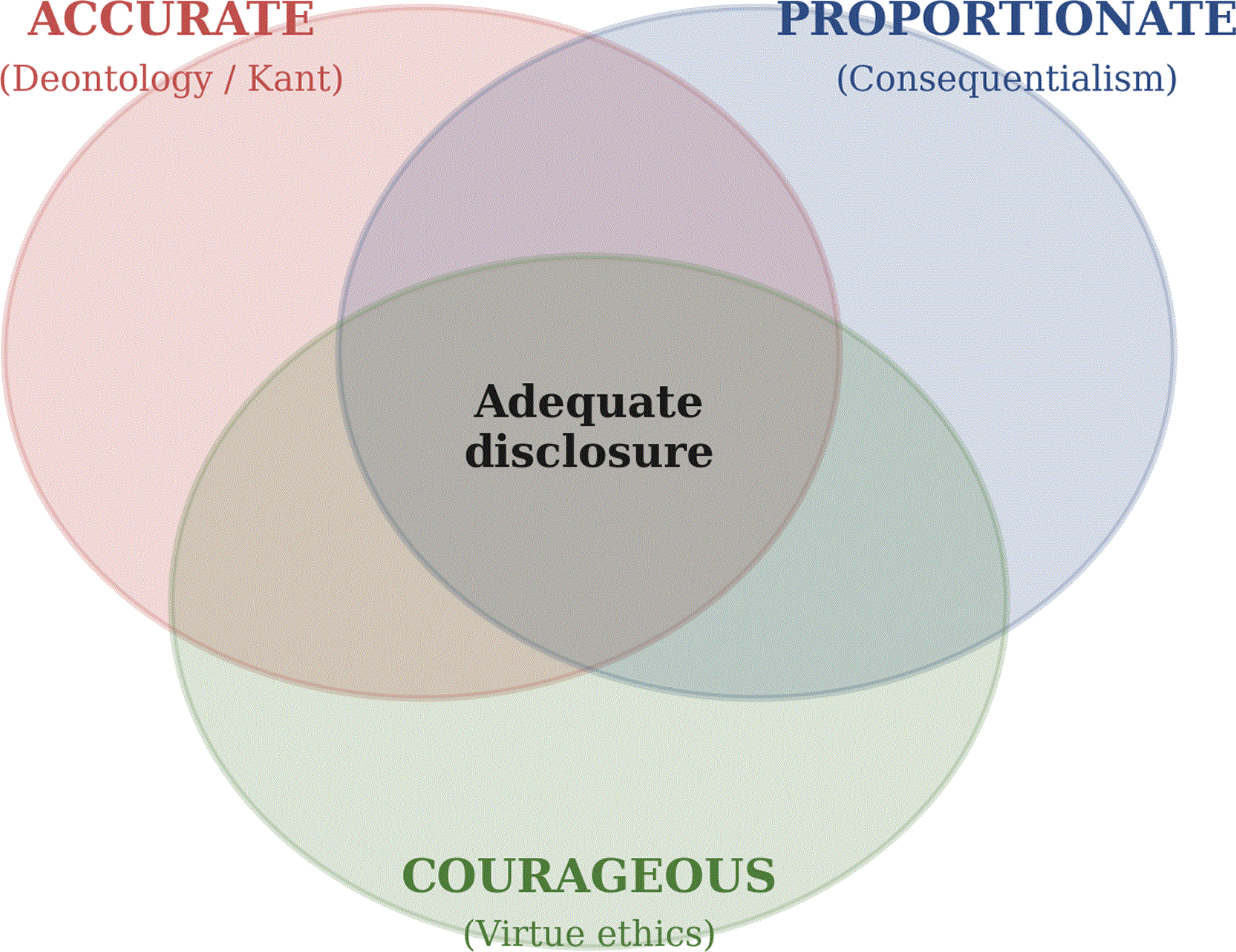
Note. Adequate disclosure is the intersection in which all three conditions hold simultaneously; each condition is grounded in a different ethical tradition.
If accuracy, proportionality, and courage were the three labels for honesty, they would always travel together. They do not. The conditions come apart in real cases, and the conditions that can be satisfied separately are not synonymous. Three cases make up this point. First, a disclosure can be accurate yet disproportionate: a firm that fears backlash and releases only the legal minimum makes no false statement, so accuracy holds, yet it starves the information environment and fails proportionality, and if fear is the motive, it fails courage too. The Greenhushing-adjacent case, then, shows that accuracy does not entail proportionality. Second, a disclosure can be welfare-promoting yet inaccurate: exaggerating climate progress to inspire an industry to follow, and whatever the effects, veracity breaks, so proportionality does not entail accuracy. Third, a disclosure can be accurate and proportionate, yet cowardly: a firm that discloses fully only because an auditor compels it, and would otherwise have hidden everything, meets both action conditions but lacks virtue. None of these is exotic; each matches a recognizable corporate behavior, and together they show three distinct dimensions, not one renamed dimension.
The fourth case highlights why accuracy must be understood as completeness rather than mere literal truth. A firm can only assert true statements that are still misled by selecting which truths to tell, foregrounding a trivial green initiative while omitting material harm. Empirical literature documents exactly this gradient from outright lies to technically true half-truths (de Jong et al., 2020) and the selective disclosure that exploits it (Marquis et al., 2016). The NDEF handles such cases through the second clause of the accuracy condition, the prohibition on concealing the material: the half-truth fails accuracy not because any sentence is false but because the disclosure as a whole is misrepresented by omission. This is why accuracy, properly specified, already works that a naive truth condition would miss, and why it cannot be reduced to the avoidance of false assertion alone.
The sharpest objection is that non-substitutability cannot apply to the consequentialist condition because consequentialism is just the view that goods may be traded off to maximize the aggregate, so to forbid trading proportionality against the other conditions is to misunderstand it. The objection succeeds against a careless version of the framework and must be answered carefully. The reply distinguishes between these two levels. Within the consequentialist condition, proportionality is indeed a balancing notion: it asks whether this disclosure, against feasible alternatives, best serves the information environment, and whether the internal question is settled by weighing effects. The non-substitutability claim operates at a different meta-level: it concerns how the verdicts of the three distinct traditions combine into an all-things-considered judgment of adequacy. The claim is not that good consequences may never be weighed against each other, but that an act that fails the deontological accuracy test is not made adequate by scoring well on the consequentialist test and conversely. The joint necessity at the meta-level is fully compatible with balancing inside each condition.
This meta-level non-substitutability is not stipulated; it is supported by a consequentialist argument, which is why convergence is stable rather than coincidental. A disclosure regime that permitted welfare-justified deception, which allowed accuracy to be traded away whenever the numbers seemed to favor it, would destroy the credibility that makes any disclosure informative in the first place. Once audiences know that claims may be false when falsehood pays, no claim carries information and the welfare benefits that justify the occasional lie evaporate. Therefore, a sophisticated, rule-level consequentialist has reason to treat accuracy as a near-inviolable constraint rather than a tradeable quantity (Mill, 1863/1998). The three traditions converge not by accident but because each pursued rigorously points to the same structural requirement: honest disclosure must be protected as a condition of the practice, not optimized away within it. Convergence is thus best read as evidence that courageous, accurate, and proportionate disclosure is the only stable equilibrium of the normative system, the position that does not undermine itself when generalized.
Joint necessity is granted, and the framework still needs an internal structure for cases where the conditions pull apart. This structure provides NDEF with action-guiding content instead of leaving three standoff conditions. Accuracy takes the role of a side constraint: it bounds the space of permissible disclosures, ruling out assertion of the unwarranted and concealment of the material before any welfare calculation starts. Proportionality then works inside that space, choosing among accurate disclosures that best serve the information environment. After all, accuracy alone does not tell a firm how much to say or how to frame it, and an accurate disclosure can still be misled by dropping the context or burying the material in the trivial. Courage is not a third action criterion; it is the disposition that explains why a firm keeps meeting the first two conditions when no one is forcing them. The ordering also names a real moral remainder: where only fully accurate disclosure would itself cause grave and disproportionate harm, the framework does not dissolve the conflict by formula. It asks that accuracy not be sacrificed lightly, and that any departure be carried as an acknowledged moral cost, not a balance, struck and forgotten.
This ordering yields a precise definition of an adequate zone between overclaiming and silence. A disclosure sits in the zone when it asserts nothing unwarranted and conceals nothing material (accuracy holds), when it is the accurate option that best serves stakeholders’ warranted information needs (proportionality is optimized inside the constraint), and when it comes from a settled disposition to truthful communication, not from compulsion or fear (courage is present). Greenwashing leaves the zone by breaching accuracy from the side of excess; greenhushing leaves it by breaching proportionality, and usually courages, from the side of deficiency. Table 5 and Figures 3 and 4 summarize the framework and spectrum, respectively.
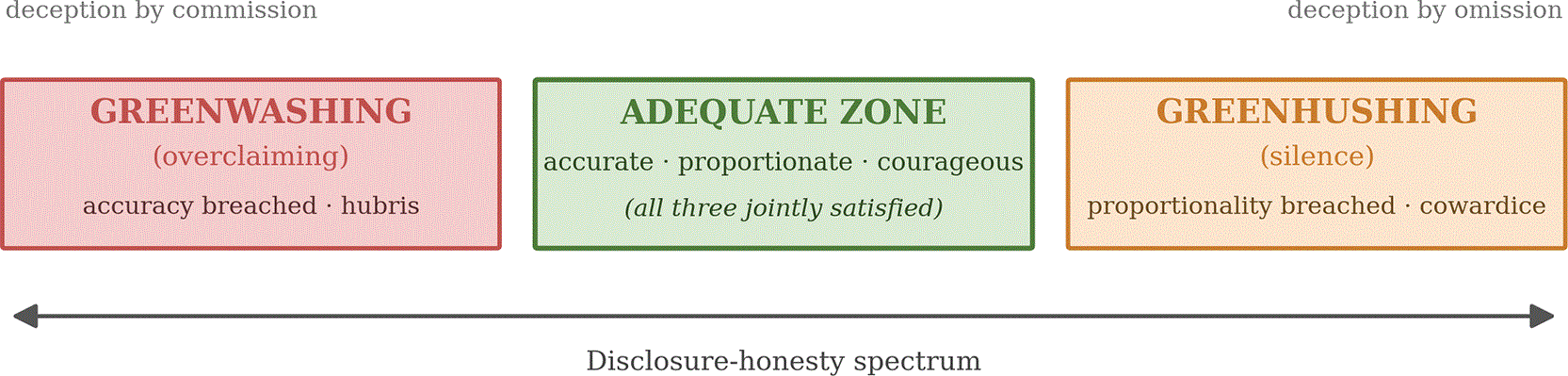
Note. Adequacy is not the midpoint of a single quantity of disclosure but the region in which all three NDEF conditions are met simultaneously; a firm can leave the zone in either direction.
The NDEF turns a debate mostly conducted in strategic terms into a question of disclosure honesty with a definite normative structure, and three implications follow for theory, practice, and policy. For theory, the framework joins two pieces of literature that grew apart and shows that their objects were continuous. Greenwashing research is the study of accuracy failures on the side of excess, greenhushing research, the study of proportionality, and courage failures on the side of deficiency. Both are read as departures from a single standard. The integration also clarifies what normative contributions add. Accounts that already treat the two practices together are explanatory: they predict when firms overclaim or fall silent (Hilton, 2025a, 2025b; Kim & Lyon, 2015). The NDEF states what firms ought to do, and why silence can be wrong even when it is strategically rational and legally permitted.
In practice, the framework sets a harder test than legal compliance, and the gap between the two is where most of the ethical action lies. A firm can satisfy the disclosure law by reporting the mandated minimum and still fail proportionality and courage if it is quietly under-communicating material achievements to dodge scrutiny. The NDEF shifts the manager’s question from what must we disclose to what honest disclosure requires of us, given what we know, and what stakeholders are entitled to understand. The courage condition carries real weight here because the same disclosure can be adequate, depending on the disposition behind it. This points to governance, incentives, and culture that make truthful communication a habit instead of a one-off compliance episode. Figure 5 illustrates the framework as a practical evaluation sequence.
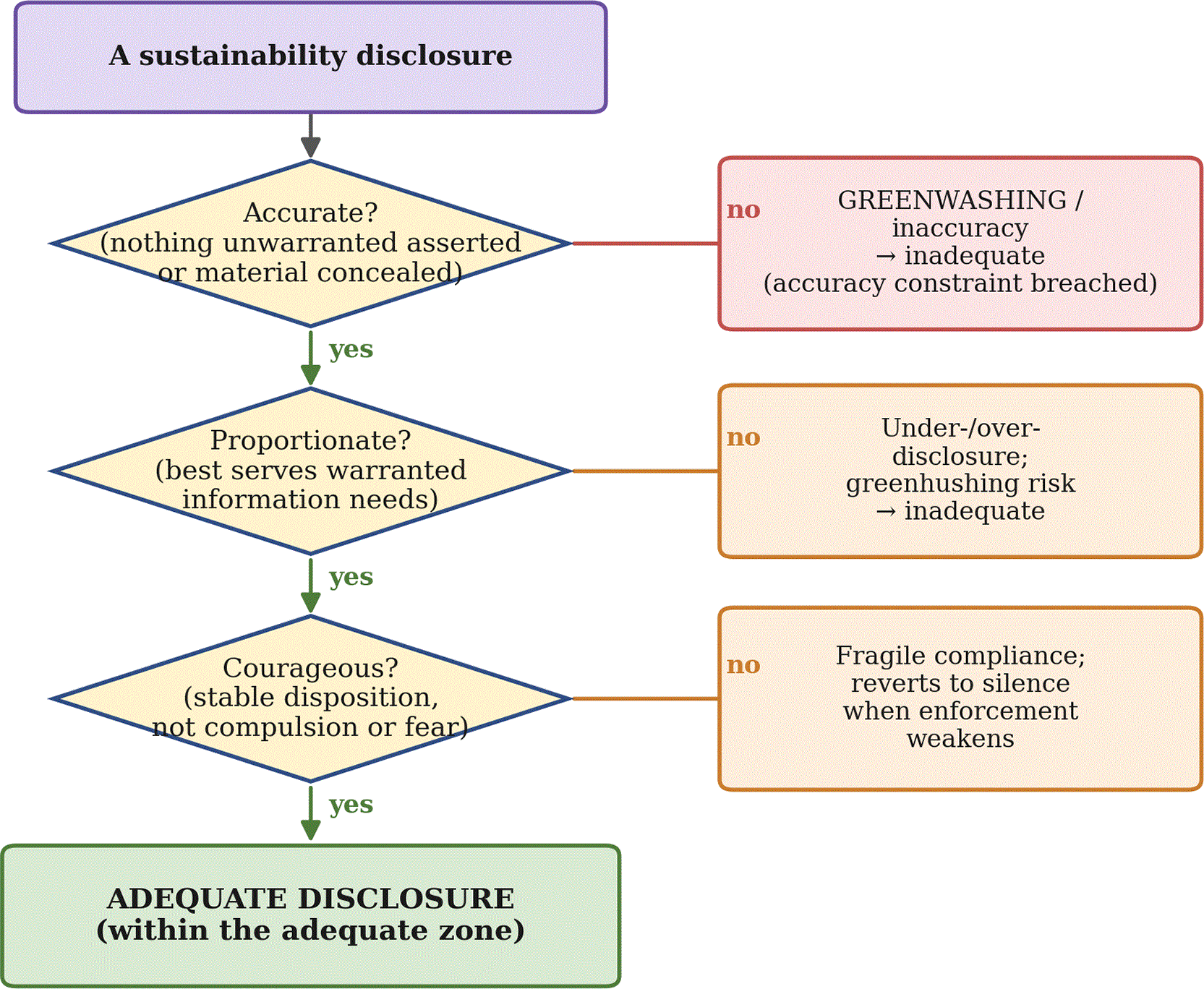
Note. The conditions are applied in lexical order: accuracy as a side-constraint, proportionality within it, and courage as the stabilizing disposition. Failure at any stage places the disclosure outside the adequate zone.
For policy, the 2025–2026 European deregulatory turn offers a near-experimental illustration of the framework’s value, and specifically of why courage is not a redundant condition. The Omnibus package narrows the reporting scope and removes a large share of previously mandatory data points (Council of the European Union, 2026). In the NDEF analysis, this predicts a shift in the strategic temptation from greenwashing to greenhushing: firms that disclosed only because they were compelled, and that therefore satisfied accuracy and proportionality without courage, are precisely those most likely to fall silent once compulsion is withdrawn. The prediction has an empirical footing: stronger environmental regulation is associated with less corporate greenhushing (Wang et al., 2026), so by the same inverse relationship, the withdrawal of mandatory disclosure should push firms toward silence (Hilton, 2025b). This is the case three pattern of the discussion of the relabeling objection realized at the level of the whole regime. The implication for regulators is that mandatory disclosure rules secure the action conditions but not the disposition; when the rules contract, only firms with a genuine commitment to truthful communication will continue to disclose adequately. A disclosure policy aimed only at preventing false claims, the overclaiming pole, is structurally incomplete because it does nothing to prevent the silence invited by deregulation.
The framework also bears on the design of anti-greenwashing instruments, such as substantiation requirements for environmental claims. These target the accuracy constraint on the side of excess, which is necessary, but not sufficient. Raising the cost and legal risk of making any environmental claim, with no matching expectation of proportionate disclosure and well-meaning rules against greenwashing, can push firms into greenhushing instead, trading one failure of honesty for the other (Villiers, 2026). The NDEF makes that trade-off visible and argues for judging disclosure policy against both poles at once, not optimizing it against overclaiming alone.
The final implication concerns measurement and assurance. The accuracy condition assumes that claims can be checked, and a growing toolkit, from expanded taxonomies to machine-learning detection, aims to do that (Siano et al., 2017; Abouarab et al., 2024; Zhao, Q., et al., 2026a). However, measurement aimed only at catching exaggeration leaves the silence pole untouched. Recent work that operationalizes greenhushing directly, including a consumer-based attitude scale (Yakın et al., 2026) and investor-judgment experiments on disclosure assurance (Sakchuenyos & Haji, 2025), suggests that proportionality and courage conditions are becoming measurable as well. An assurance regime built on the NDEF would check not only that what is said is true but that what is material is said, and would read continued disclosure under weakening enforcement as evidence of the courage the framework asks for.
The argument has limitations that bound its claims, and naming them precisely is a part of the contribution. The first is methodology. The corpus was assembled through open scholarly search and citation tracing, with metadata verified against Crossref, rather than through an exhaustive query of proprietary indexes, which is interpretive and conceptual rather than exhaustive. A formal, reproducible search of Scopus and Web of Science, with explicit inclusion and exclusion criteria and a documented selection flow, should accompany submission and may surface sources that refine the synthesis. The corpus is also asymmetric: although the Greenhushing evidence base has grown quickly, it remains thinner than the greenwashing literature and leans in places on grey literature, principally South Pole (2022), so empirical claims about the prevalence of silence are provisional. These are limits of evidence, not of the normative argument that stands on the philosophical reasoning of Sections 5 and 6.
A further evidentiary caveat concerns the geographic concentration of a recent empirical corpus. A large share of greenwashing and greenhushing studies published since 2022 draws on Chinese listed-firm data and a distinctive regulatory setting (for example, Long et al., 2024; Wang et al., 2026; Zhang et al., 2026a). This concentration reflects data availability and a fast-moving policy environment, but it bounds the generalizability of the empirical regularities, and claims about how firms respond to disclosure regulations should be read with that limit in mind. The normative framework itself is not tied to any jurisdiction, yet the behavioral predictions in the Discussion will require testing across institutional settings, including the European context, whose deregulation motivates them.
The second limitation concerns its philosophical scope. The framework is built from three canonical Western traditions, and this is a substantive narrowing rather than a neutral starting point. Other normative resources could change the analysis: discourse ethics would recast disclosure as a condition of legitimate communicative action and might ground the public’s entitlement to information more directly than any of the three traditions used here (Habermas, 1983/1990); care ethics, relational and non-Western traditions, and indigenous environmental ethics would frame the duties of disclosure differently. The convergence reported here is therefore a convergence among the three traditions, not a proof of universal agreement, and future work should test whether the accurate-proportionate-courageous structure survives contact with these other lenses or must be revised. A further philosophical task is to specify materiality; since the accuracy side constraint depends on a defensible account of which concealed information counts as material, a question this article has treated as given.
The third direction is empirical operationalization. The NDEF is a normative framework, but its three conditions invite measurement: accuracy through verification of claims against performance, proportionality through the fit between disclosed and material information, and courage through the persistence of disclosure under varying enforcement and reputational pressure. The rapid growth of empirical greenhushing research, which has exploited regulatory changes in natural experiments (Wang et al., 2026; Zhang et al., 2026a; Liu et al., 2026), suggests that the framework’s central behavioral prediction is testable: the withdrawal of mandatory disclosure should increase greenhushing among previously compelled firms. Confirming or disconfirming that prediction would connect the normative framework to observable corporate behavior and would test, rather than merely assuming, the claim that courage is the condition that stabilizes honest disclosure when external pressure relaxes.
Corporate sustainability disclosures fail in two directions, and an ethics fit for this moment must address both. The article has argued that greenwashing and greenhushing are two poles of a single disclosure-honesty spectrum, one deceiving by commission and the other by omission. Through Kantian deontology, utilitarian consequentialism, and virtue ethics, the spectrum drew the same verdict from all three: traditions that disagree about the foundations of morality still converge in condemning both poles. That convergence is a finding, not a coincidence, because each tradition pursued rigorously lands on the same requirement, honest disclosure as a condition of the practice. The article built the Normative Disclosure Ethics Framework, on which adequate disclosure must be accurate, proportionate, and courageous: accuracy as a side constraint, proportionality as optimization within it, and courage as the disposition that holds the whole steady when enforcement weakens.
The deregulatory turn now under way sharpens the framework’s value instead of diminishing it. As mandatory disclosure contracts, the temptation slides from overclaiming toward silence, and a standard tuned only to the overclaiming pole will miss the failure of the new environment. Between overclaiming and silence, the zone of adequacy is fixed by three conditions that cannot be traded for one another. The practical lesson is plain: honest disclosure depends less on what firms are compelled to say than on courage to say what is true once no one compels them to say anything at all.
Not applicable. This study is a review of the published literature and does not involve human participants, human data, or animals. No ethical approval or consent was obtained from any participant.
This article is a review of previously published, third-party copyrighted works, together with the authors’ own coding of those works. No new primary data were generated. The complete list of sources with persistent identifiers (DOIs) or official URLs is provided in the accompanying dataset. Because the sources are under their original copyright, the full texts are not redistributed; each can be obtained from its original publisher using the listed DOI or URL. Open-access items (for example, the United Nations Global Compact 2004 report and EU Directive 2022/2464 in the Official Journal) are freely available at the given URLs.
The authors’ own contributions, namely the screening log for all 88 records with inclusion and exclusion decisions, source-to-theory and source-to-theme coding matrices, and the proposition-evidence map, are openly available to support reproducibility and reuse.
Zenodo.org: Dataset for “Between Overclaiming and Silence: A Systematic Literature Review and Normative Ethics Framework for Corporate Sustainability Disclosure”. https://doi.org/10.5281/zenodo.21484032 (Sidarta, 2026a).
This project contains the following extended data: a workbook with a screening log, cited-corpus register, coding matrices, proposition-evidence map, and an empirical codebook and template for a planned follow-up study (the template contains no measured values).
Data are available under the terms of the Creative Commons Zero “No rights reserved” data waiver (CC0 1.0 Public Domain Dedication). Underlying third-party publications remain under their original copyright and are not included.
This structured, integrative review followed the principles of the Preferred Reporting Items for Systematic Reviews and Meta-Analyses for transparent screening and reporting adapted to a conceptual synthesis. A completed PRISMA 2020 checklist has been deposited in the repository below, and the corresponding PRISMA-adapted flow diagram is presented in Figure 2. The records screened, found relevant, synthesized, and excluded (for reasons) are also reported in the Methods section and in the deposited screening log.
Zenodo: Dataset checklist for “Between Overclaiming and Silence: A Systematic Literature Review and Normative Ethics Framework for Corporate Sustainability Disclosure” https://doi.org/10.5281/zenodo.21484032 (Sidarta, 2026b).
The completed PRISMA 2020 checklist and flow diagram are available under the terms of the Creative Commons Zero “No rights reserved” data waiver (CC0 1.0 Public Domain Dedication).