Просмотр новости
Найдите то, что Вас интересует
 Спутники
 РН
РН SpaceX
 Роскосмос
 NASA
NASA
СпутникиРНSpaceXРоскосмосNASA

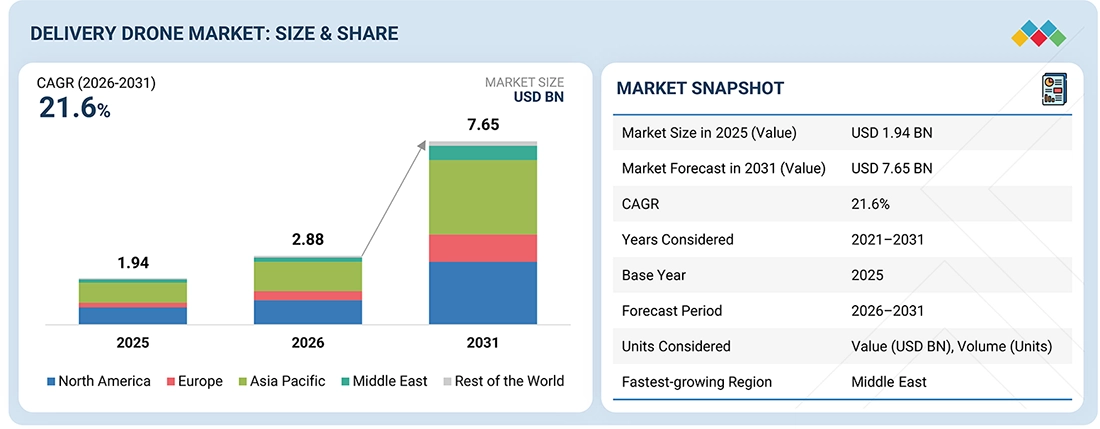
USD 7.65 BN
MARKET SIZE, 2031



Source: Secondary Research, Interviews with Experts, MarketsandMarkets Analysis
The delivery drone market is projected to grow from USD 2.88 billion in 2026 and reach USD 7.65 billion by 2031 at a CAGR of 21.6% during the forecast period, and in terms of volume, the market is projected to grow from 114,939 units in 2026 to 292,544 units by 2031. Companies are using drones for deliveries to speed up last-mile deliveries. Improved battery life and flight systems are making commercial drone operations more feasible. Drones are being used by companies to deliver medical supplies, food, consumer goods, and industrial materials to different locations.
By Region
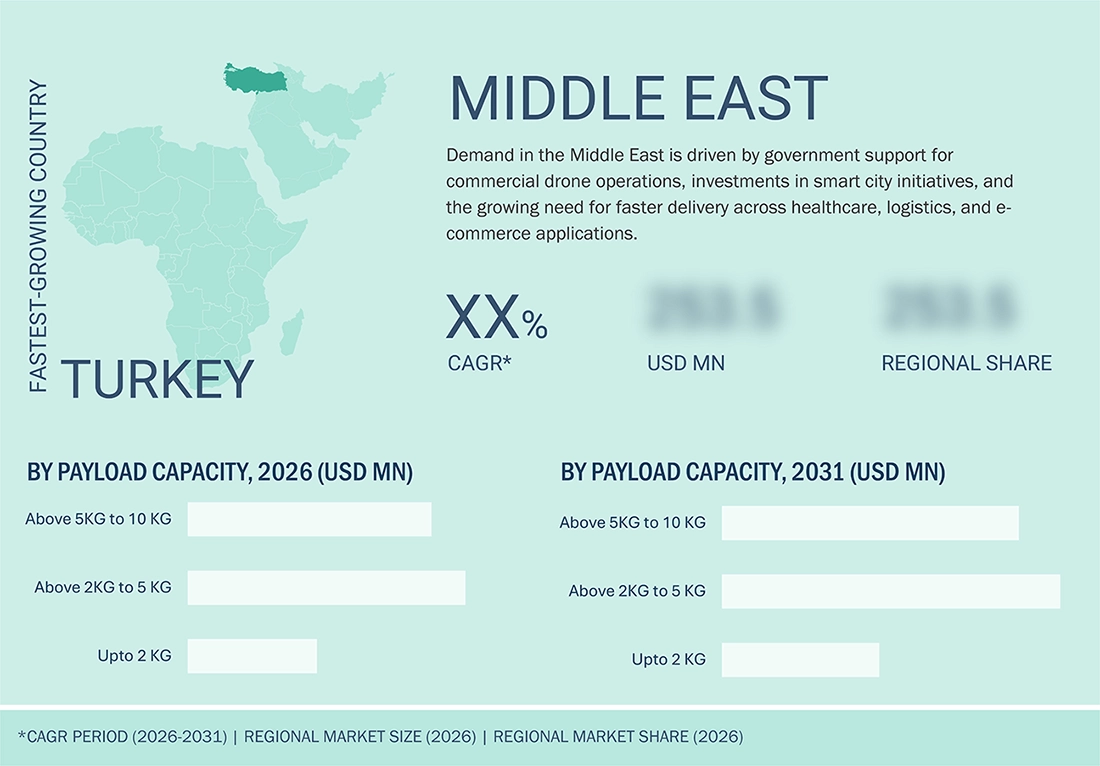
The Middle Eastern delivery drone market is projected to register the highest CAGR of 27.8% between 2026 and 2031.
By MTOW
The above 55-100 Kg segment is projected to register the highest CAGR of 24.9% between 2026 and 2031.
By Application
The logistics & courier segment is projected to be the most dominant in 2026.
Competitive Landscape
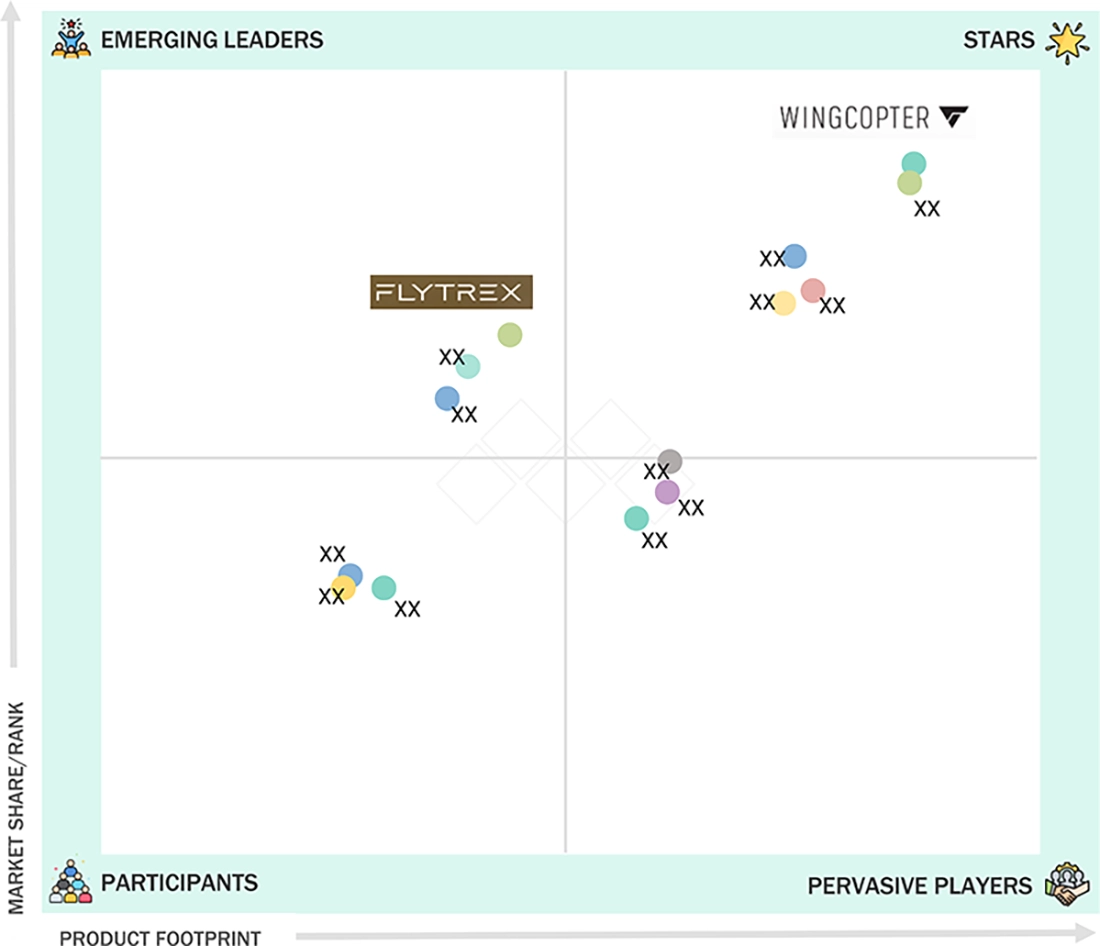
Wingcopter, PABLO AIR, and Blueflite were identified as some of the star players in the delivery drone market (global), given their strong market share and product footprint.
The delivery drone market is driven by the rising requirement for reliable and time-sensitive delivery services in urban and remote locations while keeping delivery operations efficient. As customers increasingly demand faster deliveries and road-based logistics often face challenges such as traffic congestion and limited accessibility, there is growing demand for drone-based solutions that can provide faster, more consistent deliveries. This is encouraging logistics providers, healthcare organizations, and retailers to invest in delivery drone systems that improve service reliability, reduce transit times, and support efficient last-mile operations.
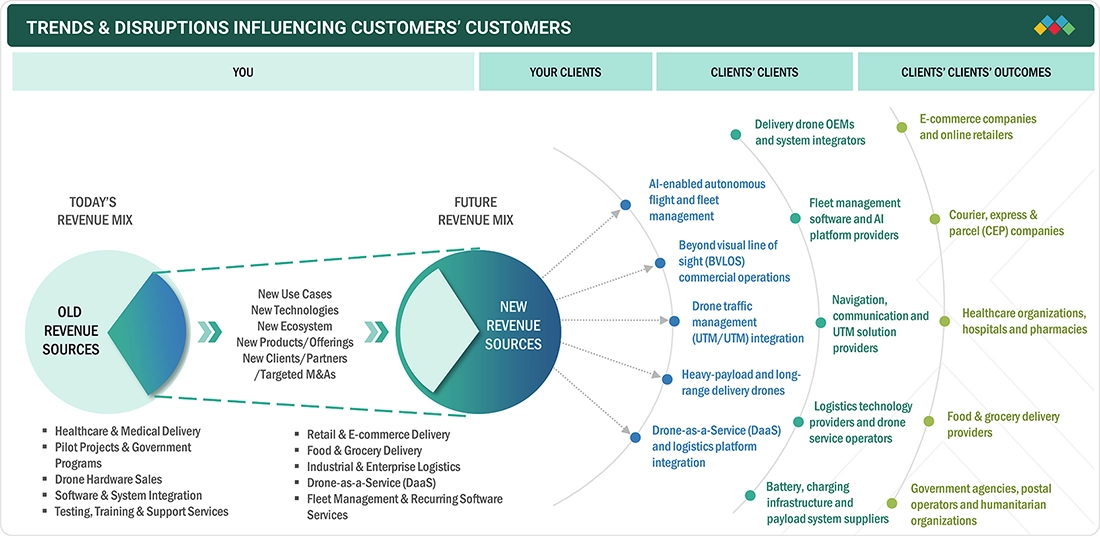
The impact on customers in the delivery drone market is mainly driven by the growing need for faster and more dependable delivery services across public sectors, logistics, retail, and healthcare. Organizations aim to improve service quality and reach locations that are difficult or costly to serve through old modes of transport. Drone delivery is becoming an important part of their logistics operations. This is creating demand for delivery drone solutions that are easy to deploy, scalable across different delivery volumes and capable of supporting routine commercial operations while maintaining consistent service levels.
Source: Secondary Research, Interviews with Experts, MarketsandMarkets Analysis



OPPORTUNITIES
Impact
Level

Source: Secondary Research, Interviews with Experts, MarketsandMarkets Analysis
The rapid growth of e-commerce, food delivery, healthcare logistics, and same-day delivery services is increasing the need for faster and more flexible last-mile transportation. Delivery drones can bypass road congestion, reduce delivery times, and reach remote or difficult-to-access locations more efficiently than conventional transport. This is encouraging logistics providers, retailers, and healthcare organizations to expand the use of drone delivery services.
Delivery drone performance is highly affected by weather conditions such as heavy rain, strong winds, fog, and extreme temperatures. These conditions can reduce flight stability, limit operational range, and increase safety risks, making it difficult to maintain reliable delivery schedules. As a result, operators often need backup ground transportation, increasing overall operating costs and limiting large-scale deployment.
Retailers and logistics companies are expanding investments in drone delivery to support same-day, scheduled, and on-demand deliveries. As commercial drone operations become more common and fulfillment networks continue to evolve, delivery drones are expected to play a larger role in transporting parcels directly to customers. This creates opportunities for drone manufacturers, software providers, and service operators to expand commercial deployments and long-term partnerships.
The expansion of drone delivery services depends on public confidence in safety, privacy, and community acceptance. Concerns related to low-altitude flights, onboard cameras, noise generated during take-off and landing, and operations over residential areas continue to influence public perception. Addressing these concerns through improved drone design, transparent operating practices, and regulatory compliance remains essential for broader commercial adoption.
| COMPANY | USE CASE DESCRIPTION | BENEFITS |
|---|---|---|
|
|
Wingcopter has deployed its Wingcopter 198 delivery drone for transporting medical supplies, laboratory samples, and parcels through partnerships with healthcare providers, logistics companies, and government agencies. The platform supports Beyond Visual Line of Sight (BVLOS) operations and serves both urban and remote locations. | Demonstrates the commercial viability of long-range drone delivery for healthcare and parcel logistics; supports faster deliveries, improved access to remote communities, and reduced dependence on conventional ground transportation |
|
|
PABLO AIR has conducted autonomous drone delivery demonstrations and pilot projects for parcel transportation using its drone platforms and fleet management software. The company integrates drone operations with unmanned traffic management (UTM) systems to support commercial logistics. | Highlights the integration of autonomous delivery drones with digital airspace management; supports safer drone operations, scalable logistics services, and the expansion of urban drone delivery networks. |
|
|
Blueflite develops autonomous cargo drones designed for transporting parcels, medical supplies, and industrial goods. Its logistics platform combines autonomous flight with fleet management software to support scheduled and on-demand delivery operations. | Demonstrates the use of autonomous drone systems for commercial logistics across healthcare and industrial applications; improves delivery efficiency while reducing transportation time for high-priority shipments |
Logos and trademarks shown above are the property of their respective owners. Their use here is for informational and illustrative purposes only.
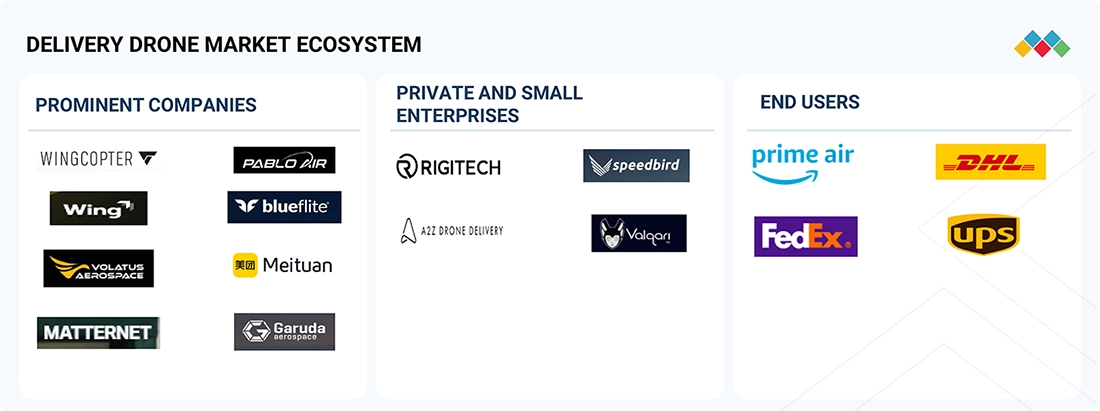
The delivery drone market includes a mix of drone manufacturers, autonomous flight technology providers, software developers, and delivery service operators such as Wingcopter, Zipline, Garuda Aerospace, Wing, Matternet, Manna Air Delivery, Blueflite, Flytrex, PABLO AIR, and Kite Aero. These companies develop delivery drone platforms, flight control software, fleet management systems, and supporting logistics solutions for commercial operations. Smaller companies such as RigiTech, Speedbird Aero, A2Z Drone Delivery, and Valqari contribute through specialized delivery platforms and niche logistics applications. The ecosystem is supported by end users, including hospitals and healthcare providers, restaurants and hotel chains, defense and military organizations, industrial and energy companies, and logistics and courier companies, whose adoption of drone-based delivery services is driving commercial deployments and expanding the use of delivery drones across multiple industries.
Logos and trademarks shown above are the property of their respective owners. Their use here is for informational and illustrative purposes only.
Source: Secondary Research, Interviews with Experts, MarketsandMarkets Analysis
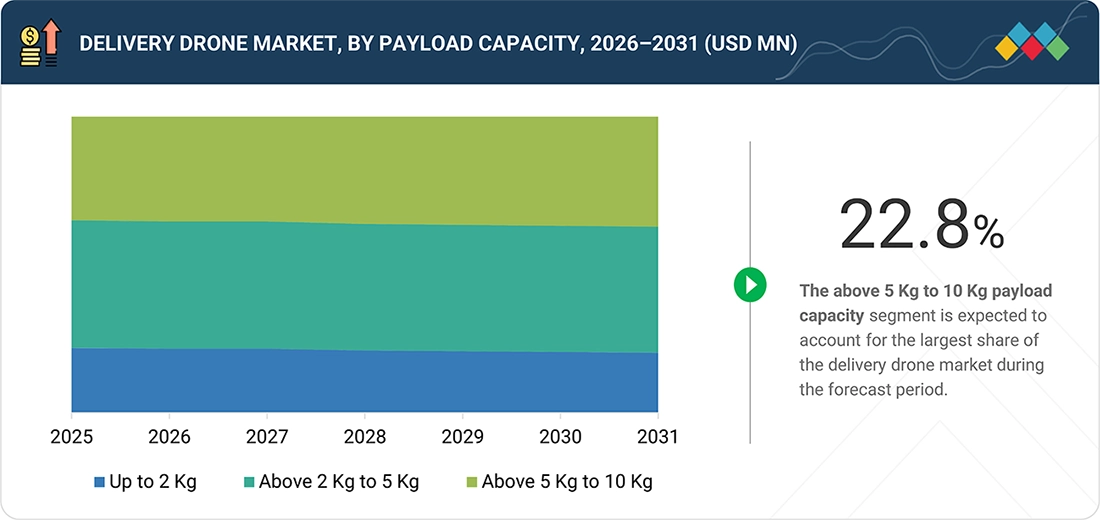
The above 2 Kg to 5 Kg segment holds the largest share of the delivery drone market because it is suitable for most commercial delivery applications. It can carry parcels, food, medicines, and other small packages while maintaining good flight efficiency. This payload range is widely used by commercial delivery drone operators, making it the largest segment in the market.
The above 20–50 KM segment holds the largest share of the delivery drone market because it meets the range requirements of most commercial delivery operations. It is suitable for parcel delivery, food delivery, and healthcare logistics across urban, suburban, and nearby regional locations. This balance between flight range, battery performance, and operating cost makes it the most widely adopted range segment.
The logistics & courier segment holds the largest share of the delivery drone market because logistics companies are increasingly using drones to improve last-mile delivery services. Drones help reduce delivery time, lower operating costs, and improve access to remote locations. The growing need for faster parcel movement is supporting the adoption of delivery drones in this segment.
The 40–80 KM/H segment holds the largest share of the delivery drone market because it provides a good balance between flight speed, battery consumption, and delivery efficiency. This speed range is suitable for most commercial delivery operations, including parcel, food, and healthcare deliveries. Many commercial delivery drones are designed to operate within this speed range, making it the most commonly used segment.
The up to 25 Kg segment holds the largest share of the delivery drone market because most commercial delivery drones fall within this weight category. These drones are easier to operate under existing regulations and are suitable for carrying small and medium-sized payloads. Their lower operating cost and wide use in commercial delivery services support their leading market position.
The 30–90 minutes segment holds the largest share of the delivery drone market because it provides sufficient flight time for most commercial delivery routes. This endurance allows drones to complete deliveries efficiently while carrying typical payloads. Most commercial delivery drone platforms are designed to operate within this flight duration, making it the largest segment.
The airframe & structural assembly segment holds the largest share of the delivery drone market because it forms the main structure of every delivery drone. The airframe supports the payload, battery, propulsion system, and other critical components. Demand for this segment increases directly with the production of new delivery drones, making it the largest component segment.
The rotary wing segment holds the largest share of the delivery drone market because it can take off and land vertically without requiring a runway. These drones are suitable for urban deliveries, short-distance logistics, and healthcare applications where landing space is limited. Their wide use in commercial last-mile delivery operations supports their leading market share.
The battery electric segment holds the largest share of the delivery drone market because most commercial delivery drones use electric propulsion systems. Battery-powered drones produce lower operating costs, require less maintenance, and generate no direct emissions during flight. Improvements in battery technology are further supporting the adoption of battery-electric delivery drones.
The Middle East delivery drone market is expected to register the fastest growth during the forecast period. The market is supported by government initiatives to expand commercial drone operations, increasing investments in smart city and autonomous transportation projects, and the growing demand for faster delivery services. Countries such as the UAE and Saudi Arabia are strengthening drone regulations and investing in digital infrastructure to support commercial drone deployment. The increasing use of delivery drones in the healthcare, logistics, and e-commerce industries is expected to further drive market growth across the region.
The delivery drone market matrix includes a key player, Wingcopter (Star), backed by its commercial BVLOS operations, long-range delivery drone technology, and healthcare and logistics projects. It has expanded through partnerships and deployments in a number of countries. Flytrex (Emerging Leader) is gaining traction as FAA-approved delivery services are on the rise and commercial operations are expanding in the US. Flytrex is making its mark with scalable food and parcel delivery services.
Source: Secondary Research, Interviews with Experts, MarketsandMarkets Analysis
| REPORT METRIC | DETAILS |
|---|---|
| Market Size in 2025 | USD 1.94 Billion |
| Market Forecast in 2031 | USD 7.65 Billion |
| CAGR | 21.6% |
| Years Considered | 2021–2031 |
| Base Year | 2025 |
| Forecast Period | 2026-2031 |
| Units Considered | Value (USD Million/Billion), Volume (Units) |
| Report Coverage | Revenue forecast, company ranking, competitive landscape, growth factors, and trends |
| Segments Covered |
|
| Regions Covered | North America, Asia Pacific, Europe, Middle East, Rest of the World |
We have successfully delivered the following deep-dive customizations:
| CLIENT REQUEST | CUSTOMIZATION DELIVERED | VALUE ADDS |
|---|---|---|
| Leading Manufacturer | Additional segment breakdown for countries | Additional country-level market sizing tables for segments/sub-segments covered at the regional/global level to gain an understanding of market potential by each country |
| Emerging Leader | Additional company profiles | Competitive information on targeted players to gain granular insights into direct competition |
| Regional Market Leader | Additional country market estimates | Additional country-level deep dive for a more targeted understanding of the total addressable market |
 Exclusive indicates content/data unique to MarketsandMarkets and not available with any competitors.
4
MARKET OVERVIEW
Explains the evolving landscape through demand-side drivers, supply-side constraints, and opportunity hotspots.4.3
UNMET NEEDS AND WHITE SPACES
4.4
INTERCONNECTED MARKETS AND CROSS-SECTOR OPPORTUNITIES
4.5
STRATEGIC MOVES BY TIER 1/2/3 PLAYERS
5
INDUSTRY TRENDS
Outlines emerging trends, technology impact, and regulatory signals affecting growth trajectory and stakeholder decisions.5.1
MACROECONOMIC OUTLOOK
5.1.2
GDP TRENDS AND FORECAST
5.1.3
TRENDS IN GLOBAL DRONE INDUSTRY
5.1.4
TRENDS IN GLOBAL DELIVERY DRONE INDUSTRY
5.4
INVESTMENT & FUNDING SCENARIO
5.5.1
INDICATIVE PRICING ANALYSIS, BY SEGMENT
5.5.2
INDICATIVE PRICING ANALYSIS, BY KEY PLAYERS
5.7
KEY CONFERENCES AND EVENTS, 2026-2027
5.8
TRENDS/DISRUPTIONS IMPACTING CUSTOMER BUSINESS
5.11
IMPACT OF 2025 US TARIFFS ON DELIVERY DRONE MARKET
5.11.3
PRICE IMPACT ANALYSIS
5.11.4
IMPACT ON COUNTRIES/REGIONS
5.11.5
IMPACT ON DIFFERENT END USERS
6
TECHNOLOGICAL ADVANCEMENTS, PATENTS, INNOVATIONS, AND FUTURE APPLICATIONS
6.1
KEY EMERGING TECHNOLOGIES
6.2
COMPLEMENTARY TECHNOLOGIES
6.3
ADJACENT TECHNOLOGIES
6.4
TECHNOLOGY/PRODUCT ROADMAP
7
SUSTAINABILITY AND REGULATORY LANDSCAPE
7.1
REGIONAL REGULATIONS AND COMPLIANCE
7.1.1
REGULATORY BODIES, GOVERNMENT AGENCIES, AND OTHER ORGANIZATIONS
7.2
SUSTAINABILITY INITIATIVES
7.2.1
CARBON IMPACT AND ECO-APPLICATIONS OF DELIVERY DRONES
7.3
SUSTAINABILITY IMPACT AND REGULATORY POLICY INITIATIVES
7.4
CERTIFICATIONS, LABELING, AND ECO-STANDARDS
8
CUSTOMER LANDSCAPE & BUYER BEHAVIOR
8.1
DECISION-MAKING PROCESS
8.2
BUYER STAKEHOLDERS AND BUYING EVALUATION CRITERIA
8.3
ADOPTION BARRIERS & INTERNAL CHALLENGES
8.4
UNMET NEEDS FROM VARIOUS END USES
9
DELIVERY DRONE MARKET, BY COMPONENT (MARKET SIZE & FORECAST TO 2031 - USD MILLION)
9.2
AIRFRAME & STRUCTURAL ASSEMBLY
9.3
PROPULSION SYSTEM, MOTORS & PROPELLERS/ROTORS
9.4
BATTERY & POWER MANAGEMENT SYSTEMS
9.5
AVIONICS, FLIGHT CONTROL & NAVIGATION SYSTEMS
9.6
COMMUNICATION, CONNECTIVITY & TRACKING SYSTEMS
9.7
PAYLOAD BAY, CARGO BOX & RELEASE / HANDLING SYSTEMS
9.8
EMBEDDED SOFTWARE, AUTONOMY & FLEET MANAGEMENT SYSTEMS
10
DELIVERY DRONE MARKET, BY PAYLOAD CAPACITY (MARKET SIZE & FORECAST TO 2031 - USD MILLION)
11
DELIVERY DRONE MARKET, BY CRUISE SPEED (MARKET SIZE & FORECAST TO 2031-USD MILLION)
11.4
ABOVE 80 TO 120 KM/H
12
DELIVERY DRONE MARKET, BY RANGE (MARKET SIZE & FORECAST TO 2031-USD MILLION)
13
DELIVERY DRONE MARKET, BY MTOW (MARKET SIZE & FORECAST TO 2031-USD MILLION)
14
DELIVERY DRONE MARKET, BY ENDURANCE (MARKET SIZE & FORECAST TO 2031-USD MILLION)
14.4
ABOVE 90-180 MINUTES
15
DELIVERY DRONE MARKET, BY PLATFORM CONFIGURATION (MARKET SIZE & FORECAST TO 2031-USD MILLION)
16
DELIVERY DRONE MARKET, BY PROPULSION TYPE (MARKET SIZE & FORECAST TO 2031-USD MILLION)
17
DELIVERY DRONE MARKET, BY APPLICATION (MARKET SIZE & FORECAST TO 2031-USD MILLION)
17.6
GOVERNMENT & PUBLIC SAFETY
18
DELIVERY DRONE MARKET, BY REGION (MARKET SIZE & FORECAST TO 2031-USD MILLION)
18.4.6
REST OF ASIA PACIFIC
19.2
KEY PLAYER COMPETITIVE STRATEGIES/RIGHT TO WIN
19.3
REVENUE ANALYSIS - TOP 5 PLAYERS
19.4
MARKET SHARE ANALYSIS OF KEY PLAYERS,
19.6
COMPANY EVALUATION MATRIX: KEY PLAYERS,
19.6.5
COMPANY FOOTPRINT, KEY PLAYERS,
19.6.5.1
COMPANY FOOTPRINT
19.6.5.2
REGION FOOTPRINT
19.6.5.5
ENDURANCE FOOTPRINT
19.7
COMPANY EVALUATION MATRIX: STARTUPS/SMES,
19.7.1
PROGRESSIVE COMPANIES
19.7.2
RESPONSIVE COMPANIES
19.7.5
COMPETITIVE BENCHMARKING: STARTUPS/SMES,
19.7.5.1
LIST OF KEY STARTUPS/SMES
19.7.5.2
COMPETITIVE BENCHMARKING OF KEY STARTUPS/SMES
19.8
COMPETITIVE SCENARIO
19.8.3
OTHER DEVELOPMENTS
20.1.4
GARUDA AEROSPACE LTD.
20.1.6
WING AVIATION LLC.
20.1.10
MANNA AIR DELIVERY
20.1.11
VOLATUS AEROSPACE INC.
20.2
OTHER PLAYERS (STARTUPS)
20.2.1
RIGI TECHNOLOGIES SA
20.2.3
A2Z DRONE DELIVERY
20.2.9
UBIFLY TECHNOLOGIES
21.1.1.1
KEY DATA FROM SECONDARY SOURCES
21.1.2.1
KEY DATA FROM PRIMARY SOURCES
21.1.2.2
KEY PRIMARY PARTICIPANTS
21.1.2.3
BREAKDOWN OF PRIMARIES
21.1.2.4
KEY INDUSTRY INSIGHTS
21.2
MARKET SIZE ESTIMATION
21.2.1
BOTTOM-UP APPROACH
21.2.3
BASE NUMBER CALCULATION
21.3
MARKET FORECAST APPROACH
21.4
RESEARCH ASSUMPTIONS
21.5
RESEARCH LIMITATIONS AND RISK ASSESSMENT
22.2
KNOWLEDGESTORE: MARKETSANDMARKETS’ SUBSCRIPTION PORTAL
22.3
CUSTOMIZATION OPTIONS
The study involved four major activities in estimating the current size of the delivery drone market. Exhaustive secondary research was done to collect information on the market, its adjacent markets, and its parent market. The next step was to validate these findings, assumptions, and sizing with industry experts across the value chain through primary research. Demand-side analysis was conducted to estimate the overall market size. After that, market breakdown and data triangulation procedures were employed to estimate the sizes of various segments and subsegments within the market.
Secondary ResearchDuring the secondary research process, various sources were consulted to identify and collect information for this study. The secondary sources included government sources, such as SIPRI; corporate filings, including annual reports, press releases, and investor presentations from companies; white papers, journals, and certified publications; and articles from recognized authors, directories, and databases.
Primary ResearchExtensive primary research was conducted after acquiring information regarding the delivery drone market scenario through secondary research. Several primary interviews were conducted with market experts from the demand and supply sides across major countries of North America, Europe, Asia Pacific, and the Rest of the World (RoW). Primary data was collected through questionnaires, emails, and telephonic interviews.

To know about the assumptions considered for the study, download the pdf brochure
The top-down and bottom-up approaches were used to estimate and validate the size of the delivery drone market. The research methodology used to estimate the size of the market included the following details:

After determining the overall market size, the total market was divided into several segments and subsegments. The data triangulation and market breakdown procedures explained below were implemented, wherever applicable, to complete the overall market engineering process and arrive at the estimated market numbers for the market segments and subsegments. The data was triangulated by studying various factors and trends from the demand and supply sides. Additionally, the market size was validated using top-down and bottom-up approaches.
The delivery drone market encompasses unmanned aerial vehicles and associated delivery-specific systems used to transport lightweight goods, parcels, medical supplies, food, retail products, industrial samples, agricultural inputs, and other small commercial payloads from one point to another. The market is limited to delivery drones with cargo/payload capacity of up to 10 kg and includes drone platforms, onboard cargo-carrying systems, navigation and communication systems, ground control infrastructure, fleet management software, docking/charging systems, and integration services required for safe and reliable autonomous or remotely supervised delivery operations.
These systems are installed and operated across healthcare logistics, retail and e-commerce delivery, food and grocery delivery, postal and courier services, industrial site logistics, agriculture support logistics, campus delivery, remote-area supply, and emergency logistics. The market includes both new drone deployment and replacement, upgrade, modernization, and fleet expansion of delivery drone systems.
MarketsandMarkets offers the following customizations for this market report:
Product Analysis

MarketsandMarkets has been crucial to our research findings and so far, they are the best source we've been able to locate. I'm sure nobody has the predictions nailed, but they seem to know it better than most.