Просмотр новости
Найдите то, что Вас интересует
 Спутники
 РН
РН SpaceX
 Роскосмос
 NASA
NASA
СпутникиРНSpaceXРоскосмосNASA

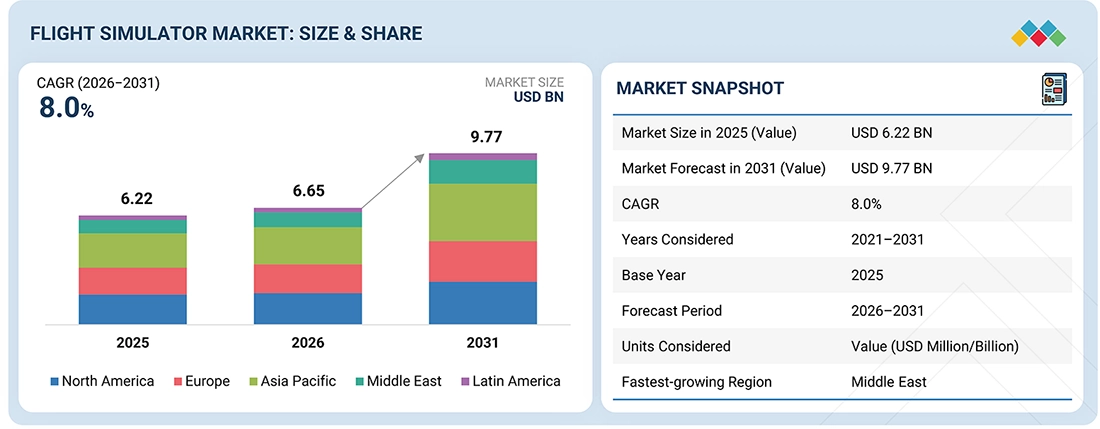
USD 9.77 BN
MARKET SIZE, 2031



Source: Secondary Research, Interviews with Experts, MarketsandMarkets Analysis
The flight simulator market is projected to grow from USD 6.65 billion in 2026 to USD 9.77 billion by 2031 at a CAGR of 8.0%. The market is mainly driven by rising pilot training needs, growth in air travel and aircraft fleets, strict safety and certification requirements and the need to reduce training cost, aircraft downtime and real-flight risk. It is also supported by demand for mission training, UAV training, and newer simulator technologies such as VR/MR and digital aircraft models.
By Region
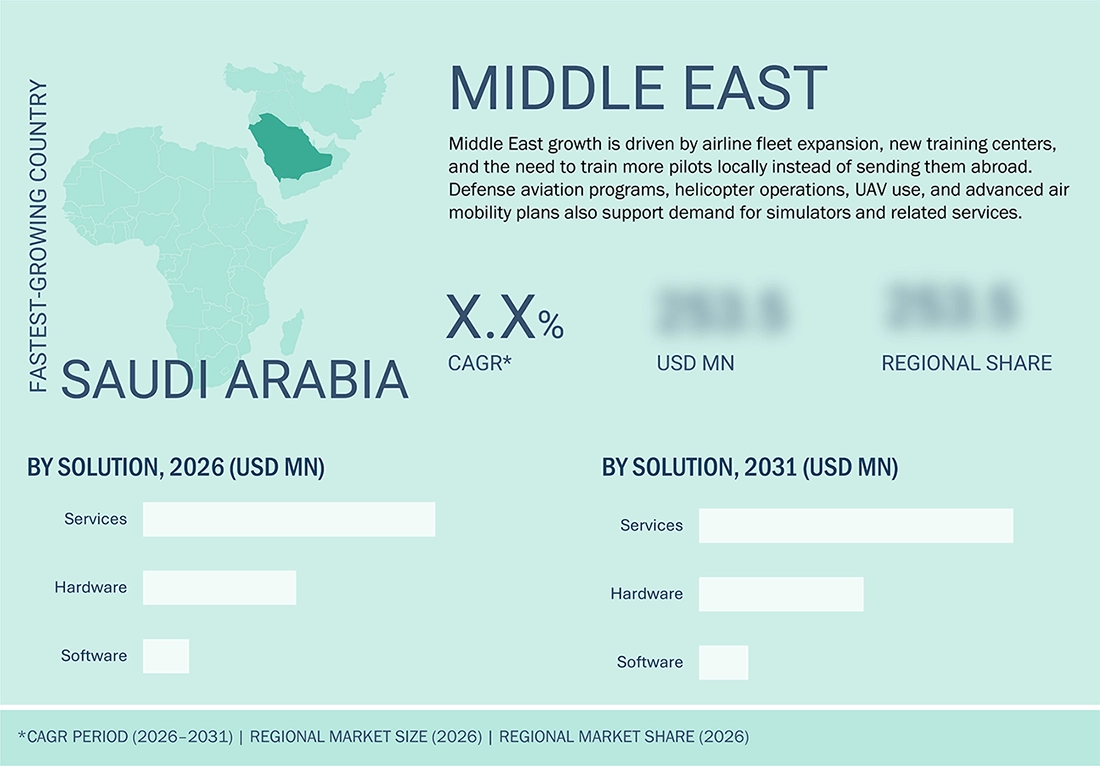
The Middle East is projected to exhibit the highest CAGR during the forecast period.
By Solution
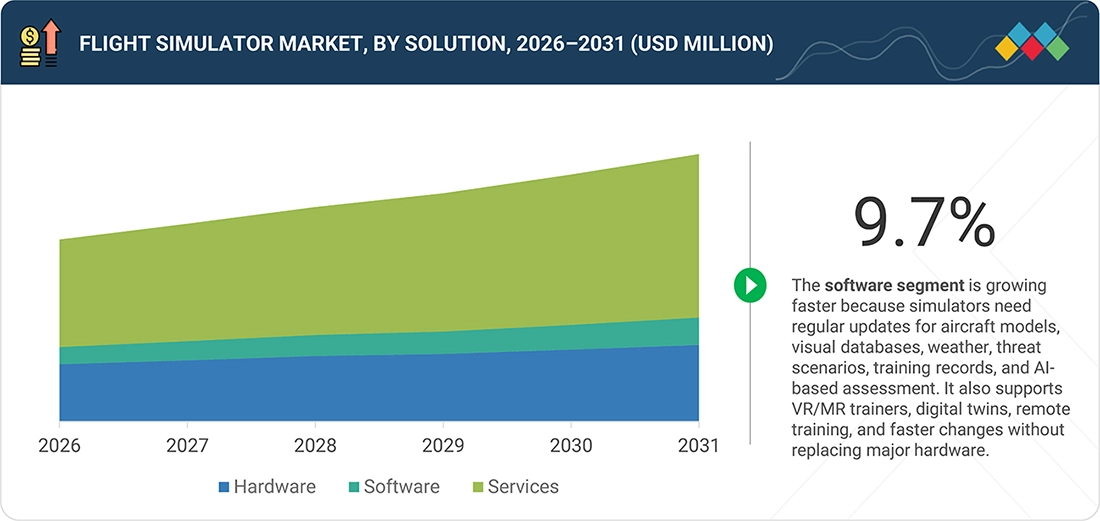
By solution, the software segment is projected to register the highest CAGR of 9.7% during the forecast period.
By Technology
By technology, the full motion system is estimated to account for the largest market share during the forecast period.
By Type
By type, the full flight simulators segment is estimated to account for 64.2% market share in 2026.
Competitive Landscape - Key Companies
Major market players have adopted both organic and inorganic strategies, including partnerships and investments. CAE Inc (Canada), Flightsafety International (US), and Thales (France) have entered into a number of agreements and partnerships to cater to the growing demand for flight simulators across innovative applications.
Competitive Landscape - Startups/SMEs
Reiser Simulation, Precision Flight Controls, and Flightdeck Solutions have distinguished themselves among startups and SMEs by securing strong footholds in specialized niche areas, underscoring their potential as emerging market leaders.
The flight simulator market is driven by the need to train pilots and crews safely without using live aircraft for every training hour. Airlines, defense forces, UAV operators and new air mobility companies use simulators to lower training cost, meet safety rules and practice difficult situations. Demand is also supported by aircraft fleet growth, pilot shortages, and the need for regular refresher training. Simulators are increasingly used for mission training, emergency response, instrument flying, and complex aircraft procedures that are risky or costly to repeat in real aircraft.
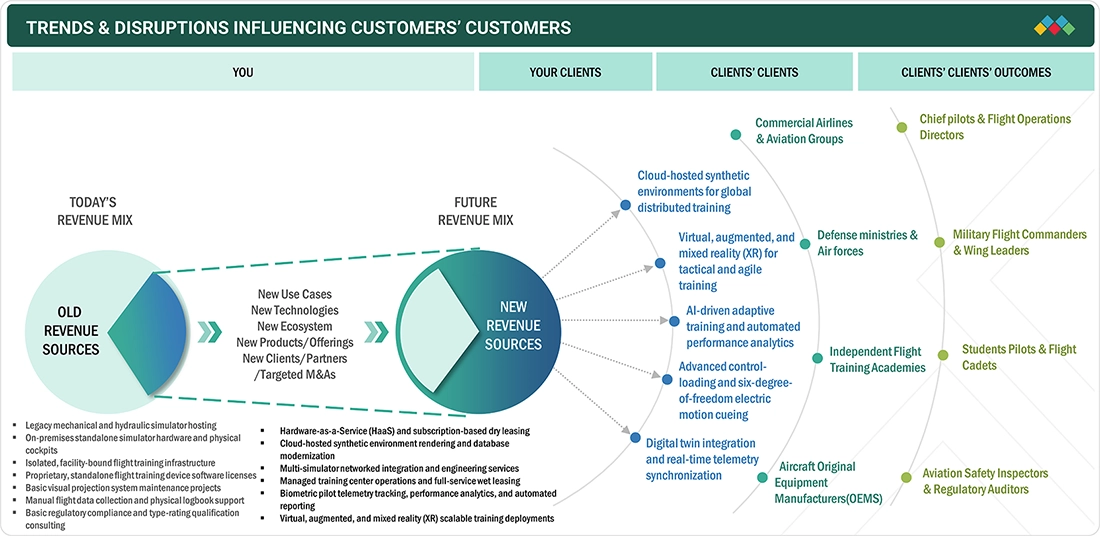
The flight simulator market is moving from mainly standalone simulator hardware, physical cockpits, fixed training centers, basic projection systems, separate software licenses, and manual training records to more connected and service-based training models. Future demand is being shaped by hardware-as-a-service, subscription-based leasing, cloud-hosted synthetic training environments, updated aircraft and airport databases, multi-simulator networking, managed training center operations, biometric pilot tracking, automated performance reporting, and VR/MR-based training. These changes affect commercial airlines, defense forces, flight training academies and aircraft OEMs because they need safer, more flexible and more cost-controlled ways to train pilots, crews, cadets, military operators and safety inspectors. The main technology shift is toward cloud training, AI-based adaptive learning, digital twin models, real-time telemetry, better motion cueing and scalable immersive training systems.
Source: Secondary Research, Interviews with Experts, MarketsandMarkets Analysis



OPPORTUNITIES
Impact
Level

Source: Secondary Research, Interviews with Experts, MarketsandMarkets Analysis
Mandatory pilot training hours drive demand for flight simulators because pilots must complete regular training, checks, and refresher sessions to remain qualified. Simulators help airlines, training schools and defense operators meet these requirements without using real aircraft for every training activity, which reduces cost, risk and aircraft downtime.
High upfront purchase capital limits the adoption of flight simulators because full flight simulators, motion systems, cockpit replicas, visual systems, and integration work require large initial spending. This can delay buying decisions for smaller airlines, training schools, and operators with limited budgets, even when simulator-based training is needed.
Advanced Air Mobility integration creates an opportunity for the flight simulator market because air taxis, eVTOL aircraft, and new urban air services will need dedicated pilot and operator training. Simulators can help train crews on new flight controls, routes, emergency procedures, and mixed airspace operations before these aircraft are used at scale.
OEM proprietary data access is a challenge because accurate simulators need aircraft data, flight models, cockpit logic, avionics behavior, and system response details from aircraft manufacturers. Limited or restricted access to this data can slow simulator development, increase validation work and make it harder to build certified training devices for commercial, military, UAV and advanced air mobility platforms.
| COMPANY | USE CASE DESCRIPTION | BENEFITS |
|---|---|---|
|
|
Airbus is supporting commercial aircraft pilot training through a training center equipped with full flight simulators, classrooms, and briefing rooms for A320 and A350 pilots. | Supports type rating and recurrent training | Builds local pilot training capacity | Reduces dependence on live aircraft and overseas training |
|
|
Boeing is using live virtual training by linking a ground-based simulator with an in-flight T-7A Red Hawk aircraft to support military pilot training and mission rehearsal. | Supports fighter pilot training | Allows safe practice of tactical scenarios | Connects live aircraft with simulator-based training |
|
|
Avion builds and operates full flight simulators for Airbus A320 family and Boeing 737 NG and MAX aircraft, and supports airline and training center pilot training through simulator devices and training centers. | Supports airline pilot training | Helps operators add simulator capacity | Reduces reliance on live aircraft for training |
Logos and trademarks shown above are the property of their respective owners. Their use here is for informational and illustrative purposes only.
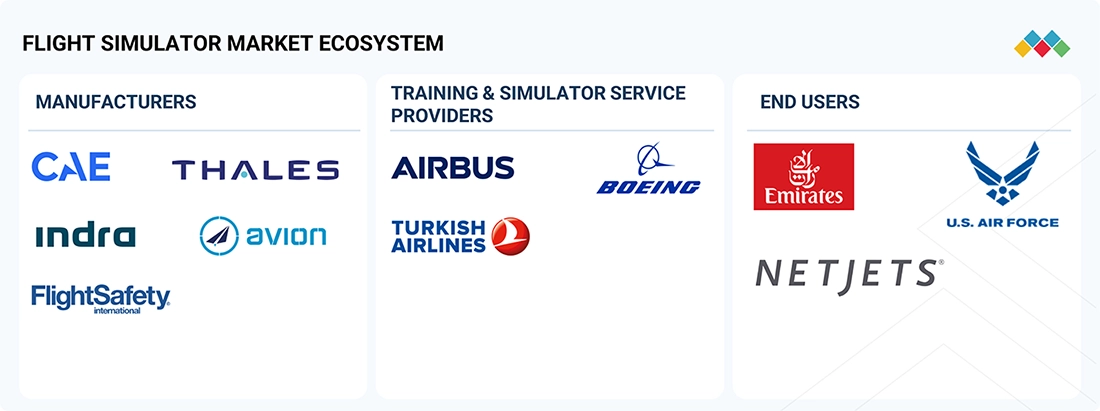
The flight simulator market ecosystem includes manufacturers, training and simulator service providers, and end users. Manufacturers such as CAE, Thales, FlightSafety, Indra, and Avion supply flight simulation hardware, software, cockpit trainers, full flight simulators, flight training devices, visual systems, motion systems, instructor stations, and aircraft system models. Training and simulator service providers such as Airbus, Boeing, and Turkish Airlines use simulator infrastructure to provide pilot training, type rating, recurrent training, procedure training, and aircraft-specific training support. End users include airlines, defense forces, and business aviation operators such as Emirates, the US Air Force, and NetJets. These users rely on simulators for pilot training, mission training, emergency procedure training, instrument flight training, and aircraft familiarization. The ecosystem also includes software providers, visual database suppliers, maintenance teams, certification support providers, and system integrators that help keep simulators updated, qualified, and ready for training use.
Logos and trademarks shown above are the property of their respective owners. Their use here is for informational and illustrative purposes only.
Source: Secondary Research, Interviews with Experts, MarketsandMarkets Analysis
The services are expected to dominate because simulators need regular maintenance, software and database updates, certification support, parts replacement, and operator training throughout their lifecycle. Airlines, training centers, and defense users also rely on support contracts to keep simulators available, compliant, and ready for daily training.
The part-task trainers are expected to grow faster because they are lower cost, easier to install, and useful for focused training on cockpit procedures, avionics, emergency tasks, UAV operations, and specific aircraft systems. Airlines, training schools, and defense users can use them to train more people without using full simulators for every lesson.
The full motion systems are expected to dominate because they are widely used in high-value full flight simulators for type rating, recurrent training, emergency practice, and military mission training. Airlines, training centers, and defense users need motion-based training to better reflect aircraft handling, crew response, and abnormal conditions.
The advanced air mobility is expected to grow faster because eVTOL, air taxi, air shuttle, and air ambulance programs need new pilot training methods before large-scale operations. Since these aircraft use different cockpit layouts, flight controls, and operating rules, operators will need simulators for procedure training, emergency practice, and certification support.
The pilot training is expected to dominate because airlines, flight schools, business aviation operators, and defense users need regular simulator-based training for type rating, IFR, cockpit procedures, emergency handling, and recurrent checks. These needs occur throughout a pilot’s career, making demand more continuous than one-time or limited mission training.
The Middle East is projected to grow faster because airlines in the region are expanding fleets, adding routes, and building local pilot training capacity. New training centers, defense aviation programs, helicopter operations, UAV use, and future air mobility plans are also increasing demand for simulators and support services.
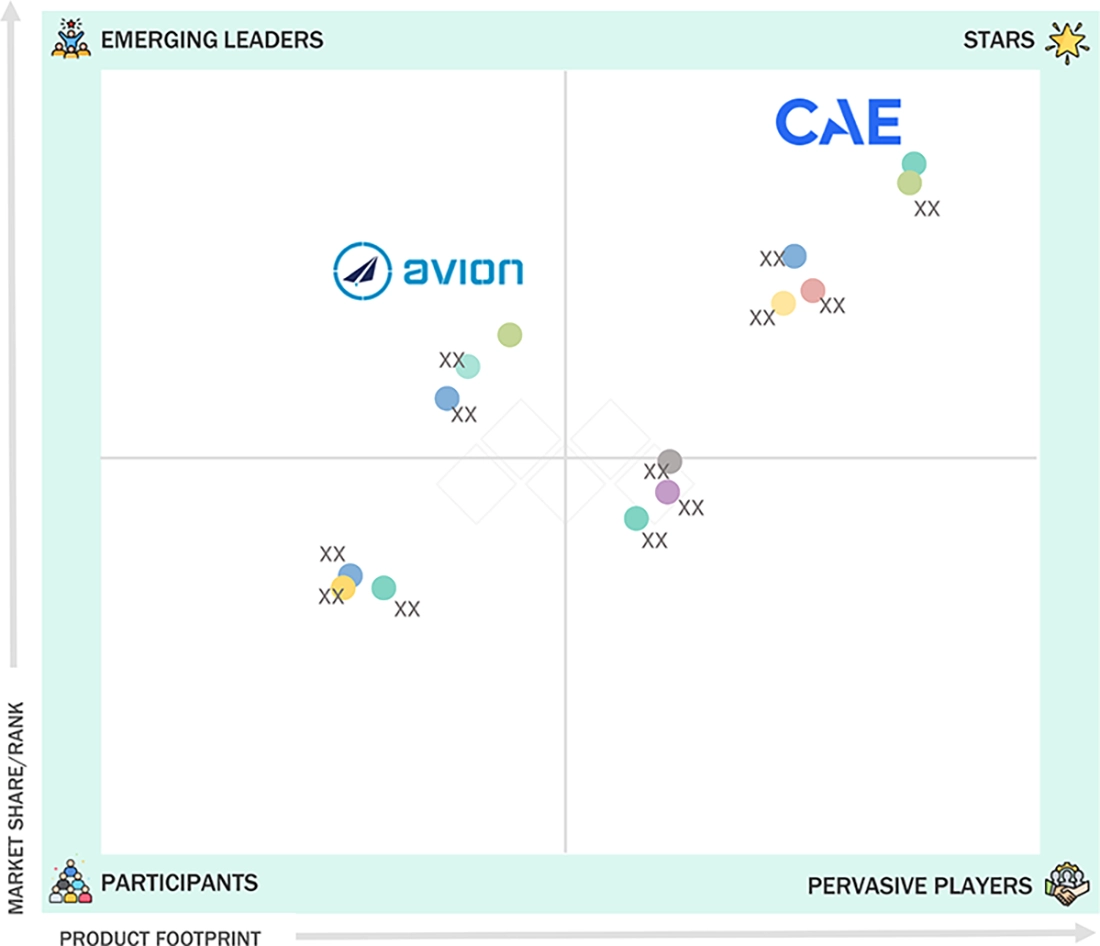
In the flight simulator market matrix, CAE (Star) is placed strongly because it has a wide simulator portfolio and a large role across civil and defense training. Its position is supported by full flight simulators, flight training devices, cockpit trainers, visual systems, motion systems, software, training services, maintenance, and simulator updates. CAE also serves airlines, business aviation users, and defense customers, which gives it both a strong product footprint and a solid market position. Avion (Emerging Leader) is placed well because it provides flight simulators and training devices, with a focused position in pilot training and aircraft-specific simulation. However, its overall scale, installed base, and service network appear smaller than CAE, so it fits better as an emerging leader rather than a star. Overall, companies with broad simulator coverage, stronger customer reach, and wider civil and defense training presence are placed higher in the matrix, while companies with narrower product lines or smaller market presence are placed lower.
Source: Secondary Research, Interviews with Experts, MarketsandMarkets Analysis
| REPORT METRIC | DETAILS |
|---|---|
| Market Size in 2025 | USD 6.22 Billion |
| Market Size in 2026 | USD 6.65 Billion |
| Market Forecast in 2031 | USD 9.77 Billion |
| CAGR | 8.0% |
| Years Considered | 2021–2031 |
| Base Year | 2025 |
| Forecast Period | 2026–2031 |
| Units Considered | Value (USD Billion/Million) |
| Report Coverage | Revenue Forecast, Company Ranking, Competitive Landscape, Growth Factors, and Trends |
| Segments Covered |
|
| Regions Covered | North America, Europe, Asia Pacific, Middle East, Latin America, Africa |
We have successfully delivered the following deep-dive customizations:
| CLIENT REQUEST | CUSTOMIZATION DELIVERED | VALUE ADDS |
|---|---|---|
| Leading Manufacturer | Additional segment breakdown for countries | Additional country-level market sizing tables for segments/subsegments covered at the regional/global level to gain an understanding of market potential by each country |
| Emerging Leader | Additional company profiles | Competitive information on targeted players to gain granular insights into direct competition |
| Regional Market Leader | Additional country market estimates | Additional country-level deep dive for a more targeted understanding of the total addressable market |
 Exclusive indicates content/data unique to MarketsandMarkets and not available with any competitors.
4
MARKET OVERVIEW
Highlights the market structure, growth drivers, restraints, and near-term inflection points influencing performance.4.2.1.1
MANDATORY PILOT TRAINING HOURS
4.2.1.2
INCREASE IN AIR TRANSPORT PASSENGER TRAFFIC
4.2.2.1
HIGH UPFRONT PURCHASE CAPITAL
4.2.2.2
REGULATORY CERTIFICATION BACKLOGS
4.2.3.1
REGULATORY CERTIFICATION BACKLOGS
4.2.3.2
LIVE FLIGHT OPERATING EXPENSES
4.2.4.1
OEM PROPRIETARY DATA ACCESS
4.2.4.2
NETWORK CYBERSECURITY RISKS
4.3
UNMET NEEDS & WHITE SPACES
4.4
INTERCONNECTED MARKETS AND CROSS-SECTOR OPPORTUNITIES
4.5
STRATEGIC MOVES BY TIER-1/2/3 PLAYERS
5
INDUSTRY TRENDS
Presents a concise view of industry direction, strategic priorities, and key indicators influencing market momentum.5.3.1
AVERAGE SELLING PRICE OF FLIGHT SIMULATOR, BY KEY PLAYERS,
5.3.2
AVERAGE SELLING PRICE TREND, BY REGION (2019-2025)
5.4
IMPACT OF 2025 US TARIFFS – FLIGHT SIMULATOR MARKET
5.4.3
PRICE IMPACT ANALYSIS
5.4.4
IMPACT ON COUNTRY/REGION
5.4.5
IMPACT ON END-USE INDUSTRIES
5.5.1
IMPORT SCENARIO (HS CODE: 8805)
5.5.2
EXPORT SCENARIO (HS CODE: 8805)
5.7
KEY CONFERENCES & EVENTS 2026-2027
5.8
INVESTMENT AND FUNDING SCENARIO
5.9
TRENDS/DISRUPTION IMPACTING CUSTOMERS’ BUSINESS
5.11
TOTAL COST OF OWNERSHIP (TCO)
5.12
MACROECONOMIC OUTLOOK
5.12.2
GDP TRENDS AND FORECAST
5.12.3
TRENDS IN GLOBAL FLIGHT SIMULATOR INDUSTRY
5.12.4
TRENDS IN GLOBAL TRAINING INDUSTRY
6
TECHNOLOGICAL ADVANCEMENTS, AI-DRIVEN IMPACT, PATENTS, INNOVATIONS, AND FUTURE APPLICATIONS
6.1
KEY EMERGING TECHNOLOGIES
6.1.1
ADVANCED VISUAL SYSTEMS, IMAGE GENERATORS, AND TERRAIN DATABASES
6.1.2
AI/ML-BASED ASSESSMENT, DEBRIEFING, AND ADAPTIVE SCENARIO GENERATION
6.1.3
HIGH-FIDELITY FLIGHT DYNAMICS, CONTROL LOADING, AND MOTION CUEING
6.2
COMPLEMENTARY TECHNOLOGIES
6.2.1
ADVANCED VISUAL & IMAGE GENERATION SYSTEMS
6.2.2
MOTION CUEING & HAPTIC FEEDBACK TECHNOLOGIES
6.3
ADJACENT TECHNOLOGIES
6.3.1
LVC AND DISTRIBUTED MISSION TRAINING NETWORKS
6.3.2
ATC, AIRSPACE, AND AIRPORT ENVIRONMENT SIMULATION
6.7
IMPACT OF AI/GEN AI ON FLIGHT SIMULATOR MARKET
6.7.1
TOP USE CASES AND MARKET POTENTIAL
6.7.2
BEST PRACTICES FOLLOWED BY MANUFACTURERS
6.7.3
CASE STUDIES OF AI IMPLEMENTATION IN THE FLIGHT SIMULATOR MARKET
6.7.4
INTERCONNECTED ADJACENT ECOSYSTEM AND IMPACT ON MARKET PLAYERS
6.7.5
CLIENTS’ READINESS TO ADOPT AI-INTEGRATED FLIGHT SIMULATOR
6.8
SUCCESS STORIES AND REAL-WORLD APPLICATIONS
7
REGULATORY LANDSCAPE AND SUSTAINABILITY INITIATIVES
7.1
REGIONAL REGULATIONS AND COMPLIANCE
7.1.1
REGULATORY BODIES, GOVERNMENT AGENCIES, AND OTHER ORGANIZATIONS
7.2
SUSTAINABILITY INITIATIVES
7.3
IMPACT OF REGULATORY POLICIES ON SUSTAINABILITY INITIATIVES
8
CUSTOMER LANDSCAPE & BUYER BEHAVIOR
8.1
DECISION-MAKING PROCESS
8.2
KEY STAKEHOLDERS IN BUYING PROCESS AND THEIR EVALUATION CRITERIA
8.2.1
KEY STAKEHOLDERS IN BUYING PROCESS
8.3
ADOPTION BARRIERS & INTERNAL CHALLENGES
8.4
UNMET NEEDS FROM VARIOUS END-USE INDUSTRIES
9
FLIGHT SIMULATOR MARKET, BY SOLUTION
Market Size, Volume & Forecast – USD Million9.2.1
COCKPIT AND CABIN REPLICAS
9.2.2
VISUAL DISPLAY SYSTEMS AND PROJECTORS
9.2.3
CONTROL LOADING AND FLIGHT CONTROLS
9.2.4
INSTRUCTOR OPERATING STATION
9.2.5
AVIONICS PANELS, GAUGES, AND INTERFACES
9.2.6
HAPTIC, SENSOR TRACKING, AND ELECTRONICS
9.3.2
SCENARIO GENERATION AND THREAT/WEATHER LIBRARIES
9.3.3
TERRAIN, AIRPORT, AND VISUAL DATABASES
9.3.4
AI ASSESSMENT/AFTER-ACTION REVIEW MODULE
9.3.5
DIGITAL TWIN MODELS
9.3.6
LMS AND TRAINING MANAGEMENT INTEGRATION
9.3.7
FLIGHT DYNAMICS AND AIRCRAFT SYSTEM MODELS
9.4.1
MAINTENANCE AND SUPPORT
9.4.2
SOFTWARE UPGRADES AND DATABASE UPDATES
9.4.3
INSTALLATION, INTEGRATION, AND COMMISSIONING
9.4.4
CERTIFICATION AND QUALIFICATION SUPPORT
9.4.5
HARDWARE UPGRADES AND RETROFITS
9.4.6
TRAINING-AS-A-SERVICE
10
FLIGHT SIMULATOR MARKET, BY TYPE
Market Size, Volume & Forecast – USD Million10.2
FULL FLIGHT SIMULATORS
10.3
FLIGHT TRAINING DEVICES
10.4
COCKPIT PROCEDURE TRAINERS
11
FLIGHT SIMULATOR MARKET, BY TECHNOLOGY
Market Size, Volume & Forecast – USD Million11.4
IMMERSIVE HEAD MOUNTED DISPLAY SYSTEMS/VR-MR TRAINER CONFIGURATIONS
12
FLIGHT SIMULATOR MARKET, BY APPLICATION
Market Size, Volume & Forecast – USD Million12.2.1
NARROW-BODY AIRCRAFT
12.2.2
WIDE-BODY AIRCRAFT
12.2.3
REGIONAL TRANSPORT AIRCRAFT
12.2.4
COMMERCIAL HELICOPTERS
12.3
BUSINESS & GENERAL AVIATION
12.4.2
TRANSPORT AIRCRAFT
12.4.3
SPECIAL MISSION AIRCRAFT
12.4.4
MILITARY HELICOPTERS
12.5
UNMANNED AERIAL VEHICLES
12.5.3
FIXED-WING HYBRID VTOL UAV
12.6
ADVANCED AIR MOBILITY
12.6.2
AIR SHUTTLES & AIR METROS
12.6.3
AIR AMBULANCE & MEDICAL EMERGENCY VEHICLES
12.6.4
PERSONAL AERIAL VEHICLES
13
FLIGHT SIMULATOR MARKET, BY END-USE
Market Size, Volume & Forecast – USD Million13.2.1
INSTRUMENT FLIGHT RULES (IFR) TRAINING
13.2.2
BASIC PROCEDURE TRAINING
13.2.3
MULTI-CREW COOPERATION (MCC) & JET TRANSITION
13.2.4
EMERGENCY & ABNORMAL OPERATIONS
13.3
MISSION & TACTICAL TRAINING
13.3.1
COMBAT & WEAPONRY TRAINING
13.3.2
DEFENSIVE ELECTRONIC WARFARE
13.3.3
INTERCONNECTED FLEET OPERATIONS
13.3.4
DANGEROUS OPERATIONS TRAINING
14
FLIGHT SIMULATOR MARKET, REGIONAL ANALYSIS
14.3.7
REST OF EUROPE (DENMARK, SWEDEN, BELGIUM)
14.4.7
REST OF ASIA PACIFIC (VIETNAM, SINGAPORE, PHILIPPINES)
14.5.3
REST OF MIDDLE EAST (IRAN, ISRAEL)
14.6.3
REST OF LATIN AMERICA (CHILE, COLOMBIA, MEXICO)
14.7.3
REST OF AFRICA (NIGERIA, EGYPT)
15
COMPETITIVE LANDSCAPES
15.2
KEY PLAYER COMPETITIVE STRATEGIES/RIGHT TO WIN (AUGUST 2021–JUNE 2026)
15.3
MARKET SHARE ANALYSIS,
15.4
REVENUE ANALYSIS, 2020-2025
15.5
COMPANY EVALUATION MATRIX: KEY PLAYERS,
15.5.5
COMPANY FOOTPRINT: KEY PLAYERS,
22.5.5.1
COMPANY FOOTPRINT
22.5.5.2
REGION FOOTPRINT
22.5.5.3
SOLUTION FOOTPRINT
22.5.5.5
APPLICATION FOOTPRINT
15.6
COMPANY VALUATION AND FINANCIAL METRICS
15.7
COMPANY EVALUATION MATRIX: STARTUPS/SME,
15.7.1
PROGRESSIVE COMPANIES
15.7.2
RESPONSIVE COMPANIES
15.7.5
COMPETITIVE BENCHMARKING: STARTUPS/SMES,
22.7.5.1
DETAILED LIST OF STARTUPS/SMES
22.7.5.2
COMPETITIVE BENCHMARKING OF KEY STARTUPS/SMES
15.8
TECHNOLOGY COMPARISON
15.9
COMPETITIVE SCENARIO
16.1.1.1
BUSINESS OVERVIEW
16.1.1.2
PRODUCTS/SOLUTIONS/SERVICES OFFERED
16.1.1.3
RECENT DEVELOPMENTS
16.1.2
FLIGHTSAFETY INTERNATIONAL
16.1.2.1
BUSINESS OVERVIEW
16.1.2.2
PRODUCTS/SOLUTIONS/SERVICES OFFERED
16.1.2.3
RECENT DEVELOPMENTS
16.1.3.1
BUSINESS OVERVIEW
16.1.3.2
PRODUCTS/SOLUTIONS/SERVICES OFFERED
16.1.3.3
RECENT DEVELOPMENTS
16.1.4.1
BUSINESS OVERVIEW
16.1.4.2
PRODUCTS/SOLUTIONS/SERVICES OFFERED
16.1.4.3
RECENT DEVELOPMENTS
16.1.5
TRU SIMULATION + TRAINING
16.1.5.1
BUSINESS OVERVIEW
16.1.5.2
PRODUCTS/SOLUTIONS/SERVICES OFFERED
16.1.5.3
RECENT DEVELOPMENTS
16.1.6.1
BUSINESS OVERVIEW
16.1.6.2
PRODUCTS/SOLUTIONS/SERVICES OFFERED
16.1.6.3
RECENT DEVELOPMENTS
16.1.7.1
BUSINESS OVERVIEW
16.1.7.2
PRODUCTS/SOLUTIONS/SERVICES OFFERED
16.1.7.3
RECENT DEVELOPMENTS
16.1.8.1
BUSINESS OVERVIEW
16.1.8.2
PRODUCTS/SOLUTIONS/SERVICES OFFERED
16.1.8.3
RECENT DEVELOPMENTS
16.1.9.1
BUSINESS OVERVIEW
16.1.9.2
PRODUCTS/SOLUTIONS/SERVICES OFFERED
16.1.9.3
RECENT DEVELOPMENTS
16.1.10.1
BUSINESS OVERVIEW
16.1.10.2
PRODUCTS/SOLUTIONS/SERVICES OFFERED
16.1.10.3
RECENT DEVELOPMENTS
16.1.11.1
BUSINESS OVERVIEW
16.1.11.2
PRODUCTS/SOLUTIONS/SERVICES OFFERED
16.1.11.3
RECENT DEVELOPMENTS
16.1.12.1
BUSINESS OVERVIEW
16.1.12.2
PRODUCTS/SOLUTIONS/SERVICES OFFERED
16.1.12.3
RECENT DEVELOPMENTS
16.1.13.1
BUSINESS OVERVIEW
16.1.13.2
PRODUCTS/SOLUTIONS/SERVICES OFFERED
16.1.13.3
RECENT DEVELOPMENTS
16.1.14
FRASCA INTERNATIONAL
16.1.14.1
BUSINESS OVERVIEW
16.1.14.2
PRODUCTS/SOLUTIONS/SERVICES OFFERED
16.1.14.3
RECENT DEVELOPMENTS
16.1.15.1
BUSINESS OVERVIEW
16.1.15.2
PRODUCTS/SOLUTIONS/SERVICES OFFERED
16.1.15.3
RECENT DEVELOPMENTS
16.1.16.1
BUSINESS OVERVIEW
16.1.16.2
PRODUCTS/SOLUTIONS/SERVICES OFFERED
16.1.16.3
RECENT DEVELOPMENTS
17.1.1.1
KEY DATA FROM SECONDARY SOURCES
17.1.1.2
LIST OF KEY SECONDARY SOURCES
17.1.2.1
KEY DATA FROM PRIMARY SOURCES
17.1.2.2
KEY PRIMARY PARTICIPANTS
17.1.2.3
BREAKDOWN OF PRIMARY INTERVIEWS
17.1.2.4
KEY INDUSTRY INSIGHTS
17.2
MARKET SIZE ESTIMATION
17.2.1
BOTTOM-UP APPROACH
17.2.3
MARKET SIZE CALCULATION FOR BASE YEAR
17.3
MARKET FORECAST APPROACH
17.6
RESEARCH ASSUMPTIONS
17.7
RESEARCH LIMITATIONS AND RISK ASSESSMENT
18.2
KNOWLEDGESTORE: MARKETSANDMARKETS’ SUBSCRIPTION PORTAL
18.3
CUSTOMIZATION OPTIONS
The study involved four major activities to estimate the current size of the flight simulator market. Exhaustive secondary research was conducted to gather information on the flight simulator market, its adjacent markets, and its parent market. The next step was to validate these findings, assumptions, and sizing with industry experts across the value chain through primary research. Demand-side analysis was conducted to estimate the overall market size. Thereafter, data triangulation procedures were employed to estimate the sizes of various segments and subsegments within the flight simulator market.
Secondary ResearchDuring the secondary research process, various sources were consulted to identify and collect information for this study. The secondary sources included government sources, such as SIPRI; corporate filings, including annual reports, press releases, and investor presentations; white papers, journals, and certified publications; and articles from recognized authors, directories, and databases.
Primary ResearchExtensive primary research was conducted after acquiring information on the flight simulator market through secondary research. Several primary interviews were conducted with market experts from the demand and supply sides across major countries of North America, Europe, the Asia Pacific, the Middle East, Latin America, and Africa. Primary data was collected through questionnaires, emails, and telephonic interviews.

To know about the assumptions considered for the study, download the pdf brochure
Top-down and bottom-up approaches were used to estimate and validate the size of the flight simulator market. The research methodology used to estimate the size of the market included the following details:

After determining the overall market size, the total market was classified into several segments and subsegments. The data triangulation and market breakdown procedures explained below were implemented, wherever applicable, to complete the overall market engineering process and arrive at the estimated market numbers for the market segments and subsegments. The data was triangulated by examining various factors and trends on both the demand and supply sides. Additionally, the market size was validated using top-down and bottom-up approaches.
The flight simulator market covers hardware, software, and services used to replicate aircraft, UAV, and advanced air mobility operations for pilot and mission training, including full flight simulators, training devices, cockpit trainers, VR/MR systems, visual systems, motion platforms, and services.
MarketsandMarkets offers the following customizations for this market report:
Product Analysis

MarketsandMarkets has been crucial to our research findings and so far, they are the best source we've been able to locate. I'm sure nobody has the predictions nailed, but they seem to know it better than most.