Просмотр новости
Найдите то, что Вас интересует
 Спутники
 РН
РН SpaceX
 Роскосмос
 NASA
NASA
СпутникиРНSpaceXРоскосмосNASA

USD 0.84 BN
MARKET SIZE, 2031



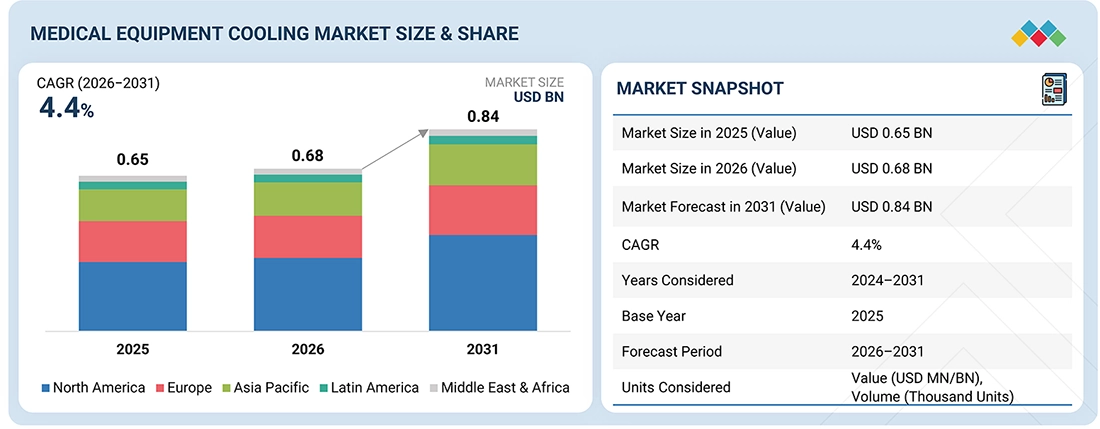
Source: Secondary Research, Interviews with Experts, MarketsandMarkets Analysis
The global medical equipment cooling market is projected to grow from USD 0.68 billion in 2026 to USD 0.84 billion by 2031, at a CAGR of 4.4% during the forecast period. The market was valued at USD 0.65 billion in 2025. This market is driven by the increasing adoption of advanced diagnostic, laboratory, and biologics equipment requiring precise thermal management, alongside expanding healthcare infrastructure and demand for reliable temperature-controlled medical storage equipment. Advancements in high-performance medical technologies are increasing demand for precision thermal management to ensure device reliability and clinical accuracy. At the same time, the shift toward compact, connected, and energy-efficient healthcare equipment is accelerating innovation in intelligent cooling solutions, creating opportunities for differentiated products that improve performance, regulatory compliance, and lifecycle value.
BY REGION
By region, North America accounted for a 40-45% share of the global medical equipment cooling market in 2025.
BY PRODUCT
By product, the ultra-low temperature freezers segment is expected to register a CAGR of 4.6% between 2026 and 2031.
BY END USER
By end user, the blood collection centers & blood component providers segment held a 45-50% share of the medical equipment cooling market in 2025.
COMPETITIVE LANDSCAPE - KEY PLAYERS
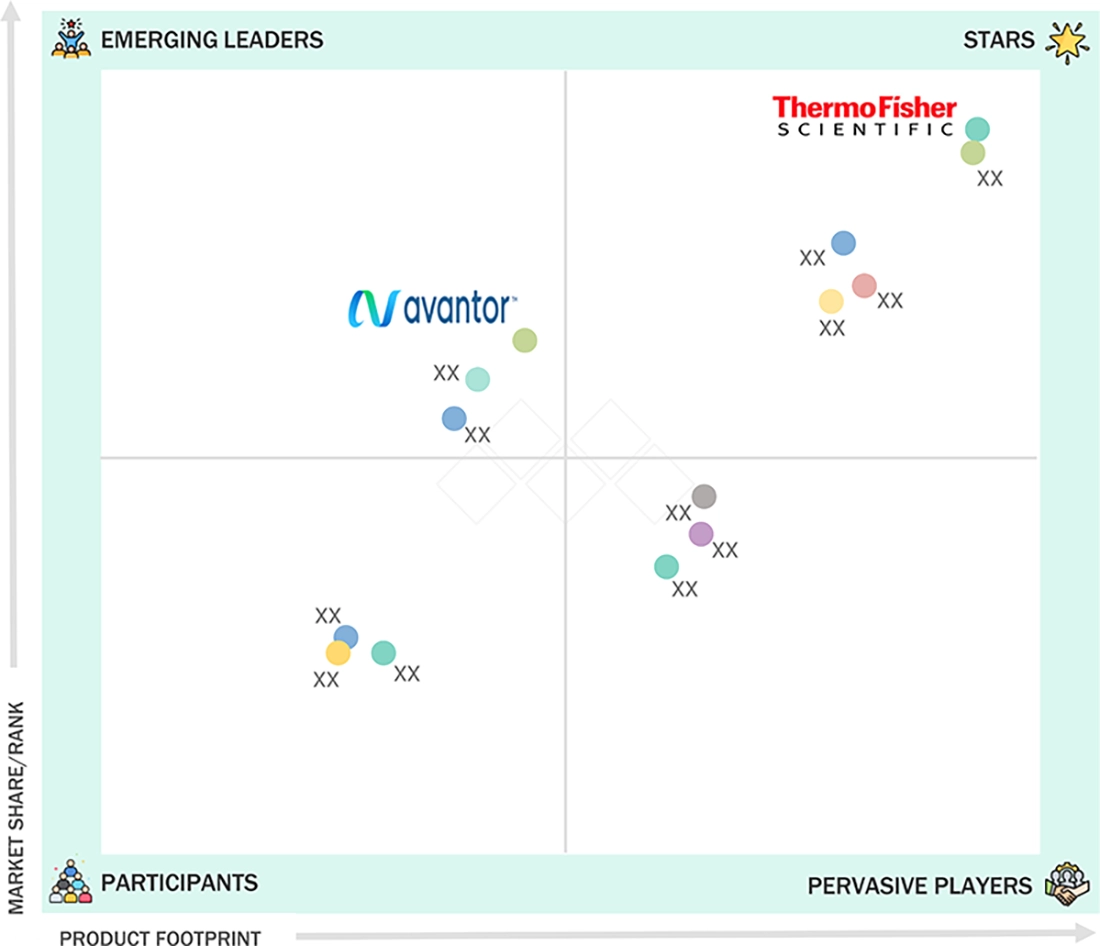
Thermo Fisher Scientific, Inc. (US) and Avantor, Inc (US) were recognized as star players due to their established strong product portfolios and geographic presence.
COMPETITIVE LANDSCAPE - STARTUPS/SMES
CoolMed Ltd (UK) (progressive company) and K2 Scientific (US) (responsive company) have established themselves among startups and SMEs, supported by strong product portfolios and effective business strategies.
The medical equipment cooling market is driven by the rising adoption of advanced diagnostic and laboratory equipment requiring precise thermal management. Opportunities are expanding through healthcare infrastructure development, growing biobanking and biologics production, and increasing demand for energy-efficient cooling systems with smart temperature monitoring and environmentally sustainable refrigeration technologies.
The medical equipment cooling market is witnessing significant transformation through the adoption of IoT-enabled temperature monitoring, remote diagnostics, and predictive maintenance, enabling real-time asset management and improved operational reliability. Manufacturers are increasingly developing energy-efficient refrigeration systems using low-global-warming-potential (low-GWP) refrigerants to comply with evolving environmental regulations. Growing demand for ultra-low-temperature storage driven by biologics, cell and gene therapies, and biobanking is accelerating innovation in precision cooling technologies. Additionally, automation, cloud-based monitoring platforms, and integrated cold chain management solutions are enhancing regulatory compliance, operational efficiency, and traceability across hospitals, laboratories, blood banks, and pharmaceutical facilities.
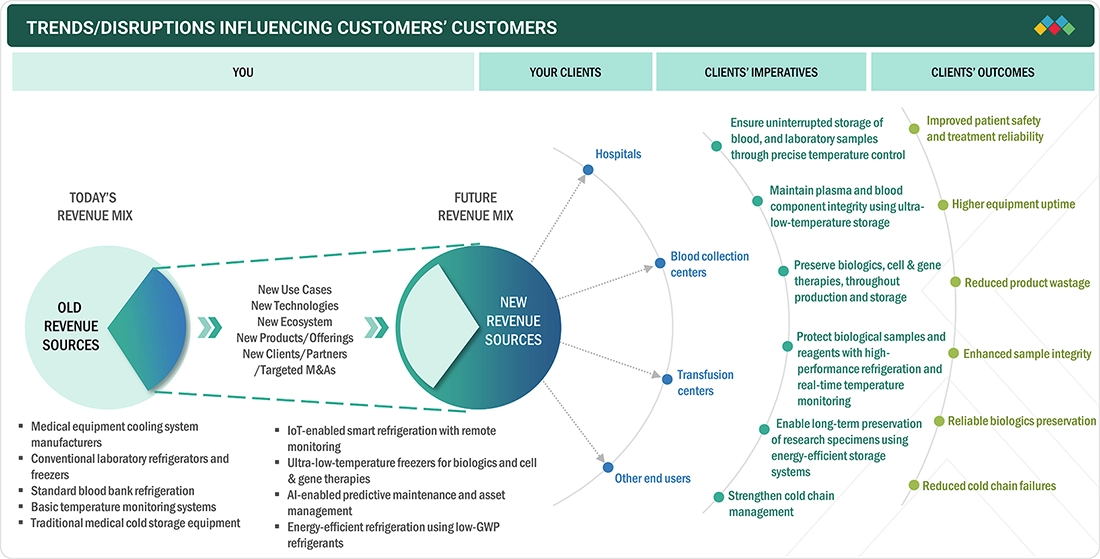
Source: Secondary Research, Interviews with Experts, MarketsandMarkets Analysis




OPPORTUNITIES
Impact
Level

Source: Secondary Research, Interviews with Experts, MarketsandMarkets Analysis
The increasing use of immunoglobulins, albumin, coagulation factors, and other plasma-derived medicinal products is a major driver for the medical equipment cooling market. These biologics require strict temperature-controlled storage and transportation to maintain their stability, efficacy, and safety throughout the supply chain. The growing prevalence of immune deficiencies, bleeding disorders, neurological diseases, and other chronic conditions has increased demand for plasma therapies, encouraging healthcare facilities, blood banks, and plasma fractionation centers to invest in advanced medical refrigeration and ultra-low temperature cooling equipment.
High capital investment remains a significant restraint in the medical equipment cooling market, as advanced refrigeration systems, ultra-low-temperature freezers, cryogenic storage equipment, and temperature monitoring technologies require substantial upfront expenditure. In addition to procurement costs, installation, infrastructure upgrades, energy consumption, maintenance, and regulatory compliance increase the total cost of ownership. These financial barriers particularly affect small hospitals, diagnostic laboratories, and healthcare facilities in developing economies, limiting the adoption of advanced cooling technologies despite growing demand for temperature-sensitive medical products.
Government initiatives to strengthen healthcare infrastructure and cold chain networks present significant opportunities for the medical equipment cooling market. Investments in blood banks, vaccine storage facilities, plasma collection centers, public health laboratories, and emergency preparedness programs are increasing demand for reliable refrigeration and monitoring systems. Financial incentives, healthcare modernization programs, and public-private partnerships aimed at improving temperature-controlled storage and transportation capabilities are encouraging wider adoption of advanced medical cooling equipment, particularly in emerging economies seeking to expand access to quality healthcare services.
A shortage of skilled technicians and limited maintenance resources poses a major challenge for the medical equipment cooling market. Advanced refrigeration systems require specialized expertise for installation, calibration, preventive maintenance, and troubleshooting to ensure uninterrupted operation and compliance with regulatory standards. Many healthcare facilities, particularly in low- and middle-income regions, face difficulties in recruiting qualified personnel and allocating sufficient maintenance budgets. These constraints increase the risk of equipment failure, temperature excursions, higher operating costs, and potential loss of valuable medical products and biological samples.
| COMPANY | USE CASE DESCRIPTION | BENEFITS |
|---|---|---|
|
|
Provides ultra-low-temperature freezers, laboratory refrigerators, cryopreservation systems, blood bank refrigerators, and environmental chambers for pharmaceutical manufacturing, clinical diagnostics, biobanking, vaccine storage, and life sciences research; Designed to deliver precise temperature control and long-term preservation of temperature-sensitive biological materials across healthcare and research facilities worldwide | Ensures integrity and stability of biological samples, vaccines, and plasma-derived products through precise temperature management | Improves laboratory efficiency | Supports regulatory compliance | Reduces sample loss | Enables reliable cold chain operations across hospitals, research institutes, and pharmaceutical manufacturing facilities globally |
|
|
Offers biomedical refrigerators, ultra-low-temperature freezers, blood bank refrigerators, vaccine storage systems, cryogenic storage equipment, and intelligent IoT-enabled cold chain solutions for hospitals, blood centers, research institutes, pharmaceutical companies, and public health organizations; Engineered for secure storage and remote temperature monitoring | Enhances cold chain reliability through real-time monitoring | Minimizes temperature excursions | Improves operational efficiency | Supports safe storage of vaccines, blood, plasma, and biological specimens while ensuring regulatory compliance and uninterrupted healthcare operations across diverse clinical environments |
|
|
Supplies ultra-low-temperature freezers and precision laboratory cooling equipment for molecular biology, genomics, proteomics, microbiology, cell culture, and biopharmaceutical research; Designed to provide uniform temperature distribution and secure preservation of valuable biological samples in academic and industrial laboratories | Protects high-value research samples through stable ultra-low-temperature storage, reducing degradation risks | Supports reproducible scientific research | Improves laboratory productivity | Lowers operating costs through energy-efficient systems | Enables long-term storage of sensitive biological materials |
|
|
Delivers vaccine refrigerators, blood bank refrigerators, plasma freezers, laboratory refrigerators, transport cold boxes, and medical cold chain equipment supporting immunization programs, blood transfusion services, hospitals, pharmaceutical companies, and public health agencies; Designed for reliable storage and transportation under challenging environmental conditions | Maintains product quality throughout storage and transportation, reducing spoilage of vaccines, blood, and plasma | Strengthens immunization programs | Improves blood transfusion safety | Supports regulatory compliance | Enables dependable cold chain performance in both urban and remote healthcare settings |
|
|
Manufactures medical refrigeration solutions including blood bank refrigerators, plasma freezers, pharmacy refrigerators, laboratory refrigerators, and vaccine storage systems for hospitals, diagnostic laboratories, blood banks, pharmaceutical facilities, and research organizations; Engineered for reliable temperature control and continuous operation in healthcare environments | Ensures safe preservation of blood components, pharmaceuticals, and laboratory samples through dependable cooling performance | Improves healthcare facility efficiency | Minimizes product wastage | Supports regulatory requirements | Provides cost-effective refrigeration solutions for expanding healthcare infrastructure in emerging markets |
Logos and trademarks shown above are the property of their respective owners. Their use here is for informational and illustrative purposes only.
The medical equipment cooling ecosystem is supported by a collaborative value chain comprising manufacturers, distributors, regulatory bodies, and end users. Manufacturers develop advanced cooling-enabled medical systems, while distributors ensure broad market access. Regulatory agencies establish safety and performance standards, and hospitals, clinics, and ambulatory surgery centers drive adoption through demand for reliable, compliant, and high-performance cooling solutions that ensure optimal equipment performance and patient safety.
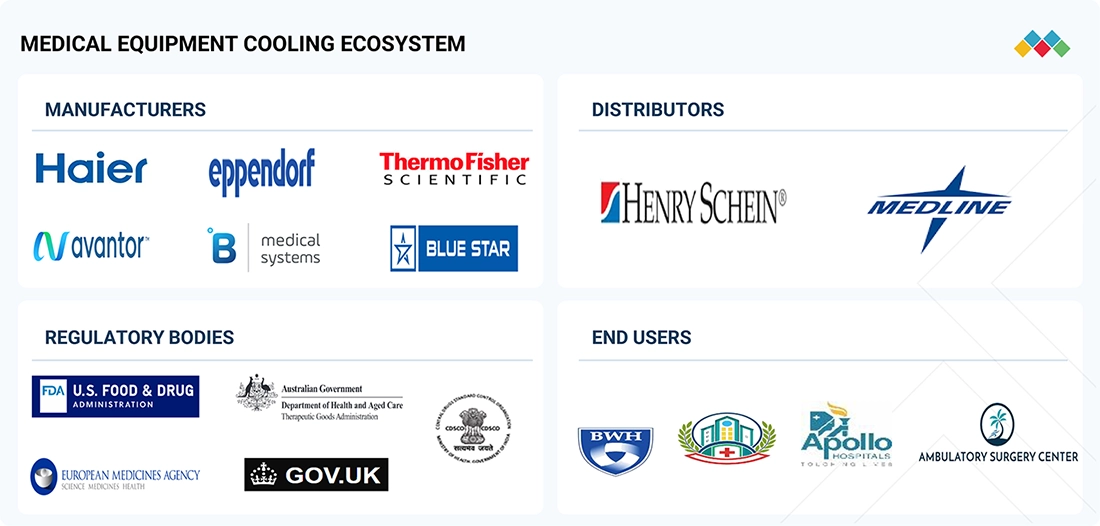
Logos and trademarks shown above are the property of their respective owners. Their use here is for informational and illustrative purposes only.
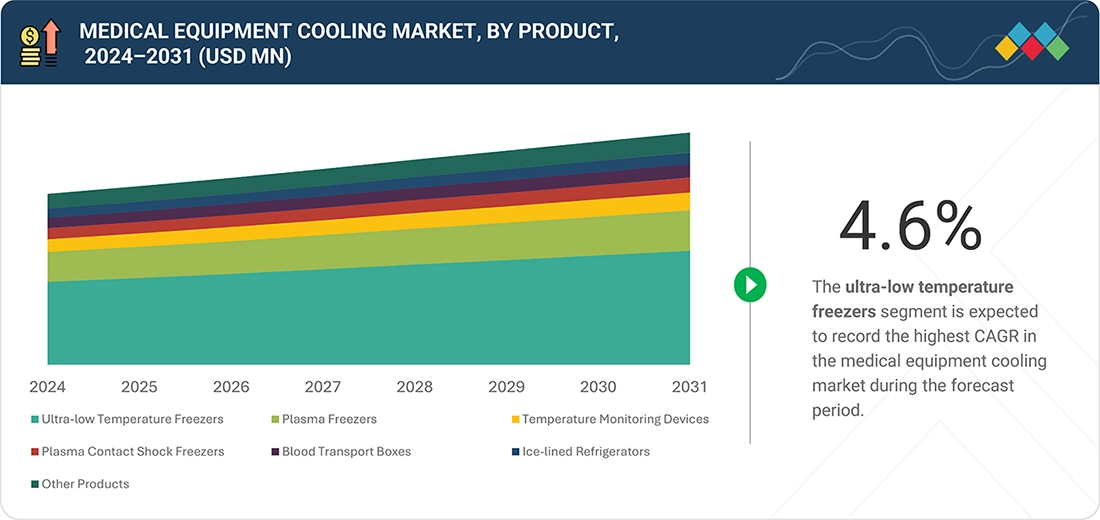
Source: Secondary Research, Interviews with Experts, MarketsandMarkets Analysis
Based on product, the ultra-low temperature freezers segment accounted for the largest share in the market in 2025. This is due to its critical role in preserving plasma, plasma-derived medicinal products, vaccines, biological samples, and other temperature-sensitive materials at temperatures as low as −86°C. Their widespread use across blood banks, hospitals, pharmaceutical and biotechnology companies, and research laboratories, coupled with increasing demand for biologics, biobanking, and plasma fractionation, continues to drive strong market adoption.
Based on the end user, the blood collection centers & blood component providers segment held the largest market share in 2025 due to its essential role in collecting, processing, storing, and supplying plasma and blood components for transfusion and plasma fractionation. Rising demand for plasma-derived therapies, increasing blood donation programs, and expanding plasma collection infrastructure have driven adoption of advanced refrigeration, ultra-low-temperature freezers, and temperature monitoring systems. Stringent storage regulations further strengthen demand for reliable medical equipment cooling equipment in these facilities.
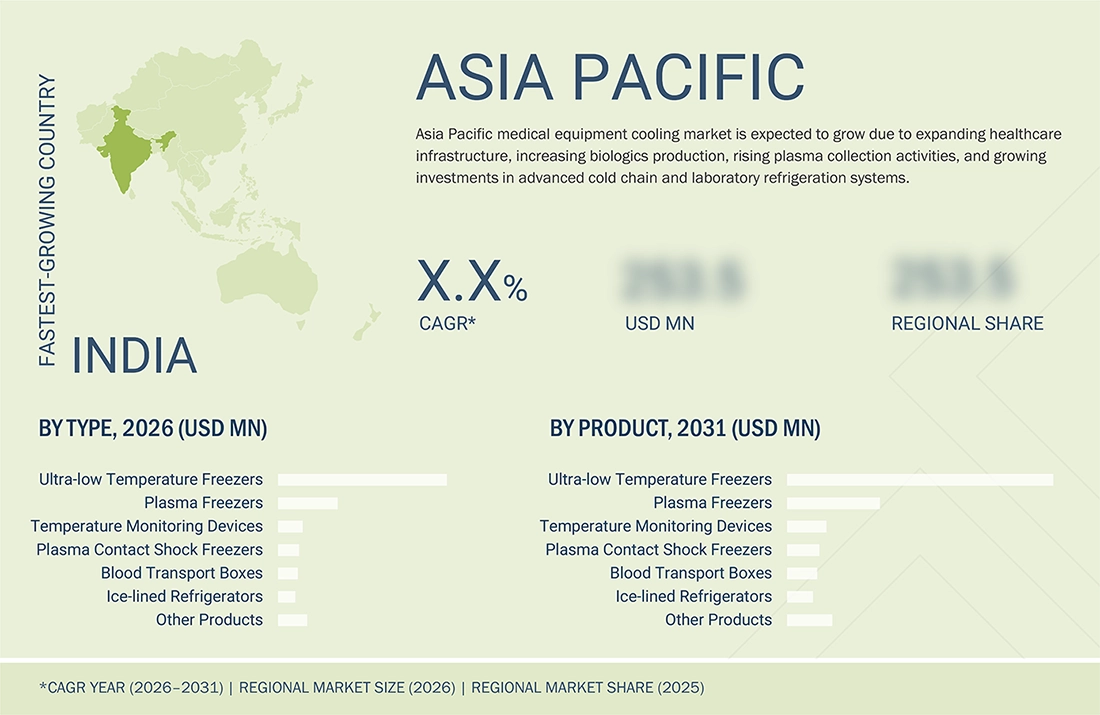
The Asia Pacific medical equipment cooling market is expected to exhibit the highest growth rate between 2026 and 2031. In Asia Pacific, the market is being driven by rapid healthcare infrastructure expansion, rising investments in advanced diagnostics and imaging systems, and increasing adoption of AI-enabled and minimally invasive medical technologies. Growing demand for reliable, high-performance equipment across hospitals, diagnostic centers, and ambulatory facilities is accelerating the need for precision thermal management. Governments across China, India, Japan, and Southeast Asia are prioritizing healthcare modernization and local medical device manufacturing, creating additional growth momentum. At the same time, the shift toward compact, energy-efficient, and digitally connected medical devices is driving innovation in intelligent cooling solutions that enhance equipment uptime, compliance, and lifecycle performance.
In the medical equipment cooling market matrix, Thermo Fisher Scientific Inc. (US) (Star) leads with its unmatched global presence, strong brand recognition, and comprehensive portfolio of medical equipment cooling products. Avantor, Inc. (US) (Emerging Leader) is rapidly gaining traction with its versatile products, which include medical equipment cooling products.
Source: Secondary Research, Interviews with Experts, MarketsandMarkets Analysis
| REPORT METRIC | DETAILS |
|---|---|
| Market Size in 2025 (Value) | USD 0.65 Billion |
| Market Size in 2026 (Value) | USD 0.68 Billion |
| Market Forecast in 2031 (Value) | USD 0.84 Billion |
| Growth Rate | CAGR of 4.4% from 2026-2031 |
| Years Considered | 2024-2031 |
| Base Year | 2025 |
| Forecast Period | 2026-2031 |
| Units Considered | Value (USD Million/Billion), Volume (Thousand Units) |
| Report Coverage | Revenue Forecast, Company Ranking, Competitive Landscape, Growth Factors, and Trends |
| Segments Covered |
|
| Regional Scope | North America, Asia Pacific, Europe, Latin America, and the Middle East & Africa |
We have successfully delivered the following deep-dive customizations:
| CLIENT REQUEST | CUSTOMIZATION DELIVERED | VALUE ADDS |
|---|---|---|
| Company Information |
|
Insights on market share analysis by country |
| Geographic Analysis |
|
Country-level demand mapping for new product launches and localization strategy planning |
 Exclusive indicates content/data unique to MarketsandMarkets and not available with any competitors.
4
MARKET OVERVIEW
This section summarizes market dynamics, key shifts, and high-impact trends shaping demand outlook.4.3
UNMET NEEDS AND WHITE SPACES
4.4
INTERCONNECTED MARKETS AND CROSS-SECTOR OPPORTUNITIES
4.5
STRATEGIC MOVES BY TIER-1/2/3 PLAYERS
5
INDUSTRY TRENDS
Covers the key developments, trend analysis, and actionable insights to support strategic planning and positioning.5.1
PORTER’S FIVE FORCES ANALYSIS
5.2
MACROECONOMIC OUTLOOK
5.2.2
GDP TRENDS AND FORECAST
5.2.3
TRENDS IN VACCINE STORAGE EQUIPMENT INDUSTRY
5.3
SUPPLY CHAIN ANALYSIS
5.6.1
AVERAGE SELLING PRICE TREND, BY KEY PLAYER, 2023–2025
5.6.2
AVERAGE SELLING PRICE TREND, BY PRODUCT, 2023–2025
5.6.3
AVERAGE SELLING PRICE TREND, BY REGION, 2023–2025
5.7.1
IMPORT SCENARIO (HS CODE 8418)
5.7.2
EXPORT SCENARIO (HS CODE 8418)
5.8
KEY CONFERENCES AND EVENTS, 2026–2027
5.9
TRENDS/DISRUPTIONS IMPACTING CUSTOMER BUSINESS
5.10
INVESTMENT AND FUNDING SCENARIO
5.12
IMPACT OF US TARIFFS – GLOBAL MEDICAL EQUIPMENT COOLING MARKET
5.12.3
PRICE IMPACT ANALYSIS
5.12.4
IMPACT ON COUNTRIES/REGIONS
5.12.5
IMPACT ON END USERS
6
TECHNOLOGICAL ADVANCEMENTS, AI-DRIVEN IMPACT, PATENTS, INNOVATIONS, AND FUTURE APPLICATIONS
6.1
KEY EMERGING TECHNOLOGIES
6.2
COMPLEMENTARY TECHNOLOGIES
6.3
TECHNOLOGY/PRODUCT ROADMAP
6.6
IMPACT OF AI/GEN AI ON MEDICAL EQUIPMENT COOLING MARKET
6.6.1
TOP USE CASES AND MARKET POTENTIAL
6.6.2
BEST PRACTICES FOLLOWED BY OEMS IN MEDICAL EQUIPMENT COOLING MARKET
6.6.3
CASE STUDIES RELATED TO AI/GEN AI IMPLEMENTATION IN MEDICAL EQUIPMENT COOLING MARKET
6.6.4
INTERCONNECTED ECOSYSTEM AND IMPACT ON MARKET PLAYERS
7.1
REGIONAL REGULATIONS AND COMPLIANCE
7.1.1
REGULATORY BODIES, GOVERNMENT AGENCIES, AND OTHER ORGANIZATIONS
7.2
CERTIFICATIONS, LABELING, AND ECO-STANDARDS
8
CUSTOMER LANDSCAPE AND BUYER BEHAVIOR
8.1
DECISION-MAKING PROCESS
8.2
KEY STAKEHOLDERS INVOLVED IN BUYING PROCESS AND THEIR EVALUATION CRITERIA
8.2.1
KEY STAKEHOLDERS IN BUYING PROCESS
8.2.2
EVALUATION CRITERIA
8.3
ADOPTION BARRIERS AND INTERNAL CHALLENGES
8.4
UNMET NEEDS OF VARIOUS END USERS
9
GLOBAL MEDICAL EQUIPMENT COOLING MARKET, BY PRODUCT (MARKET SIZE & FORECAST TO 2031 – IN VALUE, USD MILLION & IN VOLUME, THOUSAND UNITS)
9.2
ULTRA-LOW-TEMPERATURE FREEZERS
9.4
TEMPERATURE MONITORING DEVICES
9.5
PLASMA CONTACT SHOCK FREEZERS
9.6
BLOOD TRANSPORT BOXES
9.7
ICE-LINED REFRIGERATORS
10
GLOBAL MEDICAL EQUIPMENT COOLING MARKET, BY END USER (MARKET SIZE & FORECAST TO 2031 – IN VALUE, USD MILLION)
10.2
BLOOD COLLECTION CENTERS & BLOOD COMPONENT PROVIDERS
10.3
HOSPITALS & TRANSFUSION CENTERS
10.4
CLINICAL RESEARCH LABORATORIES
11
GLOBAL MEDICAL EQUIPMENT COOLING MARKET, BY REGION (MARKET SIZE & FORECAST TO 2031 – IN VALUE, USD MILLION & IN VOLUME, THOUSAND UNITS)
11.4.6
REST OF ASIA PACIFIC
11.5.3
REST OF LATIN AMERICA
11.6
MIDDLE EAST & AFRICA
11.6.2
REST OF MIDDLE EAST & AFRICA
12.2
KEY PLAYER COMPETITIVE STRATEGIES/RIGHT TO WIN, 2022–2026
12.3
REVENUE SHARE ANALYSIS, 2021–2025
12.4
MARKET SHARE ANALYSIS,
12.5
BRAND/PRODUCT COMPARISON
12.6
COMPANY EVALUATION MATRIX: KEY PLAYERS,
12.6.5
COMPANY FOOTPRINT: KEY PLAYERS,
12.6.5.1
COMPANY FOOTPRINT
12.6.5.2
REGION FOOTPRINT
12.6.5.3
PRODUCT FOOTPRINT
12.6.5.4
END USER FOOTPRINT
12.7
COMPANY EVALUATION MATRIX: STARTUPS/SMES,
12.7.1
PROGRESSIVE COMPANIES
12.7.2
RESPONSIVE COMPANIES
12.7.5
COMPETITIVE BENCHMARKING: STARTUPS/SMES,
12.7.5.1
DETAILED LIST OF KEY STARTUPS/SMES
12.7.5.2
COMPETITIVE BENCHMARKING OF KEY STARTUPS/SMES
12.8
COMPANY VALUATION AND FINANCIAL METRICS
12.9
COMPETITIVE SCENARIO
13.1.1
THERMO FISHER SCIENTIFIC, INC.
13.1.2
HAIER BIOMEDICAL (HAIER GROUP)
13.1.4
B MEDICAL SYSTEMS (AZENTA)
13.1.7
GODREJ AND BOYCE MANUFACTURING CO. LTD.
13.1.9
VESTFROST SOLUTIONS A/S
13.1.11
DEEPEE COOLING PRODUCTS
13.1.12
BERLINGER & CO. AG
13.1.13
MONNIT CORPORATION
13.1.14
ZHEJIANG HELI REFRIGERATION EQUIPMENT CO. LTD.
13.1.15
HELMER SCIENTIFIC (TRANE TECHNOLOGIES)
13.2.1
QINGDAO CAREBIOS BIOLOGICAL TECHNOLOGY CO., LTD.
13.2.4
ZHONGKE MEILING CRYOGENICS CO., LTD.
13.2.5
BIONICS SCIENTIFIC TECHNOLOGIES (P) LTD.
13.2.6
STERICOX INDIA PRIVATE LIMITED
13.2.7
ENVIRO TECHNOLOGIES
13.2.10
PHILIPP KIRSCH GMBH
14.1.1.1
LIST OF KEY SECONDARY SOURCES
14.1.1.2
KEY DATA FROM SECONDARY SOURCES
14.1.2.1
KEY DATA FROM PRIMARY SOURCES
14.1.2.2
LIST OF PRIMARY INTERVIEW PARTICIPANTS
14.1.2.3
BREAKDOWN OF PRIMARY INTERVIEWS
14.1.2.4
KEY INDUSTRY INSIGHTS
14.2
MARKET SIZE ESTIMATION
14.2.1
BOTTOM-UP APPROACH
14.2.3
MARKET SIZE CALCULATION FOR BASE YEAR
14.3
MARKET FORECAST APPROACH
14.6
RESEARCH ASSUMPTIONS
14.7
RESEARCH LIMITATIONS
15.2
KNOWLEDGESTORE: MARKETSANDMARKETS’ SUBSCRIPTION PORTAL
15.3
CUSTOMIZATION OPTIONS
The research study aimed to estimate the current market size of the medical equipment cooling market through several key activities. Comprehensive secondary research was conducted to gather information on the medical equipment cooling industry. The next step involved validating these findings, assumptions, and size estimates with industry experts across the value chain through primary research. To estimate the total market size, both top-down and bottom-up approaches were utilized. Following this, market segmentation and data triangulation procedures were employed to determine the sizes of different segments and subsegments within the medical equipment cooling market.
Secondary ResearchThe secondary research process involved the widespread use of secondary sources, directories, databases (Bloomberg Businessweek, Factiva, and D&B Hoovers), white papers, annual reports, investor presentations, SEC filings of companies and publications from government sources, such as National Institutes of Health (NIH), US FDA, US Census Bureau, World Health Organization (WHO), International Trade Administration (ITA), Global Burden of Disease Study, and Centers for Medicare and Medicaid Services (CMS), were referred to identify and collect information for the global Medical equipment cooling market study. It was also used to obtain important information on key players, market classification & segmentation aligned with industry trends, and key developments from market and technology perspectives, down to the bottom-most level. A database of the key industry leaders was also prepared using secondary research.
Primary ResearchIn the primary research process, various sources from the supply and demand sides were interviewed to obtain qualitative and quantitative information for this report. The primary sources on the supply side include industry experts, such as CEOs, vice presidents, marketing and sales directors, technology & innovation directors, and other key executives from leading companies and organizations in the medical equipment cooling market. The primary demand-side sources include ambulatory surgical centers, hospitals, clinics, and other end users. Primary research was conducted to validate the market segmentation, identify key players, and gather insights into key industry trends and key market dynamics.
A breakdown of the primary respondents is provided below:

Note 1: C-level executives include CEOs, CFOs, COOs, and VPs.
Others include sales managers, marketing managers, business development managers, product managers, distributors, and suppliers.
Companies are classified into tiers based on their total revenue. The tiers are as follows:
Tier 1 = > USD 10 billion, Tier 2 = USD 1 billion to USD 10 billion, and Tier 3 = <USD 1 billion
Source: MarketsandMarkets Analysis
To know about the assumptions considered for the study, download the pdf brochure
For the global market value, annual revenue figures were calculated based on the revenue mapping of major product manufacturers and OEMs active in the global medical equipment cooling market. All major product manufacturers were identified at the global and/or country/regional level. Revenue mapping for the respective business segments/subsegments was done for the major players. Additionally, the global medical equipment cooling market was split into various segments and sub-segments:
The data mentioned above was consolidated and added with detailed inputs and analysis from MarketsandMarkets and presented in this report.
Medical Equipment Cooling Market : Top-Down and Bottom-Up Approach
After determining the overall size of the global medical equipment cooling market using the methodology described above, the market was segmented into several segments and subsegments. The data triangulation and market breakdown procedures were employed, as applicable, to complete the overall market engineering process and obtain exact market value data for the key segments and subsegments. The extrapolated market data was triangulated by studying various macro indicators and regional trends from the demand- and supply-side participants.
The medical equipment cooling market comprises temperature-controlled equipment and cooling solutions designed to store, preserve, and transport temperature-sensitive medical products, including blood components, plasma, plasma-derived medicinal products, vaccines, biological samples, and laboratory materials. These systems ensure product integrity, regulatory compliance, and operational reliability across hospitals, blood banks, diagnostic laboratories, research institutions, and pharmaceutical and biotechnology facilities.
Based on the given market data, MarketsandMarkets offers customizations tailored to your company’s specific needs. The following customization options are available for the report:


Director of Market Insights, Data and Analytics
Leading Pharmaceutical Company

We at SFI Health approached MarketsandMarkets for an Opportunity Assessment on "Incidence and Prevalence of Focus Indications" as we wanted to know the most attractive HCPs like Physician, Functional MD, Naturopath and Pharmacist. The project was critical for us to ensure our focus on the right target which would enable sustainable growth and profitability for SFI Health. The business insights provided exceeded our expectations and we were extremely impressed. The team at MarketsandMarkets is highly professional and detail oriented and very well understood our business needs. MarketsandMarkets offers a unique combination of expertise and dedicated engagement model. We identified 2 new products to be launched in coming months, based on the research findings provided by MarketsandMarkets. We are happy with the services and would strongly recommend MarketsandMarkets to my peers in the industry.

Head of Commercial Analytics
Leading Pharmaceutical Company

We partnered with MarketsandMarkets for an assessment study on hard empty capsules. The team was extremely professional in understanding our business requirements and we received timely responses to all our queries. The market intelligence and the recommendations has met our business requirements. We were extremely impressed to see the final study results; it really exceeded our expectations. The market intelligence offered by MarketsandMarkets, and clarity on next steps will help us achieve our business objective for the Year 2021. We are happy with the services and would strongly recommend MarketsandMarkets to my peers in the industry.

Senior Director Business Development & Innovation
Italian Multinational in life sciences sector and a World Leader in imaging diagnostics
We were pleased with targeted insights that MarketsandMarkets identified from a custom study on the 'Radiation Dose Management Solutions Market'. Your team identified and characterized the market participants as well as underlying trends accurately. This study was useful to Bracco in formulating business strategies for our dose monitoring product lines and we thank MarketsandMarkets for the job well done.
Market Development and Strategy Manager
Leader in Health care Coding, Payment & Analytics Solutions.
The value for our organization comes from three things: depth of research, specificity of segments and being easy to work with. As important as the first two are, the third can't be underestimated. MarketsandMarkets, maybe more than any other research vendor, wants to know what is top of mind for our team and what big questions we are grappling to answer.
Their customer first approach and high value engagement model, have given us great analysis and excellent value for money