Просмотр новости
Найдите то, что Вас интересует
 Спутники
 РН
РН SpaceX
 Роскосмос
 NASA
NASA
СпутникиРНSpaceXРоскосмосNASA

USD 159.81 BN
MARKET SIZE, 2032



Source: Secondary Research, Interviews with Experts, MarketsandMarkets Analysis
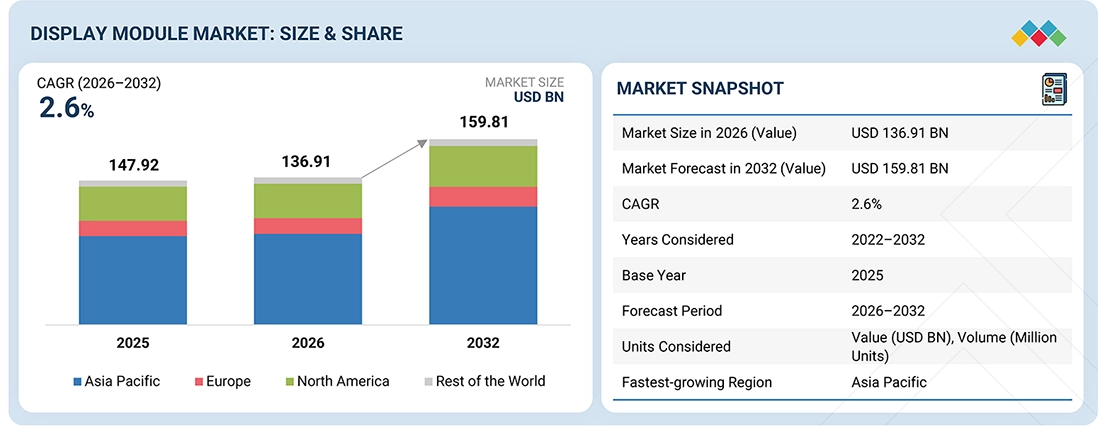
The global display module market is estimated to reach USD 159.81 billion by 2032 from USD 136.91 billion in 2026, at a CAGR of 2.6%. The display module market is witnessing steady growth, driven by increasing demand for high-performance displays across consumer electronics, automotive, healthcare, industrial, and commercial applications. Rising adoption of advanced display technologies such as OLED, AMOLED, Mini-LED, and MicroLED, coupled with growing shipments of smartphones, laptops, televisions, wearables, and automotive infotainment systems, continues to fuel market expansion. Continuous advancements in flexible, foldable, and energy-efficient display modules, along with investments in next-generation manufacturing technologies, are further strengthening the market. Additionally, the rapid expansion of consumer electronics manufacturing in the Asia Pacific and the increasing integration of display modules into connected and intelligent devices are expected to support sustained growth throughout the forecast period.
BY REGION
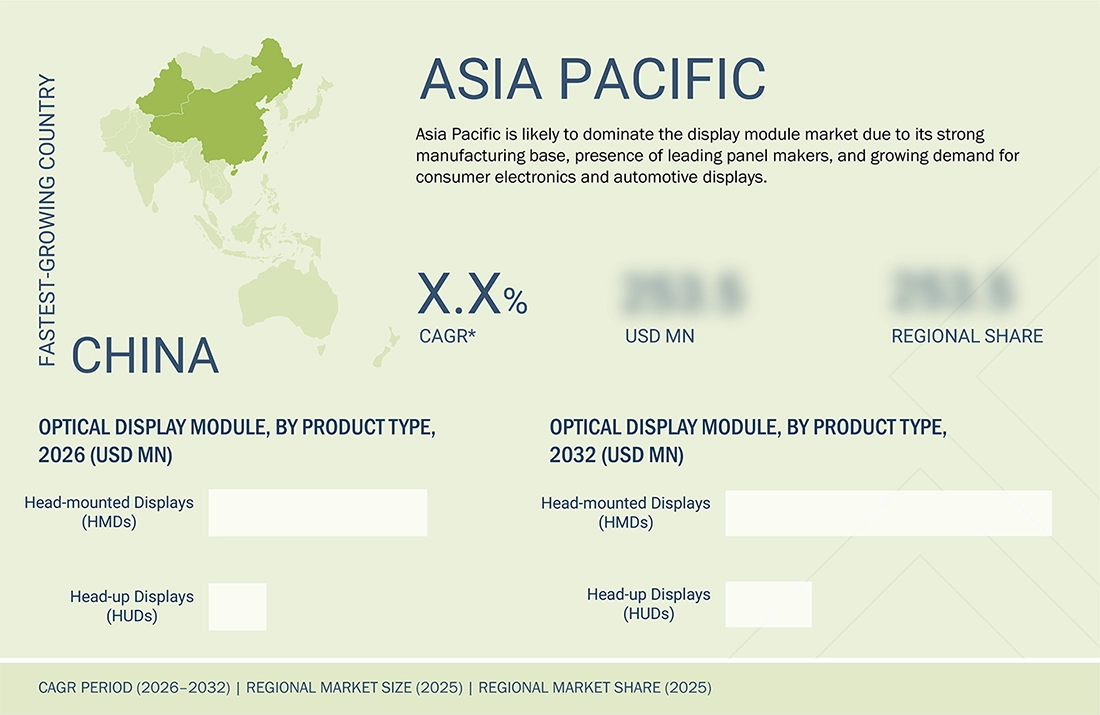
The Asia Pacific is projected to register the highest CAGR of ~24.7% of the optical display module market.
BY PRODUCT TYPE
The non-optical display modules segment held the largest market share of ~97.4% in 2025.
BY DISPLAY SIZE
Microdisplays are expected to grow at the highest CAGR of ~20.3%.
BY END-USE INDUSTRY
The consumer electronics end-use industry held the largest market share in 2025.
COMPETITIVE LANDSCAPE: KEY PLAYERS
Samsung Display, LG Display, BOE Technology Group, and AUO Corporation were identified as key players in the display module market due to their heavy investments in fabrication facilities, process technologies, and research and development to improve resolution, brightness, energy efficiency, and form factors.
COMPETITIVE LANDSCAPE: STARTUPS/SMES
Porotech, Aledia, and VueReal are notable startups and SMEs that are gaining traction owing to their focus on niche applications, rapid innovation, and customized solutions for wearables, smart glasses, automotive, healthcare, and industrial devices, enabling them to compete effectively with established display manufacturers.
The increasing demand for high-performance display modules is a major factor driving the display module market. Growing adoption of display modules across smartphones, tablets, laptops, televisions, wearable devices, automotive displays, and industrial equipment is accelerating market growth. End users increasingly prefer display modules that offer higher resolution, improved color accuracy, faster refresh rates, lower power consumption, and slimmer form factors to enhance user experience. This trend is encouraging manufacturers to invest in advanced display module technologies such as OLED, AMOLED, Mini-LED, and MicroLED, while expanding production capacity and developing innovative, energy-efficient display solutions for next-generation electronic devices.
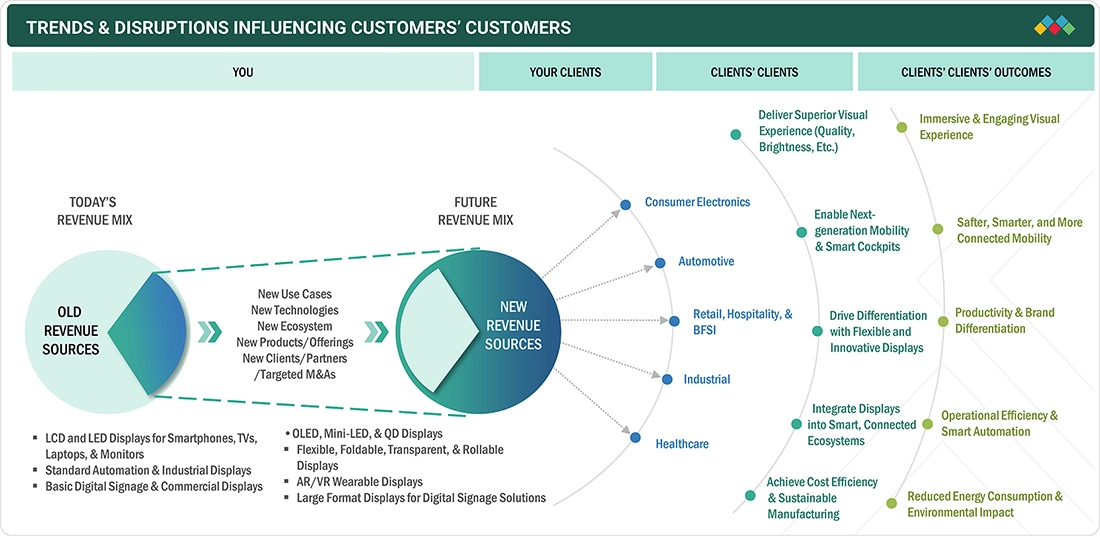
The display module market is undergoing a significant transformation as demand shifts from conventional LCD and LED modules toward advanced OLED, Mini-LED, Micro-LED, and quantum dot (QD)-based display technologies. Emerging applications in automotive digital cockpits, AR/VR devices, foldable smartphones, industrial automation, healthcare equipment, and smart retail are expanding the market beyond traditional consumer electronics. These disruptions are driving manufacturers to prioritize superior visual performance, energy efficiency, flexible form factors, and seamless integration with AI-enabled connected ecosystems. As a result, companies are investing in next-generation manufacturing capabilities, innovative display materials, and strategic partnerships to develop differentiated products, improve production efficiency, and unlock new revenue streams while delivering immersive user experiences, enhanced operational efficiency, and sustainable display solutions.
Source: Secondary Research, Interviews with Experts, MarketsandMarkets Analysis



OPPORTUNITIES
Impact
Level

Source: Secondary Research, Interviews with Experts, MarketsandMarkets Analysis
The growing consumer preference for enhanced visual experiences is driving demand for high-resolution display modules in smartphones, TVs, laptops, gaming devices, and tablets. Features such as higher brightness, improved color accuracy, faster refresh rates, and lower power consumption are becoming standard expectations. This trend is encouraging manufacturers to invest in advanced display technologies such as OLED, Mini-LED, and Micro-LED, thereby accelerating market growth.
Increasing competition among display manufacturers, particularly in the LCD segment, has led to continuous declines in average selling prices. Manufacturers face pressure to reduce costs while maintaining product quality and technological innovation. This pricing pressure impacts profit margins and limits the ability of smaller players to invest in next-generation display technologies.
The increasing commercialization of foldable smartphones, transparent displays, and advanced automotive cockpit displays is creating significant growth opportunities for display module manufacturers. Automakers are integrating large, curved, and OLED-based displays into connected vehicles, while consumer electronics brands continue to innovate with flexible form factors. These emerging applications are expanding the addressable market beyond traditional display devices.
The display module industry relies heavily on specialized materials such as glass substrates, semiconductors, display driver ICs, OLED materials, and rare earth elements. Supply chain disruptions, geopolitical uncertainties, and fluctuations in raw material availability can delay production and increase manufacturing costs. Ensuring a stable supply chain while scaling advanced display technologies remains a major challenge for manufacturers.
| COMPANY | USE CASE DESCRIPTION | BENEFITS |
|---|---|---|
|
|
Expanding OLED, AMOLED, and foldable display modules for smartphones, automotive displays, IT devices, and XR applications, with a focus on thinner, energy-efficient, and high-performance modules | Enhanced display quality and power efficiency | Advanced flexible display solutions | Stronger premium product positioning |
|
|
Increasing production of OLED, Mini-LED, and flexible display modules while expanding manufacturing capacity for consumer electronics, automotive, and industrial applications | Higher production scalability | Improved display module performance | Expanded customer reach |
|
|
Developing OLED and large-format display modules for TVs, automotive, gaming, and commercial applications with enhanced brightness, durability, and energy efficiency | Superior visual performance | Improved energy efficiency | Broader adoption in premium and automotive applications |
Logos and trademarks shown above are the property of their respective owners. Their use here is for informational and illustrative purposes only.
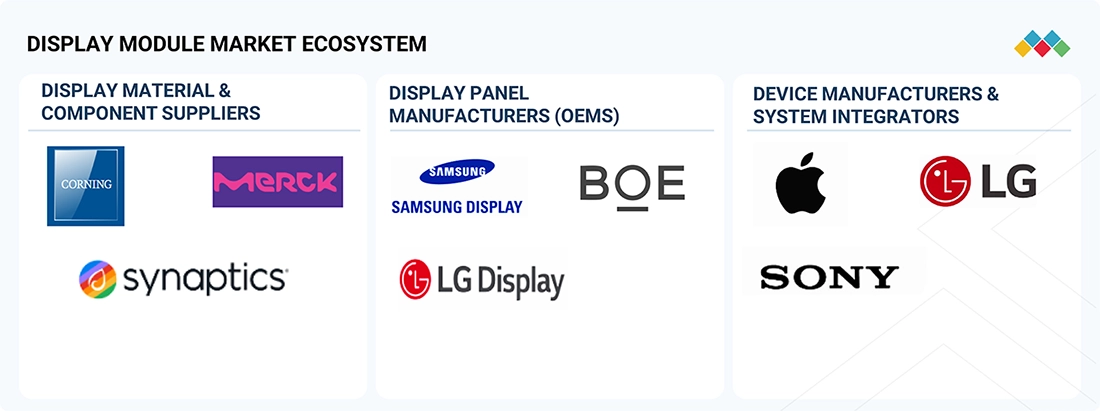
The display module market ecosystem consists of a collaborative value chain that begins with display material and component suppliers, such as Corning, Merck, and Synaptics, which provide essential materials, glass substrates, chemicals, and display driver ICs. These components are integrated by display panel manufacturers, including Samsung Display, LG Display, and BOE, to produce advanced LCD and OLED display modules. The finished display modules are then adopted by device manufacturers and system integrators such as Apple, LG Electronics, and Sony for integration into smartphones, televisions, laptops, automotive displays, wearables, and other smart electronic devices, driving innovation and commercialization across end-use industries.
Logos and trademarks shown above are the property of their respective owners. Their use here is for informational and illustrative purposes only.
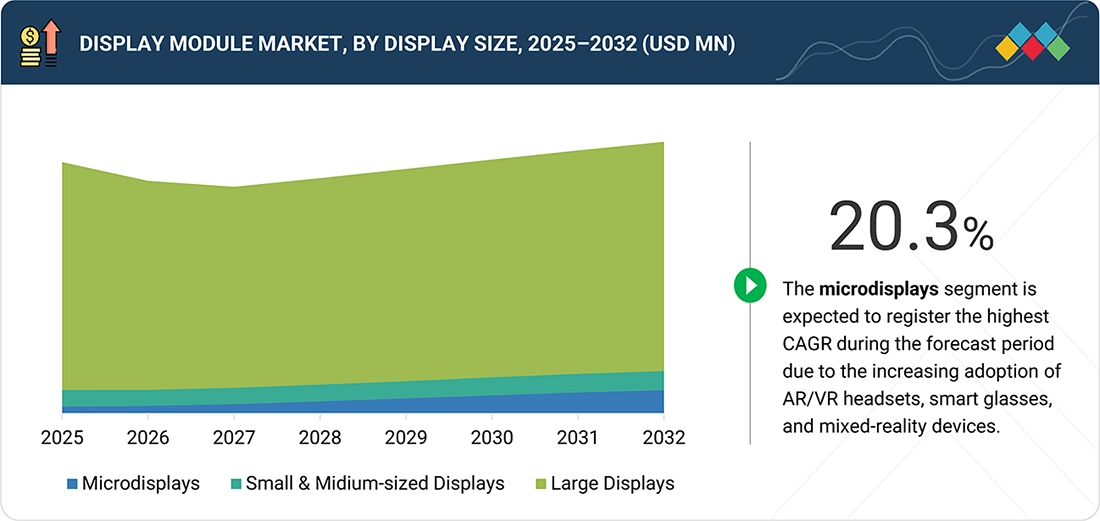
Source: Secondary Research, Interviews with Experts, MarketsandMarkets Analysis
LCD-based display modules hold the largest share of the display module market owing to their cost-effectiveness, well-established manufacturing ecosystem, high production volumes, and extensive adoption across televisions, monitors, laptops, smartphones, digital signage, automotive displays, and industrial equipment. While OLED, Mini-LED, and Micro-LED display modules are gaining traction in premium applications, LCD display modules continue to dominate high-volume and cost-sensitive segments by offering an optimal balance of performance, reliability, and affordability.
Non-optical display modules hold the largest share of the display module market due to their widespread adoption across consumer electronics, automotive, industrial equipment, medical devices, and commercial displays. Technologies such as LCD, OLED, Mini-LED, and Micro-LED offer superior image quality, energy efficiency, and design flexibility, making them the preferred choice for smartphones, televisions, laptops, monitors, and digital signage. Continuous advancements in display resolution, brightness, refresh rates, and power efficiency further strengthen the dominance of non-optical display modules across both consumer and industrial applications.
Consumer electronics hold the largest share of the display module market due to the high production volumes of smartphones, televisions, laptops, tablets, monitors, smartwatches, and gaming devices. Growing consumer demand for high-resolution, energy-efficient, and premium displays has accelerated the adoption of advanced display modules such as LCD, OLED, and Mini-LED across these devices. Frequent product launches, shorter device replacement cycles, and continuous innovations in display quality further reinforce the dominance of the consumer electronics segment in the global display module market.
Display modules larger than 9 inches hold the largest share of the display module market in 2025 due to their extensive use in televisions, monitors, laptops, automotive infotainment systems, digital signage, and industrial control panels. The increasing demand for larger, high-resolution displays in both consumer and commercial applications, coupled with the adoption of advanced technologies such as OLED, Mini-LED, and high-refresh-rate LCDs, continues to drive this segment. Additionally, the growing integration of large-format displays in smart vehicles and enterprise environments further strengthens the market dominance of display modules exceeding 9 inches.
Asia Pacific holds the largest share of the display module market due to the strong presence of leading display panel manufacturers, well-established electronics manufacturing hubs, and an extensive cross-country supply chain, including China, South Korea, Japan, and Taiwan. The region benefits from high production volumes of smartphones, televisions, laptops, and automotive displays, supported by growing consumer demand and continuous investments in OLED, Mini-LED, and Micro-LED technologies. Favorable government policies, lower manufacturing costs, and increasing exports of display modules further reinforce Asia Pacific's market leadership.
Samsung Display is a star player in the display module market owing to its leadership in OLED technologies, large-scale manufacturing capabilities, and continuous innovation in next-generation displays. In contrast, Sharp Corporation is emerging as a leader by expanding its presence in high-value segments such as automotive, industrial, and large-format displays, leveraging its expertise in advanced display technologies and niche applications.
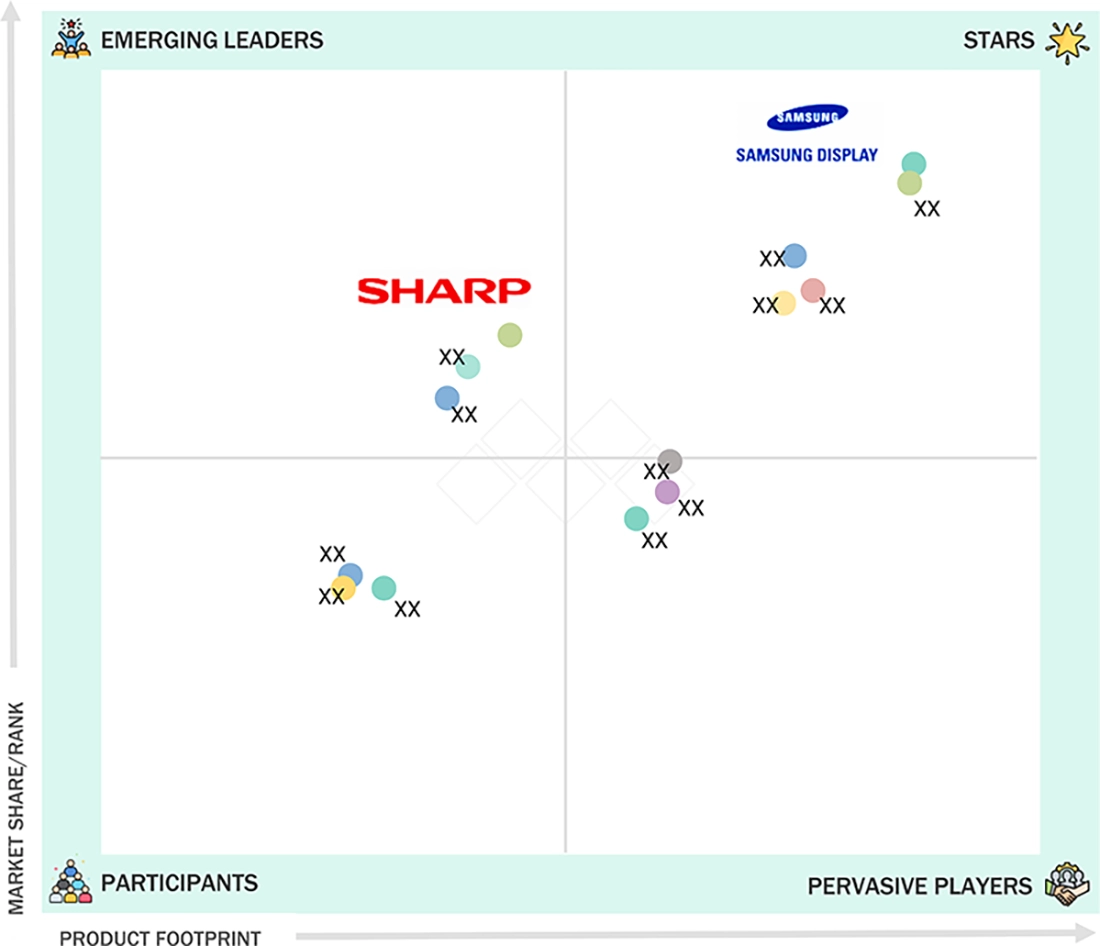
Source: Secondary Research, Interviews with Experts, MarketsandMarkets Analysis
| REPORT METRIC | DETAILS |
|---|---|
| Market Size in 2025 (Value) | USD 147.92 BN |
| Market Size in 2026 (Value) | USD 136.91 BN |
| Market Forecast in 2032 (Value) | USD 159.81 BN |
| Growth Rate | CAGR of 2.6% from 2026 to 2032 |
| Years Considered | 2022–2032 |
| Base Year | 2025 |
| Forecast Period | 2026–2032 |
| Units Considered | Value (USD BN), Volume (Million Units) |
| Report Coverage | Revenue Forecast, Company Ranking, Competitive Landscape, Growth Factors, and Trends |
| Segments Covered |
|
| Regional Scope | North America, Europe, Asia Pacific, Rest of the World |
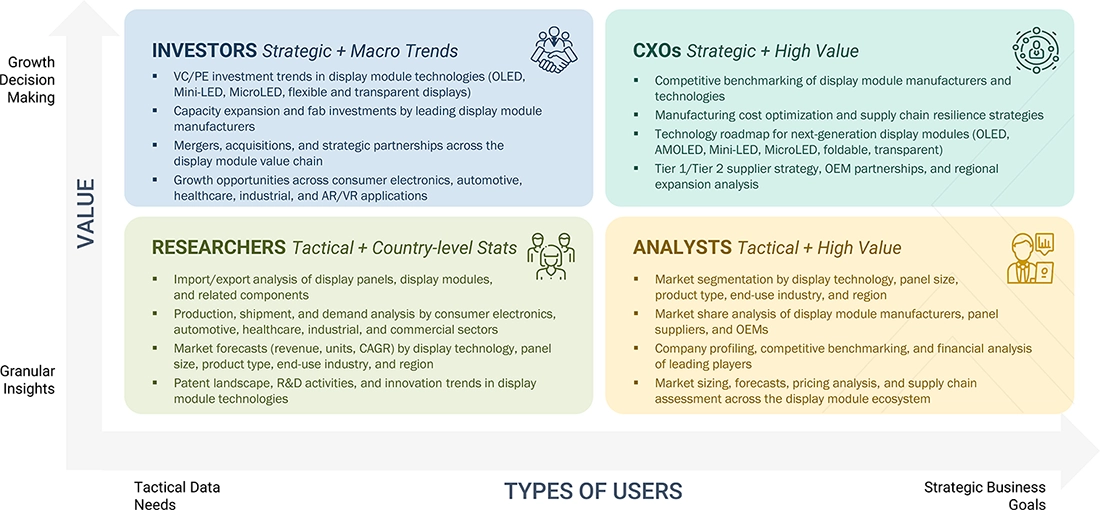
We have successfully delivered the following deep-dive customizations:
| CLIENT REQUEST | CUSTOMIZATION DELIVERED | VALUE ADDS |
|---|---|---|
| Display module manufacturer/Panel OEM |
|
Identified high-growth technology segments, capacity expansion opportunities, and competitive positioning strategies to strengthen market share |
| Consumer electronics OEM (Smartphones, TVs, Laptops, Wearables) | Assessed display module sourcing strategies, supplier landscape, technology adoption trends, and cost-performance trade-offs across smartphones, televisions, laptops, tablets, and wearable devices | Recommended supplier diversification strategies and next-generation display technology adoption to optimize product differentiation and supply chain resilience |
| Automotive OEM/Tier-1 Supplier | Evaluated the adoption of automotive display modules for digital instrument clusters, infotainment systems, central control displays, passenger displays, and head-up displays (HUDs), including supplier benchmarking and regional demand analysis | Identified emerging opportunities in connected, electric, and software-defined vehicles while benchmarking automotive display innovations and regulatory requirements |
| Material supplier/Display component manufacturer |
|
Mapped the display ecosystem, identified supply chain risks, localization opportunities, and strategic partnerships with leading panel manufacturers and device OEMs |
| Investment firm/Private equity/Strategic investor | Performed market attractiveness assessment covering technology evolution, regional manufacturing hubs, competitive intensity, M&A activity, and investment opportunities across the display module value chain | Identified high-growth investment areas, emerging display technologies, and potential acquisition targets with strong long-term revenue potential |
 Exclusive indicates content/data unique to MarketsandMarkets and not available with any competitors.
4
MARKET OVERVIEW
Provides a snapshot of current market scenario, value chain context, and factors impacting competitive intensity.4.3
INTERCONNECTED MARKETS AND CROSS-SECTOR OPPORTUNITIES
4.4
STRATEGIC MOVES BY TIER-1/2/3 PLAYERS
5
INDUSTRY TRENDS
Covers the key developments, trend analysis, and actionable insights to support strategic planning and positioning.5.2
PORTER'S FIVE FORCES ANALYSIS
5.7
TRENDS/DISRUPTIONS IMPACTING CUSTOMER BUSINESS
5.9
IMPACT OF 2025 US TARIFF –DISPLAY MODULE MARKET
5.9.1.2
PRICE IMPACT ANALYSIS
5.9.2
IMPACT ON COUNTRIES/REGIONS
5.9.3
IMPACT ON END-USER INDUSTRIES
6
TECHNOLOGICAL ADVANCEMENTS, AI-DRIVEN IMPACT, PATENTS, INNOVATIONS, AND FUTURE APPLICATIONS
6.2
COMPLEMENTARY TECHNOLOGIES
6.3
ADJACENT TECHNOLOGIES
6.4
TECHNOLOGY/PRODUCT ROADMAP
6.6
IMPACT OF AI/GEN AI ON DISPLAY MODULE MARKET
7.1
REGIONAL REGULATIONS AND COMPLIANCE
7.1.1
REGULATORY BODIES, GOVERNMENT AGENCIES, AND OTHER ORGANIZATIONS
8
CUSTOMER LANDSCAPE & BUYER BEHAVIOR
8.2
DECISION-MAKING PROCESS
8.3
KEY STAKEHOLDERS INVOLVED IN BUYING PROCESS AND THEIR EVALUATION CRITERIA
8.3.1
KEY STAKEHOLDERS IN BUYING PROCESS
8.4
ADOPTION BARRIERS & INTERNAL CHALLENGES
8.5
UNMET NEEDS OF VARIOUS INDUSTRIES
9
DISPLAY MODULE MARKET, BY TYPE
Market Size, Volume & Forecast – USD Million9.2
OPTICAL DISPLAY MODULES
9.3
ELECTRONIC DISPLAY MODULES (NON-OPTICAL)
10
OPTICAL DISPLAY MODULE MARKET, BY DISPLAY TECHNOLOGY
Market Size, Volume & Forecast – USD Million10.6
OTHER OPTICAL DISPLAY TECHNOLOGIES
11
ELECTRONIC DISPLAY MODULE (NON-OPTICAL) MARKET, BY DISPLAY TECHNOLOGY
Market Size, Volume & Forecast – USD Million11.7
OTHER ELECTRONIC DISPLAY TECHNOLOGIES
12
DISPLAY MODULE MARKET, BY PRODUCT TYPE
Market Size, Volume & Forecast – USD Million12.2
OPTICAL MODULE-BASED PRODUCTS
12.2.1
HEAD-MOUNTED DISPLAYS (HMDS)
12.2.2
HEAD-UP DISPLAYS (HUDS)
12.3
NON-OPTICAL MODULE-BASED PRODUCTS
12.3.2
TABLETS, MONITORS, & LAPTOPS
12.3.3
DIGITAL SIGNAGE & COMMERCIAL DISPLAYS
12.3.4
AUTOMOTIVE DISPLAYS (EXCLUDING HUDS)
12.3.5
WEARABLES (EXCLUDING HMDS)
12.3.8
OTHER PRODUCT TYPES
13
DISPLAY MODULE MARKET, BY END-USE INDUSTRY
Market Size, Volume & Forecast – USD Million13.2
CONSUMER ELECTRONICS
13.4
SPORTS & ENTERTAINMENT
13.6
RETAIL, HOSPITALITY, & BFSI
13.10
AEROSPACE & DEFENSE
13.11
OTHER END-USE INDUSTRIES
14
DISPLAY MODULE MARKET, BY DISPLAY SIZE
Market Size, Volume & Forecast – USD Million14.2
MICRODISPLAYS (DISPLAYS FOR NEAR-EYE DEVICES, HUDS, OTHERS)
14.2.1
LESS THAN 0.5 INCH
14.2.3
MORE THAN 1.0 INCHES
14.3
SMALL & MEDIUM-SIZED DISPLAYS (UP TO 9 INCHES)
14.4
LARGE DISPLAYS (MORE THAN 9 INCHES)
15
DISPLAY MODULE MARKET, BY DISPLAY RESOLUTION
Market Size, Volume & Forecast – USD Million16
DISPLAY MODULE MARKET, BY DISPLAY PANEL TYPE (QUALITATIVE)
Market Size, Volume & Forecast – USD Million17
DISPLAY MODULE MARKET, BY INTERFACE TYPE (QUALITATIVE)
Market Size, Volume & Forecast – USD Million17.2
LVDS (LOW VOLTAGE DIFFERENTIAL SIGNALING)
17.3
MIPI (MOBILE INDUSTRY PROCESSOR INTERFACE)
17.4
HDMI (HIGH-DEFINITION MULTIMEDIA INTERFACE)
17.6
VGA (VIDEO GRAPHICS ARRAY)
17.7
OTHER INTERFACE TYPES
18
DISPLAY MODULE MARKET, BY REGION
Market Size, Volume & Forecast – USD Million18.4.6
REST OF ASIA PACIFIC
18.5.1
MIDDLE EAST & AFRICA
18.5.1.2
REST OF MIDDLE EAST & AFRICA
19.2
KEY PLAYER STRATEGIES/RIGHT TO WIN
19.3
REVENUE ANALYSIS, 2022–2025
19.4
MARKET SHARE ANALYSIS,
19.5
BRAND/PRODUCT/TECHNOLOGY COMPARISON
19.6
COMPANY EVALUATION MATRIX: KEY PLAYERS
19.6.5
COMPANY FOOTPRINT: KEY PLAYERS,
19.6.5.1
COMPANY FOOTPRINT
19.6.5.2
REGION FOOTPRINT
19.6.5.3
DISPLAY TECHNOLOGY FOOTPRINT
19.6.5.4
VERTICAL FOOTPRINT
19.6.5.5
PRODUCT TYPE FOOTPRINT
19.7
COMPANY EVALUATION MATRIX: STARTUPS/SMES,
19.7.1
PROGRESSIVE COMPANIES
19.7.2
RESPONSIVE COMPANIES
19.7.5
COMPETITIVE BENCHMARKING: STARTUPS/SMES
19.7.5.1
DETAILED LIST OF KEY STARTUPS/SMES
19.7.5.2
COMPETITIVE BENCHMARKING OF KEY STARTUPS/SMES
19.8
COMPANY VALUATION AND FINANCIAL METRICS
19.9
COMPETITIVE SCENARIO
20.2
DISPLAY MODULE MANUFACTURERS
20.2.2
WINSTAR DISPLAY CO., LTD.
20.2.3
NEWHAVEN DISPLAY INTERNATIONAL, INC.
20.2.5
RAYSTAR OPTRONICS, INC.
20.2.6
SHENZHEN GESIGHT TECHNOLOGY CO., LTD.
20.2.7
TRULY SEMICONDUCTORS
20.2.8
VISHAY INTERTECHNOLOGY, INC.
20.2.14
HIMAX TECHNOLOGIES
20.3
DISPLAY PANEL MANUFACTURERS
20.3.1
SONY GROUP CORPORATION
20.3.3
EMAGIN (SAMSUNG DISPLAY)
20.3.4
BOE TECHNOLOGY GROUP LTD.
20.3.5
SEIKO EPSON CORPORATION
The study involved four major activities in estimating the current size of the display module market. Exhaustive secondary research was conducted to gather information on the market, adjacent markets, and the overall high-end refractometer landscape. These findings, along with assumptions and projections, were validated through primary research involving interviews with industry experts and key stakeholders across the value chain. Both top-down and bottom-up approaches were utilized to estimate the overall market size. Subsequently, market breakdown and data triangulation techniques were applied to determine the sizes of various segments and subsegments. Two key sources, secondary and primary, were leveraged to conduct a comprehensive technical and commercial assessment of the display module market.
Secondary ResearchThe secondary research process referred to various secondary sources to identify and collect necessary information for this study. The secondary sources included annual reports, press releases, and investor presentations of companies; white papers; journals and certified publications; and articles from recognized authors, websites, directories, and databases. Secondary research was conducted to obtain key information about the industry’s supply chain, the market’s value chain, the total pool of key players, market segmentation according to the industry trends (to the bottom-most level), regional markets, and key developments from market- and technology-oriented perspectives. The secondary data was collected and analyzed to determine the overall market size, which is further validated through primary research.
Primary ResearchExtensive primary research was conducted after gaining knowledge about the current scenario of the display module market through secondary research. Several primary interviews were conducted with experts from the demand and supply sides across five major regions—North America, Europe, Asia Pacific, and the RoW. This primary data was collected through questionnaires, emails, and telephonic interviews.

Notes: The three tiers of companies have been defined based on their total revenue as of 2025. The categorization given below has been applied:
To know about the assumptions considered for the study, download the pdf brochure
In the complete market engineering process, top-down and bottom-up approaches and several data triangulation methods were used to estimate and forecast the overall market segments and subsegments listed in this report. Key players in the market were identified through secondary research, and their market shares in the respective regions were determined through primary and secondary research. This entire procedure included the study of annual and financial reports of the top market players and extensive interviews for key insights (quantitative and qualitative) with industry experts (CEOs, VPs, directors, and marketing executives).
All percentage shares, splits, and breakdowns were determined using secondary sources and verified through primary sources. All the parameters affecting the markets covered in this research study were accounted for, viewed in detail, verified through primary research, and analyzed to obtain the final quantitative and qualitative data. This data was consolidated and supplemented with detailed inputs and analysis from MarketsandMarkets and presented in this report.
The top-down approach was used to estimate and validate the total size of the display module market.

After estimating the overall market size, the label identification market was classified into subsegments. The overall market engineering process was finalized through data triangulation and market segmentation, yielding accurate statistics for all segments and subsegments. This triangulation involved analyzing various trends and factors on both the demand and supply sides. Furthermore, label identification market data were verified and validated using both top-down and bottom-up approaches.
The label identification market comprises technologies, instruments, software, and consumables used to accurately identify, authenticate, and track biological, chemical, and material samples in laboratory environments. These technologies include barcode and RFID systems, laboratory information management systems (LIMS), sample labeling and tracking solutions, molecular identification technologies, microbial identification systems, and automated data management platforms. Label identification is widely used across pharmaceutical and biotechnology companies, clinical and diagnostic laboratories, academic and research institutes, food and beverage testing, environmental testing, and forensic laboratories to improve sample traceability, workflow efficiency, regulatory compliance, data integrity, and the accuracy of analytical and diagnostic results.
With the market data given, MarketsandMarkets offers customizations according to the company’s specific needs. The following customization options are available for the report:
Company Information:


Business Development Manager-Technology Business
Leading Japanese MNC specializing in optics and imaging products
MarketsandMarkets™ response is quick. Their attitude is flexible and positive. Analyst Insights are globally considered and significant. Client Services quickly respond to our inquiry and demand. Their wide range of global surveys help us make our strategic plan.
We hope Knowledge Store will be easier to search for a report.
We engaged with MarketsandMarkets on a study to perform an analysis and recommend a Go-To-Market strategy for metrology and process control in the semiconductor market. The study was tailored to our targets and needs with well-defined milestones. Our overall experience with the MarketsandMarkets team was very good throughout the project in all aspects including the analysis methodologies used, the quality and depth of primary and secondary data sets, the professionalism and flexibility of the team and the ability to meet the target schedule and milestones. We want to thank MarketsandMarkets team for a job well done.