Просмотр новости
Найдите то, что Вас интересует
 Спутники
 РН
РН SpaceX
 Роскосмос
 NASA
NASA
СпутникиРНSpaceXРоскосмосNASA

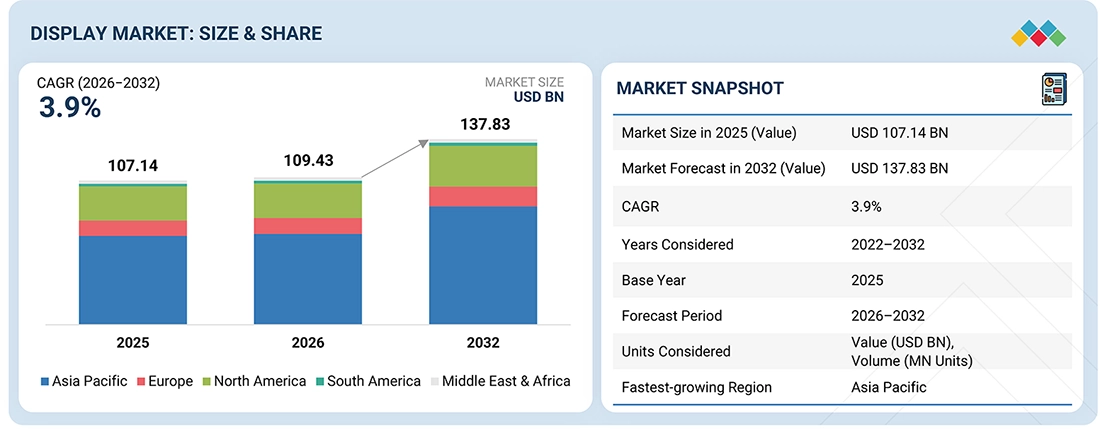
USD 137.83 BN
MARKET SIZE, 2032



Source: Secondary Research, Interviews with Experts, MarketsandMarkets Analysis
The display market is estimated to grow from 109.43 billion in 2026 to USD 137.83 billion by 2032, at a CAGR of 3.9%. The transition from traditional LCD displays to advanced technologies such as OLED, Mini-LED, and Micro-LED is accelerating market growth. These technologies offer advantages including improved image quality, deeper blacks, higher energy efficiency, thinner form factors, and greater design flexibility. Their adoption is expanding beyond premium smartphones and televisions to include laptops, automotive displays, wearables, and commercial applications. Continuous technological advancements and declining manufacturing costs are expected to further support their penetration across multiple verticals, including consumer electronics, sports & entertainment, and automotive.
BY REGION
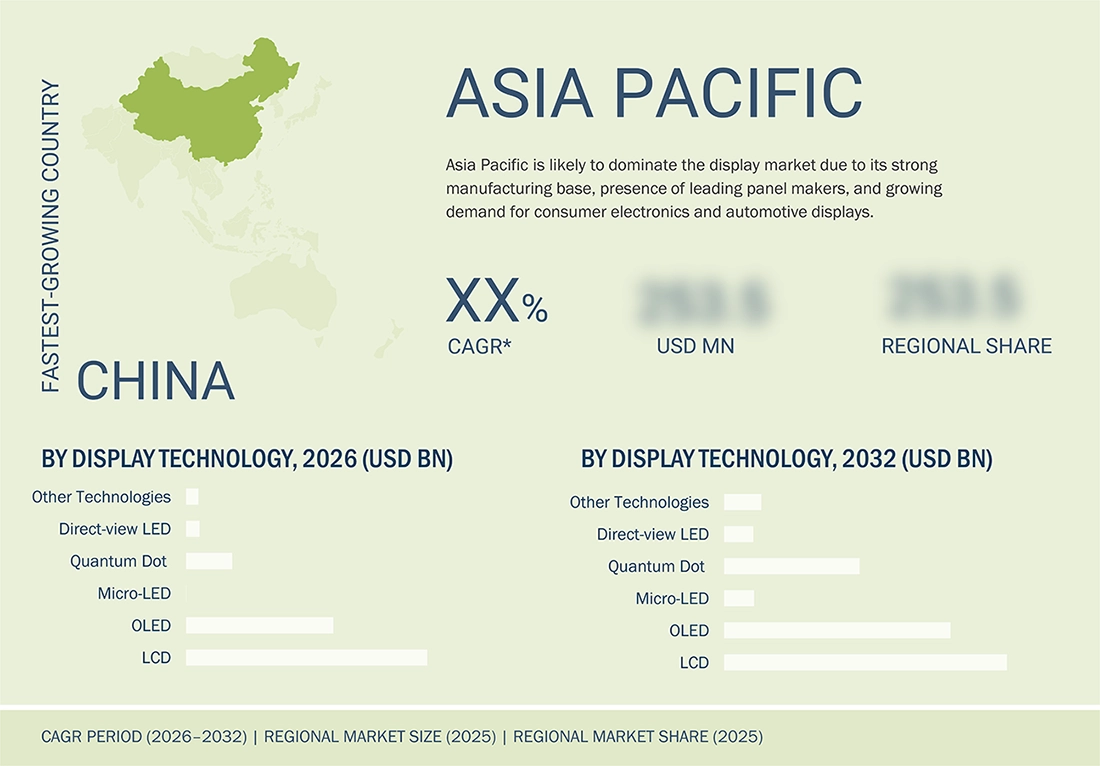
The Asia Pacific region is anticipated to record the highest CAGR of 4.5% in the display market during the forecast period.
BY PANEL SIZE
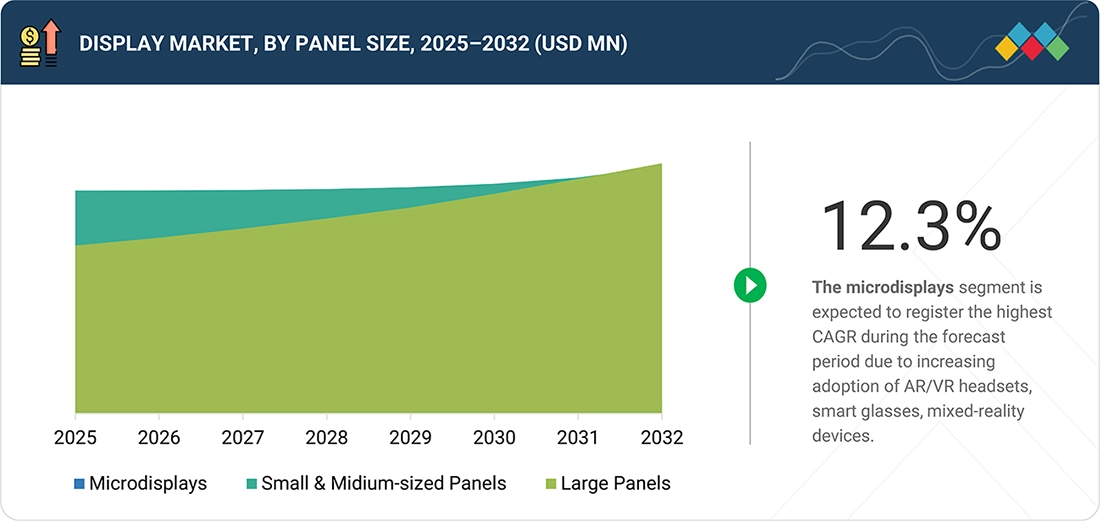
Microdisplays are expected to register the highest CAGR of 12.3% in the display market, by panel size, from 2026 to 2032.
BY VERTICAL
The aerospace & defense vertical is expected to witness the highest CAGR of 22.6% in the display market during the forecast period.
BY DISPLAY TECHNOLOGY
Micro-LED is expected to be the fastest-growing display technology during the forecast period.
BY PRODUCT TYPE
Television sets are expected to account for the largest share of the display market, by product type, in 2032.
COMPETITIVE LANDSCAPE (KEY PLAYERS)
Samsung Display, LG Display, BOE Technology Group, and AUO Corporation were identified as key players in the display market due to their heavy investments in fabrication facilities, process technologies, and research and development to improve resolution, brightness, energy efficiency, and form factors.
COMPETITIVE LANDSCAPE (STARTUPS/SMES)
Porotech, Aledia, and VueReal are notable startups and SMEs that are gaining traction owing to their focus on niche applications, rapid innovation, and customized solutions for wearables, smart glasses, automotive, healthcare, and industrial devices, enabling them to compete effectively with established display manufacturers.
The increasing consumer preference for superior visual experiences is a major factor driving the display market. Demand for high-resolution displays, including Full HD, 4K, and 8K panels, continues to rise across televisions, smartphones, laptops, monitors, and gaming devices. Consumers are increasingly seeking displays with enhanced color accuracy, contrast ratios, brightness, and refresh rates to support high-quality content consumption, gaming, and professional applications. This trend is encouraging manufacturers to invest in advanced display technologies and expand production capacities.
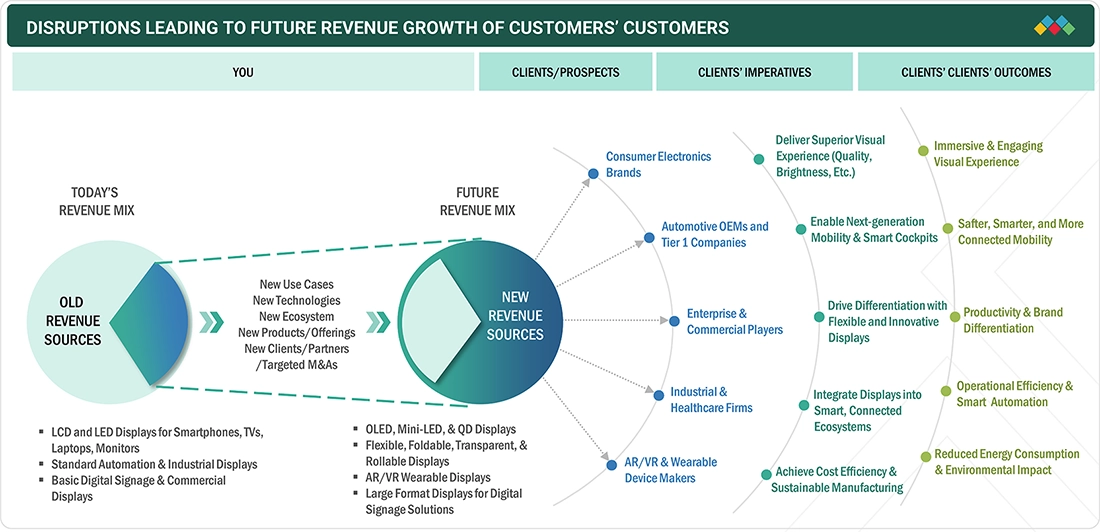
The display market is expected to undergo a significant transformation over the next 7–10 years, with revenue shifting from traditional LCD and LED display technologies toward next-generation display solutions such as OLED, Mini-LED, Micro-LED, QD displays, and flexible form factors. This transition is being driven by the emergence of new use cases, technological innovations, evolving customer requirements, and expanding ecosystem partnerships. Consumer electronics brands, automotive OEMs, enterprise players, industrial users, and AR/VR device manufacturers are increasingly demanding displays that offer superior visual performance, enhanced connectivity, design flexibility, and energy efficiency. As a result, display manufacturers are focusing on advanced display upgrades and innovative solutions that enable immersive user experiences, smart mobility applications, productivity enhancements, and sustainable operations. The analysis highlights that future growth opportunities in the display market will be concentrated in high-value, application-specific display technologies rather than conventional display products, making innovation and portfolio diversification critical for long-term revenue expansion.
Source: Secondary Research, Interviews with Experts, MarketsandMarkets Analysis



OPPORTUNITIES
Impact
Level

Source: Secondary Research, Interviews with Experts, MarketsandMarkets Analysis
The growing consumer preference for enhanced visual experiences is driving demand for high-resolution displays, including 4K and 8K panels, across smartphones, televisions, laptops, gaming monitors, and tablets. Increasing consumption of digital content, gaming, and streaming services is further accelerating the adoption of premium display technologies.
The display market is characterized by intense competition among manufacturers, particularly in Asia Pacific, leading to continuous price reductions and declining average selling prices. While lower prices support demand growth, they also exert significant pressure on profit margins and profitability across the value chain.
Advancements in display materials and manufacturing technologies are enabling the commercialization of flexible, foldable, transparent, and rollable displays. These innovations are creating new product categories and use cases across consumer electronics, automotive, retail, and commercial applications, opening significant growth opportunities for market participants.
Despite their technological advantages, next-generation display technologies such as Micro-LED face challenges related to manufacturing complexity, low production yields, and high production costs. Scaling these technologies for mass-market adoption while maintaining quality and profitability remains a critical challenge for industry participants.
| COMPANY | USE CASE DESCRIPTION | BENEFITS |
|---|---|---|
|
|
Samsung Display continues to expand its OLED portfolio for smartphones, IT devices, automotive displays, and emerging XR applications through innovations in foldable, flexible, and high-resolution display technologies. | Enhanced display quality and color accuracy | Reduced power consumption | Enabled foldable and flexible form factors | Strengthened premium device differentiation |
|
|
BOE is investing heavily in OLED, Mini-LED, and flexible display technologies while expanding production capacity to address growing demand from consumer electronics and automotive applications. | Increased production scalability | Broader customer reach | Enhanced display performance | Improved competitiveness in premium display segments |
|
|
LG Display is advancing OLED and large-format display technologies for TVs, automotive applications, and commercial displays, focusing on improved brightness, durability, and energy efficiency. | Superior viewing experience | Improved energy efficiency | Expanded adoption of OLED technology | Enhanced automotive and premium TV offerings |
Logos and trademarks shown above are the property of their respective owners. Their use here is for informational and illustrative purposes only.
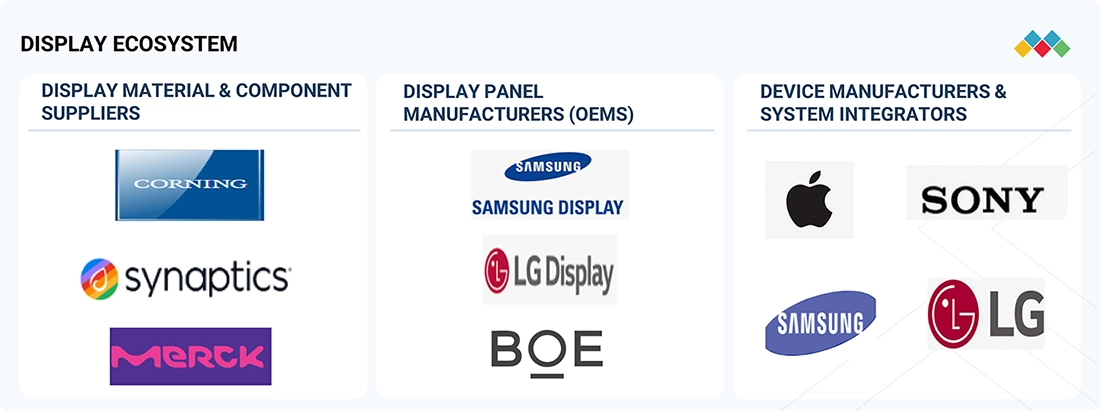
The display ecosystem primarily comprises three interconnected groups that collectively drive innovation, production, and commercialization of display technologies. Display material and component suppliers, such as Corning Incorporated, Merck KGaA, and Universal Display Corporation, provide essential inputs, including display glass, OLED emissive materials, polarizers, driver ICs, and semiconductor components that determine display performance, efficiency, and durability. Display panel manufacturers, including Samsung Display, LG Display, BOE Technology Group, and AUO Corporation, utilize these materials to design and manufacture LCD, OLED, Mini-LED, and Micro-LED panels while investing heavily in advanced fabrication technologies and capacity expansion. Device manufacturers and system integrators, such as Apple Inc., Samsung Electronics, Sony Group Corporation, and LG Electronics, incorporate these display panels into smartphones, televisions, laptops, automotive infotainment systems, digital signage, wearables, and AR/VR devices. Together, these ecosystem participants form an integrated value chain that enables continuous technological advancements and supports the long-term growth of the global display market.
Logos and trademarks shown above are the property of their respective owners. Their use here is for informational and illustrative purposes only.
Source: Secondary Research, Interviews with Experts, MarketsandMarkets Analysis
LCD technology accounts for the largest market share due to its cost-effectiveness, mature manufacturing ecosystem, high production capacity, and widespread adoption across televisions, monitors, laptops, smartphones, digital signage, and industrial applications. Despite the growing adoption of OLED and Micro-LED technologies, LCD remains the preferred choice for high-volume and price-sensitive applications because it offers a strong balance of performance, reliability, and affordability.
The microdisplays segment is expected to register the highest CAGR during the forecast period due to increasing demand for AR/VR headsets, smart glasses, mixed-reality devices, wearable electronics, and defense visualization systems, all of which require compact, lightweight, and ultra-high-resolution displays with high pixel density and low power consumption.
Smartphones are expected to account for the largest share of the display market during 2026–2032 due to their high shipment volumes, widespread global adoption, and increasing integration of advanced display technologies such as OLED, LTPO OLED, and foldable displays. Continuous device replacement cycles and growing demand for premium smartphones further support the segment's dominant market position.
Consumer electronics is expected to account for the largest share of the display market during the forecast period owing to the massive shipment volumes of smartphones, televisions, laptops, monitors, tablets, and wearable devices. Continuous product replacement cycles, increasing adoption of OLED and Mini-LED technologies, and growing demand for high-resolution displays contribute to the segment's dominant position.
Asia Pacific is expected to dominate the display market in terms of both market share and CAGR due to the presence of major display manufacturers such as Samsung Display and LG Display, coupled with the region's extensive consumer electronics manufacturing ecosystem. The growing adoption of smartphones, televisions, laptops, electric vehicles, and advanced display technologies such as OLED and Micro-LED, particularly in China, South Korea, Japan, and India, further supports the region's leadership position and sustained market growth.
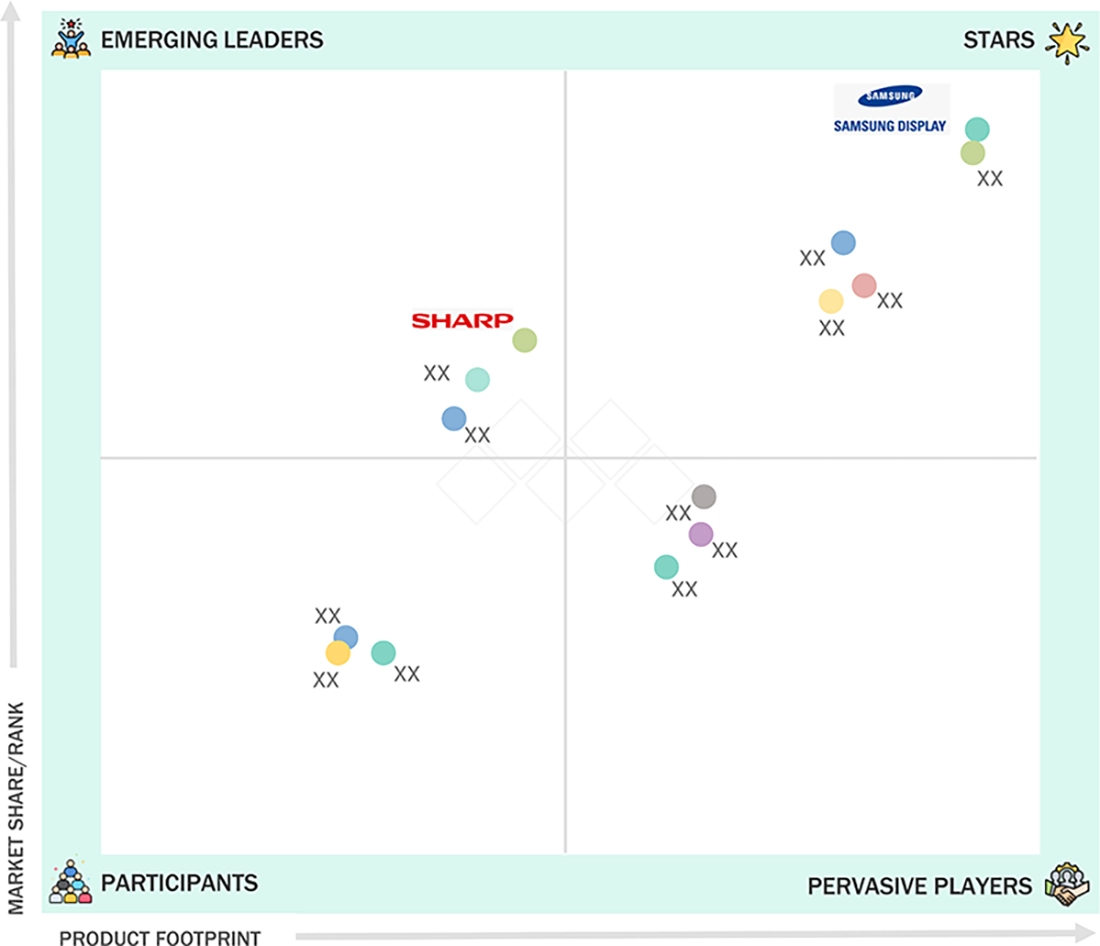
Samsung Display is a star player in the display market owing to its leadership in OLED technologies, large-scale manufacturing capabilities, and continuous innovation in next-generation displays. In contrast, Sharp Corporation is emerging as a leader by expanding its presence in high-value segments such as automotive, industrial, and large-format displays, leveraging its expertise in advanced display technologies and niche applications.
Source: Secondary Research, Interviews with Experts, MarketsandMarkets Analysis
| REPORT METRIC | DETAILS |
|---|---|
| Market Size in 2025 (Value) | USD 107.14 Billion |
| Market Forecast in 2026 (Value) | USD 109.43 Billion |
| Market Forecast in 2032 (Value) | USD 137.83 Billion |
| CAGR | CAGR of 3.9% from 2026-2032 |
| Years Considered | 2022–2032 |
| Base Year | 2025 |
| Forecast Period | 2026–2032 |
| Units Considered | Value (USD Billion), Volume (Million Units) |
| Report Coverage | Revenue Forecast, Company Ranking, Competitive Landscape, Growth Factors, and Trends |
| Segments Covered |
|
| Regions Covered | North America, Europe, Asia Pacific, South America, and Middle East & Africa |
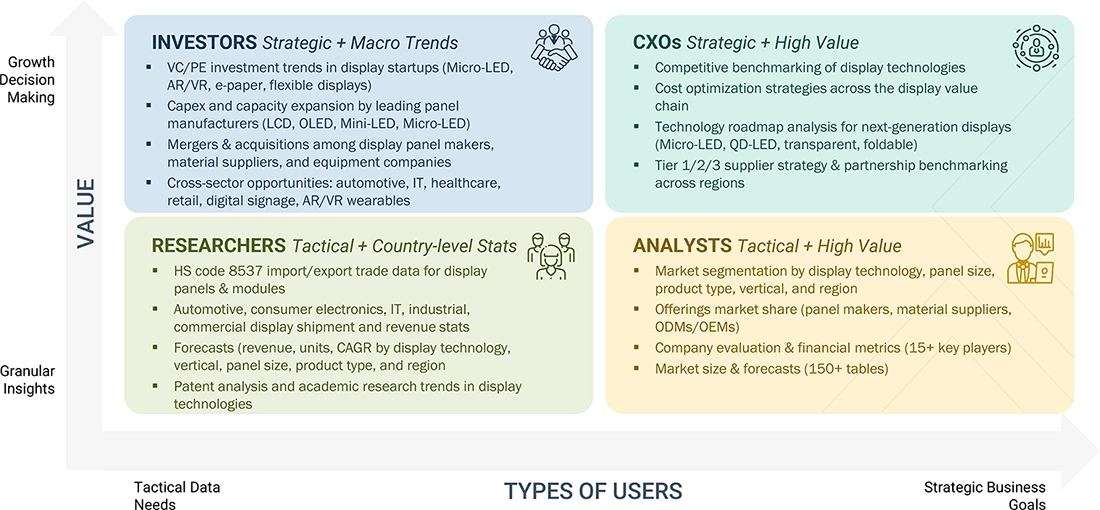
We have successfully delivered the following deep-dive customizations:
| CLIENT REQUEST | CUSTOMIZATION DELIVERED | VALUE ADDS |
|---|---|---|
| Consumer Electronics OEM | Competitive benchmarking of OLED, LCD, Mini-LED, and Micro-LED adoption strategies, display sourcing analysis, and product roadmap assessment across smartphones, TVs, laptops, tablets, and wearables |
|
| Display Panel Manufacturer | Application-specific analysis of display demand across consumer electronics, automotive, healthcare, industrial, and commercial sectors, including technology transition assessment and capacity planning |
|
| Display Material & Component Supplier | Assessment of demand trends for display glass, OLED materials, driver ICs, backlighting units, polarizers, and semiconductor components, including supply chain and pricing analysis |
|
| Automotive & Mobility Company | Evaluation of display requirements for digital cockpits, infotainment systems, passenger displays, head-up displays (HUDs), and software-defined vehicles |
|
| Commercial Display & Digital Signage Provider | Analysis of display deployment trends across retail, hospitality, transportation, education, healthcare, and smart city infrastructure applications |
|
| AR/VR & Wearable Device Developer | Evaluation of microdisplay technologies, display performance requirements, supply ecosystem, and commercialization strategies for smart glasses and immersive devices |
|
| Industrial & Healthcare Equipment Manufacturer | Assessment of display adoption trends in medical imaging, surgical visualization, industrial automation, control systems, and ruggedized display applications |
|
 Exclusive indicates content/data unique to MarketsandMarkets and not available with any competitors.
4
MARKET OVERVIEW
Maps the market evolution with focus on trend catalysts, risk factors, and growth opportunities across segments.4.3
INTERCONNECTED MARKET AND CROSS-SECTOR OPPORTUNITIES
4.4
STRATEGIC MOVES BY TIER 1/2/3 PLAYERS
5
INDUSTRY TRENDS
Captures industry movement, adoption patterns, and strategic signals across key end-use segments and regions.5.1
PORTER’S FIVE FORCES ANALYSIS
5.2
MACROECONOMICS OUTLOOK
5.2.2
GDP TRENDS AND FORECAST
5.2.3
TRENDS IN GLOBAL DISPLAY INDUSTRY
5.5.1
AVERAGE SELLING PRICE TREND OF DISPLAY TECHNOLOGY, BY KEY PLAYER, 2022–2025
5.5.2
AVERAGE SELLING PRICE TREND, BY REGION, 2022–2025
5.5.3
PRICING RANGE OF DISPLAYS, BY PANEL SIZE,
5.5.4
PRICING RANGE OF PRODUCTS, BY PANEL SIZE,
5.6.1
IMPORT SCENARIO (HS CODE 8537)
5.6.2
EXPORT SCENARIO (HS CODE 8537)
5.7
KEY CONFERENCE AND EVENTS, 2026–2027
5.8
TRENDS/ DISRUPTION IMPACTING CUSTOMER BUSINESS
5.9
INVESTMENT AND FUNDING SCENARIO
5.11
IMPACT OF US TARIFF – DISPLAY MARKET
5.11.3
PRICE IMPACT ANALYSIS
5.11.4
IMPACT ON COUNTRIES/REGIONS
5.11.5
IMPACT ON VERTICALS
6
STRATEGIC DISRUPTION, PATENTS, DIGITAL, AND AI ADOPTIONS
6.1
KEY EMERGING TECHNOLOGIES
6.2
COMPLEMENTARY TECHNOLOGIES
6.3
TECHNOLOGY/PRODUCT ROADMAPS
6.5
IMPACT OF AI/GEN AI ON THE DISPLAY MARKET
6.5.1
TOP USE CASES AND MARKET POTENTIAL
6.5.2
BEST PRACTICES IN THE DISPLAY MARKET
6.5.3
CASE STUDIES OF AI IMPLEMENTATION IN THE DISPLAY MARKET
6.5.4
INTERCONNECTED ADJACENT ECOSYSTEM AND IMPACT ON MARKET PLAYERS
6.5.5
CLIENTS’ READINESS TO ADOPT GENERATIVE AI IN THE DISPLAY MARKET
6.6
SUCCESS STORIES AND REAL-WORLD APPLICATIONS
7.1
REGIONAL REGULATIONS AND COMPLIANCE
7.1.1
REGULATORY BODIES, GOVERNMENT AGENCIES, AND OTHER ORGANIZATIONS
8
CUSTOMER LANDSCAPE & BUYER BEHAVIOR
8.2
DECISION-MAKING PROCESS
8.3
BUYER STAKEHOLDERS AND BUYING EVALUATION CRITERIA
8.3.1
KEY STAKEHOLDERS IN BUYING PROCESS
8.4
ADOPTION BARRIERS & INTERNAL CHALLENGES
8.5
UNMET NEEDS OF VARIOUS VERTICALS
9
DIFFERENT DISPLAY DIMENSIONS IN DISPLAY MARKET
10
DIFFERENT DISPLAY RESOLUTIONS IN DISPLAY MARKET
11
DIFFERENT DISPLAY PANEL TYPES IN DISPLAY MARKET
12
DIFFERENT INTERACTIVE CAPABILITIES IN DISPLAY MARKET
12.3
INTERACTIVE DISPLAYS
13
DIFFERENT FORM FACTORS IN DISPLAY MARKET
14
DIFFERENT REFRESH RATES IN DISPLAY MARKET
15
DISPLAY MARKET, BY DISPLAY TECHNOLOGY
Market Size, Volume & Forecast – USD Million15.5
DIRECT-VIEW LED (DLED)
15.7
OTHER DISPLAY TECHNOLOGIES (LCOS, DLP)
16
DISPLAY MARKET, BY PANEL SIZE
Market Size, Volume & Forecast – USD Million16.2
MICRODISPLAYS (UP TO 2 INCHES)
16.3
SMALL & MEDIUM-SIZED PANELS (2–32 INCHES)
16.4
LARGE PANELS (GREATER THAN 32 INCHES)
17
DISPLAY MARKET, BY PRODUCT TYPE
Market Size, Volume & Forecast – USD Million17.5
DIGITAL SIGNAGE & LARGE FORMAT DISPLAYS
17.9
OTHER PRODUCTS (E-READERS, GAMING CONSOLES, SMART MIRRORS, HOME APPLIANCES, CAMERAS AND ELECTRONIC VIEWFINDERS (EVFS), PHOTO FRAMES, MEDICAL DEVICES, INDUSTRIAL DISPLAYS, AND PROJECTORS)
18
DISPLAY MARKET, BY VERTICAL
Market Size, Volume & Forecast – USD Million18.2
CONSUMER ELECTRONICS
18.4
SPORTS & ENTERTAINMENT
18.6
RETAIL, HOSPITALITY & BFSI
18.7
INDUSTRIAL & ENTERPRISE
18.10
AEROSPACE & DEFENSE
18.11
OTHER VERTICALS (GOVERNMENT, ENERGY & POWER)
19
DISPLAY MARKET, BY REGION
Market Size, Volume & Forecast – USD Million19.4.5
REST OF ASIA PACIFIC
19.5.3
REST OF SOUTH AMERICA
19.6
MIDDLE EAST & AFRICA
19.6.3
REST OF MIDDLE EAST & AFRICA
20.2
KEY PLAYER COMPETITIVE STRATEGIES/RIGHT TO WIN (JANUARY 2023–MAY 2026)
20.3
REVENUE ANALYSIS (2021 – 2025)
20.4
MARKET SHARE ANALYSIS,
20.5
BRAND/PRODUCT/TECHNOLOGY COMPARISON
20.6
COMPANY EVALUATION MATRIX: KEY PLAYERS,
20.6.5
COMPANY FOOTPRINT: KEY PLAYERS,
20.6.5.1
COMPANY FOOTPRINT
20.6.5.2
REGION FOOTPRINT
20.6.5.3
DISPLAY TECHNOLOGY FOOTPRINT
20.6.5.4
PANEL SIZE FOOTPRINT
20.6.5.5
PRODUCT TYPE FOOTPRINT
20.6.5.6
VERTICAL FOOTPRINT
20.7
COMPANY EVALUATION MATRIX: STARTUPS/SMES,
20.7.1
PROGRESSIVE COMPANIES
20.7.2
RESPONSIVE COMPANIES
20.7.5
COMPETITIVE BENCHMARKING: STARTUPS/SMES,
20.7.5.1
DETAILED LIST OF KEY STARTUPS/SMES
20.7.5.2
COMPETITIVE BENCHMARKING OF KEY STARTUPS/SMES
20.8
COMPANY VALUATION AND FINANCIAL METRICS
20.9
COMPETITIVE SCENARIO
21
DISPLAY MARKET, COMPANY PROFILES
21.1.3
BOE TECHNOLOGY GROUP
21.1.5
INNOLUX CORPORATION
21.1.7
TCL CSOT TECHNOLOGY CO., LTD.
21.1.8
SONY GROUP CORPORATION
21.2.2
TIANMA MICROELECTRONICS CO., LTD.
21.2.4
TRULY INTERNATIONAL HOLDINGS LIMITED
21.2.5
PANASONIC HOLDINGS CORPORATION
21.2.9
NORITAKE ITRON CORP.
21.2.10
JAPAN DISPLAY INC.
21.2.11
UNILUMIN GROUP CO., LTD.
21.2.14
WINSTAR DISPLAY CO., LTD.
21.2.15
WISECHIP SEMICONDUCTOR INC.
22.1.2
KEY DATA FROM SECONDARY SOURCES
22.1.3.1
KEY DATA FROM PRIMARY SOURCES
22.1.3.2
KEY PRIMARY PARTICIPANTS
22.1.3.3
BREAKDOWN OF PRIMARY INTERVIEWS
22.1.3.4
KEY INDUSTRY INSIGHTS
22.2
MARKET SIZE ESTIMATION
22.2.1
BOTTOM-UP APPROACH
22.2.3
MARKET SIZE CALCULATION FOR BASE YEAR
22.3
MARKET FORECAST APPROACH
22.6
RESEARCH ASSUMPTIONS
22.7
RESEARCH LIMITATIONS
23.2
KNOWLEDGE STORE: MARKETSANDMARKETS’ SUBSCRIPTION PORTAL
23.3
CUSTOMIZATION OPTIONS
The research process for this technical, market-oriented, and commercial study of the display market included the systematic gathering, recording, and analysis of data about companies operating in the market. It involved the extensive use of secondary sources, directories, and databases (Factiva and Oanda) to identify and collect relevant information. In-depth interviews were conducted with various primary respondents, including experts from core and related industries and preferred manufacturers, to obtain and verify critical qualitative and quantitative information as well as to assess the growth prospects of the market. Key players in the display market were identified through secondary research, and their market rankings were determined through primary and secondary research. This included studying annual reports of top players and interviewing key industry experts, such as CEOs, directors, and marketing executives.
Secondary ResearchIn the secondary research process, various secondary sources were referred to for identifying and collecting information relevant to this study. Secondary sources include annual reports, press releases, and investor presentations of companies; white papers, certified publications, and articles from recognized authors; directories; and databases. Secondary research has been mainly conducted to obtain key information about the supply chain and value chain of the industry; a total pool of key players; segmentation of the market according to the industry trends, geographic markets, and key developments from market- and technology-oriented perspectives.
Primary ResearchIn the primary research process, primary sources from the supply and demand sides were interviewed to obtain qualitative and quantitative information for this report. Primary sources from the supply side include experts, such as CEOs, vice presidents, marketing directors, technology and innovation directors, subject-matter experts, consultants, and related key executives from major companies and organizations operating in the display market.
After the complete market engineering process (market statistics calculations, market breakdown, market size estimations, market forecasting, and data triangulation), extensive primary research was conducted to gather information and verify and validate the critical market numbers.
Several primary interviews were conducted with experts from the demand and supply sides across four major regions—North America, Europe, Asia Pacific, and RoW (South America and the Middle East & Africa). This primary data was collected through questionnaires, emails, and telephonic interviews.
BREAKDOWN OF PRIMARY INTERVIEW PARTICIPANTS

Note: Other designations include product managers, sales managers, and marketing managers.
Three tiers of companies have been defined based on their total revenue as of 2025: tier 3: revenue less than USD 500 million; tier 2: revenue between USD 500 million and USD 1 billion; and tier 1: revenue more than USD 1 billion.
RoW includes South America and the Middle East & Africa.
To know about the assumptions considered for the study, download the pdf brochure
In the complete market engineering process, top-down and bottom-up approaches and several data triangulation methods were used to estimate and forecast the overall market segments and subsegments listed in this report. Key players in the market were identified through secondary research, and their market shares in the respective regions were determined through primary and secondary research. This entire procedure included the study of annual and financial reports of the top market players and extensive interviews for key insights (quantitative and qualitative) with industry experts (CEOs, VPs, directors, and marketing executives).
All percentage shares, splits, and breakdowns were determined using secondary sources and verified through primary sources. All the parameters affecting the markets covered in this research study were accounted for, viewed in detail, verified through primary research, and analyzed to obtain the final quantitative and qualitative data. This data was consolidated and supplemented with detailed inputs and analysis from MarketsandMarkets and presented in this report.
BOTTOM-UP APPROACH
TOP-DOWN APPROACH

After arriving at the overall market size, the market was split into several segments and subsegments using the market size estimation processes as explained above. Data triangulation and market breakdown procedures were employed to complete the entire market engineering process and determine each market segment's and subsegment's exact statistics. The data was triangulated by studying various factors and trends from the demand and supply sides in the display market.
The display market comprises technologies, components, and systems used to visualize information, images, videos, and interactive content across a wide range of electronic devices and applications. The market includes display panels and solutions based on LCD, OLED, Mini-LED, Micro-LED, Quantum Dot, and other emerging technologies used in smartphones, televisions, laptops, monitors, tablets, wearables, automotive displays, digital signage, industrial equipment, healthcare devices, and AR/VR systems. Market growth is driven by increasing demand for high-resolution, energy-efficient, and advanced display solutions that enhance user experience, support digital transformation, and enable next-generation applications across consumer, commercial, automotive, and industrial sectors.
With the given market data, MarketsandMarkets offers customizations according to the company’s specific needs. The following customization options are available for the report:


Business Development Manager-Technology Business
Leading Japanese MNC specializing in optics and imaging products
MarketsandMarkets™ response is quick. Their attitude is flexible and positive. Analyst Insights are globally considered and significant. Client Services quickly respond to our inquiry and demand. Their wide range of global surveys help us make our strategic plan.
We hope Knowledge Store will be easier to search for a report.
We engaged with MarketsandMarkets on a study to perform an analysis and recommend a Go-To-Market strategy for metrology and process control in the semiconductor market. The study was tailored to our targets and needs with well-defined milestones. Our overall experience with the MarketsandMarkets team was very good throughout the project in all aspects including the analysis methodologies used, the quality and depth of primary and secondary data sets, the professionalism and flexibility of the team and the ability to meet the target schedule and milestones. We want to thank MarketsandMarkets team for a job well done.