Просмотр новости
Найдите то, что Вас интересует
 Спутники
 РН
РН SpaceX
 Роскосмос
 NASA
NASA
СпутникиРНSpaceXРоскосмосNASA

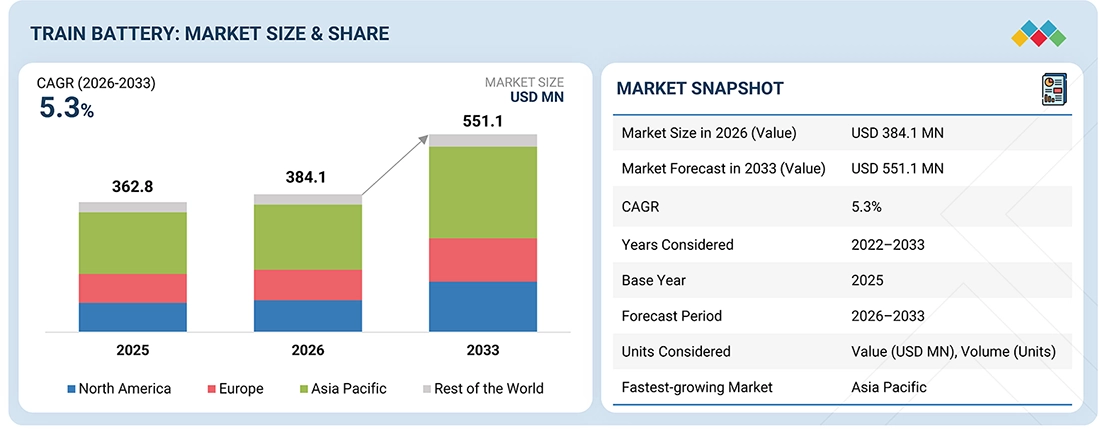
USD 551.1 MN
MARKET SIZE, 2033



Source: Secondary Research, Interviews with Experts, MarketsandMarkets Analysis
The train battery market is projected to grow from USD 384.1 million in 2026 to USD 551.1 million by 2033, reflecting a CAGR of 5.3%. The global rolling stock industry is undergoing a significant transformation, driven by decarbonization goals, railway electrification programs, urban transit expansion, and fleet modernization initiatives. Rail operators worldwide are increasingly adopting electric, hybrid-electric, battery-electric, and diesel-electric rolling stock to reduce emissions and improve operational efficiency. As rolling stock OEMs integrate advanced battery systems for propulsion, regenerative braking, energy storage, and auxiliary power, train batteries are becoming a critical enabler of sustainable rail transportation. Battery chemistry preferences are also evolving across regions. Lithium Iron Phosphate (LFP) batteries are expected to see the highest demand in China, India, and Southeast Asia due to their longer cycle life, superior thermal stability, and lower lifecycle costs, making them well-suited for metro and regional rail applications. In contrast, Nickel Manganese Cobalt (NMC) batteries are expected to dominate in Europe and North America, where higher energy density is preferred for longer-range battery-electric and hybrid trains operating on non-electrified regional routes. Supported by rail decarbonization initiatives, fleet replacement programs, and rising investments in low-carbon mobility, the train battery market is emerging as a high-growth opportunity for battery suppliers, rolling stock manufacturers, and investors across the global railway value chain.
BY REGION
Asia Pacific holds the largest market for train battery market, with a share >40% in terms of value, in 2026.
BY BATTERY TYPE
The auxiliary battery segment is the fastest-growing segment, with a CAGR of more than 4.6% in terms of value.
BY BATTERY TECHNOLOGY
Nickel-cadmium batteries hold the largest market share of >70%, in terms of value, in 2026.
BY ENGIE HEAD
Electric locomotive will be the fastest-growing in engine/head segment, in terms of value.
BY APPLICATION
The passenger coaches segment holds the major market share among applications, in terms of value.
BY ADVANCE TRAIN TYPE
The full-battery operated train segment is expected to be the fastest-growing in the advance train type segment.
AFTERMARKET, BY ROLLING STOCK
Passenger coaches holds the largest market share of >65% in terms of value
AFTERMARKET, BY BATTERY TYPE
Nickel-cadmium batteries is the fastest-growing segment with a CAGR more than 4.0%
AFTERMARKET, BY APPLICATION
Auxiliary batteries holds the largest market in aftermarket, by application segment with a market share more than 65%, in terms of value
COMPETITIVE LANDSCAPE
Key players such as Saft, Enersys, Exide Industries, GS Yuasa Corporation, Amara Raja Batteries Ltd, and Hoppecke Batterien Gmbh & Co. Kg are contributing to market growth through continuous investments in advanced lithium-ion and next-generation battery technologies, strategic collaborations with rolling stock OEMs, and the development of high-performance energy storage systems for electric, hybrid, metro, and high-speed trains.
The growing electrification of railway networks, expansion of metro systems, and modernization of rolling stock fleets are driving demand for auxiliary and starter batteries across locomotives, EMUs, DMUs, coaches, trams, metros, and high-speed trains. These batteries support critical functions such as engine starting, emergency backup power, signaling, communication, lighting, HVAC, and onboard electronics. Ni-Cd batteries remain the preferred choice for auxiliary applications due to their reliability, long service life, and ability to withstand harsh operating conditions, particularly in Europe and North America. Lead-acid batteries continue to be widely used for starter applications in diesel-electric locomotives because of their cost-effectiveness and proven performance. Meanwhile, LFP batteries are gaining traction in the Asia-Pacific region, especially in China and India, owing to their enhanced safety, longer cycle life, and lower lifecycle costs. As rail operators continue to modernize fleets and expand rail networks, demand for advanced auxiliary and starter batteries is expected to grow steadily.
The train battery market is being shaped by several transformative trends, including the shift toward decarbonized rail transport, growing adoption of battery-electric and hybrid trains, expansion of metro and high-speed rail networks, and increased railway electrification. Rising demand for longer operating ranges, faster charging, improved safety, and lower total cost of ownership is driving innovation in battery technologies, battery management systems, and energy storage solutions. At the same time, digitalization, adoption of regenerative braking, battery recycling initiatives, and stricter environmental regulations are disrupting traditional rail power systems, positioning advanced train batteries as a critical enabler of a future sustainable and energy-efficient railway ecosystem.
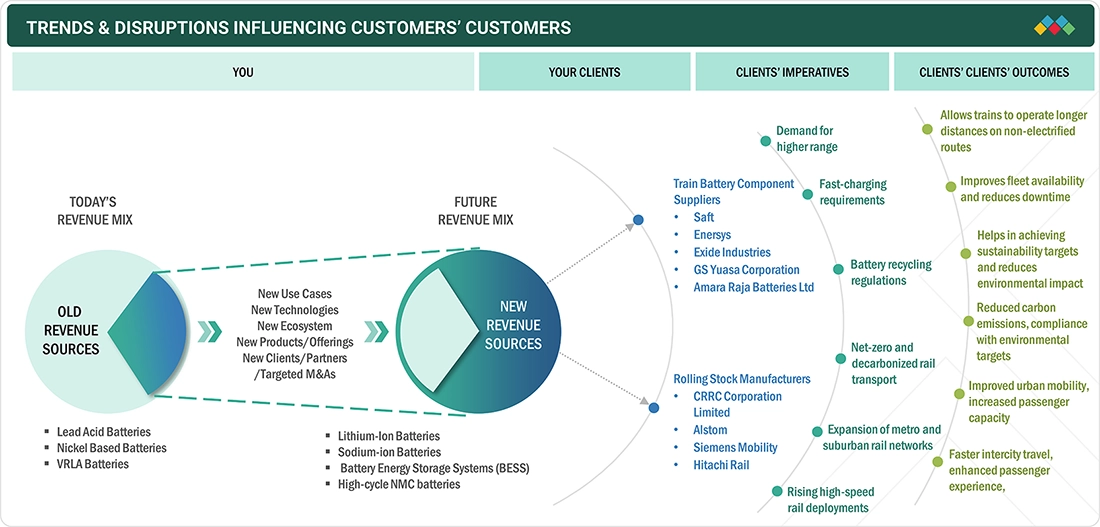
Source: Secondary Research, Interviews with Experts, MarketsandMarkets Analysis




OPPORTUNITIES
Impact
Level

Source: Secondary Research, Interviews with Experts, MarketsandMarkets Analysis
Grid decarbonization and regenerative energy utilization strategies are emerging as major drivers of the train battery market as rail operators and governments seek to reduce carbon emissions and improve energy efficiency across railway networks. Modern trains with regenerative braking systems capture and store energy generated during braking, which can then be reused for auxiliary systems, reducing overall energy consumption. As railways increasingly integrate renewable energy sources and pursue net-zero targets, advanced battery systems are becoming essential for energy storage, load balancing, and maximizing the use of recovered energy. Demand is also rising among high-speed and intercity passenger trains that require reliable backup power for signaling, HVAC, communications, and onboard systems during power interruptions. Regionally, Europe and Japan are seeing growing interest in Lithium Titanate Oxide (LTO) batteries for select rail applications because of their superior safety, long cycle life, and strong performance under frequent charge-discharge cycles, while China and India are increasingly adopting Lithium Iron Phosphate (LFP) batteries in metro and regional rail networks because of their lower lifecycle costs, enhanced safety, and robust domestic manufacturing ecosystems. These trends are accelerating demand for advanced train batteries that support reliable, energy-efficient, and low-emission rail operations.
High lifecycle costs and operational reliability concerns remain key constraints on the train battery market, as battery systems account for a significant share of the total cost of battery-electric and hybrid rail vehicles. Rail operators require batteries that can withstand demanding operating conditions, frequent charge-discharge cycles, and long service lives while maintaining consistent performance and safety. Battery degradation over time, replacement costs, thermal management requirements, and the need for specialized maintenance can increase the total cost of ownership. Additionally, concerns about battery performance under extreme temperatures, during long-distance operations, and in mission-critical rail applications may slow adoption, particularly among operators prioritizing proven reliability and long-term operational efficiency.
Retrofitting existing rolling stock is emerging as a significant opportunity for the train battery market, particularly in regions where rail operators are pursuing decarbonization without the high cost of procuring new trains. Rather than converting diesel-electric locomotives into fully battery-powered trains, operators are increasingly focusing on diesel-to-electro-diesel and electro-diesel-to-battery-assisted retrofits, enabling trains to operate more efficiently on both electrified and non-electrified routes while reducing fuel consumption and emissions. This trend is most prominent in Europe, where stringent emissions regulations and extensive rail electrification programs are encouraging operators to modernize aging fleets through battery integration and energy management upgrades. Battery retrofits are also gaining traction in select passenger and regional rail applications in the UK, Germany, and other European markets as a cost-effective alternative to full fleet replacement. As railways continue to extend asset life while meeting sustainability targets, demand for auxiliary batteries, onboard energy storage systems, battery management systems, and retrofit integration services is expected to grow, creating new revenue opportunities across the train battery value chain.
Battery performance limitations in heavy-duty and long-range rail operations remain a significant challenge for the train battery market, as freight locomotives, high-speed trains, and long-distance regional services require substantial energy capacity and continuous power output. Current battery technologies often face trade-offs between energy density, weight, charging time, and operational range, making it difficult to fully replace diesel traction in demanding rail applications. Large battery packs can increase vehicle weight, impact payload capacity, and raise capital costs, while range limitations may require additional charging infrastructure or hybrid power systems. As a result, battery manufacturers and rolling stock OEMs must continue advancing battery chemistry, energy management systems, and charging technologies to meet the performance, reliability, and operational requirements of heavy-duty rail transport.
| COMPANY | USE CASE DESCRIPTION | BENEFITS |
|---|---|---|
|
|
Expanding its NexSys iON lithium-ion battery platform, advanced Thin Plate Pure Lead (TPPL) batteries, and intelligent Battery Management Systems (BMS) for transportation and industrial applications | Enables EnerSys to address growing demand for maintenance-free, longer-life, and digitally connected battery systems in modern rail fleets |
|
|
Investing in Intensium lithium-ion battery systems, rail-certified LFP (Lithium Iron Phosphate) and NMC-based energy storage solutions, and modular traction battery platforms for battery-electric and hybrid trains | Strengthens its position in battery-electric rolling stock, hybrid train projects, and railway decarbonization initiatives |
|
|
Focusing on industrial lithium-ion batteries, high-capacity LIM series lithium-ion systems, energy storage systems (ESS), and next-generation high-cycle-life battery technologies | Supports demand for reliable, long-life batteries in metros, passenger trains, and railway backup power applications while expanding into future traction battery opportunities |
|
|
Investing in LFP lithium-ion cell manufacturing, battery pack assembly, Battery Management Systems (BMS), and gigafactory development through its advanced energy business | Positions the company to benefit from India's railway electrification, metro expansion, and increasing localization of lithium-ion battery sourcing |
Logos and trademarks shown above are the property of their respective owners. Their use here is for informational and illustrative purposes only.
The ecosystem mapping highlights various train battery market players, including raw material suppliers, component suppliers, OEMs, dealers & distributors, and end users. The leading players in the train battery market are Saft (France), Enersys (US), Exide Industries (India), GS Yuasa Corporation (Japan), and Amara Raja Batteries Ltd (India), among others.
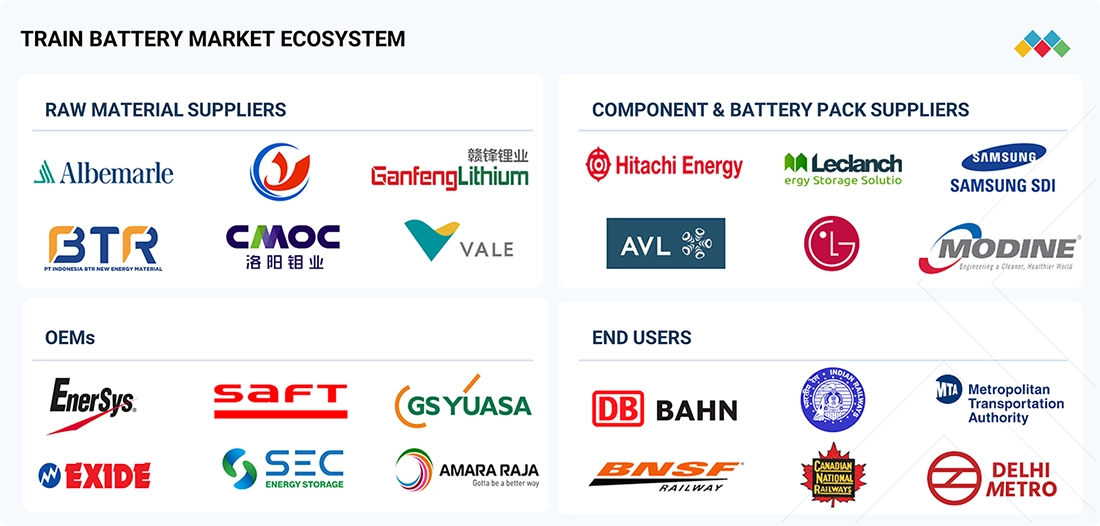
Logos and trademarks shown above are the property of their respective owners. Their use here is for informational and illustrative purposes only.
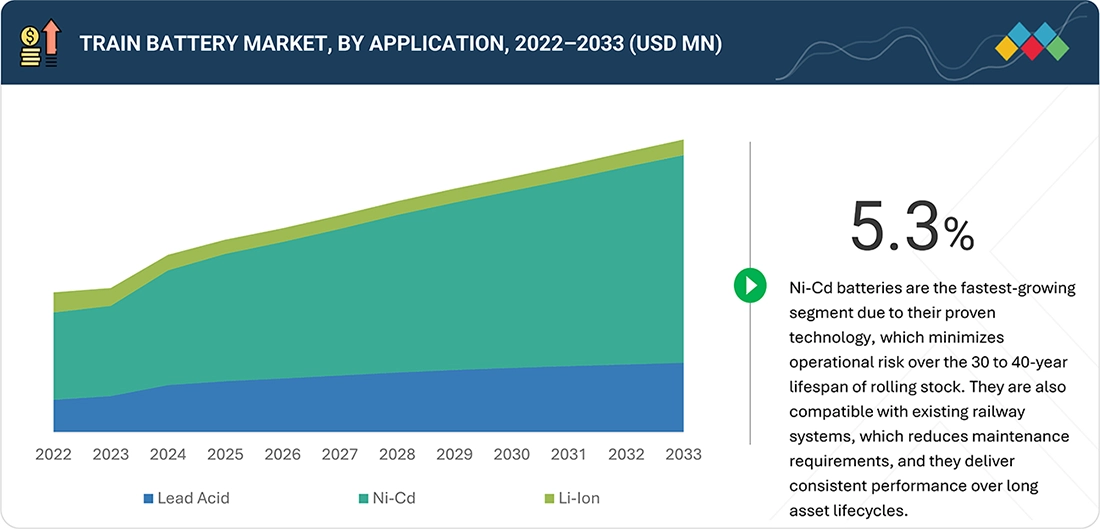
Source: Secondary Research, Interviews with Experts, MarketsandMarkets Analysis
The train battery market is expanding across battery types, driven primarily by the growing deployment of advanced onboard electronic and safety systems that require reliable auxiliary power, even when the main traction system is shut down. Modern rolling stock, including locomotives, EMUs, DMUs, metros, trams, coaches, and high-speed trains, increasingly relies on auxiliary batteries to support critical applications such as Train Control & Management Systems (TCMS), emergency lighting, signaling and safety systems, CCTV, communication networks, Wi-Fi, automatic door operation, HVAC, condition monitoring sensors, predictive maintenance platforms, and ETCS/PTC signaling equipment. This trend is particularly strong in Europe and North America, where railway operators are investing heavily in digitalization and intelligent fleet management, driving demand for high-cycle, maintenance-friendly auxiliary batteries. In terms of battery chemistry, Ni-Cd batteries remain the preferred choice for safety-critical auxiliary applications due to their proven reliability, long service life, and resistance to harsh operating conditions, especially in Europe and North America. Meanwhile, LFP batteries are gaining traction in China, India, and other Asia-Pacific markets because of their enhanced safety, longer cycle life, and lower lifecycle costs, while lead-acid batteries continue to be used in cost-sensitive starter and auxiliary applications. As rail operators continue to modernize fleets and expand digital train capabilities, demand for advanced auxiliary battery systems is expected to increase steadily, driving growth across the train battery market.
Nickel-Cadmium (Ni-Cd) batteries continue to dominate the train battery market because they are widely used as auxiliary and backup power batteries in locomotives, EMUs, DMUs, passenger coaches, metros, trams, and high-speed trains, where reliability and safety are critical. These rolling stock types require uninterrupted power for signaling, train control systems, emergency lighting, communication equipment, HVAC, door operation, and onboard electronics, even under extreme temperatures, vibration, and frequent charge-discharge cycles. Ni-Cd batteries are preferred for these applications because of their long service life, high durability, low maintenance requirements, and proven performance in harsh railway environments. Regionally, demand is strongest in Europe, where stringent railway safety standards and the large installed base of passenger trains, metros, and high-speed rail systems continue to support Ni-Cd adoption. North America also represents a significant market, particularly for locomotives and passenger rail fleets that require dependable auxiliary power systems. Meanwhile, Asia-Pacific remains a major consumer due to ongoing metro expansions, high-speed rail investments, and fleet modernization programs, although some operators are gradually introducing lithium-based alternatives for selected applications. The large installed base of rolling stock using Ni-Cd batteries and the recurring need for battery replacements continue to support strong demand for this technology across global railway networks.
Modern passenger coaches rely heavily on battery systems to power lighting, HVAC, passenger information displays, Wi-Fi, CCTV, communication systems, automatic doors, and emergency backup functions. As rail operators invest in fleet modernization, premium passenger experiences, and smart rail technologies, the battery content per coach is rising. In addition, the expansion of intercity, regional, and high-speed rail networks across Asia Pacific, Europe, and the Middle East is driving the procurement of new passenger coaches equipped with advanced auxiliary power systems. The need to ensure the uninterrupted operation of critical onboard systems, even during power disruptions, continues to strengthen demand for reliable train batteries in the passenger coach segment.
The multiple units (EMUs and DMUs) segment is expected to drive growth in the train battery aftermarket owing to their high utilization rates, intensive operating schedules, and increasing reliance on battery-powered auxiliary systems. Unlike locomotives, multiple units operate with distributed power architectures and a larger number of onboard systems, including HVAC, passenger information displays, communication systems, lighting, CCTV, automatic doors, and train control equipment, all of which depend on reliable battery performance. Frequent charge-discharge cycles, coupled with the need to maintain high fleet availability and passenger service reliability, result in regular battery replacement and maintenance requirements. Regionally, EMUs account for the largest share of aftermarket demand in Asia-Pacific and Europe, supported by extensive metro, suburban, regional, and high-speed rail networks in countries such as China, India, Japan, Germany, and France. Meanwhile, DMUs continue to generate significant battery replacement demand in North America, the UK, and parts of Europe, where many regional and non-electrified rail routes remain in operation. As rail operators continue investing in fleet modernization, digital rail technologies, and passenger comfort systems, the multiple units segment is expected to remain a key contributor to train battery aftermarket demand, creating opportunities for battery replacement, monitoring, and lifecycle management services.
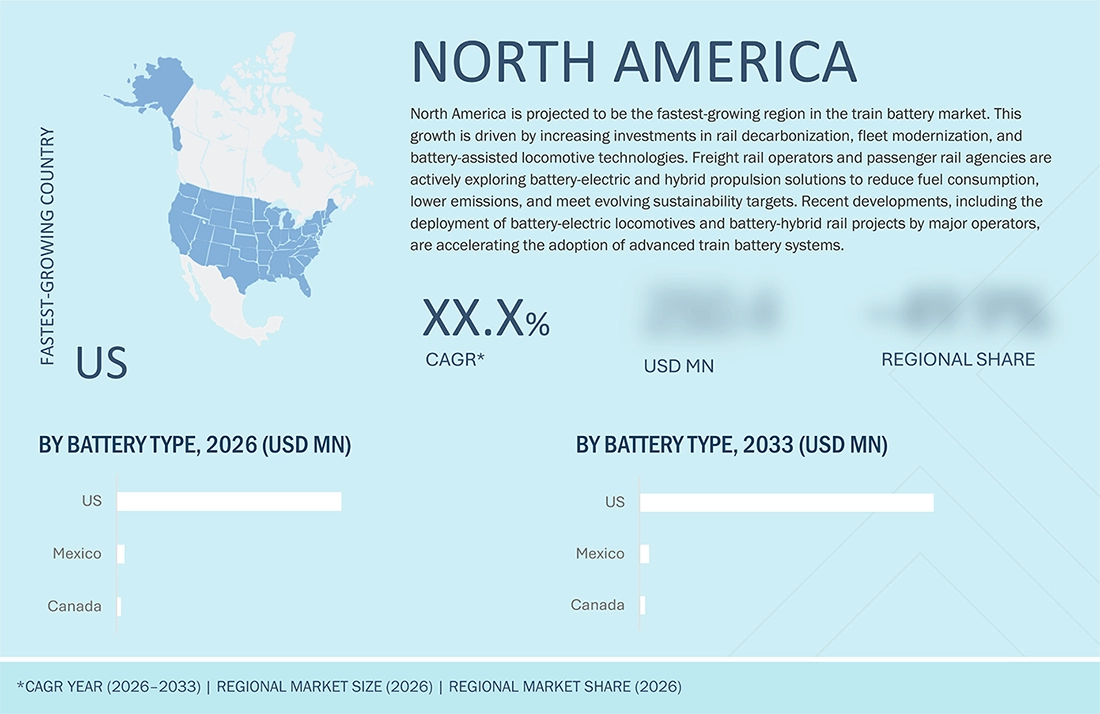
North America is projected to be the fastest-growing region, at a CAGR of about 6.9% over the forecast period, supported by increased investment in rail decarbonization, fleet modernization, and battery-assisted locomotive technologies. Freight rail operators and passenger rail agencies are actively exploring battery-electric and hybrid propulsion solutions to reduce fuel consumption, lower emissions, and meet evolving sustainability targets. Recent developments, such as the deployment of battery-electric locomotives and battery-hybrid rail projects by major operators, are accelerating the adoption of advanced train battery systems. In addition, growing investments in commuter rail, transit modernization, and rail infrastructure upgrades across the US and Canada are increasing demand for auxiliary and energy storage batteries. The region's strong focus on reducing operating costs, improving energy efficiency, and advancing low-emission transportation is expected to create significant opportunities for train battery manufacturers over the coming years.
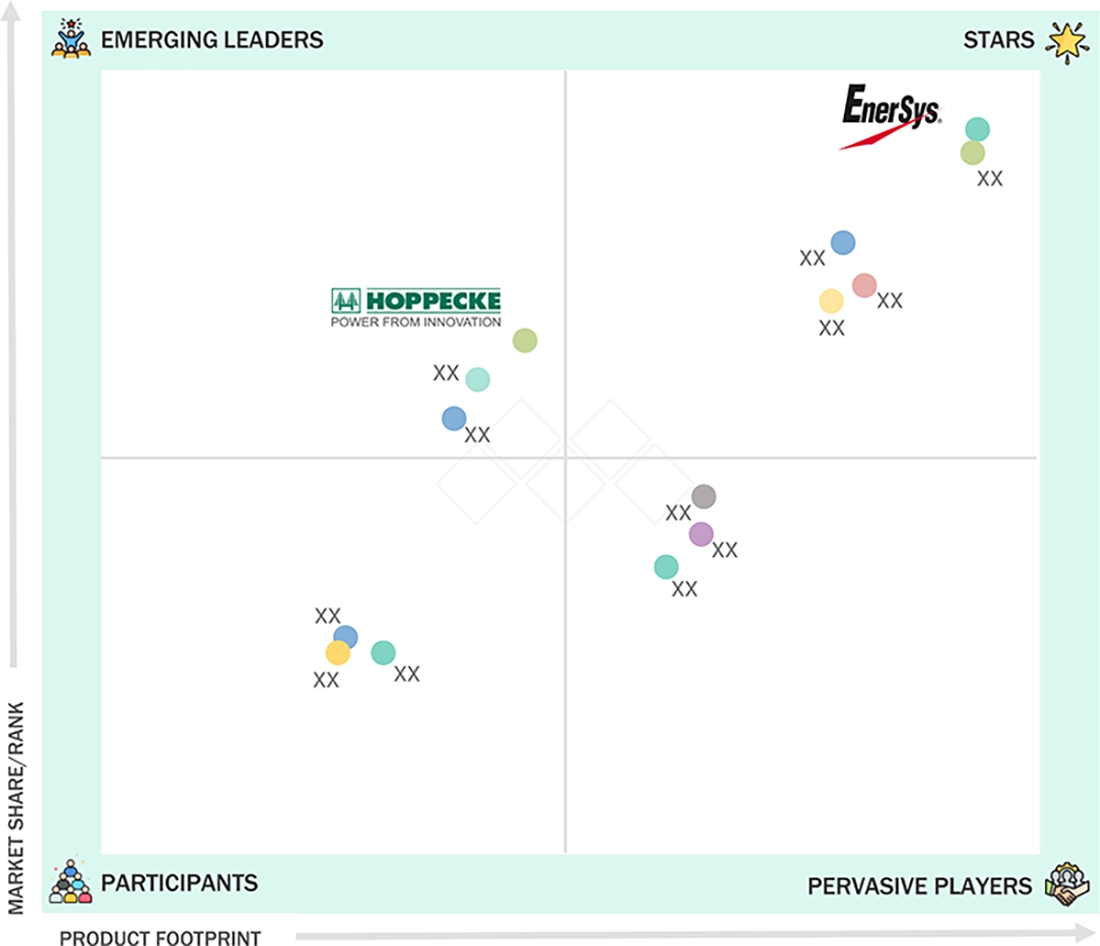
In the train battery market matrix, Enersys (Star) leads with a strong global presence, an extensive rail battery portfolio, and established relationships with rolling stock OEMs and rail operators across passenger, freight, metro, and locomotive applications. HOPPECKE Batterien GmbH & Co. KG (Emerging Leader) is gaining traction through investments in rail-specific lithium-ion battery systems and energy storage solutions, as well as strategic partnerships with railway operators and OEMs, indicating strong growth potential to move toward the leaders' quadrant.
Source: Secondary Research, Interviews with Experts, MarketsandMarkets Analysis
| REPORT METRIC | DETAILS |
|---|---|
| Market Size in 2025 (Value) | USD 362.8 Million |
| Market Size in 2026 (Value) | USD 384.1 Million |
| Market Forecast in 2033 (Value) | USD 551.1 Million |
| Growth Rate | CAGR of 5.3% from 2026 to 2033 |
| Years Considered | 2022-2033 |
| Base Year | 2025 |
| Forecast Period | 2026-2033 |
| Units Considered | Value (USD Million), Volume (Units) |
| Report Coverage | Revenue forecast, company ranking, competitive landscape, OEM analysis, growth factors, and trends |
| Segments Covered |
|
| Regional Scope | Asia Pacific, Europe, North America, and Rest of the World |
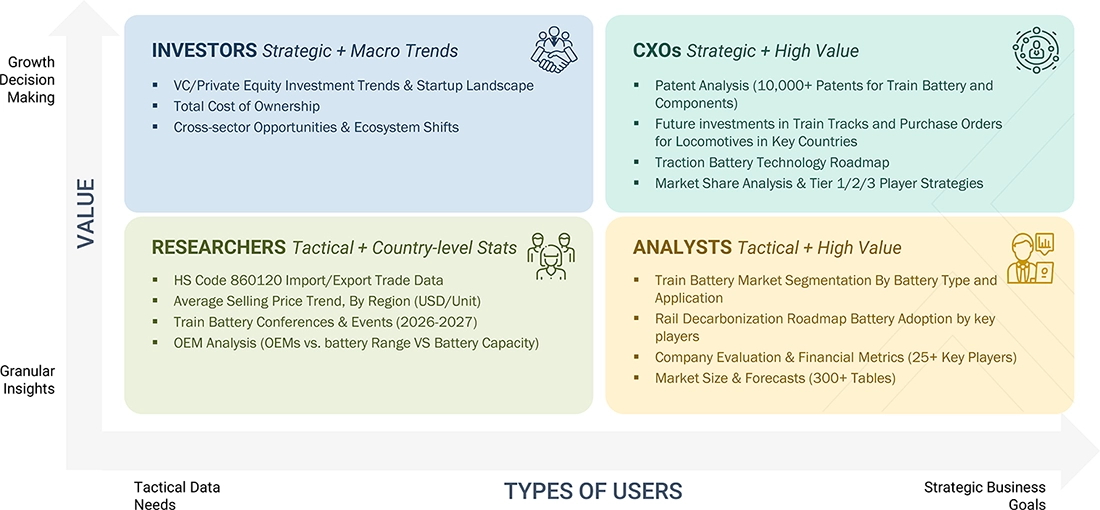
We have successfully delivered the following deep-dive customizations:
| CLIENT REQUEST | CUSTOMIZATION DELIVERED | VALUE ADDS |
|---|---|---|
| Identify high-growth opportunities across train battery technologies and applications |
|
|
| Understand the impact of rail decarbonization and electrification on battery demand |
|
|
| Benchmark competitors and identify market positioning opportunities |
|
|
| Evaluate customer ecosystem and supply chain dynamics |
|
|
| Assess regulatory, safety, and operational challenges impacting battery adoption |
|
|
 Exclusive indicates content/data unique to MarketsandMarkets and not available with any competitors.
4
MARKET OVERVIEW
Captures industry movement, adoption patterns, and strategic signals across key end-use segments and regions.4.3
UNMET NEEDS AND WHITE SPACES
4.4
INTERCONNECTED MARKETS AND CROSS-SECTOR OPPORTUNITIES
4.5
STRATEGIC MOVES BY TIER-1/2/3 PLAYERS
5
INDUSTRY TRENDS
This section summarizes market dynamics, key shifts, and high-impact trends shaping demand outlook.5.1
MACROECONOMIC OUTLOOK
5.1.2
GDP TRENDS AND FORECAST
5.1.3
TRENDS IN GLOBAL TARIN BATTERY INDUSTRY
5.2
SUPPLY CHAIN ANALYSIS
5.4.1
AVERAGE SELLING PRICE TREND, BY REGION, 2022–2025
5.4.2
AVERAGE SELLING PRICE TREND, BY BATTERY TYPE, 2022–2025
5.5.1
IMPORT SCENARIO, (HS CODE 860120), 2020–2025
5.5.2
EXPORT SCENARIO, (HS CODE 860120), 2020–2025
5.6
KEY CONFERENCES AND EVENTS, 2026–2027
5.7
TRENDS/DISRUPTIONS IMPACTING CUSTOMER BUSINESS
5.9
FUNDING, BY USE CASE APPLICATION
5.11.1
BATTERY MANUFACTURER VS. BATTERY VOLTAGE
5.11.2
BATTERY MANUFACTURER VS. BATTERY CAPACITY
5.11.3
BATTERY CAPACITY VS. RANGE
5.12
FUTURE INVESTMENTS AND CONTRACTS FOR BATTERY ELECTRIC TRAINS
5.13
FUTURE TRAIN ROUTES AND METRO PROJECTS IN KEY REGIONS
5.14
TCO FOR BATTERY ELECTRIC TRAIN VS. DIESEL TRAIN
5.15
RAIL DECARBONIZATION ROADMAP & BATTERY ADOPTION OUTLOOK
5.16
AUXILIARY BATTERY EVOLUTION
5.17
TRACTION BATTERY TECHNOLOGY ROADMAP
6
TECHNOLOGICAL ADVANCEMENTS, AI-DRIVEN IMPACT, PATENTS, INNOVATIONS, AND FUTURE STRATEGIC APPLICATIONS
6.1.1.1
LITHIUM-ION BATTERIES
6.1.1.2
BATTERY MANAGEMENT SYSTEMS
6.1.1.3
FAST CHARGING TECHNOLOGY
6.1.1.4
SMART MONITORING SYSTEMS
6.1.1.5
THERMAL MANAGEMENT SYSTEMS
6.1.2
COMPLEMENTARY TECHNOLOGY
6.1.2.1
TRAIN AUXILIARY POWER UNITS (APUS)
6.1.2.2
ONBOARD ENERGY STORAGE SYSTEMS
6.1.2.3
PREDICTIVE MAINTENANCE SYSTEMS
6.1.3
ADJACENT TECHNOLOGY
6.1.3.1
HYDROGEN FUEL CELL TECHNOLOGY
6.1.3.2
MICROGRID TECHNOLOGY
6.1.3.3
HYBRID PROPULSION SYSTEMS
6.1
TECHNOLOGY/PRODUCT ROADMAP
6.4
IMPACT OF AI/GEN AI ON TRAIN BATTERY MARKET
6.4.1
TOP USE CASES AND MARKET POTENTIAL
6.4.2
BEST PRACTICES IN TRAIN BATTERY DEVELOPMENT
6.4.3
CASE STUDIES OF AI IMPLEMENTATION ON TRAIN BATTERY MARKET
6.4.4
INTERCONNECTED ADJACENT ECOSYSTEM AND IMPACT ON MARKET PLAYERS
6.4.5
CLIENTS’ READINESS TO ADOPT GENERATIVE AI IN THE TRAIN BATTERY MARKET
6.6
SUCCESS STORIES AND REAL-WORLD APPLICATIONS
7.5
REGIONAL REGULATIONS AND COMPLIANCE
7.5.1
REGULATORY BODIES, GOVERNMENT AGENCIES, AND OTHER ORGANIZATIONS
7.5.2
GLOBAL SAFETY REGULATIONS
8
CUSTOMER LANDSCAPE & BUYER BEHAVIOR
8.1
DECISION-MAKING PROCESS
8.2
BUYER STAKEHOLDERS AND BUYING EVALUATION CRITERIA
8.3
ADOPTION BARRIERS & INTERNAL CHALLENGES
8.4
UNMET NEEDS FROM VARIOUS END-USE INDUSTRIES
9
TRAIN BATTERY MARKET, BY APPLICATION & BATTERY TYPE
Market Size, Volume & Forecast – USD Million(MARKET SIZE & FORECAST TO 2033 – IN VALUE, USD MILLION & VOLUME)
9.2.1
LEAD-ACID BATTERIES
9.3.1
LEAD-ACID BATTERIES
9.3.3
LITHIUM-ION BATTERIES
10
TRAIN BATTERY MARKET, BY BATTERY TYPE & BATTERY TECHNOLOGY
Market Size, Volume & Forecast – USD Million(MARKET SIZE & FORECAST TO 2033 – IN VALUE, USD MILLION & VOLUME)
10.1.1
LEAD-ACID BATTERIES
10.1.1.1
CONVENTIONAL LEAD-ACID BATTERIES
10.1.1.2
VALVE-REGULATED LEAD-ACID BATTERIES
10.1.1.3
GEL TUBULAR LEAD-ACID BATTERIES
10.1.2
NICKEL-CADMIUM BATTERIES
10.1.2.1
SINTER/PINE NICKEL-CADMIUM BATTERIES
10.1.2.2
POCKET PLATE NICKEL-CADMIUM BATTERIES
10.1.2.3
FIBER/PINE NICKEL-CADMIUM BATTERIES
10.1.3
LITHIUM-ION BATTERIES
10.1.3.1
LITHIUM IRON PHOSPHATE BATTERIES
10.1.3.2
LITHIUM TITANATE OXIDE BATTERIES
10.2
KEY PRIMARY INSIGHTS
11
TRAIN BATTERY MARKET, BY ENGINE/HEAD
Market Size, Volume & Forecast – USD Million(MARKET SIZE & FORECAST TO 2033 – IN VALUE, USD MILLION & VOLUME)
11.3
DIESEL MULTIPLE UNITS
11.4
ELECTRIC MULTIPLE UNITS
11.5
KEY PRIMARY INSIGHTS
12
TRAIN BATTERY, BY APPLICATION
Market Size, Volume & Forecast – USD Million(MARKET SIZE & FORECAST TO 2033 – IN VALUE, USD MILLION & VOLUME)
12.4
LIGHT RAILS/TRAMS/MONORAILS
12.6
KEY PRIMARY INSIGHTS
13
TRAIN BATTERY MARKET, BY ADVANCED TRAIN TYPE
Market Size, Volume & Forecast – USD Million(MARKET SIZE & FORECAST TO 2033 – IN VOLUME, USD MILLION & VOLUME)
13.3
FULLY BATTERY-OPERATED TRAINS
13.5
KEY PRIMARY INSIGHTS
14
TRAIN BATTERY AFTERMARKET, BY ROLLING STOCK
Market Size, Volume & Forecast – USD Million(MARKET SIZE & FORECAST TO 2033 – IN VALUE, USD MILLION & VOLUME)
14.5
KEY PRIMARY INSIGHTS
15
TRAIN BATTERY AFTERMARKET, BY BATTERY TYPE
Market Size, Volume & Forecast – USD Million(MARKET SIZE & FORECAST TO 2033 – IN VALUE, USD MILLION & VOLUME)
15.3
NICKEL-CADMIUM BATTERIES
15.4
KEY PRIMARY INSIGHTS
16
TRAIN BATTERY AFTERMARKET, BY APPLICATION
Market Size, Volume & Forecast – USD Million(MARKET SIZE & FORECAST TO 2033 – IN VALUE, USD MILLION & VOLUME)
16.4
KEY PRIMARY INSIGHTS
17
TRAIN BATTERY MARKET, BY REGION
Market Size, Volume & Forecast – USD Million(MARKET SIZE & FORECAST TO 2033 – IN VOLUME, THOUSAND UNITS)
17.6
KEY PRIMARY INSIGHTS
18
TRAIN BATTERY AFTERMARKET, BY REGION
Market Size, Volume & Forecast – USD Million(MARKET SIZE & FORECAST TO 2033 – IN VALUE, USD MILLION & VOLUME AT GLOBAL LEVEL)
18.5
KEY PRIMARY INSIGHTS
STRATEGIC ASSESSMENT OF LEADING PLAYERS, MARKET RANKING/SHARE, REVENUE ANALYSIS, COMPANY POSITIONING, AND COMPETITIVE BENCHMARKS INFLUENCING MARKET POTENTIAL
19.2
KEY PLAYER STRATEGIES/RIGHT TO WIN
19.3
REVENUE ANALYSIS, (2022-2025)
19.4
GLOBAL MARKET SHARE ANALYSIS FOR TRAIN BATTERY MANUFACTURERS,
19.5
COMPANY VALUATION AND FINANCIAL MATRIX
19.8
COMPANY EVALUATION MATRIX: KEY PLAYERS,
19.8.5
COMPANY FOOTPRINT: KEY PLAYERS,
19.8.5.1
COMPANY FOOTPRINT
19.8.5.2
REGION FOOTPRINT
19.8.5.3
BY APPLICATION FOOTPRINT
19.8.5.4
BY BATTERY TYPE FOOTPRINT
19.9
COMPANY EVALUATION MATRIX: BATTERY MANUFACTURERS FOR FULLY BATTERY-OPERATED TRAINS,
19.9.5
COMPANY FOOTPRINT: KEY PLAYERS,
19.9.5.1
COMPANY FOOTPRINT
19.9.5.2
REGION FOOTPRINT
19.9.5.3
TRAIN TYPE FOOTPRINT
19.9.5.4
ENGINE HEAD FOOTPRINT
19.10
COMPETITIVE SCENARIO
IN-DEPTH REVIEW OF COMPANIES, PRODUCTS, RECENT INITIATIVES, AND POSITIONING STRATEGIES IN THE TRAIN BATTERY MARKET LANDSCAPE
20.1.1
TRAIN BATTERY MANUFACTURER
20.1.1.3
GS YUASA INTERNATIONAL LTD
20.1.1.4
EXIDE INDUSTRIES LTD.
20.1.1.5
AMARA RAJA BATTERIES LIMITED
20.1.1.6
HOPPECKE BATTERIEN GMBH & CO. KG
20.1.1.8
FIRST NATIONAL BATTERY
20.1.1.9
POWER & INDUSTRIAL BATTERY SYSTEMS GMBH
20.1.1.10
EXIDE TECHNOLOGIES
20.1.1.11
TOSHIBA CORPORATION
20.1.2
ADDITIONAL COMPANIES
20.1.2.1
EAST PENN MANUFACTURING COMPANY
20.1.2.2
MICROTEX ENERGY PRIVATE LIMITED
20.1.2.3
AEG POWER SOLUTION
20.1.2.4
FURUKAWA ELECTRIC CO., LTD
20.1.2.5
HUNAN FENGRI POWER & ELECTRIC CO., LTD
20.1.2.6
SHUANGDENG GROUP CO., LTD.
20.1.2.8
SHIELD BATTERIES LIMITED
20.1.2.10
DMS TECHNOLOGIES
20.1.2.11
NATIONAL RAILWAYS SUPPLY
20.1.2.15
STAR BATTERY LTD
21.1.1.1
KEY DATA FROM SECONDARY SOURCES
21.1.2.1
KEY DATA FROM PRIMARY SOURCES
21.1.2.2
KEY PRIMARY PARTICIPANTS
21.1.2.3
BREAKDOWN OF PRIMARY INTERVIEWS
21.1.2.4
KEY INDUSTRY INSIGHTS
21.2
MARKET SIZE ESTIMATION
21.2.1.1
BOTTOM-UP APPROACH
21.2.1.2
TOP-DOWN APPROACH
21.2.1.3
BASE NUMBER CALCULATION
21.3
MARKET FORECAST APPROACH
21.6
RESEARCH ASSUMPTIONS
21.7
RESEARCH LIMITATIONS AND RISK ASSESSMENT
This research study relied on extensive secondary sources, including company annual reports and presentations, industry association publications, industry magazine articles, directories, technical handbooks, the World Economic Outlook, technical articles, and databases, to identify and collect information on the train battery market. In-depth interviews were conducted with primary respondents, including key industry participants, subject-matter experts, C-level executives of key market players (train battery manufacturers, battery component manufacturers), and industry consultants, among other experts, to obtain and verify critical qualitative and quantitative information and to assess market prospects.
Secondary ResearchSecondary sources for this research study included train battery associations and organizations, corporate filings (such as annual reports, investor presentations, and financial statements), and trade, business, and industry associations. Secondary data were collected and analyzed to determine the overall market size, which was further validated by primary research.
Primary ResearchExtensive primary research was conducted after understanding the train battery market through secondary research. Several primary interviews were conducted with market experts from the demand side (OEMs) across major regions, namely, North America, Europe, and Asia Pacific. Approximately 80% of primary interviews were conducted with the demand side, and 20% with train battery component manufacturers. Primary data was collected through questionnaires, emails, and telephonic interviews.
The canvassing of primary sources covered various departments within organizations, such as sales, operations, and marketing, to provide a holistic view in the report. After interacting with industry experts, brief sessions were held with highly experienced independent consultants to reinforce the findings from primary sources. These sessions, along with the opinions of in-house subject matter experts, led to the conclusions described in the remainder of this report.
Breakdown of Primaries

Note: Others include sales managers, marketing managers, product managers, etc.
To know about the assumptions considered for the study, download the pdf brochure
Bottom-up Approach
The bottom-up approach was used to estimate and validate the size of the train battery market by battery type. In this approach, country-wise sales data for different railway types (diesel locomotives, diesel multiple units (DMUs), electric locomotives, electric multiple units (EMUs), metros, high-speed trains, light rails/trams/monorails, and passenger coaches) were obtained from secondary sources, and sales statistics from industry associations and organizations were compiled. Following this, secondary research was used to determine the percentage penetration of battery types (Lead-acid Batteries, Ni-Cd Batteries, and Lithium-ion Batteries) by railway type per country. Then the Average Selling Price (ASP) was multiplied by each battery type for all train types to arrive at the country-wise value of the train and battery types. These numbers, when collated, represent the regional and global train battery market size and forecast (volume as well as value) for train and battery types. The forecasting was based on factors such as GDP, economic stability, war conditions in the Middle East and Europe, regulations, investments and deals for battery technology by the key players, and investments by governing bodies for new railway tracks, etc.
Country-level tractor sales were multiplied by the battery-type penetration at the country level to determine the market size of the train battery market for each battery type in terms of volume. The forecast was based on factors such as war conditions, GDP growth rate, government investments, and others. In terms of volume, the country-level railway-type market size for each train-type category was summed to derive the regional market. All the regional markets were summed to derive the global train battery market's power output by battery type.
The country-wise forecast for train types is based on multiple factors, including OEM investments in the country for train battery manufacturing plants, emissions regulations, the technological landscape, economic conditions, increasing demand for electric trains, and future train battery model launches.
The country-level train battery market was then multiplied by the country-level average selling price of train batteries, which resulted in the country-level market size.
The train battery ASP by battery type for each country was derived from secondary sources and model mapping, and validated through primary sources. The addition of the respective countries provides the regional-level market. Then, the summation of regional-level markets provides the global train battery market by battery type in terms of value. A similar approach was used to derive the train aftermarket by battery type. However, these submarkets were analyzed at the regional level.
Top-down Approach
The top-down approach estimated and validated the market by engine/head (diesel locomotive, electric multiple units, diesel multiple units, and electric locomotive) in terms of volume and value. The train battery market value (USD million) and volume (units) by region were derived from the global market. The penetration of each engine/head type at the regional level was derived from secondary sources and model mapping, and validated through interviews with experts. The model mapping provided information such as the dominant drive type (head (diesel locomotive, electric multiple units, diesel multiple units, and electric locomotive)) and model with drive type offerings by key OEMs. The penetration of each drive type was multiplied by the regional train type market to obtain the train battery market for engine/head by value and volume by drive type for each region. All region-wise markets were summed to derive the total train market value and volume by engine/head type. The top-down approach was followed by train type, by passenger coaches, advanced train type, by application, aftermarket by battery type, and aftermarket by application segments.
Train Battery Market : Top-Down and Bottom-Up Approach
After determining the overall market size, the market was segmented into several segments and subsegments using the market size estimation processes explained above. Data triangulation and market breakdown procedures were employed to complete the overall market engineering process and arrive at the exact statistics for each market segment and subsegment, wherever applicable. The data was triangulated by analyzing various factors and trends from both the demand and supply sides.
According to Saft, rail batteries are an important component of energy storage systems used for end-use applications such as starters, lighting, air conditioning, access mechanisms, water-filling systems, isolators, connectors, and battery management control (BMC) systems.
According to Exide Industries, the train battery is securely housed within a battery enclosure located beneath the coach. In railway applications, the battery operates in a dusty environment, experiences moderate to high levels of vibration, encounters fluctuating temperatures, has limited windows for inspection and maintenance, and operates continuously in a charge-discharge cycle. This represents the most rigorous evaluation of a battery's performance and longevity, emphasizing the critical importance of reliability.
With the given market data, MarketsandMarkets offers customizations based on the company’s needs.


PRODUCT DIRECTOR, WEASLER
Global Provider of Industrial Actuation & Control Solutions
Our organization was interested in learning more about the attractiveness of a particular market space. We contacted MarketsandMarkets to help us based on previous positive experiences we had with them. The results did not disappoint! We discussed our objectives with them, and the team at MarketsandMarkets developed and executed a proposal that met our needs precisely. We were very impressed by their level of expertise, the quality of the analysis and their insightful recommendations. We would not hesitate in working with them again in the future.

Vice President
A global technology company that develops safer, greener and more connected solutions.
We contracted with MarketsandMarkets to evaluate the value chain and potential go-to-market partners related to our interest in the Fleet Management space. The team successfully completed the work on time and at the pricing agreed. MarketsandMarkets listened and understood our objectives and collaborated well with us to help us get the visibility we needed to make an investment.
We have subsequently used MarketsandMarkets again related to Smart Cities to good results.