Просмотр новости
Найдите то, что Вас интересует
 Спутники
 РН
РН SpaceX
 Роскосмос
 NASA
NASA
СпутникиРНSpaceXРоскосмосNASAAndrew Abbott's 'Maine' is strange, wonderful and worth the trip.
I ventured out last Sunday to Brunswick to meet an artist named Andrew Abbott, who has a show up at Frank Brockman Gallery called, simply, “Maine” (through at least October, though maybe longer). His mother had been the one to send me a message about the exhibition and asked me to come see it. It was pouring outside, and all I really wanted to do was curl up in bed with a good book.
I am very glad I roused myself for the rainy drive. “Maine” is the most fascinating, wildly imaginative, strangest art experience I have had in a long, long time. I would even call it visionary. By which I mean that in all its strangeness, it is fully worth the two-flight climb to the gallery.
There is a painting in the show titled (or maybe not titled) “Frequency.” The upper third is deeply black, but we can discern what look like a city and masses of people in the shadows. They are eerie, as if suspended in some sort of purgatorial dimension. The foreground below them is filled with what appear to be figures that are both human and machine (or perhaps machines that are partially human). They are so densely rendered and layered atop one another that the distinction between figure and technological contraption is impossible to parse definitively.
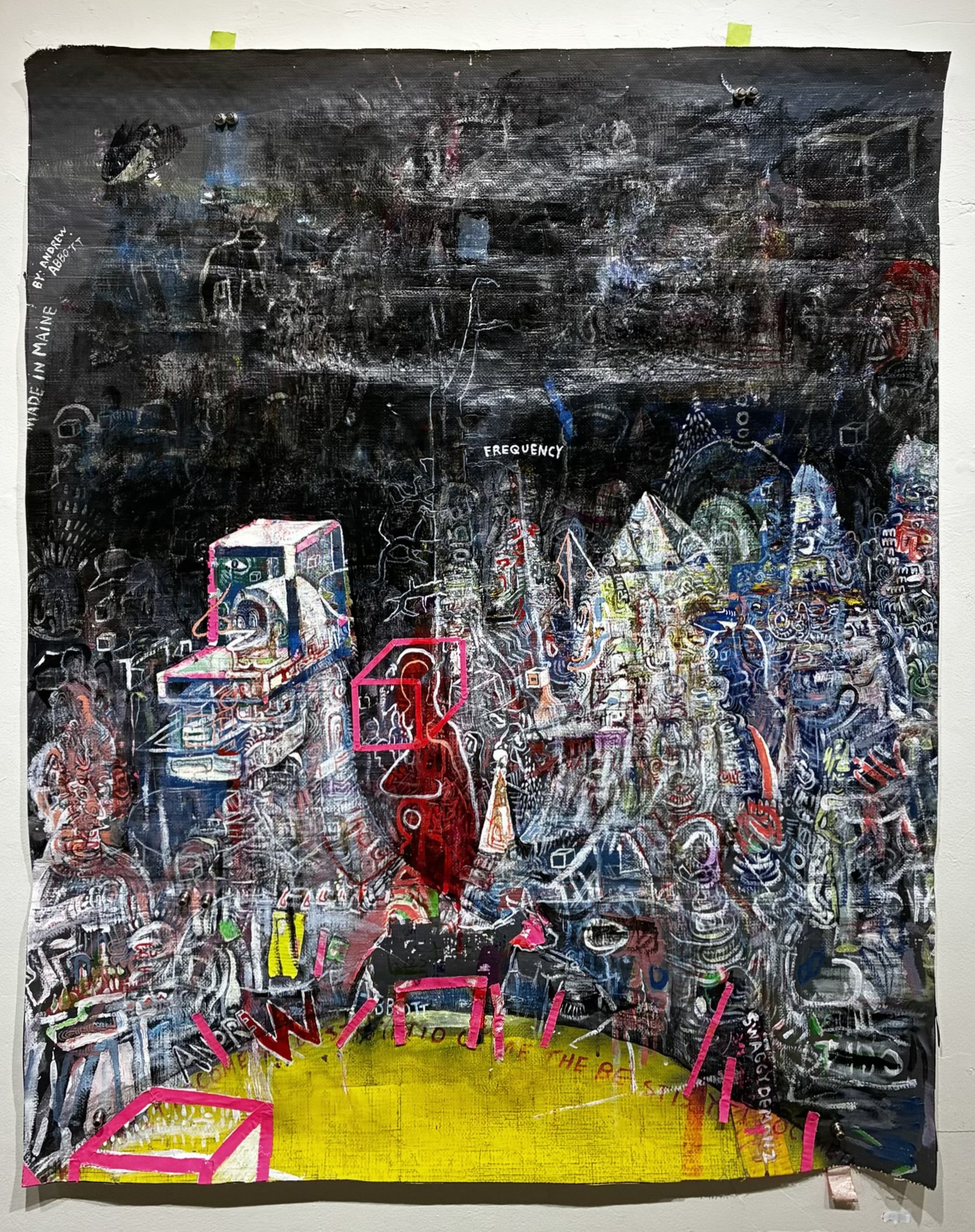 Andrew Abbott, “Frequency,” acrylic on tent material. (Image courtesy of the artist)
Floating between these two sections of the painting is the word “FREQUENCY,” but when I ask Abbott if this is the title of the work, which is on unstretched tent canopy fabric, he says, “I don’t know. Maybe you just named it.” (Which is why I say it may or may not be the actual title.) In fact, this word could probably have served as the moniker for the entire exhibition, for Abbott is tuning into so many frequencies at once that you must take a breath between each work to regather yourself and continue on what I can only describe as a magical mystery tour.
Abbott, who lives in New York but grew up part of his early life in Maine, where his mother still lives, has led a peripatetic existence: North Carolina, Nova Scotia, Nigeria, Jamaica, Georgia, Louisiana, Puerto Rico, Spain, Oakland. The paintings on exhibit span from the 1990s through now.
They are executed — if one can say that of work that is essentially spontaneously unfolded and resolutely informal — on discarded materials: cardboard, brown paper shopping bags, a door, a guitar, pegboard, bead board, the backsides of picture frames, paper, Styrofoam, a section of toilet seat foraged from an old army base, canopy tent fabric, cereal boxes, a skateboard. Some are acrylic, some cheap house paint, many also augmented by ink or pencil or scratched into with some other instrument.
“I’m trying to create a masterpiece, but from nothing,” he told me. Whether these are masterpieces or not is a judgement I will leave to others. But one cannot ignore the fantastical creativity and inventiveness of Abbott’s mind. It is not so much that he is ADHD as it is that he operates as a vessel for imagery to arise and come into being. He took some art classes, but is largely self-taught and, one must assume, prodigiously but naturally gifted.
Abbott reminds me of the naïfs played by Johnny Depp — Edward Scissorshands, Gilbert Grape, Sam in “Benny and Joon”— who manifest enormous creativity and empathy almost in spite of themselves. Like those characters, he is visionary in the sense that subjects, characters, apparitions and more flow freely through him into two-dimensional existence, unimpeded by egoic filters of any kind. His paintings are more visions than anything else.
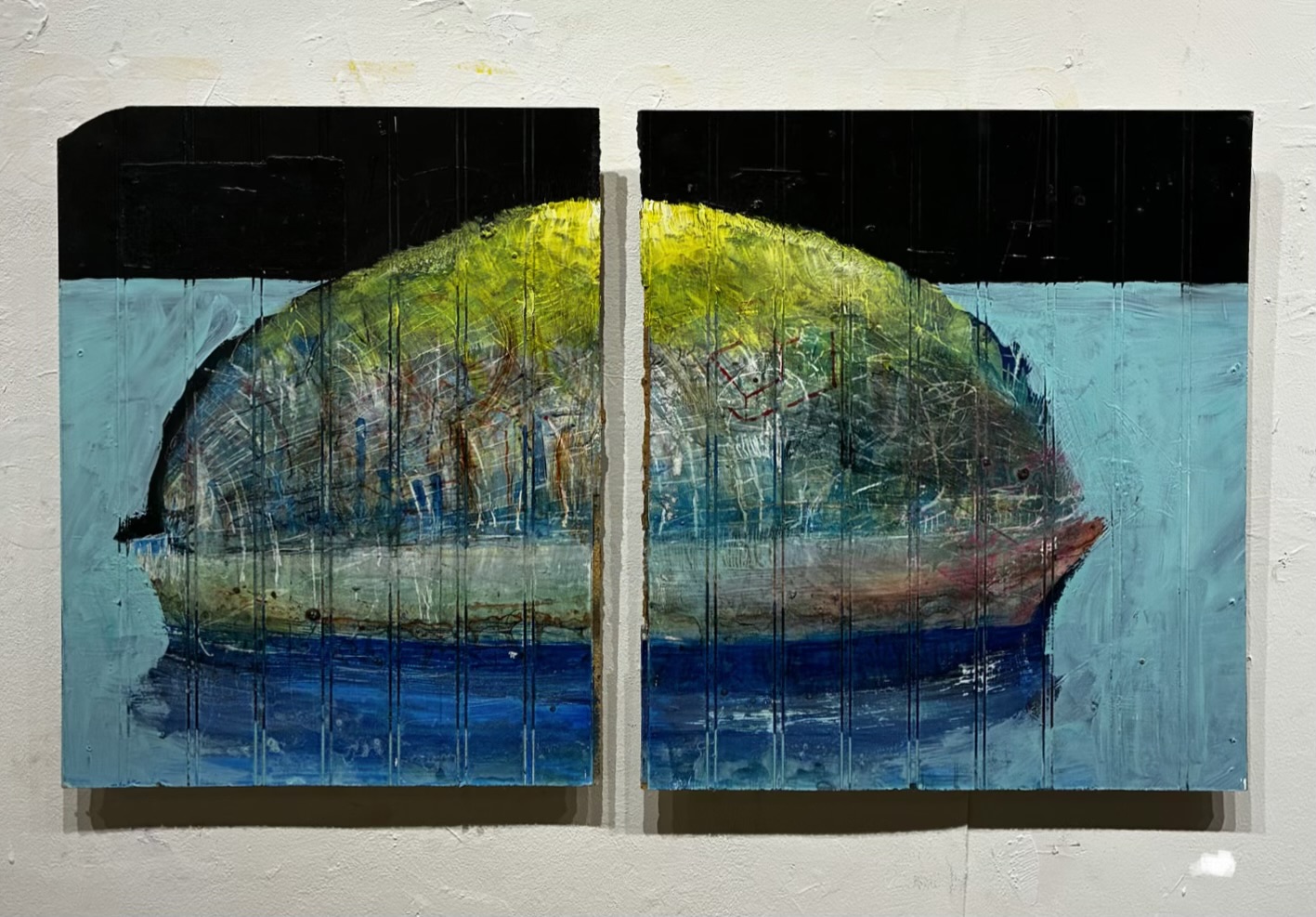 Andrew Abbott, “Broken Ship Of My Heart,” acrylic on wood. (Image courtesy of the artist)
Which is why, though we can look at some of this imagery as off-putting and even disturbing, it is essentially neither. It is simply curious. The sheer diversity of resource material speaks to a mind that is utterly open and receptive, beginning with an extensive yet unintellectual knowledge of art history.
Abbott’s work is like the love child of Salvador Dali (arguably his primary influence), Hieronymus Bosch, R. Crumb, Ralph Steadman, Marcel Duchamp, Max Ernst, graffiti artists, comic books, Hayao Miyazaki and Guillermo del Toro (the Pale Man from this director’s film “Pan’s Labyrinth” kept coming to mind). The work is constantly tripping in and out of various dimensions of reality and fantasy all at once.
An untitled work on paper adhered to bead board shows a figure with crossed arms. But these arms are repeated multiple times, progressing from foreground back into the interior of the figure’s torso. As we move into its body, one pair of crossed arms cradles another figure, the next cradles a head, the next another head until we reach a final figure near the heart that suddenly appears to be the owner of the other crossed arms. Whose arms are whose, exactly? Who is cradling whom? Who is the interior figure? An alter ego? A hidden true self?
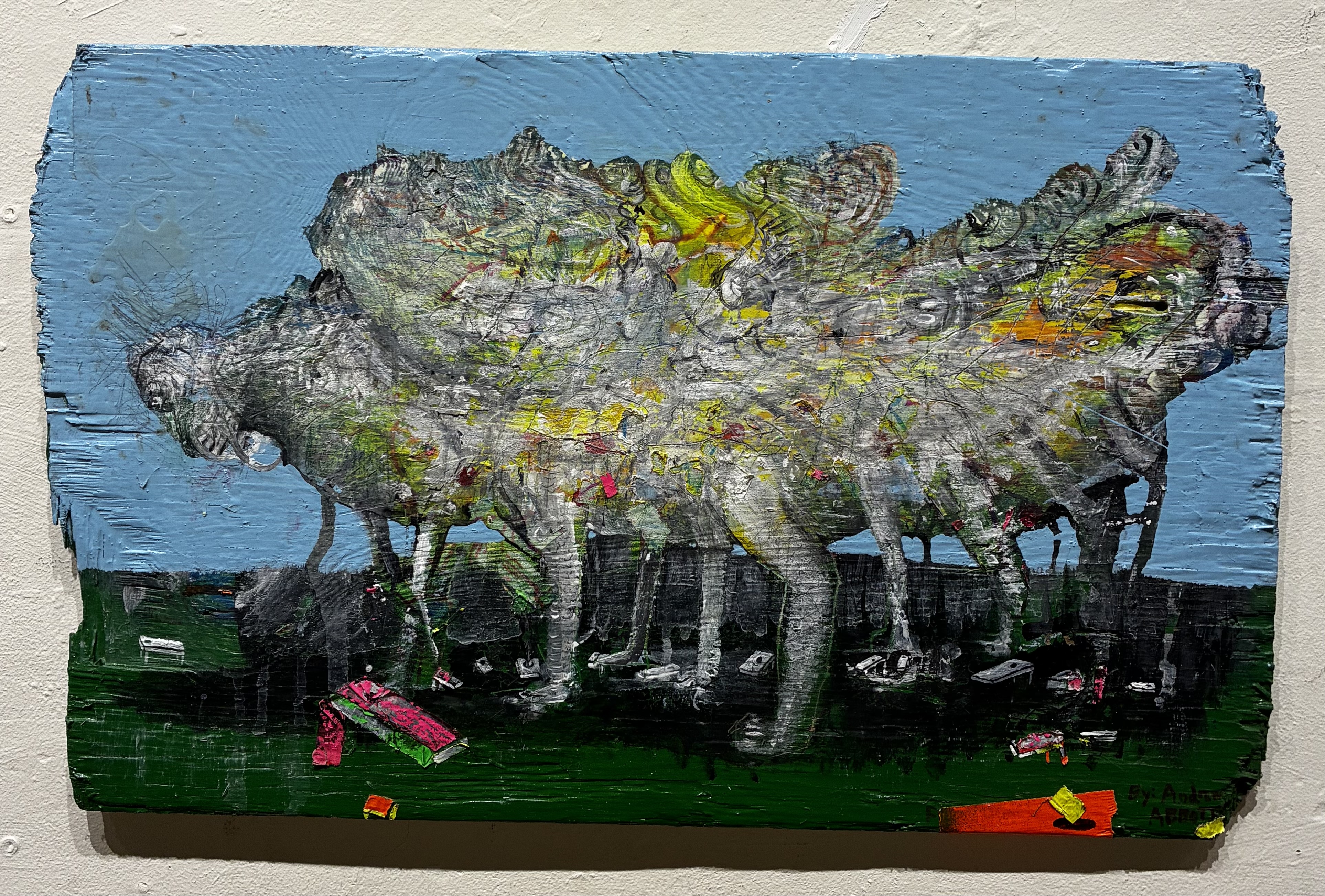 Andrew Abbott, “Cliff island soliloquy,” acrylic on driftwood. (Image courtesy of the artist)
To confuse things further, the head of the primary figure also contains other figures and heads, and a shadowy second figure seems to stand behind the main one extending a hand that holds an object that looks like a bell or a Buddha (a recurrent image in many works). The whole composition suggests a being with a teeming, active interiority populated by other beings, thoughts, desires, memories, influential people in its development … and on and on. A thought bubble emanating from the primary figure’s mouth is empty, as if to say speechlessly “I can’t even …” to the incredible cacophony and richness of its interior life. In fact, Abbott says, “I think it’s a miracle I’m here. I just can’t believe the miracle of existence.”
“Cliff island soliloquy,” painted on a rough-edged piece of board, clearly draws from Dali’s “Temptation of St. Anthony,” in which the saint kneels in the Egyptian desert holding a crucifix against a parade of erotic torments and demons, all carried on the backs of elephants whose legs attenuate toward the ground into a jumble of spindly, crisscrossing limbs. In Abbott’s painting, all the animals have been smooshed together into one blob of paint and exuberant, frenzied mark-making. It is supported by more than a dozen legs.
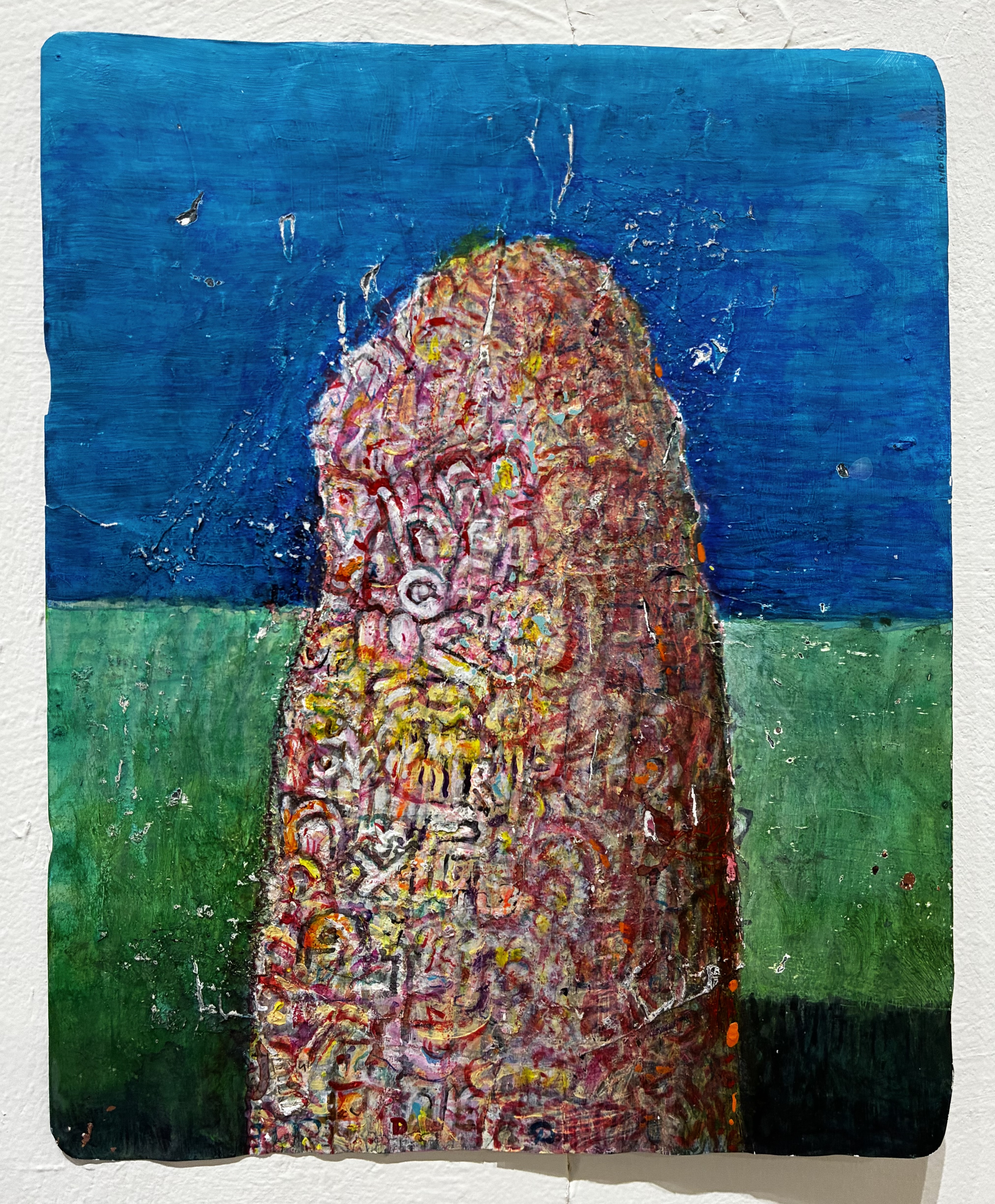 Andrew Abbott, “Phallic explanation,” acrylic on paper. (Image courtesy of the artist)
In “Phallic explanation” (also named while on my visit to the gallery), a priapic form looms before a landscape. Its surface swarms with a mass of letters, presumably offering an unintelligible “explanation” of its biological function, its sexual impulses, possibly some ideas about power and who knows what else.
“Something’s ticking on the wall” is painted on the back of an octagonal frame and its glass. In it, two figures face each other. One reaches out toward a laptop that has replaced the other figure’s head. The reaching figure is typing something into the keyboard/head as a real head appears on the computer screen. Simultaneously, the laptop-headed figure reaches into the abdomen of the being facing it to type a message onto another computer inside its stomach. Abbott is obviously commenting on technology and the way it rules our lives and substitutes actual feelings and reality for virtual versions of the same.
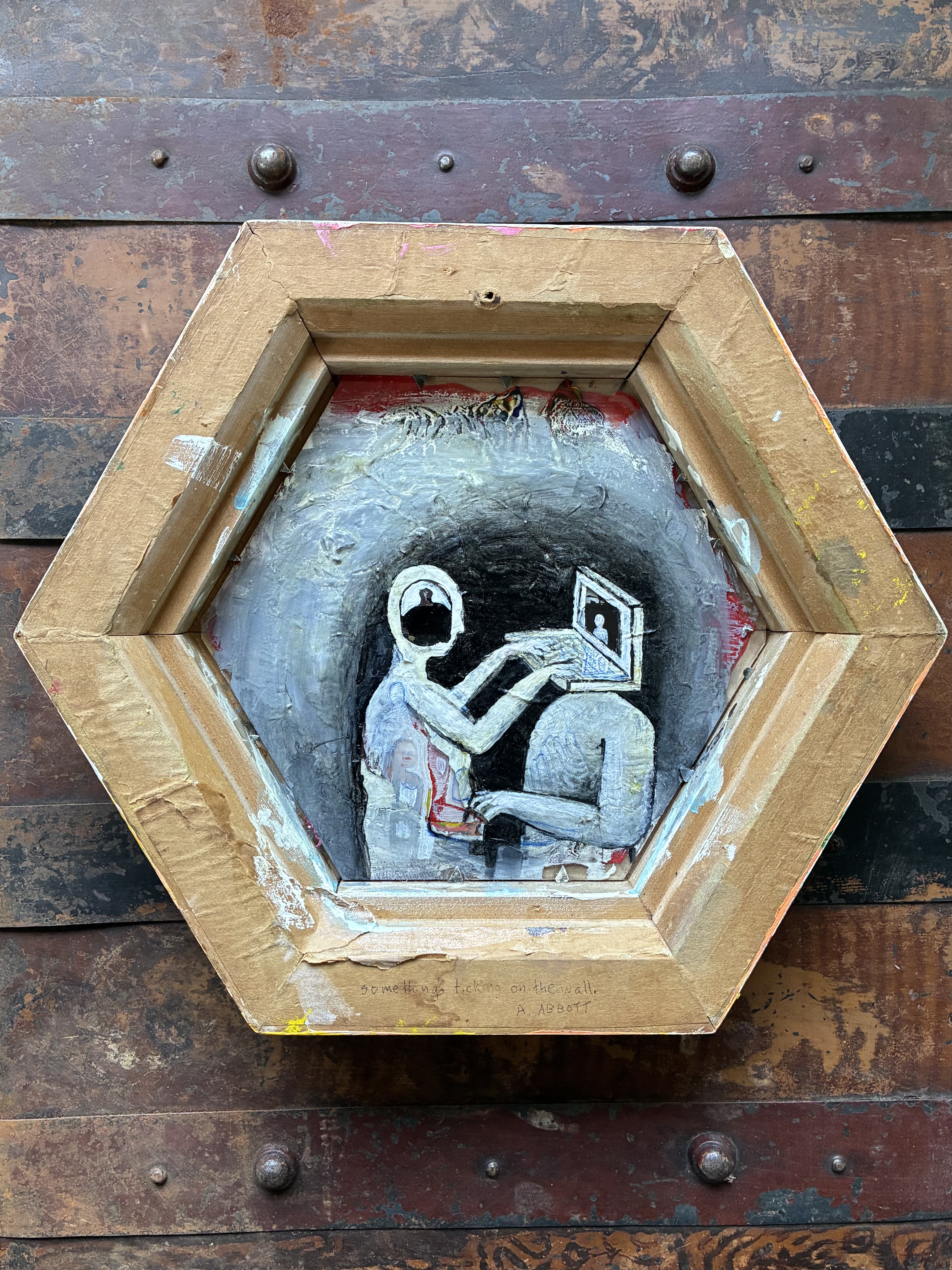 Andrew Abbott, “Something’s ticking on the wall,” acrylic on wood/glass. (Image courtesy of the artist)
But you can’t really extract an explanation from Abbott for any of these works, since he revisits paintings intermittently over periods of time, channeling whatever is coming through that day (of which he has no recall). Each painting is a massive mind dump, probably done in a semi-trancelike state. But they are often executed with the skill of Renaissance masters. His fluidity with drawing and pushing acrylic to look almost like a Jan van Eyck oil is nothing short of astonishing.
How on earth this agility happened, considering Abbott is fundamentally an autodidact, adds to the mystery and further corroborates the view of him as a visionary artist.
Jorge S. Arango has written about art, design and architecture for over 35 years. He lives in Portland and can be reached at [email protected]. This column is free to access through support by The Dorothea and Leo Rabkin Foundation.
“Maine” (at least through October, maybe longer). Frank Brockman Gallery, 68 Maine St., Brunswick, 207-808-9044.
| # | Наименование новости | Тональность | Информативность | Дата публикации |
|---|---|---|---|---|
| 1 | Fall art exhibits lean into retrospectives | 0 | 35.8 | 09-09-2026 |
| 2 | Ogunquit Museum’s Sprinchorn exhibit is worth more than one visit | Column | 0 | 36.57 | 23-09-2026 |
| 3 | 6 Portland art shows showcase vibrant work | Column | 0 | 42.84 | 26-08-2026 |
| 4 | At this Maine auction, people bid with stories | 0 | 37.2 | 12-09-2026 |
| 5 | PMA’s Winslow Homer exhibit recasts the artist in a fresh medium | Column | 0 | 40.74 | 02-09-2026 |
| 6 | Maine Lit Fest returns with writers ‘responding to the moment’ | 0 | 38.28 | 23-09-2026 |
| 7 | For these Maine artists, creativity has no retirement age | 0 | 38.96 | 16-09-2026 |
| 8 | Musician Cidny Bullens revives his one-man show of music, loss and transition | 0 | 37.85 | 14-09-2026 |
| 9 | Beautiful Blackbird Children’s Book Festival highlights children’s stories | 0 | 31.5 | 03-09-2026 |
| 10 | Playwright’s new work tells the story of Portland’s unhoused through one person’s eyes | 0 | 35.8 | 23-09-2026 |