Просмотр новости
Найдите то, что Вас интересует
 Спутники
 РН
РН SpaceX
 Роскосмос
 NASA
NASA
СпутникиРНSpaceXРоскосмосNASACarl Sprinchorn painted and drew a wide plethora of subjects, from urban scenes to landscapes to figures.
 “Carl Sprinchorn: All the World is a Painting” is at the Ogunquit Museum of American Art through Nov. 1. (Photo courtesy of OMAA)
There are so many surprises in the Ogunquit Museum of American Art’s exhibition “Carl Sprinchorn: All the World is a Painting” (through Nov. 1) that it merits a return trip or two at least. Surprise number one: In his heyday during the 1910s through 1950s Sprinchorn (1887-1971), hardly a household name nowadays, enjoyed enormous success, an extensive roster of exhibitions, critical acclaim and close artistic relationships with some of the 20th century’s greatest artists, including his mentor Robert Henri and his friends Marsden Hartley, Charles Demuth, Florine Stettheimer and William and Marguerite Zorach.
So why is Sprinchorn not more recognized today? Perhaps because he was, as his biographer Mary Towley Swanson wrote, “a composite of opposites”? He painted and drew everything from gritty urban scenes to lumberjacks in the North Maine Woods to vibrant expressionistic landscapes to sporting scenes to figures (mostly male). Could it be attributed to how frequently he changed his style (landscapes that hover somewhere between Thomas Hart Benton and Arthur Dove, Art Deco-influenced sporting scenes, hunky Hartleyesque portraits of men)? Was he simply overshadowed by his famous artist friends?
It certainly cannot be solely because he was a gay man in an era where that was not accepted. Hartley was intensely private about his sexuality, though art enthusiasts of the day would have recognized the coded nature of his homoeroticism. Demuth was out, albeit within the proscriptions imposed by the era. Yet both were towering figures in art history long before university-level queer studies programs hailed them as role models and idols of queer culture. Certainly, one of the show’s important achievements is to open up and examine Sprinchorn’s sexuality and how it informed his art.
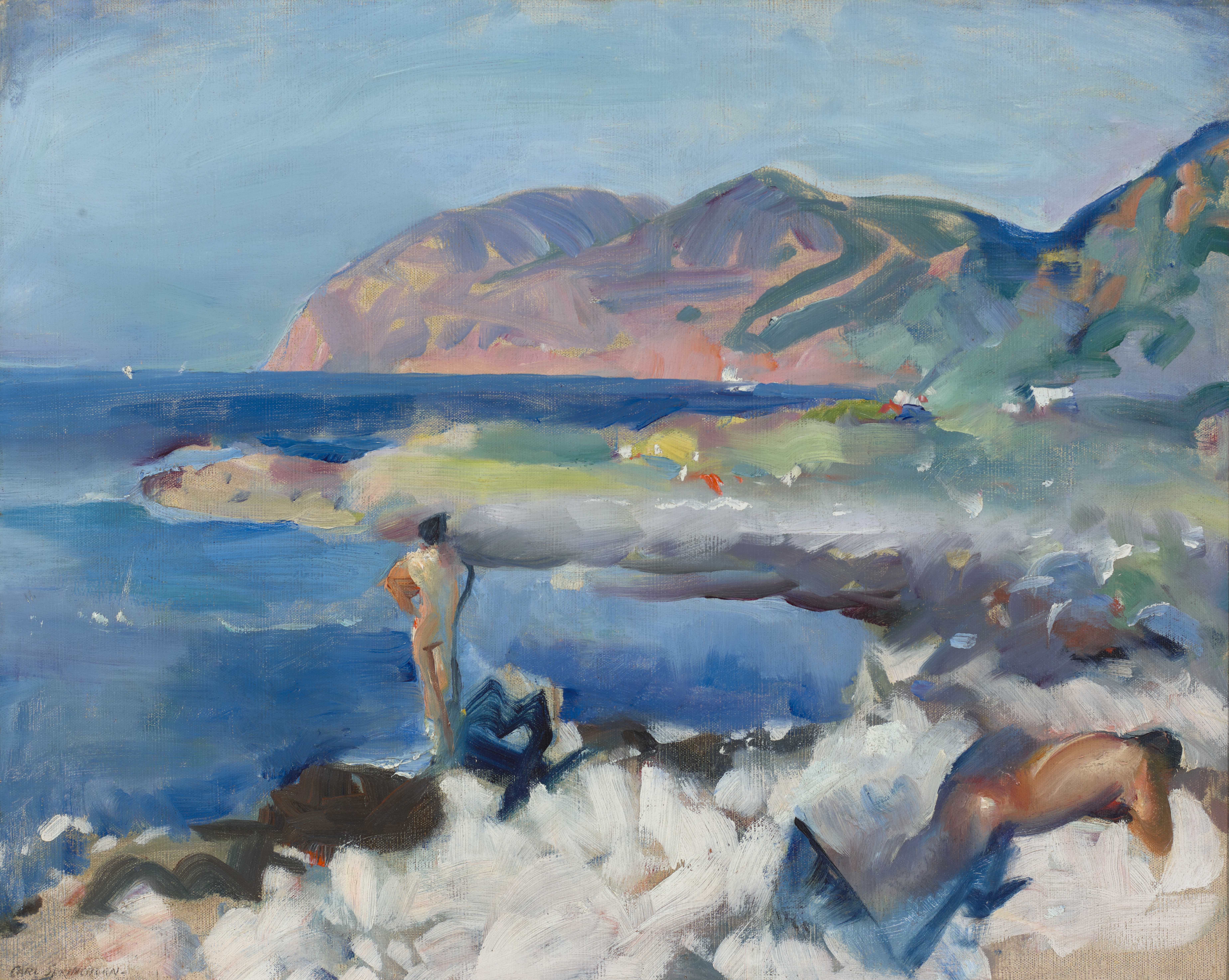 Carl Sprinchorn, “California Beach Scene.” (Photo by Luc Demers)
This is an achievement in itself and might come as a surprise to people only vaguely familiar with his art. Enter “Carl Sprinchorn” in your internet search and you will come up with scant, if any, information about the artist’s sexual proclivities, in spite of the fact that there exist many letters in which he writes frankly about his homoerotic inspiration and the blatantly obvious domination of sinewy male bodies as his primary figurative subject matter. The Ogunquit show also sheds some light on a longtime affair with a Swedish colleague.
In painting after painting, we see men with splayed legs, their hands frequently resting in their crotches (undated “Swaggering Laborer,” “Man in Yellow Trousers” circa 1928, and “Bilito” of 1926). Or they recline seductively (“Trapper in His Shack, Shin Pond, Maine” of 1941-46, which is clearly a male take on Matisse’s “Blue Nude” and the undated “Reclining Man [Nocturne in the Park]” suggests a gay rendezvous spot in a public park). Many show off their tight buttocks and beefy musculature (“Alewife Fishermen” of 1925, “The Life Boat,” not dated). So why the prudishness around popular documentation of his work?
The show brings Sprinchorn out of the closet and frees him from the penumbra of obscurity to “contextualize his practice,” reads the exhibition summary, “within the wider discussions of modernism, queer history, environmental concern, and transnational artistic exchange.” I’m not quite convinced about the environmental concern aspect, honestly, as the logging camp images that became one of his most enduring themes were more about male sexuality and the nobility of labor than any concerns or conversations about deforestation. I can’t even imagine this was in Sprinchorn’s consciousness.
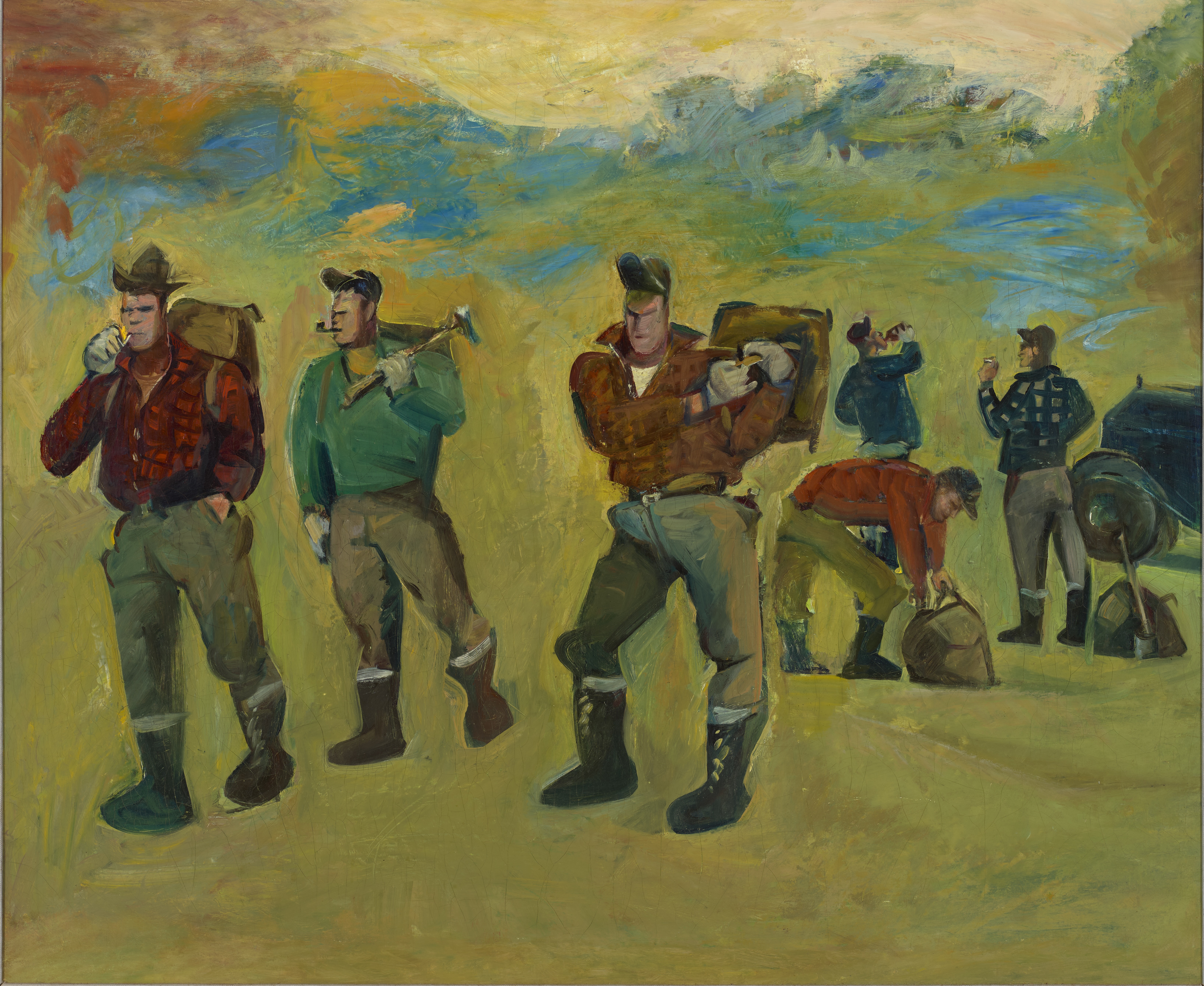 Carl Sprinchorn, “Lumberjacks, Shin Pond,” 1941, oil on board. (Photo by Luc Demers, Collection of Jay DeMartine)
He was born in Sweden and came to New York at the age of 15 to pursue painting studies with Robert Henri. Sprinchorn did not speak English, but the two men were able to communicate through gesture and a kind of sign language. Henri told the budding artist that the work he’d brought to show the elder painter was terrible but gave the boy a chance. Eventually, Henri would praise Sprinchorn as one of his best students. “His work has more virility and character to it than years of academic puttering over mush could give it,” Henri wrote to a friend.
The artist traveled a lot, not infrequently with his friend Hartley, including throughout Maine. Sprinchorn spent summers in Ogunquit, Monhegan Island and Monson, then a town of Swedish immigrants, and gravitated to the logging camps of Patten. His portraits of lumberjacks are the equivalent of his friend Hartley’s pictorial preoccupation with blocky beefcake men on the beach, and we can see the influence quite clearly.
But another revelation of the show is that Sprinchorn was quite a superb landscape painter, one who infused a restless energy and spiritual presence into scenes of nature. Sprinchorn recognized this within himself, writing a friend: “I have been called a mystic. I think that I have a pantheistic spirit towards nature that prevents mere copying of nature.” I spent a lot of time in one gallery transfixed by over a dozen landscapes that hang salon-style on a wall.
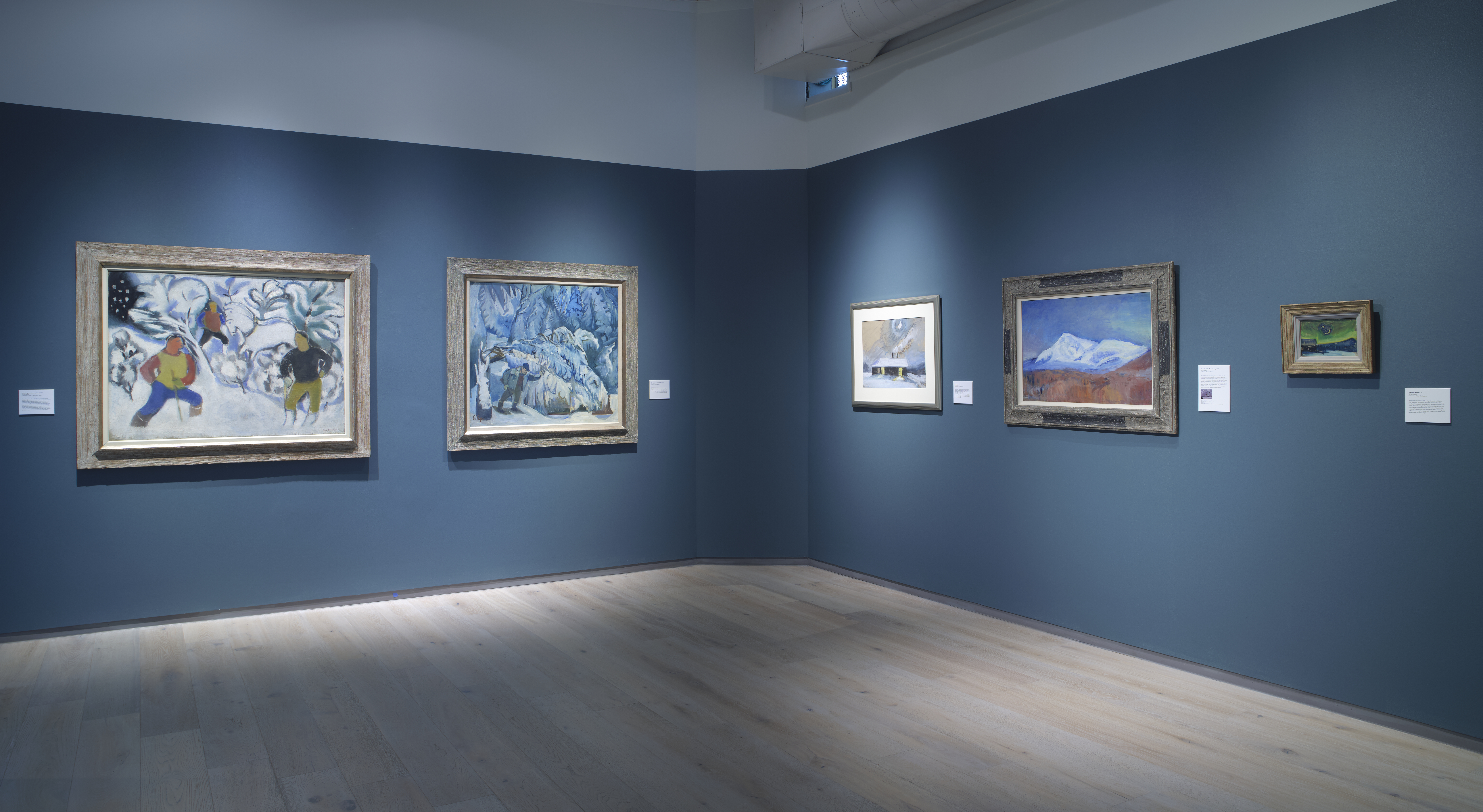 “Carl Sprinchorn: All the World is a Painting” is at the Ogunquit Museum of American Art through Nov. 1. (Photo courtesy of OMAA)
“Windswept Ridge” (1911) approaches the wildness of van Gogh, echoing the way the post-Impressionist depicted windblown cypress. So does “Potato Field in Lightning Storm” (1947), which feels like a cousin to van Gogh’s “Wheatfield with Crows.” In these and the undated “Fiery Forest of Trees” or “Three Boatmen in Rapids” (1941), we feel the instability and potential menace of nature. They are not academically realistic. Rather, in them Sprinchorn wielded bold colors with quick brushstrokes to extract maximum expression and emotion from a scene. This was true of many students of Henri, who also included George Bellows and John Sloane.
On the other hand, he could also paint the quiet and sublime with equal, if subtler expressionism. “Mt. Chase with Canoe,” an undated watercolor on this same wall, is dreamy and woozy. Another undated “Mt. Chase” image in oil emanates a kind of hushed thrill of the peak drenched in autumn colors. And Sprinchorn’s “Mount Katahdin, Easter Sunday” (1940) — which the label says was his “North Star when he chose to settle in Maine in 1937”— radiates a tranquil, self-knowing power.
But it was also in this gallery that I started to grasp perhaps why Sprinchorn might not have enjoyed the notoriety of his more renowned colleagues. It began to dawn with “Boreal Pageant (Monson, Maine),” a 1921 scene of three men and a pair of horses in a snowy forest. It struck me that more than a painting, it resembled an Art Deco-era travel poster. Its preponderance of curves and arched forms, the stylized graphic quality of the three figures and the horses, the emphasis on primary colors and the hail-and-hearty-men-of-good-cheer depiction border on the commercial.
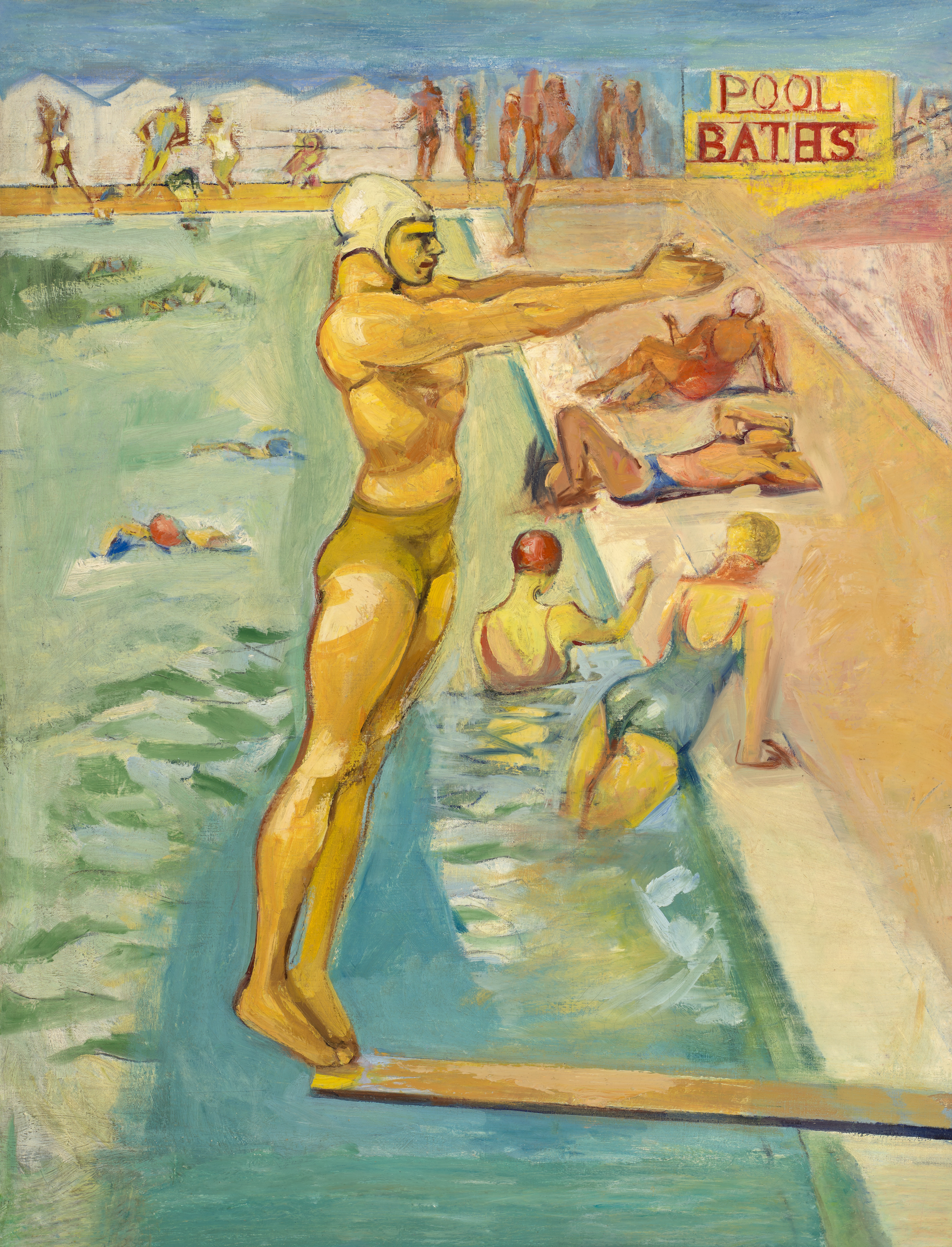 Carl Sprinchorn, “The Diver — Coney Island,” 1934, oil on canvas. (Photo by Luc Demers, Collection of Roy Goldberg and Keith Sherman)
It happens in the next gallery, too, with “The Diver, Coney Island” of 1934, “The Life Boat” and even, to some extent, “The Alewife Fishermen.” That is not to say that painters who adopted this sort of stylization are not remembered (Tamara de Lempicka springs immediately to mind). But this strong identification with an aesthetic that was essentially decorative tends to date the works very narrowly, knocking them out of favor when a style with more substance emerges and becomes popular. Hartley never fell for this. Nor did the Zorachs or Demuth.
I wonder if the easily traceable influences also contributed to this, particularly Hartley and his blocky, broad-shouldered men. I think if we were to place Hartley’s beach boys next to Sprinchorn’s lumberjacks, the more impactful — and explicit — homoeroticism would be Hartley’s. As such, they would have caused more of a sensation on their debut than Sprinchorn’s tamer versions of masculinity. As stylized as Hartley’s men can be, there is something about the palette, the body hair and the subjects’ gaze that feels like it gets inside you.
Which is not to say that Sprinchorn does not fully deserve a double retrospective (the other opens at Bates College Museum on Oct. 1), or that his career is not due for a thorough and overdue reappraisal. He was a talented and wonderful artist and certainly played a role in the various currents of modernism that intersected here from the late 1920s through the 1950s. And the show has many evocative, spellbinding paintings. Perhaps this reevaluation will even posthumously alter the way he is regarded by art historians.
Jorge S. Arango has written about art, design and architecture for over 35 years. He lives in Portland and can be reached at [email protected]. This column is free to access through support by The Dorothea and Leo Rabkin Foundation.
“Carl Sprinchorn: All the World is a Painting,” Ogunquit Museum of American Art, 543 Shore Road, Ogunquit. Through Nov. 1. Hours are 10 a.m.-5 p.m. daily. For more, 207-646-4909 or ogunquitmuseum.org
| # | Наименование новости | Тональность | Информативность | Дата публикации |
|---|---|---|---|---|
| 1 | Fall art exhibits lean into retrospectives | 0 | 35.8 | 09-09-2026 |
| 2 | Brunswick gallery plays host to an imaginative, strange visionary exhibit | Column | 0 | 36.55 | 16-09-2026 |
| 3 | For these Maine artists, creativity has no retirement age | 0 | 38.96 | 16-09-2026 |
| 4 | PMA’s Winslow Homer exhibit recasts the artist in a fresh medium | Column | 0 | 40.74 | 02-09-2026 |
| 5 | At this Maine auction, people bid with stories | 0 | 37.2 | 12-09-2026 |
| 6 | Portland Museum of Art set to open outdoor pavilion | 0 | 31.13 | 22-09-2026 |
| 7 | Maine Lit Fest returns with writers ‘responding to the moment’ | 0 | 38.28 | 23-09-2026 |
| 8 | 14 Maine events to get the most out of fall | 0 | 38.1 | 28-09-2026 |
| 9 | 8 Maine events include Common Ground Country Fair, Biddeford Oktoberfest | 0 | 36.46 | 21-09-2026 |
| 10 | Read the poem ‘Oysters’ by Maya Critchfield | 0 | 49.39 | 23-09-2026 |