Просмотр новости
Найдите то, что Вас интересует
 Спутники
 РН
РН SpaceX
 Роскосмос
 NASA
NASA
СпутникиРНSpaceXРоскосмосNASAThe state's art world abounds with artists still working and creating well into their 90s.
The inimitable baseball player and manager Yogi Berra famously said, “It ain’t over ’til it’s over.” In the Maine art world, we have many vibrant examples of this maxim. Alex Katz and Lois Dodd are one year away from the centenary of their births. William Irvine is 95, Richard Estes 94, and Josefina Auslender and Alison “Wooly” Hildreth are the nonagenarian “newbies” at 92. All are still painting and exhibiting, and none shows any sign of “retiring” from creating art.
Katz’s “Dancing with Reality” retrospective has just closed at Germany’s Kunsthalle Tübingen, and Colby College in Waterville is currently featuring “Out of Sight: A Drawing Survey” (through Oct. 11). Dodd’s retrospective at the Kuntshalle in the Hague, “Framing the Ephemeral,” closed this past April and she continues to exhibit work through her Maine and New York galleries (Caldbeck in Rockland and Alexandre, respectively). “William Irvine: Heading Home,” at Courthouse Gallery in Ellsworth, ran through early August.
Last month was big for Richard Estes, who enjoyed exhibitions at his New York gallery, Schoelkopf, and at Dowling Walsh in Rockland. Auslender recently had an exhibition of new work at Sarah Bouchard Gallery in Woolwich, and “Josefina Auslender: Drawing Myself Free,” a thorough career retrospective at Bowdoin College Museum of Art, closed this past May. Finally, Hildreth’s multiple-venue retrospective in 2023-24 culminated at the Center for Maine Contemporary Art in Rockland. She recently had a show at Moss Galleries in Falmouth and has newly joined the roster of artists at Cove St. Arts in Portland.
Not all of them could contribute to this article. Alex Katz’s grandson Isaac, for example, has said his grandfather wants to use his remaining energies to paint as much as possible. So we sat down with three of these legendary creatives to talk about how aging has or has not affected their work and their attitude toward it, as well as their inspirations and the adaptations they have made to physical impediments that arise with aging.
JOSEFINA AUSLENDER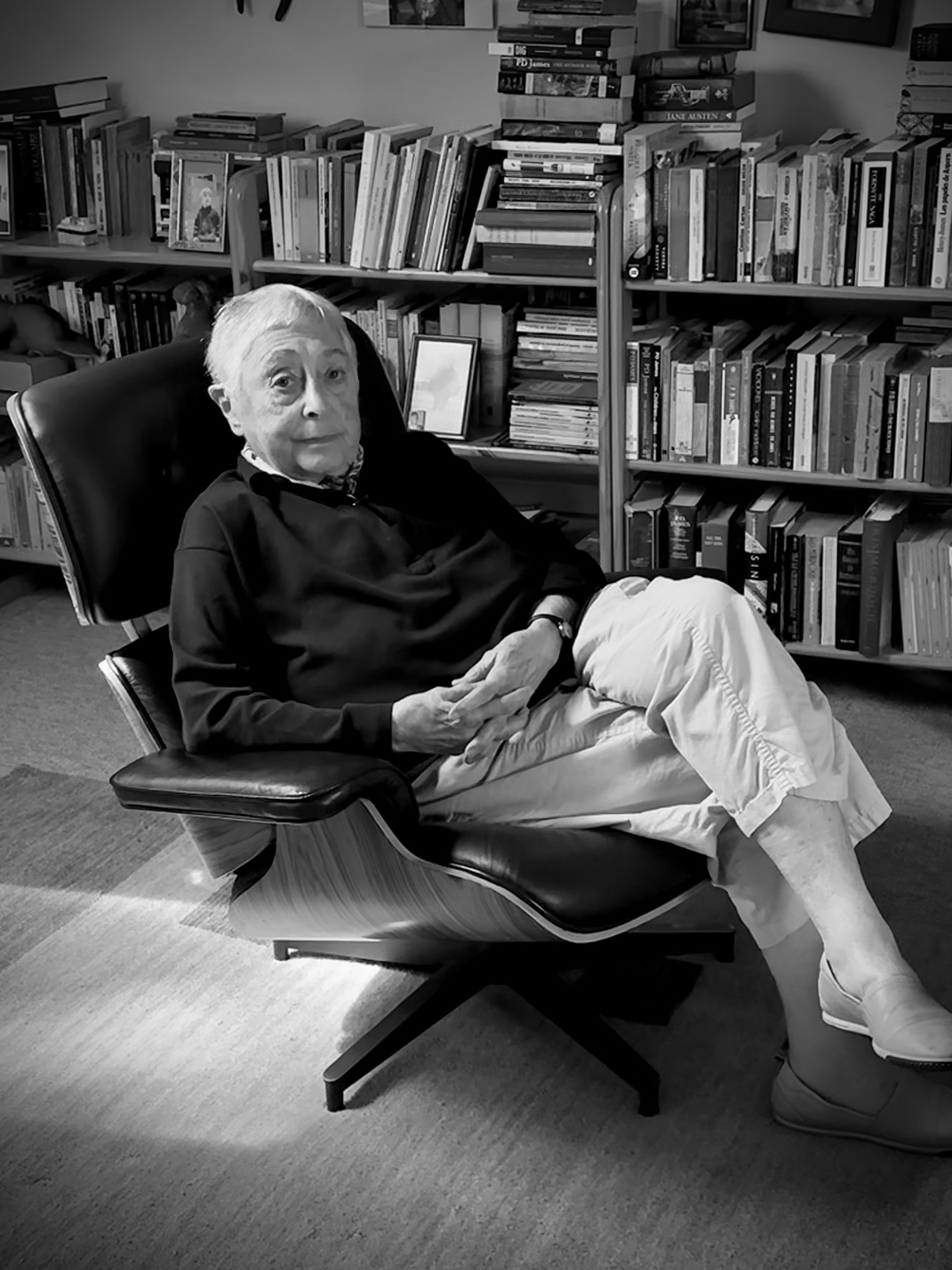 Josefina Auslender at home. (Photo by Marcelo Auslender)
“It’s wonderful to be able to make art. Our body, our appearance seems to change. But you have to keep dancing to the music. The image always changes, but always what shows up feels young and fresh.“
Auslender was born in Argentina and had early success as a ceramist and, later in the 1960s, an artist working in graphite and colored pencil. Her many series — “La Ciudad” (The City, here meaning Buenos Aires), “Los Cuerpos” (The Bodies, having to do with the state terrorism of her country’s Dirty War), “Los Caprichos” (The Caprices) and others — have explored the language of surrealism and abstraction through graphite, colored pencil, dye and, now, ink. She settled in Cape Elizabeth in the late 1980s.
This latest shift in material was largely a physical necessity. “Losing strength in my hand was difficult,” she says of graphite and pencil, a medium that required pressing deeply and repeatedly into paper, a material that provided more resistance than one might imagine. “You can orient light with graphite and its shine. But ink is completely free. I don’t have to submit to any rules. I started working with ink when I was in my eighties. You have to play around with it. It goes where it wants. You must have an intense freedom to play with that because it’s more spontaneous. You can keep playing until you ruin it or you make something wonderful.”
 Josefina Auslender, “Los Cuerpos 01,” 1979, graphite, ink, and colored pencil on paper. (Photo by Luc Demers, courtesy of Sarah Bouchard Gallery)
Aging, however, has brought a more expansive sort of liberty in various respects. “We lose the fear we have as a young person — of not getting lost in our thoughts, of being successful, of not making enemies. When you can say ‘To hell with that,’ it gives us ‘seniority.’ ”
Throughout her life in art, she explains, “I changed frequently. At times I had to stop myself because I was so enthusiastic about so many things,” she says. “But one always changes. We have to change our point of view to adapt to a world that is very changeable and susceptible. If not, we don’t understand what is happening anymore. My art changes completely with new experiences.”
 Josefina Auslender, “Untitled (from La Chimera del Oro),” 2026, ink on paper. (Photo by Luc Demers)
Auslender likens the time we are living in to pre-World War II. “There’s so much disappearing that is beautiful. So much is uncertain,” she observes. “Young people are very worried. But we must adapt and develop a capacity to listen, and we learn not to have fear.” What has sustained her are three constants: “love for people, for beautiful things, for harmony.”
Turning 90, she recalls, felt like a kind of reckoning. “It was really a kind of turbulence inside me,” she says. “I wasn’t anxious. But I’m not sure I have the time to say all I want to say.”
ALISON HILDRETH“I have my heroes — Terry Winters, Anselm Kiefer, Dürer, Caravaggio, Pontormo — but not anyone I would emulate. I have enough resource and inspiration that I don’t need to rely on them. I have so much, I just go to the studio and figure out what to concentrate on. I don’t think about any of this in terms of age.“
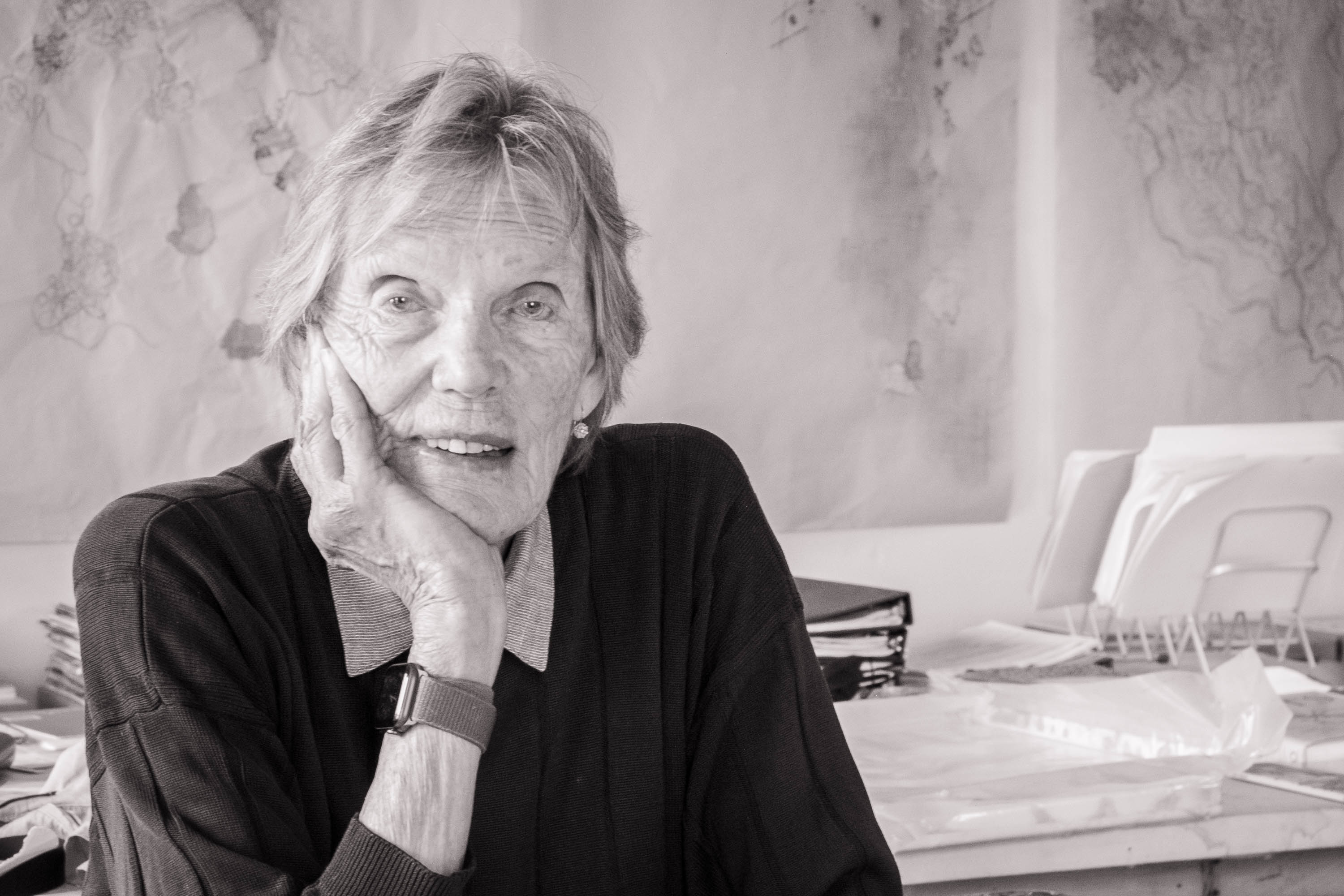 Alison Hildreth. (Photo by David Etnier)
Hildreth sees her art — and her life — as a kind of perpetual flow, one that carries her along and to which she must be open and inquisitive. It’s difficult to get Hildreth to talk about herself because she is so modest and self-effacing that practically every definitive statement comes with a qualifier or disclaimer.
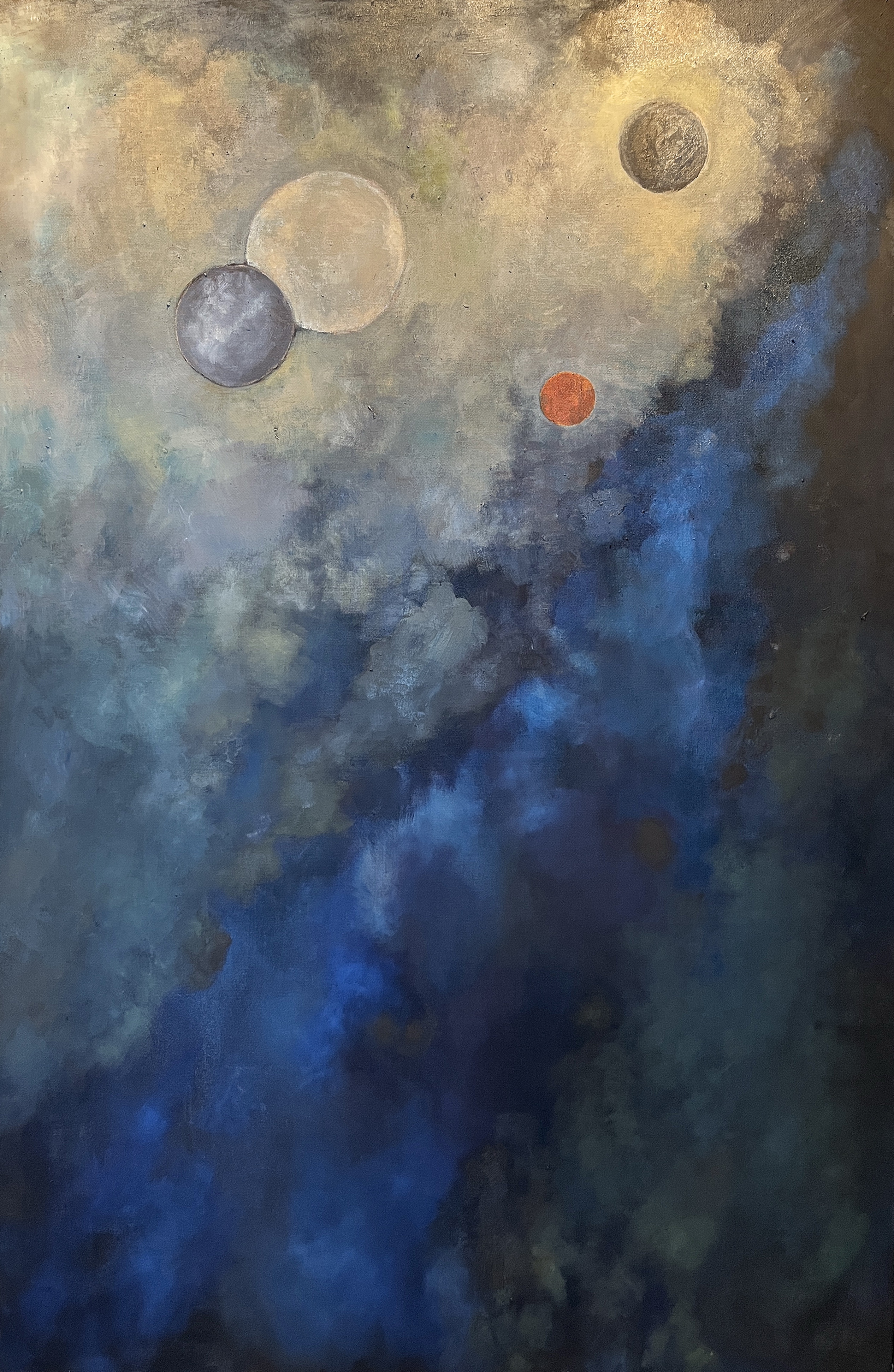 Alison Hildreth, “Untitled,” 2026, oil on linen. (Image courtesy of the artist)
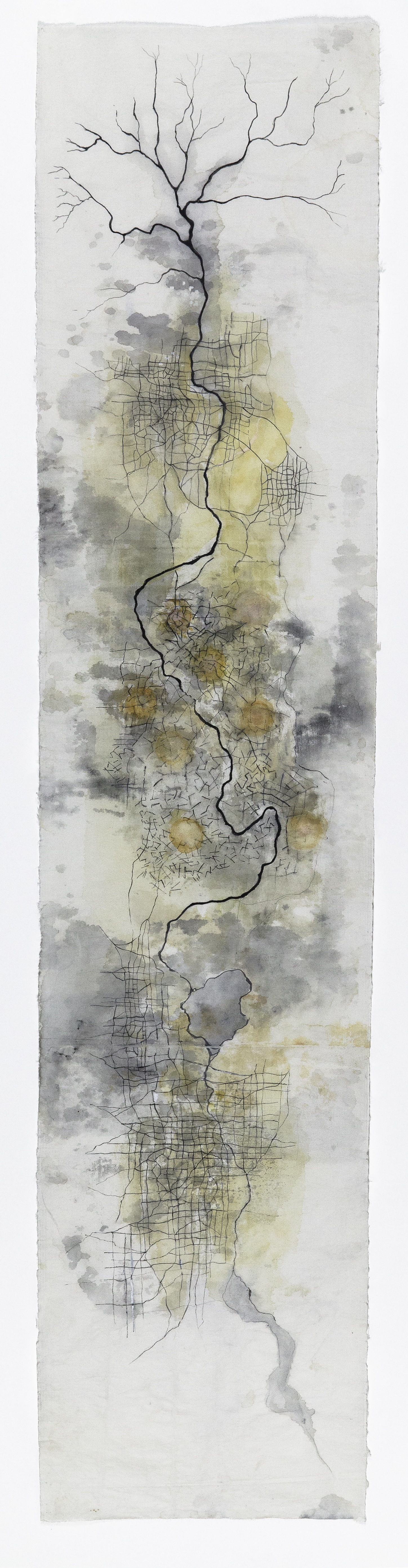 Alison Hildreth, “River 1,” 2025, pen and ink and color wash on Kitakata paper. (Image courtesy of the artist)
But Hildreth is an incredibly prolific artist who, for over six decades, has worked in painting, drawing, collage, printmaking, puppetry and other media, and has explored everything from history, philosophy and cartography (of the land and memory) to the swarm mentality of bats and ants.
“I’m always influenced by what I’m reading,” she explains. “These things come through in some way. I did 50 or 60 dry points and an installation of hanging bats, then maybe 40 paintings of bats. Along the way I got interested in ants. Between that and W.G. Sebald’s Rings of Saturn and Austerlitz, which talks about Theresienstadt [a Nazi concentration camp] I got into mapping. It’s surprising where some sort of inspiration will come from.”
More recently, Hildreth has been looking up at the cosmos for her subject matter. “I have quite a few books on space, none of which I understand,” she quips. But for the moment, she believes, “I’ve gone as far in terms of space and moons and planets as I think I’m going to go.” She has been deeply affected, on the other hand, by the conflict in Gaza, and has done some collaged pieces and drawings shaped like that tragically traumatized strip of land.
Each new unfolding provides her novel avenues of inquiry, both personally and in terms of her art. “I’m always trying to push forward, take what I’ve done and move it further,” she continues. “You can’t stay on the same lily pad. I would be bored. To me, that’s a lot of what art is about: invention. It’s an exploration, and there are answers in there for myself.”
Fame and fortune have never interested Hildreth. “If that’s what you want for yourself,” she advises younger artists, “you have to do some work, talk to people, go to events. Pay attention to the work. You must have the work first, before you think about a gallery.”
What does that mean for how she wishes to be remembered? “I don’t think about it, about legacy,” she says. “If the work is good, it will stick around for a while. If it’s not, it won’t.”
WILLIAM IRVINE“At my age, time has taken away so many of my desires or has made me incapable of pursuing them. However, the desire to paint has lasted all my life, from my childhood in Scotland, ten years showing and living in London, through sixty years in Maine, bitter winters, losing a lovely wife to cancer, remarrying, exploring islands, painting, exhibiting, painting. Time has been on my side as an artist, clearing away distractions, keeping me fit enough to work.”
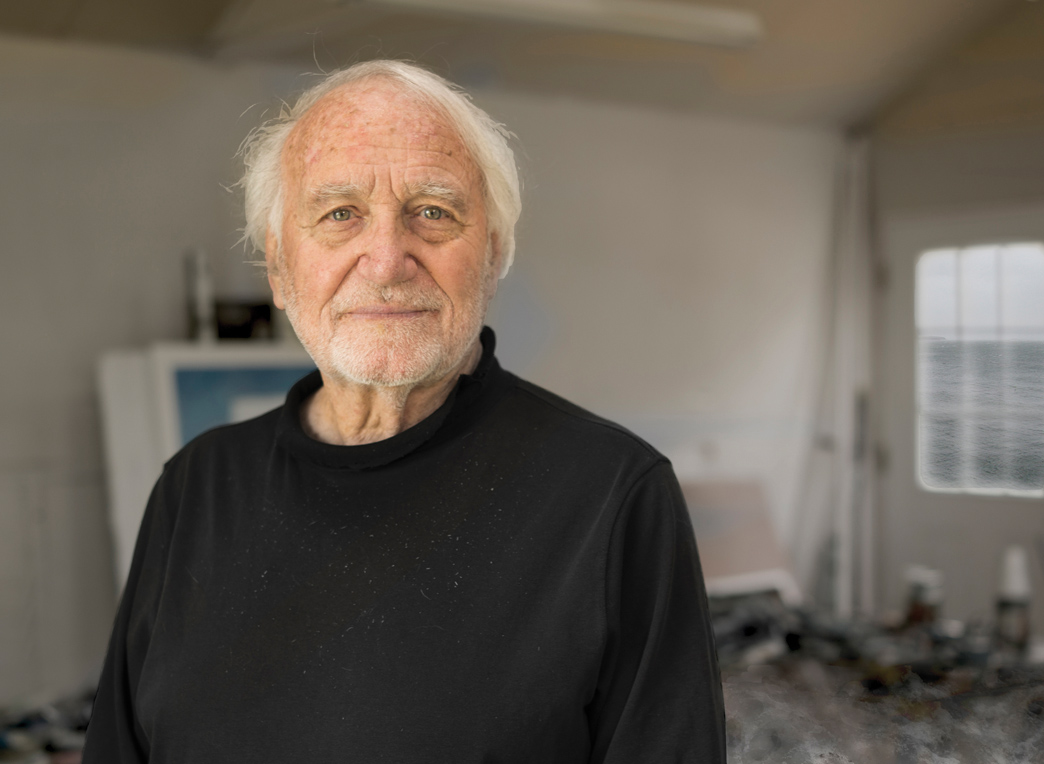 William Irvine. (Photo by Jeffery C. Becton)
Irvine was born in Troon, Scotland, and married an American woman who brought him to Maine. Though he claims that, “As I get older, I have found little change in my approach to painting,” there has been, in fact, quite a bit of evolution. He dabbled in abstraction but never took completely to the complete obliteration of content that it required. “When I came to Maine,” he recalls, “something in my painting completely changed. There was something about the landscape that didn’t lend itself to abstraction.”
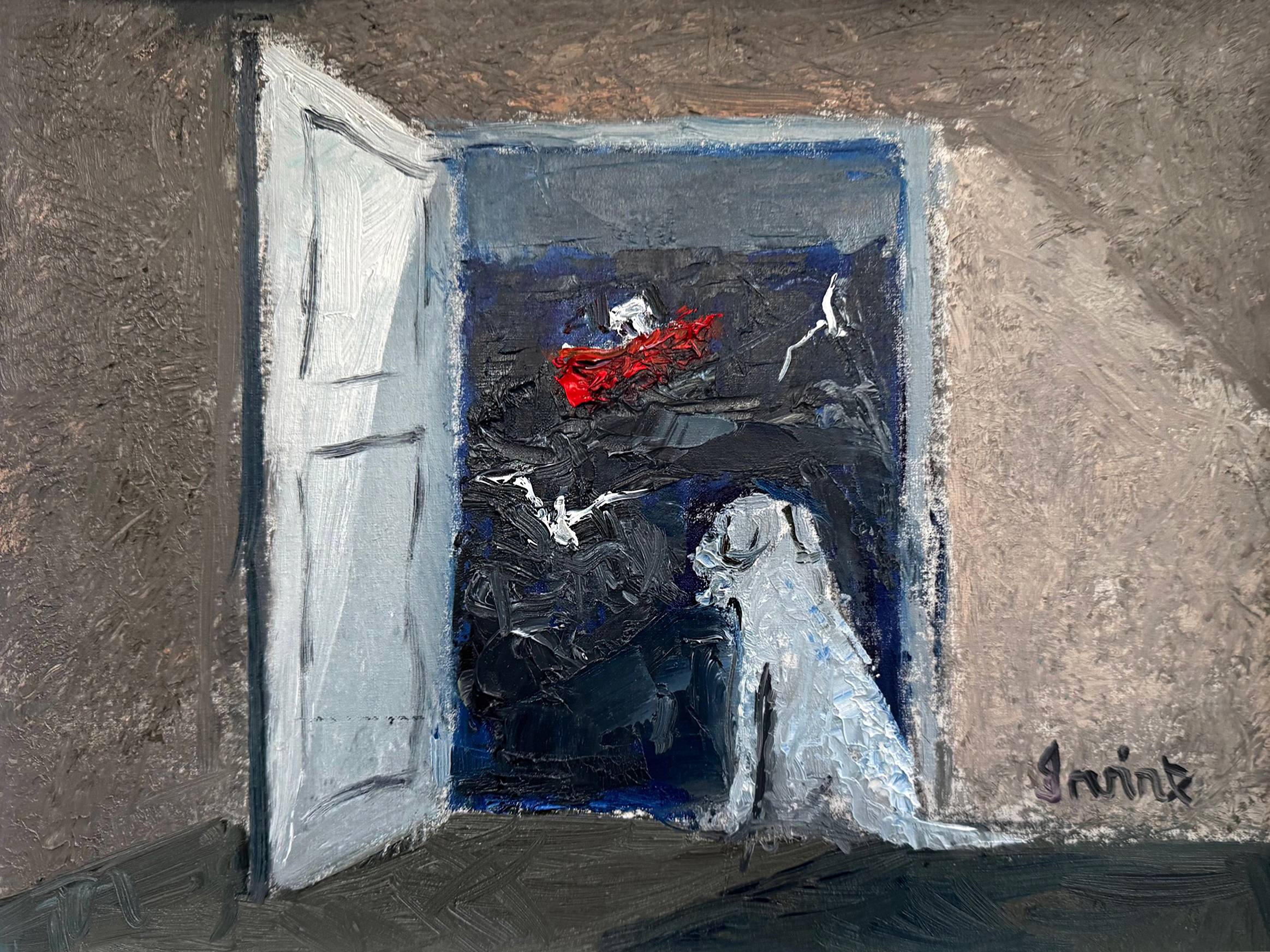 William Irvine, “Dog At The Door,” 2025, oil on canvas. (Image courtesy of Courthouse Gallery)
True, his artistic leanings since childhood never faltered. “I’ve always had that compulsion to express myself in my studio,” he says, “Age has not changed, nor diminished that desire that I found in me when I was a young boy.”
His art, too, has always been about the sensorial experience, not just the representation of something. “When I have that compulsion to paint, perhaps just a vague image of a boat and a sinking cloud that encompasses the feeling I want to express, I will set about it with the knowledge of what I have done before and the desire to find a clearer path to completion. This often leads me to areas of abstraction, color fields, etc. There is always a need to shock yourself with a new image that expresses your initial impulse. To me a successful painting is one that takes a step back and declares its independence.”
And his technique, too, has morphed since he started painting at 14. “Some years ago, in my haste to complete a painting in a single stretch, I used paper towels to apply the oil paint onto the canvas because I was able to put down paint on top of wet paint, whereas a brush could very well smudge the paint. I discovered that by using this method, I achieved a certain density that helped the expression.”
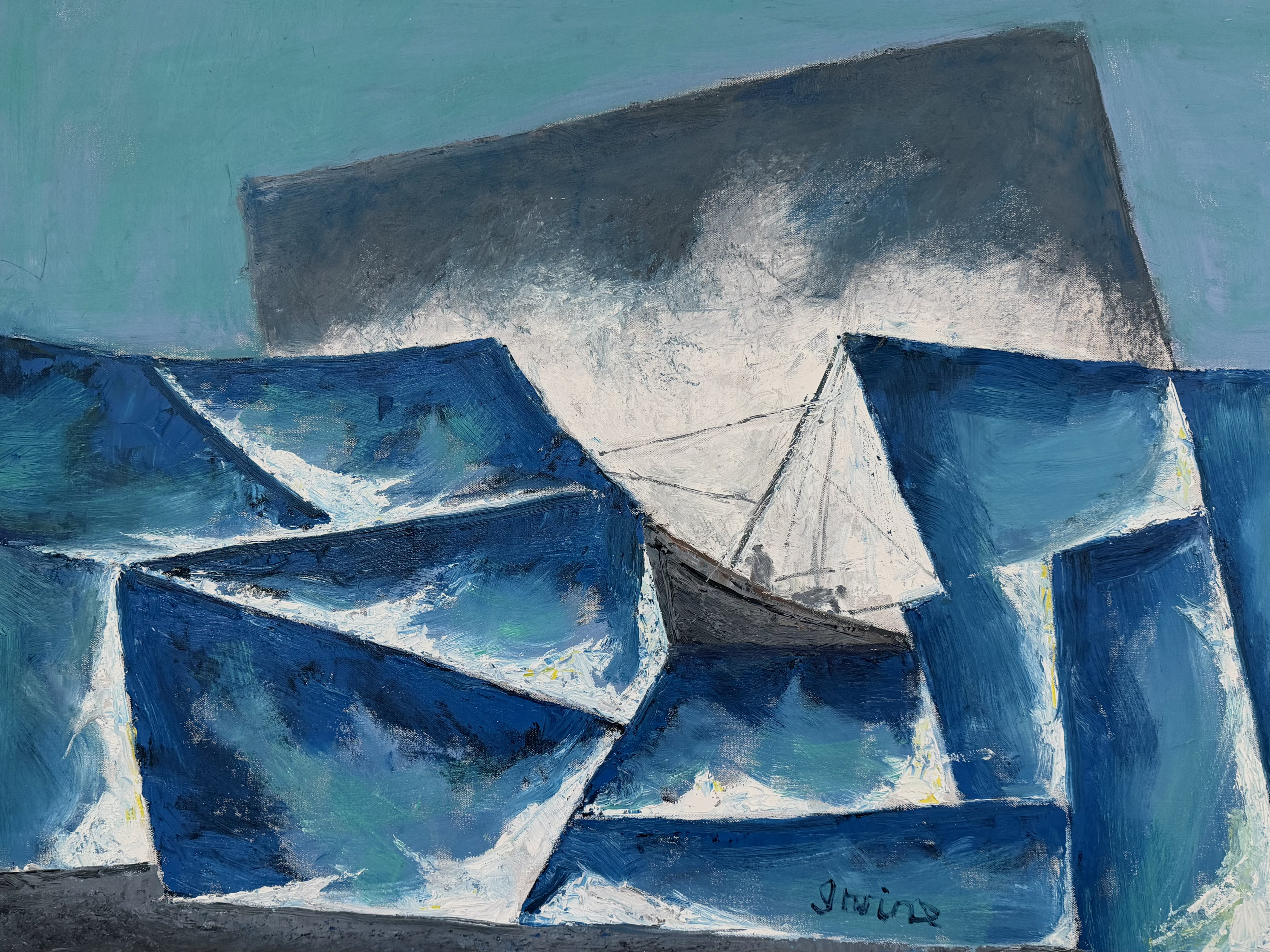 William Irvine, “The Rough Sea,” 2026, oil on canvas. (Image courtesy of Courthouse Gallery)
Eventually, however, this method resulted in severe shoulder pain, “so I looked for another way. This led to using large brushes, household brushes. I like the way the sweeping strokes added to the expression. However, whenever my shoulder feels good, I sometimes go back to my earlier technique.”
His counsel to young artists, Irvine says, “is to familiarize yourself with the great art of the past to the present. To understand and to feel that art is the medium through which we share our souls. Then you can embark on this amazing journey.”
Jorge S. Arango has written about art, design and architecture for over 35 years. He lives in Portland and can be reached at [email protected]. This column is free to access through support by The Dorothea and Leo Rabkin Foundation.
| # | Наименование новости | Тональность | Информативность | Дата публикации |
|---|---|---|---|---|
| 1 | 6 Portland art shows showcase vibrant work | Column | 0 | 42.84 | 26-08-2026 |
| 2 | At this Maine auction, people bid with stories | 0 | 37.2 | 12-09-2026 |
| 3 | Portland Museum of Art set to open outdoor pavilion | 0 | 31.13 | 22-09-2026 |
| 4 | Bored with social media? Get your hands on a Maine zine | 0 | 35.09 | 27-08-2026 |
| 5 | Maine Lit Fest returns with writers ‘responding to the moment’ | 0 | 38.28 | 23-09-2026 |
| 6 | PMA’s Winslow Homer exhibit recasts the artist in a fresh medium | Column | 0 | 40.74 | 02-09-2026 |
| 7 | Fall art exhibits lean into retrospectives | 0 | 35.8 | 09-09-2026 |
| 8 | Ogunquit Museum’s Sprinchorn exhibit is worth more than one visit | Column | 0 | 36.57 | 23-09-2026 |
| 9 | Playwright’s new work tells the story of Portland’s unhoused through one person’s eyes | 0 | 35.8 | 23-09-2026 |
| 10 | 14 Maine events to get the most out of fall | 0 | 38.1 | 28-09-2026 |