Просмотр новости
Найдите то, что Вас интересует
 Спутники
 РН
РН SpaceX
 Роскосмос
 NASA
NASA
СпутникиРНSpaceXРоскосмосNASAThe author, 89, contemplates the power of imagination and the future that young people are inheriting.
 Author Lois Lowry at her home in Bridgton in August. (Derek Davis/Staff Photographer)
“There is no Frigate like a Book” — so goes the poem by Emily Dickinson. In her latest novel, “Building 903,” Lois Lowry ponders just how far a book can transport a reader. The year is 2099. Life is optimized. Animals are extinct. An autocratic ruler named Zokiris has outlawed all books. When 14-year-old Tessa stumbles into a mystery that seems to have engulfed her missing twin brother, Theo, the power of reading in this parallel world is put to the test.
Lowry, 89, is the author of over 50 books for children, ranging from the “Anastasia Krupnik” series to “Number the Stars,” a work of historical fiction that tells the story of resistance in Nazi-occupied Denmark. Her book, “The Giver,” has been translated into countless languages, and, most likely, “you might have had to read it in eighth grade.” With “Building 903,” Lowry returns to an imagined future with apprehension about the current moment and a full-throated appeal in support of imagination. She spoke with the Portland Press Herald in her home in Bridgton about the power of language, the movement of culture and the worldwide legacy of her work.
‘Building 903’ turns up the heat on several contemporary fears that readers might have about technology, politics and power. Where did the story first begin for you?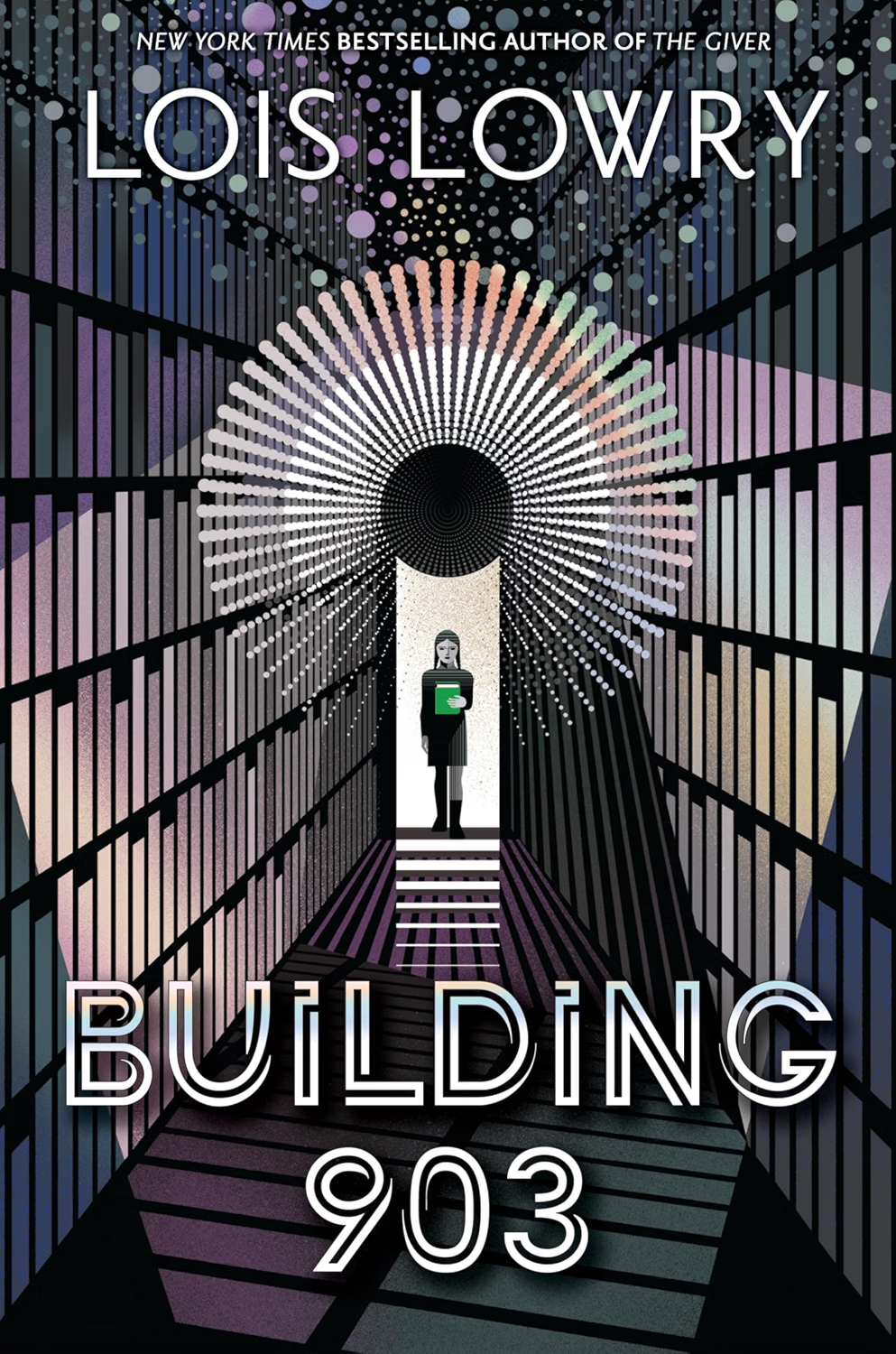
There could be many answers to that. I had published a book some years ago that was set in an unnamed future. “The Giver” had been part of my history with my readers, and I’m answering questions about it on my computer every morning.
But more recently, I began to get pissed off, for lack of a better phrase, by the fact that universities are no longer teaching literature. I was an English major at Brown, and to me, literature is the backbone of our whole intellectual civilization. I discovered when I went to pick up one of my grandchildren at his high school that they have no library anymore. I was supposed to meet him there, and he was in the room where all the empty shelves were, but the books were gone. All of that was getting to me, so I started thinking about what the world would be like without books.
I began to create a world where books had been illegal for more than 50 years. I always have a young protagonist because that’s my audience, and then I realized that their parents would also not ever have seen, touched, smelled, felt, opened or read a book. What would that do to a culture? What the book is really about is the loss of imagination, which would also lead to a collective loss of empathy. It changes the whole tenor of a civilization.
One of the core ideas of the book is the power of imagination. How do you see this book as about needing to choose joy in our lives, that it’s something people need to move towards when technologies may be pushing us the opposite way?You’re correct in what you say, but I also wanted to incorporate how science will have advanced. I needed to incorporate some of the science that we live with, even though I avoided every physics and chemistry class that I could when I was in school. I tend to overall focus my mind on what you describe, which is more amorphous than AI or Einsteinian theory, but I use that as a goal, an overarching, permeating feeling rather than any specificity.
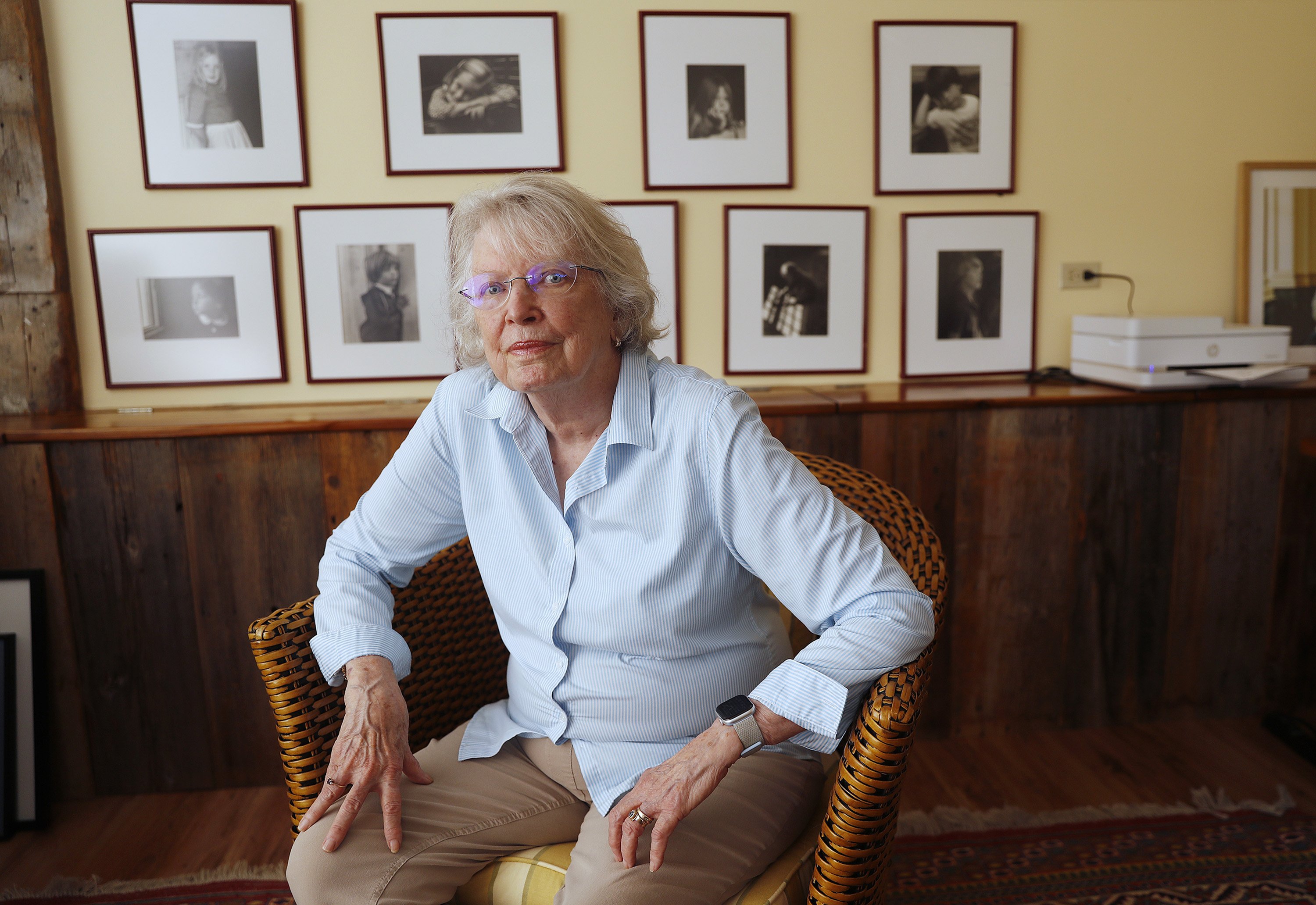 In the mid-1970s, after competing her degree in English literature at the University of Southern Maine, Lowry worked as a freelance writer and photographer. (Derek Davis/Staff Photographer)
Purchase this image
In the mid-1970s, after competing her degree in English literature at the University of Southern Maine, Lowry worked as a freelance writer and photographer. (Derek Davis/Staff Photographer)
Purchase this imageI grew up in an era where I had no television. In fact, I lived out of this country when I was 11, 12, 13 years old. Certainly, no computers. My father gave me a typewriter for my 13th birthday, which in those days was a magnificent gift.
I was never happier than when I sat down with a very long, slow-moving book. I can’t write those now for kids because they won’t read them. They need to turn pages fast. That sort of kills me to condense my own thoughts in a way that I can’t write a leisurely book. That’s what I would like to be doing, but no one would read it, and I think that’s just indicative of the way our world has sped up.
In this story, there’s language that has a utilitarian function, to support imagination or to obfuscate meaning. Do you see that our relationship to language is continuing to move in one of these directions?I think it probably always has, and certainly is and always will. Somebody on the internet had written a little thing about what words mean and specific things that kids are now saying. There were phrases and words that I’ve never heard. This is junior high talk. Everybody invents things that are cool to say when they’re about 12 years old. That’s always been part of our changing language.
You’ve written over 50 books. You’ve had this deep relationship to writing throughout your life, and this book is about the power of storytelling. What do you think the power of story has been in your life?My mother was the perfect mother for me. Because she had been a teacher, she valued books. She read to us when we were children. I lived in a house filled with books, and because of my father’s profession, we moved from place to place. I was a very introverted, shy child, but I was a keen observer. I spent all my time noting things and remembering them — I remember details that go back to when I was 3 years old.
I remember these things in a narrative way, storylike. “The child is four years old now, and she’s in our apartment in New York, and her father is out on the street. It’s a Sunday, and he’s getting into a car. Suddenly, her mother runs through the house, upset, goes out to the sidewalk, and she hears her mother say, ‘You have to put your uniform on.’” My parents are both long dead, and this is a question I wish I had asked them. My mother had heard the news on Dec. 7 of the bombing of Pearl Harbor, where we used to live. Did the radio announce that anybody in the military had to put their uniform on, even though it was Sunday? Why else would she have told him that? I’ll never know the answer. I was just making a story out of everything. Every place we went was to me a setting.
You’ve written works of historical fiction, like ‘Number the Stars,’ and imagine completely different worlds with speculative fiction in ‘The Giver’ and now this book. As you looked at the challenges or the changes that were frustrating you, why was science fiction most suitable to you?This was not true of me during my adolescence. I looked ahead and knew what my future was going to be like. I was going to go to college and get married and have a job, maybe I’d be a writer, I hoped, but I wasn’t worried about any of it. Today’s kids are very concerned about the future, and rightly so. We messed everything up so much. I have similar concerns, but I’m not going to be around for the future. My concerns are for them, for my grandchildren, my soon-to-be great-grandchildren. That has put me on that trajectory of postulating, what could this be like?
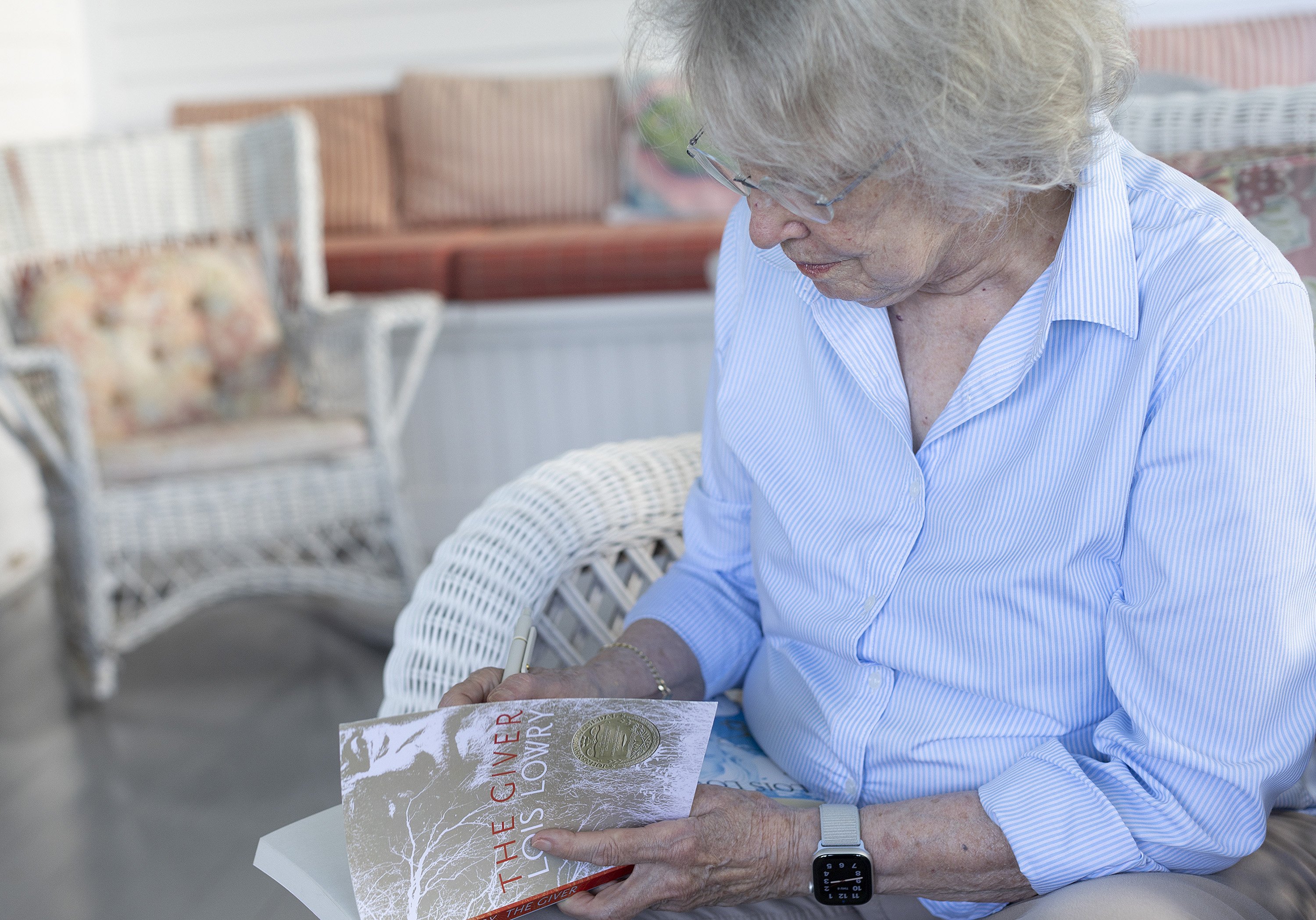 Lowry signs a copy of The Giver. (Derek Davis/Staff Photographer)
Purchase this image
Lowry signs a copy of The Giver. (Derek Davis/Staff Photographer)
Purchase this imageDuring the pandemic, I Zoomed with classrooms around the world. The whole world was shut down. The book that they’d all read was “The Giver,” which has been translated into a zillion languages, so I ended up talking with kids around the world about that book. I found that, without exception, all of those kids’ main interest and concern was, “How can we keep this from happening?” Although that was some years back now, that still is on their mind, maybe more so now.
Your writing has meant so much to readers around the world. There’s this deep relationship your readers have with your books. What does that legacy mean to you?When I wrote my first book, it surprised me when I began to get letters from readers. In those days, they were actual letters forwarded from the publisher, and a few of those still come in, but now it’s instantaneous. I can feel the connection that these young people, and frequently older people as well, have with what they read. It’s very touching. I do that every morning after Wordle. I sit down with that email, and some of it is just tedious, like, “Please tell me all the similes and metaphors in this book. I need this information by Thursday.” But most of it is a description of their very passionate connection to something they’ve read. I’m sure it goes to a zillion other authors too, and it’s a reminder of what literature can be and can do.
Michael Colbert is the editor-at-large for books.
Lois Lowry will be celebrating the release of “Building 903” with Rebecca Traister at Westbrook Performing Arts Center, 471 Stroudwater Street, Westbrook, 6:30 – 8 p.m. Tuesday. Tickets are $10 and available at events.humantix.com.
| # | Наименование новости | Тональность | Информативность | Дата публикации |
|---|---|---|---|---|
| 1 | Maine Lit Fest returns with writers ‘responding to the moment’ | 0 | 38.28 | 23-09-2026 |
| 2 | Maine Lit Fest’s headliner Min Jin Lee’s new book explores immigration and what it means to be successful | 0 | 38.53 | 23-09-2026 |
| 3 | Poet from Presque Isle muses on queer awakening as a marriage dissolves | 0 | 39.61 | 16-09-2026 |
| 4 | Playwright’s new work tells the story of Portland’s unhoused through one person’s eyes | 0 | 35.8 | 23-09-2026 |
| 5 | For these Maine artists, creativity has no retirement age | 0 | 38.96 | 16-09-2026 |
| 6 | E.B. White’s 98-year-old poem is now a children’s book | 0 | 38.53 | 26-08-2026 |
| 7 | Read the poem ‘Shaker Village’ by Bill Schulz | 0 | 48.83 | 16-09-2026 |
| 8 | Read the poem ‘Oysters’ by Maya Critchfield | 0 | 49.39 | 23-09-2026 |
| 9 | Book Excerpt: Emily St. John Mandel’s ‘Exit Party’ Imagines a Future Where a Spy Could Disappear | 0 | 5.71 | 10-09-2026 |
| 10 | This week’s writer spotlight feature is: @mojowitchcraft! Since the last time… | 0 | 20.17 | 06-08-2026 |

