Просмотр новости
Найдите то, что Вас интересует
 Спутники
 РН
РН SpaceX
 Роскосмос
 NASA
NASA
СпутникиРНSpaceXРоскосмосNASAIn her new novel, 'American Hagwon,' Lee writes about the Korean diaspora as she follows a family across three countries as they navigate education, immigration and sacrifice.
 Min Jin Lee attends the GQ Global Creativity Awards at the Water Street Associates Building in New York in April 2023. (Evan Agostini/Invision/AP)
Min Jin Lee’s “American Hagwon” is a sweeping family saga about what people sacrifice in the pursuit of a better life. Spanning Korea, Australia and California from the 1990s into the 2000s, the novel follows the Koh family through immigration, financial upheaval and the relentless pressures of education systems. At the center of the story is the question: If education and hard work can lead to success, what happens when success itself becomes the measure of a life? The novel is an intimate portrait of family that explores ambition, class, sacrifice and the meaning of wisdom.
“American Hagwon” is Lee’s third novel and follows her acclaimed books “Free Food for Millionaires” and “Pachinko.” She is the Portland headliner for the upcoming Maine Lit Fest, where she will read from and discuss her new book. She spoke with the Portland Press Herald about education, diaspora as a global experience and the search for a life well-lived.
I interpreted ‘American Hagwon’ to be a book about ambition and its consequences — what it costs people and what it makes them sacrifice. When you began writing this book, did you start with a knowledge of the themes and then create the story, or did you craft the setting, characters and plot, and subsequently find yourself discovering the themes?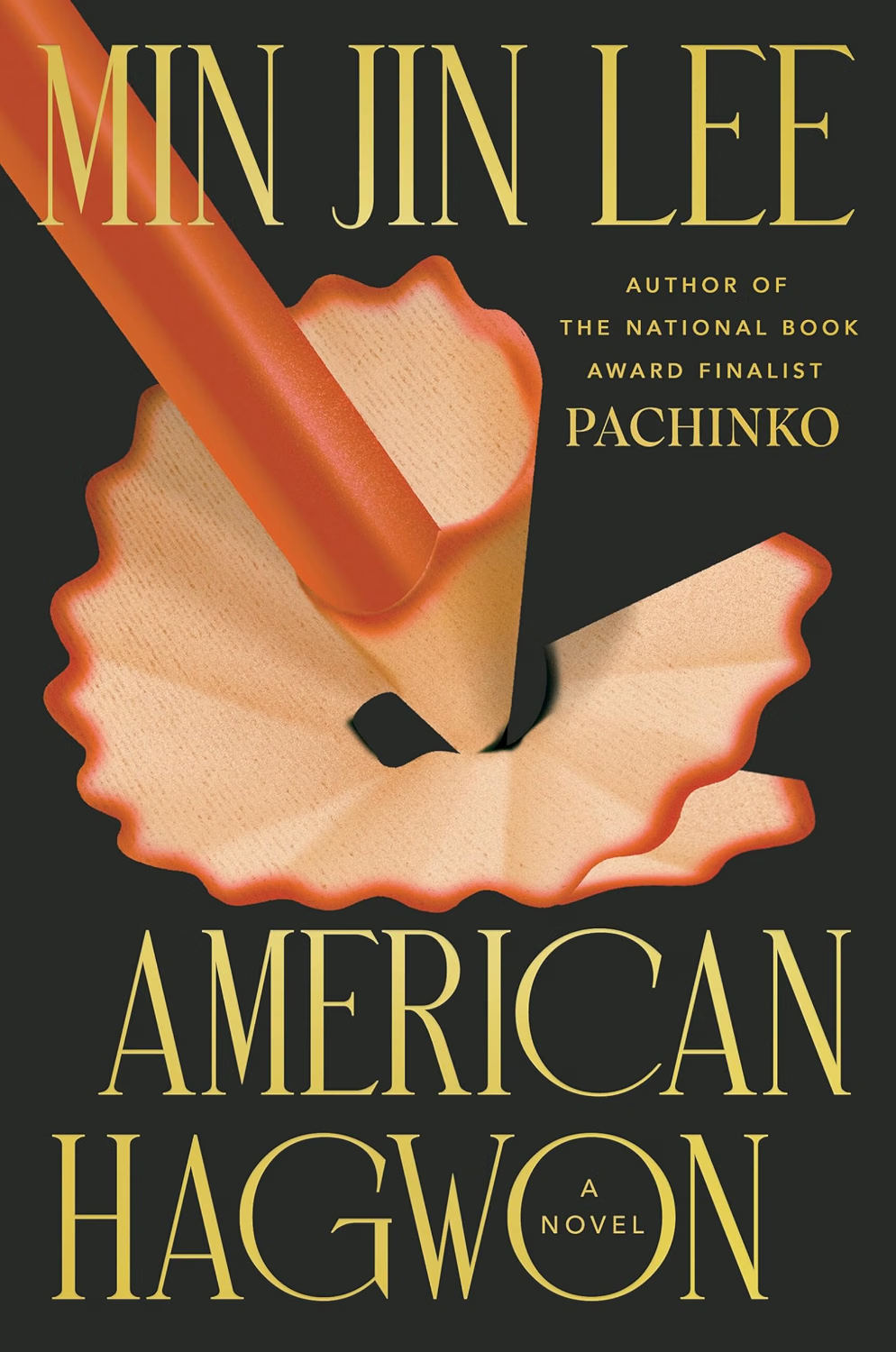
Once I figure out the subject of a novel, I start the book with several larger questions. For “American Hagwon,” I wanted to write about why education is so important to Koreans around the world. As I worked on the book, I wanted to understand how individuals define wisdom and how each person’s philosophy on wisdom affects his or her choices. When I focus on the questions, I find that the characters, settings and dilemmas appear very naturally. Also, once I understand a character’s personality, the character’s decisions need to feel true. In short, for me, the themes come first then the plot unspools.
A central tension in the novel is that education is both a source of hope and enormous pressure for the Koh family. How have your own experiences with education systems informed your work?My mother and father believe that a child chooses the quality of her education. They believe that no one can ever tell a child to study. My father routinely told me to go to sleep early instead of studying too hard. They were pleased when I did well, but they didn’t know what I studied or how I approached my schoolwork. There are many stereotypes about Asian parents, and in my research, I can attest that they are just stereotypes. Asian and Asian-American parents have wide ranging philosophies regarding education. Examining the structures of society is more helpful. I think younger folks feel a lot of pressure today, not always from parents, teachers or peers but rather because the world is changing so rapidly that it is not easy to figure out what kind of education matters. Also, the cost of higher education and the lack of entry-level jobs for college graduates cause a great deal of modern anxiety.
The Koh family’s pressure to succeed only seems to intensify rather than disappear after immigration. Why do you think the immigrant experience can make achievement feel like such a high-stakes moral obligation?The Koh family feels greater pressure after they immigrate to the United States because they have experienced a drop in status and resources, and a loss of community. The parents’ education in Korea matters less in the U.S. and their experiences in Korea, Australia and the U.S. matter less because the parents are older, which makes it harder to start again. I wanted to critique how even a highly selective college in one country may mean little to nothing in another country and even less when age discrimination is a factor. When the Koh children witness the struggles of their parents, they are more motivated to work to reclaim their collective family status and become even more invested in their family values. That said, every child can respond differently to a parent’s loss of socio-economic status. The Koh children are highly motivated individuals but each have different personalities and each expresses his or her wishes differently.
This book asks whether people are defined by what they accomplish or by something deeper in their humanity. Did writing ‘American Hagwon’ change the way you think about the difference between being successful and living a good life?Writing this book made me learn a great deal about the meaning of a life well-lived versus what is commonly accepted as a good life. Also, I think Maslow’s hierarchy of needs made me understand better how individuals shift their needs depending on their socioeconomic circumstances. I’ve always cared about wisdom, but writing this book made me realize that one’s values and conduct need to be better aligned to live peacefully.
The novel moves through various landscapes: Korea, Australia and California. The characters also live through economic changes, particularly the 1997 Asian financial crisis. What did moving the story across these different places and periods allow you to explore?This middle-class family moves across the globe because they are looking for work for themselves and opportunities for their children. Following their movements allowed me to explore how modern families are surviving today. Ordinary people are moving across borders to find work, schools and stable governments. Most people do not want to leave their home countries; however, when they do, mothers and fathers need to figure out where to live, how to educate their children and how to find work. I learned a great deal about the resourcefulness of people who move.
You have described ‘American Hagwon’ as the third book in your diaspora trilogy, an exploration of the Korean diaspora and the impact Koreans have on where they settle. After spending so many years writing this family, how do you think about the meaning of ‘diaspora’ now?Diaspora is an ancient Greek term, which means “to scatter,” and it is commonly understood today to describe people who originate from a place, have been scattered and remain connected to the place and culture of their origin. I believe that diaspora is a modern condition for all people around the world — we can have environmental, economic, political, religious, educational and cultural reasons for diaspora. I remain deeply interested in this subject and want to explore its causes and effects because I believe diaspora will not only persist but will only become more commonplace as imagined and real borders disappear. Above all, I believe that when a person leaves, the place of origin changes, and when the person arrives, the person changes the destination.
You’ll be bringing ‘American Hagwon’ to the Maine Literary Festival as a headlining guest author. What are you most looking forward to about the festival?I love Maine, and I feel deeply privileged to meet my Maine readers. I am also looking forward to seeing my friends in Portland. I wish there was time for some hiking.
Kaylie Saidin is a writer based in Wilmington, N.C.
“An Evening with Min Jin Lee” will be held at First Parish Church, 425 Congress St., Portland, 7-8:30 p.m. Oct. 3. General admission tickets are $10 and available online at mainewriters.app.neoncrm.com/nx/portal/neonevents/events?path=%2Fportal%2Fevents%2F53758.
| # | Наименование новости | Тональность | Информативность | Дата публикации |
|---|---|---|---|---|
| 1 | Maine Lit Fest returns with writers ‘responding to the moment’ | 0 | 38.28 | 23-09-2026 |
| 2 | I didn't think 'Pachinko' could be topped. Then I read 'American Hagwon' | 0 | 14.56 | 28-09-2026 |
| 3 | Lois Lowry imagines the perils of a world without books in her new novel | 0 | 35.59 | 23-09-2026 |
| 4 | Poet from Presque Isle muses on queer awakening as a marriage dissolves | 0 | 39.61 | 16-09-2026 |
| 5 | Fight for US citizenship recounted in early immigration struggle | 0 | 41.91 | 09-09-2026 |
| 6 | Playwright’s new work tells the story of Portland’s unhoused through one person’s eyes | 0 | 35.8 | 23-09-2026 |
| 7 | 6 of the Best New Book Releases Out September 29, 2026 | 0 | 19.01 | 29-09-2026 |
| 8 | Read the poem ‘Oysters’ by Maya Critchfield | 0 | 49.39 | 23-09-2026 |
| 9 | The Top 5 Longreads of the Week | 0 | 24.82 | 18-09-2026 |
| 10 | 14 Maine events to get the most out of fall | 0 | 38.1 | 28-09-2026 |