Просмотр новости
Найдите то, что Вас интересует
 Спутники
 РН
РН SpaceX
 Роскосмос
 NASA
NASA
СпутникиРНSpaceXРоскосмосNASACumberland resident Rick Ramseyer describes his grandmother’s efforts to become an American citizen while encountering an intractable immigration bureaucracy.
 Rick Ramseyer (Photo by Riechelle van der Valk)
“Girl Without a Country” tells the true story of an immigrant’s struggle to become a United States citizen after her application was denied because she would not pledge to kill in defense of the country. Her perseverance in multiple court hearings drew national attention starting nearly 100 years ago and was part of a larger movement recognizing the rights of pacifists and conscientious objectors, illustrating the long-standing issues in America’s approach toward immigration.
First-time author Rick Ramseyer has a master’s degree in journalism from the University of Missouri and is a two-time recipient of a Hewnoaks Artistry Residency in Lovell. His longtime interest in this story began as a teenager when he came across a cardboard box containing newspaper clippings, letters and court documents from the 1920s about the woman — his maternal grandmother — and her efforts to become a citizen.
Your book describes the challenges faced by Martha Graber, an immigrant from Alsace-Lorraine, in becoming an American citizen. What obstacles did she face?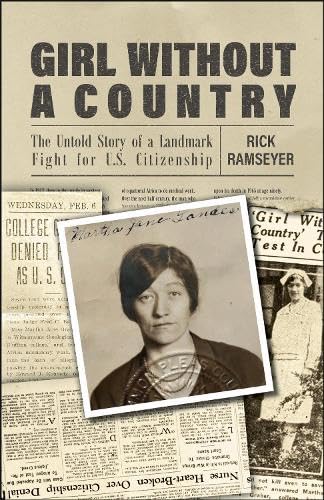
Martha had lived quietly and successfully in the U.S. for about 20 years as a French immigrant when her case began. She was a Mennonite — one of the traditional “peace” churches — as well as a registered nurse. During her first citizenship hearing, she refused, as a pacifist, to say she would be willing to kill to defend the nation, though she said many times during the hearing and afterward that she would be willing to give her life for it. Her answer didn’t sit well with the naturalization examiner and the judge, and she was denied citizenship, which was quickly picked up by newspapers. Over the next 19 months, a diverse group of stakeholders watched her case with interest and alarm.
What prompted Martha to seek American citizenship in the first place? After all, she had been in the U.S. for 20 years before applying.Her dream was to serve as a medical missionary in Africa — specifically a hospital in Gabon founded by Albert Schweitzer — and she wanted to become a U.S. citizen before she went overseas. She filed some paperwork in Iowa in 1925 and then started the hearing process in 1929 in Ohio, likely thinking that obtaining citizenship would be a formality. Things didn’t work out that way.
There is an irony in all this isn’t there, for pacifist women seeking citizenship?Yes. Even as she was being denied citizenship for her refusal to take up arms, women weren’t even eligible to serve in the military at that time, so tying her citizenship to this requirement was at best misguided. This was pointed out in numerous editorials and news stories in 1929 and 1930.
Martha’s case didn’t happen in a vacuum. What else was happening nationally for pacifists seeking to become citizens?There were a number of other cases going on at the same time, including a citizenship denial that was upheld by the U.S. Supreme Court. One of the chapters of the book also gets into exceptions and inconsistences, with some pacifists who held similar beliefs as Martha becoming citizens with few issues. There’s also a chapter focused on congressional hearings in Washington, D.C., about conscientious objection and citizenship, with Martha’s case front and center.
Your book is based upon a strong foundation of research. How did it all get started?Years ago as a middle-schooler in Ohio, I was kicking around the basement of my parents’ home when I came across a box in a closet beneath the stairs. The box contained a bunch of court documents along with news clips with headlines like “Nurse Heart-Broken Over Citizenship Denial,” “Wouldn’t Kill to be Citizen” and “Conscience Keeps Ohio Girl Without a Country.” It turned out the “girl” in question was my grandmother, who at the time her court case began was 29 years old. There were twists and turns on my journey to publication, but I finally got serious about researching and writing the book probably 10 years ago.
Many people have an interest in their family history even if they never get around to writing a book about it. What’s your advice on how amateur family historians can get started?Honestly, just get started. As I mention in the acknowledgements, one of my regrets is not beginning sooner, as I lost the opportunity to interview several family members who passed away before or during the book’s creation. But I’m hoping the family members I did speak with, or received information from, plus newspaper clippings, letters and court documents, allowed me to bring Martha’s story to life.
Martha faced prejudice because she was a Mennonite, a pacifist and had a slight German accent. Do you see parallel prejudice facing today’s immigrants?One of the things that immigrants faced 100 years ago, and continue to face today, is the sense in some circles that anyone who is different is somehow unworthy or unwelcome. In Martha’s case, her story took place largely in the period after World War I, when anti-German sentiment was high. She was technically a citizen of France, but she grew up in a German-speaking area and had a very slight German accent. That, along with general suspicion of Mennonites given their pacifist beliefs, was certainly part of her story.
Immigration is one of the most important issues in the country, if not the world, today. What lessons from Martha’s journey to citizenship apply today?Though I don’t consider the book political or religious — it’s really the story of a woman put under a national spotlight as she tried to become a citizen — I tried to put everything in context, like what is a Mennonite, what is a conscientious objector, what prejudice did immigrants face, how have U.S. immigration laws evolved and so on. One of the challenges was to try to weave in that context without losing sight of the court case at the center. Readers will have to decide if I succeeded.
Dave Canarie is an attorney and USM faculty member. He lives in South Portland.
| # | Наименование новости | Тональность | Информативность | Дата публикации |
|---|---|---|---|---|
| 1 | Maine Lit Fest’s headliner Min Jin Lee’s new book explores immigration and what it means to be successful | 0 | 38.53 | 23-09-2026 |
| 2 | States and cities sue over 'public charge' green card restrictions | 0 | 7.73 | 14-09-2026 |
| 3 | Group Says DHS Wrongly Axed Naturalization Services Grant | 0 | 8.18 | 28-09-2026 |
| 4 | Rubio: New US site lets Americans apply online for passport | 0 | 6.16 | 29-09-2026 |
| 5 | Poet from Presque Isle muses on queer awakening as a marriage dissolves | 0 | 39.61 | 16-09-2026 |
| 6 | A Message From Prairieland Prisoner Autumn Hill: “Don’t Be Afraid” | 0 | 9.76 | 25-09-2026 |
| 7 | My grandmother’s story is why I believe America is worth celebrating | 0 | 7.79 | 31-08-2026 |
| 8 | Trump Is Laying the Groundwork for the Mass Deportation of Migrant Children | 0 | 9.08 | 21-08-2026 |
| 9 | Can U.S Citizens Vote Abroad From Spain? | 0 | 7.66 | 17-09-2026 |