Просмотр новости
Найдите то, что Вас интересует
 Спутники
 РН
РН SpaceX
 Роскосмос
 NASA
NASA
СпутникиРНSpaceXРоскосмосNASABackground Civic virtue formation in Islamic educational institutions remains underexplored at the family level. While pesantren (Islamic boarding schools) affiliated with Nahdlatul Ulama (NU) are recognized as pillars of civic character development in Indonesia, the intersubjective mechanisms through which spiritual well-being and family resilience construct civic virtue have not been systematically examined. This study addresses the gap by investigating lived experiences of families within NU pesantren communities in Purwakarta, West Java. Methods A Schutzian social phenomenological design was employed to explore the intersubjective construction of civic virtue within pesantren family units. Purposive sampling yielded 10 families (n = 30 participants: father, mother, and enrolled santri per family) from three NU-affiliated pesantren in Purwakarta. Data were collected through in-depth phenomenological interviews guided by Schutz’s concepts of typification, relevance structures, and stock of knowledge. Bracketing procedures were documented prior to analysis. Data were analyzed through phenomenological reduction, identification of typifications, mapping of motivational relevance, and intersubjective reconstruction. Results Three essential intersubjective structures were identified: (1) a shared spiritual lifeworld — the pesantren ecosystem functions as a taken-for-granted moral horizon that permeates family life beyond institutional boundaries; (2) typification of civic virtue as ‘hubbul wathan minal iman’ — families collectively typify love of nation as a religious obligation, converting civic behavior into an expression of faith; and (3) layered motivational structures — because-motives rooted in kiai authority and transmitted family narratives, and in-order-to motives directed toward national integrity and intergenerational moral continuity. Conclusions The study presents an Intersubjective Civic Capital model demonstrating that spiritual well-being functions as the ontological antecedent of civic virtue, mediated by family resilience as an intersubjective mechanism. These findings extend Schutzian social phenomenology to the civic education domain and provide empirical evidence that salaf Islamic institutions serve as moral anchors for national identity in an era of digital disruption.
Research Article
[version 1; peer review: awaiting peer review]
https://orcid.org/0000-0002-0837-9305
1,2, Karim Suryadi1, Siti Nurbayanihttps://orcid.org/0000-0002-4786-3124
1, [...] Asep Mahpudzhttps://orcid.org/0009-0009-9555-1588
1, Ryan Prayogihttps://orcid.org/0009-0008-3753-1979
1, MIrza Hardian1, Dwi Nanda Akhmad Romadhonhttps://orcid.org/0009-0006-7276-8440
1https://orcid.org/0000-0002-0837-9305
1,2, Karim Suryadi1, [...] Siti Nurbayanihttps://orcid.org/0000-0002-4786-3124
1, Asep Mahpudzhttps://orcid.org/0009-0009-9555-1588
1, Ryan Prayogihttps://orcid.org/0009-0008-3753-1979
1, MIrza Hardian1, Dwi Nanda Akhmad Romadhonhttps://orcid.org/0009-0006-7276-8440
11 Universitas Pendidikan Indonesia, Bandung, West Java, Indonesia
2 Universitas Islam Syekh-Yusuf, Tangerang, Indonesia
Zindan Baynal Hubi
Roles: Conceptualization, Investigation, Methodology, Writing – Original Draft Preparation
Karim Suryadi
Roles: Supervision, Validation, Writing – Review & Editing
Siti Nurbayani
Roles: Investigation, Resources, Writing – Review & Editing
Asep Mahpudz
Roles: Data Curation, Investigation, Resources
Ryan Prayogi
Roles: Formal Analysis, Methodology, Writing – Review & Editing
MIrza Hardian
Roles: Investigation, Software, Visualization
Dwi Nanda Akhmad Romadhon
Roles: Formal Analysis, Validation
OPEN PEER REVIEW
REVIEWER STATUS AWAITING PEER REVIEW
civic virtue; family resilience; spiritual well-being; Schutzian phenomenology; pesantren; Nahdlatul Ulama; Islamic education; intersubjectivity; Indonesia; wathaniyah
Corresponding authors: Zindan Baynal Hubi, Karim Suryadi Competing interests: No competing interests were disclosed.
Grant information: This research was supported by the Indonesian Education Scholarship (Beasiswa Pendidikan Indonesia/BPI) under the Ministry of Education, Culture, Research, and Technology of the Republic of Indonesia, managed through the Center for Educational Financing Services (PPAPT Kemdiktisaintek) and the Indonesia Endowment Fund for Education (Lembaga Pengelola Dana Pendidikan/LPDP). Grant reference: BPI/LPDP Doctoral Scholarship, cohort 2022. The funding agencies had no role in study design, data collection and analysis, decision to publish, or preparation of the manuscript.
The funders had no role in study design, data collection and analysis, decision to publish, or preparation of the manuscript.
Copyright: © 2026 Baynal Hubi Z et al. This is an open access article distributed under the terms of the Creative Commons Attribution License, which permits unrestricted use, distribution, and reproduction in any medium, provided the original work is properly cited. How to cite: Baynal Hubi Z, Suryadi K, Nurbayani S et al. Constructing Civic Virtue Through Spiritual Well-Being and Family Resilience: A Schutzian Phenomenological Study at Nahdlatul Ulama Pesantren, Purwakarta, Indonesia [version 1; peer review: awaiting peer review]. F1000Research 2026, 15:1263 (https://doi.org/10.12688/f1000research.185976.1) First published: 31 Jul 2026, 15:1263 (https://doi.org/10.12688/f1000research.185976.1) Latest published: 31 Jul 2026, 15:1263 (https://doi.org/10.12688/f1000research.185976.1)
Civic virtue — the disposition to act in ways that sustain and strengthen democratic community — has long been recognized as foundational to a functioning civic order.1 Yet the formation of civic virtue does not occur in institutional vacuums. It is embedded in the texture of everyday life, particularly within family units and the communities of meaning that surround them.2 In Indonesia, pesantren (Islamic boarding schools) occupy a unique structural position: they simultaneously function as educational institutions, spiritual communities, and family-like moral ecosystems that shape the civic character of millions of young Muslims.3
Nahdlatul Ulama (NU), Indonesia’s largest Islamic organization with over 90 million members, operates an extensive network of pesantren across the archipelago.4 NU pesantren are historically documented as seedbeds of nationalist sentiment — most notably through the 1945 Resolusi Jihad (Jihad Resolution) declared by KH. Hasyim Asy’ari, which framed the defense of the newly independent nation as a religious obligation.5 This foundational moment established a theological framework in which civic virtue and spiritual practice are inseparable: love of nation (hubbul wathan) is constituted as an expression of faith (minal iman).6
Despite the historical and sociological significance of this tradition, the micro-level mechanisms through which civic virtue is constructed within pesantren family units remain underexplored in the scholarly literature. Existing studies tend to foreground the role of the kiai (pesantren scholar-leader) and the institutional curriculum in civic character development,7 while the family as a locus of intersubjective meaning-making has received comparatively little attention. Particularly undertheorized is the relationship between spiritual well-being — the sense of meaning, transcendence, and moral coherence derived from religious practice — and the resilience of families in sustaining civic commitment across generations.8
This study addresses this gap through Alfred Schutz’s social phenomenology, which offers conceptual tools uniquely suited to examine how civic virtue is intersubjectively constructed within the shared lifeworld of pesantren communities.9 Schutzian concepts of typification, relevance structures, and motivational structures allow the researcher to trace the pathways through which spiritual well-being becomes sedimented into the stock of knowledge of pesantren families, eventually manifesting as civic dispositions and practices.10
This study therefore asks: How is civic virtue intersubjectively constructed through spiritual well-being and family resilience within Nahdlatul Ulama pesantren communities in Purwakarta, Indonesia? The aim is to develop a phenomenologically grounded model of civic virtue formation that accounts for the spiritual and familial dimensions of this process, contributing to both Schutzian social theory and the empirical literature on civic education in Islamic contexts.
This study employed Schutzian social phenomenology as its methodological framework.11 Unlike transcendental (Husserlian) phenomenology, Schutzian phenomenology begins from the premise that human experience is always already intersubjective — constituted within shared social worlds rather than in the isolated consciousness of individual subjects.12 This orientation makes it particularly appropriate for studying civic virtue, which is by definition a relational and collective phenomenon. The research design was approved by the institutional research ethics board of Universitas Islam Syekh-Yusuf on 13 October 2025 Approval No.: UIN-Syekh-Yusuf/XII/2026), and all participants provided written informed consent.
Consistent with phenomenological rigor, the researchers documented a bracketing statement prior to fieldwork in which prior assumptions were identified and suspended. The lead researcher acknowledged a prior institutional affiliation with one of the pesantren sites and documented this relationship explicitly. Bracketing was treated as an ongoing process rather than a one-time procedure, revisited through reflexive journaling throughout the data collection and analysis phases.
Purposive sampling was used to select 10 pesantren family units from three NU-affiliated pesantren in Purwakarta Regency, West Java. Inclusion criteria were: (1) families with at least one child (santri) enrolled in full residence at an NU pesantren for a minimum of two years; (2) Muslim families residing in Purwakarta; and (3) willingness to participate in multiple interview sessions. Families were considered the unit of analysis; within each family, three members were interviewed separately — the father, the mother, and the enrolled santri — yielding a total sample of 30 individual participants. This triadic structure was designed to capture the intersubjective dimensions of civic virtue formation across generational and role-differentiated perspectives within the same family lifeworld. Profiles of the ten participating family units, including pesantren affiliation and duration of santri residence, are summarized in Table 1.
Data were collected through in-depth phenomenological interviews conducted between November 2025 and May 2026. Each family member participated in two interview sessions: an initial orientation interview (approximately 60 minutes) and a deeper follow-up interview (approximately 90 minutes). Interviews were conducted in Bahasa Indonesia with some use of Sundanese and Javanese as contextually appropriate. Interview guides were structured around Schutzian concepts: questions were designed to elicit descriptions of specific lived situations (thematic relevance), the interpretive frameworks used by families to make sense of civic obligations (interpretive relevance), and the motivational structures underlying civic action (motivational relevance). In addition, field observations were conducted during family visits and pesantren activities. Interviews were audio-recorded with participants’ consent and transcribed verbatim.
Analysis followed a five-phase Schutzian phenomenological procedure adapted from Schutz and Luckmann.13 In the first phase (phenomenological reduction), transcripts were read in their entirety to suspend theoretical preconceptions and attend to the meaning of lived experience as described by participants. In the second phase (meaning unit identification), meaning units relevant to the research question were demarcated within each transcript. In the third phase (typification analysis), recurrent typifications — shared categories through which participants made sense of civic virtue and spiritual well-being — were identified and mapped. In the fourth phase (relevance structure mapping), the three dimensions of relevance (thematic, interpretive, motivational) were systematically analyzed for each family unit. In the fifth phase (intersubjective reconstruction), cross-family patterns were synthesized to construct an account of the shared social world in which civic virtue is constituted. Member checking was conducted with six participant families to assess the adequacy of interpretations.
Trustworthiness was established through four criteria adapted for Schutzian phenomenology. Adequacy was ensured through member checking and the sustained engagement of the research team with participant lifeworlds over seven months. Logical consistency was maintained through systematic cross-referencing of typifications and relevance structures across cases. Compatibility was achieved by grounding interpretations in verbatim transcript data rather than researcher paraphrase. Reflexivity was documented through a bracketing journal maintained throughout the study.
Three essential intersubjective structures were identified through Schutzian phenomenological analysis: (1) the shared spiritual lifeworld as moral horizon; (2) typification of civic virtue as religious obligation; and (3) layered motivational structures of civic engagement. Each structure is reported below with supporting verbatim data.
Across all ten family units, participants described the pesantren not merely as an educational institution but as a pervasive moral atmosphere that extended into domestic life. This finding corresponds to Schutz’s concept of the lifeworld as a pre-given taken-for-granted reality within which all meaningful action is constituted.14 The shared lifeworld of pesantren families was characterized by three features: rhythmic spiritual practice (solat, recitation, communal prayer), continuous moral framing of everyday decisions through Islamic reference, and the constitutive authority of the kiai as a symbolic presence within family discourse.
"Setiap pagi kami bangun dengan dzikir, dan anak-anak kami tahu bahwa menjadi warga negara yang baik itu bagian dari ibadah kami. Kiai pernah bilang, cinta tanah air itu bagian dari iman — dan kata-kata itu hidup di rumah kami setiap hari." (F-03, Father)
(Every morning we wake with dhikr, and our children know that being a good citizen is part of our worship. The kiai once said, love of the nation is part of faith — and those words live in our home every day.)
This habitualized spiritual rhythm created what Schutz termed a symbolic universe — a stable meaning structure within which civic obligations were rendered self-evident rather than requiring deliberate justification. Participants did not describe civic virtue as a product of explicit civic education; rather, it emerged as an organically sedimented element of their stock of knowledge, inseparable from their spiritual practice.
"Saya tidak mengajarkan cinta tanah air secara khusus kepada anak saya — itu sudah muncul sendiri dari cara kami beribadah dan menghormati kiai kami." (F-07, Mother)
(I do not teach love of the nation explicitly to my child — it arises naturally from the way we worship and respect our kiai.)
The second essential structure concerns the typification through which families collectively categorize civic virtue. Across all family units, participants employed a shared typification: civic virtue is constituted as the expression of hubbul wathan minal iman — love of nation as part of faith. This typification is not merely a slogan but functions, in Schutzian terms, as a recipe knowledge — a ready-at-hand interpretive tool that participants apply to resolve ambiguity in civic situations.
"Kalau ada berita yang memecah belah, kami tanya: apakah ini sesuai dengan ajaran kiai? Kalau tidak, kami diam. Cinta tanah air itu bukan tentang ikut-ikutan, tapi tentang tanggung jawab agama." (F-01, Santri)
(When there is news that divides, we ask: is this in line with the kiai’s teachings? If not, we stay silent. Love of nation is not about following the crowd, but about religious responsibility.)
This typification constitutes civic virtue as simultaneously religious and political, collapsing the distinction that secular civic education frameworks typically maintain. The consequence is that civic disengagement or anti-social behavior is experienced not merely as civic failure but as religious transgression, providing a uniquely robust motivational underpinning for civic commitment. Table 2 summarizes representative civic situations, the typifications families applied to interpret them, and the resulting civic actions.
Santri = student enrolled in an Islamic boarding school (pesantren).
The third essential structure concerns the motivational architecture of civic engagement. Schutz distinguishes between because-motives (looking backward to constitutive experiences) and in-order-to motives (oriented toward future goals).15 Both layers were richly present in participant accounts.
Because-motives were predominantly organized around three sources: (1) the transmitted memory of the Resolusi Jihad and its equation of national defense with religious duty; (2) the embodied authority of the kiai whose teachings constitute the primary epistemic reference for civic judgment; and (3) formative family narratives of sacrifice and commitment transmitted across generations.
"Kakek saya ikut berjuang mempertahankan kemerdekaan. Beliau selalu bilang bahwa kiai yang memerintahkan jihad itu bukan hanya jihad fisik — tapi jihad mempertahankan nilai. Itu yang saya wariskan ke anak saya." (F-05, Father)
(My grandfather participated in defending independence. He always said that the kiai who commanded jihad commanded not only physical jihad — but a jihad to defend values. That is what I pass on to my child.)
In-order-to motives were organized around two primary orientations: intergenerational moral continuity (ensuring that the next generation inherits an integrated spiritual-civic identity) and the maintenance of national integrity in the face of digital disruption and ideological fragmentation.
"Saya ingin anak saya menjadi warga negara yang kuat — bukan karena dipaksa undang-undang, tapi karena dia tahu bahwa itu bagian dari imannya. Kalau imannya kuat, NKRI-nya juga kuat." (F-09, Mother)
(I want my child to be a strong citizen — not because the law compels it, but because she knows it is part of her faith. If her faith is strong, the unity of Indonesia is strong.)
The findings of this study extend Schutzian social phenomenology to the domain of civic education by demonstrating that civic virtue formation in NU pesantren communities operates through a tri-level intersubjective architecture: the shared lifeworld as pre-given moral horizon, typification as cognitive-normative shorthand, and motivational structures as the dynamic engine of civic action.
The first finding — that the pesantren lifeworld permeates family life as a taken-for-granted moral atmosphere — substantively advances the literature on institutional civic socialization. Prior studies have largely situated civic character development within the classroom or dormitory context of pesantren.16 This study demonstrates that the pesantren’s civic influence operates primarily through the habituation of spiritual practice rather than explicit curriculum, a mechanism that Berger and Luckmann term symbolic universe maintenance.11 This finding has implications for civic education design: interventions that focus exclusively on explicit knowledge transmission may underestimate the formative power of the spiritual habitus that families import from pesantren ecosystems into domestic life. This implicit, habitus-based pathway contrasts with explicit character-education policy interventions documented elsewhere in Indonesia, such as the Bandung Masagi program, which cultivates civic virtue primarily through structured curricular activity rather than through spiritually embedded family practice19; the present findings suggest that the two pathways are complementary rather than substitutable.
The second finding — the typification of civic virtue as hubbul wathan minal iman — contributes to the theoretical debate on the relationship between religious identity and civic commitment. Contrary to secularization-informed frameworks that treat religiosity and civic engagement as potentially competing orientations,17 this study finds that in the NU pesantren context, spiritual well-being functions as a positive antecedent of civic virtue by constituting civic obligations as religiously meaningful. This finding is consistent with Putnam and Campbell’s argument that religious communities provide social capital that supports civic participation,18 while extending their analysis by specifying the phenomenological mechanism through which this occurs.
The third finding — the layered motivational structure of because-motives and in-order-to motives — provides a phenomenologically precise account of the intergenerational transmission of civic commitment. The centrality of the Resolusi Jihad as a motivational resource across all family units demonstrates that historical collective memory functions as a powerful because-motive that is actively maintained and transmitted within pesantren family culture. This finding has significant implications for understanding why NU-affiliated communities exhibit high levels of civic resilience in the face of digital disruption and ideological radicalism.
The Intersubjective Civic Capital model proposed by this study ( Figure 1) integrates these three structures into a coherent theoretical account. Spiritual well-being constitutes the ontological antecedent of civic virtue by establishing the lifeworld conditions within which civic typifications become meaningful. Family resilience functions as the intersubjective mechanism through which these typifications are transmitted and sustained across generations. Civic virtue emerges as the practical manifestation of this intersubjective capital in everyday social life.
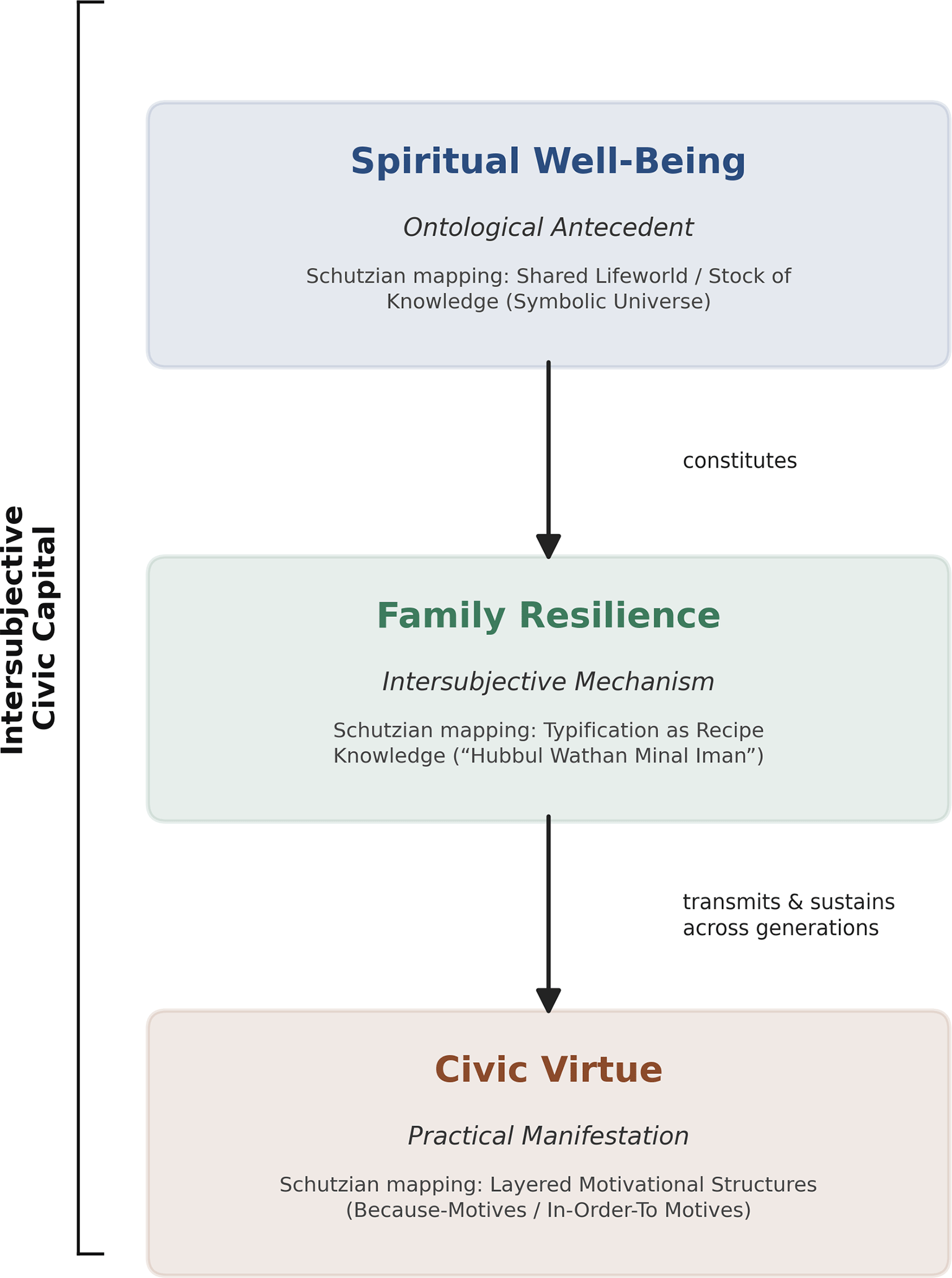
The model depicts a three-level intersubjective architecture linking spiritual well-being, family resilience, and civic virtue. Spiritual well-being (top) constitutes the ontological antecedent, corresponding to the Schutzian shared lifeworld and stock of knowledge (symbolic universe). Family resilience (middle) functions as the intersubjective mechanism, corresponding to typification as recipe knowledge, exemplified by the typification “hubbul wathan minal iman” (love of nation as part of faith). Civic virtue (bottom) is the practical manifestation, corresponding to the layered motivational structures identified in this study (because-motives and in-order-to motives). Arrows indicate the direction of intersubjective constitution and intergenerational transmission; the bracket denotes that all three levels jointly constitute Intersubjective Civic Capital, the theoretical model proposed by this study.
This study has several limitations that should be acknowledged. First, the geographic scope is restricted to Purwakarta Regency, limiting the transferability of findings to other regional and institutional contexts. Second, the study focused exclusively on NU-affiliated pesantren; comparative study of khalaf (modern) pesantren or other Islamic organizations would strengthen the theoretical model. Third, as with all phenomenological research, the researcher’s interpretive judgment plays an ineliminable role in the construction of findings; reflexivity procedures were employed to minimize but cannot eliminate this influence.
This study demonstrates that civic virtue in Nahdlatul Ulama pesantren communities in Purwakarta is constructed through an intersubjective process in which spiritual well-being functions as the ontological antecedent and family resilience as the mediating mechanism. Three essential structures — shared spiritual lifeworld, typification of civic virtue as religious obligation, and layered motivational structures — collectively constitute what this study terms Intersubjective Civic Capital.
These findings make three contributions to scholarship. Theoretically, they extend Schutzian social phenomenology to the civic education domain, demonstrating its applicability to the analysis of collective moral formation in religious communities. Empirically, they provide micro-level evidence of how NU pesantren sustain civic commitment across generations through the integration of spiritual practice and civic identity. Practically, they suggest that civic education interventions in Indonesian Islamic educational contexts should be designed in dialogue with the spiritual and familial dimensions of civic formation rather than treating civic virtue as an exclusively curricular outcome.
Future research should extend this model through comparative phenomenological study across different pesantren typologies (salaf/khalaf ), geographic regions, and Islamic organizational affiliations. Longitudinal designs would allow examination of how the Intersubjective Civic Capital model holds across the transition from pesantren to wider societal contexts.
This study was conducted in accordance with the principles of the Declaration of Helsinki. Ethical approval was obtained from the Research Ethics Committee of Universitas Islam Syekh-Yusuf on 13 October 2025 (Approval No.: UIN-Syekh-Yusuf/XII/2026), prior to the commencement of data collection. All participants provided written informed consent prior to participation. Participant identities are protected through anonymization codes. Audio recordings were stored on encrypted devices accessible only to the research team and will be deleted following data verification.
The underlying data for this study — anonymized interview transcripts, field notes, and the bracketing journal — are available in Zenodo under the following DOI: https://doi.org/10.5281/zenodo.21066794.20 Dataset title: “Research Dataset: Schutzian Phenomenological Analysis of Civic Identity Formation in Pesantren Families, West Java” License: Creative Commons Attribution 4.0 International (CC-BY 4.0). Note: participant identities are protected through the use of family codes (F-01 to F-10) in all deposited materials.
The authors express sincere gratitude to the pengasuh, pengurus, santri, and families of the participating pesantren in Purwakarta for their openness and cooperation throughout the research process.
This research was supported by the Indonesian Education Scholarship (Beasiswa Pendidikan Indonesia/BPI) under the Ministry of Education, Culture, Research, and Technology of the Republic of Indonesia, managed through the Center for Educational Financing Services (PPAPT Kemdiktisaintek) and the Indonesia Endowment Fund for Education (Lembaga Pengelola Dana Pendidikan/LPDP). Grant reference: BPI/LPDP Doctoral Scholarship, cohort 2022. The funding agencies had no role in study design, data collection and analysis, decision to publish, or preparation of the manuscript.
The funders had no role in study design, data collection and analysis, decision to publish, or preparation of the manuscript.
© 2026 Baynal Hubi Z et al. This is an open access article distributed under the terms of the Creative Commons Attribution License, which permits unrestricted use, distribution, and reproduction in any medium, provided the original work is properly cited.
Current Reviewer Status:
AWAITING PEER REVIEW
AWAITING PEER REVIEW
?
Key to Reviewer Statuses VIEW HIDE
ApprovedThe paper is scientifically sound in its current form and only minor, if any, improvements are suggested
Approved with reservations A number of small changes, sometimes more significant revisions are required to address specific details and improve the papers academic merit.
Not approvedFundamental flaws in the paper seriously undermine the findings and conclusions