Просмотр новости
Найдите то, что Вас интересует
 Спутники
 РН
РН SpaceX
 Роскосмос
 NASA
NASA
СпутникиРНSpaceXРоскосмосNASACrew shortages led to major disruptions in ferry service along several routes that commuters and visitors depend on. It remained unclear how long these will last.
Most Washington state ferry routes were canceled or down to one boat Monday after so many engine room employees called in sick it triggered a crew shortage that threw the system into chaos.
Washington State Ferries warned of “serious disruptions” while 13 of its 18 vessels are out of service. What occurred was unprecedented in the past decade.
On Monday morning, 23 engine rooms employees called in sick and every qualified employee that could replace them refused to fill in, the state ferry agency said in a statement posted on X.
All of the employees who called in sick are members of the union Marine Engineers’ Beneficial Association, according to Washington State Ferries. Gov. Bob Ferguson met with union officials and state leadership Monday, implying the event was a coordinated union effort.
Yet the Marine Engineers Beneficial Association said that the sick call-ins “were not initiated or aided” by the union, and that they found out “the same way the public did — through media reports.”
Nor were the sick call-ins part of a collective bargaining effort, said national union secretary treasurer Roland Rexha on Monday afternoon. Negotiations for the engineers’ current 2026-to-2028 contract ended in July after they went to arbitration.
The union had been asking for a pay increase to achieve parity with their counterparts working above deck who earn about 20% more per year, and for a decrease in overtime to relieve exhausted workers, Rexha said.
Rexha said Monday’s chaos exposes an “unsustainable” system onboard the ferries that is “held together with gum and duct tape.”
Ferguson said Monday afternoon that he plans to work to increase staffing levels, but also called the disruption a significant harm and inconvenience to Washington residents.
“I was very direct in our meeting: My expectation is that every vessel on every route is fully operational no later than the first vessel sailing tomorrow morning,” Ferguson said.
On Monday night, Washington State Ferries announced that “more normal service across the system” was expected Tuesday. Kitsap Transit pledged to run more fast ferries if the state ferry routes remained suspended or reduced.
No one could say for sure which ferries would be running again in the morning.
Engineers overworked?Every day, about 75 engine room crew members are needed for two 12-hour shifts to operate the 21 Washington State Ferries vessels, spokesperson Justin Fujioka said.
When an employee calls in sick, the state can ask others to fill the positions, but they don’t have to. So if enough people refuse to come in on a day off, the boats can’t set sail, said ferry officials.
The union said Monday that the state has been staffing only the minimum amount considered legally safe — doing away with requirements in a previous union contract that called for an extra crew member who would cover anyone who called in sick.
As a result, engineers have had to work “abusive amounts of overtime” to fill temporary vacancies, which has caused crew shortages and ensuing sailing cancellations when workers “threw their hands up,” the union said.
Engineers are scheduled to work a seven-day work week, and are asked to work the number of overtime hours required by the current stopgap system, which can exceed 1,500 hours of overtime per year, the union said.
“Using overtime volunteers to meet minimum safety requirements is irresponsible; indeed, it courts disaster,” the union said Monday.
The union said Washington State Ferries management has demanded to freeze engineer wages at 20% below their shipmates’, which has “killed morale and incentivized qualified people to work elsewhere.” Maritime engineers in the public and private sector make 40% more than state ferry engine room employees, the union said.
The ferry agency said in its statement Monday morning that chief engineers have a base salary of $157,000 per year, but can make more than $350,000 with overtime. Some criticized the state for highlighting that number, saying that is the high side and that many engineers make far less.
Ferry engineers’ discord has been brewing for years.
In 2024, the union had similar complaints, saying members were overworked and underpaid after working tens of thousands of hours of overtime while staffing was short, causing “burnout” that had led to thousands of canceled sailings in years prior.
At the time, the union, which represented 400 engine room workers at Washington State Ferries, was entering contract negotiations to get its members pay parity with deck workers after across-the-board wage increases of about 5% each year were given in their most previous contract. Negotiations for the July 2025 through June 2027 contracts were beginning that spring.
State ferry workers do not have a legally protected right to strike, unlike private workers at Boeing. That stands in contrast to policies in California and Oregon, which don’t ban work stoppages by public employee unions except for those essential for safety and public health, like firefighters and police officers. Washington ferry workers must go through an arbitration process that the union has said is tipped in the state’s favor.
“We don’t have any levers to pull to get an equitable negotiation on pay. When we are at the table, they know we can’t win,” Marshall Warner, assistant engineer on the Cathlamet, told Cascade PBS in 2024. “If we could strike, everyone would have higher wages.”
On Monday, the union said the chaos was “a crisis of [Washington State Ferries] management’s own making” and chalked it up to “a frantic cry for help from an abused and frustrated group of highly skilled and committed workers.”
Union members want to provide safe, reliable and timely service to Washington ferry riders, and ferry riders want to see the crew members treated well, too, Rexha said. “They value these workers.”
Most days, Bo Bowen of Freeland takes the 6:30 a.m. ferry from Clinton to get to work in Mukilteo, but after delays kept drivers waiting over an hour to board, he decided to leave his car behind and walk on the ferry on his way back to the island.
Bowen said he was concerned delays caused by the “sick-out” could continue past Monday.
“I wish they would find another way to negotiate or express their concerns,” he said. “We’ve got a large group of people that commute this route, being that it is only a 15-minute ferry ride, but from a 15-minute ferry ride to an hour-and-a-half wait puts a lot of troubles on people.”
Gov. Ferguson repeated the sentiment Monday afternoon in a statement, saying he is a regular ferry passenger and prioritizes restoring ferry service beyond unusual events like Monday’s.
Ferguson said he spoke with union leadership Monday and was always open to their issues, but demanded ferry service resume Tuesday.
In his nine years with the agency, Washington State Ferries spokesperson Fujioka said he’s never seen a disruption to this level.
Ferry routes canceled, reduced and delayed
A majority of Washington State Ferries’ routes across Puget Sound were canceled on Monday or operating on reduced service, while 13 of 18 vessels in the fleet were out of service after 23 engine room employees called in sick.
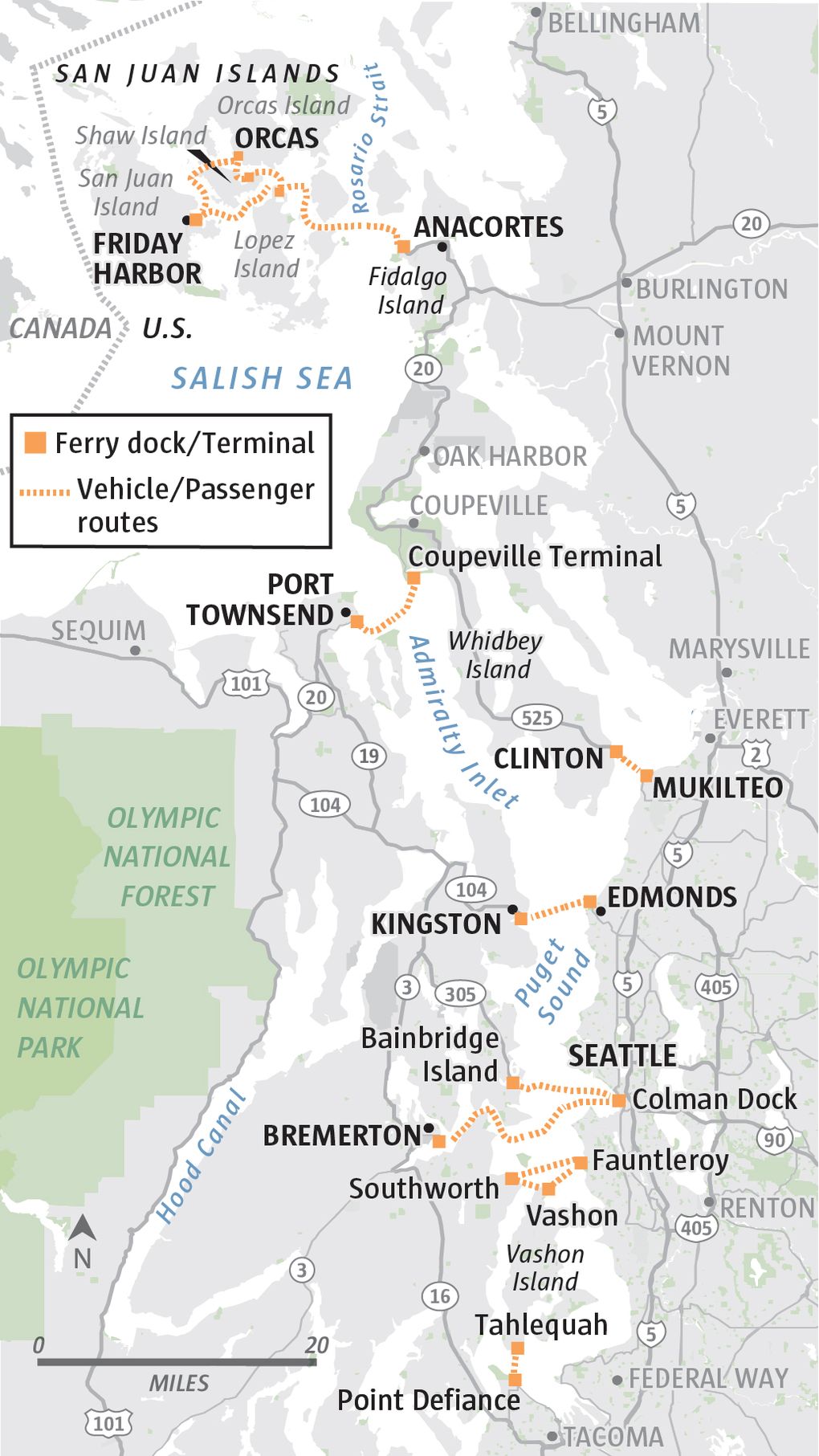
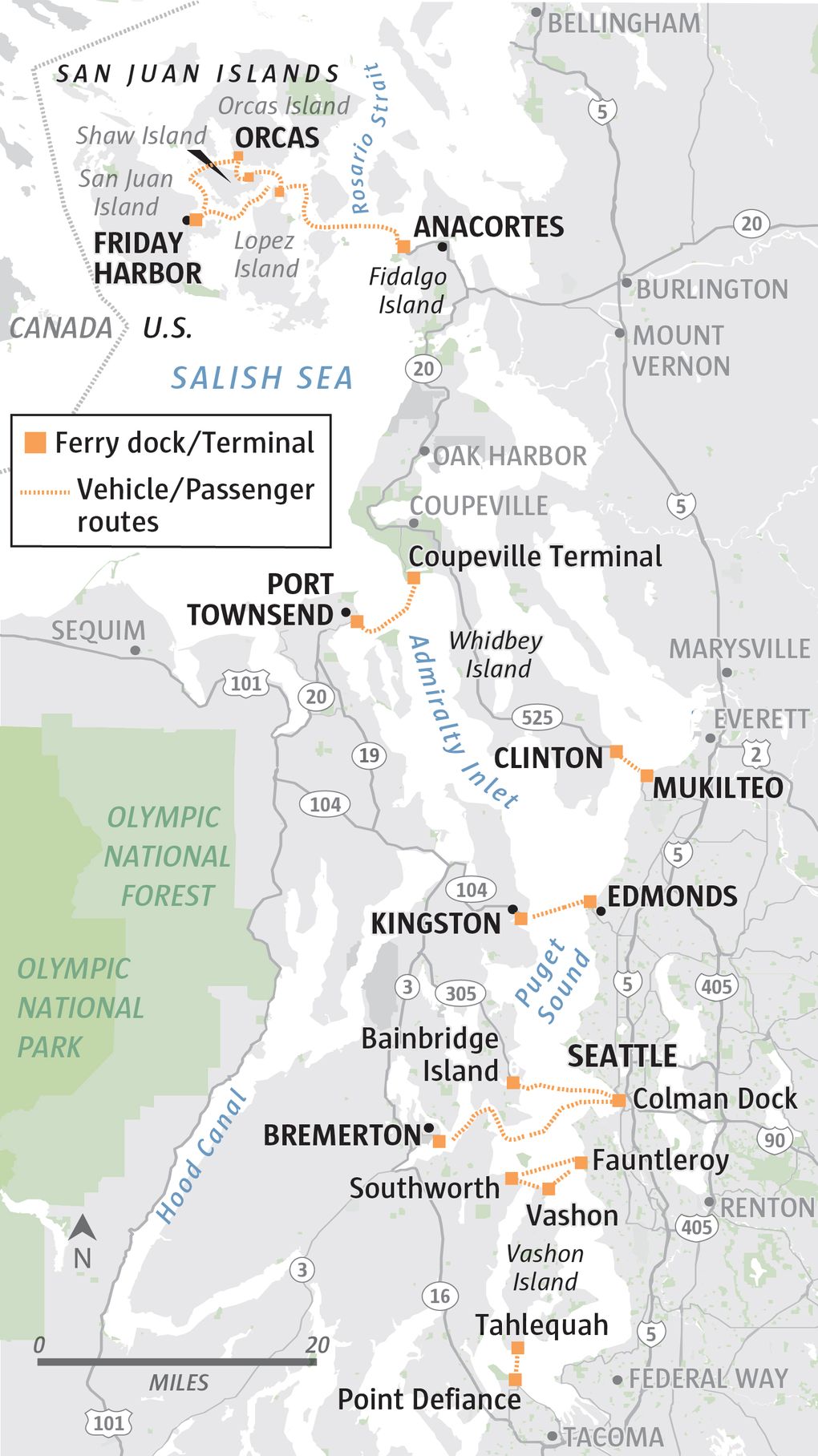
After its 5:30 a.m. sailing from Seattle, the Seattle-Bainbridge route went out of service entirely Monday morning, according to the state Department of Transportation.
The Edmonds-Kingston route went out of service after 7:10 a.m.
In the San Juan Islands, the No. 3 Samish was left alone sailing all stops from Anacortes to Lopez Island, Shaw Island, Orcas Island and Friday Harbor, while the other two ferries went out of service.
Sailings on the No. 4 Tillikum interisland ferry were also down, though the vessel was expected to help with traffic at 8:45 a.m. to make stops eastbound to Anacortes at Friday Harbor, Orcas Island and Shaw Island.
The Samish was running 70 minutes behind schedule Monday morning, Washington State Ferries reported.
On the Port Townsend-Coupeville route, the No. 1 Kennewick didn’t run at all Monday.
The No. 1 and No. 2 routes of the Fauntleroy-Vashon Island-Southworth triangle route were canceled early Monday, leaving the route to operate on a No. 3 bonus boat sailing schedule alone. Three-boat service resumed Monday evening.
Kitsap Transit, which operates passenger-only fast ferry service between Seattle and Bremerton, tried to help out by operating two extra sailings to Southworth, departing Pier 50 in Seattle at 9:15 a.m. and the Southworth Ferry Terminal at 9:45 a.m.
The Seattle-Bremerton route went down to one-boat service while morning sailings on the No. 2 Chimacum had been canceled. All No. 1 sailings carried on as scheduled, but riders were told they may see delays loading onto the vessel.
Again, Kitsap Transit added a sailing at 12:15 p.m. from Bremerton and 1 p.m. from Seattle, Washington State Ferries reported.
The Mukilteo-Clinton route also went down to one-boat service Monday morning, with all No. 2 sailings out of service.
There was a three-hour wait for drivers at about 8:30 a.m., the transportation department said, and the single running boat was 45 minutes behind schedule.
Later that morning, fog loomed low at Mukilteo Landing, where hundreds of vehicles waited in line to board a ferry to Whidbey Island.
Aaron Kessler of Mukilteo said he had already waited an hour and 20 minutes to board, a wait that typically takes him 15 to 20 minutes. He was on his way to visit a friend on Whidbey Island.
“There is no schedule,” a ticket salesperson said. “We’re running on a load-and-go basis.”
Peg Roy of Everett said it was her first time traveling out of the revamped ferry dock, where she had been waiting for about half an hour.
“Since I haven’t taken the ferry in eons, I didn’t know what to expect,” she said.
She didn’t mind the time to walk her dog and enjoy the view.
Seattle Times staff reporter Joseph O’Sullivan contributed to this report.
Kai Uyehara: kuyehara@seattletimes.com: Kai Uyehara is a breaking news reporter at The Seattle Times.
Ann Duan: aduan@seattletimes.com: Ann Duan is a metro intern at The Seattle Times, covering a range of local news. She previously interned at The Daily Herald in Everett, The Olympian and U.S. News & World Report. She has also written for Street Sense Media and for The GW Hatchet while studying journalism at George Washington University. Duan grew up in Washington, between Renton, Mukilteo, Mill Creek and Shoreline.
| # | Наименование новости | Тональность | Информативность | Дата публикации |
|---|---|---|---|---|
| 1 | Most Washington State Ferries routes back to regular service Tuesday | 0 | 10.97 | 06-10-2026 |
| 2 | Railway repairs to cancel 22 ferry trips at Edmonds dock this week | 0 | 11.52 | 05-10-2026 |
| 3 | Seattle weekend traffic forecast calls for pain at the Ship Canal | 0 | 10.38 | 02-10-2026 |
| 4 | Seattle losing highway lanes this weekend; Bellevue gets reprieve | 0 | 13.29 | 10-09-2026 |
| 5 | Hoh River Bridge to close for repairs; long detours on Highway 101 | 0 | 13.68 | 23-09-2026 |
| 6 | Labor Day weekend traffic: Here are the worst times to drive | 0 | 9.81 | 03-09-2026 |
| 7 | NCDOT's Ferry Division to begin emergency Stumpy Point-Rodanthe ferry route service | 0 | 5.01 | 27-09-2026 |
| 8 | Emergency ferry route for Hatteras Island begins | 0 | 9.09 | 27-09-2026 |
| 9 | Transports: une panne informatique a touché les serveurs d'Île-de-France Mobilités, ce jeudi matin, semant la pagaille pour des millions de voyageurs franciliens | 0 | 6.44 | 01-10-2026 |
| 10 | Seattle gets a new light rail station, and then a long wait | 0 | 10.99 | 27-09-2026 |