Просмотр новости
Найдите то, что Вас интересует
 Спутники
 РН
РН SpaceX
 Роскосмос
 NASA
NASA
СпутникиРНSpaceXРоскосмосNASAThere are any number of ways to track the expanding development of quantum computing, from the strides being made in error-corrected qubits – logical qubits – and fault-tolerant systems to the software and algorithms cropping up around them. Another way is look at the work traditional hardware OEMs are putting into collaborating with quantum computing vendors and getting the necessary infrastructure in order for hybrid quantum-classical HPC datacenters.
Such hybrid datacenters going to be what will bridge the gap between theoretical vision of quantum computing and the practical use by enterprises.
As we have previously covered, Cisco Systems is accelerating its work in creating the vendor-neutral networking layer for quantum computing, from developing the architecture to its Universal Quantum Switch prototype, unveiled in April.
Nvidia clearly sees a quantum future where QPUs share the stage with GPUs and CPUs, along with the quantum-focused product lineup it’s putting together.
“We don’t build quantum computers, and yet we are deeply integrated into the quantum computing industry and we create libraries,” Nvidia co-founder and chief executive officer Jensen Huang said last year. “CUDA-Q is the programming model for hybrid classical accelerated quantum. We have cuQuantum, libraries that help you simulate quantum circuits, and DGX-Quantum, to do error correction in quantum computers. We partner with them, we support them, we help them in any possible way.”
More recently, at their respective user conferences, both HPE and Dell gave quantum computing a greater presence than in past events, putting a spotlight on everything from partnerships to architecture for the hybrid datacenters as well as the cloud to expectations of how quantum computing will roll out.
At its Discover 2026 show last month, HPE announced partnerships with Intel, IQM Quantum Computers, Quantinuum, QuEra, and Rigetti, among others, as the system maker builds out a platform for integrating quantum systems of multiple modalities with its family of Cray supercomputers. A key part is creating testbeds for a range of tasks, from design hybrid algorithms to software interoperability to benchmarking HPC-quantum workflows.
For HPE, it’s all about the integration point, according to Trish Damkroger, senior vice president and general manager of HPC and AI infrastructure solutions at HPE.
“If you look at rack-scale now, we're not even designing the rack,” Damkroger told The Next Platform at the show, describing the nature of the HPE's role. “We are manufacturing it, but Nvidia is giving us a reference design, and then we add what we can to differentiate around that. We will not make the quantum devices, just like we don't make the silicon. I look at quantum as another accelerator. We will be putting the network to it. You've got to bring that all together. Putting on top that a software stack. It's all about integrating it all, making, hopefully, a single control plane to make it easy to control the different accelerators on the machine, and then about deploying and servicing.”
Much of quantum computing now is accessed through the cloud, but there is a push to put them into HPC datacenters, integrated with classical servers, for a variety of reasons that include security, sovereignty, and integration with classical systems in facilities that already support myriad technologies, from CPUs and GPUs to varied storage and networking systems and specialized accelerators.
Quantum computing is “becoming more mainstream,” Damkroger said. “Right now, if you talk to Oak Ridge National Laboratory, home of the Cray-based Frontier supercomputer, they can order up quantum over the cloud and try things out. But it's getting to the point where they want to have those devices and actually try them. We're not at the Cray-1 level yet, but we're getting there. We're going to start really seeing those Cray-1 quantum machines produced.”
Damkroger does not mean literally that there is a quantum machine that is being called a Cray-1, but that the quantum market is at the same place supercomputing was when the Cray-1 was launched in 1975.
D-Wave, which for most of its history has offered annealing quantum computing via its Leap cloud service, but the company began selling its Advantage systems directly to organizations last year.
Likewise, IQM also sells access to its superconducting quantum systems to academic institutions and enterprises through its Resonance cloud. That said, the Finland-based vendor is focused on on-premises datacenters, as shown by its having sold 23 systems around the world. Recently, it announced the LUMI AI Factory, which is led by CSC – IT Center for Science in Finland, will deploy its Halocene H4 next year.
The Halocene family of systems, aimed at error correction research, was introduced in November 2025, launching with a 150-qubit system. IQM also offers its Radiance line that right now starts with 20 qubits but can upgrade to 54. A Radiance system was on display on the Discover show floor.
Oak Ridge, whose “Frontier” supercomputer is built on HPE’s Cray EX235A HPC systems, in June announced that Pathfinder, a 20-qubit IQM Radiance quantum system (below), went operational. It’s the first quantum system bought by the national lab and the first IQM has sold in the United States.
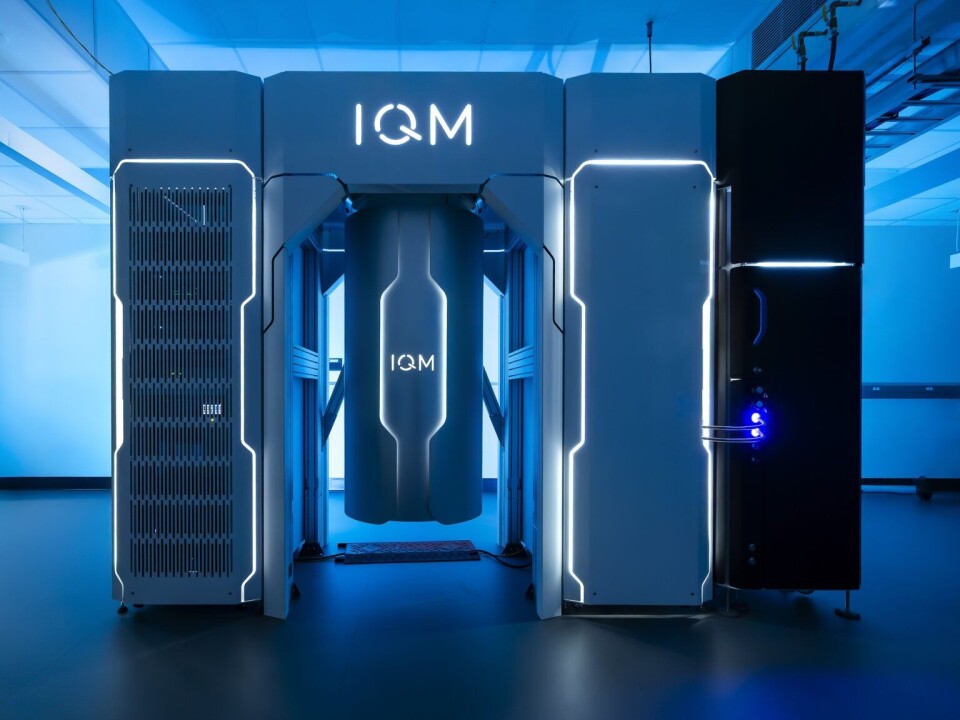
“There has been healthy debate about where quantum computing finds its first real foothold in enterprise,” Ron Bewtra, IQM’s country director in North America, wrote recently. “Cloud access is one model. Standalone systems are another. My view, shaped by what I’ve seen in the U.S. market, is that the most credible near-term path runs through HPC.”
Dell is following the same path. The vendor over the past 10 years has worked with more than 20 quantum companies, according to John Roese, global chief technology officer and chief AI officer at Dell. The road forward for quantum systems is as part of a hybrid environment, Roese told The Next Platform.
“There are no quantum computers that are only built with QPUs,” he said. “They are all hybrid quantum systems. Our strategy is to be their best friend, to treat it like an accelerator, just like GPUs, and to make sure that we are well-positioned, that when they build the system, we can help them build it in a way that's industrialized and consumable by our customers.”
One of those companies is Equal1, whose prototype of its RacQ quantum computer was on display at the recent Dell Technologies World 2026 event. RacQ is the latest generation of the vendor’s Bell-1 Server, which company executives said is a rack-mounted system that can fit into a standard 19-inch datacenter rack. Equal1’s modality of choice is silicon-spin qubits that are fabricated using standard CMOS, creating a quantum system-on-a-chip (SOC) that puts all the components of the system into a single silicon package.

It’s built using standard semiconductor processes for easier scalability. The system runs at about 1.6 kilowatts, weight 400 kilograms – it can fit in a standard Dell 42U frame – and includes an integrated cryocooler that keeps an internal temperature of 0.3 Kelvin, a critical need for the silicon-spin qubits to reduce thermal noise and extend coherence times. Having the cooling system integrated removes the need for a cryogenic system outside of the computer.
The RacQ is part of what Equal1 calls a hybrid quantum-classical computing (HQCC) integration, with classical and quantum workloads running together. Pre- and post-processing stays with the classical system; the quantum computer runs the quantum-intensive subroutines, or algorithmic building blocks the require mathematically heavy-duty computations exponentially faster than traditional systems.
In the demonstration at the show, Dell PowerEdge servers were used as those classical counterparts.
The RacQ represents the levers that are being pull simultaneously to accelerate work in the quantum world, Roese said. A key one is that quantum computers are getting better.
“For that Equal1 system to go from a five-qubit system to 1,000 qubits or even a million qubits, it requires two engineering feats,” he said. “One is they have a small semiconductor where the qubits actually live that goes from like 3 millimeters squared to 11 millimeters squared inside of the 300-millikelvin environment. The second thing is, they have to take the control system, which is now a bunch of boxes, and turn it into a processor and then use what's called Cryo-CMOS, which is the ability to run CMOS compute inside of a super-cooled environment. That's a whole different technology.”
Roese added that with Dell servers as the hybrid part, “I could roll that in right next to an Nvidia NVL72 rack and connect the two things together and I have all the basic compute to do a CPU-GPU-QPU system.”
AI will play a key role in this, according to Burns Healy, Dell’s quantum infrastructure lead. AI helps generate quantum algorithms, which will make quantum computing easier for the user, Healy said during a roundtable at the event. Predictive machine learning will help organizations with such needs as understanding when to turn on their GPU rather than their QPU, CPU, or FPGA. A QPU is another accelerator. There already are ways to understand which chip architectures are better for which workloads.
“This is another way of thinking about that,” he said. “Quantum is obviously a little bit more complicated because different kinds of quantum processors are built on different technologies and so as long as those coexist, you'll need to consider the complication of different quantum processors being better at different workloads.”
All of this factors into the demand for classical-quantum hybrid environments, Healy said.
“Honestly, having a QPU in a lab that you can access via the cloud is neat, but if you want real kind of near-term quantum advantage, you're not going to have that not be co-located with HPC because, relative to qubits, the silicon is the cheap part,” he said. “Anything you can do – and it turns out there's a lot you can do – that improves the throughput and the accuracy of the quantum compute on the silicon-powered nodes [is critical]. Hybrid is the name of the game, not just for workloads but also just for pre-processing quantum data, post-processed quantum data, calibration, adaptive quantum circuits. We're really in a schema where we're saying what is the absolute most of this compute that I can offload to the GPU while we're preserving the restrictive element the QPU time for just really what is needed.”
| # | Наименование новости | Тональность | Информативность | Дата публикации |
|---|---|---|---|---|
| 1 | How HPC And AI Digital Twins Accelerate Quantum Error Correction | 0 | 10 | 17-04-2026 |
| 2 | Oak Ridge Starts Weaving Together A Quantum, Classical HPC, And AI System Stack | 0 | 10 | 21-05-2026 |
| 3 | QuiX Quantum Shows Off A Photonic Architecture For HPC Datacenters | 0 | 10 | 07-07-2026 |
| 4 | HPE Rides The Agentic AI Wave Back Into The Datacenter | 0 | 8.1 | 22-06-2026 |
| 5 | Quantum-Augmented Applications: Integrating Quantum Subroutines into Classical Software Stacks | 0 | 21.11 | 20-08-2026 |
| 6 | A Deep Dive On China’s “LineShine” All-CPU, Exaflops-Class Supercomputer | 0 | 32.22 | 25-06-2026 |
| 7 | How HPC Is Igniting Discoveries In Dinosaur Locomotion – And Beyond | 0 | 10 | 17-10-2025 |
| 8 | Three HPC Gurus Ask: Do We Still Need GPUs? | 0 | 10 | 30-06-2026 |
| 9 | IBM: Three Demonstrations Prove Quantum Advantage Has Been Reached | 0 | 10 | 31-07-2026 |
| 10 | Analysis: Recent AI data centre BESS technology and deployment partnerships | 0 | 7.66 | 23-07-2026 |