Просмотр новости
Найдите то, что Вас интересует
 Спутники
 РН
РН SpaceX
 Роскосмос
 NASA
NASA
СпутникиРНSpaceXРоскосмосNASAThere are a number of ways to measure the growing maturity of quantum computing, from qubit counts – both physical and logical – and fault tolerant thresholds to the speed in terms of CLOPS (circuit layer operations per second) and reliable operations executed with QuOps, or quantum operations.
Then there is quantum advantage. There are slight differences in the definition depending on who you’re talking to, but the gist is that quantum advantage occurs when a quantum system can solve a practical and real-world problem more quickly, cheaper, or more accurately than a classical supercomputer.
Some vendors have claimed to have reached quantum advantage – from Google’s announcement last year of its Google Echoes Algorithm running on its Willow chip to quantum infrastructure software maker Q-CTRL in May saying it “achieved evidence of practical quantum advantage” in material science running its software on IBM’s Quantum Platform – but as seen here, there is plenty of debate within the scientific community whether quantum advantage actually has been reached just yet.
There also have been claims of quantum supremacy, including Google’s assertion in 2019 regarding its 53-qubit Sycamore quantum processor and D-Wave last year touting a version of its Advantage 2 quantum annealing system, which also has been challenged. The usefulness of the problem solved is the difference between advantage and supremacy. For quantum advantage, the problem needs to be practical and real-world; with supremacy, it’s any task that can be done faster by a quantum system than classical computer, even if the job itself is useless
IBM and quantum startup Pasqal last year laid out what they said are the requirements that need to be met to declare quantum advantage. Big Blue also has its Quantum Advantage Tracker, a platform-agnostic framework for collecting and validating results of quantum advantage claims.
This week, IBM and several partners in a series of research papers are detailing demonstrations run on the IT giant’s Heron quantum chip (below) where they say those requirements – that the work by the quantum systems is done with more accurately, cheaper, and more efficiently than classical systems, and that the output can be rigorously validated – were met.
It’s an important step on the continuing trek toward fault-tolerant, practical, and commercial quantum computing, according to Jay Gambetta, IBM Fellow and director of IBM Research.
“These demonstrations prove that we can scale quantum computing forward with confidence,” Gambetta told journalists in a conference call. “First, they show that quantum computers can solve problems that go beyond the reach of classical methods that could run on the biggest classical computers. And second, they show a series of results of quantum computers that can be validated with confidence, even for problems where classical computers using current methods cannot solve these problems. To me, this marks a huge milestone for the field. We can now move quantum advantage beyond just demonstrating computational power – because we've established the trust in these methods – to looking at problems for science, business, and technology as we go forward in this technology.”
Algorithmiq is a startup that develops quantum software and algorithms for such industries as life sciences, chemistry, and material science. Eight months ago, the company submitted to the Quantum Advantage Tracker a demonstration where it simulated what co-founder and chief technology officer Sabrina Maniscalco called a “real-world disordered matter” and created a simulation framework to test it. The project addresses a challenge in some sciences in that materials like catalysts and batter electrolytes comes with irregular structures and variation to effect how they can move energy and particles through a system.
“Most of the physics that we are taught in school describe really something that is rather idealized: idealized materials, perfect crystals, clean symmetric structures,” Maniscalco said. “But the real world isn't like that. All materials that will power the next generation of clean energy and industry are messy, disordered, and irregular, and this messiness is exactly what makes them hard to simulate, and exactly why understanding the matters.”
In the eight months since it was pulled into the Quantum Advantage Tracker, no classical system has been able to reliably reproduce the same results at scale, she said. IBM ran the same experiment on other quantum processors with different noise and calibrations, and Algorithmiq worked with classical simulation companies like the Flatiron Institute to challenge its findings.
The experiments using two different IBM quantum chips produced consistent results within the margin of error every time – “This consistency is not coincidence, it’s evidence,” Maniscalco said – while about a half-done classical simulation methods couldn’t match the quantum results, as seen below.
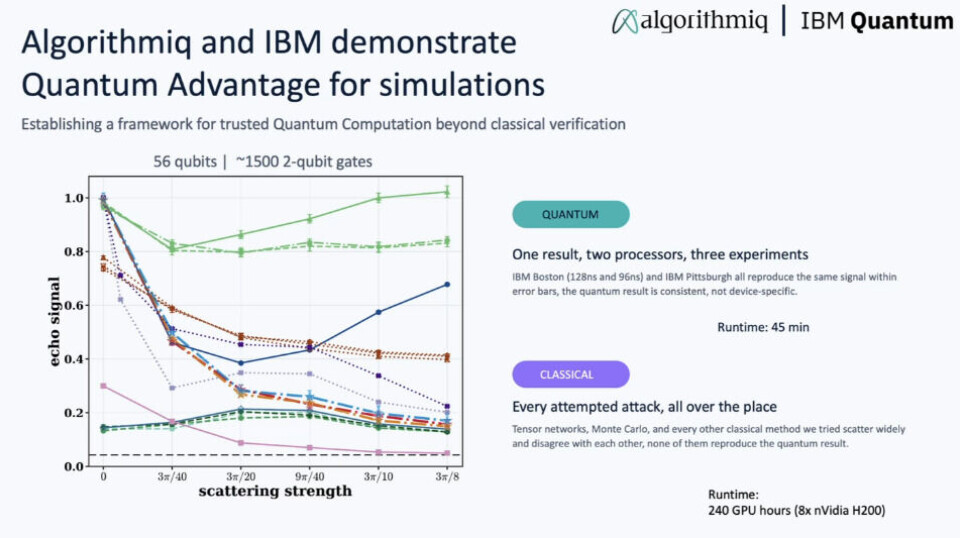
“They didn't even agree with each other,” she said. “We pushed them to the limits of what can be run in terms of memory or time and with the needed libraries. This is why this claim has held for eight months and counting.”
Another demonstration by Qedma Quantum Computing focused on studying and simulating the physics of materials. The vendor’s Quantum Error Suppression and Error Mitigation (QESEM) software aims to improve the performance of quantum systems by suppressing and mitigating hardware noise.
“Put in a general framework, we're looking at materials that are driven externally by laser fields, by light,” said Netanel Linder, Qedma’s co-founder and chief technology officer. “It's a very important field of science, of research in physics, with a lot of technological applications. For example, optical electronics. It's also a very hard system to study, and it requires simulations.”
The problem with classical systems is that they can only do such simulations on a limited basis. The researchers initially ran it on the Fugaku supercomputer powered by 48-core AMD CPUs and Nvidia H100 GPUs, with material of 28 and 35 electrons and using finite-size scaling, a physics method in which small computer models are studied and the results are used to extrapolate what will happen in larger systems. In this case, real-sized materials have billions of electrons.
Qedma’s tests found (below) that when running two types of classical simulations – for time and magnetization – on Fugaku, the simulations initially agreed with each other, but eventually they started going in separate directions.
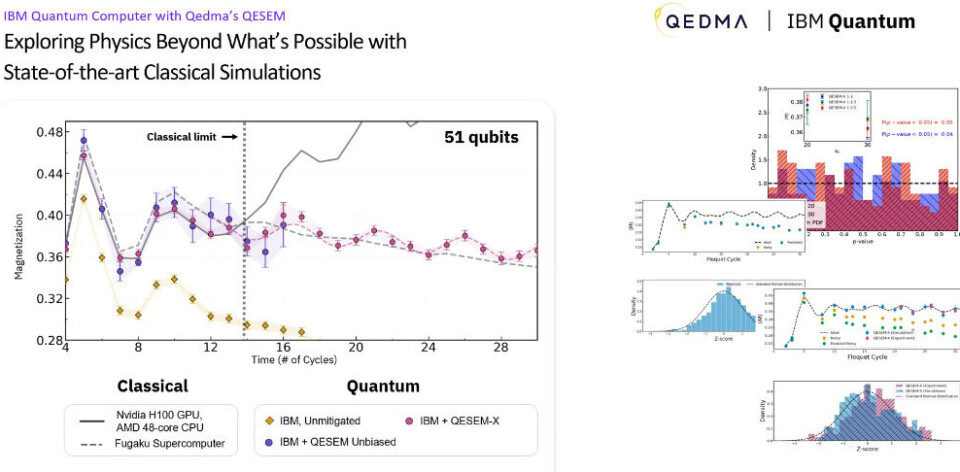
“Actually, the H100 server runs out of memory and starts getting really bad results,” Linder said. “You cannot see these oscillations. The question is, are there any oscillations in the system or not? For this, we turn to the quantum computer.”
Qedma ran simulations using a 51-bit IBM system, first without its QESEM software, then with the software in a mode that has a theoretical guarantee of convergence, and then in a more efficient variant that can be pushed further but doesn’t include the theoretical guarantees. They were able to see oscillations in the quantum systems.
To validate the results, Qedma ran the tests on two quantum models from Quantinuum – H2 and Helios (below), both trapped-ion systems, a different modality from the superconducting quantum systems from IBM – and got results matching those from IBM. They than ran the tests on two 74-qubit systems that scaled to show real-sized materials with billions of electrons, he said.

QEDMA ran Fugaku for 700,000 CPU hours and couldn’t reproduce the oscillations. The IBM Heron r3 “Boston” systems ran for only seven hours, Linder said. If the researchers tried to push Fugaku more, they would have to use 80,000 GPU servers running for half a year to close in on the results, which he said “clearly, this is not possible.”
“In the end, this is the first quantum advantage experiment that was done on commercially available hardware using commercially available software,” he said. “We've shown that how important error reduction is to unlocking quantum performance and to achieving trusted results.”
In their work with IBM, University of Chicago researchers created a structured alternative to random circuit sampling (RCS), a benchmark that has long been used to test whether quantum systems can outperform classical computers. RSC works by having a quantum system generate patterns that are too complex for classical computers to efficiently reproduce them. A key obstacle has been verification, IBM’s Gambetta said.
In this case, as the problem gets more difficult, it gets harder and then unfeasible to prove the quantum system’s is correct without making assumptions about how the quantum system works. This is where trust in the computation becomes important, he said. Researchers have been working on spacetime codes, where they created an extremely complex circuit, then inject insular qubits, measure symmetries, and filter the results to do an error-correction code.
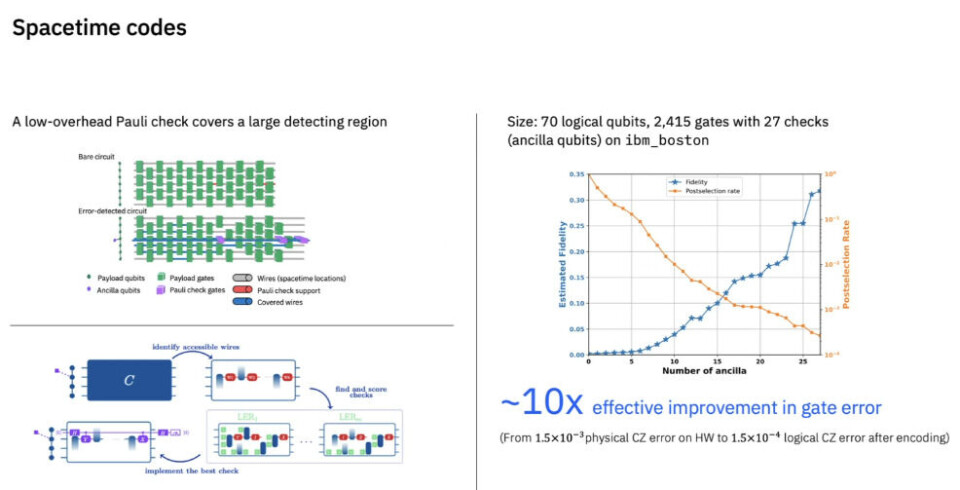
“This allows us to run on about 70 logical qubits using about 21 insulars and run up to 2,415 logical two-qubit gates,” he said. “If you were to look at this and take the physical error of the device ... we effectively reduce this by a factor of 10X.”
It also includes 468 logical T “hard” gates that, along with the 2,415 logical gates, prove the complexity of a quantum circuit. The circuit was encoded, helped lead to logical error rates that were ten times lower than the physical error rates and, thus, high fidelity.
“Because of the symmetry of the code and the way the gates are done on the system, we can dope it with T gates without increasing any errors,” he said, noting that the demonstration took about 16 minutes to run, in comparison with much longer simulation times with classical systems. “Essentially, we have an error correcting code on our system. We can measure the fidelity. We can increase the complexity of the classical result to simulate it by doping it with T gates.”
They verified the simulation by adding more T gates – up to 75 – and getting the same results.
“As we add more T gates, we do not see any properties of the error correction code changing,” Gambetta said. “The error correct code is essentially putting us in the right subspace allowing error correction to work and we can increase the complexity of the T gates to allow us to get a complexity separation.”
| # | Наименование новости | Тональность | Информативность | Дата публикации |
|---|---|---|---|---|
| 1 | Nvidia Brings The Power Of Open Source AI Models To Quantum Computing | 0 | 10 | 14-04-2026 |
| 2 | Quantum Pulse Does Industrial Light Magic To Deliver Massive Boost In Qubits | 0 | 10 | 17-06-2026 |
| 3 | QuiX Quantum Shows Off A Photonic Architecture For HPC Datacenters | 0 | 10 | 07-07-2026 |
| 4 | The Aspirations Of HPE And Dell In The Quantum-Classical HPC Datacenter | 0 | 16.53 | 13-07-2026 |
| 5 | Google Uses AI Reinforcement Learning For Quantum Error Correction | 0 | 10 | 20-07-2026 |
| 6 | Analyzing the new quantum computing executive orders: What they got right and what’s still missing | 0 | 6.5 | 27-07-2026 |
| 7 | UC Irvine physicists discover method to reverse ‘quantum scrambling' | 5 | 7 | 13-04-2026 |
| 8 | As Quantum Computing Evolves, So Do Antitrust Risks | 0 | 6 | 26-06-2026 |
| 9 | IBM представила квантовый компьютер на выставке в Лас-Вегасе | 0 | 0 | 09-01-2019 |
| 10 | Physicists confirm 20-year-old theory that could boost quantum technology | 0 | 6.36 | 14-07-2026 |