Просмотр новости
Найдите то, что Вас интересует
 Спутники
 РН
РН SpaceX
 Роскосмос
 NASA
NASA
СпутникиРНSpaceXРоскосмосNASAFootwear is consistently the most discussed topic among the clients on our guided trips in southern Utah during the planning phases. It comes up in our online discussion board, during gear list reviews, and on our virtual group calls. Why? I think it’s due to: This post should be helpful for any reader who is…
The post Recommended footwear for deserts and canyons appeared first on Skurka Adventures.
Footwear is consistently the most discussed topic among the clients on our guided trips in southern Utah during the planning phases. It comes up in our online discussion board, during gear list reviews, and on our virtual group calls. Why? I think it’s due to:
This post should be helpful for any reader who is planning a backpacking trip in a desert, including but not limited to southern Utah and northern Arizona. For years I’ve been wanting to write it; going forward, I’ll keep it updated as existing models change and as new models are introduced.
TLTRMy list of recommended footwear is very intentional. But if you don’t care to read my reasonings, start shopping based on this list:
The La Sportiva Mutant (men’s, women’s) is my overall pick for backpacking and light canyoneering, and my personal favorite. Katie Gerber, the co-director of my guiding program, prefers the Astral Loop (women’s only) for the same applications.
For more trips with more consistent technical terrain, consider the La Sportiva TX Guide (men’s, women’s), which are more climbing-inspired and which have a more durable outsole than the Mutant.
The Altra Lone Peak (generations 4-9; not 1-3) and Salomon Speedcross (men’s, women’s) are okay for backpacking trips with light technical terrain only. Both can be worrisomely sloppy when pushed beyond these light applications. If you can still find them, the Topo Ultraventure Pro (men’s) is probably a better choice. Also consider the La Sportiva Wildcat and possibly the Ultra Raptor (which is closely related but about which I don’t have a recent first-hand report).
La Sportiva is the most prominently featured brand on this page, because they make excellent outdoor footwear. I have no affiliation with them.
Expected conditionsDecisions about clothing, footwear, and equipment should account for the conditions that will likely be encountered. In the desert, footwear selection is most driven by these three to five conditions:
Fine-grained blow sand is a hallmark of trips on the Colorado Plateau (e.g. Grand Canyon, Moab, Escalante). Its significance is most acute when off-trail; on established trails, the sand becomes somewhat compacted by the traffic. In deserts with different geological origins (e.g. Anza-Borrego in southern California, which has more metamorphic rocks), sand may not be a concern.
Periodic water crossings and wading is the final consideration, with the frequency and depth depending on the route, time of year, and recent weather events. In Escalante, our groups are in water on most days, ranging from ankle-deep creeks that can almost be hopped across to full-on swims in deep canyons.
 Thigh-deep ford of the Escalante, which is an hourly occurrence when hiking up or down the canyon.
Characteristics of good desert shoes
Thigh-deep ford of the Escalante, which is an hourly occurrence when hiking up or down the canyon.
Characteristics of good desert shoes
For desert locations it’s critical that shoes are:
1. Breathable. Problems arise when feet are wet and/or hot for extended periods. Versus “waterproof” shoes, breathable models dry out more quickly and trap less heat.
2. Durable. The desert is hard on shoes, particularly the uppers. They come into contact with scratchy sage, prickly cacti, and sandpaper-like sandstone; and they are regularly getting wet and drying out. Durability is model-specific; universal rules about various classes of materials (e.g. meshes, leathers, rubbers, adhesives) do not exist. My best advice is to use models from brands that have a good track record, at least based on online reviews; better yet, stick with brands with which you have a good track record.
Depending on the location and your activity, it could also be critical that your shoes are:
3. Sand-resistant. Sand-filled shoes are uncomfortable; they lead to blisters; and they necessitate regular time-consuming stops in order to dump them out. To determine if shoes are sand-resistant, it’s best to field-test them (or have someone else field-test them). If you can’t do that, start with the tongue. Gusseted tongues, which connect to the upper on both sides, will keep out more sand. Then perform the “flashlight test” on the upper:
Breathability and sand-resistance are somewhat mutually exclusive. Ideally, find the most breathable shoe that is still sand-resistant. But if you must favor one characteristic over the other, err towards greater sand-resistance for trips in sandy locations.
 I’m not overexaggerating the importance of sand-resistance. Would you want to do this every hour?
4. Sticky (rubber). High performance rubber compounds are more capable and confidence-inspiring when hiking, scrambling, or climbing on rock. Good purchase is exceptionally important on slickrock, which has good grip but few features like ledges, pockets, and knobs. All things being equal, stickier rubber will be less durable. Manufacturers like La Sportiva that make hiking shoes and climbing shoes seem to have higher performing rubber compounds; we also like Vibram Megagrip.
5. Stiffness and lateral stability. Hiking across angled slopes (“side-hilling”) and up/down steep terrain places different pressure on footwear. Shoes that fit loosely, that have mushy midsoles, and/or that are high off the ground will perform poorly in these scenarios. Determine a model’s lateral stability by wear-testing it in a store, by twisting it linearly (holding the toe in one hand, the heel in the other), and finding the stack height spec.
Recommended shoes for desert backpackingI have been guiding trips in southern Utah for almost ten years, and these recommendations are based on my first-hand experience and that of hundreds of clients.
La Sportiva MutantI’m placing the Mutants (men’s, women’s) first in this list, even though it’s otherwise alphabetical, because they check all the boxes and are my personal pick for backpacking: breathable, sand-resistant, durable, sticky, and stable. They fit average-sized feet, but can be tightened down for people like me who would otherwise prefer the Bushido, which sadly fails in this location because it isn’t sand-resistant.
For itineraries with more consistent scrambling and technical climbing or canyoneering, other models with more lateral stiffness and more durability will perform better than the Mutants, though they are adequate for this application, too.
My lone criticism with the Mutants is the limited lifespan of the lugged outsole. Mine tolerated only about fifty hard field days before they were too bald for continued use.
 La Sportiva Mutant, my personal favorite and probably the overall best pick
If your feet are paddle-like or if your planned route is mostly on high quality Pacific Crest Trail-like trails, the Lone Peak 4, 5, 6, 7, 8, or 9 could be an option.
Starting with the fourth generation, Altra began using the same upper as in the (very sand-resistant) Salomon Speedcross to remedy their notoriously poor durability (which may not have entirely fixed the problem, per Thomas). They also improved the outsole, to the respectable MaxTrac. Starting with the ninth-generation, Altra began offering a Vibram-outsoled version, the Lone Peak 9 Plus.
For normal-sized feet and for frequent uneven terrain, however, the Lone Peak is a suboptimal choice: the sloppy fit and soft midsole make it difficult to scramble on featured or smooth rock, or to hike on sloping surfaces like slickrock. Most of the guides would discourage the Lone Peak on our trips, and some actually want us to prohibit it. I understand the sentiment — I, too, have been made nervous multiple times by clients with under-developed proficiency on mildly technical terrain whose difficulties are exacerbated by these Ronald McDonald clown-like shoes. But I’ve also seen excellent-on-their-feet clients who use them just fine. Bottom line: The wearer really matters.
 Altra Lone Peak
These are Katie’s favorites. She wore them for a Grand Canyon traverse, the Pfiffner Traverse, local 13ers and 14ers, and most other personal and guided trips that she’s done in the past couple of years.
“I recommend them for their supreme sand-resistance and durability. Because Astral has its roots in PFDs and river footwear, the same features that make great river shoes — grippy on rock, well-draining, and quick drying — also make them great desert shoes. They don’t have quite the stiffness as some of the other models on this list but I’ve never found their lateral stability to be an issue when off-trail. They’re also zero drop and have a wide-ish toe box, so they’re great for people who prefer that type of fit.”
 The Loops after 850 hard miles! Trashed but remarkably still in tact.
For the 2025 season, La Sportiva has made positive changes to its TX product line. Most notably, it released the TX Guide (men’s, women’s), which is now our top pick for technical canyon travel. In fact, I just bought a pair for the 2026 season after seeing a client and another guide with them.
Versus the Mutant, the TX Guide scrambles and climbs better, has a stickier and longer-lasting outsole, and is equally sand-resistant. The fit is less accommodating though — they have a narrower Bushido-esque last. For backpacking trips with infrequent or mild technical terrain, the TX Guide is too much shoe.
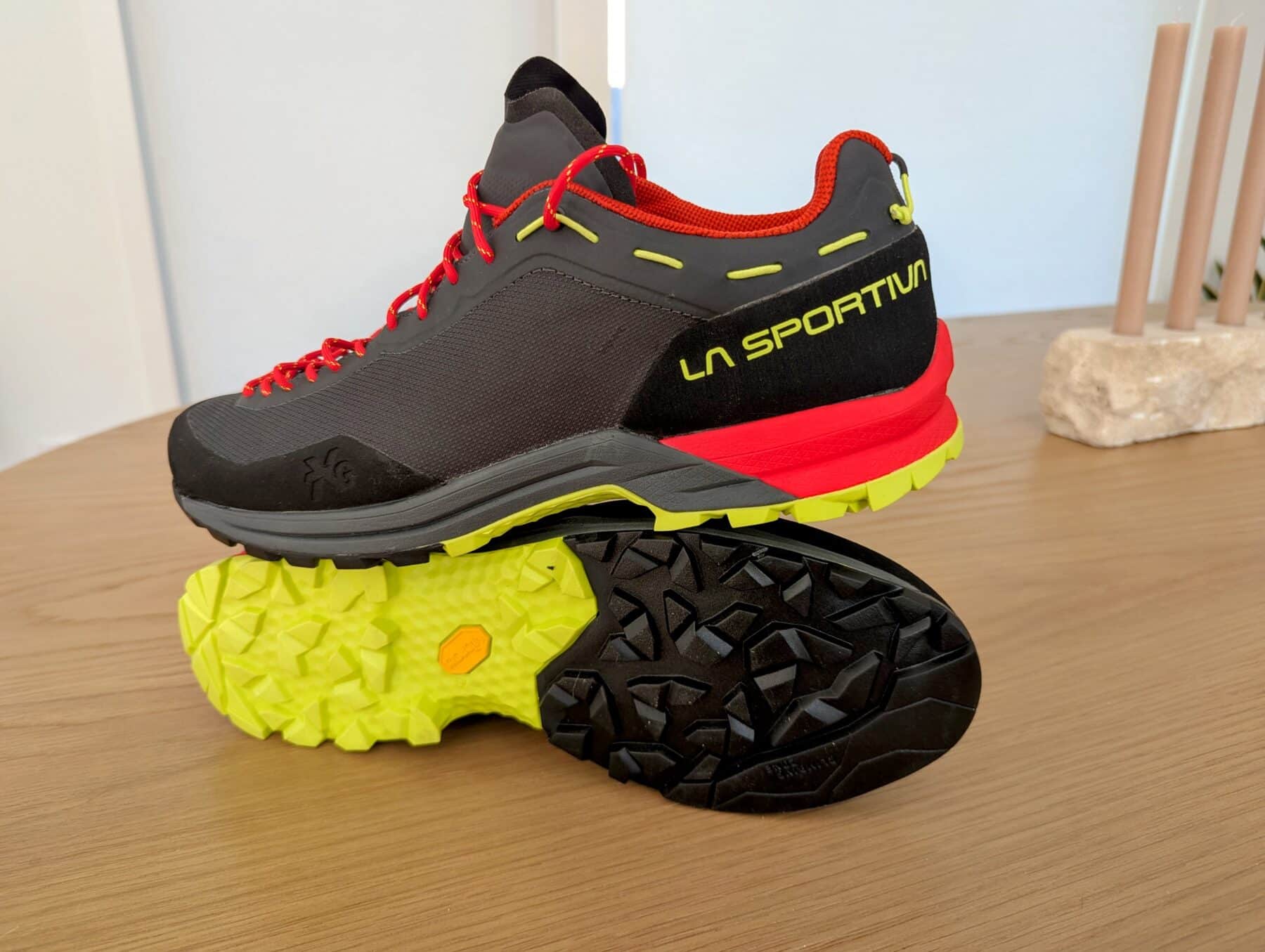
The TX Guide should not be confused with the TX Guide Leather, which are identical save for their leather upper, which will not fare as well in wet canyons. In contrast, the normal TX Guide is made of a sand-resistant synthetic mesh.
The origins of the TX Guide come from the TX3 (men’s, women’s) and TX4 (men’s, women’s), which we used to recommend for our most technical trips. For 2025 the TX-3 has been discontinued; you may find inventory still. The TX-4 is still in the line-up.
The TX-3 and TX-4 have a roomier fit than the TX Guide, but otherwise they’re less well suited for our desert trips. Neither model has a gusseted upper, which creates an easy entry point for sand. The TX3 have a mesh upper that drains better, dries faster, and has better longevity with repeated soakings; while the TX-4 leather upper is more sand-resistant, abrasion-resistant, and foot-conforming. I used to say that the TX-3 is probably a better choice if most of your trips are wet; the TX4, if most of your trips are dry.
 TX-3 with mesh upper
 TX-4 with leather upper
The Wildcat has been in La Sportiva’s lineup for more than a decade. Despite its large-holed mesh upper, the Wildcat is very sand-resistant, according to alumnus Randy who wore them for two consecutive years in Escalante. I’m guessing that they have an interior mesh layer that is much more sand-resistant than the exterior one.
I would not recommend the Wildcats if you expect to subject them to extensive abrasion — I’ve seen them get thrashed by one hard week in Alaska’s Brooks Range. But if you’re sticking to sandy trails and open cross-country terrain, they’d be an option.
 Ultra Raptor
 Wildcat
Eric Volk is the only person I know who has used these. His report:
Personal favorite but might only recommend for someone concerned about foot pain that also wants superbly-safe stiffness for scrambling. A/B tested them on long off-trail hike with Bushido’s at a resupply. Mild foot pain disappeared immediately upon switching. Most comfortable trail runner I’ve worn.
Mesh surprisingly blocked fine sand in the Grand Canyon. The tongue isn’t gusseted yet the excessive inner padding seems to seal against most sands.
Grippy-ness at least on par to Bushidos. The tread, while grippy, is not unique in durability compared to other canyon shoes.
I initially tested by literally kicking cacti and dragging them across limestone throughout the San Juan river. The 360-deg rand is bomb-proof. Invaluable vs. prior hours of removing painful cacti spines when wearing other shoes. Durability perhaps overkill for Escalante.
No apparent drainage but didn’t have drying issues in sun after wading. Remarkable stability despite ‘high’ stack.
 Scarpa Ribelle Run XT, used and new. The used pair have seen “hundreds of burley off-trail miles of voracious Grand Canyon limestone. Hardly a scratch — only some mesh worn through via pinky toe abrasion.”
Salomon Speedcross
Scarpa Ribelle Run XT, used and new. The used pair have seen “hundreds of burley off-trail miles of voracious Grand Canyon limestone. Hardly a scratch — only some mesh worn through via pinky toe abrasion.”
Salomon Speedcross
The Speedcross has a very sand-resistant upper and reasonably sticky lugs; and many people like its fit. For backpacking trips without extensive scrambling, it’s a good choice. However, its lug shape and pattern are not optimized for uneven or steep slickrock: it’s missing lugs around its perimeter, and the lugs tend to bend under pressure.
 Salomon Speedcross
The Pro has been discontinued, but select sizes were still available on clearance when this post was first published in March 2024. If you like other Topo models, scoop this one up because it’s a good choice for desert backpacking. Breathable, sand-resistant, durable, sticky, sufficiently stiff. It’ was more on par with the Mutant than other models in this list like the Lone Peak and Speedcross. It’s probably most akin to the Wildcat and Ultra Raptor; it is not as capable as the Mutant.
Topo Terraventure 3 and MTN Racer 2The current iterations of these models will NOT work in the desert, as I explain later. But earlier versions did.
In the process of finding shoes that perform well in the desert, we have found many that don’t. The aspect in which they most often fail is their sand-resistance — most users aren’t concerned about it, so most manufacturers don’t design for it.
Especially for trips in sandy environments, I would advise against the models below.
From Brandon, one of our guides:
 Topo Terraventure, a so-so pick
Salewa models NOT recommended
Topo Terraventure, a so-so pick
Salewa models NOT recommended
From Eric, a multi-time alumnus who has traversed the Grand Canyon and Brooks Range:
More from Eric:
Leave a comment below, particularly if you:
Thanks!
Disclosure. I strive to offer field-tested and trustworthy information, insights, and advice. I have no financial affiliations with or interests in any brands or products, and I do not publish sponsored content
This website is supported by affiliate marketing, whereby for referral traffic I receive a small commission from select vendors like Amazon or REI, at no cost to the reader. As an Amazon Associate I earn from qualifying purchases.
| # | Наименование новости | Тональность | Информативность | Дата публикации |
|---|---|---|---|---|
| 1 | High Sierra record snowpack: Implications for trip planning, gear selection, and skills | 0 | 8.81 | 25-05-2023 |
| 2 | Aquamira: Why we like it, and how we use it | 0 | 10.09 | 01-03-2024 |
| 3 | Detouring: San Joaquin River bridge alternates | 0 | 7.62 | 18-05-2023 |
| 4 | Waistbelts vs. Hydration Vests: What’s Better for Trail Running? | 0 | 8.11 | 19-08-2026 |
| 5 | Can I just complain about Merrells for a second? I grew up wearing these awful shoes, surrounded by… | 0 | 13.3 | 19-08-2026 |
| 6 | New Balance's 3-in-1 hiking boot zips and strips down to camp slippers | 0 | 9.97 | 14-07-2026 |
| 7 | Water shoes make summer activities easier and they’re on sale | 5 | 7 | 09-07-2026 |
| 8 | Water shoes make summer activities easier and they’re on sale | 5 | 6 | 09-07-2026 |
| 9 | Рубрика #мысливпоходе Зачем мы ходим в горы? Несем на себе ... | 0 | 6.02 | 27-07-2026 |
| 10 | Water shoes make summer activities easier and they’re on sale | 0 | 5.23 | 09-07-2026 |