Просмотр новости
Найдите то, что Вас интересует
 Спутники
 РН
РН SpaceX
 Роскосмос
 NASA
NASA
СпутникиРНSpaceXРоскосмосNASABackground Computational models of lithospheric seismicity have diversified across physics-based rupture simulation, statistical seismicity models, and machine-learning (ML) forecasting, yet no synthesis has systematically linked this technical literature to lithosphere literacy — the capacity of non-specialists to interpret model outputs critically. This review maps the model landscape and evaluates its literacy-facing translation. Methods A rapid systematic review was conducted following PRISMA 2020 reporting items, adapted for a single-reviewer, web-search-based protocol rather than a full multi-database (Scopus/Web of Science/IEEE Xplore) export. Eight structured queries were run across a general academic web-search engine in a single session (8 July 2026). Sixty records were retrieved; after removing 3 duplicates, 57 unique records were screened against pre-specified eligibility criteria; 29 were included in the final synthesis. Results Included studies clustered into four families: physics-based rupture/wave-propagation and fault-interaction models (n = 9), machine-learning forecasting frameworks (n = 9), hazard/uncertainty visualisation and communication studies (n = 6), and education/literacy-translation studies (n = 5). Explicit uncertainty communication was reported in a minority of ML studies; dedicated literacy- or education-facing translation was reported in fewer than one-fifth of all included studies, and almost never co-occurred with physics-based or ML forecasting studies. Conclusions A structural gap separates technically advanced seismicity modelling from literacy-oriented translation. A three-tier framework — mechanistic transparency, uncertainty communication, and pedagogical translation — is proposed to guide future model reporting. Given the single-reviewer, web-search-based search strategy, these findings should be treated as a rapid evidence assessment; a full systematic review with independent dual screening and formal database export is recommended before the framework is used for policy or curriculum decisions.

Zulva R, Suhandi A, Setiawan A et al. Computational Modelling of Lithospheric Seismicity for Lithosphere Literacy: A Rapid Systematic Review and Evaluative Framework [version 1; peer review: awaiting peer review]. F1000Research 2026, 15:1327 (https://doi.org/10.12688/f1000research.186541.1)
Systematic Review
[version 1; peer review: awaiting peer review]
https://orcid.org/0000-0002-0507-1268
1, Andi Suhandi1, Agus Setiawan1, [...] Deni Moh.Budiman1, Sohibun -1, Dandan Luhur Saraswati1, Dwi Nanda Akhmad Romadhonhttps://orcid.org/0009-0006-7276-8440
1https://orcid.org/0000-0002-0507-1268
1, Andi Suhandi1, [...] Agus Setiawan1, Deni Moh.Budiman1, Sohibun -1, Dandan Luhur Saraswati1, Dwi Nanda Akhmad Romadhonhttps://orcid.org/0009-0006-7276-8440
11 Universitas Pendidikan Indonesia, Bandung, West Java, Indonesia
Rahmi Zulva
Roles: Conceptualization, Formal Analysis, Funding Acquisition, Methodology, Resources, Writing – Original Draft Preparation
Andi Suhandi
Roles: Data Curation, Supervision, Validation, Writing – Review & Editing
Agus Setiawan
Roles: Investigation, Supervision, Validation, Writing – Review & Editing
Deni Moh.Budiman
Roles: Project Administration, Supervision, Validation, Writing – Review & Editing
Sohibun -
Roles: Formal Analysis, Supervision, Validation, Visualization
Dandan Luhur Saraswati
Roles: Investigation, Project Administration, Software, Writing – Review & Editing
Dwi Nanda Akhmad Romadhon
Roles: Conceptualization, Validation, Writing – Review & Editing
OPEN PEER REVIEW
REVIEWER STATUS AWAITING PEER REVIEW
Computational models of lithospheric seismicity have diversified across physics-based rupture simulation, statistical seismicity models, and machine-learning (ML) forecasting, yet no synthesis has systematically linked this technical literature to lithosphere literacy — the capacity of non-specialists to interpret model outputs critically. This review maps the model landscape and evaluates its literacy-facing translation.
MethodsA rapid systematic review was conducted following PRISMA 2020 reporting items, adapted for a single-reviewer, web-search-based protocol rather than a full multi-database (Scopus/Web of Science/IEEE Xplore) export. Eight structured queries were run across a general academic web-search engine in a single session (8 July 2026). Sixty records were retrieved; after removing 3 duplicates, 57 unique records were screened against pre-specified eligibility criteria; 29 were included in the final synthesis.
ResultsIncluded studies clustered into four families: physics-based rupture/wave-propagation and fault-interaction models (n = 9), machine-learning forecasting frameworks (n = 9), hazard/uncertainty visualisation and communication studies (n = 6), and education/literacy-translation studies (n = 5). Explicit uncertainty communication was reported in a minority of ML studies; dedicated literacy- or education-facing translation was reported in fewer than one-fifth of all included studies, and almost never co-occurred with physics-based or ML forecasting studies.
ConclusionsA structural gap separates technically advanced seismicity modelling from literacy-oriented translation. A three-tier framework — mechanistic transparency, uncertainty communication, and pedagogical translation — is proposed to guide future model reporting. Given the single-reviewer, web-search-based search strategy, these findings should be treated as a rapid evidence assessment; a full systematic review with independent dual screening and formal database export is recommended before the framework is used for policy or curriculum decisions.
lithosphere; seismicity modelling; computational geophysics; machine learning; earthquake forecasting; science literacy; PRISMA; rapid review
Corresponding author: Andi Suhandi Competing interests: No competing interests were disclosed.
Grant information: This research was supported by the Indonesian Education Scholarship (Beasiswa Pendidikan Indonesia, BPI), administered by the Center for Higher Education Funding and Assessment (Pusat Pembiayaan dan Pendanaan Pendidikan Tinggi, PPAPT), Ministry of Higher Education, Science, and Technology of the Republic of Indonesia, and by the Indonesian Endowment Fund for Education (Lembaga Pengelola Dana Pendidikan, LPDP).
The funders had no role in study design, data collection, analysis, decision to publish, or preparation of the manuscript.
The funders had no role in study design, data collection and analysis, decision to publish, or preparation of the manuscript.
Copyright: © 2026 Zulva R et al. This is an open access article distributed under the terms of the Creative Commons Attribution License, which permits unrestricted use, distribution, and reproduction in any medium, provided the original work is properly cited. How to cite: Zulva R, Suhandi A, Setiawan A et al. Computational Modelling of Lithospheric Seismicity for Lithosphere Literacy: A Rapid Systematic Review and Evaluative Framework [version 1; peer review: awaiting peer review]. F1000Research 2026, 15:1327 (https://doi.org/10.12688/f1000research.186541.1) First published: 07 Aug 2026, 15:1327 (https://doi.org/10.12688/f1000research.186541.1) Latest published: 07 Aug 2026, 15:1327 (https://doi.org/10.12688/f1000research.186541.1)
The lithosphere is the mechanical outer shell of the Earth whose deformation and rupture behaviour underlies most surface seismic hazard. Computational modelling of this behaviour has progressed along two largely separate tracks: physics-based numerical simulation of stress accumulation, fault interaction, and rupture dynamics,1,3,4,14 and statistical or machine-learning (ML) approaches to seismicity forecasting from catalogue, geodetic, and satellite data.5–12,13,16,17 Both tracks have matured rapidly: three-dimensional regional wave-propagation simulation is now routine,2,28,29,30 and ML methods have diversified into graph-neural, transformer, and Bayesian architectures for forecasting and rupture-dynamics tasks.9,10,16,17
A parallel and comparatively neglected problem is how these computational outputs are translated into lithosphere literacy: the capacity of students, practitioners, and the public to interpret seismic hazard information critically, as a probabilistic construct rather than as either a deterministic prediction or an unintelligible number. Existing systematic reviews of ML in earthquake seismology synthesise algorithmic performance5,6,10 but do not evaluate the communicative or pedagogical properties of the models reviewed. Conversely, geoscience-education literature has examined simulation-based learning gains19,20 and hazard-map visualisation design21,23,24 but rarely in explicit dialogue with the computational-modelling literature that generates the underlying hazard estimates.
This asymmetry has both theoretical and methodological consequences. Theoretically, treating predictive skill and communicability as independent properties risks producing models that are accurate but uninterpretable to their intended audiences, or literacy interventions built on outdated mechanistic assumptions. Methodologically, the two literatures use incommensurable evaluation metrics (e.g., ROC-AUC and Molchan diagrams for forecasting skill versus comprehension gains and risk-perception shift for literacy outcomes), which impedes direct comparison.
This review asks: (RQ1) what classes of computational model have been applied to lithospheric seismicity phenomena in the recent literature; (RQ2) how is model uncertainty represented and reported across these classes; and (RQ3) to what extent, and through what mechanisms, have these models been translated into literacy- or education-facing outputs. The contribution is twofold: an evidence synthesis addressing RQ1-RQ3, and a three-tier evaluative framework (mechanistic transparency, uncertainty communication, pedagogical translation) intended to guide future model development and reporting.
This review is reported following the PRISMA 2020 Statement,31 adapted explicitly for a rapid, single-reviewer, web-search-based design; it does not claim compliance with the dual-independent-reviewer and formal multi-database-export standard expected of a full systematic review, and this limitation is treated as a first-class methodological constraint rather than a footnote (see Section 4.2).
No prospective protocol was registered in PROSPERO, because PROSPERO registration presupposes a full systematic-review design with at least two independent screeners, which this rapid review does not implement. The eligibility criteria, search strategy, and extraction fields below were nonetheless specified before screening began and were not altered during the review.
Population/Phenomenon: computational or computer-based models of lithospheric processes with seismic expression (fault rupture, stress transfer, seismicity clustering, earthquake forecasting, ground-motion synthesis). Concept: model architecture, validation approach, uncertainty treatment, and any literacy- or education-facing translation. Context: peer-reviewed journal articles, peer-reviewed conference/workshop reports, and citable preprints (arXiv) in English. Exclusion: non-peer-reviewed web pages, blogs, software product pages, conference programmes/session listings, seminar announcements, patents, and studies whose primary domain was outside lithospheric/seismic processes (e.g., medical simulation, structural-building assessment without a lithosphere model, general-purpose physics simulation).
Records were retrieved using a general academic web-search engine (not a single indexed bibliographic database) across eight structured queries executed in one session on 8 July 2026: (i) computational model seismicity lithosphere review 2024–2025; (ii) machine learning earthquake prediction lithosphere numerical modeling systematic review; (iii) PRISMA systematic review computer simulation geohazard education literacy; (iv) “computational model” lithosphere seismicity education literacy public understanding; (v) machine learning earthquake forecasting model uncertainty communication public; (vi) geoscience simulation classroom learning earthquake plate tectonics computer model; (vii) seismic hazard visualization tool science communication non-specialist; (viii) physics-based earthquake simulator open source educational outreach. No date, language, or citation filters were applied beyond the eligibility criteria.
Screening (title/abstract, then full text where accessible) was performed by a single reviewer against the eligibility criteria in Section 2.2; there was no second, independent screener and no adjudication step. This is the principal deviation from PRISMA’s standard dual-screening requirement and is the main reason this manuscript is labelled a rapid, not a full, systematic review. The complete, item-level screening log — every record identified, its screening stage, inclusion/exclusion decision, and stated reason — is provided as Underlying data (see Data Availability Statement) so that the decisions can be audited and, in a subsequent full review, independently replicated by a second reviewer.
For included records, the following were extracted narratively: model family (physics-based simulation, fault-interaction model, ML forecasting, hazard-visualisation/communication study, education/literacy-translation study), spatial/temporal scale, input data type, whether an explicit uncertainty metric was reported, and whether a literacy- or education-facing translation product (dashboard, curriculum unit, public visualisation) was described.
Given the single-reviewer design, a formal PROBAST or AMSTAR-2 scoring was not applied in full (both require, or strongly recommend, independent dual assessment for a reliable score); instead, each included record was checked narratively against three PROBAST-derived domains — predictor/parameter transparency, outcome definition clarity, and validation against independent data — and flagged where a domain could not be assessed from the available text. This is reported as a scoping-level, not a certified, risk-of-bias appraisal.
Given the heterogeneity of outcome metrics across physics-based and ML studies, and the rapid (non-dual-reviewer) design, a narrative and framework-based synthesis was used rather than meta-analytic pooling, consistent with Synthesis Without Meta-analysis (SWiM) guidance. Counts by model family (Section 3.2) are descriptive tallies of the 29 included records, not effect-size estimates.
Figure 1 presents the PRISMA 2020 flow diagram for this rapid review. The diagram file (PRISMA_flow_diagram.png) is deposited together with the completed PRISMA 2020 checklist at the Zenodo record cited in the Data Availability Statement and in Reference 32. Table 1 reports the corresponding numerical breakdown of records identified, screened, and excluded at each stage.
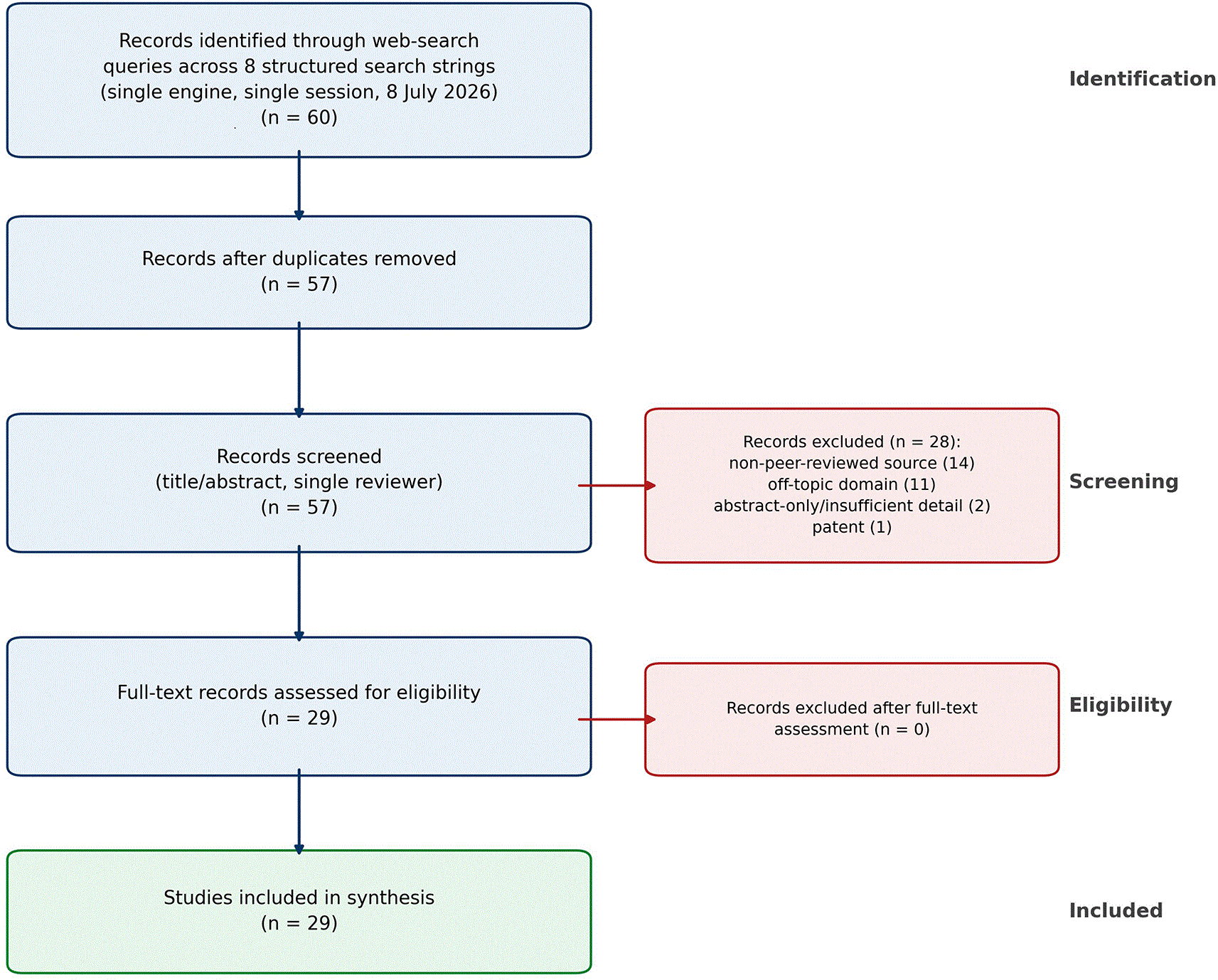
Table 2 summarises the distribution of the 29 included records across model and study families.
Among the nine machine-learning forecasting studies, an explicit, quantified uncertainty metric (e.g., Bayesian posterior interval, prediction interval, confidence band) was reported in a minority of cases16; most reported point-estimate skill metrics (e.g., accuracy, AUC) without an accompanying communicable uncertainty statement. Among the physics-based and fault-interaction studies, uncertainty was typically expressed as parameter sensitivity or scenario range rather than as a single probabilistic statement usable by a non-specialist audience.
Only five of the 29 included records15,19,20,25,26 described a literacy- or education-facing translation product, and none of these five were also machine-learning forecasting studies; the visualisation/communication cluster16,21,22,23,24,27 addressed translation of hazard information but predominantly for professional or civil-defence audiences rather than general public or classroom literacy. This supports the pattern anticipated in Section 1: literacy-facing translation and state-of-the-art forecasting modelling were, in this sample, produced by largely non-overlapping research communities.
Based on the synthesis above, a three-tier framework is proposed to evaluate computational models of lithospheric seismicity for their literacy contribution, independent of predictive performance:
1. Mechanistic transparency — the degree to which model assumptions, governing equations, and parameter provenance are documented in a form auditable by non-specialists and instructors.
2. Uncertainty communication — whether probabilistic outputs are reported with an explicit, non-deterministic framing suitable for public and classroom use, rather than as a bare point estimate.
3. Pedagogical translation — the existence and quality of a derivative product (visualisation, simulation interface, curriculum unit) that operationalises the model for literacy purposes.
This framework is offered as a coding scheme for future data extraction; its inter-rater reliability and construct validity have not yet been empirically tested and should be established in a full review with independent dual coders.
The evidence synthesised here indicates a structural asymmetry: technical sophistication in lithospheric seismicity modelling (Section 3.2) has advanced without a proportionate mechanism for translating that sophistication into literacy-oriented outputs (Section 3.4). This is consistent with, though not directly evidenced by, patterns previously documented in adjacent domains of simulation-based science education, where implementation fidelity and translation to non-specialist audiences are frequently under-reported.
Several limitations constrain the strength of the conclusions that can be drawn. First, retrieval relied on a general web-search engine across eight queries in a single session rather than a formal export from Scopus, Web of Science, or IEEE Xplore; coverage is therefore neither exhaustive nor bibliometrically reproducible in the way a database export would be, and the true population of eligible studies is almost certainly larger than the 57 screened here. Second, screening and eligibility decisions were made by a single reviewer without independent duplicate screening or a κ statistic for inter-rater agreement; some borderline inclusion/exclusion decisions (documented in the screening log) would benefit from a second reviewer’s judgement. Third, no meta-analytic pooling of predictive-skill metrics was attempted, and none should be inferred from the descriptive counts in Section 3.2. Fourth, the three-tier framework proposed in Section 3.5 is inductive and has not been validated against an independent sample or tested for inter-rater reliability.
These limitations mean the manuscript should be read, and is presented to reviewers, as a rapid evidence assessment that motivates and partially populates a full systematic review protocol — not as a substitute for one. Where F1000Research reviewers require full PRISMA compliance (dual independent screening, multi-database export, registered protocol), the author commits to executing that design as a version 2 update, using the present manuscript’s eligibility criteria and extraction fields as the starting protocol.
The three-tier framework proposed in Section 3.5 is deliberately positioned alongside, not as a replacement for, existing evaluative instruments. PROBAST addresses risk of bias in prediction-model studies but is silent on communicability to non-specialist audiences; the SWiM (Synthesis Without Meta-analysis) guideline addresses reporting of heterogeneous quantitative synthesis but likewise does not address audience-facing translation. Science-communication frameworks such as the Mental Models Approach evaluate public risk perception but are not designed to audit the technical transparency of the underlying computational model. The present framework therefore occupies a specific, previously unfilled niche: it cross-walks model-reporting transparency (an internal, technical property) against communicability (an external, audience-facing property) within a single coding instrument. This positioning is a conceptual contribution rather than an empirically validated instrument, and its added value relative to applying PROBAST and a communication checklist separately has not yet been tested.
Subject to the limitations in Section 4.2, three practical implications follow. First, journals and preprint venues publishing computational lithosphere-seismicity models could reasonably require an explicit uncertainty-communication statement, analogous to the Data Availability Statement now required for data, so that the mechanistic-transparency and uncertainty-communication tiers of the framework become auditable at the point of publication rather than inferred post hoc by reviewers. Second, funders and doctoral training programmes in computational geophysics could incentivise a stated literacy or education translation plan as a deliverable alongside the primary model output, closing the gap documented in Section 3.4 at the point of research design rather than after publication. Third, for national disaster-mitigation agencies (e.g., Indonesia’s BMKG and BNPB), the finding that literacy-facing translation and state-of-the-art forecasting modelling are produced by largely non-overlapping communities suggests a concrete institutional need for a boundary-spanning role or unit that routinely converts model output into literacy-tested public communication products.
Three concrete next steps would upgrade this rapid review to full PRISMA compliance. First, the eligibility criteria and Boolean strategy specified in Section 2.2–2.3 should be executed as a formal export from Scopus, Web of Science Core Collection, and IEEE Xplore, with the search string piloted for sensitivity and specificity and the export archived with a timestamp. Second, title/abstract and full-text screening should be performed independently by at least two reviewers, with a calculated inter-rater agreement statistic (e.g., Cohen’s kappa) and a third-reviewer adjudication step for disagreements, replacing the single-reviewer screening reported here. Third, the three-tier framework proposed in Section 3.5 should be piloted on a subset of the newly retrieved studies by two independent coders to establish its inter-rater reliability before it is applied to the full corpus. These three steps, rather than cosmetic editing, are what would allow the manuscript’s conclusions to be asserted with the confidence expected of a Scopus-indexed systematic review.
Computational models of lithospheric seismicity have diversified rapidly across physics-based, statistical, and machine-learning approaches, but in the 29 studies synthesised here their translation into lithosphere literacy remained inconsistent and rarely co-located with state-of-the-art forecasting work. A three-tier framework — mechanistic transparency, uncertainty communication, pedagogical translation — is proposed to guide future model development and reporting. Because this synthesis used a rapid, single-reviewer, web-search-based method, a full systematic review with dual independent screening and multi-database export is the necessary next step before the framework’s generalisability can be asserted with confidence.
This review synthesises previously published, publicly available literature and did not involve human participants, animal subjects, or primary data collection. Formal ethics committee approval was therefore not required.
Repository: Zenodo. Dataset title: Screening log for: Computational Modelling of Lithospheric Seismicity for Lithosphere Literacy. This item-level log lists all 57 unique records identified across the 8 search queries (8 July 2026), the screening stage at which each was assessed, the inclusion/exclusion decision, and the stated reason. https://doi.org/10.5281/zenodo.21257140 (Rahmi Z, 2026, Reference 32). Licence: CC-BY 4.0.
None additional beyond the screening log.
Repository: Zenodo. Item title: PRISMA 2020 checklist and flow diagram for: Computational Modelling of Lithospheric Seismicity for Lithosphere Literacy. The completed PRISMA 2020 checklist and PRISMA flow diagram are available at https://doi.org/10.5281/zenodo.21257140.
The author gratefully acknowledges the support of the Indonesian Education Scholarship (Beasiswa Pendidikan Indonesia, BPI), administered by the Center for Higher Education Funding and Assessment (Pusat Pembiayaan dan Pendanaan Pendidikan Tinggi, PPAPT), Ministry of Higher Education, Science, and Technology of the Republic of Indonesia, and the Indonesian Endowment Fund for Education (Lembaga Pengelola Dana Pendidikan, LPDP), whose funding made the doctoral research programme underlying this manuscript possible. The author also thanks the institution hosting the author’s doctoral studies for administrative and academic support during the preparation of this review.
This research was supported by the Indonesian Education Scholarship (Beasiswa Pendidikan Indonesia, BPI), administered by the Center for Higher Education Funding and Assessment (Pusat Pembiayaan dan Pendanaan Pendidikan Tinggi, PPAPT), Ministry of Higher Education, Science, and Technology of the Republic of Indonesia, and by the Indonesian Endowment Fund for Education (Lembaga Pengelola Dana Pendidikan, LPDP).
The funders had no role in study design, data collection, analysis, decision to publish, or preparation of the manuscript.
The funders had no role in study design, data collection and analysis, decision to publish, or preparation of the manuscript.
© 2026 Zulva R et al. This is an open access article distributed under the terms of the Creative Commons Attribution License, which permits unrestricted use, distribution, and reproduction in any medium, provided the original work is properly cited.
Current Reviewer Status:
AWAITING PEER REVIEW
AWAITING PEER REVIEW
?
Key to Reviewer Statuses VIEW HIDE
ApprovedThe paper is scientifically sound in its current form and only minor, if any, improvements are suggested
Approved with reservations A number of small changes, sometimes more significant revisions are required to address specific details and improve the papers academic merit.
Not approvedFundamental flaws in the paper seriously undermine the findings and conclusions
Open Peer Review
AWAITING PEER REVIEW
Sign up for content alerts
Alongside their report, reviewers assign a status to the article:
Approved - the paper is scientifically sound in its current form and only minor, if any, improvements are suggested
Approved with reservations - A number of small changes, sometimes more significant revisions are required to address specific details and improve the papers academic merit.
Not approved - fundamental flaws in the paper seriously undermine the findings and conclusions