Просмотр новости
Найдите то, что Вас интересует
 Спутники
 РН
РН SpaceX
 Роскосмос
 NASA
NASA
СпутникиРНSpaceXРоскосмосNASAThis systematic review identifies approaches, CT dimensions, outcomes and challenges for the implementation of computational thinking (CT) in science education. A systematic review of a curated Scopus dataset of 248 journal articles on CT in science education published between 2016 and 2025 was conducted. 44 studies were selected for the qualitative study, following the PRISMA 2020 guidelines. The findings of this review were obtained by means of a descriptive and inductive thematic synthesis of the selected studies. The results show that in science education, instead of a focus on programming and coding, CT is used as a pedagogical tool for the scientific practices and models of science and for inquiry-based learning of science. A conceptual and functional shift is identified from the four dimensions of CT and from systems thinking and modeling as learning objectives to scientific competences that are used as learning resources for understanding science. The more CT is used as an educational source for experiences of science, the more it can bring about transformations. However, the sustainable implementation of CT is obstructed by the aspect of teacher readiness, the assessment of CT, the curriculum and the capabilities of students. More research is needed that focuses on system support for learning CT in order to ensure sustainable implementation of CT in science education.

Kurniawan Y, Suhandi A, Samsudin A et al. Developing Computational Thinking in Science Education: A Systematic Review of Instructional Approaches, Learning Outcomes, and Implementation Challenges [version 1; peer review: awaiting peer review]. F1000Research 2026, 15:1321 (https://doi.org/10.12688/f1000research.186997.1)
Systematic Review
[version 1; peer review: awaiting peer review]
https://orcid.org/0000-0002-6997-9179
1, Andi Suhandi2, Achmad Samsudinhttps://orcid.org/0000-0003-3564-6031
3, Muslim Muslim4, Riski Muliyanihttps://orcid.org/0000-0002-2277-4619
5https://orcid.org/0000-0002-6997-9179
1, Andi Suhandi2, [...] Achmad Samsudinhttps://orcid.org/0000-0003-3564-6031
3, Muslim Muslim4, Riski Muliyanihttps://orcid.org/0000-0002-2277-4619
51 Department of Science Education, Universitas Pendidikan Indonesia, Bandung, West Java, Indonesia
2 Department of Science Education, Universitas Pendidikan Indonesia, Bandung, West Java, Indonesia
3 Department of Science Education, Universitas Pendidikan Indonesia, Bandung, West Java, Indonesia
4 Department of Science Education, Universitas Pendidikan Indonesia, Bandung, West Java, Indonesia
5 Department of Science Education, Universitas Pendidikan Indonesia, Bandung, West Java, Indonesia
Yudi Kurniawan
Roles: Conceptualization, Formal Analysis, Investigation, Methodology, Visualization, Writing – Original Draft Preparation, Writing – Review & Editing
Andi Suhandi
Roles: Supervision, Writing – Review & Editing
Achmad Samsudin
Roles: Supervision, Writing – Review & Editing
Muslim Muslim
Roles: Supervision, Writing – Review & Editing
Riski Muliyani
Roles: Visualization
OPEN PEER REVIEW
REVIEWER STATUS AWAITING PEER REVIEW
This systematic review identifies approaches, CT dimensions, outcomes and challenges for the implementation of computational thinking (CT) in science education. A systematic review of a curated Scopus dataset of 248 journal articles on CT in science education published between 2016 and 2025 was conducted. 44 studies were selected for the qualitative study, following the PRISMA 2020 guidelines. The findings of this review were obtained by means of a descriptive and inductive thematic synthesis of the selected studies. The results show that in science education, instead of a focus on programming and coding, CT is used as a pedagogical tool for the scientific practices and models of science and for inquiry-based learning of science. A conceptual and functional shift is identified from the four dimensions of CT and from systems thinking and modeling as learning objectives to scientific competences that are used as learning resources for understanding science. The more CT is used as an educational source for experiences of science, the more it can bring about transformations. However, the sustainable implementation of CT is obstructed by the aspect of teacher readiness, the assessment of CT, the curriculum and the capabilities of students. More research is needed that focuses on system support for learning CT in order to ensure sustainable implementation of CT in science education.
computational thinking; instructional approaches; learning outcomes; systematic literature review.
Corresponding author: Andi Suhandi Competing interests: No competing interests were disclosed.
Grant information: This study was supported by the Indonesian Education Scholarship, Center for Higher Education Funding and Assessment, and Indonesian Endowment Fund for Education. All of statement, findings, recommendation, and conclusions in this study are those of the author and not reflect the views of the funding institutions.
The funders had no role in study design, data collection and analysis, decision to publish, or preparation of the manuscript.
Copyright: © 2026 Kurniawan Y et al. This is an open access article distributed under the terms of the Creative Commons Attribution License, which permits unrestricted use, distribution, and reproduction in any medium, provided the original work is properly cited. How to cite: Kurniawan Y, Suhandi A, Samsudin A et al. Developing Computational Thinking in Science Education: A Systematic Review of Instructional Approaches, Learning Outcomes, and Implementation Challenges [version 1; peer review: awaiting peer review]. F1000Research 2026, 15:1321 (https://doi.org/10.12688/f1000research.186997.1) First published: 07 Aug 2026, 15:1321 (https://doi.org/10.12688/f1000research.186997.1) Latest published: 07 Aug 2026, 15:1321 (https://doi.org/10.12688/f1000research.186997.1)
Over the last decade, the field of Computational Thinking (CT) has significantly evolved from being predominantly associated with programming to being a fundamental scientific practice that supports knowledge construction, problem solving and critical thinking across a broad range of disciplines (Grizioti, 2025; Tariq et al., 2025; Y. Li et al., 2020). As most of the scientific research is increasingly carried out to use computational methods to study complex systems, to analyze very large data sets and to build models of phenomena that cannot be observed directly or are even not possible to study by means of traditional experiments, the use of computational approaches to scientific inquiry is becoming more and more prevalent. Thus, CT is no longer only about writing programs, but also a scientific practice that is used to frame questions, to make sense of data and to develop explanations of phenomena (Hurt et al., 2023; Ogegbo & Ramnarain, 2022; Weintrop et al., 2016). As a consequence, CT has become an essential educational construct in its own right, that is significant to education outside of computer science. It is a scientific practice that is fundamental to conducting and making sense of data-intensive scientific work.
In recent years, much of scientific inquiry has involved an increasing number of computational methods. Thus, students engaged in scientific inquiry are not only studying the phenomena of the natural world and increasing their understanding of scientific concepts, they are also representing those ideas computationally, analyzing and interpreting data, and using evidence to explain complex systems by thinking computationally and representing their ideas in a variety of ways (Hurt et al., 2023; Waterman et al., 2020; Weintrop et al., 2016). This computational way of thinking is one of the eight core science and engineering practices, which represent NGSS framework, that should be fully integrated into the range of scientific practices that are presented to students throughout the elementary, middle school, and high school years in order for them to fully engage in real scientific practices in school and beyond (Peel A. et al., 2025; Cabrera et al., 2024; Tankersley A. et al., 2024; Lilly et al., 2023).
Responding to the evolvement of educational expectations, CT in science education is a rapidly developing field of research. Many different models of CT are being implemented on different levels in various subjects. In the literature, a variety of approaches for the implementation of CT in science education are described. These include computational modeling, modeling, inquiry-based learning, project-based learning, educational robotics, constructionism, argumentation, as well as approaches for integrated STEM education (Cannady et al., 2025; Kumala et al., 2023; Chang et al., 2023; Aalbergsjø, 2022; Voon et al., 2022; Psycharis, 2019). Most of the studies about computational thinking in science education present various approaches to implement computational thinking in order to support scientific practices and to include computational practices in real-world situations. Instead of trying to find the best approach to implement computational thinking in science education, one should rather develop environments that support computational thinking and connect computational practices with scientific practices in real-world situations in order to support scientific inquiry and an understanding of science (Dabholkar et al., 2025; Farris & McLaughlin, 2024; Hurt et al., 2023).
Recent advances in science education are accompanied by an increasing variety of teaching approaches. From an initial description of computational thinking (CT) in basic cognitive processes like decomposition, abstraction, pattern recognition, and algorithmic thinking, recent frameworks and studies within the scope of science education more and more follow a more multidimensional view of CT as a key competency for scientific practices and modeling with computational models (Hurt et al., 2023). Next to already existing views on the integration of CT into science education as well as teaching approaches that foster specific scientific practices like data usage, and practices when encountering bugs in computer models and handling them (Tofel-Grehl et al., 2022; Adler & Kim, 2018), the most important question for us is if results on CT within the scope of science education can explain differences between single teaching approaches with respect to single dimensions of CT as well as differences of learning outcomes.
Research on computational thinking (CT) in science education has been flourishing over the last years, and an increasing number of review studies aim at systematizing the corresponding findings. These reviews on CT in science education are viewed from different perspectives, such as the implementation of CT in science lessons (Ogegbo & Ramnarain, 2022), STEM education (Addido et al., 2023; X. Wang et al., 2023), computational literacy (Braun & Huwer, 2022), programming and coding (Hutchison et al., 2025; Melro et al., 2023), teacher education (Yun & Crippen, 2025), and assessment of CT (Lu et al., 2022; Weintrop D. et al., 2021; G. Chen et al., 2017). The corresponding body of evidence is diverse and is growing. It points to the large potential of CT for scientific inquiry, problem solving, and for a more integrated approach to learning in science, technology, engineering, and mathematics (STEM) as well as to current trends and ways of implementation. Thus, a solid basis for further research on CT in science education has been established.
There is considerable value in individual analytical reviews of evidence which cover a number of relevant dimensions in relation to the integration of computational thinking (CT) into science education. So far, reviews of the evidence with respect to CT in science education have focused on different aspects of instruction, using different tools for learning, different types of assessment, in different environments and different educational settings. While such reviews of evidence provide individual insights, collectively they provide only a partial understanding or perspective on the integration of CT into science education. In each of the individual reviews, a number of pedagogically and conceptually related dimensions of evidence have been analyzed in relation to each other. However, the reviews have not addressed the relationships between the different approaches to instruction and the different dimensions of CT and the associated outcomes, and the problems encountered when trying to integrate CT into science education for students at different levels of education.
The review has three principal contributions to the literature. First, the review provides an integrated synthesis of different elements relating to the computational thinking dimension, namely, the types of instruction that should be implemented to teach CT, the different dimensions of CT that should be addressed in science education instruction, the learning outcomes expected from the integration of CT into science education curriculum and the challenges that need to be addressed when attempting to implement the integration of CT into science classroom. Second, the review articulates a pedagogical perspective or understanding of CT. In particular, the review describes and explains the types of instruction, and how they can support the development of different computational competencies in science learning. Third, the review outlines a number of emerging research priorities that will need to be addressed in future research, extending beyond the study of a single classroom to consider issues of curriculum, teacher professional development, assessment, and longer-term implementation. The review therefore provides an integrated perspective on the topic and highlights the key issues that need to be addressed in future research, which will be of use to both researchers and educators.
This systematic literature review will synthesize empirical studies from 2016 until 2025 which investigate the implementation of computational thinking in science education. The review does not only provide a list of evidence, it will also analyze the relations between the implemented educational approaches and the corresponding dimensions of computational thinking. Furthermore, the review will analyze the learning outcomes as well as the obstacles of implementation. This analysis of interdependencies will provide new insights for future research as well as for the design and implementation of curricula, teaching and teacher education with respect to computational thinking in science education. Therefore, the review is addressed to the following research questions:
RQ1. What instructional approaches are used to develop computational thinking in science education?
RQ2. What dimensions of computational thinking are targeted by these instructional approaches?
RQ3. What learning outcomes are reported in the literature?
RQ4. What challenges and future directions are identified for computational thinking integration in science education?
This study follows the guidelines for the systematic review of research studies PRISMA (Page et al., 2021) to carry out a systematic review of research studies and to synthesize empirical evidence for the pedagogical strategies to foster CT in science education. The study aims at identifying the dimensions of CT that are fostered by the various methods, the outcomes of implementing CT in science education as well as the problems encountered. In contrast to other reviews that focus on specific technologies, programming environments or on specific levels of education, this review focuses on a variety of methodologies to foster CT in different contexts of science education. Hence, this review provides a comprehensive overview of the various pedagogical strategies for fostering CT in science education. This review was not prospectively registered and no formal risk of bias assessment was conducted as the review aimed to synthesize thematic evidence rather than estimate intervention effects.
Scopus was selected as the sole database due to its comprehensive coverage of high-quality peer-review publications and its widespread use in bibliometric and systematic literature reviews.
The investigation was conducted utilizing the subsequent query: TITLE-ABS-KEY (“computational thinking”) AND TITLE-ABS-KEY (education OR learning OR teaching OR STEM) AND PUBYEAR >2015 AND PUBYEAR <2026 AND (LIMIT-TO (SRCTYPE, “j”)) AND (LIMIT-TO (PUBSTAGE, “final”)) AND (LIMIT-TO (DOCTYPE, “ar”)) AND (LIMIT-TO (LANGUAGE, “English”)). The literature search was conducted on 31 May 2026.
This systematic literature review is based on a dataset generated from the same Scopus search as used for the bibliometric study on CT in science education. The search resulted 7347 records. Subsequently, several filters were applied, such as the year of publication (2016–2025), document type (journal articles), source type (journals), publication status (published final version of record) and language of publication (English). In total 248 journal articles were included in the curated dataset. From the corpus of 248 articles the studies were filtered again using specific inclusion and exclusion criteria for this review on CT in science education. Finally, 44 studies were included in the qualitative synthesis of this review.
The screening procedure was conducted in accordance with PRISMA 2020 guidelines. The screening was conducted by using Microsoft Excel and Rayyan. After this procedure, articles were screened in three sequential stages: title screening, abstract screening, and full-text eligibility assessment. This task was undertaken to identify studies relevant to the objectives of this review. Studies were included if they empirically investigated the implementation of computational thinking in science education through instructional interventions and reported learning outcomes related to computational thinking.
A set of criteria for including or excluding studies was jointly developed by the research team to ensure that relevant studies were selected and selected studies remained relevant. The criteria for including studies of CT’s evolution were: 1) studies about the evolution of CT; 2) studies about CT that were conducted and reported within a science education framework; 3) studies that included scientific concepts, scientific inquiry, scientific modeling or science-related problem solving; 4) studies that described the instructional methods, pedagogical interventions or learning paradigms for CT; 5) studies that reported results from empirical research; 6) full studies that were published in peer-reviewed journals; and 7) studies written in English.
The studies that are focused on computer science, programming, robotics and engineering without including any science learning were excluded from the study. The studies in which computational thinking is defined and explained but there are no practical applications in terms of instruction were also excluded from the study. The studies that do not contain any CT-related data, review studies, editorials, theoretical studies and studies conducted in the context of science education contexts were not included in the study. The detailed inclusion and exclusion criteria of the studies selected in this study are presented in Table 1.
1. Articles were investigated computational thinking development;
2. Articles were situated within science education contexts;
3. Articles involved science concepts, scientific inquiry, scientific modeling, or science-related problem solving;
4. Articles reported instructional interventions;
5. Articles were presented empirical findings
1. Articles focused solely on computer science education
2. Articles discussed computational thinking conceptually without instructional implementation
3. Articles did not report CT-related learning outcomes;
4. Articles belonged to review or bibliometric studies;
5. Articles were unrelated to science education
At the screening stage, all of the selected studies were evaluated using predefined criteria for inclusion and exclusion. Studies that did not deal with the topics of computational thinking and science education and/or lacked information on instructional interventions were excluded from analysis. 51 studies in total were identified as relevant for the screening and were subsequently analyzed at full-text level. During full-text analysis 7 studies were excluded because they were labeled as STEM interventions but were actually restricted to issues of programming, robotics, engineering design and technology without including science learning content. The 44 studies, which in the full-text analysis met all of the predefined criteria for inclusion, were then analyzed and synthesized. A complete study selection overview is given in the PRISMA flow diagram (Fig. 1).
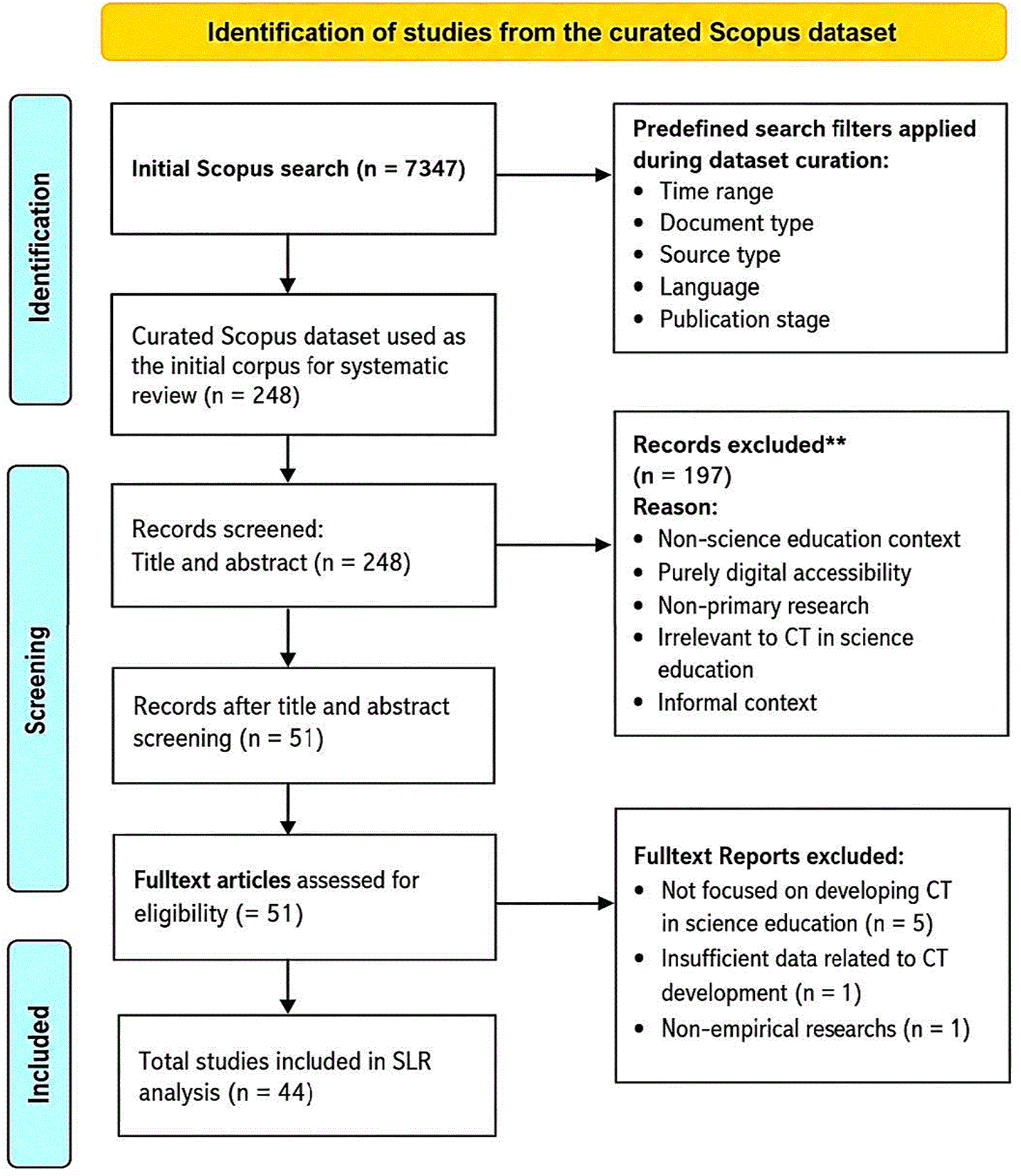
A data extraction form was designed in a structured format based on the four studies. All the data were collected and organized into four main groups of bibliographic data, educational data, pedagogical approaches and dimensions of computational thinking, results, problems for implementation and future research studies related to the studies. The four research studies were used as four established analytical study domains for the data. The results of thematically analogous findings were systemically organized into superordinate categories through inductive theme classification within each of the study domains. Through continuous comparison of comparable concepts between studies, the results were systematically categorized into superordinate categories. A consistent coding framework was developed in the end and presented in Table 2. This framework was then used for organization of extracted data through corresponding categories.
The findings from the included studies were analyzed by means of a coding system using a description and thematic synthesis. For RQ1 the teaching approaches were grouped thematically and described, and the frequency of the single approaches were analyzed. For RQ2 the single approaches were analyzed by means of CT-dimensions abstraction, decomposition, and algorithmic thinking. For RQ3 the single approaches were analyzed by means of the cognitive, emotive and behavioral domains of science learning and the aspect of “integrated learning” by means of CT in order to make sense of science information. For RQ4 the single approaches were analyzed thematically in order to identify problems and future directions of using CT in science teaching from the perspective of the teacher’s computational thinking pedagogical content knowledge (CTPCK). The single approaches for cultivating CT in science education by means of the single instructional approaches, the CT-dimensions as well as the single science learning outcomes were analyzed and integrated. Two researchers coded a subset of articles. The disagreements that occurred were solved by discussion in order to ensure dependability according to the qualitative synthesis protocols.
All research questions (RQ1–RQ4) were coded non-mutually exclusive to allow for a complete literature synthesis. The integrated approach of science-CT education is complex and thus studies may employ a hybrid approach (A13, A44), investigate different cognitive dimensions (A14, A41) and/or report on different outcomes. Hence, an item could be assigned to “Robotics” and “5E Model” for instance, depending on the query syntax applied in a study on tactile computing. “Computational Modeling” for example can comprise “Data Practices” and “Algorithmic Thinking” (A43) and thus the coded CT dimensions (RQ2) are non-mutually exclusive as well. The cumulative frequencies for each category of coded data thus may exceed the number of studies (n = 44). This option allows for a more in-depth account of the different ways in which CT can be developed in integrated science-CT education within various contexts by means of qualitative synthesis.
Table 3 displays all the pedagogical categories that have been developed by inductive topic coding. There are 44 studies which have been analyzed in terms of these categories. The largest number of studies are based on computational modeling (n = 13). This is followed by project-oriented learning (n = 10), educational robotics (n = 9), context-specific pedagogy (n = 6), constructionism/making (n = 6) and 5E learning cycle/inquiry-oriented learning/argumentation learning (n = 5). In summary, the scientific education by means of CT training is very diverse.
• PjBL
• STEAM
• STEAM-integrated PjBL
• Educational robotics
• Inquiry-based learning
• 5E Learning Cycle Model
• Argumentation Learning
The synthesis shows that most of the reviewed studies use computational modeling as the main educational approach to foster CT in science education. As a result, there is a shift from mere programming to modeling for science and modeling of science in order to support the construction of scientific knowledge. Most approaches of CT focus on coding as the main activity, but in recent approaches, CT is supported by using computational models to represent, to model or to explain scientific phenomena (Li et al., 2025; Kubsch & Hamerski, 2022; Omar et al., 2017). The use of simulations, agent-based models, and digital modeling environments in order to have students develop computational procedures and to construct scientific explanations for given phenomena by analyzing dynamic relations between variables within said models, is a current trend in order to have students create models of scientific phenomena. This current trend is supported by the fact that recent developments in natural science, where models are generated, tested and modified in order to generate, test and refine scientific explanations of complex natural phenomena, for constructing evidence, for data anlysis, are being mimicked by computational models (Sun et al., 2026; Dabholkar et al., 2025; Sun L. et al., 2023). Consequently, computation is no longer treated merely as a technical skill but increasingly functions as an epistemic tool for scientific representation, reasoning, and inquiry. So, the integration of computational modeling into classroom practice led to a wider shift in how computational thinking is taught.
The emergence of variety of pedagogical models to implement modeling in science teaching are currently being worked out. This first overview lists FACT, McodeE, ExPreSsion and SCT Tree. It becomes clear that the integration of computational thinking and science education is still a field in full development. The large number of proprietary approaches indicates this (Yun & Crippen, 2025; Vieyra et al., 2024). While there are many lesson design frameworks that address particular scientific content for particular student ages working with particular software, there is no current integrated approach to teaching. So, the problem of instructional integration remains. However, there are an increasing number of examples of computational modeling lessons as well as of lessons that use an inquiry-based approach in order to teach CT to students and in doing so, allow them to practice the scientific practices that are at the core of CT (Richter et al., 2022; Psycharis, 2019; Grizioti, 2025).
Table 4 summarizes the CT dimensions addressed across the reviewed studies. The most dimension of CT are Decomposition, Abstraction, Pattern Recognition, Algorithmic Thinking. The Computational modeling and simulation also appeared most frequently. The noticeable finding is the emergence of system thinking in CT dimension in 5 articles.
It is important to note that computational thinking in science education is expanding conceptually. Classic framework of computational thinking was concentrated on decomposition, abstraction, pattern recognition, and algorithmic thinking. In contrast with this synthesis result that dimension of computational thinking is expand to computational modeling, systems thinking, data practices, creativity, and interdisciplinary problem solving (Hurt et al., 2023; Kafai & Proctor, 2022; Weintrop et al., 2016). This evolution implies the growing integration of computational thinking with scientific practices rather than programming activities alone.
The implications of it are students should be enabled to develop their modeling and simulation skills as well as their data skills for scientific inquiries instead of learning various programming languages (Sun et al., 2026; Grizioti, 2025). Second, assessments of CT must also be measured in all its aspects and not only algorithmic thinking (Yuana et al., 2025; Lu et al., 2022; G. Chen et al., 2017). CT should be integrated into the science instructional design for scientific inquiry so that CT is used by students as tools to explain and investigate scientific and real-world problems. CT should be integrated into the science instructional design for scientific inquiry so that CT is used by students as tools to explain and investigate scientific and real world problems (Yuana et al., 2025; Ogegbo & Ramnarain, 2022; C. Wang et al., 2022a).
Also, the results of the preceding question are confirmed that computational thinking expands by the usual teaching arrangement. The dimensions of the computational thinking do not show up in all teaching situations. So, with respect to the learning tasks of the teaching techniques different instructional methods target different dimensions of the computational thinking. This regularity is described by the influence of the teaching design for the emerging computational thinking skills (Adorni et al., 2025; Palop et al., 2025; Kong, 2016). Table 5 shows the prevalent alignment between instructional methodologies and computational thinking dimensions across reviewed research.
This review does not only present various approaches for teaching computational thinking and corresponding dimensions of CT, but it also explains the relationships between them in more detail. The specific teaching approaches support specific dimensions of CT (Fayanto et al., 2024; Deng et al., 2020). All of these approaches to learning are natural to their respective methodologies. The computational modeling of scientific systems supports systems thinking, model building, and evidence-based reasoning over algorithm implementation. Inquiry-oriented learning approaches, such as scientific investigation, typically have students abstract important factors of interest from systems under investigation; analyze data; and explain observations of systems. In contrast, approaches such as robotics-based education support algorithmic thinking and debugging by implementing a series of steps in a program, testing the program’s logic, finding bugs, and “tweaking” a solution to a problem. Project-based approaches support a variety of approaches to addressing real scientific problems through collaborative computational design and learning in real scientific work.
This study show that in addition to supporting different aspects of CT equally, different pedagogical approaches support different dimensions of CT based on the epistemic processes and learning activities they support. Therefore, rather than choosing an approach for reasons of available technology, current trends in curricula etc., one should choose an approach on the basis of the CT competencies one wants to support and for which there is strong alignment of goals, learning activities, assessment and outcomes of CT.
This information imply an implication for teachers. All teachers have to consider the specific CT dimension they intend to develop rather than selecting instructional approaches based on curriculum trends or technological availability. The information of alignment can support learning process from preparation until evaluation in the end of class (Fig. 2).

The findings indicate that CT is a learning outcome that can be supported by pedagogical approaches, but it is not merely a set of cognitive skills to be learned. The various aspects of CT are manifested in different ways depending on the specific epistemic demands of different learning environments (Zhang et al., 2024; Melro et al., 2023; Deng et al., 2020). Thus, while there are many studies that report on the development of CT, the results are inconsistent. Future design of CT instructional approaches should not focus on whether or not CT is being developed, but on which aspects of CT are most relevant to support students’ abilities to achieve specific scientific learning goals.
This review reveals that introducing CT to science education can lead to a variety of learning outcomes, far beyond simple calculations. The results of the reviewed studies presented in Table 6 reveal a range of very positive outcomes for students, including their CT skills, their understanding of science, their affective development, their higher-order thinking skills, and their scientific sense-making, to name but a few. All of these outcomes can be fostered in a variety of ways and thus, CT is turning into a very valuable pedagogical tool to support science education through a variety of cognitive and affective results.
RQ3 was concerned with the outcomes reported by the students. As mentioned before for RQ1 and RQ2, the results were balanced with respect to the distribution of reported outcomes. In particular, there were reported positive effects on the students’ skills in computational thinking as well as on their science knowledge. Finally, there were also positive effects on the affective outcomes (i.e. students’ motivation for learning, engagement, and confidence to learn) due to computer science teaching. Computer science teaching is no longer intended to make students computing competent; instead, it is integrated in the teaching of the sciences in order to support the construction of scientific knowledge by means of computational practices.
Several different approaches to epistemic teaching can explain the variety in learning results (Barzilai & Chinn, 2024; Gheyssens et al., 2022; Schuster et al., 2018). Students use computational modeling and simulation to graphically represent abstract scientific processes, test hypotheses by varying parameters, and to study the dynamics of complex systems in detail. By means of inquiry-based learning of scientific reasoning and CT, students learn to ask questions, to interpret data, and to explain phenomena. In project-based and collaborative learning environments, students communicate with each other, work together, are creative and solve problems using computer tools. Thus, in a concrete setting of real scientific problems, different teaching methods can foster different aspects of student learning and thus yield a wide range of educational benefits (Pinar et al., 2025; Rani, Dolly, 2025; Schuster et al., 2018).
There is another finding that the growing prominence of integrated scientific sense-making as a learning outcome. Integrated scientific sense-making was reported less frequently than the other categories of outcomes for CT in science education. However, it is one of the key outcomes for science education that CT can produce. Rather than solving a computational problem, students use computational representations to explain scientific phenomena, to compare and evaluate different explanations of phenomena, to make sense of data by interpreting it, and to construct scientific arguments from evidence (Wiese et al., 2024; Voon et al., 2022; Pallant & Lee, 2015). Thus, this outcome supports our prior assertion that in science education, CT functions as an epistemic practice for generating and communicating scientific knowledge rather than as another technical practice such as learning to program (Hurt et al., 2023; Krakowski et al., 2023; Weintrop et al., 2016).
The educational value of CT for students’ learning of science goes beyond them becoming computationally competent. This analyzed show that the experience or practice in class can support students’ conceptual understanding, scientific reasoning, motivation, collaboration and higher order thinking using a variety of scientific acitivities. The outlined in the above synthesis note is promotion of scientific literacy and/or computational literacy are two ways in which CT can be of value to science education. CT is not a learning outcome in itself. It is a method/approach to science education which can promote a more meaningful and open science education through an inquiry approach (Farris & McLaughlin, 2024; Braun & Huwer, 2022).
This review outlines current research on problems that impede the successful implementation of CT in classrooms. We already mentioned the positive results of RQ3 in which a range of studies provide evidence of the positive effect of CT on learning. The problems outlined in RQ1, RQ2 and RQ4 all relate to the implementation of CT in classrooms. Table 7 summarizes challenges and future directions to implement CT in science education.
RQ1 indicates that the main problem of the implementation of CT in the classroom is the teacher preparation for teaching using computational practices and for connecting these practices with scientific inquiry in learning. In many cases, teachers are well prepared to teach about science, or they are well prepared to teach computation, but they lack preparation to support their students to integrate computational practices with scientific inquiry in learning for computational thinking. In addition, problems that students’ cognition present for CT are transdisciplinary in nature. In learning, students are expected to apply a range of scientific concepts, different computational representations, data interpretation and various aspects of algorithmic thinking. The demands of these different aspects on students’ working memory can pose a problem, so scaffolding in instruction is necessary to deal with these problems (D. Chen et al., 2026; Yang et al., 2025; Tawfik A.A. et al., 2024; Moore et al., 2020).
While there is positive learning outcomes reported for many studies (RQ3), also a number of obstacles for an integration of computational thinking into the curricula of formal science classes have been made known (RQ4). The positive results from controlled studies are hardly replicable on a larger scale. Students experience problems in managing their cognitive load while learning programming logic and corresponding science content at the same time. Teachers experience problems with their instructional readiness for integrating CT into their regular instruction.
A persistent difficulty with evaluation pertains to computational thinking pedagogical content knowledge (CTPCK). Assessing students’ computational thinking processes (CT) while they are learning to apply CT in science teaching (CT PCK) assessment requires a different type of assessment. Students will demonstrate processes of, for example, abstraction, systems thinking, modeling and iterative testing and revising while problem solving in CT-based science lessons. Thus, the many aspects of CT that students can learn will not be measured by typical assessments.
The isolation of single classroom interventions is no longer sufficient when it comes to future education research on computational thinking. Rather, sustainable ecosystems for education are needed. It is not sufficient that single instructional approaches are effective (Liu et al., 2024; Lee et al., 2022; Kite et al., 2021). The future research is needed that looks at issues of alignment with curricula, teacher professional development, inclusive participation as well as at issues of sustainability and long-term implementation. In the future, research on computational thinking in education should go beyond measuring the effectiveness of education and look at issues of educational scalability. Moreover, from a disciplinary perspective, most studies on the implementation of computational thinking in science education are conducted in the domain of physics or in integrated STEM contexts. The biological and chemical sciences are strongly underrepresented in the reviewed studies. Future studies thus have to investigate how computational thinking can be implemented in a truly disciplinary way in these underrepresented sciences by means of discipline-specific instructional approaches for computational thinking.
The development of CT research in science education is dependent on two parallel developments: On the one hand, the design of appropriate instruction and on the other hand the setting up of an adequate and coherent educational system. This also includes curriculum, teachers’ long-term professional development, diagnosis and learning evaluation as well as equal access to science education. If these system-related requirements are not met, learning gains cannot be sustained and cannot be implemented in other classrooms (Madariaga et al., 2023; C. Wang et al., 2022b). Finally, all findings of this study suggest that the future of CT in science education is not just going to be addressed by introducing new forms of instruction but rather by establishing complete educational systems (ecosystems) that support pedagogy, curriculum, teacher professionalization, assessment and equal access to high quality resources. While there is an intense development of a wide variety of new forms of instruction for computational thinking, the setup of curricula, teacher education and assessment is not developing at a similar pace. This difference needs to be in the focus of future research on computational thinking in science education.
This review has a number of limitations. The search was restricted to the Scopus database. As a result, studies not listed on Scopus have been excluded from this review. No assessment of risk of bias has been conducted as this review seeks to provide a qualitative thematic synthesis of the findings from included studies. Readers must be aware of these methodological decisions when interpreting the findings from this review.
This literature review, which includes 44 papers published between 2016 and 2025, focuses on the implementation of computational thinking in science classes, not in programming classes. Computational thinking in scientific inquiry and in scientific explanation and reasoning is promoted by many pedagogical approaches, including, but not limited to, investigation-oriented, project-based, robotics, argumentation-based, and constructionism followed by computational modeling in modeling and education.
Science education using CT extends beyond deconstruction, abstraction, pattern recognition and algorithmic thinking. It can include computer modeling, systems thinking, data analysis, creativity and problem solving in many disciplines within an integrated scientific sense-making activity. Thus, the range of computational competencies that can be developed in education should be matched by the range of approaches used in designing educational approaches for CT in science education. Comprehensive support of computational thinking in science education can facilitate both students and teachers to better understand core scientific concepts and support higher-order thinking. Moreover, it supports students to construct an integrated scientific sense-making. By using science education with a new perspective, computational thinking fosters students’ creativity, supports their emotional development, and encourages teamwork and problem solving in a multidisciplinary context. However, more research is required to support computational thinking in educational ecosystems that consist of content, teacher professional development, assessment, and access.
Authors would like to acknowledge the Indonesian Education Scholarship, Center for Higher Education Funding and Assessment, and Indonesian Endowment Fund for Education for their support of this study.
This study was supported by the Indonesian Education Scholarship, Center for Higher Education Funding and Assessment, and Indonesian Endowment Fund for Education. All of statement, findings, recommendation, and conclusions in this study are those of the author and not reflect the views of the funding institutions.
The funders had no role in study design, data collection and analysis, decision to publish, or preparation of the manuscript.
© 2026 Kurniawan Y et al. This is an open access article distributed under the terms of the Creative Commons Attribution License, which permits unrestricted use, distribution, and reproduction in any medium, provided the original work is properly cited.
Current Reviewer Status:
AWAITING PEER REVIEW
AWAITING PEER REVIEW
?
Key to Reviewer Statuses VIEW HIDE
ApprovedThe paper is scientifically sound in its current form and only minor, if any, improvements are suggested
Approved with reservations A number of small changes, sometimes more significant revisions are required to address specific details and improve the papers academic merit.
Not approvedFundamental flaws in the paper seriously undermine the findings and conclusions
Open Peer Review
AWAITING PEER REVIEW
Sign up for content alerts
Alongside their report, reviewers assign a status to the article:
Approved - the paper is scientifically sound in its current form and only minor, if any, improvements are suggested
Approved with reservations - A number of small changes, sometimes more significant revisions are required to address specific details and improve the papers academic merit.
Not approved - fundamental flaws in the paper seriously undermine the findings and conclusions