Просмотр новости
Найдите то, что Вас интересует
 Спутники
 РН
РН SpaceX
 Роскосмос
 NASA
NASA
СпутникиРНSpaceXРоскосмосNASAAn international team of researchers has discovered that kilometre-scale mud flows at some of the world’s largest mud volcanoes may not form during a single powerful eruption, as previously believed. Instead, the new study suggests that entire mud flows can slowly creep across the landscape for many years, much like glaciers, with each new eruption reactivating […]
The post A new mechanism behind the growth of giant mud volcano flows in Azerbaijan appeared first on Domů.
An international team of researchers has discovered that kilometre-scale mud flows at some of the world’s largest mud volcanoes may not form during a single powerful eruption, as previously believed. Instead, the new study suggests that entire mud flows can slowly creep across the landscape for many years, much like glaciers, with each new eruption reactivating and pushing older deposits farther downslope. This process has remained largely overlooked in studies of mud volcanism
The findings are based on field observations, satellite imagery, InSAR deformation measurements, and geophysical imaging collected between 2022 and 2025 at Lokbatan, one of the most active mud volcanoes on Earth.
“Lokbatan consists of two active craters connected to a mud flow extending for more than one kilometre downslope. Such large mud flows are common at major mud volcanoes and were traditionally interpreted as the product of a single exceptionally large eruption,” said Adriano Mazzini from the University of Oslo, lead author of the study.
“When we visited Lokbatan roughly two weeks after a relatively small eruption that covered only the immediate surroundings of one crater, we discovered fresh fractures running along the margins of the entire older mud flow. We began to realize that it was not only the newly erupted mud that was moving downslope, but the whole pre-existing mud body. These observations ultimately triggered our investigation into the processes controlling the growth of these giant mud flows,”said Petr Brož from the Institute of Geophysics of the Czech Academy of Sciences, co-author of the study.
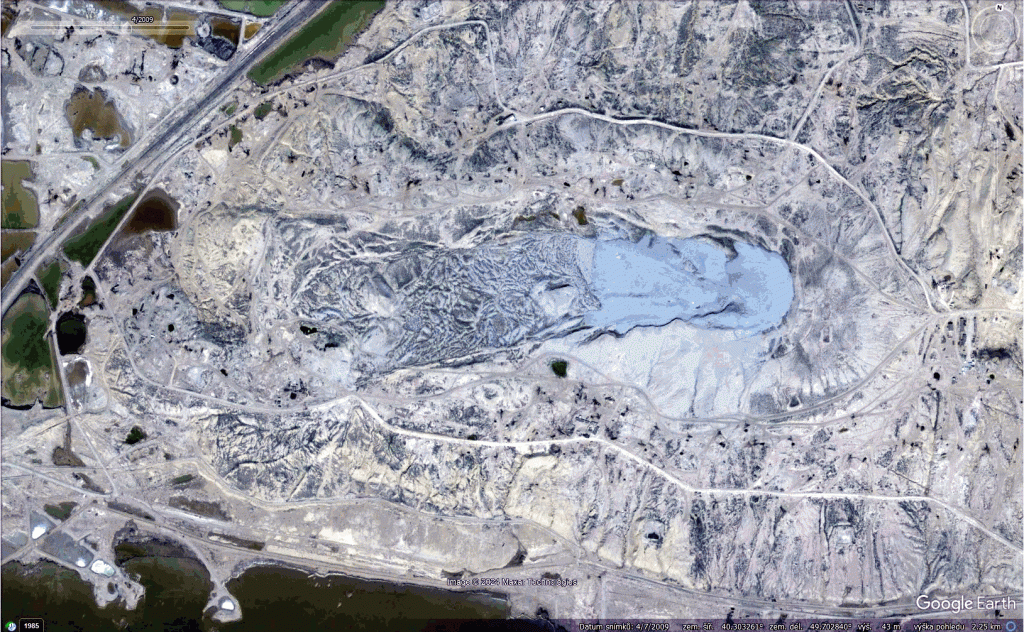
Animation 1: Animation based on Google Earth satellite imagery showing the gradual downslope movement of the Lokbatan mud flow over individual years following the emplacement of relatively small volumes of freshly erupted mud near the crater area.
According to the researchers, each eruption deposits a new layer of mud around the crater area. Even when the erupted volumes are relatively small, the added weight appears sufficient to reactivate older deposits resting on a weak, water-rich subsurface layer. In this respect, freshly erupted mud behaves much like newly fallen snow on a glacier, adding mass that gradually drives the movement of older parts of the flow.
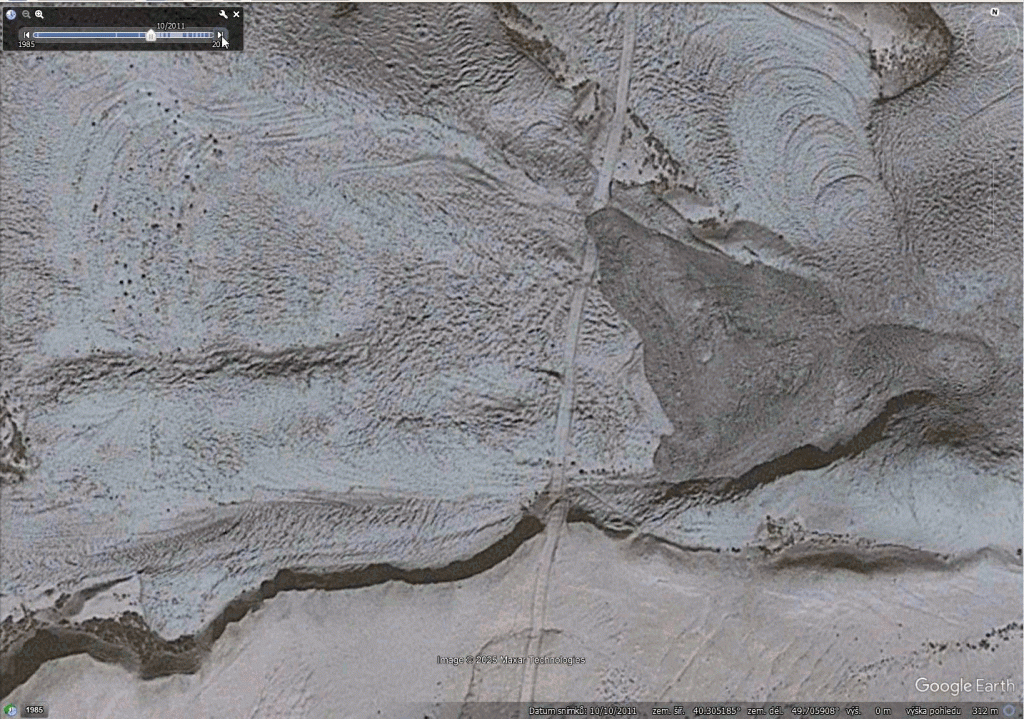
Animation 2: Detailed view of the crater surroundings showing the eruption of mud and the subsequent movement of the mud flow.
The team combined repeated field surveys with satellite observations and electrical resistivity tomography, which revealed the presence of a conductive layer roughly 25 meters beneath the surface. The researchers interpret this layer as a lubricating horizon that facilitates the gradual sliding of the mud flow.
“At Lokbatan, we combined direct field measurements with satellite radar observations capable of detecting ground movements with centimetre-scale precision. Both approaches consistently showed that the old mud flow remains active and continues to move. Rather than being the relic of a single catastrophic eruption, it represents a dynamic system that can be repeatedly reactivated by new eruptions over many years or even decades,” explained Michal Břežný from the University of Ostrava.
Not just Lokbatan
The newly identified mechanism is likely not restricted to a single site.
“We recently analyzed several dozen mud volcanoes across Azerbaijan and identified at least nineteen sites showing similar creeping movements of older mud flows,” said Caroline Fenske from the Institute of Geophysics of the Czech Academy of Sciences. “In some cases, these flows move by several metres to even tens of metres per decade. Lokbatan therefore appears not to be an exception, but rather an example of a much more widespread process that has largely escaped scientific attention. The findings could significantly change how we understand the long-term evolution of large mud volcanoes and the geological hazards associated with them.”
The results also demonstrate that Azerbaijan represents a remarkable natural laboratory for studying mud volcanism, surface deformation, and landscape evolution. At the same time, they highlight a previously underappreciated geological hazard. Many mud volcanoes occur in close proximity to oil and gas fields, roads, pipelines, and other infrastructure. If old mud flows can continue creeping across the landscape for decades, their movement may pose a long-term threat to the stability of such structures and should be considered in future monitoring and planning efforts.
The study, titled “Mud volcanism and creepy mud flows: a new model”, combines expertise from researchers in Norway, the Czech Republic, Switzerland, France, Italy, and Azerbaijan.
Contact:
Dr. Adriano Mazzini
email: adriano.mazzini@geo.uio.no
Dr. Petr Brož
petr.broz@ig.cas.cz
Link to the study:
Link to visual materials:
https://drive.google.com/drive/folders/1pmlaaAE1IOgNm6QVEuneYWNm0O9U7DwF?usp=sharing