Просмотр новости
Найдите то, что Вас интересует
 Спутники
 РН
РН SpaceX
 Роскосмос
 NASA
NASA
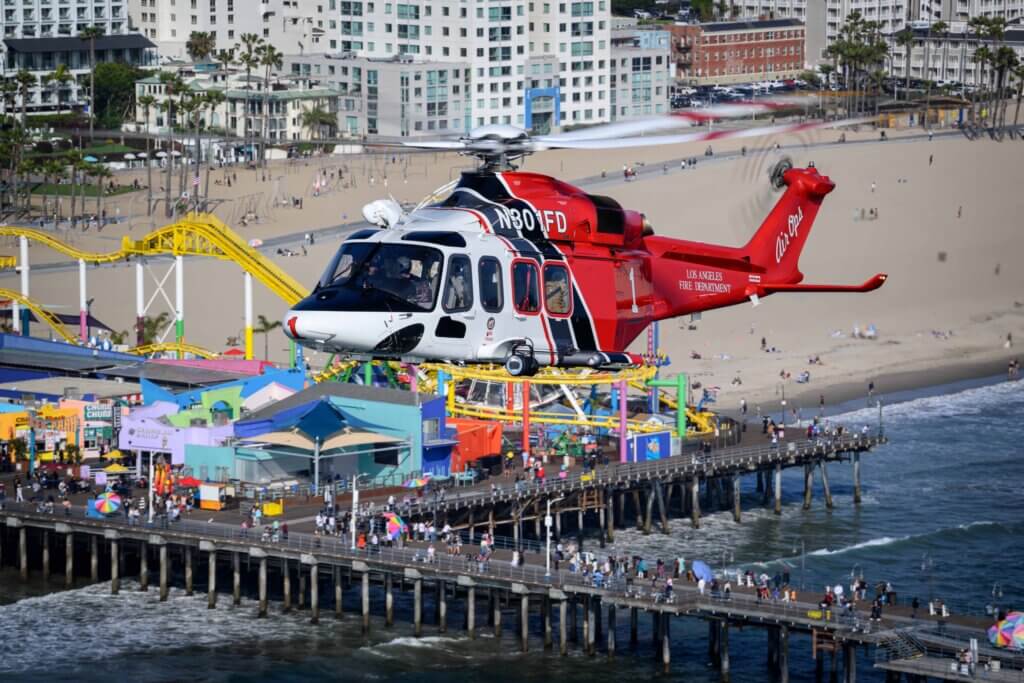
СпутникиРНSpaceXРоскосмосNASALos Angeles Fire Department’s AW139 crews are multi-mission specialists and fire experts. Their mix of skills is both their greatest strength and one of their biggest challenges.
The post Inside LAFD air operations: The AW139 crews battling California’s biggest wildfires appeared first on Vertical Mag.
The Santa Ana winds originate in the Great Basin as cool, high-pressure air flows down-slope across California, heating up along the way. Their demure name belies the fact that they can reach hurricane-force. Bone-dry, and blowing across the tinderbox of the chaparral brush, they have earned another name: the devil winds.
In early January 2025, after eight months of drought, the devil winds started gusting at up to 90 miles per hour (145 kilometers per hour).
It was these conditions that enabled a brush fire in the vicinity of the Pacific Palisades neighborhood of western Los Angeles to grow from 20 to 200 acres in 20 minutes. And it was these conditions that the LA Fire Department Air Operations crews launched into.
Those crews belong to a single small unit based at Fire Station 114 in Van Nuys Airport, flying the Leonardo AW139. When a fire the size of the Palisades takes hold, every member swings into action.
“We didn’t stop turning the rotors for five days straight, day and night, 24 hours,” said Joel Smith, a “Pilot 3” with the Los Angeles Fire Department Air Operations. As a Pilot 3, he is fully mission command qualified, and he is also the unit’s safety pilot, responsible for flight safety compliance and culture.
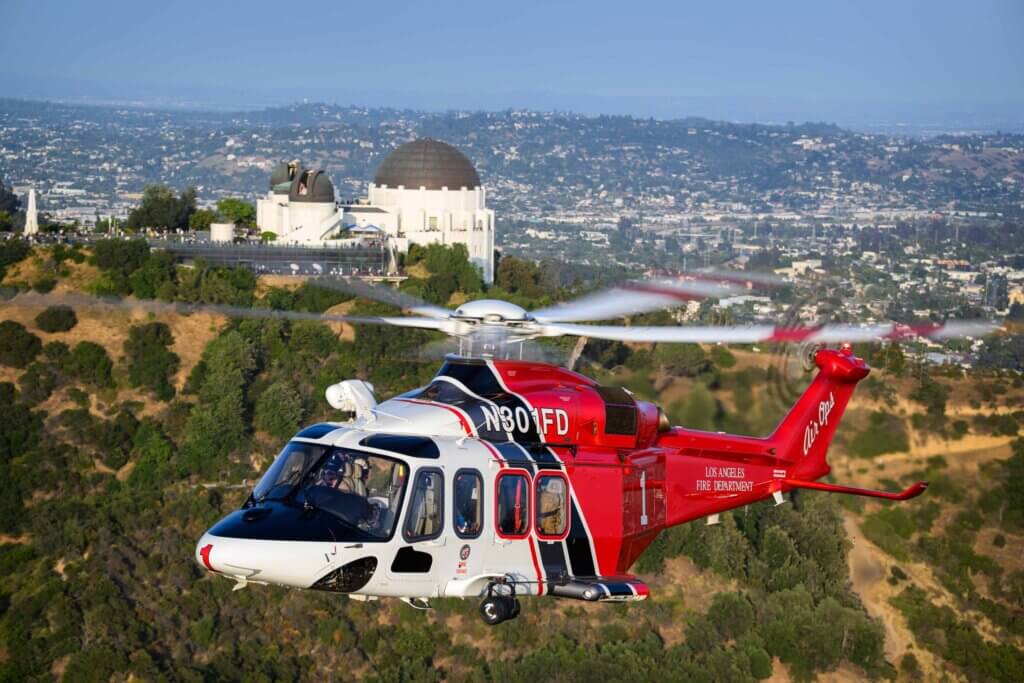 Lloyd Horgan Photo
With fires demanding such a high operational tempo, things like scheduled maintenance become a matter of perfect timing.
“We’ll call maintenance and say, ‘Hey, we have a fire, we’re bumping up against a maintenance time,’ “ explained Smith. “They’ll get those guys over here, we’ll shut it down, they do their quick inspection, and we are back up and out.”
That tempo is written into their response.
“For every brush fire, the city requires us to put three water-dropping helicopters out the door,” said Smith. “So that’s why you see a full hangar.”
While firefighting is what is literally written on the aircraft, the same airframes and crews cover a wide variety of work that guarantees they stay busy — and aircraft utilization stays high.
“If you think of anything that you can do with a helicopter, we do it here,” said Smith. “We do firefighting. We do hoist rescues. We pick up people that injure themselves hiking or mountain biking, through snake bites, and we do swift water rescues.”
On occasion, the aircraft are used to long-line horses that have fallen or become trapped.
“We can re-outfit the aircraft in a matter of minutes,” said Dustin Hurwitz, a firefighter paramedic and aeromedic with the unit. “From an air ambulance [to firefighting] to a troop transport, or whatever we need.”
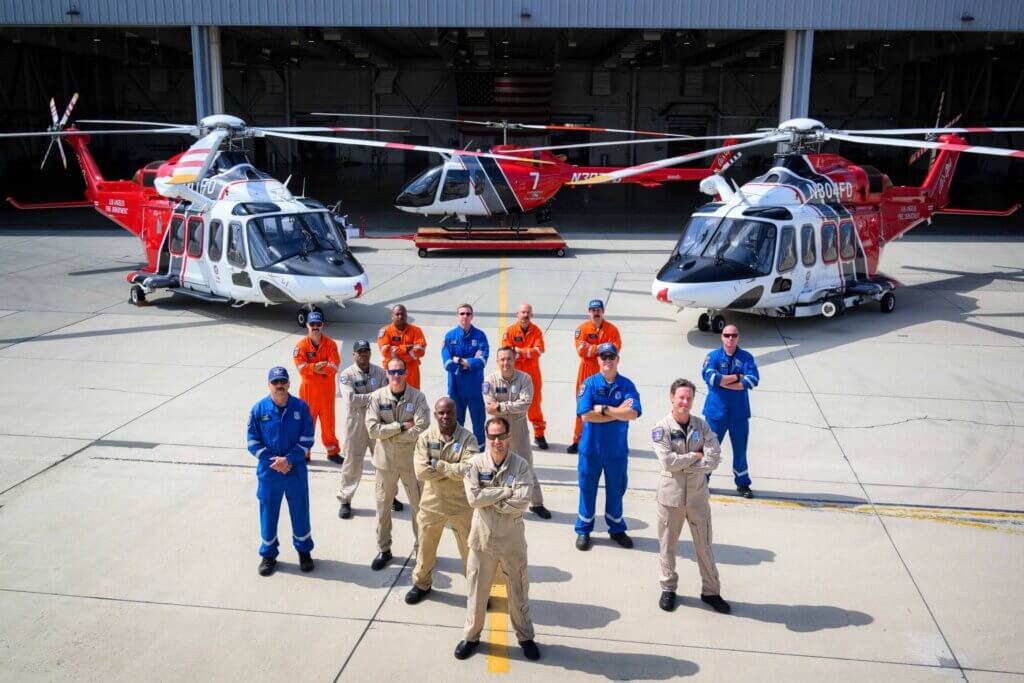 Lloyd Horgan Photo
With such an emphasis on lifting things, it’s little wonder that LAFD Air Ops selected a relatively large helicopter, but firefighting in close quarters comes with unique safety considerations that also influence the choice of platform.
“What the AW139 does really well is that it doesn’t produce a ton of downwash when we’re over a fire, so we’re not fanning the flames into unburned brush,” said Smith. “If I had 1,000 gallons, 1,500 gallons of water, and I’m dropping it that close to my crew on the ground, you could potentially kill somebody. With this, we typically can get in a little closer and safer.”
Like most modern twins, safety margin is designed in. Certified as a Category A helicopter, the AW139 must be capable of safely continuing flight in specific circumstances with one engine inoperative.
“The Category A capability when our guys are hoisting, we have that reliability, that if we have a problem with one of the engines, that aircraft’s going to stay with us,” said chief pilot Dan Child. “And we’ll be able to retract our guy off the hoist cable, get him back in the aircraft, and fly away.”
To preserve that contingency, the aircraft all-up mass must be below a certain limit, so weight needs to be saved wherever it can. That includes in the cockpit.
“We’re one of the rare units … that fly this aircraft single pilot,” said Smith, except during marginal weather or high-workload night missions. “The workload can get pretty high, but the way we train is that if your workload is really, really high, slow down.”
This approach requires not only discipline and self-awareness, but also early cues from the aircraft when it is approaching the edges of its own envelope.
“It’s built well and it’s very good at telling you what it does like and what it doesn’t like,” said Smith. “For example, it does not necessarily like crosswinds. It’ll tell you, it leans pretty hard to one side.”
While the pilots focus on getting maximum performance out of their aircraft, the AW139’s size enables it to get the maximum performance from the rest of the crew — principally by giving them the space to operate.
“It’s very similar to a large ground ambulance,” said Matthew Carter, a firefighter paramedic. “We’re not cramped like you are maybe in a different aircraft that’s very confined.”
Having this amount of space makes room for the three crewmembers that LAFD Air Ops typically flies with in the aircraft cabin. Two are firefighter paramedics: one who will be hoisted to the scene, and the other as a safety member. The third is a crew chief who operates the hoist itself.
Investing in peopleJust to be eligible to join the Air Operations team requires specialist skills, and LAFD invests in their development.
“Our department offers the opportunity for EMTs [emergency medical technicians] that would like to go to paramedic school, to go,” said Carter. “They pay for the school, they give you the time off to go and get educated, then come back and act as a paramedic.”
Once trained, the firefighter paramedics have a combination of skills that enable them to be deployed to complex scenes in difficult environments.
“We have a ventilator on the helicopter that the rest of the department doesn’t have,” said Hurwitz. “There are a couple of treatments that only we are allowed to do here.”
However, the combined nature of the work and the limitations in access and backup mean expectations are high.
“You’re the guy. You’re on the ground by yourself, doing the problem solving,” said Hurwitz. “I don’t have the luxury of four fire engines and a couple of trucks there to help do all the heavy lifting. You’re it.”
Every single firefighter paramedic is, perhaps unsurprisingly, required to be a firefighter before they train as a paramedic. The firefighter cadre also serves as the sole recruitment pool for LAFD pilots, and prospective candidates are expected to show both dedication to their profession and investment in themselves.
“You serve the city as a firefighter for at least four years before you’re eligible,” said Smith. “To get here as a pilot, you need 100 hours of helicopter time and a private pilot certificate, along with your four years on the job.”
This unique progression system makes LAFD Air Operations teams unusually flexible in terms of crew composition.
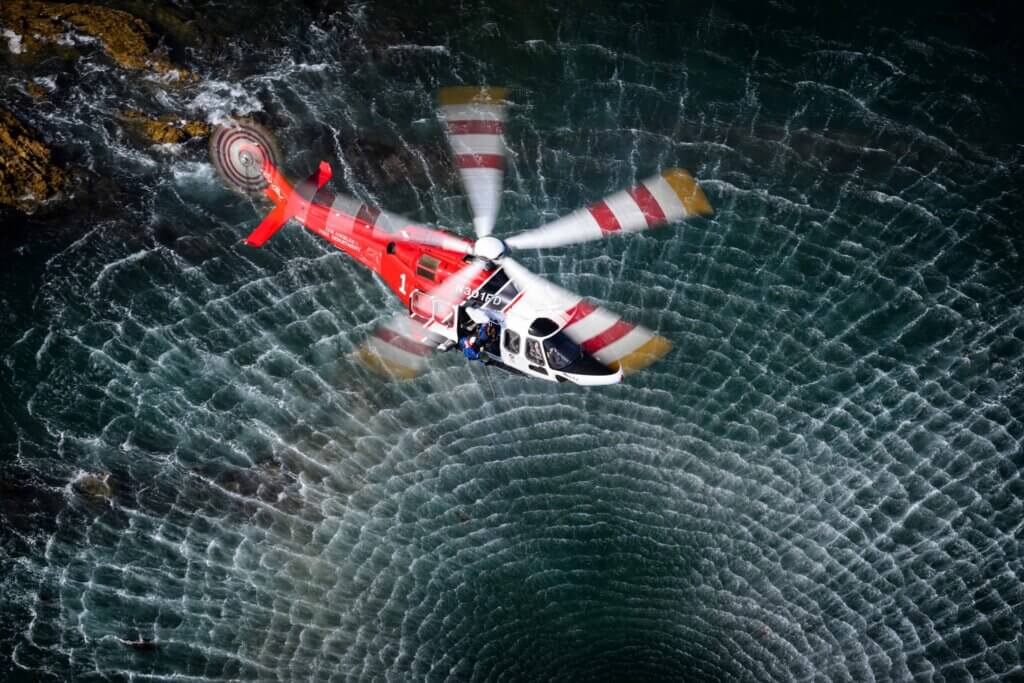 Lloyd Horgan Photo
“You start out as a rescuer, you go to the safety member, which is a cabin crew safety, and then you go to hoist operator,” said Smith. “So all of our pilots here are certified in all three positions in the back.”
Once selected, pilot trainees benefit from a training partnership with the LAPD, before cutting their teeth in one of the department’s two Bell 505s as a “Pilot 1.”
“The other helicopter we use is the Bell 505 Jet Ranger,” said Smith. “We use that primarily for our trainees, learning the old stick and rudder skills, autorotations, landing in very tight spots.”
The department’s 505 is also used as its “HELCO” platform, directing firefighting efforts. This is not a job for the new recruits. Instead, pilots leaving training go to Leonardo’s factory in Philadelphia where they achieve their type rating and “Pilot 2” status, before being qualified in all aspects of mission command and single-pilot operation as a Pilot 3.
It is a long apprenticeship, after which they are still expected to be able to fulfill the roles in the back of the aircraft. Everyone in the machine is expected to stay on top of their game, and that requires constant practice with very little tolerance for time “out of the seat.”
“All the things we do here, I would call perishable skills,” said Carter, summing up the challenge. “You train, you keep that knife blade sharp. All it takes is a little bit of time not doing it, and those things fade away pretty quick.”
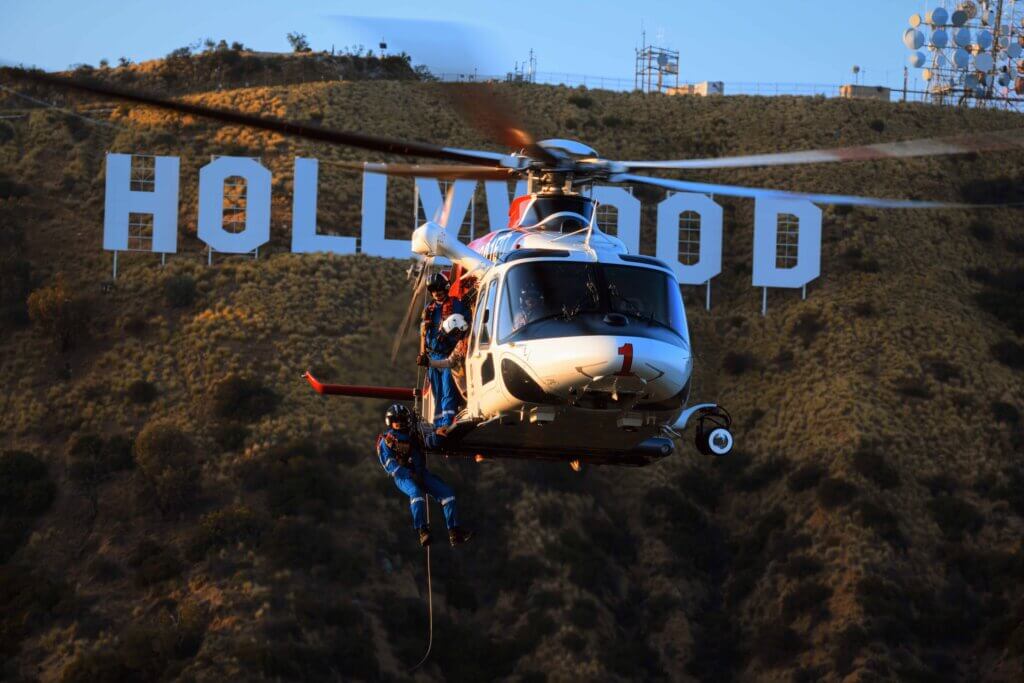 Lloyd Horgan Photo
Putting practice into action
Lloyd Horgan Photo
Putting practice into action
When a large fire starts, it is a small team that is expected to respond with everything they have.
“If we’re at home on a rest day, we [could] get a phone call: ‘Hey, we’ve got a big fire, all hands on deck,’ “ said Smith.
At this point, the time for training and preparation is over, and the challenge becomes logistical, as it did when the team was mobilized in response to the Palisades fire.
“When that whole thing kicked off, as we recalled all the pilots, we also had to recall ground support, which included all our Helitac guys,” said Child. “Now we’ve got to start staffing and sleeping people here. It’s a lot of bodies, and we start working on rotation. We have to sleep here, we have to feed everybody.”
Contrary to popular perception, it is rare for a fire to be fully extinguished from the air. Most wildfires instead must be physically fought on the ground, cut and dug out to eliminate the chance of later reignition. LAFD’s Helitac team are all drawn from the LAFD Air Operations’ sister unit — Fire Station 90 — collocated at Van Nuys. Like their aviator colleagues, they must hold down multiple qualification both across regular firefighting duties and in specialist techniques that enable them to be deployed from the helicopters into close contact with the fire, and then in close coordination with the aircraft. As with the aircrew, the routine on major fires is punishing for such a small, specialized team.
 Lloyd Horgan Photo
“The Palisades was my first long campaign fire here,” said Taylor Rappaport, an engineer paramedic assigned to Fire Station 90 and one of the unit’s Helitac members. “To go for basically three weeks straight, 10 hours a day, it was a lot. It was extremely taxing on everybody, mentally and physically. You are just turned on, completely focused the whole time.”
Both logistical insight and engineering foresight are required to keep the team sustained and the aircraft maintained for that length of time. But beyond this is the challenge of balancing and managing the human fatigue that comes with operating at that tempo for such an extended period. There are no natural pauses in wildfires, and human beings are notoriously poor at estimating their own fatigue.
The team at LAFD Air Operations depend on one another to gauge when is the right time to change crews.
“We’re like brothers,” said Cherif Amin, a Pilot 3 with the unit. “When a guy needs a break, you can tell someone’s tired or has had a rough day or night.”
Shared formative experience as firefighters is a large part of what enables this approach to mutual fatigue management. But it is also what contributes to the need for it. With such a small pool from which to draw recruits, LAFD Air Operations faces a dilemma. Despite reducing the amount of training that pilot candidates are expected to self-fund, the rising cost of basic flight training threatens their ability to attract recruits from within their ranks.
“To become a pilot here, you have to get your pilot’s license on your own,” said Amin. “Back in the days before today’s requirements, they required you to have 500 hours. Now it’s just 100. In order to build that time, it’s very expensive.”
Conversely, recruiting pilots from outside their organization would pose a challenge not only in terms of culture and career progression for those already in the pipeline, but also with very real operational drawbacks.
“If I were hired here from outside, from some other part of the country, I wouldn’t understand the culture that we have here as firefighters for the city of Los Angeles,” said Smith. “It feels like home to us.”
The land and the property that the crews of LAFD Air Operations fight to defend from the forces of nature are their own. But the fires are not getting any smaller and the seasons are becoming ever longer.
When the Palisades fire raged, the people of Los Angeles could depend on the fact that a small but uniquely flexible team would assemble; any member able to fulfil almost any task, all with an expert’s knowledge about how fires, and each other, work.
Producing those skills and capabilities requires novel approaches to recruitment, selection, and training. But sustaining them into the future will require even more.
| # | Наименование новости | Тональность | Информативность | Дата публикации |
|---|---|---|---|---|
| 1 | Smoke and yaw: Lessons from the 2017 LAFD AW139 firefighting accident | 0 | 14.75 | 16-07-2026 |
| 2 | Modern wildfire response depends on layered aerial firefighting | 0 | 7.44 | 13-07-2026 |
| 3 | How longer fire seasons are reshaping helicopter maintenance | 0 | 7.92 | 01-07-2026 |
| 4 | Smarter suppression: How helicopter tech aids the fight against wildfires | 0 | 9.18 | 07-07-2026 |
| 5 | Night vision: Welcome to the dark side of aerial firefighting | 0 | 7.5 | 09-07-2026 |
| 6 | Sikorsky Black Hawk: Born for battle, built for fire | 0 | 6.75 | 06-07-2026 |
| 7 | Inside Florida’s effort to bring public safety aviation together before disaster strikes | 0 | 6.03 | 17-06-2026 |
| 8 | Virginia State Police Aviation Division is a lifeline from above | 0 | 5.43 | 29-07-2026 |
| 9 | Florida Air Ops: How Aviation Crews Prepare for Hurricane Season | 0 | 5.91 | 26-05-2026 |
| 10 | MAFFS aircraft deployed in support of fighting wildfires | 0 | 5.39 | 17-07-2024 |