Просмотр новости
Найдите то, что Вас интересует
 Спутники
 РН
РН SpaceX
 Роскосмос
 NASA
NASA
СпутникиРНSpaceXРоскосмосNASAProduction of this potent greenhouse gas is triggered by a newfound feature of these microbes — one with a funny name: hydrogenobody.
Cows belch a lot of methane, a potent greenhouse gas. But it’s not their fault. Scientists have identified a new trigger for the process. It resides in some microbes that live in the cows’ guts.
This tiny organelle appears to help control how much of this greenhouse gas the cows burp out.
@scientificamericanNotoriously, cows burps are rather potent — a single cow can burp out as much as 220 pounds of methane a year. And scientists just identified the special structure inside microbes in their gut that is responsible for all that methane. It’s called a hydrogenobody. Read more at the 🔗 in our bio. 📝🎤: Jackie Flynn Mogensen 🎥: Kelso Harper 🎞️: Marta Hill 📷: Getty Images, Chuanqi Jiang/Jinying He/Che Hu/Institute of Hydrobiology, Chinese Academy of Sciences Fei Xie et al.,Rumen ciliates modulate methane emissions in ruminants.Science392,eadv4244(2026).DOI:10.1126/science.adv4244 #cows #methane #science #climate #greenhousegases
♬ original sound – Scientific American – Scientific American
Some 30 percent of methane produced by farming comes from cud-chewing animals, or ruminants. These include cattle, sheep, goats and deer.
Like organs in the body, a cell’s organelles perform specific roles. The new organelle was found in fuzzy, single-celled ciliates (SIL-ee-ets). These microbes belong to a group known as protozoa.
Ciliates get their name from the hairlike structures — cilia — that help these cells move and sense their environment. These tiny furballs make up about one-fourth of all microbes living in the rumen. That’s the first stomach of cud-chewing animals. There, these microbes help break down grass and other plants.
The new organelle makes hydrogen gas. So its discoverers are calling it a hydrogenobody (Hy-droh-GEN-uh-BAH-dee). The hydrogen it spews causes still other microbes in the rumen to produce methane.
To date, ciliates haven’t been studied much, says Ivan Čepička. He works at Charles University in Prague in the Czech Republic. He did not take part in the new research, but does study microbes, including protozoa.
Researchers in China have now cataloged DNA from ciliates found in ruminants. They’ve turned up 65 species, 45 never before identified.
These new species fell into three major groups. One type, Vestibuliferida, look like microscopic Koosh balls. Entodiniomorphida’s cilia develop appear like a shock of hair coming out of just one part of their cell. The third type of these microbes remains an unclassified family.
Tiny microbes, big impactSome organisms that make hydrogen can prompt other microbes — archaea (Ar-KEE-uh) — to make methane. But those hydrogen-makers usually have organelles called hydrogenosomes (Hy-droh-GEN-uh-soams). They’re related to another organelle that makes energy.
But hydrogenosomes had not shown up in ciliates. So how rumen ciliates made hydrogen had been a mystery, Čepička says. The new study seems to have solved it: That gas comes from the hydrogenobodies. They’re located at the base of the structures that make ciliates look so fuzzy.
Researchers at the Chinese Academy of Sciences in Wuhan and several Chinese universities reported the surprising finding April 30 in Science.
The group had studied 100 dairy cows. The more ciliates these cattle had, the more methane-producing archaea they had. And the more methane-making archaea present, the more methane the cows belched.
Among ciliates, the Vestibuliferida are especially furry and have more hydrogenobodies. They also spew more methane than Entodiniomorphida.
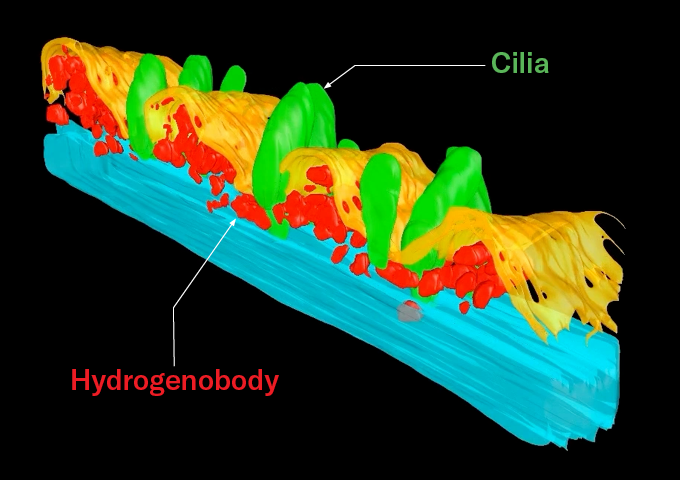 Hydrogenobodies appear red in this 3-D reconstruction of a slice of a protozoa cell in cud-chewing animals. Hydrogenobodies cluster at the base of hairlike cilia (green) just under the cell membrane (yellow). The more cilia protozoa have, the more hydrogen they make — and the more methane other gut microbes will spew. Chuanqi Jiang, Jinying He, and Che Hu/Institute of Hydrobiology/Chinese Academy of Sciences, adapted by B. Price
What’s next?
Hydrogenobodies appear red in this 3-D reconstruction of a slice of a protozoa cell in cud-chewing animals. Hydrogenobodies cluster at the base of hairlike cilia (green) just under the cell membrane (yellow). The more cilia protozoa have, the more hydrogen they make — and the more methane other gut microbes will spew. Chuanqi Jiang, Jinying He, and Che Hu/Institute of Hydrobiology/Chinese Academy of Sciences, adapted by B. Price
What’s next?
One way to cut the methane in cow burps might be to remove Vestibuliferida from their rumen, the team suggests. It might also be possible to just curb the microbes’ growth.
People have tried to wipe out ciliates from the rumen, notes Todd Callaway. When they did, he adds, they saw a drop in how much methane cows make. But there was a downside, he adds: Cows with fewer ciliates produced less milk and meat. Callaway is a microbiologist and ruminant nutritionist. He works at the University of Georgia in Athens.
Keeping protozoa out of the rumen is hard, Callaway says. Cattle must be isolated in sealed barns. Their feed must be microbe-free. And they need to be kept at least 200 meters (660 feet) from other cattle. At that distance, the ciliates would no longer spread between cattle through the air.
Learning more about ciliates might lead to techniques that cut a cow’s methane burps while keeping her milk and muscle (meat) levels high.
Any such treatments are still a long way off, Callaway says. “This is step one of probably 25. But it’s a good step.”
agriculture: The growth of plants, animals or fungi for human needs, including food, fuel, chemicals and medicine.
archaea: (singular: archaeon) One of the three domains of life on Earth. This group consists of single-celled prokaryotes — organisms without a cell nucleus. Archaea are best known for living in extremely harsh environments, such as very salty water or highly acidic or hot places.
cattle: Also known as bovines (because they’re members of the subfamily known as Bovinae), these are breeds of livestock raised as a source of milk and meat. Although the adult females are known as cows and the males as bulls, many people refer to them all, generally, as cows.
cell: (in biology) The smallest structural and functional unit of an organism. Typically too small to see with the unaided eye, it consists of a watery fluid surrounded by a membrane or wall. Most organisms, such as yeasts, molds, bacteria and some algae, are composed of only one cell.
cilia: (singular cilium) Small hairlike features that occur on the surface of some cells and larger tissue structures. They can move and their wavelike motion can propel liquids to move in a particular direction. Cilia play an important role in many biological functions throughout the body.
dairy: Containing milk or having to do with milk. Or a building or company in which milk is prepared for distribution and sale.
DNA: (short for deoxyribonucleic acid) A long, double-stranded and spiral-shaped molecule inside most living cells that carries genetic instructions. It is built on a backbone of phosphorus, oxygen, and carbon atoms. In all living things, from plants and animals to microbes, these instructions tell cells which molecules to make.
family: A taxonomic group consisting of at least one genus of organisms.
greenhouse gas: A gas that contributes to the greenhouse effect by absorbing heat. Carbon dioxide is one example of a greenhouse gas.
gut: An informal term for the gastrointestinal tract, basically the stomach and intestines. These organs digest — break down — foods and absorb their nutrients for use by the body.
hydrogen: The lightest element in the universe. As a gas, it is colorless, odorless and highly flammable. It’s an integral part of many fuels, fats and chemicals that make up living tissues. It’s made of a single proton (which serves as its nucleus) orbited by a single electron.
methane: A hydrocarbon with the chemical formula CH4 (meaning there are four hydrogen atoms bound to one carbon atom). It’s a natural constituent of what’s known as natural gas. It’s also emitted by decomposing plant material in wetlands and is belched out by cows and other ruminant livestock. From a climate perspective, methane is 80 times more potent than carbon dioxide is in trapping heat in Earth’s atmosphere, making it a very important greenhouse gas.
microbiologist: A scientist who studies microorganisms, the infections they might cause or ways that they can interact with their environment.
organ: (in biology) Various parts of an organism that perform one or more particular functions. For instance, an ovary is an organ that makes eggs, the brain is an organ that makes sense of nerve signals and a plant’s roots are organs that take in nutrients and moisture.
organelle: Specialized structures, such as mitochondria, found within a cell.
organism: Any living thing, from elephants and plants to bacteria and other types of single-celled life.
potent: An adjective for something (like a germ, poison, drug or acid) that is very strong or powerful.
protozoa: (sing: protozoan) Any of many types of single-celled organisms, most of them too small to be seen with the unaided eye. They include amoebas, paramecia and many others. Some can cause disease in humans and other animals.
rumen: The first and largest part of a cow or steer’s four-part stomach. It’s where microbes break down fiber into nutrients that the animal can use.
species: A group of similar organisms capable of producing offspring that can survive and reproduce.
Tina Hesman Saey is a senior staff writer and reports on molecular biology at Science News. She has a Ph.D. in molecular genetics from Washington University in St. Louis and a master’s degree in science journalism from Boston University.
| # | Наименование новости | Тональность | Информативность | Дата публикации |
|---|---|---|---|---|
| 1 | Microbes that dwell in tree bark devour major climate gases | 0 | 10.4 | 04-03-2026 |
| 2 | Ученые создали катализатор для превращения воздуха в топливо | 0 | 8.92 | 27-07-2026 |
| 3 | Microbes turn CO₂ into protein and vitamin B9 at commercially viable prices | 0 | 10.76 | 12-08-2026 |
| 4 | Only 10 viral particles cause H5N1 avian flu infection in cows | 0 | 7 | 15-06-2026 |
| 5 | Dormant microbes from Ötzi the Iceman’s body can grow in the lab | 0 | 9.78 | 23-07-2026 |
| 6 | Российские ученые нашли способ получить топливо из воздуха | 0 | 4.44 | 27-07-2026 |
| 7 | How H5N1 bird flu hid unrecognized for weeks in dairy cattle | 0 | 8 | 19-06-2026 |
| 8 | U.S. and Mexico Unveil A New Weapon To Fight Screwworm, the Parasite Threatening Cattle Herds | 0 | 11.13 | 13-07-2026 |
| 9 | Ferngesteuerte Kakerlaken laufen mit „Taucheranzug“ unter Wasser | 0 | 5 | 01-07-2026 |
| 10 | Scientists develop diving suits for cyborg cockroach swarms - and it could enable them to explore Mars | 5 | 7 | 05-07-2026 |