Просмотр новости
Найдите то, что Вас интересует
 Спутники
 РН
РН SpaceX
 Роскосмос
 NASA
NASA
СпутникиРНSpaceXРоскосмосNASAA UT San Antonio researcher warns that dementia cases could triple by 2050 and that no health system on earth is ready for it. But Dr. Claudia Suemoto says the outlook isn't hopeless: everyday choices around exercise, diet, and community can meaningfully lower your risk, especially if you start by around age 35.

Published July 19, 2026 at 10:00 AM CDT

The University of Texas at San Antonio
By 2050, the number of people with dementia worldwide is expected to triple, and according to UT San Antonio Claudia Suemoto, MD, PhD, MSc, there's no way to prepare for it.
"There is a very beautiful study published in Nature in 2008 that says that the wealth of a nation is related to its cognitive reserve," she explained, "and no country on earth — it doesn't matter how rich they are — has a health system prepared to have a lot of older people with dementia."
Suemoto is a professor in the Department of Quantitative and Qualitative Health Sciences at the Kate Marmion School of Public Health at UT San Antonio and is cross-appointed to the Glenn Biggs Institute for Alzheimer's and Neurodegenerative Diseases. She is studying ways to reduce that number before the explosion occurs.
"We have non-modifiable risk factors like sex, race, and genetics that we cannot change. But we have a bunch of modifiable risk factors that we can change," Suemoto explained. She is building a map of modifiable risk factors for dementia specific to South Texas. She is also offering solutions. For example, she says making San Antonio a more walkable city would make a big difference.
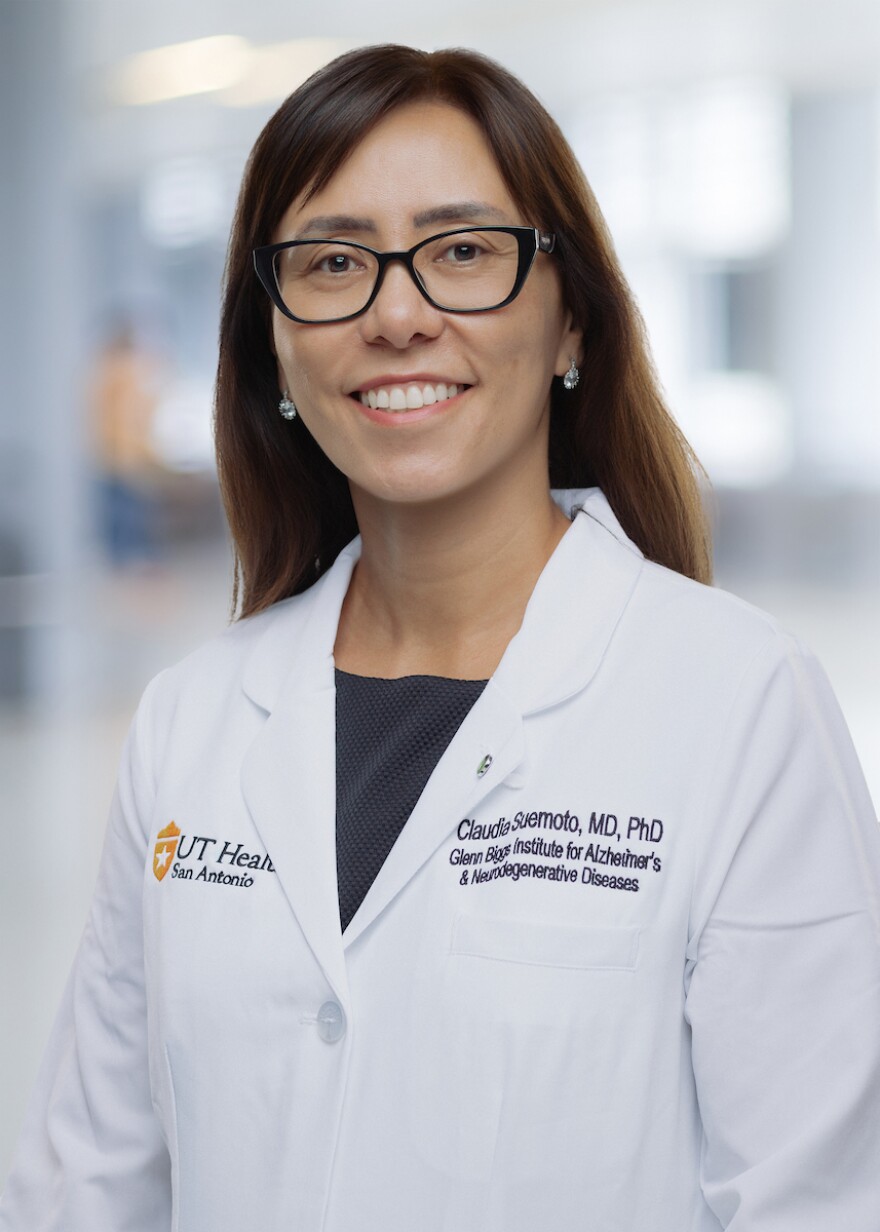
DAVID CONSTANTE
/
UT Health San Antonio
"Through physical exercise, you can control a lot of modifiable risk factors like high blood pressure, cholesterol, and diabetes," she said. "So if the environment is friendly for you to do that, you can improve your health without thinking too much."
Another thing? Stop eating so much ultra-processed food.
"If you consume a lot of food that comes from ultra-processed origins, you're going to have a faster cognitive decline," she said.
People who keep their brains engaged with continuing education or complex jobs also have a reduced risk of developing dementia.
Modifiable factors that increase your risk of developing dementia include being surrounded by polluted air. Being cut off from community and meaningful interpersonal relationships also increases your risk. Suemoto says these risk factors can add up quickly. "And if you have fewer risk factors, you're gonna have less cerebrovascular disease and less Alzheimer's disease."
To have the greatest impact on your cognitive health as you age, Suemoto says you should begin to make these changes at around 35 years old.
"We know that these risk factors, if they are present every day in your life for years, are going to cause brain lesions we associate with Alzheimer's disease," she explained, "and this is going to give you a higher risk of dementia symptoms later in life."
In May, Suemoto was awarded a $500,000 UT System Faculty STARs (Science and Technology Acquisition and Retention) award to invest in additional state-of-the-art equipment that will allow her to more deeply and precisely explore the complex interplay between genetic and environmental factors in the development of dementia.
Science & Medicine is a collaboration between TPR and The University of Texas Health Science Center at San Antonio that explores how scientific discovery in San Antonio advances the way medicine is practiced everywhere.

| # | Наименование новости | Тональность | Информативность | Дата публикации |
|---|---|---|---|---|
| 1 | Almost half of dementia cases could be prevented—but change is needed | 0 | 8 | 03-07-2026 |
| 2 | DM: учёные назвали диету, при которой снижен риск деменции при Альцгеймере | 5 | 7 | 27-06-2026 |
| 3 | Ученые: здоровая сердечно-сосудистая система снижает риск развития деменции | 0 | 0 | 08-08-2019 |
| 4 | Успейте до 50 лет. Три приема, которые отодвинут деменцию на десятилетия | 0 | 9.45 | 12-08-2026 |
| 5 | Деменция не приговор: ученые назвали способ снизить риск болезни | 2 | 6 | 03-07-2026 |
| 6 | Врач назвала привычки, которые реально помогают снизить риск деменции | 0 | 5 | 11-07-2026 |
| 7 | Where you live could shape your dementia risk, massive study finds | 0 | 10.79 | 13-07-2026 |
| 8 | How to Lower Your Risk of Dementia Starting in Middle Age - January 15, 2025 | 0 | 23.33 | 15-01-2025 |
| 9 | Ученые назвали способ предотвратить 45% случаев деменции | 0 | 7 | 08-07-2026 |
| 10 | Россиян предупредили о повышающих риск развития деменции повседневных привычках | 0 | 5 | 04-07-2026 |