Просмотр новости
Найдите то, что Вас интересует
 Спутники
 РН
РН SpaceX
 Роскосмос
 NASA
NASA
СпутникиРНSpaceXРоскосмосNASALargely disconnected from politics, they tilt liberal on economic concerns but not on social issues Tuned-Out Middle are defined largely by their relatively low levels of interest in politics and participation in elections. While they are roughly equally likely to associate with the Republican and Democratic parties, most don’t identify as partisans, and they tend […]
This Pew Research Center study goes beyond Americans’ partisan attachments and vote choices to explore the values and attitudes that underlie the political landscape and the Republican and Democratic parties. We did this by creating a political typology, which classifies the public into nine groups based on their responses to 30 questions about government, economics, immigration, elected officials and other topics. To learn more about this project, jump to “About the political typology.”
Why did we do this?Pew Research Center conducts research to help the public, media and decision-makers understand important topics. We have studied Americans’ political values and attitudes, and their views on politics more broadly, for decades. This is the ninth version of the political typology; the first was conducted nearly 40 years ago.
Learn more about Pew Research Center.
How did we do this?We surveyed 10,357 U.S. adults from Nov. 17 to 30, 2025. Everyone who took part in this survey is a member of the Center’s American Trends Panel. The survey represents the views of the full U.S. adult population. We then used a statistical technique called cluster analysis to divide people into nine groups. (For more on the process of dividing people into groups and surveys used for analysis, jump to Appendix B.)
Here are the survey questions used for this analysis, the detailed responses and the survey methodology.
Tuned-Out Middle are defined largely by their relatively low levels of interest in politics and participation in elections. While they are roughly equally likely to associate with the Republican and Democratic parties, most don’t identify as partisans, and they tend not to hold strong positions on political issues. Just 32% voted in the 2024 election.
 Allie Sullberg
Still, on some issues they tilt in an ideological direction. For instance, majorities express a preference for larger government and support several social welfare policies. But they tend to be more moderate or conservative on issues related to gender identity and sexuality. They are generally moderate on immigration – supporting both border security and a pathway to legal status for those in the country illegally.
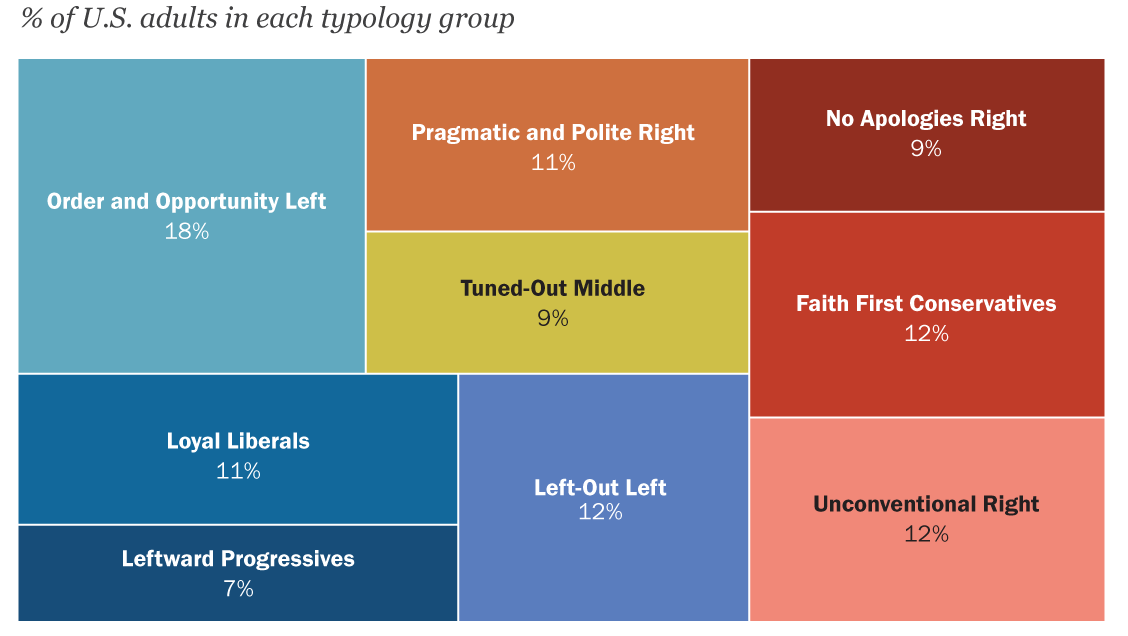
Tuned-Out Middle are one of nine groups in Pew Research Center’s 2026 Political Typology. To learn more about the typology, start with the overview. To find which group is your best fit, take the quiz.
Tuned-Out Middle are:
Pew Research Center’s political typology divides the American public into nine political groups based on responses to 30 questions about people’s social and political values and beliefs.
The goal of this long-standing project is to go beyond partisan leanings or vote choices to provide a deeper understanding of the American political landscape. This is the ninth version of the political typology – the first was conducted nearly 40 years ago.
These questions were asked in a survey of 10,357 U.S. adults conducted Nov. 17-30, 2025, using Pew Research Center’s American Trends Panel – a nationally representative panel of randomly selected U.S. adults.
For more on the cluster analysis process used to create the groups, the questions used, and how we look at data across multiple surveys, visit Appendix B.
Take the typology quiz to find out which political typology group you fit into.
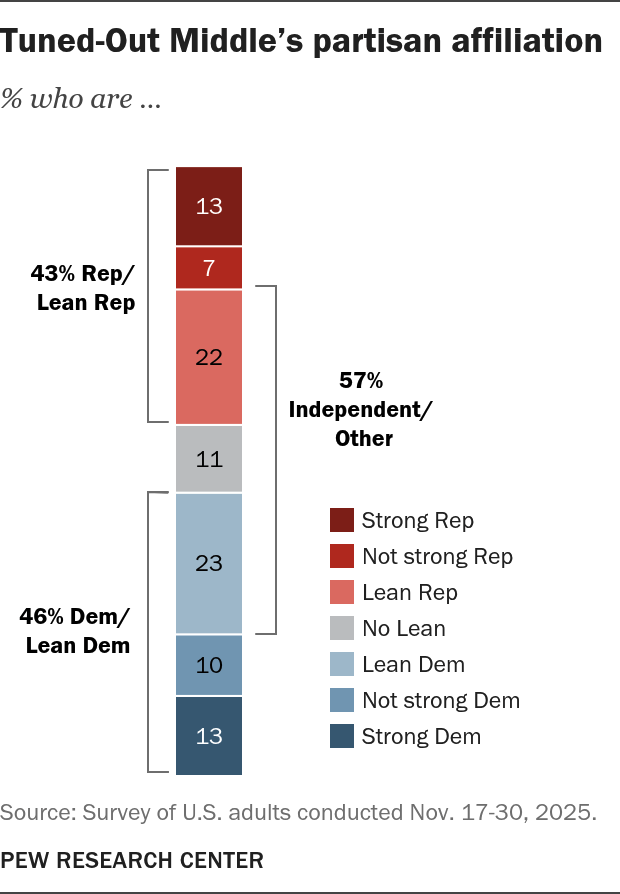
Political affiliation, voting and engagementTuned-Out Middle are closely divided in their political affiliation. Nearly identical shares associate with the Democratic Party (46%) and the GOP (43%).
Tuned-Out Middle’s partisan affiliation
% who are …
Source: Survey of U.S. adults conducted Nov. 17-30, 2025.
PEW RESEARCH CENTER
Tuned-Out Middle’s partisan affiliation
% who are …
| Strong Dem | Not strong Dem | Lean Dem | No Lean | Lean Rep | Not strong Rep | Strong Rep | |
|---|---|---|---|---|---|---|---|
| Tuned-Out Middle | 13% | 10% | 23% | 11% | 22% | 7% | 13% |
Source: Survey of U.S. adults conducted Nov. 17-30, 2025.
PEW RESEARCH CENTER
But most do not have a strong attachment to either party. More than half view themselves as independents or something else, and 11% say they do not lean toward either of the two major parties.
About half (52%) call themselves moderate, with most of the remainder identifying as conservative (31%) rather than liberal (13%).
Tuned-Out Middle are largely disengaged from politics:
Tuned-Out Middle especially stand out from the other typology groups for their low engagement with politics. They are less interested in politics overall and less likely to say there is a great deal of difference in what the parties stand for. They also are more likely to express the view that they feel judged by others because of the language they use to express themselves.
Tuned-Out Middle: Tuning out of politics and the news, but not on key issues
% who say …
| Leftward Progressives | |
| Loyal Liberals | |
| Left-Out Left |
| Order and Opportunity Left | |
| Tuned-Out Middle | |
| Pragmatic and Polite Right |
| Unconventional Right | |
| Faith First Conservatives | |
| No Apologies Right |
They at least sometimes feel unfairly judged because of how they express themselves
They follow the news all or most of the time
There is a great deal of difference in what the Democratic and Republican parties stand for
The government has a responsibility to provide an adequate standard of living
Same-sex marriage is bad for society
Violent crime is a very big problem in the country today
Note: For full question wordings and distributions, refer to the detailed tables. The April 2025 question about government responsibility had a sample size of 114 Tuned-Out Middle, for a margin of error plus or minus 10.4 percentage points at the 95% confidence interval.
Source: Surveys of U.S. adults conducted April 7-13, Aug. 18-24, Sept. 22-28 and Nov. 17-30, 2025, and April 20-26, 2026.
PEW RESEARCH CENTER
Tuned-Out Middle: Tuning out of politics and the news, but not on key issues
% who say …
| Typology group | They at least sometimes feel unfairly judged because of how they express themselves | They follow the news all or most of the time | There is a great deal of difference in what the Democratic and Republican parties stand for | The government has a responsibility to provide an adequate standard of living | Same-sex marriage is bad for society | Violent crime is a very big problem in the country today |
|---|---|---|---|---|---|---|
| Leftward Progressives | 32% | 38% | 55% | 97% | <1% | 18% |
| Loyal Liberals | 20% | 64% | 71% | 86% | 1% | 19% |
| Left-Out Left | 39% | 20% | 45% | 88% | 8% | 43% |
| Order and Opportunity Left | 36% | 32% | 58% | 82% | 22% | 53% |
| Tuned-Out Middle | 54% | 19% | 35% | 74% | 47% | 51% |
| Pragmatic and Polite Right | 23% | 41% | 62% | 58% | 41% | 54% |
| Unconventional Right | 30% | 29% | 59% | 50% | 34% | 45% |
| Faith First Conservatives | 22% | 36% | 77% | 41% | 77% | 57% |
| No Apologies Right | 20% | 57% | 77% | 26% | 55% | 65% |
Note: For full question wordings and distributions, refer to the detailed tables. The April 2025 question about government responsibility had a sample size of 114 Tuned-Out Middle, for a margin of error plus or minus 10.4 percentage points at the 95% confidence interval.
Source: Surveys of U.S. adults conducted April 7-13, Aug. 18-24, Sept. 22-28 and Nov. 17-30, 2025, and April 20-26, 2026.
PEW RESEARCH CENTER
Tuned-Out Middle hold moderate and mixed political values. They modestly favor a larger government and a robust social safety net, which extends to support for programs such as Social Security and government-provided healthcare. But they also hold somewhat conservative views on issues such as same-sex marriage and gender identity.
They tend to fall toward the middle of the political spectrum on many other issues, including climate change, immigration, abortion and foreign policy.
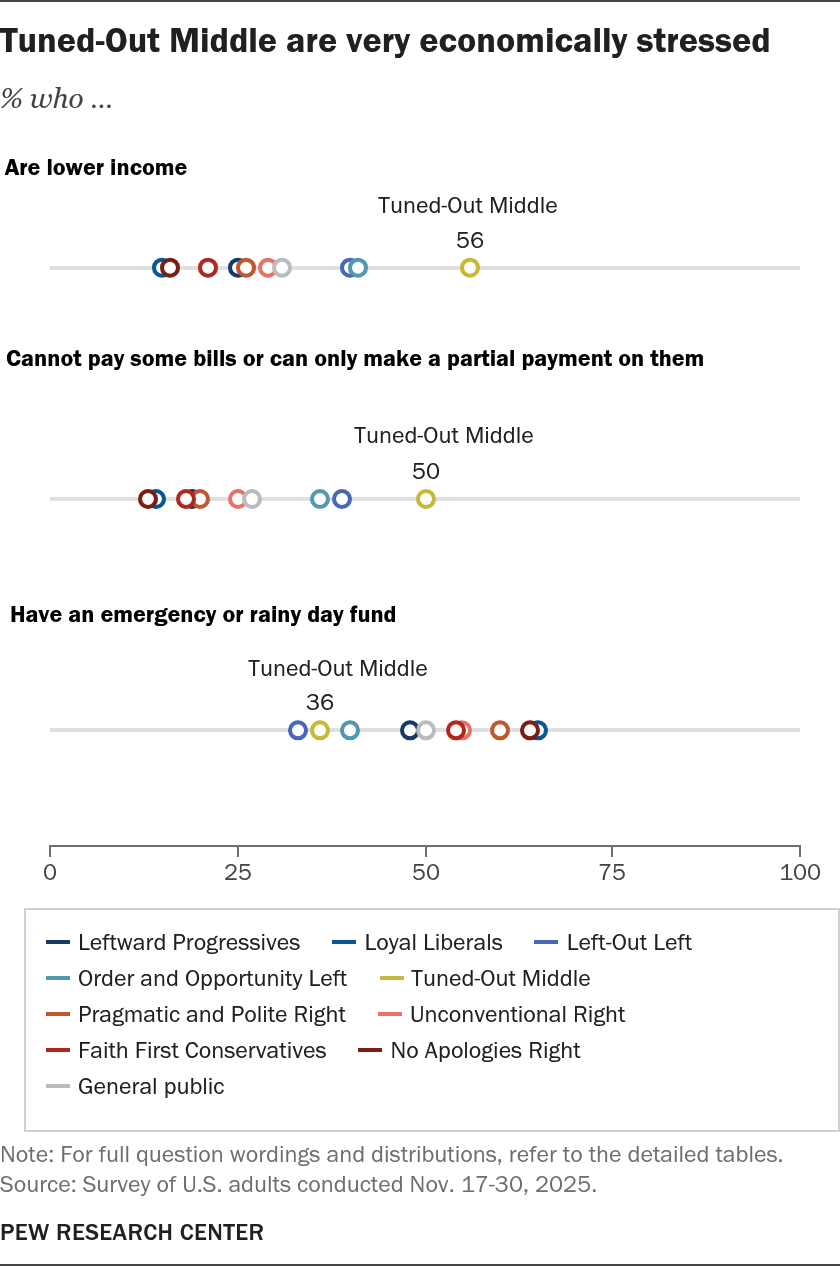
Financially stressedTuned-Out Middle are very economically stressed
% who …
Note: For full question wordings and distributions, refer to the detailed tables.
Source: Survey of U.S. adults conducted Nov. 17-30, 2025.
PEW RESEARCH CENTER
Tuned-Out Middle are very economically stressed
% who …
| Leftward Progressives | Loyal Liberals | Left-Out Left | Order and Opportunity Left | Tuned-Out Middle | Pragmatic and Polite Right | Unconventional Right | Faith First Conservatives | No Apologies Right | General public | |
|---|---|---|---|---|---|---|---|---|---|---|
| Are lower income | 25% | 15% | 40% | 41% | 56% | 26% | 29% | 21% | 16% | 31% |
| Cannot pay some bills or can only make a partial payment on them | 19% | 14% | 39% | 36% | 50% | 20% | 25% | 18% | 13% | 27% |
| Have an emergency or rainy day fund | 48% | 65% | 33% | 40% | 36% | 60% | 55% | 54% | 64% | 50% |
Note: For full question wordings and distributions, refer to the detailed tables.
Source: Survey of U.S. adults conducted Nov. 17-30, 2025.
PEW RESEARCH CENTER
Tuned-Out Middle are one of the most economically strained typology groups:
This group is also among the most doubtful that Americans have a great deal or fair amount of control over how successful they will be financially (48% of Tuned-Out Middle say this).
Jump to the detailed tables to learn more about Tuned-Out Middle and the other typology groups.
| # | Наименование новости | Тональность | Информативность | Дата публикации |
|---|---|---|---|---|
| 1 | Left-Out Left | 0 | 5 | 10-06-2026 |
| 2 | How the political typology groups feel about the Republican and Democratic parties | 0 | 5 | 10-06-2026 |
| 3 | How voting, political participation and news sources differ across political typology groups | 0 | 5 | 10-06-2026 |
| 4 | Beyond Red vs. Blue: The Political Typology | 0 | 7 | 10-06-2026 |
| 5 | Pragmatic and Polite Right | 2 | 6 | 10-06-2026 |
| 6 | Loyal Liberals | 0 | 5 | 10-06-2026 |
| 7 | Order and Opportunity Left | 0 | 5 | 10-06-2026 |
| 8 | Political Typology | 0 | 5 | 10-06-2026 |
| 9 | Democrats and Republicans engage in public life in similar ways | 0 | 6.14 | 16-07-2026 |
| 10 | The political typology illustrates gaps in political values by age, race and ethnicity | 0 | 7 | 10-06-2026 |