Просмотр новости
Найдите то, что Вас интересует
 Спутники
 РН
РН SpaceX
 Роскосмос
 NASA
NASA
СпутникиРНSpaceXРоскосмосNASAModerate in tone and on many issues, with a small-government streak Pragmatic and Polite Right hold a mix of conservative, moderate and somewhat liberal issue positions: They skew more conservative on economics and the role of government, while tilting more liberal on issues related to race and in their orientation to the rest of the […]
This Pew Research Center study goes beyond Americans’ partisan attachments and vote choices to explore the values and attitudes that underlie the political landscape and the Republican and Democratic parties. We did this by creating a political typology, which classifies the public into nine groups based on their responses to 30 questions about government, economics, immigration, elected officials and other topics. To learn more about this project, jump to “About the political typology.”
Why did we do this?Pew Research Center conducts research to help the public, media and decision-makers understand important topics. We have studied Americans’ political values and attitudes, and their views on politics more broadly, for decades. This is the ninth version of the political typology; the first was conducted nearly 40 years ago.
Learn more about Pew Research Center.
How did we do this?We surveyed 10,357 U.S. adults from Nov. 17 to 30, 2025. Everyone who took part in this survey is a member of the Center’s American Trends Panel. The survey represents the views of the full U.S. adult population. We then used a statistical technique called cluster analysis to divide people into nine groups. (For more on the process of dividing people into groups and surveys used for analysis, jump to Appendix B.)
Here are the survey questions used for this analysis, the detailed responses and the survey methodology.
Pragmatic and Polite Right hold a mix of conservative, moderate and somewhat liberal issue positions: They skew more conservative on economics and the role of government, while tilting more liberal on issues related to race and in their orientation to the rest of the world.
 Allie Sullberg
They are also moderate in their style, prizing civility and cooperation. While they are more Republican than Democratic on balance, they are fairly mixed in their partisanship and vote choices.
Pragmatic and Polite Right are one of nine groups in Pew Research Center’s 2026 Political Typology. To learn more about the typology, start with the overview. To find which group is your best fit, take the quiz.
Pragmatic and Polite Right are economically conservative, but not absolutist: They are far more likely than groups to the left to say it’s important for the U.S. economic system to be based on capitalism and to view the economic system as at least somewhat fair. But they are more likely than groups to their right to see economic inequality as a problem in the country and to support raising corporate tax rates.
Pragmatic and Polite Right have moderate to liberal views when it comes to race and diversity. In contrast to groups to their right, clear majorities say the nation’s racial, ethnic and religious diversity strengthens American society, that the legacy of slavery continues to affect the condition of Black people in the country, and that Black, Hispanic and Asian Americans face at least some discrimination.
Pragmatic and Polite Right are:
Pew Research Center’s political typology divides the American public into nine political groups based on responses to 30 questions about people’s social and political values and beliefs.
The goal of this long-standing project is to go beyond partisan leanings or vote choices to provide a deeper understanding of the American political landscape. This is the ninth version of the political typology – the first was conducted nearly 40 years ago.
These questions were asked in a survey of 10,357 U.S. adults conducted Nov. 17-30, 2025, using Pew Research Center’s American Trends Panel – a nationally representative panel of randomly selected U.S. adults.
For more on the cluster analysis process used to create the groups, the questions used, and how we look at data across multiple surveys, visit Appendix B.
Take the typology quiz to find out which political typology group you fit into.
Political affiliation, voting and engagementWhile a 56% majority of Pragmatic and Polite Right associate with the GOP, more than a third (37%) have ties to the Democratic Party.
Pragmatic and Polite Right’s partisan affiliation
% who are …
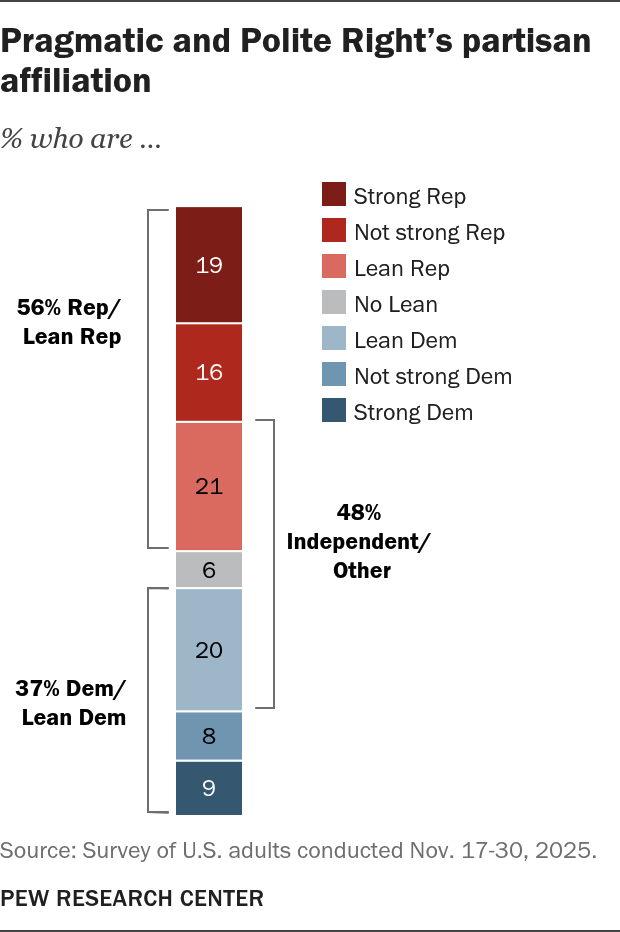
Source: Survey of U.S. adults conducted Nov. 17-30, 2025.
PEW RESEARCH CENTER
Pragmatic and Polite Right’s partisan affiliation
% who are …
| Strong Dem | Not strong Dem | Lean Dem | No Lean | Lean Rep | Not strong Rep | Strong Rep | |
|---|---|---|---|---|---|---|---|
| Pragmatic and Polite Right | 9% | 8% | 20% | 6% | 21% | 16% | 19% |
Source: Survey of U.S. adults conducted Nov. 17-30, 2025.
PEW RESEARCH CENTER
Many in the group lean toward or are only weakly attached to one of the parties, and half are self-described moderates.
Although they are a Republican-oriented group, Pragmatic and Polite Right are more likely than the more right-leaning typology groups to express frustration and anger with the Republican Party, and they hold a more negative (54%) than positive view (45%) of the GOP overall. At the same time, 67% view the Democratic Party unfavorably.
Pragmatic and Polite are moderately politically engaged:
Pragmatic and Polite Right hold a measured mix of positions in several domains.
Pragmatic and Polite Right: Small-government conservatives with a measured approach to many policy issues
% who say …
| Leftward Progressives | |
| Loyal Liberals | |
| Left-Out Left |
| Order and Opportunity Left | |
| Tuned-Out Middle | |
| Pragmatic and Polite Right |
| Unconventional Right | |
| Faith First Conservatives | |
| No Apologies Right |
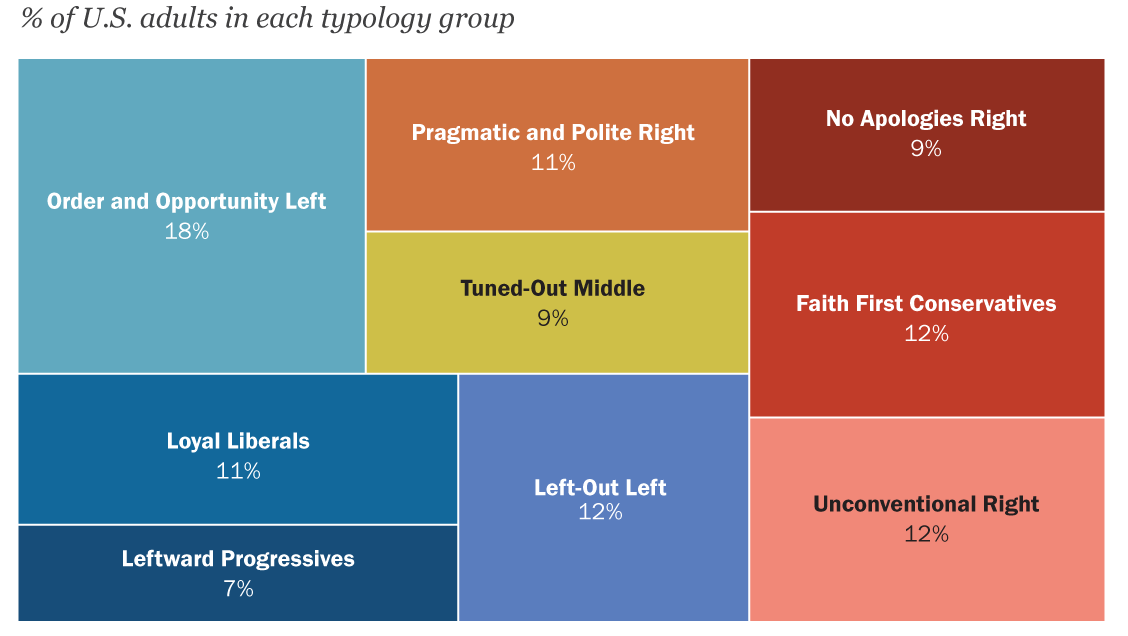
Tax rates on large businesses and corporations should be raised
They favor suspending all asylum applications
They don’t like the way Donald Trump conducts himself
It is very important that the U.S. is respected by other countries
Gun violence is a very big problem in the country today
They are not comfortable with people displaying the Confederate flag
Note: For full question wordings and distributions, refer to the detailed tables.
Source: Surveys of U.S. adults conducted Jan. 27-Feb. 2 and Nov. 17-30, 2025, and Jan. 20-26, March 23-29 and April 20-26, 2026.
PEW RESEARCH CENTER
Pragmatic and Polite Right: Small-government conservatives with a measured approach to many policy issues
% who say …
| Typology group | Tax rates on large businesses and corporations should be raised | They favor suspending all asylum applications | They don’t like the way Donald Trump conducts himself | It is very important that the U.S. is respected by other countries | Gun violence is a very big problem in the country today | They are not comfortable with people displaying the Confederate flag |
|---|---|---|---|---|---|---|
| Leftward Progressives | 97% | 2% | 96% | 55% | 74% | 94% |
| Loyal Liberals | 92% | 4% | 95% | 79% | 74% | 90% |
| Left-Out Left | 82% | 15% | 84% | 50% | 55% | 69% |
| Order and Opportunity Left | 74% | 21% | 65% | 59% | 72% | 67% |
| Tuned-Out Middle | 54% | 38% | 44% | 37% | 41% | 41% |
| Pragmatic and Polite Right | 62% | 32% | 49% | 75% | 57% | 64% |
| Unconventional Right | 51% | 48% | 28% | 49% | 29% | 43% |
| Faith First Conservatives | 35% | 55% | 9% | 65% | 19% | 29% |
| No Apologies Right | 21% | 76% | 3% | 59% | 10% | 22% |
Note: For full question wordings and distributions, refer to the detailed tables.
Source: Surveys of U.S. adults conducted Jan. 27-Feb. 2 and Nov. 17-30, 2025, and Jan. 20-26, March 23-29 and April 20-26, 2026.
PEW RESEARCH CENTER
They want border security and are concerned about illegal immigration, but they do not support the administration’s widespread deportation efforts. Two-thirds say there should be a path to legal status for those living in the country illegally. And when it comes to the Trump administration’s stepped-up immigration enforcement actions and suspensions of asylum applications, this group clearly breaks from those to its right.
Though they backed Donald Trump over Kamala Harris in 2024 (by 54% to 40% among those who voted), just 36% approve of Trump’s job performance as of April. Majorities of Pragmatic and Polite Right say they do not have confidence in Trump on most key issues facing the country, and most have either mixed feelings about (39%) or don’t like (49%) the way he conducts himself as president.
Pragmatic and Polite Right differ from groups to their right on foreign policy. They are second only to Loyal Liberals in the importance they place on America being respected around the world (75% say this is very important). They also put more value than groups to their right on traditional U.S. alliances and multilateral institutions such as NATO. And when it comes to the conflict between Russia and Ukraine, 59% say the U.S. has a responsibility to help Ukraine defend itself (no more than a third of those in groups to their right say this).
While they are somewhat conservative on issues of sexuality and gender identity, they take positions closer to the middle – or left – on several other cultural issues. For instance, 57% say gun violence is a very big problem in the country (no more than three-in-ten of those in groups to the right say this). They are also more likely than other right-leaning typology groups to express discomfort with people displaying the Confederate flag (64% say they would not be comfortable with this, while just 13% say they would be).
Civility and consistencyPragmatic and Polite Right tend to dislike heated, confrontational or overly aggressive politics to a greater degree than other groups. This especially separates them from groups to their right.
Pragmatic and Polite Right prefer proven approaches and think officials should avoid heated language
% who say …

Note: For full question wordings and distributions, refer to the detailed tables.
Source: Surveys of U.S. adults conducted Aug. 4-10 and Nov. 17-30, 2025, and Jan. 20-26, 2026.
PEW RESEARCH CENTER
Pragmatic and Polite Right prefer proven approaches and think officials should avoid heated language
% who say …
| Leftward Progressives | Loyal Liberals | Left-Out Left | Order & Opportunity Left | Tuned-Out Middle | Pragmatic & Polite Right | Unconventional Right | Faith First Conservatives | No Apologies Right | General public | |
|---|---|---|---|---|---|---|---|---|---|---|
| Elected officials should avoid heated or aggressive language | 84% | 85% | 76% | 83% | 64% | 86% | 71% | 80% | 74% | 78% |
| The best way to solve problems is using proven approaches that solve problems gradually | 67% | 75% | 74% | 76% | 61% | 78% | 69% | 61% | 44% | 68% |
Note: For full question wordings and distributions, refer to the detailed tables.
Source: Surveys of U.S. adults conducted Aug. 4-10 and Nov. 17-30, 2025, and Jan. 20-26, 2026.
PEW RESEARCH CENTER
They overwhelmingly (86%) say elected officials should avoid heated or aggressive language because it could encourage people to take violent action.
Nearly eight-in-ten (78%) prefer an incremental approach to solving the country’s problems rather than new approaches that may fix things quickly but risk making them worse.
The group’s preference for “polite” politics surfaces in several of their other views. For instance, 72% hold the view that people saying offensive things is a major problem in society today, and 70% say they dislike it a lot when politicians humiliate their political opponents.
Jump to the detailed tables to learn more about Pragmatic and Polite Right and the other typology groups.
| # | Наименование новости | Тональность | Информативность | Дата публикации |
|---|---|---|---|---|
| 1 | Unconventional Right | 0 | 5 | 10-06-2026 |
| 2 | No Apologies Right | 2 | 3 | 10-06-2026 |
| 3 | Tuned-Out Middle | 0 | 5 | 10-06-2026 |
| 4 | Loyal Liberals | 0 | 5 | 10-06-2026 |
| 5 | Leftward Progressives | 3 | 7 | 10-06-2026 |
| 6 | Faith First Conservatives | 0 | 5 | 10-06-2026 |
| 7 | Order and Opportunity Left | 0 | 5 | 10-06-2026 |
| 8 | Left-Out Left | 0 | 5 | 10-06-2026 |
| 9 | How voting, political participation and news sources differ across political typology groups | 0 | 5 | 10-06-2026 |
| 10 | Democrats and Republicans engage in public life in similar ways | 0 | 6.14 | 16-07-2026 |