Просмотр новости
Найдите то, что Вас интересует
 Спутники
 РН
РН SpaceX
 Роскосмос
 NASA
NASA
СпутникиРНSpaceXРоскосмосNASAHere's all the latest local and international news concerning climate change for the week of July 6 to July 12, 2026.
Here's all the latest local and international news concerning climate change for the week of July 6 to July 12, 2026.
Published Jul 11, 2026
Last updated 9 hours ago
8 minute read
 File photo of musicians playing outside during a heat wave in France. Western Europe recorded it hottest June on record this year. Photo by CHRISTOPHE DELATTRE /AFP via Getty Images
Article content
Here’s the latest news concerning climate change and biodiversity loss in B.C. and around the world, from the steps leaders are taking to address the problems, to all the up-to-date science.

THIS CONTENT IS RESERVED FOR SUBSCRIBERS ONLY
Subscribe now to read the latest news in your city and across Canada.
SUBSCRIBE TO UNLOCK MORE ARTICLES
Subscribe now to read the latest news in your city and across Canada.
REGISTER / SIGN IN TO UNLOCK MORE ARTICLES
Create an account or sign in to continue with your reading experience.
THIS ARTICLE IS FREE TO READ REGISTER TO UNLOCK.
Create an account or sign in to continue with your reading experience.
or
Article content
Check back every Saturday for more climate and environmental news or sign up for our Sunrise newsletter HERE.
Article content
Article content
Article content
In climate news this week:Article content
• Firefighters battle two out-of-control wildfires near Boston Bar
• First Nation challenges port plan to dredge Metro Vancouver’s Second Narrows for oil tankers
• Heat wave pushed U.K. power grid to record operating strain
• Western Europe had hottest June on record
Article content
Article content
Human activities like burning fossil fuels and farming livestock are the main drivers of climate change, according to the UN’s intergovernmental panel on climate change. This causes heat-trapping greenhouse gas levels in Earth’s atmosphere, increasing the planet’s surface and ocean temperature.
Article content
By signing up you consent to receive the above newsletter from Postmedia Network Inc.
Article content
The panel, which is made up of scientists from around the world, including researchers from B.C., has warned for decades that wildfires and severe weather, such as the province’s deadly heat dome and catastrophic flooding in 2021, would become more frequent and intense because of the climate emergency. It has issued a code red for humanity and warns the window to limit warming to 1.5 C above pre-industrial times is closing.
Article content
According to NASA climate scientists, human activities have raised the atmosphere’s carbon dioxide content by 50 per cent in less than 200 years, and “there is unequivocal evidence that Earth is warming at an unprecedented rate.”
Article content
As of July 5, 2026, carbon dioxide in the atmosphere was 431.44 parts per million, down slightly from 432.34 ppm the previous month, according to the latest available data from the NOAA measured at the Mauna Loa Observatory, a global atmosphere monitoring lab in Hawaii. The NOAA notes there has been a steady rise in CO2 from under 320 ppm in 1960.
Article content
Article content
Article content
Article content
Quick facts:Article content
• The global average temperature in 2023 reached 1.48 C higher than the pre-industrial average, according to the EU’s Copernicus Climate Change Service. In 2024, it breached the 1.5 C threshold at 1.55 C.
• 2025 was the third warmest on record after 2024 and 2023, capping the 11th consecutive warmest years.
• Human activities have raised atmospheric concentrations of CO2 by nearly 49 per cent above pre-industrial levels starting in 1850.
• The world is not on track to meet the Paris Agreement target to keep global temperature from exceeding 1.5 C above pre-industrial levels, the upper limit to avoid the worst fallout from climate change including sea level rise, and more intense drought, heat waves and wildfires.
• UNEP’s 2025 Emissions Gap Report, released in early December, shows that even if countries meet emissions targets, global temperatures could still rise by 2.3 C to 2.5 C this century.
• In June 2025, global concentrations of carbon dioxide exceeded 430 parts per million, a record high.
• There is global scientific consensus that the climate is warming and that humans are the cause.
Article content
Article content
 Carbon dioxide in the atmosphere warms the planet, causing climate change. Human activities have raised the atmosphere’s carbon dioxide content by 50% in less than 200 years, according to NASA.
Article content
Article content
Latest NewsArticle content
More evacuations, structures lost as two out-of-control wildfires rage near Boston BarArticle content
Two out-of-control wildfires near Boston Bar have led to more evacuations and destroyed some structures at a resort.
Article content
As of Friday morning, the Brunswick Creek wildfire had burned 26 square kilometres, while the Ainslie Creek wildfire had burned 155 square kilometres. The two fires are collectively known as the Brunswick Complex.
Article content
The Brunswick fire was showing a moderate rate of spread and groundcrews conducted direct attacks along the fire’s edge while structure protection crews patrolled throughout the community, said an update from the B.C. Wildfire Service on Friday morning.
Article content
“We continue to see poor overnight recoveries and active fire throughout the night,” the service said.
Article content
“Over the next two days we will see slightly lower temperatures and higher relative humidity, however this does not represent a downturn in conditions, just a two-day slight reprieve. This will help moderate fire behaviour; however when steep slopes and gusty wind conditions align, we are likely to see higher activity.”
Article content
Article content
Article content
—Tiffany Crawford
Article content
 A new oil pipeline proposal from Alberta to B.C. terminates at Roberts Bank, the home of the existing GTC Deltaport container, and adjacent to the Tsawwassen First Nation. Photo by Jason Payne /PNG
Article content
First Nation challenges port plan to dredge Metro Vancouver’s Second Narrows for oil tankersArticle content
The Tsleil-Waututh Nation is asking a court to stop the Vancouver Fraser Port Authority from dredging the Second Narrows, a scheme designed to accommodate fuller oil tankers shipping crude from the Trans Mountain pipeline.
Article content
The North Shore First Nation asked the Federal Court of Canada on Thursday to overturn the permit that allows the port authority to deepen the water of the channel that passes under the Ironworkers Memorial Bridge, the nation said in a news release.
Article content
The nation argues Canada failed to adequately consult it before the port’s permit was issued last month and it was based on an unreasonable determination that the work wouldn’t have a significant impact on the environment. The Nation has been involved in a multi-year project to restore the tidal flats north of the channel.
Article content
“While Tsleil-Waututh understands the proposed dredge is an important step for Canada’s international trade objectives, including increasing the amount of oil moving through the (Burrard) Inlet from Westridge Marine Terminal, the approval process has been rushed and has not addressed any of Tsleil-Waututh Nation’s concerns about marine shipping impacts,” said Chief Justin George.
Article content
Article content
“Tsleil-Waututh has a sacred stewardship obligation, a responsibility to care for our lands, air and waters. While we attempted to resolve these outstanding issues in good faith, our concerns were ignored, leaving us no choice but to go to court to protect our territory and interests.”
Article content
Article content
—Bloomberg News
Article content
Is there room for an oil shipping terminal at Roberts Bank with a second container port planned?Article content
There is a big question hanging over the choice of Roberts Bank in Delta as the location for a new oil shipping terminal. Can it be done?
Article content
Roberts Bank is already the location of two artificial islands — one is B.C. Ferries’ Tsawwassen terminal, the other is the Roberts Bank Superport that contains the Westshore coal terminal and Deltaport, Canada’s largest container-handling facility. There is also a $3.5-billion second container terminal planned adjacent to the coal and container terminal on a new 1.3-square-kilometre artificial island, with a hoped-for construction start in 2028.
Article content
Approval for the second container terminal was granted because it was determined the project was key to supporting Canada’s economic growth and the Pacific Gateway trade corridor, after an environmental assessment determined the project would cause significant adverse effects on the environment, threatening species like chinook, orcas and birds.
Article content
If it were decided the additional environmental impacts from an oil shipping terminal could be tolerated, there is still the question of whether there is enough room at Roberts Bank for another major terminal, and whether two major projects could be built at the same time.
Article content
The proponents of the project — the Alberta and federal governments — have no answers to those questions, at least for now.
Article content
Article content
—Gordon Hoekstra
Article content
Climate change keeps adding to the list of uninsurable assets, Allianz executive saysArticle content
Extreme weather events — such as the heat wave gripping Europe — are making a growing number of assets too risky to insure, according to a director at Europe’s largest primary insurer.
Article content
“Certain locations and perils cannot be covered as we would wish them to be covered,” Günther Thallinger, who sits on the management board of Allianz SE, said in an interview. “We cannot help it.”
Article content
Heat, floods, storms and wildfires “could become so frequent that they challenge traditional insurance models,” he said. “Risk-adequate pricing would not be affordable any longer.”
Article content
Article content
The warning comes as millions of Europeans endure some of the highest temperatures recorded in the region, with scientists identifying man-made climate change as the culprit. Researchers at World Weather Attribution estimate that June temperatures were between 5 C and 12 C above seasonal averages across France, Germany, Italy, Spain and southern England, as Europe heats up faster than other continents.
Article content
Article content
—Bloomberg News
Article content
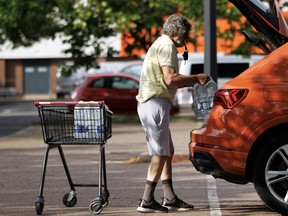 File photo of a man in the U.K. stocking up on water during a heat wave. Photo by Dan Kitwood /Getty Images
Article content
Heat wave pushed U.K. power grid to record operating strainArticle content
On a sweltering day in late June, the U.K.’s power grid came under exceptional strain. As temperatures rose, wind generation slumped and electricity prices spiked, forcing Britain’s grid operator to take emergency measures to keep the lights on.
Article content
The system ultimately held. But fresh analysis shows the grid’s frequency remained below its normal operating level for almost 26 minutes — the longest such stretch on record, according to energy data provider Montel — leaving the system with less margin for error if another problem had occurred.
Article content
The findings come as Britain’s grid faces political scrutiny. Shadow Energy Secretary Claire Coutinho has accused the National Energy System Operator of withholding information and risking blackouts, citing whistleblowers who contacted her about actions taken on June 23. While Coutinho hasn’t provided evidence for the claims, and NESO denies wrongdoing, the dispute has drawn renewed attention to the resilience of the U.K.’s grid.
Article content
Article content
The episode underscores a broader challenge facing Europe. As heat waves grow hotter, longer and more frequent, electricity demand is becoming less predictable just as power systems rely increasingly on weather-dependent renewable generation. That’s leaving grid operators with limited flexibility when conditions don’t co-operate.
Article content
—Bloomberg News
Article content
Western Europe had hottest June on record: climate scientistsArticle content
June was the hottest on record western Europe and the second warmest globally, the Copernicus Climate Change Service reported this week.
Article content
The month saw Europe hit by extreme heat over land and sea, with much of western Europe experiencing a record-breaking heat wave and marine heat waves across the western Mediterranean and along the Atlantic coasts.
Article content
June heat waves broke monthly and all-time temperature records across several European countries and contributed to severe health impacts, including heat-related deaths, the report said.
Article content
Europe also saw widespread dryness that, together with extreme heat, contributed to wildfire activity, particularly in the Iberian Peninsula and southern France, and heightened drought risk in parts of eastern Europe, the report said.
Article content
The June heat wave occurred against a backdrop of increasingly dry soils across western and Central Europe, further exacerbating drought conditions that had begun to develop during May’s heat wave.
Article content
—Tiffany Crawford
Article content
Article content
| # | Наименование новости | Тональность | Информативность | Дата публикации |
|---|---|---|---|---|
| 1 | B.C. Wildfires Updates: Air quality worsens in east Fraser Valley | Eby, Greene to meet with officials in Penticton | Summerland blaze continues to grow | Arson a major concern | 0 | 6.52 | 12-08-2026 |
| 2 | More evacuations, structures lost as two out-of-control wildfires rage near Boston Bar | -2 | 6 | 09-07-2026 |
| 3 | Итоги недели: паводок в Фокино, новые законы в России и пожары в Европе | 0 | 10.35 | 01-01-1970 |
| 4 | онлайн заказ Плавание в бассейне Яндекс Маркет Задумывались ли вы ... | 0 | 0 | 21-02-2025 |
| 5 | Багаевская: Ночь 18 дек, Вт | 0 | 0 | 17-12-2018 |
| 6 | Багаевская: Вечер 17 дек, Пн | 0 | 0 | 17-12-2018 |
| 7 | На Украине арестовали экс-главу Апелляционного суда Крыма Чернобука | 0 | 0 | 05-11-2018 |
| 8 | Россияне назвали доход, необходимый им для достойной жизни: 50-80 тысяч рублей | 0 | 0 | 26-04-2021 |
| 9 | L'OM en route vers la deuxième place : une victoire historique à Angers | 0 | 0 | 10-02-2025 |
| 10 | Билибино: Вечер 31 окт, Ср | 0 | 0 | 30-10-2018 |