Просмотр новости
Найдите то, что Вас интересует
 Спутники
 РН
РН SpaceX
 Роскосмос
 NASA
NASA
СпутникиРНSpaceXРоскосмосNASAI know there are loads of threads on these but my one isn't presenting with any overtly obvious faults. It basically works but doesn't weld very well anymore and it used to be a great machine, even for welding upside down under cars. Any help fixing it would be much appreciated.
The arc is unstable and wants to hover in mid air which often ends up cooking the hell out of the shroud and torch but somehow avoids destroying the tip.
Very difficult to weld vertically or overhead, can just about tack stuff horizontally but seam welding isn't possible anymore. Keeping a weld pool is really difficult and it does seem a little down on power. You basically can't get the frying bacon sound, it either stutters or makes a weird hummy zap as the arc lifts away from the weld pool.
The spot timer and wire feed adjustment seem to work OK but i have had issues with poor wire feed torque at low wire speeds which I seem to have more or less sorted (usual suspects like the torch liner, roller adjustment and reel pre-load etc)- I tested the motor with a 12v battery powering it and it seems to have plenty of grunt so I think the wirefeed motor itself is OK. At low wire speeds you can hear the RPM surging up and down though slowly and rhythmically so I will slacken the rollers and see if it does this with the physical load disconnected as maybe there's some wirefeed speed instability issue there.
It has the TW114304 surface mount control PCB. I've cleaned it and the pots and couldn't see anything wrong with it (I've chipped and modified loads of old bosch surface mount ECUs so I have some idea of what to look for physically and can solder/ rework these no problem but have no competency beyond that re fault finding or testing this telwin PCB).
I was thinking some basic fault finding with a meter might be worthwhile on it and perhaps just wholesale replace any limited life parts like tantalums or electrolytics.
Could this be a diode issue?
I've checked basic stuff like the return cable connections, torch connections- fitted a different torch too to no avail.
Any tips of where to start fault finding much appreciated because nothing is clearly faulty, it just doesn't weld very well and I used to really enjoy welding with this machine- when I first got it it was a revelation compared to my old sip migmate and now its far worse than the sip was!
Cheers 
eddie49 Member
I would suggest you start by measuring and recording the DC output voltage from the torch tip to the workpiece clamp, at each of the six positions of the voltage control switch.
I would suggest you start by measuring and recording the DC output voltage from the torch tip to the workpiece clamp, at each of the six positions of the voltage control switch.
Many thanks, will do this and post the result

BrokenBiker Forum Supporter
which bot of wales are you in?
which bot of wales are you in?
I'm in North Pembrokeshire but visit Swansea quite a bit
BrokenBiker Forum Supporter
I'm in North Pembrokeshire but visit Swansea quite a bit
ah bit of a stretch for me to offer to lend a hand
The pcb mounted transformer (240 to12v) can be a weak point on most pcbs as they are the minium the manufacture can get away with.
Link to polish site with replacement pcb. https://plytkadomigomatu.pl/pl/p/TW...4306-cod114306-TW115104-cod114483-TW115581/96
The schmatic in the pdf maynot be same as yours so use with caution.
Note machine may also be know under the brand Telwin
Doing a conversion of Polish zloty to pounds gives 189,00zl = £38.53 !
185 195_9.pdf
1.6 MB · Views: 29
I would suggest you start by measuring and recording the DC output voltage from the torch tip to the workpiece clamp, at each of the six positions of the voltage control switch.
Tried to take readings but I think my cheap rolson multi meter was struggling. I couldn't see much or any smoothing provision in the welder so I wonder if the DC output is naturally ragged so the meter wasn't really recognising it consistently as either AC or DC. If I held the trigger on for longer than a second or so the measured voltage would drop randomly between - volts and +10v. The only way I could get coherent readings was to blip the trigger for about a second and use the AC 200v scale.
Power control scale looked something like this: 1= 25v. 2=35v. 3=45v. 4=50v. 5=60v. 6=75v.
On DC 200v scale, power settings 1-3 all gave about 35v on a blip of the trigger and settings 3-6 gave about 65v.
I did however further investigate the wire feed and I've got it welding a LOT better. I think its been overtightened and that plus lack of lubrication in the wirefeed reduction gearbox seemed to be a significant cause of the wire feed surging issue. I tipped the welder on its side, took off the feed roller and dribbled 10w40 into the gearbox, re-fitted the roller and tensioned the arm so that its compressing the tension spring about half way and I now have no surging and was able to do a 4" lapped seam weld on 0.8mm zintec without burning through and just a little bit proud bead wise. When I tried pulsing it I was able to lay a flat smooth bead.
I'll try some thicker stuff tonight but I actually think it's ok now.
Wire feed all along it seems. Thanks for the help ... sorry to everyone for crying wolf!!
The pcb mounted transformer (240 to12v) can be a weak point on most pcbs as they are the minium the manufacture can get away with.
Link to polish site with replacement pcb. https://plytkadomigomatu.pl/pl/p/TW...4306-cod114306-TW115104-cod114483-TW115581/96
The schmatic in the pdf maynot be same as yours so use with caution.
Note machine may also be know under the brand Telwin
Doing a conversion of Polish zloty to pounds gives 189,00zl = £38.53 !
It looks the part, many thanks. I think I'll order one for a rainy day. Do you know if wirefeed gearboxes/ motor assemblies are available and if not whether anyone has discovered a replacement or upgrade which can be made to fit?
The pcb mounted transformer (240 to12v) can be a weak point on most pcbs as they are the minium the manufacture can get away with.
Link to polish site with replacement pcb. https://plytkadomigomatu.pl/pl/p/TW...4306-cod114306-TW115104-cod114483-TW115581/96
The schmatic in the pdf maynot be same as yours so use with caution.
Note machine may also be know under the brand Telwin
Doing a conversion of Polish zloty to pounds gives 189,00zl = £38.53 !
I'm going to do some in depth comparisons but my PCB looks newer and more complex than this one.
This looks identical to it- it's for a Telmig 180/2
I've already ordered a wire feed/ motor assembly from them (£50 posted) so once I've had chance to minutely compare photos of my control board versus this I might order one of these- despite trying several different torches and checking connections I occasionally get an aborted response from the welder when pulling the torch trigger as though the torch is a one time momentary switch rather than the maintained/ latching switch it's supposed to be so I wonder if the PCB is starting to go a bit funny. I'll double check and re-clean the spot timer pot just incase that's somehow coming on sometimes but at £50 it's tempting to just fit a new control board. The rest of the welder is sound and either bomb proof (transformer, choke etc) or generic (gas valve, fan etc) so with a whole new wire feed unit and control board I'm happy it should see the welder reliable for the forseeable.
eddie49 Member
I am glad that your welder seems to have decided to behave itself again.
It would still be useful to verify the output voltages. Even with no smoothing capacitors, the welder output will be unidirectional DC which should read correctly on a digital voltmeter using the 200v DC range. It should start at about 16 volts and rise in roughly-equal increments as you step up the rotary voltage switch, reaching about 32 volts in position 6.
You could confirm that your voltmeter is accurate by measuring across a 12v car battery.
If the welder DC output between the torch tip and the work clamp is still giving strange readings, set the meter to AC and check inside the welder where the two heavy wires from the transformer secondary bolt onto the bridge rectifier. The values there should be about the same - 17 to 33 - but AC.
I am glad that your welder seems to have decided to behave itself again.
It would still be useful to verify the output voltages. Even with no smoothing capacitors, the welder output will be unidirectional DC which should read correctly on a digital voltmeter using the 200v DC range. It should start at about 16 volts and rise in roughly-equal increments as you step up the rotary voltage switch, reaching about 32 volts in position 6.
You could confirm that your voltmeter is accurate by measuring across a 12v car battery.
If the welder DC output between the torch tip and the work clamp is still giving strange readings, set the meter to AC and check inside the welder where the two heavy wires from the transformer secondary bolt onto the bridge rectifier. The values there should be about the same - 17 to 33 - but AC.
It is welding about as well as it ever did I think. I haven't tried it on anything thicker but I consider being able to continuously seam weld on 0.8mm as decent performance for any cheap-ish welder.
I checked my meter against a car battery and it held stable voltage so I think the meter is basically OK but I still cannot get a stable reading on either DC or AC scales between the tip and return clamp. I'll take some readings inside the welder as you described and let you know
It's definitely stepping up in voltage between 1 and 6 on the control but the meter doesn't seem to know what kind of volts they are and gets confused after about half a second.
Annoyingly- rookie error- it turns out my welder is basically a telmig 180/2 but with a 12v low voltage system whereas all the telmig parts which look like they fit are all 24v. Luckily I only bought the wire feed assembly and can hopefully fit my 12v motor to that but it's annoying that when I find telwin part numbers on bits of my welder I can't rely on them to actually be the right parts as the part numbers don't seem to discriminate between 12v and 24v versions. Wirefeed unit on my welder is 153007 with a 12v motor and online, 153007 is a 24v unit. I suppose this might be why a wire feed unit for a supermig 185 is £130 in the UK- because maybe only Sealey sold the 12v versions therefore lower production numbers which drives up costs for old machines.
eddie49 Member
That price - £130 - is high for a plastic wirefeed assembly. The die-cast alloy units were £30 - £40 on eBay but they have increased in price now, and are also mostly 24 volts.
If you search for "CO2 welder motor 12v" on AliExpress you can find one like this:
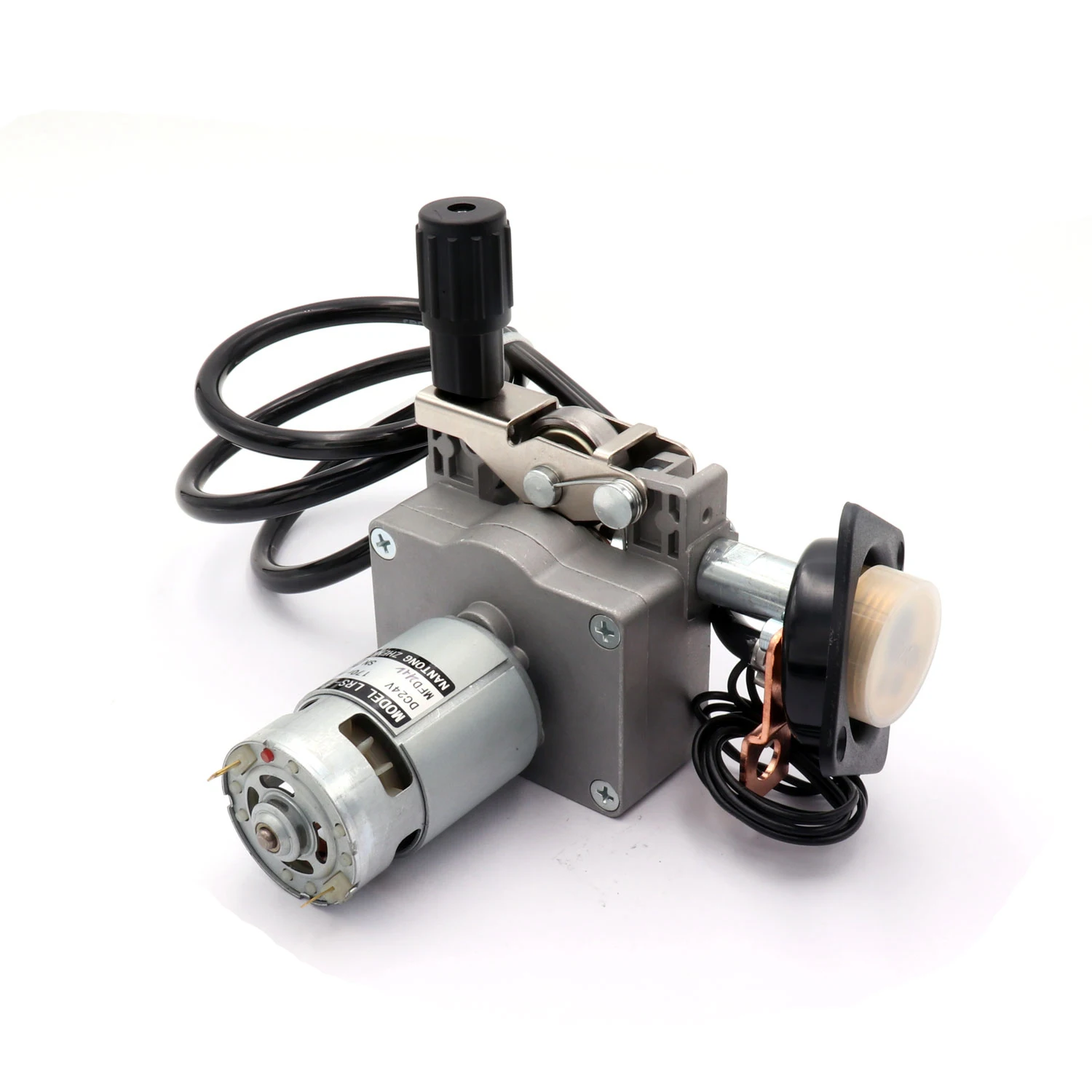
Only £32 including the Euro socket is a very good price.
[ Most items on AliExpress that concern the topic of MIG welding can be found by adding the magic search clue "CO2 welder".]
The issue of the "output voltage dropping after 0.5 seconds" could be a faulty voltmeter. If there is actually a fault in the welder, it could be that the contacts on the rather small black plastic relay on the PCB have burnt. It is used instead of a genuine Contactor and must have a tough life.
So to update...
I found a new control board on Allegro which is basically polish Amazon. There's a company in Poland who specialise in building replacement control boards for all sorts of welders, upgrading weak components in the process. It's a through hole PCB so a much better bet long term than the old surface mount design and it has good reviews.
It carries the correct tw114306 / 304 part numbers and has a 12v transformer . Cost about £35 ISH with postage to the UK.
For the wire feed I just bought a genuine telwin 153007 unit from an eBay seller in Italy. It's quite likely I'll have to swap my 12v motor into it. My motor is ok, just the gearbox which is worn.
Will update once I've installed the new board and wire feeder.
if you strip the gearbox and remove the old grease clean it all up and replace with new grease this a known problem there was a thread on here a long time ago about it
Update.
Telwin 153007/ 153044 wire feeder arrived from Italy today.
Typically had a 24v motor so I dismantled both my old one, the new one and swapped my old 12v motor into the new wire feeder which involved extracting and refitting the tiny gear pressed onto the motor shaft (easy enough with some supports, a vice, some care and a punch and hammer).
In short, it's completely transformed the welder. The weird surging and weak feed issue has totally gone. Really dramatic difference even though there was nothing obviously amiss in the old gearbox.
Telwin have redesigned 153007 (now 153044) and they've reduced the number of layshafts/ reduction gear sets significantly... 5 down to 3 or something. The gear on the motor shaft is a lot smaller now so a bit more fiddly to work with. They've also made the tensioner and grooved roller quick release and it generally feels more solid.
For the same money I could've probably bought something better but I didn't fancy any measuring or fabrication (lol).
Hopefully the new control board will be here in a few days to solve the occasional failure to do anything when pulling the trigger (all connections good and several torches tried so pretty sure it's the control board).
Looking at the welder now the only bespoke ish bit left now is the main on/ off / voltage switch. If I can get one I'm thinking it's probably worth ordering one now because it feels like it wants to break (it's always felt like that).
I assume everything else in the welder is kind of either bomb proof (transformer) or generic and easily sourced?
Final update lol.
Fitted the new control board today which finally arrived from Poland.
It fitted perfectly more or less, some slight adapting needed to secure the speed pot was all.
All issues now fully resolved- wire feed is super consistent and has decent torque even with a 4m torch and at low speed. All the surging and other issues went with the new feed assembly and the intermittent no weld (just a click) has also been solved with the new PCB.
Pics below showing new Vs old parts (new parts installed and old parts held next to them for comparison).
Delivery was a bit long winded for both parts but it was preferable for me than £80 for a repair job on the old board, NLA from sealey and telwin or £125 for just a feed assembly from amp starters.co.uk
A metal Chinese feeder was a cheaper option but I didn't fancy any custom fitment.
So if anyone is having issues with their control board, especially if it's got loads of SMT stuff like mine did I can highly recommend a new more straightforward one from DesignOffice on Allegro.pl and/or a new feed assembly from an Italian telwin distributor (e.g brico utensili).
Thanks everyone for the help and info!
Turbo Member
The wire feed motor is a known weakness in the sealey/telwin welders.
There is a diy modification I have seen that braces the upper feed roller bracket to stop it bending.
Apparently the plastic housing bends and causes wire feed issues.
Over tightening the clamp screw can cause this.
The clamp should be loose enough so that if the wire welds itself to the mig tip the rollers should slip.
To test this press the end of the torch against the floor and pull the trigger.
The wire feed motor is a known weakness in the sealey/telwin welders.
There is a diy modification I have seen that braces the upper feed roller bracket to stop it bending.
Apparently the plastic housing bends and causes wire feed issues.
Over tightening the clamp screw can cause this.
The clamp should be loose enough so that if the wire welds itself to the mig tip the rollers should slip.
To test this press the end of the torch against the floor and pull the trigger.
Definitely, it's almost a great design with the metal shafts and metal gears but the plastic housing lets it down. Coming from a sip migmate though the telwin wire feed was a revelation !
Interesting re the bracket. Would be difficult on the replacement as that outer bush no longer has screws holding it on.
I'd read not to overtighten it. That's exactly what I did to my old one. Bottomed out the spring and ran it that way for years. It sounded like there was cyclic binding in the gearbox.
I'll be careful to let the spring do the job of pressurising the roller from now on! The rollers definitely slip if you push the wire into a surface.

The wire feed motor is a known weakness in the sealey/telwin welders.
There is a diy modification I have seen that braces the upper feed roller bracket to stop it bending.
Apparently the plastic housing bends and causes wire feed issues.
Over tightening the clamp screw can cause this.
The clamp should be loose enough so that if the wire welds itself to the mig tip the rollers should slip.
To test this press the end of the torch against the floor and pull the trigger.
You’re thinking of SIP, not Telwin. 
| # | Наименование новости | Тональность | Информативность | Дата публикации |
|---|---|---|---|---|
| 1 | Milwaukee CHPX SDS drill problem | 0 | 2 | 05-07-2026 |
| 2 | Issues with my VCM lens when shooting video | 0 | 5 | 05-07-2026 |
| 3 | Permanent silicone problem… | -5 | 2 | 07-07-2026 |
| 4 | Spusu Roaming Voice - VoLTE problem | 0 | 10 | 21-07-2026 |
| 5 | RGB readings not working. | 0 | 10 | 22-07-2026 |
| 6 | Mehrere Probleme in libseccomp (Fedora) | 0 | 5 | 20-07-2026 |
| 7 | Migmate 150 dual purpose to euro torch | 0 | 5 | 07-07-2026 |
| 8 | Odd glitch on OrcusPatera in Orbiter 2024 | 0 | 24.29 | 14-02-2026 |
| 9 | 24-105 Z - does it tend to overexpose? | 0 | 5 | 06-07-2026 |
| 10 | R5II Startup from Sleep | 0 | 0 | 29-06-2026 |