Просмотр новости
Найдите то, что Вас интересует
 Спутники
 РН
РН SpaceX
 Роскосмос
 NASA
NASA
СпутникиРНSpaceXРоскосмосNASAOn the seventieth anniversary of Dr. B. R. Ambedkar’s mass conversion, a scholar reflects on the history and legacy of the Dalit Buddhist movement.
The post B. R. Ambedkar and the Dalit Quest for Dignity appeared first on Tricycle: The Buddhist Review.
The value of a man was reduced to his immediate identity and nearest possibility. To a vote. To a number. To a thing. Never was a man treated as a mind. As a glorious thing made of star dust.
—Rohith Vemula, January 17, 2016
On a January morning in 2016, a 26-year-old PhD scholar at the University of Hyderabad left behind a suicide note that would shake India’s conscience. The Dalit student and activist Rohith Vemula had been suspended from his university, evicted from his hostel, and effectively erased from institutional life because of his caste and his activism with the Ambedkar Students’ Association (ASA). His words have since become one of the most quoted testimonies to the lived reality of caste in modern India.
Rohith’s death did not silence his family. Three months later, on April 14, 2016—the 125th birth anniversary of Dr. B. R. Ambedkar, the famed Dalit activist and chief architect of the Indian Constitution—his mother, Radhika, and his brother, Raja, traveled from Hyderabad to the Dr. Babasaheb Ambedkar Bhavan in Dadar, Mumbai, where thirty Buddhist monks administered the Deeksha vows in the presence of Prakash Ambedkar, the great man’s grandson. They converted to Buddhism. Rohith’s childhood friend Riyaz Shaikh and ASA activist Charbad Raju converted alongside them.
They convert to Buddhism as protest, as survival, as the most radical act available to them: the refusal to remain within a religion that sanctifies their humiliation.
This act of conversion in response to violence is neither new nor isolated in India. It is a pattern woven through seven decades of Ambedkarite history: Caste commits violence, the state fails to respond, and Dalits reach not for weapons but for the dhamma. They convert to Buddhism as protest, as survival, as the most radical act available to them: the refusal to remain within a religion that sanctifies their humiliation.
The World Ambedkar InheritedTo understand why Dalits convert to Buddhism when atrocities occur, one must first understand what they are converting from. Caste is not merely social stratification; it is a theological architecture of pollution and purity, inscribed in shastras (scripture), enforced through violence, and reproduced across generations. For those designated “untouchable”—outside the fourfold varna system entirely—it meant being prohibited from access to temples, wells, schools, transport, jobs, and roads. It meant being forced to announce one’s presence by striking two stones together so caste Hindus could step aside. It meant sweeping streets, carrying human waste, skinning dead cattle—not by choice but by birth. It meant that one’s very shadow was considered contaminating.
Dr. Ambedkar was born into this reality on April 14, 1891. A brilliant student who earned doctorates from Columbia University and the London School of Economics, he was nonetheless barred from drinking water from a common pot in his own school, denied accommodation by landlords, and turned away from guesthouses throughout his professional life. He understood that no amount of personal achievement could dissolve caste as long as Hinduism provided its theological justification. His conclusion, reached after decades of study, political struggle, and searching engagement with multiple religious traditions, was unambiguous: Hinduism and caste were inseparable. Reform from within was impossible. Liberation required exit.
The Dhamma Deeksha: Ambedkar’s Mass ConversionOn October 14, 1956, in the city of Nagpur, in the year of the celebration of the 2,500th anniversary of the Buddha’s passage into parinirvana, Dr. Ambedkar led approximately 500,000 followers in a mass conversion to Buddhism—what became known as the Dhamma Deeksha. He was 64, gravely ill, and knew he was dying. (He died in his sleep six weeks later, three days after completing The Buddha and His Dhamma, which would become the foundational text for the Ambedkarite movement.) Before his death, he was determined to set a new school of engaged Buddhism in motion—what he termed Navayana, or the “New Vehicle.”
In taking the twenty-two vows Ambedkar prescribed, new Buddhists simultaneously rejected Hindu gods, the authority of Brahminical priests, the legitimacy of caste, and the identity of untouchability itself. They were not joining a religion so much as declaring their humanity. The vows made this explicit: “I renounce Hinduism, which is harmful for humanity and impedes the advancement of human beings, and I embrace Buddhism as my religion,” and “I believe that today I am taking new birth.” This language of rebirth was chosen with care. Buddhism offered not just a new faith but a new identity—one whose dignity was not contingent on caste, whose spiritual worth was not determined by birth, whose liberation was possible here, in this world, through ethical engagement. Further, in their explicit refusal to worship Hindu deities and to view the Buddha as an avatar of the Hindu god Vishnu, the vows push back against Hindu nationalist attempts to absorb Buddhism back into Hinduism and therefore weaken Buddhism’s power to challenge caste. Taken together, these twenty-two vows laid the foundation for Ambedkarite Buddhism, which offered a fierce rejection of Hindu nationalism and caste politics while affirming the inherent dignity and equality of all beings.
Taken together, these twenty-two vows laid the foundation for Ambedkarite Buddhism, which offered a fierce rejection of Hindu nationalism and caste politics while affirming the inherent dignity and equality of all beings.
In laying out the tenets of the Navayana movement, Ambedkar did not present the Buddha as a god to worship but as Margadata—one who shows the path. The dhamma, he insisted in The Buddha and His Dhamma, served as a social blueprint: “The function of Dhamma is to reconstruct the world.” He drew from the Pali canon’s democratic sangha as model for egalitarian community, from the Mahayana’s bodhisattva ideal as model for social service, and from his analysis of Indian society to reframe dukkha not as cosmic suffering but as the specific, structural suffering imposed by caste.
Ambedkar timed the Dhamma Deeksha to take place on the date of the Emperor Ashoka’s conversion to Buddhism. But when Emperor Ashoka converted to Buddhism in the 3rd century BCE, the conversion “came from the throne.” Imperial patronage supported monasteries and spread the dhamma throughout Asia. Ambedkar’s revival, by contrast, “came from the people”—specifically from those deemed to occupy the lowest stratum of society. This origin from the very bottom of India’s social hierarchy fundamentally shapes Ambedkarite Buddhism and explains why it carries such a sense of moral urgency. What Ambedkar left behind was not merely a new Buddhism but a new form of resistance—one that subsequent generations of Dalits would turn to whenever the violence of caste made remaining inside Hinduism unbearable.
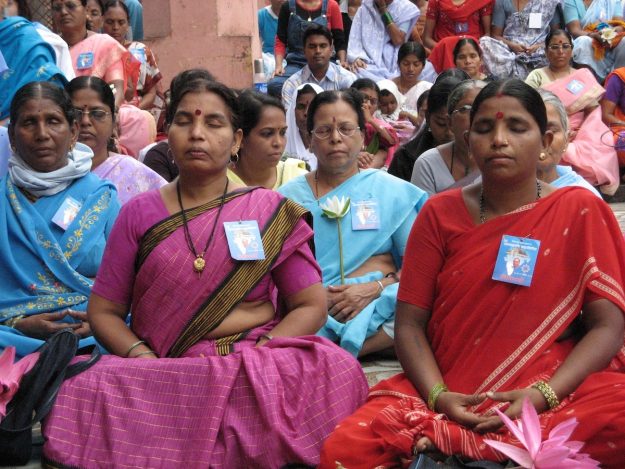 Buddhists gather in Nagpur in 2006 to celebrate the fiftieth Anniversary of Ambedkar’s Buddhist conversion. Photo by Shashi Jambhulkar. Courtesy Santosh Raut.Ambedkar’s Legacy
In the seventy years since that October morning in Nagpur, the pattern of caste violence has repeated with devastating regularity. Caste commits atrocities, and the state looks away. And Dalits, following in Ambedkar’s footsteps, respond by converting to Buddhism—not in defeat but in defiance.
In July 2016, four young Dalit men from Mota Samadhiyala village near Una, Gujarat, were stripped, bound to an SUV, and flogged publicly by cow vigilantes. Their crime was skinning a dead cow, the traditional occupation their caste had been assigned for centuries. Their attackers filmed the assault and circulated the footage. The police, presented with video evidence, were slow to act. The victims and hundreds of their family members embraced Buddhism in protest: If Hinduism made them responsible for dead cows and then targeted them for doing so, they would leave Hinduism. The act of conversion was at once a rejection of the theological framework that assigned them this labor and an assertion of dignity in the face of violence and humiliation.
In 2019, in Gundlupet, a Dalit youth was stripped, thrashed, and paraded naked—an act of humiliation designed to communicate to an entire community their assigned place. Dalit activists organized protest marches that concluded with several individuals converting to Buddhism. The symbolism was significant: In response to an act of forced stripping, these Dalits voluntarily adopted a tradition that strips a person of their caste identity at the moment of conversion.
In 2022, two Dalit youths in Bhulon Village were assaulted by upper-caste men for the act of offering aarti (prayer) at a Hindu temple—a devotional practice considered the prerogative of caste Hindus. The police refused to file cases against the offenders. More than 200 Dalit families converted to Buddhism collectively in protest, as Buddhism offered them a house of worship where no upper-caste gatekeeper could deny them entry.
Some conversions are not singular events but the culmination of long struggles. The Namantar Andolan—the sixteen-year movement to rename Marathwada University after Dr. Ambedkar—was marked by sustained upper-caste violence: riots, murders, destruction of Dalit property, burning of homes. Dominant castes attacked the very proposal of honoring Ambedkar with an institution bearing his name. But the violence did not suppress the Dalit Buddhist movement. After nearly two decades of advocacy, the university was eventually renamed in 1994, but what the struggle solidified was more enduring: a Buddhist identity in the region inseparable from political resistance.
 Buddhists celebrate the fiftieth anniversary of Ambedkar’s Buddhist conversion. Photo by Shashi Jambhulkar. Courtesy Santosh Raut.Rohith Vemula: A Life Reduced to a Number
No case has more powerfully illustrated the intersection of caste, institutional violence, and Buddhist response than that of Rohith Vemula. Rohith was an activist with the Ambedkar Students’ Association at the University of Hyderabad. Following a political clash with a right-wing student group, the university administration suspended him and four other Dalit student leaders, evicting them from their hostel and banning them from common spaces. They lived in a makeshift tent on campus. On January 17, 2016, Rohith committed suicide.
His suicide note is not a document of despair alone. It is a philosophical protest—a young man who dreamed of stars and galaxies articulating what the caste system does to the inner life of a human being. The phrase “My birth is a fatal accident” does not describe personal misfortune. It describes a social system in which being born in a particular caste is a life sentence. His note ends: “From shadows to the stars.”
His family understood. His body was cremated according to Buddhist rites. Three months later, on Ambedkar Jayanti, his mother and brother converted to Buddhism in Mumbai, taking the Deeksha vows. “From today,” Raja Vemula stated, “my mother and I will be free from shame, free from the daily humiliation, free from the guilt of praying to the same god in whose name our people have been tortured for centuries. . . . We want azadi [freedom] from the caste system.” Rohith had urged his family toward Buddhism while he was alive. In death, he finally brought them there.
A New Buddhism Born from Old SymbolsWhat is being created through these conversions is not simply a transfer of religious allegiance. It is the emergence of a distinctly Ambedkarite Buddhist culture rooted in the particular experience of caste. In Buddhist viharas across Maharashtra, the altar holds two images: the meditating Buddha and Dr. Ambedkar in his characteristic blue suit with pen, holding the Constitution he helped to craft. The pairing is deliberate: One offers the path; the other shows how that path was walked in modernity.
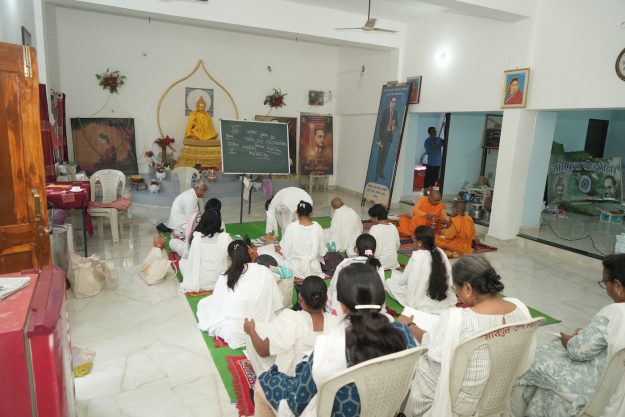 Sunday weekly dhamma class at the Sariputta Buddhist Vihara in Nagpur. Photo by Shashi Jambhulkar. Courtesy Santosh Raut.
Ancient Buddhist symbols are being reimagined through Ambedkarite imagination: The dharmachakra appears on protest banners alongside photographs of atrocity victims; the blue of Ambedkar’s suit has become the color of Dalit assertion; the Bodhi tree is reclaimed as a symbol of enlightenment available to all, not just the ritually pure. Conversion ceremonies are conducted on Ambedkar Jayanti and Dhamma Chakra Pravartan Din to connect each individual act to the collective history of 1956. At local viharas, monks and laypeople administer the twenty-two vows together, dissolving the hierarchies that traditionally separated clergy from laity. In Rohith’s case, even death became a Buddhist ritual act—his cremation insisting that his mind, “a glorious thing made of star dust,” was never reducible to his caste.
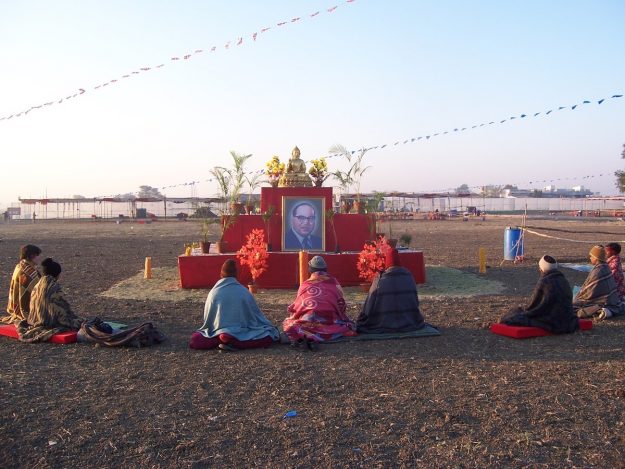 Participants engage in metta bhavana meditation at the Dhammakranti Retreat in Nagpur in 2006. Photo by Shashi Jambhulkar. Courtesy Santosh Raut.From Shadows to the Stars
When Rohith Vemula signed his final letter, “From shadows to the stars,” he was thinking of Carl Sagan and the cosmos. But the phrase has taken on a meaning larger than one man’s biography. It has become an Ambedkarite phrase, describing the journey from the shadow of caste to the light of Buddhist liberation, from the imposed darkness of untouchability to the possibility of human dignity.
Ambedkar understood this journey. “The greatest thing that the Buddha has done,” he wrote, “is to tell the world that the world cannot be reformed except by the reformation of the mind of the man and the mind of the world.” Spiritual revolution becomes the foundation for social transformation. This is what conversion enacts: a reformation of mind, a refusal to carry within oneself the shame that caste assigns. It is what Raja Vemula was describing when he said his family would be free from shame. Shame is structured into the caste system. Buddhism, in the Ambedkarite tradition, dismantles it.
For 10 million Ambedkarite Buddhists, the dhamma provides the moral foundation enabling constitutional democracy to flourish. In Ambedkar’s formulation, the Buddhist principle of maitri (loving-kindness) becomes the democratic principle of fraternity. Anatta (not-self) provides the basis for constitutional equality, as caste hierarchy is revealed to be an illusion. And the Pali canon’s descriptions of sangha become the model for democratic governance and community. But the answer is also the people themselves. When they march with Buddhist flags instead of weapons, when they demand justice with dignity, when they build communities of equality in a hierarchical society, they are collectively enacting the vision of Ambedkar’s Constitution, enabling it to flourish.
 Participants celebrate the fiftieth anniversary of Ambedkar’s conversion. Photo by Shashi Jambhulkar. Courtesy Santosh Raut.
Seventy years after Ambedkar’s conversion, his movement stands at a crossroads determining not only its own future but potentially the future of engaged Buddhism globally. The challenges it faces offer a template for how Buddhism can meet the social challenges of the modern age and set forth a path of liberation not just for individuals seeking peace but for communities seeking justice. For the global Buddhist community, Ambedkarite Buddhism poses an uncomfortable but necessary question: Can we learn from Buddhists who are actually transforming society, or will we continue ignoring them?
When we speak of engaged Buddhism, remember that 10 million people are already doing it, not as a theoretical concept but as lived reality, carrying within their bodies the memory of every flogging, every temple door slammed shut, every act of institutional violence, and choosing, still, the path of peace. The question is whether the rest of us are watching silently—or paying attention and ready to join in.
| # | Наименование новости | Тональность | Информативность | Дата публикации |
|---|---|---|---|---|
| 1 | Remembering Thich Nhat Hanh at 100 | 0 | 8.75 | 11-10-2026 |
| 2 | Contemplations on the Five Mindfulness Trainings | 0 | 7.19 | 12-10-2026 |
| 3 | What We Give Up | 0 | 10.41 | 05-10-2026 |
| 4 | Deep in the Monastery Night | 0 | 7.33 | 07-10-2026 |
| 5 | Who Is the Real Thich Minh Tue? | 0 | 5 | 25-06-2026 |
| 6 | The Elephants in the Courtroom | 0 | 5 | 26-06-2026 |
| 7 | The Song of the Earth | 0 | 8.15 | 04-10-2026 |
| 8 | The Buddha of the Future | 0 | 7.5 | 06-10-2026 |
| 9 | The Four Noble Truths of Travel | 0 | 5 | 22-06-2026 |
| 10 | Our Appointment with Life | 0 | 9.11 | 09-10-2026 |