Просмотр новости
Найдите то, что Вас интересует
 Спутники
 РН
РН SpaceX
 Роскосмос
 NASA
NASA
СпутникиРНSpaceXРоскосмосNASA
The post Once-in-a-generation materials: how metal-organic frameworks are improving efficiency and reducing energy demand appeared first on Center for Climate and Energy Solutions.
Our work to deliver more clean energy for continued economic prosperity and emission reductions faces an immediate and accelerating hurdle: a historic surge in electricity demand. The rapid expansion of data centers, reshoring of manufacturing, and economywide electrification is placing unprecedented strain on our power grids.
Meeting new demand cannot rely on building new power infrastructure alone; we must deploy advanced technologies that fundamentally improve energy efficiency. Enter metal-organic frameworks (MOFs), a quietly emerging nanotechnology that offers the potential for game changing efficiency improvements and other benefits across the clean energy economy.
MOFs are highly efficient, generally stable molecular sponges capable of trapping gases or liquids. Earning the 2025 Nobel Prize in Chemistry, they have been used commercially for 10 years. The structural networks resemble ultra-precise building scaffolding – composed of metal ions acting as joints linked by organic molecules acting as struts. This architecture creates an internal geometry with an unparalleled surface area; a single gram of a well-engineered MOF can possess a surface area equivalent to a football field. Because these cavities can be chemically tuned to attract and temporarily trap specific gases or liquids, MOFs are expanding far beyond laboratories to commercial heating, ventilation, and air conditioning (HVAC) systems and in a range of other applications.
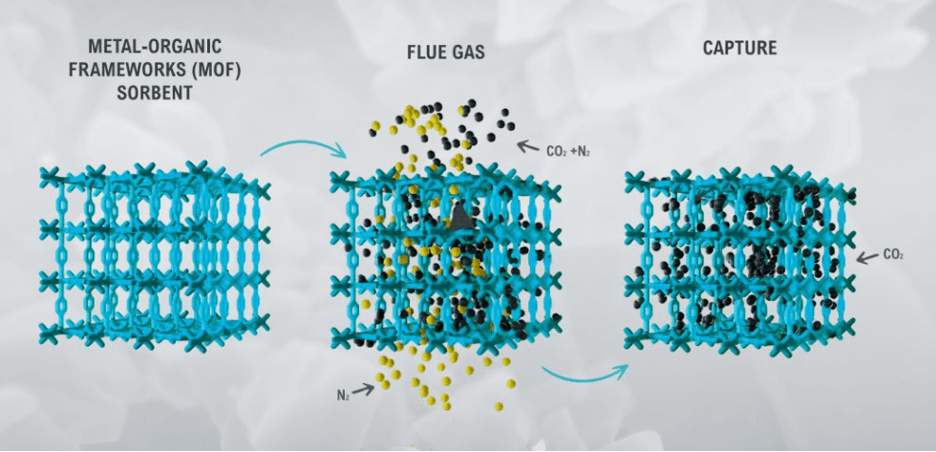
Graphic provided by Svante Technologies Inc.
The biggest hurdle for many technologies has historically been scalability from the lab to commercial application. A compelling real-world proof of concept for MOFs emerged in May 2026, when Amazon finalized a multi-year commercial agreement with U.S. startup Transaera to deploy next-generation rooftop heat pump units across its logistics facility networks.
Traditional commercial HVAC systems consume massive amounts of energy by overcooling incoming air to condense out moisture, then reheating it to a comfortable indoor temperature. A system tested by Amazon alters this dynamic by utilizing MOF-based cartridges to adsorb water vapor directly from outdoor air before any cooling takes place.
Independent data verified that the MOF-assisted system reduced HVAC energy consumption by roughly 40 percent compared to conventional units. Furthermore, unlike conventional drying agents that require energy-intensive, high-temperature heat, MOFs can release trapped moisture using the low-temperature waste heat already generated by a heat pump’s regular operation.
C2ES estimates that commercial and industrial building HVAC systems and related refrigerant leaks are responsible for around 8 to 10 percent of total U.S. greenhouse gas emissions, or 500 to 600 million metric tons of carbon dioxide equivalent annually.
With such large efficiency improvements, retrofitting or deploying new MOF-based systems across many commercial and industrial enterprises including new manufacturing facilities and data centers could significantly reduce HVAC-related emissions and energy needs.
MOF applications extend beyond HVAC systems. Efforts are underway to use these frameworks to capture carbon dioxide from industrial facilities and directly from the atmosphere.
Svante Technologies has developed proprietary filters that use CALF-20, a MOF manufactured and supplied by German chemical company BASF, to capture carbon dioxide from industrial emissions. Its commercial-scale technology is expected to be deployed by 2028 in Texas at Delek’s crude oil refinery, where it is expected to capture 145,000 metric tons of carbon annually. Other large projects in the planning phase include a bioenergy with carbon capture and storage (BECCS) facility in Saskatchewan that will capture 140,000 metric tons annually, and a Southeast U.S. paper mill project that will permanently sequester more than 500,000 metric tons of carbon dioxide annually. For reference, removing 100,000 metric tons of carbon dioxide is equivalent to avoiding the annual tailpipe emissions from around 22,000 typical cars.
Companies like CarbonCapture Inc., Climeworks, and Nuada that focus on direct air capture (DAC) of carbon dioxide are also looking into MOFs to reduce project costs and improve project efficiency. Additionally, companies like ExxonMobil and Baker Hughes are developing and acquiring MOF technologies to capture carbon dioxide from a range of sources.
MOFs versatility extends across energy-intensive, high-emissions sectors. Promising new pathways for significantly lower energy consumption are being created in the following four areas:
Maintaining economic prosperity and achieving our mid-century climate goals requires a comprehensive portfolio of solutions. Metal-organic frameworks offer a wide range of promising solutions that dramatically reduce energy needs and provide additional benefits. As examined in the C2ES Innovation Policy Matrix, targeted federal support could advance research and development, enable pilot and demonstration projects, and accelerate the ability of private industry to reach commercial scale sooner. By accelerating learning, validating real-world performance, and reducing costs, such support could help realize substantial efficiency gains while strengthening U.S. technology leadership and economic competitiveness.
| # | Наименование новости | Тональность | Информативность | Дата публикации |
|---|---|---|---|---|
| 1 | New Analysis Finds Federal Transmission Reforms Would Slash Power Sector Emissions, Boost Grid Reliability, and Save Consumers Billions | 0 | 5.9 | 30-09-2026 |
| 2 | New Report: Untapped Potential of Subsurface Hydrogen Offers No-Regrets Investment Opportunity in the US | 0 | 8.2 | 03-09-2026 |
| 3 | Subsurface Hydrogen | 0 | 8.86 | 04-09-2026 |
| 4 | Today and the Future | 0 | 7.8 | 21-09-2026 |
| 5 | New light-element crystal framework paves the way for safer all-solid-state batteries | 0 | 17.48 | 06-10-2026 |
| 6 | Engineering water infrastructure from concept to operation | 0 | 6.9 | 09-09-2026 |
| 7 | Growth and International Expansion | 0 | 6.53 | 14-09-2026 |
| 8 | The Proton Conductivity and Mechanical Properties of SPEEK-Ce:Zr Nanocomposite Membrane | 0 | 13.18 | 07-07-2026 |
| 9 | EuMW 2026: Radiating Change, Microwaves for a Sustainable Tomorrow | 0 | 21.11 | 11-08-2026 |
| 10 | Thin film motor boost | 0 | 8.19 | 17-08-2026 |