Просмотр новости
Найдите то, что Вас интересует
 Спутники
 РН
РН SpaceX
 Роскосмос
 NASA
NASA
СпутникиРНSpaceXРоскосмосNASAAs Indian companies expand overseas, a more fractious global geopolitical environment is exposing them to a wider web of sanctions, trade restrictions, data rules and regulatory regimes, making legal advice an increasingly key part of managing cross-border risk.
Mumbai: Companies are stepping up spending on legal matters as they move to close cross-border deals and resolve disputes. The trend highlights India Inc's efforts to go global while facing tighter regulations and greater compliance requirements as companies pursue more complex deals in a buzzing M&A market.
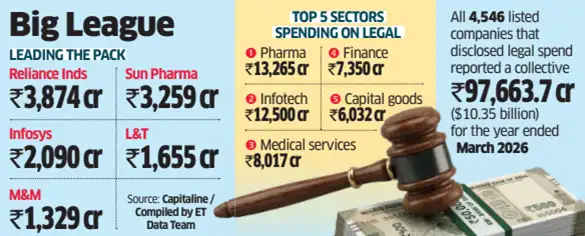
Nifty 500 companies spent ₹68,210 crore ($7.23 billion) on legal expenses last fiscal year, up 13.5% from FY25, data compiled by ET Data team showed.
Experts said one of the key drivers has been heavier spending on overseas deals, disputes and compliance.
The biggest companies account for much of that bill. Legal spending by Nifty 50 companies rose 9.7% to ₹25,519 crore, reflecting the rising prominence of legal advice in an increasingly regulated and litigious business environment.
Also Read: Essar-backed Mesabi Metallics to set up $15-billion steel plant in US
The increase, however, reflects more than higher corporate overheads.
As Indian companies expand overseas, a more fractious global geopolitical environment is exposing them to a wider web of sanctions, trade restrictions, data rules and regulatory regimes, making legal advice an increasingly key part of managing cross-border risk.
Jatin Jalundhwala, general counsel at Adani Group, said M&A and private equity deals, along with compliance, have become increasingly more complex in recent years. For Indian firms with a global presence, complexity has become a primary driver of rising legal costs, he said.
 ET Bureau
"Every acquisition now carries a longer list of questions around valuation adjustments, representations and warranties, indemnities, regulatory approvals, tax exposures and post-closing liabilities," said Jalundhwala. "Also, companies are operating under overlapping requirements covering data protection, competition, securities markets, environmental obligations, employment, consumer protection and increasingly sophisticated corporate governance standards."
Also Read: Tata Steel extends Dutch green steel pact by five months to March 2027
For technology companies, the emergence of AI has added another layer, he said.
Legal expenses typically include litigation and arbitration costs, professional fees, regulatory filings, penalties and stamp duty, among other expenses.
More broadly, the rise in legal costs is driven by regulation becoming more extensive, specialised and fast-changing, said Naveen Raju, group general counsel and executive vice president at Mahindra Group.
"In situations like transactions, the cost of failure is rising sharply, pushing boards to invest upfront in prevention and the fact that the GC's role itself has shifted from merely reviewing decisions that have been taken to actually shaping them in real time, which demands more resourcing and legal scrutiny," said Raju.
For corporate India, the legal bill is starting to look less like an overhead and more like an investment in growth, the price of having the legal firepower to move faster, take bigger bets and operate across more jurisdictions.
Across the broader listed universe, legal spending of 4,546 listed companies that reported such expenses reached ₹97,663.71 crore ($10.35 billion) in FY26.
Sanjeev Gemawat, managing director and group general counsel at Essar Group, said India's legal market has enormous headroom. A larger economy and deeper corporate activity inevitably create more legal work, while technology such as AI could allow lawyers to handle that growing workload more efficiently.
"India is moving towards a larger and more sophisticated legal economy as GDP grows, businesses globalise, regulation deepens, and legal services become increasingly technology-enabled," said Gemawat. "Even if AI substantially improves productivity and reduces the cost of individual legal tasks, the overall demand for legal services can continue to expand because the economy itself is expanding and becoming more legally intensive."
| # | Наименование новости | Тональность | Информативность | Дата публикации |
|---|---|---|---|---|
| 1 | Tata dispute sends India Inc scrambling to shore up shareholder rights | 0 | 6.34 | 25-09-2026 |
| 2 | US sanctions target growing influence of Russia’s transnational economy — expert | 0 | 7.2 | 30-09-2026 |
| 3 | India needs its own criticality assessment framework for critical minerals | 0 | 7.35 | 29-09-2026 |
| 4 | Rating upgrades moderate in H1 as India Inc faces multiple headwinds | 0 | 7.35 | 30-09-2026 |
| 5 | Factory floor or family office? India’s young rich alarm elders | 0 | 7.36 | 22-09-2026 |
| 6 | Amazon v. Perplexity: who’s in control when an AI agent acts for you? | 0 | 9.5 | 29-09-2026 |
| 7 | Indian executives are gaining clout in US corporate boardrooms | 0 | 10.13 | 28-09-2026 |
| 8 | Эксперт Войтоловский: США санкциями борются с растущим влиянием экономики России | 0 | 11.88 | 30-09-2026 |
| 9 | From Chennai to the world | 0 | 8.79 | 17-08-2026 |
| 10 | India business confidence rises 8% in September despite global headwinds: ASSOCHAM | 0 | 10 | 30-09-2026 |