Просмотр новости
Найдите то, что Вас интересует
 Спутники
 РН
РН SpaceX
 Роскосмос
 NASA
NASA
СпутникиРНSpaceXРоскосмосNASATiny water-oozing pores appear to shape the leaves’ veins into a “Voronoi diagram.”
A common houseplant hides a splendid geometric pattern.
This design, called a Voronoi diagram, appears on the leaves of the Chinese money plant. The layout may arise as waves of a plant hormone spread across a leaf during its development. A similar process may shape the vein patterns in leaves of other plants, too.
Researchers shared these findings May 12 in Nature Communications.
This is a “beautiful” showcase of how plant veins develop to move water across leaves most efficiently, says Lawren Sack. He did not take part in the research. But he does study plant biology at the University of California, Los Angeles. Veins of leaves “have so much to tell us” about how to get resources where they need to go, he says.
Lurking in leavesLeaves of the Chinese money plant (Pilea peperomioides) are speckled with pores. Called hydathodes, these pores release water. Each one is fenced in by veins to form a mosaic.
While in high school, Elijah Blum discovered a curious pattern in those leaf veins. He noticed it while plant-sitting for his sister. At the time, Blum was an intern at Cold Spring Harbor Laboratory in New York. (He’s now in college at New York University.) He shared what he’d found with his internship supervisor, computer scientist Saket Navlakha.
“He showed the plant to me, and he said, ‘Look, the veins look kind of interesting here,’” Navlakha says. “We sort of held it up to the light — and we saw that … Voronoi diagram.”
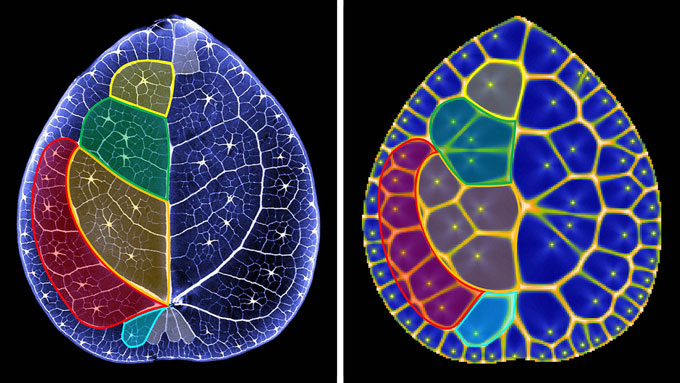 The layout of veins and pores on a Chinese money plant leaf (left, in false color) closely matches a computer model of a Voronoi diagram (right). Scientists made the computer model using the leaf’s pore positions as an array of dots. Colors show the regions on the actual leaf that correspond to regions in the computer model.Navlakha lab/CSHL
In a Voronoi diagram, a surface is split up into zones. Each zone contains a designated point. And every spot within a zone must be closer to that zone’s point than any other.
Urban planners use the same idea to decide which fire department a house should be assigned to. This helps each house in a city or town be closer to the fire station in its zone than any other station.
Patterns that look similar to Voronoi diagrams appear elsewhere in nature. The tiles on giraffe fur look like this type of design. So do the scales of dragonfly wings. But in a true Voronoi diagram, the mosaic must form around a set of points. In the Chinese money plant, the water-oozing pores serve as those points.
Making the mosaicBlum and the others were curious how this pattern might develop.
Similar leaf veins are thought to form through canalization. In this process, a hormone involved in plant development — auxin — branches out across leaves. As it does, it creates a treelike network of channels that become veins.
But that wouldn’t produce a Voronoi diagram around a leaf’s pores, the team found. Computer models instead showed that as Pilea leaves develop, waves of auxin spread out from each pore. Those waves collide to form ridges. Eventually, they become a leaf’s major veins.
More research is needed to find out why Pilea leaves follow this pattern, says team member CiCi Zheng. She studies the math of living things at the Allen Institute in Seattle, Wash.
The Voronoi diagram layout might be useful for plants, she says. This pattern keeps a leaf’s major veins — which transport water — as far as possible from its water-leaking pores. “You might want to place the veins not directly close to any of those locations where water evaporates super-fast,” Zheng says.
Sack at UCLA is excited about what new tech this finding might inspire. Past studies of leaf veins, he says, have helped engineers reimagine how to distribute resources such as water and energy. Such insights have improved solar panels, electronic circuits and irrigation systems.
“The more we know about leaf veins,” Sack says, “the more we can build functional and beautiful systems around us.”
Submit your question here, and we might answer it an upcoming issue of Science News Explores
biology: The study of living things. The scientists who study them are known as biologists.
circuit: A network that transmits electrical signals. In the body, nerve cells create circuits that relay electrical signals to the brain. In electronics, wires typically route those signals to activate some mechanical, computational or other function.
computer model: A program that runs on a computer that creates a model, or simulation, of a real-world feature, phenomenon or event.
develop: To emerge or to make come into being, either naturally or through human intervention, such as by manufacturing. (in biology) To grow as an organism from conception through adulthood, often undergoing changes in chemistry, size, mental maturity or sometimes even shape.
development: (in biology) The growth of an organism from conception through adulthood, often undergoing changes in chemistry, size and sometimes even shape.
engineer: A person who uses science and math to solve problems. As a verb, to engineer means to design a device, material or process that will solve some problem or unmet need.
evaporate: To turn from liquid into vapor.
high school: A designation for grades nine through 12 in the U.S. system of compulsory public education. High-school graduates may apply to colleges for further, advanced education.
hormone: (in botany) A chemical that serves as a signaling compound that tells cells of a plant when and how to develop, or when to grow old and die.
hydathodes: A type of microscopic, permanently open pores found on some plants (usually vascular plants). They are part of a system that moves water through the plant. They also allow some plants to exude excess water, almost like a water safety valve.
insight: The ability to gain an accurate and deep understanding of a situation just by thinking about it, instead of working out a solution through experimentation.
model: A simulation of a real-world event (usually using a computer) that has been developed to predict one or more likely outcomes. Or an individual that is meant to display how something would work in or look on others.
mosaic: Something made from an assembly of different types of objects.
network: A group of interconnected people or things. (v.) The act of connecting with other people who work in a given area or do similar thing (such as artists, business leaders or medical-support groups), often by going to gatherings where such people would be expected, and then chatting them up. (n. networking)
pore: A tiny hole in a surface. On the skin, substances such as oil, water and sweat pass through these openings.
solar: Having to do with the sun or the radiation it emits. It comes from sol, Latin for sun.
system: A network of parts that together work to achieve some function. For instance, the blood, vessels and heart are primary components of the human body's circulatory system. Similarly, trains, platforms, tracks, roadway signals and overpasses are among the potential components of a nation's railway system. System can even be applied to the processes or ideas that are part of some method or ordered set of procedures for getting a task done.
urban: Of or related to cities, especially densely populated ones or regions where lots of traffic and industrial activity occurs. The development or buildup of urban areas is a phenomenon known as urbanization.
vein: (in botany) The tubular system made up of xylem and phloem cells that a plant uses to transport materials (water and sugars, for instance) throughout its structures above- and below-ground.
vent: (n.) An opening through which gases or liquids can escape. (v.) To free gases or liquids that had been under pressure. The term can also be used to release strong, pent-up emotions, such as anger.
wave: A disturbance or variation that travels through space and matter in a regular, oscillating fashion.
| # | Наименование новости | Тональность | Информативность | Дата публикации |
|---|---|---|---|---|
| 1 | A flower-like pattern exposes chiral superconductivity's long-sought fingerprint | 0 | 13.6 | 29-04-2026 |
| 2 | This microbe turns into a ‘Hulk’ that eats its own kind | 0 | 13.57 | 12-08-2026 |
| 3 | China’s unlikely new entertainment capital | 0 | 5 | 04-12-2025 |
| 4 | China’s AI giants are handing out cash to lure in users | 0 | 5 | 09-03-2026 |
| 5 | Scientists reveal what really happens when water is trapped in tiny spaces | 0 | 8.46 | 02-07-2026 |
| 6 | Россиянам раскрыли способ защитить дачу от потопа | 0 | 5 | 16-07-2026 |
| 7 | Футуристичные фонтаны в виде бамбука в китайском городе Чэнду | 0 | 2.5 | 10-08-2026 |
| 8 | This strange crystal acts like metal and glass at the same time | 0 | 7.78 | 01-06-2026 |
| 9 | Боня показала свой чайный гриб | 0 | 6.4 | 11-08-2026 |