Просмотр новости
Найдите то, что Вас интересует
 Спутники
 РН
РН SpaceX
 Роскосмос
 NASA
NASA
СпутникиРНSpaceXРоскосмосNASAThe shape-shifting transformation of Euplotes gigatrox may reveal how early life learned to act in complex ways.
A newly discovered microbe is like a mini version of the Hulk.
This single-celled protist looks a bit like an insect. It normally grazes on bacteria and other microbes. But sometimes, a small number of this predator — named E. gigatrox — balloon to more than twice their regular size.
 Ben T. Larson and Samuel J. Lord
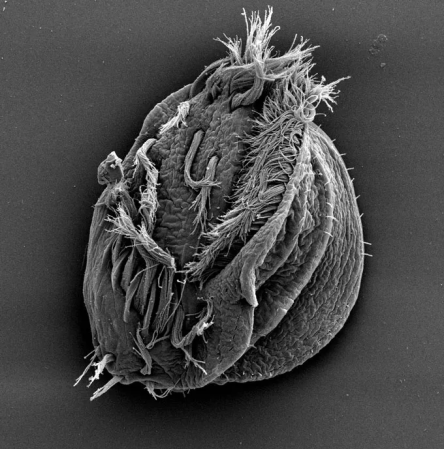
Euplotes gigatrox may look like an insect, but it’s a type of single-celled protist called a ciliate. It has lots of hairlike cilia surrounding its mouth parts (large oval depression, top). This microscope image shows the underside of the cell’s supergiant form.
As they enlarge, these “supergiant” cells turn into cannibals, gobbling up their smaller siblings. What triggers the change isn’t all that clear. But it tends to happen when there is plenty of food.
Researchers shared their new findings May 14. The work appeared in the Proceedings of the National Academy of Sciences.
Morphing into a supergiant happens in steps, says Ben Larson. A cell biologist, he works at Rensselaer Polytechnic Institute in Troy, N.Y. He discovered the Hulked-out microbes in gunk scraped from a filter at an aquarium in Curaçao. That’s a Dutch territory in the Caribbean Sea.
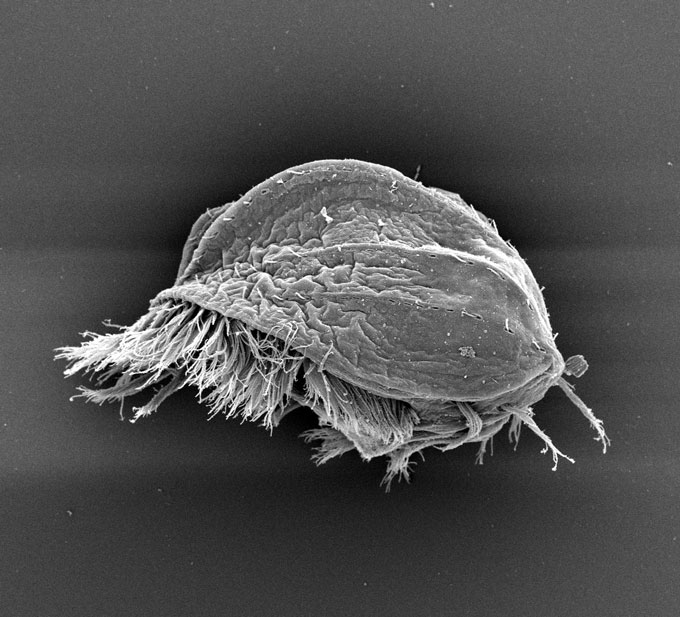
Euplotes gigatrox has two different forms: regular size and supergiant. This is a side view of the supergiant. It eats its smaller siblings by running over them and jamming them into its mouth. That mouth lurks behind the fringe of hairlike cilia.
 Ben T. Larson and Samuel J. Lord
In the first stage, “a cell gets a big mouth,” Larson says. Then, “they start running around like crazy.” At that point, they still aren’t great cannibals. But watch out! Once a would-be Hulk catches one of its siblings or cousins in its enlarged mouth, its whole body plan changes. These cells “grow up to be these just enormous cannibalistic supergiants,” Larson says.
Like Bruce Banner and the Hulk, giants and regular-size cells act differently. Regular size cells walk and swim. The big ones can only walk in circles.
Giants can return to their former size by lopsided splitting. Normal-size E. gigatrox divide just once per day. Shrinking Hulks, in contrast, can produce nine normal-size offspring in the first day. Over five days, they can generate up to 16 offspring.
Each time a giant cell divides, it shrinks somewhat. Eventually it returns to normal size and behavior.
Up to 42 percent of the species’ genes are involved in shifting from regular size to giant and back again. Learning how these protists do this may offer clues about how simple life forms develop complex behaviors. It might even point to how many-celled life first evolved.
Submit your question here, and we might answer it an upcoming issue of Science News Explores
bacteria: (singular: bacterium) Single-celled organisms. These dwell nearly everywhere on Earth, from the bottom of the sea to inside other living organisms (such as plants and animals). Bacteria are one of the three domains of life on Earth.
behavior: The way something (often a person or other organism) conducts itself or acts towards others.
biologist: A scientist involved in the study of living things.
Caribbean: The name of a sea that runs from the Atlantic Ocean in the East to Mexico and Central American nations in the West, and from the southern coasts of Cuba, the Dominican Republic and Puerto Rico down to the northern coasts of Venezuela and Brazil. The term is also used to refer to the culture of nations that border on or are islands in the sea.
cell: (in biology) The smallest structural and functional unit of an organism. Typically too small to see with the unaided eye, it consists of a watery fluid surrounded by a membrane or wall. Depending on their size, animals are made of anywhere from thousands to trillions of cells. Most organisms, such as yeasts, molds, bacteria and some algae, are composed of only one cell.
develop: To emerge or to make come into being, either naturally or through human intervention, such as by manufacturing. (in biology) To grow as an organism from conception through adulthood, often undergoing changes in chemistry, size, mental maturity or sometimes even shape.
filter: (n.) Something that allows some materials to pass through but not others, based on their size or some other feature. (v.) The process of screening some things out on the basis of traits such as size, density, electric charge.
gene: (adj. genetic) A segment of DNA that codes, or holds instructions, for a cell’s production of a protein. Offspring inherit genes from their parents. Genes influence how an organism looks and behaves.
insect: A type of arthropod that as an adult will have six segmented legs and three body parts: a head, thorax and abdomen. There are hundreds of thousands of insects, which include bees, beetles, flies and moths.
insight: The ability to gain an accurate and deep understanding of a situation just by thinking about it, instead of working out a solution through experimentation.
Proceedings of the National Academy of Sciences: A prestigious journal publishing original scientific research, begun in 1914. The journal's content spans the biological, physical and social sciences. Each of the more than 3,000 papers it publishes each year, now, are not only peer reviewed but also approved by a member of the U.S. National Academy of Sciences.
protist: A broad group of mostly single-celled organisms that are neither plants nor animals. Some, like algae, may appear plant-like. Those known as protozoans may appear animal-like. And still others appear fungi-like. More blob-like members of the group are known as amoebas.
sea: An ocean (or region that is part of an ocean). Unlike lakes and streams, seawater — or ocean water — is salty.
sibling: An offspring that shares the same parents (with its brother or sister).
Tina Hesman Saey is a senior staff writer and reports on molecular biology at Science News. She has a Ph.D. in molecular genetics from Washington University in St. Louis and a master’s degree in science journalism from Boston University.
| # | Наименование новости | Тональность | Информативность | Дата публикации |
|---|---|---|---|---|
| 1 | Une bactérie industrielle transforme les fumées nocives en biocarburant | 5 | 8 | 04-11-2025 |
| 2 | Asgard Archaea Offer Clues to How Complex Life Began | 0 | 5.85 | 09-04-2026 |
| 3 | New mechanism reveals how atypical E. coli maintain their ability to infect | 0 | 7.1 | 16-09-2026 |
| 4 | Typhoons mix up bacteria and biochemistry | 0 | 7 | 14-07-2026 |
| 5 | Cosmic gymnastics: Study reveals how our Milky Way once underwent a dramatic FLIP | 0 | 6.66 | 21-07-2026 |
| 6 | Раскрыт способ защиты от «поедающей мозг» амебы | 0 | 10 | 29-08-2026 |
| 7 | Scientists reveal which creature will RULE Earth should all humans die | 0 | 11.1 | 15-11-2024 |
| 8 | Leben am Limit: Bakterien können auch Eisen atmen | 0 | 9.45 | 26-07-2026 |
| 9 | Ученые обнаружили гриб, заимствовавший гены у бактерий ради жизни у гиперсоленого озера | 0 | 0 | 21-11-2018 |
| 10 | Mimikry: Spinnenschwanz einer Schlangenart überrascht von innen | 0 | 10 | 11-09-2026 |