Просмотр новости
Найдите то, что Вас интересует
 Спутники
 РН
РН SpaceX
 Роскосмос
 NASA
NASA
СпутникиРНSpaceXРоскосмосNASAThe puffiest planets known in our galaxy orbit a sunlike star more than 1,000 light-years from Earth.
A pair of newly found planets are the puffiest worlds ever seen. They’re both about the size of Jupiter but with less than 6 percent of its mass.
In terms of density, these planets are “like candy floss or shaving foam,” says George Dransfield. She’s an astrophysicist at the University of Oxford in England. “They’re the lightest planets that are Jupiter-sized.”
Both orbit TOI 791. That’s a sunlike star about 1,113 light-years from Earth. The TESS space telescope spotted them as they passed — or transited — in front of their star and blocked some of its light. Comparing the star when it was blocked and unblocked let Dransfield and others measure the planets’ width.
One world is about 0.993 times as wide as Jupiter. The other has about 1.155 times Jupiter’s width.
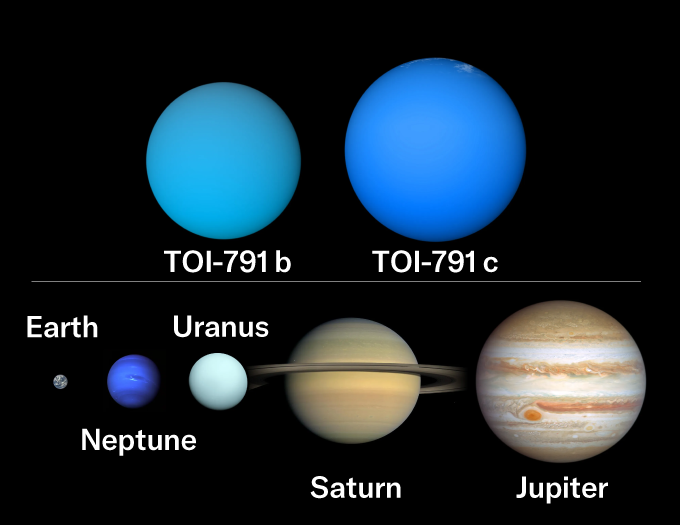 Two newfound planets that orbit the star TOI 791 (top row) are roughly as large as Jupiter and about as dense as shaving cream. Their large sizes could be due to heat “puffing” up their atmospheres.Daniel Rutter/NASA
For the team to find their density, it needed to know both the planets’ size and mass. Transits only give their size. That’s where their orbits come in. The two planets periodically pass by one another as they circle their star. As they do, the planets give each other a little gravitational tug.
“They’re in this fun little dance,” Dransfield says. “We were able to measure the masses of the planets by how much they kick each other’s orbits.”
Dransfield and her teammates tracked the planetary dance over several years. They used the Antarctic Search for Transiting ExoPlanets telescope, or ASTEP. It was the only telescope on Earth that could observe the planets’ entire transits. Why? Because it takes about 12 hours for each planet to pass in front of its star. It’s hard to find a place on Earth that gets 12 straight hours of darkness at a time during which to view that. But Antarctica gets three straight months of darkness each year.
“Without this telescope, this discovery would not have happened,” Dransfield says.
Those measurements let her team deduce the planets’ masses. One was 9.5 times the mass of Earth. The other had the heft of 18.6 Earths. (Jupiter has 317 times Earth’s mass.) That means their densities are 0.038 and 0.047 gram per cubic centimeter. For comparison, cotton candy’s density is typically about 0.05 gram per cubic centimeter.
The researchers shared these findings in the July Monthly Notices of the Royal Astronomical Society.
Sizing up superpuffsThe new planets join the small group of large but lightweight worlds known as superpuffs. Astronomers aren’t sure how they form. One theory is that they’re born far from their star and move inward. Their atmospheres would heat and puff up as they neared their stars.
Some superpuffs might have giant ring systems, which could make them look bigger than they really are. Astrophysicists Anthony Piro and Shreyas Vissapragada proposed this idea in 2020. But that’s probably not the case for the two newfound planets, says Piro.
Having two ringed planets mistaken for superpuffs around the same star would be too much of a coincidence, he says. Piro works at the Carnegie Observatories in Pasadena, Calif. He did not take part in the new study.
The host star is spinning quickly, which could be a sign that it’s fairly young, Piro notes. If so, these superpuffs might still be cooling off. They might shrink as they age. “We might be catching these planets at an intermediate stage,” Piro says.
The next step is to use the James Webb Space Telescope to probe the planets’ chemical makeup. That could reveal more about their origins, Dransfield says.
“Finding things like superpuffs, which are incredibly rare, means we can learn more about how planets form,” Dransfield says. They also offer clues about how planets evolve and what they can end up looking like. “That also helps us [understand] Earth in the wider context of the cosmos.”
Submit your question here, and we might answer it an upcoming issue of Science News Explores
Antarctica: A continent mostly covered in ice, which sits in the southernmost part of the world.
astronomer: A scientist who works in the field of research that deals with celestial objects, space and the physical universe.
astrophysicist: A scientist who works in an area of astronomy that deals with understanding the physical nature of stars and other objects in space.
atmosphere: The envelope of gases surrounding Earth, another planet or a moon.
context: The setting or circumstances that help explain an event, some statement or some conclusion.
density: The measure of how condensed some object is, found by dividing its mass by its volume.
evolve: (adj. evolving) To change gradually over generations, or a long period of time. In living organisms, such an evolution usually involves random changes to genes that will then be passed along to an individual’s offspring. These can lead to new traits, such as altered coloration, new susceptibility to disease or protection from it, or different shaped features (such as legs, antennae, toes or internal organs). Nonliving things may also be described as evolving if they change over time. For instance, the miniaturization of computers is sometimes described as these devices evolving to smaller, more complex devices.
Jupiter: (in astronomy) The solar system’s largest planet, it has the shortest day length (9 hours, 55 minutes). A gas giant, its low density indicates that this planet is composed mostly of the light elements hydrogen and helium. This planet also releases more heat than it receives from the sun as gravity compresses its mass (and slowly shrinks the planet).
light-year: The distance light travels in one year, about 9.46 trillion kilometers (almost 6 trillion miles). To get some idea of this length, imagine a rope long enough to wrap around the Earth. It would be a little over 40,000 kilometers (24,900 miles) long. Lay it out straight. Now lay another 236 million more that are the same length, end-to-end, right after the first. The total distance they now span would equal one light-year.
mass: A number that shows how much an object resists speeding up or slowing down — basically a measure of how much matter that object is made from.
orbit: The curved path of a celestial object or spacecraft around a galaxy, star, planet or moon. One complete circuit around a celestial body.
planet: A large celestial object that orbits a star but unlike a star does not generate any visible light.
star: The basic building block from which galaxies are made. Stars develop when gravity compacts clouds of gas. When they become hot enough, stars will emit light and other forms of electromagnetic radiation. The sun is our closest star.
telescope: Usually a light-collecting instrument that makes distant objects appear nearer through the use of lenses or a combination of curved mirrors and lenses. Some, however, collect radio emissions (energy from a different portion of the electromagnetic spectrum) through a network of antennas.
theoretical: An adjective for an analysis or assessment of something that based on pre-existing knowledge of how things behave. It is not based on experimental trials. Theoretical research tends to use math — usually performed by computers — to predict how or what will occur for some specified series of conditions. Experimental testing or observations of natural systems will then be needed to confirm what had been predicted.
theory: (in science) A description of some aspect of the natural world based on extensive observations, tests and reason. A theory can also be a way of organizing a broad body of knowledge that applies in a broad range of circumstances to explain what will happen. Unlike the common definition of theory, a theory in science is not just a hunch. Ideas or conclusions that are based on a theory — and not yet on firm data or observations — are referred to as theoretical. Scientists who use mathematics and/or existing data to project what might happen in new situations are known as theorists.
transit: (in astronomy) The passing of a planet, asteroid or comet across the face of a star, or of a moon across the face of a planet.
Lisa Grossman is the astronomy writer at Science News. She has a degree in astronomy from Cornell University and a graduate certificate in science writing from University of California, Santa Cruz. She lives near Boston.
| # | Наименование новости | Тональность | Информативность | Дата публикации |
|---|---|---|---|---|
| 1 | Astronomers Discover Two Super Puff Planets Lighter Than Cotton Candy | 0 | 15.69 | 21-07-2026 |
| 2 | Rare Pair of Improbably Light ‘Super-Puff’ Planets Is Discovered | 2 | 7 | 17-07-2026 |
| 3 | Astronomers found two rare super puff planets lighter than cotton candy | 0 | 7.7 | 27-06-2026 |
| 4 | Puffiest exoplanets yet found are as dense as cotton candy | 0 | 5 | 06-07-2026 |
| 5 | Cotton-Candy Exoplanets: Two for the Price of One! | 0 | 10.76 | 02-07-2026 |
| 6 | Астрономы нашли две планеты с плотностью меньше, чем у сахарной ... | 5 | 7 | 30-06-2026 |
| 7 | 🌌 «Сахарная вата» из космоса: суперпаффы 🪄 Представь планету размером ... | 0 | 4.82 | 10-09-2026 |
| 8 | ЗНАКОМЬТЕСЬ С САМЫМИ «ПУХЛЫМИ» ПЛАНЕТАМИ МЛЕЧНОГО ПУТИ 🌑 Пара недавно ... | 0 | 9.54 | 28-07-2026 |
| 9 | These Nearby Alien Planets Are Stranger – and More Hostile – Than Expected | 0 | 19.12 | 23-07-2026 |
| 10 | ✅️Астрономы подтвердили открытие двух редких планет-«суперпуфов» — TOI-791 b и ... | 7 | 7 | 18-07-2026 |