Просмотр новости
Найдите то, что Вас интересует
 Спутники
 РН
РН SpaceX
 Роскосмос
 NASA
NASA
СпутникиРНSpaceXРоскосмосNASATwo giant planets lighter than cotton candy are giving astronomers a rare new window into the origins of some of the galaxy’s strangest worlds. Astronomers have identified two of the least dense giant planets ever measured. The unusual worlds belong to a rare class known as “super-puff” planets, and both are less dense than cotton [...]
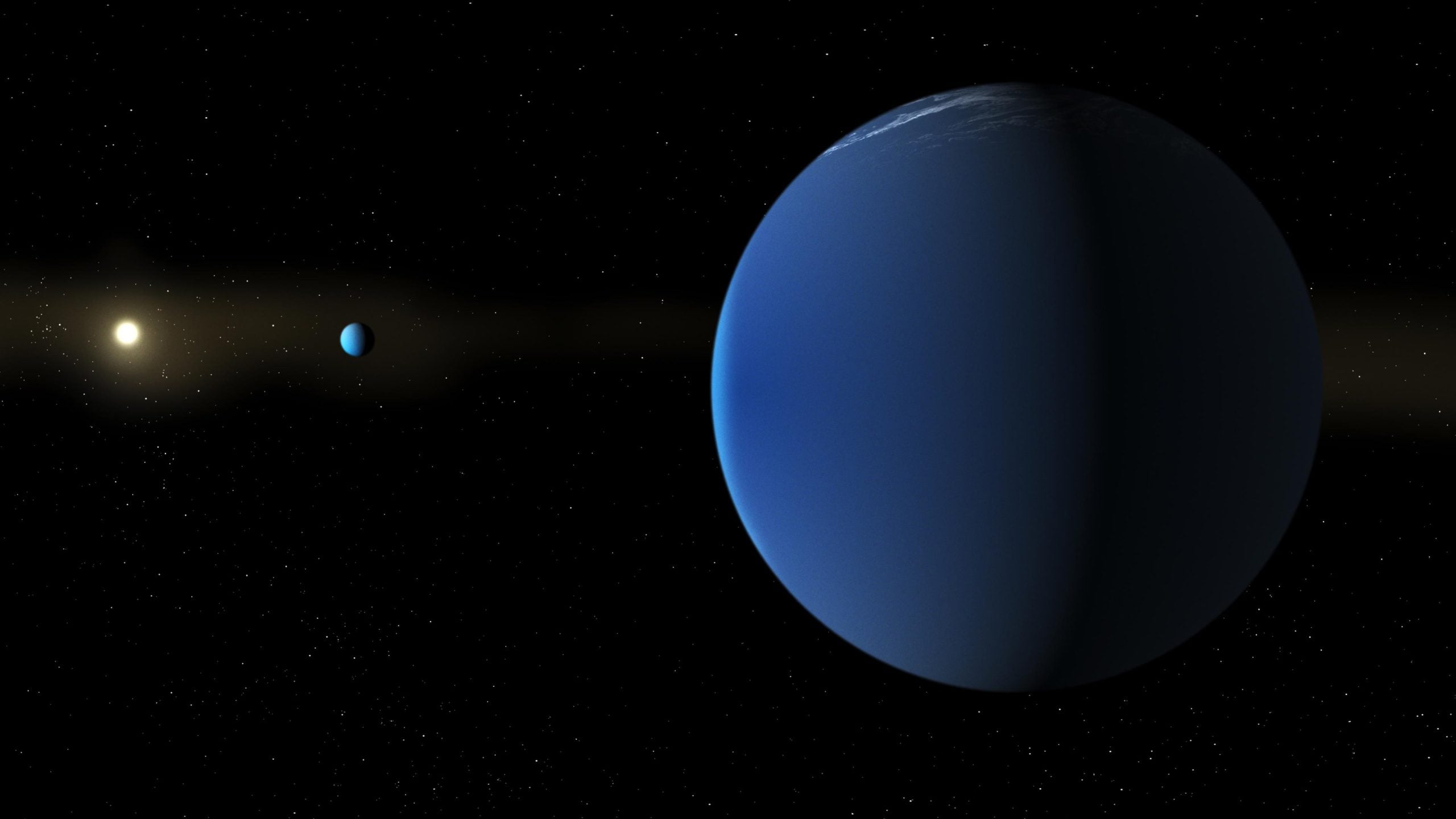 This illustration depicts the Sun-like star TOI-791 and two giant planets that NASA’s TESS space telescope discovered in its orbit. These planets, designated TOI-791 b and TOI-791 c, are roughly the size of Jupiter but a tiny fraction of its mass, meaning they have an extraordinarily low density. Credit: NASA/Daniel Rutter
Two giant planets lighter than cotton candy are giving astronomers a rare new window into the origins of some of the galaxy’s strangest worlds.
Astronomers have identified two of the least dense giant planets ever measured. The unusual worlds belong to a rare class known as “super-puff” planets, and both are less dense than cotton candy.
The discovery was made by an international team led by the University of Oxford, working with Université Côte d’Azur/Observatoire de la Côte d’Azur and the University of Birmingham. The findings were published in Monthly Notices of the Royal Astronomical Society.
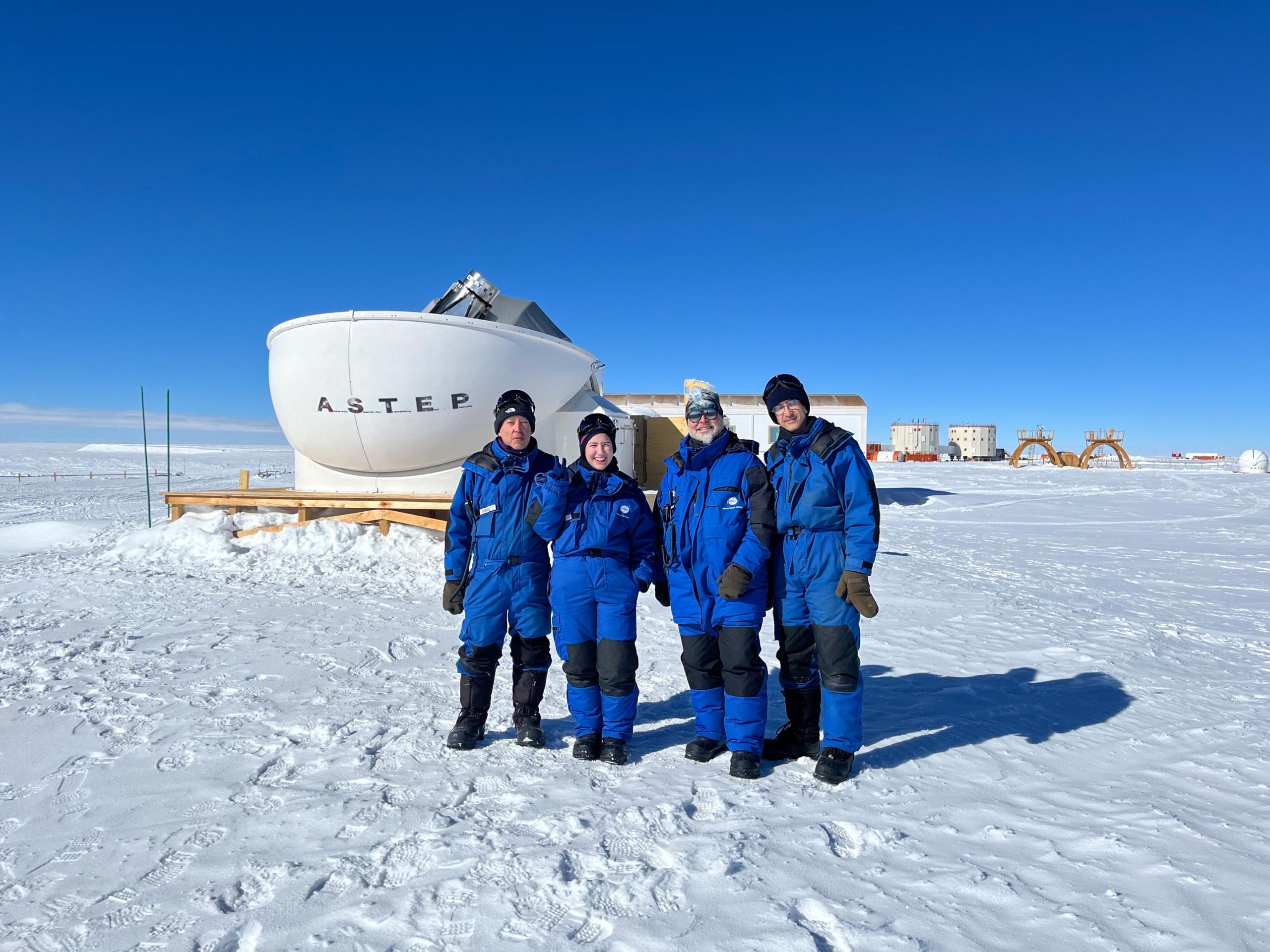 Dr. George Dransfield and colleagues with the Antarctic telescope, ASTEP (Antarctic Search for Transiting ExoPlanets), during a summer service mission in 2021/2022. Credit: Karim Agabi/IPEV/PNRAGiant Planets With Extremely Low Densities
The exoplanets, called TOI-791 b and TOI-791 c, circle an F7-type dwarf star about 1,110 light years from Earth in the southern constellation Volans.
Both worlds are approximately the size of Jupiter, but they contain far less material than their enormous dimensions might suggest. TOI-791 b has a density of only 0.038 grams per cubic centimeter, while TOI-791 c has a density of 0.047 grams per cubic centimeter.
Jupiter, by comparison, has an average density of 1.33 grams per cubic centimeter. That makes Jupiter roughly 28 to 35 times denser than the newly confirmed planets.
Cotton candy typically has a density of about 0.05 grams per cubic centimeter, meaning both planets are even less dense. Earth is far more compact, with a density of 5.5 grams per cubic centimeter.
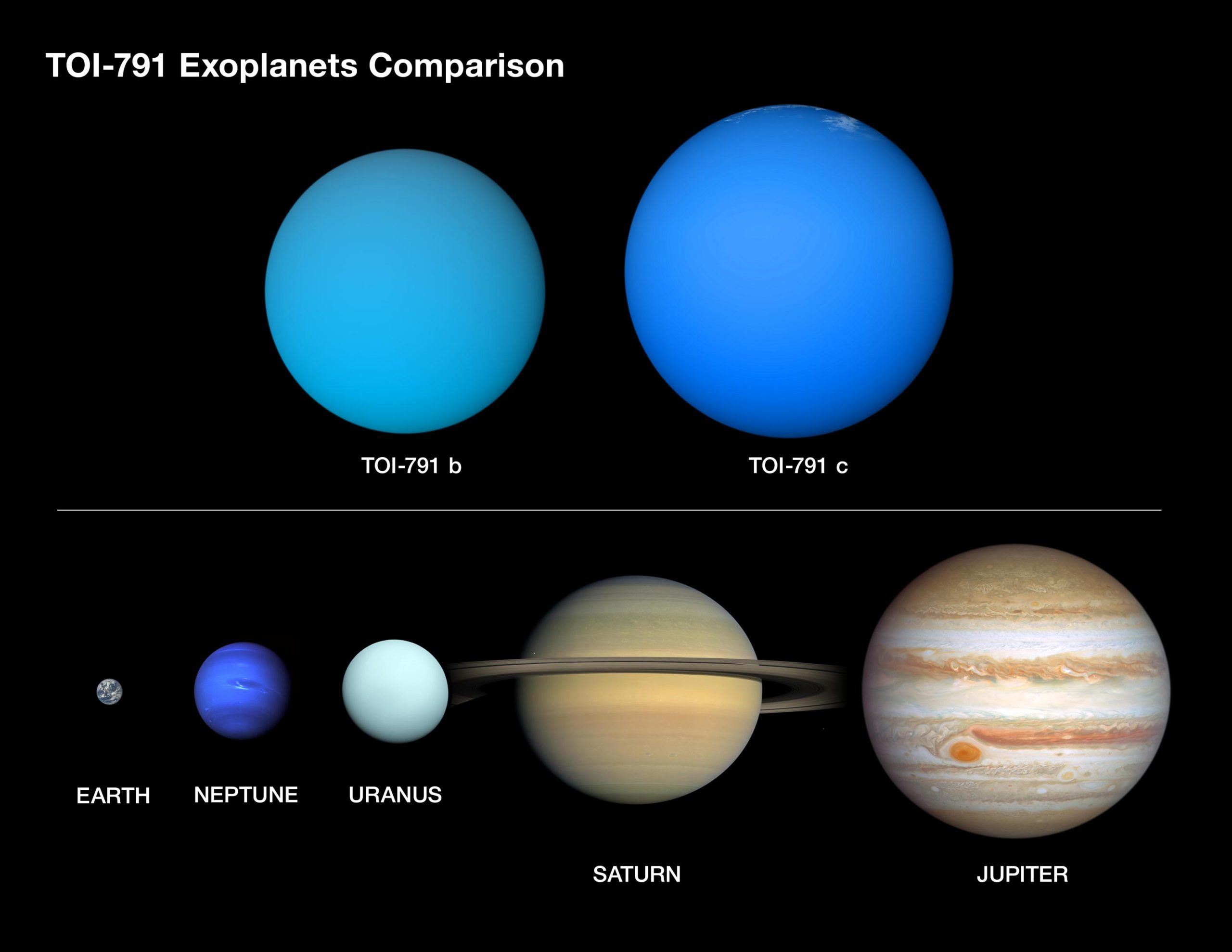 Comparison of the exoplanets in the TOI-791 system with planets in our solar system. Credit: NASA/Daniel RutterTwo Planetary Siblings Locked in an Orbital Dance
Scientists believe the two planets formed together from the same disk of gas and dust around their young host star, making them planetary “siblings.”
They are also connected through an uncommon gravitational pattern called a 5:3 mean-motion resonance. For every five trips the inner planet makes around the star, the outer planet completes almost exactly three.
As the planets orbit, their gravity causes them to repeatedly pull on one another. These interactions create small but detectable changes in the times when each planet crosses in front of the star.
Only four other known planetary systems contain more than one super-puff planet. The rarity of this arrangement makes the TOI-791 system an especially valuable place to investigate how such unusual worlds develop and change over time.
Lead author Dr. George Dransfield (she/her) (Department of Physics, University of Oxford and a presenter for BBC Sky at Night) said: “Only a handful of these super-puffy planets are known, and it is even rarer to find two in the same system. Their extremely low densities make them fascinating targets for understanding how planetary systems form and evolve.”
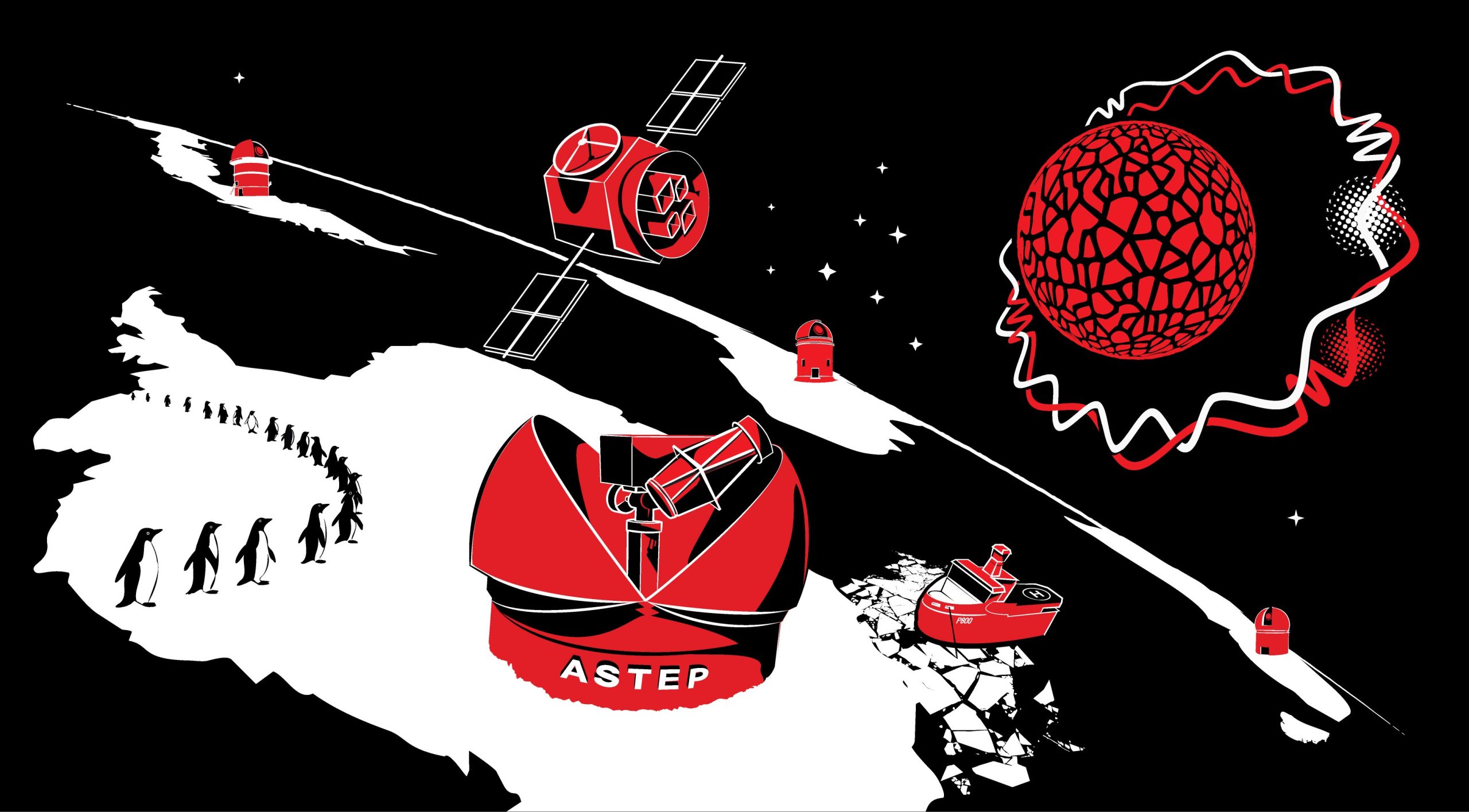 An illustration of the ASTEP (Antarctic Search for Transiting ExoPlanets) telescope at Concordia Station in Antarctica and other telescopes observing the TOI-791 systems whose two gas giants are interacting gravitationally with one another. Credit: University of Birmingham / Amanda SmithCitizen Scientists Helped Find the Planets
TOI-791 b and TOI-791 c were initially flagged as possible planets in 2019 and 2023, respectively. Volunteers made the identifications through the Planet Hunters TESS citizen-science project, which examines observations from NASA’s Transiting Exoplanet Survey Satellite (TESS) in search of previously unknown worlds.
Astronomers later used telescopes around the world to determine the sizes and masses of the planets. Combining those measurements allowed the researchers to calculate their remarkably low densities.
A planet can be detected when it moves in front of its star and blocks a small portion of the star’s light. This event is known as a ‘transit,’ and the amount of light lost helps astronomers estimate the planet’s size.
In the TOI-791 system, scientists also noticed that the transits did not occur at perfectly regular intervals. The slight timing changes were caused by the planets pulling on each other as they traveled around the star.
By studying these variations, the team estimated the mass of each world and confirmed that both planets are exceptionally diffuse.
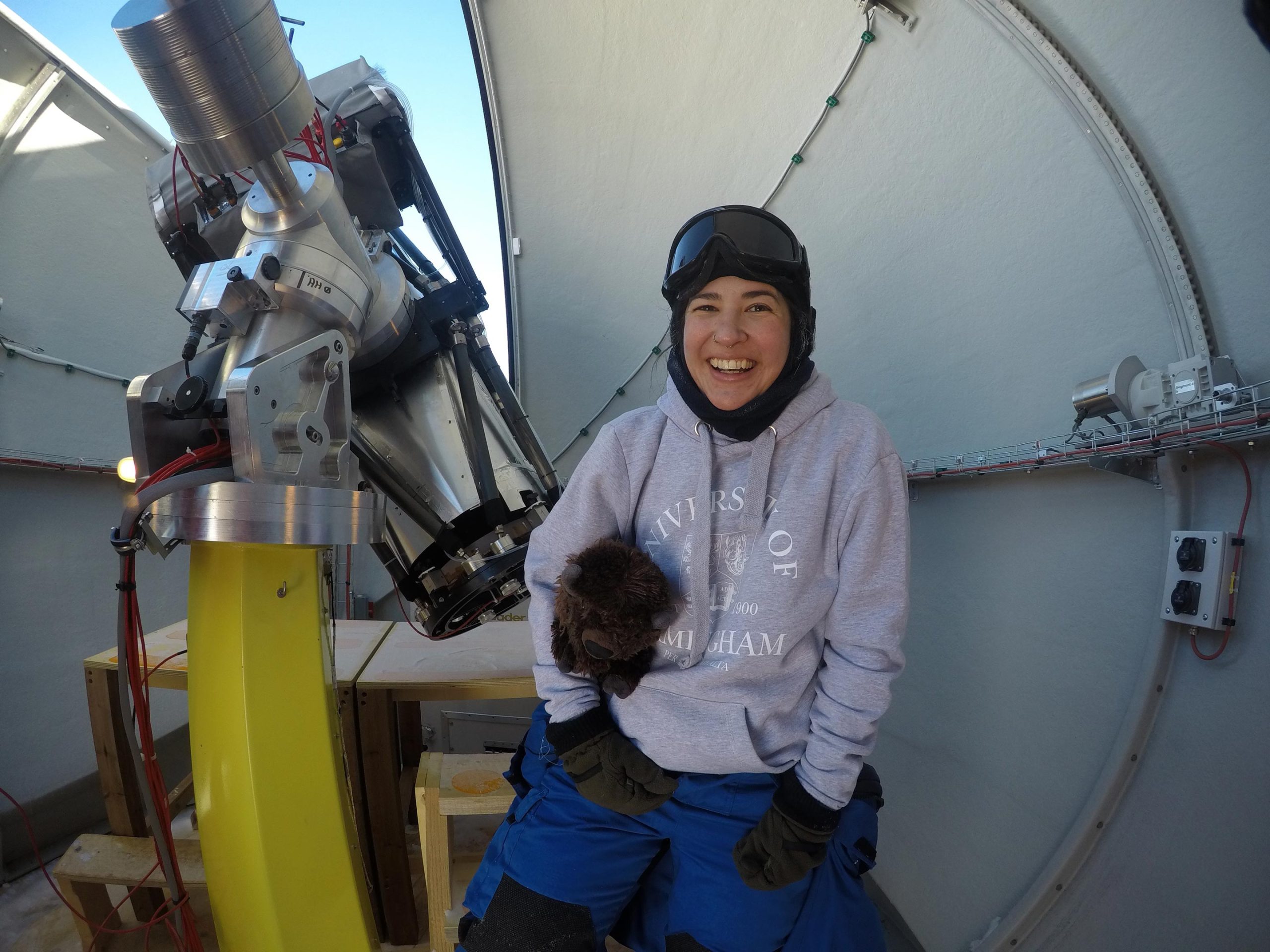 Dr. George Dransfield inside the dome of the ASTEP (Antarctic Search for Transiting ExoPlanets) telescope during her summer service mission to Antarctica in 2021/2022. Credit: George Dransfield/IPEV/PNRAAntarctic Darkness Captured Record Long Transits
The discovery was built on eight years of observations from multiple facilities, including the ASTEP (Antarctic Search for Transiting ExoPlanets) telescope at Concordia Station in Antarctica. The telescope is jointly operated by researchers from Université Côte d’Azur/Observatoire de la Côte d’Azur and international collaborators.
Antarctica offered an important observational advantage. During winter, the region experiences months of uninterrupted darkness, allowing astronomers to watch the planets cross their star without daylight breaking up the observations.
Each transit lasted more than 11 hours. These events are the longest continuous planetary transits ever fully recorded from the ground.
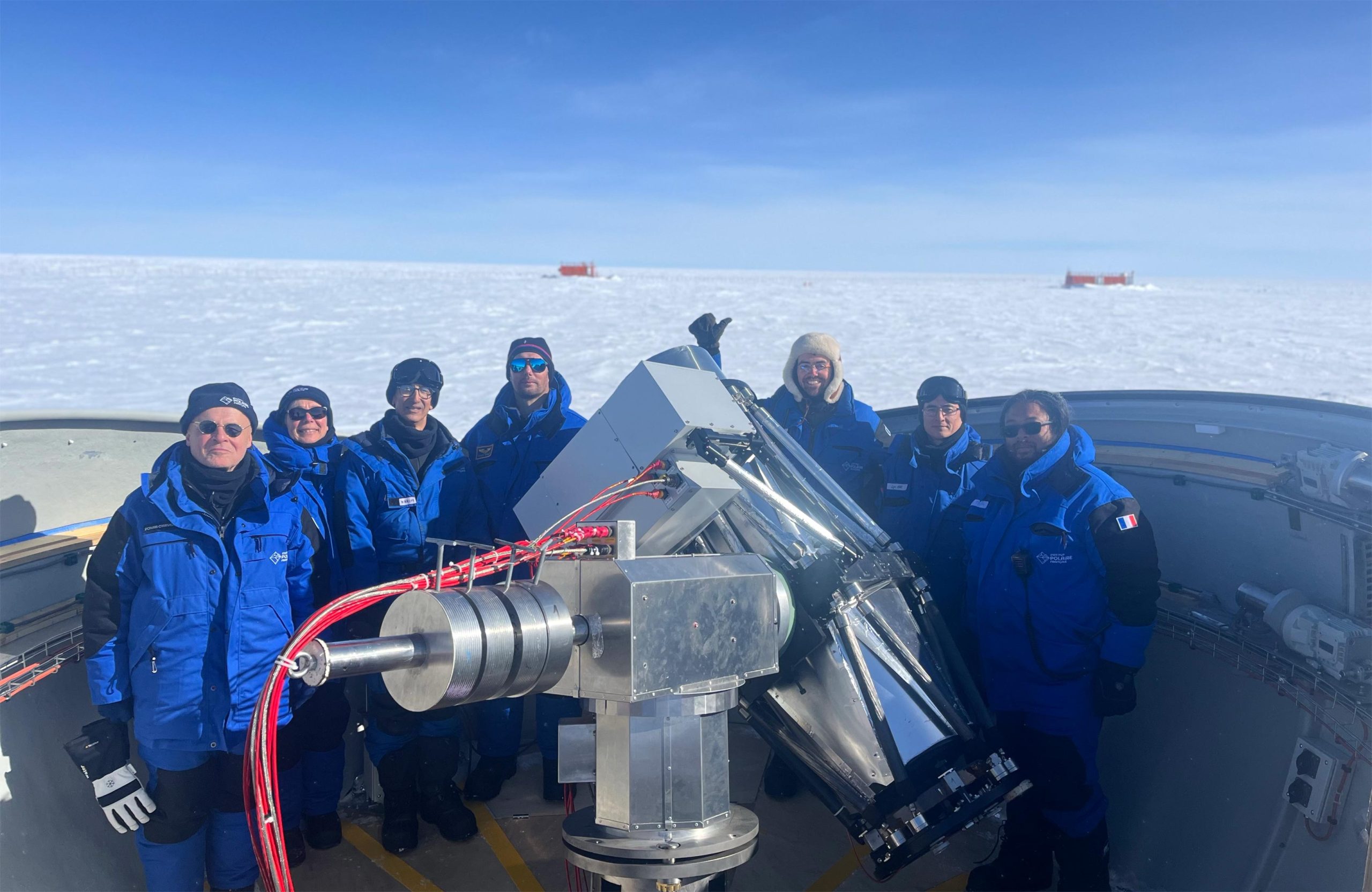 Photograph of the ASTEP (Antarctic Search for Transiting ExoPlanets) telescope, shortly after receiving its new mount. Credit: Karim Agabi / OCA / IPEV / PNRAHow Do Super-Puff Planets Form?
Scientists have not yet reached a consensus on how super-puff planets become so large while remaining so light.
One prominent explanation is that these worlds are surrounded by enormous atmospheres rich in hydrogen and helium. These gaseous layers may account for a large portion of each planet’s total mass while expanding its visible size dramatically.
The planets may have formed far from their star in a cold part of the protoplanetary disk. Under those conditions, gas could have cooled and accumulated quickly around a solid planetary core, creating an immense and lightweight outer envelope.
The research team plans additional observations to determine how the planets formed and test competing explanations for their unusually low densities.
James Webb Could Reveal Their Atmospheric ChemistryProfessor Amaury Triaud (University of Birmingham), the UK Principal Investigator of ASTEP and co-author of the study, said: “This system offers a unique laboratory for understanding how super-puff planets form and evolve. We propose to carry out space-based observations using the James Webb Space Telescope to assess if the puffy atmosphere contains carbon-, nitrogen-, and oxygen-bearing species, revealing new insight into how these unusual planets formed.”
Studying the planets with the James Webb Space Telescope could reveal which chemicals are present in their vast atmospheres. That information may help researchers reconstruct where and under what conditions the planets originated.
Professor Tristan Guillot (Université Côte d’Azur), Principal Investigator of ASTEP and co-author of the study, added: “These multi-planetary systems are complex, with gravitational interactions between the planets that evolve over very long periods, tens of years or more. This discovery highlights the importance of continued international collaboration in astronomy. Bringing together observations from Antarctica, space telescopes and observatories across several continents was essential to revealing the true nature of these extraordinary planets.”
Reference: “ASTEP confirmation of a pair of long-period Jupiter-sized planets with extremely low densities transiting TOI-791” by Georgina Dransfield, Antoine C Petit, Amaury H M J Triaud, Tristan Guillot, François-Xavier Schmider, Lyu Abe, Abdelkrim Agabi, Khalid Barkaoui, Thomas A Baycroft, Philippe Bendjoya, Rafael Brahm, Karen A Collins, Billy Edwards, Phil Evans, Alix V Freckelton, Nolan Grieves, Steve B Howell, Franco Mallia, Djamel Mekarnia, Angelica Psaridi, Daniel Sebastian, Keivan G Stassun, Chris Stockdale, Amalie Stokholm, Olga Suarez, Thiam-Guan Tan, Mathilde Timmermans, Cristilyn N Watkins, Carl Ziegler, Abderahmane Soubkiou, François Bouchy, Marion Cointepas, Vincent Deloupy, Maximilian N Günther, Michaël Gillon, Giovanni Isopi, Emmanuel Jehin, Jon M Jenkins, Andrés Jordán, Martin B Nielsen, Sara Seager, Avi Shporer, Julia V Seidel, Michal Steiner, Trifon Trifonov, Joseph D Twicken, Joshua N Winn and Aldo Zapparata, 25 June 2026, Monthly Notices of the Royal Astronomical Society.
DOI: 10.1093/mnras/stag864
Never miss a breakthrough: Join the SciTechDaily newsletter.
Follow us on Google and Google News.
| # | Наименование новости | Тональность | Информативность | Дата публикации |
|---|---|---|---|---|
| 1 | Rare Pair of Improbably Light ‘Super-Puff’ Planets Is Discovered | 2 | 7 | 17-07-2026 |
| 2 | Astronomers found two rare super puff planets lighter than cotton candy | 0 | 7.7 | 27-06-2026 |
| 3 | ‘Superpuff‘ planets are as dense as cotton candy | 0 | 15.82 | 10-08-2026 |
| 4 | Cotton-Candy Exoplanets: Two for the Price of One! | 0 | 10.76 | 02-07-2026 |
| 5 | Puffiest exoplanets yet found are as dense as cotton candy | 0 | 5 | 06-07-2026 |
| 6 | Астрономы нашли две планеты с плотностью меньше, чем у сахарной ... | 5 | 7 | 30-06-2026 |
| 7 | Leichter als Zuckerwatte: Forscher entdecken Riesenplaneten mit extrem geringer Dichte | 0 | 8.62 | 27-06-2026 |
| 8 | Super Jupiters Expose a Long Standing Space Mystery | 0 | 16.51 | 26-05-2026 |
| 9 | ЗНАКОМЬТЕСЬ С САМЫМИ «ПУХЛЫМИ» ПЛАНЕТАМИ МЛЕЧНОГО ПУТИ 🌑 Пара недавно ... | 0 | 9.54 | 28-07-2026 |
| 10 | ЗНАКОМЬТЕСЬ С САМЫМИ «ПУХЛЫМИ» ПЛАНЕТАМИ МЛЕЧНОГО ПУТИ 🌑 Пара недавно ... | 0 | 9.54 | 24-08-2026 |