Просмотр новости
Найдите то, что Вас интересует
 Спутники
 РН
РН SpaceX
 Роскосмос
 NASA
NASA
СпутникиРНSpaceXРоскосмосNASAAncient ground squirrels were anything but picky eaters. Genetic material from grasses to woolly mammoths popped up in frozen squirrel poop.
Frozen, ice-age squirrel poop doesn’t stink. At least not at first. But that changes if it warms. As it thaws, the smell shows fecal pellets are not just stony fossils. And as a new study shows, they can host DNA and clues to what ancient squirrels had dined on.
Melting feces release a pungent smell.
“There’s no mistaking. This is a very poopy-smelling lab,” says Tyler Murchie. He’s an archaeologist in Canada who studies ancient DNA. He works at the Hakai Institute in Heriot Bay, British Columbia. His team has been analyzing prehistoric squirrel scat.
In it, they turned up fragments of DNA — molecules that hold a cell’s operational instructions. The scat DNA pointed to what the squirrels had eaten. It now also helps paint a newly detailed picture of the squirrels’ ecosystem.
Murchie and his colleagues shared what they learned June 9 in Nature Communications.
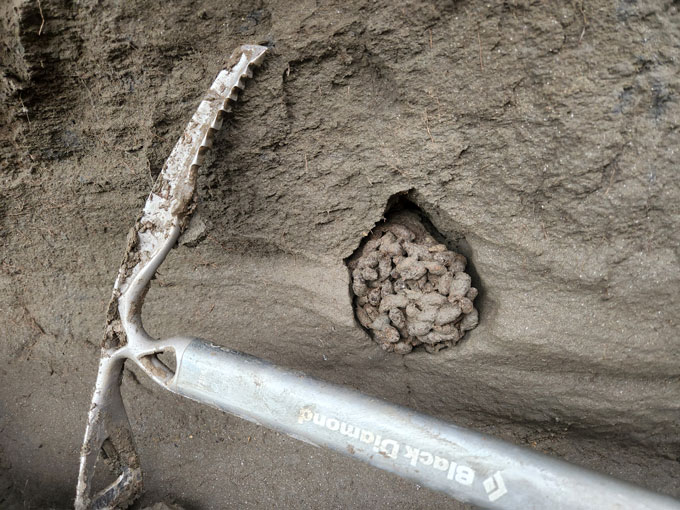 This soil hosted a surprise — a small cluster of squirrel poo. It’s been frozen in Yukon permafrost for thousands of years. These fecal pellets contained DNA from hundreds of species living in the Pleistocene ecosystem.Scott CockerA gold mine’s frozen treasure
Miners uncovered these fecal pellets. They melted Yukon permafrost to expose gold, Murchie says. This also turned up bones and the mummified remains of ancient creatures. For instance, they found bones of mammoths and steppe bison.
As the miners’ work progresses, eventually “you see these large exposures on the valley walls,” he notes. “There’s all these little pockets.” Those holes are the remains of ground squirrel burrows (genus Urocitellus).
Their homes are literally frozen in time. “They have little latrine areas and tunnel networks and caches of food,” Murchie says. (Sometimes, they even host frozen squirrels.)
Squirrels “really function as little naturalists or archivists,” Murchie says. Like “pack rats,” they stash all these bits of plant material, seeds, leaves, twigs and even bones. Scientists had already carefully cataloged contents of the burrows.
But no one had looked at the frozen poop left behind by these prehistoric Yukon squirrels.
So the researchers plugged their noses, thawed the pellets and extracted DNA from 13 squirrel coprolites — specimens of prehistoric poop. The oldest turned out to be nearly 700,000 years old. Others ranged from about 80,000 to 17,000 years old, part of the Pleistocene epoch. This was a period of alternating ice ages and warming periods.
Scientists usually assume Pleistocene squirrels were the same type found in the Yukon today. But “the species we thought these all were doesn’t seem to actually be the species that’s there today,” Murchie says. “There’s been a population turnover of some sort.”
At nearly 700,000 years old, the oldest sample could even be a new species. “It sits in its own evolutionary branch,” he says. “The closest thing to it is squirrels that are in China now.”
Prehistoric poop scoopThe poop held other surprises too. “I thought the DNA would mostly just be the squirrel plus their gut microbiome,” Murchie says. But there were fragments from what the squirrels had dined on, too.
Ground squirrels are not picky eaters. Genetic material popped up from all sorts of living things. Their menu included grasses, willows, beetles, grasshoppers, woolly mammoths, steppe bison, wolves, ancient horses and more.
Packs of ground squirrels would not have been ravenously chasing down mammoths, says Jacquelyn Gill. More likely they were scavenging, says this paleontologist who studies ancient ecosystems. Gill works at the University of Maine in Orono and did not take part in this new work. “They could have been chewing on [mammoth] bone for [its] calcium,” she says.
Rodents today frequently do that. “I remember watching one on my fence eating a bone,” Murchie says.
The ancient squirrels’ diet of both plants and animals allowed Murchie’s team to reconstruct the genomes of the mitochondria from 24 animals. Samples included 12 from the squirrels themselves, a snowshoe hare (used as a control, or comparison), two bison, three horses and six mammoths.
All those species in the scat offer a detailed window into the squirrels’ ecosystem, Gill says. “A mammoth bone will tell you a mammoth was here,” she says. “These ground squirrel coprolites are telling you we had a ground squirrel here eating these plants, living among these insects, sharing the landscape.”
It’s easy to want to study a mammoth tusk, Gill says. It’s a bit harder, she admits, to see the promise in poop. “I think you have to have a little bit of imagination and maybe a little humility.”
Submit your question here, and we might answer it an upcoming issue of Science News Explores
archaeologist: (also archeologist) The study of human history and prehistory through the excavation of sites and the analysis of artifacts and other physical remains. Those remains can range from housing materials and cooking vessels to clothing and footprints. The field these people work in is known as archeology.
archivists: (v. archive) People who collect, store and preserve materials — or archive them — including sounds, videos, data and objects, so that they can be found and used when they are needed.
beetle: An order of insects known as Coleoptera, containing at least 350,000 different species. Adults tend to have hard and/or horn-like “forewings” which covers the wings used for flight.
calcium: A chemical element and alkali metal common in minerals of the Earth’s crust and in sea salt. It is also found in bone mineral and teeth, and can play a role in the movement of certain substances into and out of cells.
colleague: Someone who works with another; a co-worker or team member.
component: Something that is part of something else (such as pieces that go on an electronic circuit board or ingredients that go into a cookie recipe).
control: (n.) A part of an experiment where there is no change from normal conditions. The control is essential to scientific experiments. It shows that any new effect is likely due only to the part of the test that a researcher has altered. For example, if scientists were testing different types of fertilizer in a garden, they would want one section of it to remain unfertilized, as the control. Its area would show how plants in this garden grow under normal conditions. And that gives scientists something against which they can compare their experimental data. (v.) To include some unchanged or unaffected conditions in an experiment so their results could later be contrasted with those from where changes had been made.
coprolite: Fossilized feces. The word coprolite, in Greek, means “dung stones.” Coprolites are very important because they can provide direct evidence of what ancient creatures ate.
diet: (n.) The foods and liquids ingested by an animal to provide the nutrition it needs to grow and maintain health. Sometimes this is a specific food-intake plan. (v.) To adopt a specific food-intake plan. People may adopt one for religious or ethical reasons, to address food allergies or to control a disease such as high blood pressure or diabetes. They may also adopt one in an effort to lose weight, although this can be unhealthy if not done under the guidance of a health professional, such as a physician or registered dietician.
DNA: (short for deoxyribonucleic acid) A long, double-stranded and spiral-shaped molecule inside most living cells that carries genetic instructions. It is built on a backbone of phosphorus, oxygen, and carbon atoms. In all living things, from plants and animals to microbes, these instructions tell cells which molecules to make.
ecosystem: A group of interacting living organisms — including microorganisms, plants and animals — and their physical environment within a particular climate. Examples include tropical reefs, rainforests, alpine meadows and polar tundra. The term can also be applied to elements that make up some artificial environment, such as a company, classroom or the internet.
epoch: (in geology) A span of time in the geologic past that was shorter than a period (which is itself, part of some era) and marked when some dramatic changes occurred.
evolutionary: An adjective that refers to changes that occur within a species over time as it adapts to its environment. Such evolutionary changes usually reflect genetic variation and natural selection, which leave a new type of organism better suited for its environment than its ancestors. The newer type is not necessarily more “advanced,” just better adapted to the conditions in which it developed.
feces: (adj. fecal) A body's solid waste, made up of undigested food, bacteria and water. The feces of larger animals are sometimes also called dung.
fossil: Any preserved remains or traces of ancient life. There are many different types of fossils: The bones and other body parts of dinosaurs are called “body fossils.” Things like footprints are called “trace fossils.” Even specimens of dinosaur poop are fossils. The process of forming fossils is called fossilization.
genetic: Having to do with chromosomes, DNA and the genes contained within DNA. The field of science dealing with these biological instructions is known as genetics. People who work in this field are geneticists.
genome: The complete set of genes or genetic material in a cell or an organism. The study of this genetic inheritance housed within cells is known as genomics.
genus: (plural: genera) A group of closely related species. For example, the genus Canis — which is Latin for “dog” — includes all domestic breeds of dog and their closest wild relatives, including wolves, coyotes, jackals and dingoes.
gut: An informal term for the gastrointestinal tract, basically the stomach and intestines. These organs digest — break down — foods and absorb their nutrients for use by the body.
insect: A type of arthropod that as an adult will have six segmented legs and three body parts: a head, thorax and abdomen. There are hundreds of thousands of insects, which include bees, beetles, flies and moths.
literally: An adjective indicating that the phrase it modifies is precisely true. For instance, to say: "It's so cold that I'm literally dying," means that this person actually expects to soon be dead, the result of getting too cold.
naturalist: A biologist who works in the field (such as in forests, swamps or tundra) and studies the interconnections between wildlife that make up local ecosystems.
network: A group of interconnected people or things. (v.) The act of connecting with other people who work in a given area or do similar thing (such as artists, business leaders or medical-support groups), often by going to gatherings where such people would be expected, and then chatting them up. (n. networking)
omnivorous: An adjective that refers to animals whose diets include both plants and animals.
paleontology: The branch of science concerned with ancient, fossilized animals and plants. The scientists who study them are known as paleontologists.
permafrost: Soil that remains frozen for at least two consecutive years. Such conditions typically occur in polar climates, where average annual temperatures remain close to or below freezing.
Pleistocene: The earlier epoch of the Quaternary Period. It ranged from 2.6 million to 11,700 years ago. The term can also refer to rocks that from this period. During this time, periods of ice ages and interglacial warming occurred. The mammoth was one of the largest land animals from this time.
population: (in biology) A group of individuals (belonging to the same species) that lives in a given area.
rodent: A mammal of the order Rodentia, a group that includes mice, rats, squirrels, guinea pigs, hamsters and porcupines.
scat: The feces shed by a wild animal, usually a mammal.
species: A group of similar organisms capable of producing offspring that can survive and reproduce.
steppe: The term for a vast, wild grassland that is typically devoid of trees (except near rivers), especially in Southeastern Europe or Asia.
woolly mammoth: A type of extinct mammal that resembled a hairy elephant.
Yukon: A northwest Canadian territory. Also the name for a river flowing roughly 3,220 kilometers (2,000 miles) from northwest Canada on through Alaska and into the Bering Sea.
Bethany Brookshire was a longtime staff writer at Science News Explores and is the author of the book Pests: How Humans Create Animal Villains. She has a Ph.D. in physiology and pharmacology and likes to write about neuroscience, biology, climate and more. She thinks Porgs are an invasive species.
| # | Наименование новости | Тональность | Информативность | Дата публикации |
|---|---|---|---|---|
| 1 | Fossil vomit shows what one 290-million-year-old predator dined on | 0 | 10.39 | 01-04-2026 |
| 2 | Ледниковые мумии "щенков" из Якутии оказались останками древних волчат | 0 | 0 | 11-06-2025 |
| 3 | Завтрак перед смертью. Желудок мамонтёнка раскрыл секреты его жизни | 0 | 8.71 | 30-07-2026 |
| 4 | The first primates may have evolved in the cold, not the tropics | 0 | 6.69 | 20-06-2026 |
| 5 | Ancient Humans Ate Shark Meat | 0 | 6.17 | 14-02-2026 |
| 6 | Ancient bees turned tooth sockets into tiny nurseries 20,000 years ago | 0 | 8.09 | 05-07-2026 |
| 7 | Snowball Earth was not completely frozen, new study reveals | 0 | 5.58 | 12-02-2026 |
| 8 | Люди ледникового периода охотились в основном на самок мамонтов | 0 | 14.17 | 30-07-2026 |
| 9 | Раскрыта тактика охотников на мамонтов Сибири - почему они не убивали самцов | 0 | 8.73 | 31-07-2026 |