Просмотр новости
Найдите то, что Вас интересует
 Спутники
 РН
РН SpaceX
 Роскосмос
 NASA
NASA
СпутникиРНSpaceXРоскосмосNASABones in the barfed-up material, which dates to a time before the dinosaurs, offer a rare peek into the diet of a prehistoric hunter.
Some 290 million years ago — before dinosaurs roamed the Earth — a predator gobbled up three other animals. Later, it barfed up their bones. Over the ages, that puke hardened into a fossil. A newly imaged cluster of bones inside it now offers a window into some of the world’s earliest land predators.
Researchers shared their new findings January 30 in Scientific Reports.
Scientists have a name for fossil vomit: regurgitalite (Ree-GER-jih-tuh-lyt). This sample held bones from three different animals eaten by one predator. That means “we can literally say, for sure, that these three were living at exactly the same place and exactly the same time, maybe to the week or even to the day,” says Arnaud Rebillard. He’ a paleontologist and was part of the research team. He works at the Museum of Natural History in Berlin, Germany.
Fossils of partially digested food, including vomit and poop, are valuable clues for studying Earth’s past. They reveal more than just which species lived in an area. They also help scientists figure out which animals were predators and which were prey.
“We need fossils like this to really tie together how the ecosystem functioned and how the food webs were structured,” says Martin Qvarnström. He did not take part in the new study. A paleontologist, he works at Uppsala University in Sweden.
Peering inside the puke pileRebillard’s team discovered the lime-sized barf blob at a fossil site known as the Bromacker locality. They scanned the fossil with powerful X-rays to get a 3-D image of what was inside (without breaking it open). That CT scan revealed a cluster of 41 bones from different animals. This suggests the debris had come from a predator’s gut.
Something leaving the gut can either be thrown up or pooped out. To find out which this was, the team analyzed chemicals in material surrounding the bones.
Unlike puke, fossilized poop tends to be high in the element phosphorus. Since it was low in phosphorus, the new fossil appears to be ancient vomit.
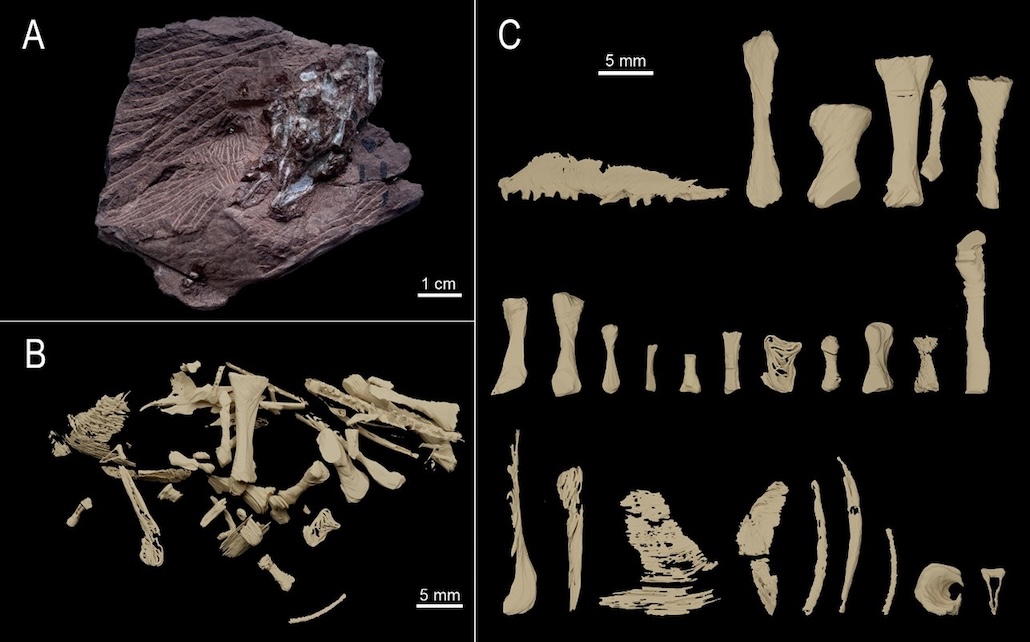 Researchers scanned 290-million-year-old fossilized vomit to find out what was in it. Figure A shows the complete specimen. Figure B shows a CT scan of it, revealing a cluster of 41 bones. Figure C shows scans of 25 bones from it that the team could attribute to prey species. Arnaud Rebillard
The researchers don’t know which predator threw up the bones. They suspect it was one of two animals similar to today’s monitor lizards (such as Komodo dragons). One candidate is Dimetrodon teutonis. It’s known for the sail on its back. The other is Tambacarnifex unguifalcatus. It had long, curved fingers and toes and sharp, backwards-curved teeth.
Both predators resembled dinosaurs. But they were not dinos. They weren’t even reptiles. Instead, they belonged to a group known as synapsids (Sih-NAP-sidz). This group includes today’s mammals and their extinct relatives.
What’s on the menuRebillard’s group found two small, lizard-like reptiles among the barfed-up bones. They also found the limb bone from a larger, reptile-like plant eater. Several more bones came from animals that could not be identified.
These bones from different species suggest the predator did not have a taste for just one type of prey. It ate whatever it could find.
“It’s kind of like a photograph of a moment in the past that is telling us about the animal that was living,” says Rebillard. “Any data that we can find about their behavior is very precious.”
Even several of today’s predators cough up bones and other body parts that are tough to digest. Owls, for instance, famously barf up the fur and bones of prey that they’ve swallowed whole.
Scientists don’t know if this is why the ancient animal spit up those bones. But that’s likely, Rebillard says. That, or the animal simply ate too much.
The site where this fossil was found preserves a snapshot of an early land ecosystem on the supercontinent Pangaea. Fossils from this site date from the Permian Period, 299 million to 254 million years ago.
Back then, predators that could travel on land often lived in semi-aquatic landscapes. There, they hunted crustaceans and fish. Around this time, plant eaters gradually started moving to dry, inland sites. New predators would soon follow.
Fossil poop and puke are much rarer inland than in aquatic habitats. That’s part of what makes the new fossil vomit so exciting. “We’re talking about almost 300-million-years-old ecosystems,” Rebillard says. Any fossil that gives such precise information about when and where animals lived “is extremely fascinating.”
aquatic: An adjective that refers to water.
behavior: The way something (often a person or other organism) conducts itself or acts towards others.
chemical: A substance formed from two or more atoms that unite (bond) in a fixed proportion and structure. For example, water is a chemical made when two hydrogen atoms bond to one oxygen atom. Its chemical formula is H2O. Chemical also can be an adjective to describe properties of materials that are the result of various reactions between different compounds.
crustaceans: Hard-shelled water-dwelling animals including lobsters, crabs and shrimp.
CT scan: (Also known as a CAT scan). The term is short for computerized axial tomography. It is a special type of X-ray scanning technology that produces cross-sectional views of the inside of a bone or body. A computer can then digitally assemble the images from these slices to create a 3-dimensional reconstruction of internal features.
debris: Scattered fragments, typically of trash or of something that has been destroyed. Space debris, for instance, includes the wreckage of defunct satellites and spacecraft.
digest: (noun: digestion) To break down food into simple compounds that the body can absorb and use for growth. Some sewage-treatment plants harness microbes to digest — or degrade — wastes so that the breakdown products can be recycled for use elsewhere in the environment.
dinosaur: A term that means terrible lizard. These reptiles emerged around 243 million years ago. All descended from egg-laying reptiles known as archosaurs. Their descendants eventually split into two lines. For many decades, they have been distinguished by their hips. Many large dinosaurs died out around 66 million years ago. But some saurischians lived on. They are now the birds we see today (and who have now evolved that so-called “bird-hipped” pelvis).
ecosystem: A group of interacting living organisms — including microorganisms, plants and animals — and their physical environment within a particular climate. Examples include tropical reefs, rainforests, alpine meadows and polar tundra. The term can also be applied to elements that make up some artificial environment, such as a company, classroom or the internet.
element: A building block of some larger structure. (in chemistry) Each of more than one hundred substances for which the smallest unit of each is a single atom. Examples include hydrogen, oxygen, carbon, lithium and uranium.
environment: The sum of all of the things that exist around some organism or the process and the condition those things create. Environment may refer to the weather and ecosystem in which some animal lives, or, perhaps, the temperature and humidity (or even the placement of things in the vicinity of an item of interest).
extinct: (n. extinction) An adjective that describes a species for which there are no living members.
food web: (also known as a food chain) The network of relationships among organisms sharing an ecosystem. Member organisms depend on others within this network as a source of food.
fossil: Any preserved remains or traces of ancient life. There are many different types of fossils: The bones and other body parts of dinosaurs are called “body fossils.” Things like footprints are called “trace fossils.” Even specimens of dinosaur poop are fossils. The process of forming fossils is called fossilization.
gut: An informal term for the gastrointestinal tract, especially the intestines.
habitat: The area or natural environment in which an animal or plant normally lives, such as a desert, coral reef or freshwater lake. A habitat can be home to thousands of different species.
herbivore: A creature that either exclusively or primarily eats plants.
limb: (in physiology) An arm or leg.
literally: An adjective indicating that the phrase it modifies is precisely true. For instance, to say: "It's so cold that I'm literally dying," means that this person actually expects to soon be dead, the result of getting too cold.
lizard: A type of reptile that typically walks on four legs, has a scaly body and a long tapering tail. Unlike most reptiles, lizards also typically have movable eyelids. Examples of lizards include the tuatara, chameleons, Komodo dragon, and Gila monster.
mammal: An animal distinguished by possessing hair or fur, the secretion of milk by females for the feeding of their young, and (typically) the bearing of live young. They also are warm-blooded (or endothermic).
monitor lizards: A family of muscular, predatory reptiles with scaled bodies, forked-tongues and a good sense of smell. Some are good swimmers, such as the water monitor, which tend to grow to about 1.5 meters (5 feet) long. The biggest monitor, the venomous Komodo dragon, can reach lengths of 3 meters, weigh in at more than 200 pounds, sprint at speeds of 20 kilometers (13 miles) per hour, and eat up to 80 percent of its body weight at a single sitting. At the other end of the spectrum is the Dampier Peninsula monitor, the smallest of these reptiles, which as an adult will span just 23 centimeters (9 inches) and weigh a mere 16 grams (0.6 ounce).
paleontologist: A scientist who specializes in studying fossils, the remains of ancient organisms.
Pangaea: (or Pangea) A supercontinent that existed from about 300 to 200 million years ago. It was composed of all of the major continents seen today, squished together.
Permian: A time in the distant geologic past, about 250 million to 300 million years ago. Many reptiles rose to prominence on land; these were not yet dinosaurs. Many large invertebrates ruled the oceans during this period. But most would die off at the end of the Permian, as it gave way to a new geologic period known as the Triassic.
phosphorus: A highly reactive, nonmetallic element occurring naturally in phosphates. Its scientific symbol is P. It is an important part of many chemicals and structures that are found in cells, such as membranes, and DNA.
predator: (adjective: predatory) A creature that preys on other animals for most or all of its food.
prey: (n.) An organism hunted by another, often for food. (v.) To attack and eat another organism.
reptile: Vertebrate animals belonging to a group known as Reptilia. Most reptiles have skin that is covered with scales or horny plates. Snakes, turtles, lizards and alligators are all reptiles. Once considered their own separate group, birds now belong to this order. With the exception of modern birds, most reptiles are cold-blooded (or ectothermic).
species: A group of similar organisms capable of producing offspring that can survive and reproduce.
synapsids: A subclass of terrestrial vertebrates. Although the earliest ones likely resembled reptiles, taxonomic data suggest they actually were extinct, non-reptile ancestors of today’s mammals (which are also synapsids).
X-ray: A type of radiation analogous to gamma rays, but having somewhat lower energy.
A version of this article appears in the August 1, 2026 issue of Science News Explores.
| # | Наименование новости | Тональность | Информативность | Дата публикации |
|---|---|---|---|---|
| 1 | Un vomi fossile de 290 millions d’années révèle la stratégie d’un prédateur du Permien | 0 | 10.84 | 13-03-2026 |
| 2 | Окаменелость запечатлела древних морских чудовищ мелового периода, пожирающих друг друга | 0 | 9.03 | 02-08-2026 |
| 3 | Did T. rex leave these 66-million-year-old bite marks? | 0 | 13.25 | 05-08-2026 |
| 4 | A 75-million-year-old fossil reveals a shocking tyrannosaur secret | 0 | 9.76 | 05-05-2026 |
| 5 | Frozen poop reveals Ice Age squirrels’ ecosystem | 0 | 7.97 | 25-08-2026 |
| 6 | This dinosaur fossil captures the final moments of a T. rex attack | 0 | 10.8 | 14-07-2026 |
| 7 | A crushed fossil revealed a dinosaur that shouldn’t have existed | 0 | 6.98 | 15-04-2026 |
| 8 | A 300-Million-Year-Old Find: It Lived on Land and Was the First to Eat Plants | 0 | 6.66 | 25-02-2026 |
| 9 | A 30-year-old fossil was hiding bones from a mysterious ancient sea monster | 0 | 7.14 | 15-08-2026 |
| 10 | This ancient animal was one of the first to eat plants on land | 0 | 7.38 | 11-02-2026 |