Просмотр новости
Найдите то, что Вас интересует
 Спутники
 РН
РН SpaceX
 Роскосмос
 NASA
NASA
СпутникиРНSpaceXРоскосмосNASASince the U.K. voted to leave the European Union, right-wing populists and their parties have regularly disrupted Europe’s political landscape.
Right-wing populist parties have had a political impact in other European nations over the past decade. These include the Netherlands and Poland, where such parties have led governments or been included in governing coalitions.
Still, it’s important to note that right-wing populists have also faced setbacks. In April, for instance, Viktor Orban and his Fidesz party lost Hungary’s parliamentary elections. Fidesz had previously won four straight national elections.
Over the past decade, commentators have repeatedly assessed and reassessed right-wing populist fortunes in Europe based on the most recent election results. But the bigger story is that, regardless of any specific election outcome, right-wing populists have become a regular feature of the political landscape and significantly disrupted European politics.
In the next year and a half, elections in countries such as France, Greece, Italy, Poland, Spain and Sweden will tell us more about the direction of right-wing populism in Europe.
What Has Driven Support for Right-Wing Populism?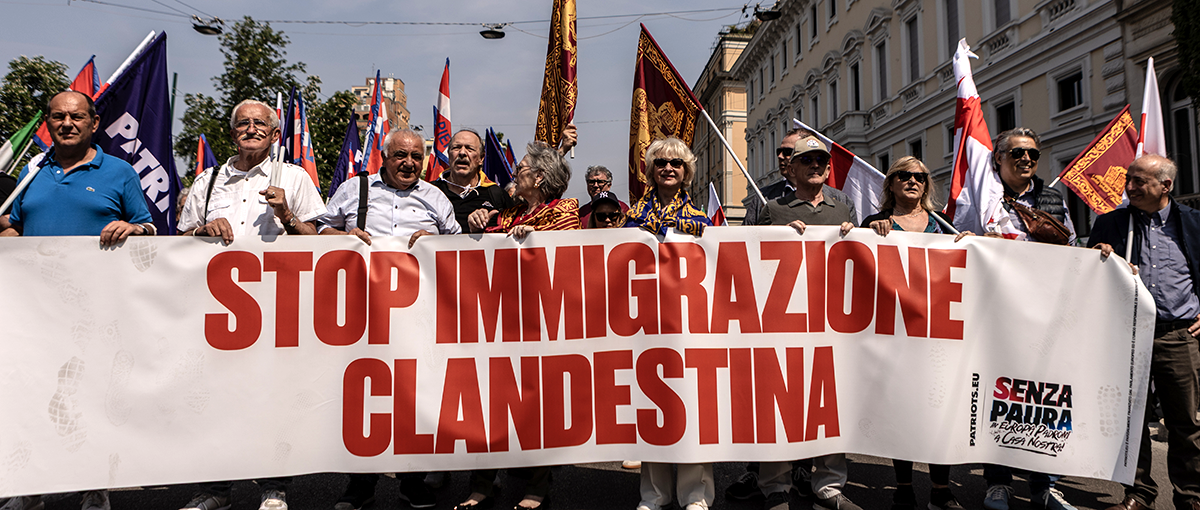 People demonstrate against illegal immigration at an event organized by Patriots for Europe, a right-wing European Parliament group, in Milan on April 18, 2026. (Andrea Carrubba/Anadolu via Getty Images)
Many factors have shaped the rise of right-wing populism in Europe and elsewhere, including economic frustrations, cultural grievances and anger at the political class.
Frustration with politicsThere are many definitions of populism, but most emphasize a belief that “the people” have been led astray by a corrupt elite.
Our surveys over the past decade have regularly found a widespread sense of frustration with, and distrust in, political elites.
Many Europeans say elected officials don’t care what they think
% who say elected officials __ what people like them think

Note: Those who did not answer are not shown.
Source: Spring 2023 Global Attitudes Survey
PEW RESEARCH CENTER
Many Europeans say elected officials don’t care what they think
% who say elected officials __ what people like them think
| Country | Don’t care | Care |
|---|---|---|
| Spain | 85 | 15 |
| Greece | 81 | 17 |
| Hungary | 78 | 19 |
| Italy | 77 | 22 |
| France | 74 | 23 |
| U.K. | 70 | 29 |
| Poland | 69 | 25 |
| Netherlands | 64 | 36 |
| Germany | 63 | 35 |
| Sweden | 43 | 56 |
| 10-country median | 72 | 24 |
Note: Those who did not answer are not shown.
Source: Spring 2023 Global Attitudes Survey
PEW RESEARCH CENTER
In a 2023 survey, majorities in nine of the 10 European countries we surveyed said most elected officials in their country do not care what people like them think. Roughly seven-in-ten or more held this view in Spain, Greece, Hungary, Italy, France, the U.K. and Poland.
According to our 2025 survey, many Europeans said few or none of the elected officials in their country are honest, understand the needs of ordinary people, focus on the most important problems, are ethical, or are well-qualified.
When we asked people in 2023 in Europe and elsewhere to describe in their own words what would make democracy work better, the most common response was changing their country’s political leaders.
Right-wing populists have often emphasized messages about giving ordinary citizens – or at least some ordinary citizens – a stronger voice in politics and more control over political elites. For instance, during the battle over Brexit, the “Vote Leave” campaign’s “Take back control” slogan resonated with many voters who felt the U.K. had ceded too much power to distant European Union elites in Brussels. (For more information on European attitudes toward the EU, see “In several European countries, EU gets more positive ratings today than during Brexit vote.“)
Economic anxietiesA nation’s economic problems can create challenges for mainstream political parties and opportunities for populist alternatives. Many scholars and writers have argued that the 2008 financial crisis set the stage for populist movements in Europe and other regions. And in the years that followed, Europeans experienced additional economic shocks, including the eurozone public debt crisis, the COVID-19 downturn and post-pandemic inflation.
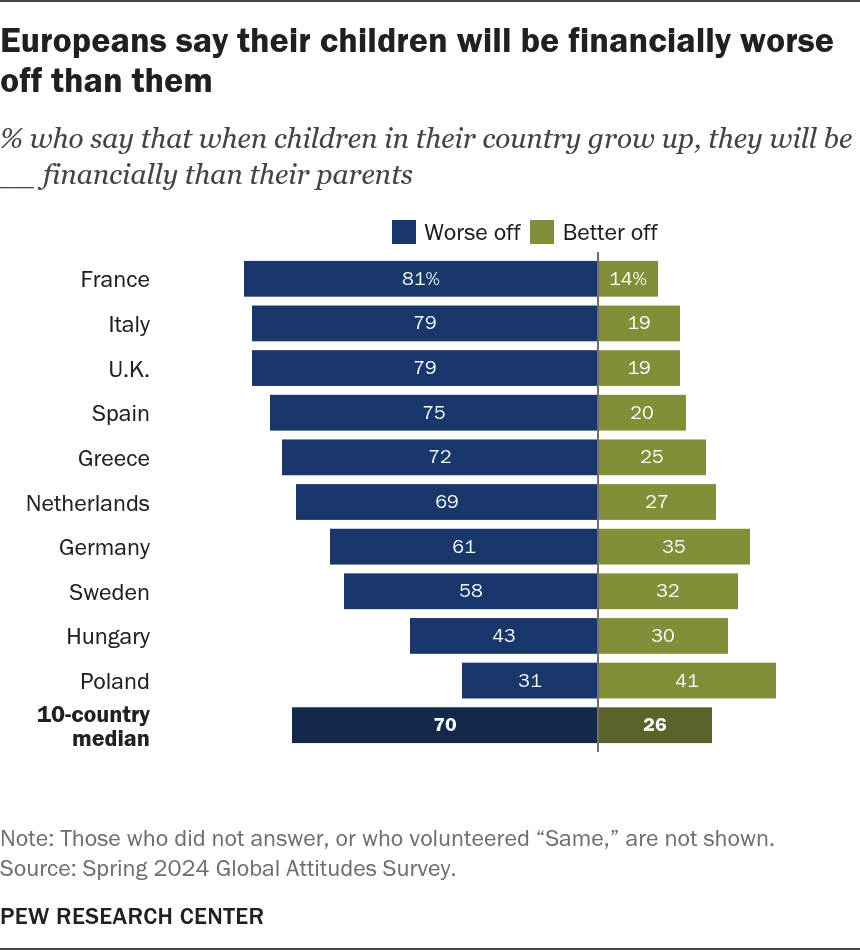
Europeans say their children will be financially worse off than them
% who say that when children in their country grow up, they will be __ financially than their parents
Note: Those who did not answer, or who volunteered “Same,” are not shown.
Source: Spring 2024 Global Attitudes Survey.
PEW RESEARCH CENTER
Europeans say their children will be financially worse off than them
% who say that when children in their country grow up, they will be __ financially than their parents
| Country | Worse off | Better off |
|---|---|---|
| France | 81 | 14 |
| Italy | 79 | 19 |
| U.K. | 79 | 19 |
| Spain | 75 | 20 |
| Greece | 72 | 25 |
| Netherlands | 69 | 27 |
| Germany | 61 | 35 |
| Sweden | 58 | 32 |
| Hungary | 43 | 30 |
| Poland | 31 | 41 |
| 10-country median | 70 | 26 |
Note: Those who did not answer, or who volunteered “Same,” are not shown.
Source: Spring 2024 Global Attitudes Survey.
PEW RESEARCH CENTER
More broadly, the rise of an increasingly interconnected global economy in recent decades has created resentments among those who feel left behind by globalization. Often, this group includes many working-class people with less education who in previous decades tended to vote for left-of-center parties but have increasingly turned to the populist right.
All of these economic anxieties have left Europeans pessimistic about the long-term economic future. Across 10 European countries we surveyed in 2024, a median of 70% said that when children in their country grow up, they will be financially worse off than their parents.
This economic pessimism and anxiety has shaken confidence in mainstream parties and the political status quo. And it has been fertile ground for the growth of right-wing populism.
Cultural grievancesIn addition to economic frustrations, support for right-wing populism is associated with cultural grievances and reactions to rapid social change.
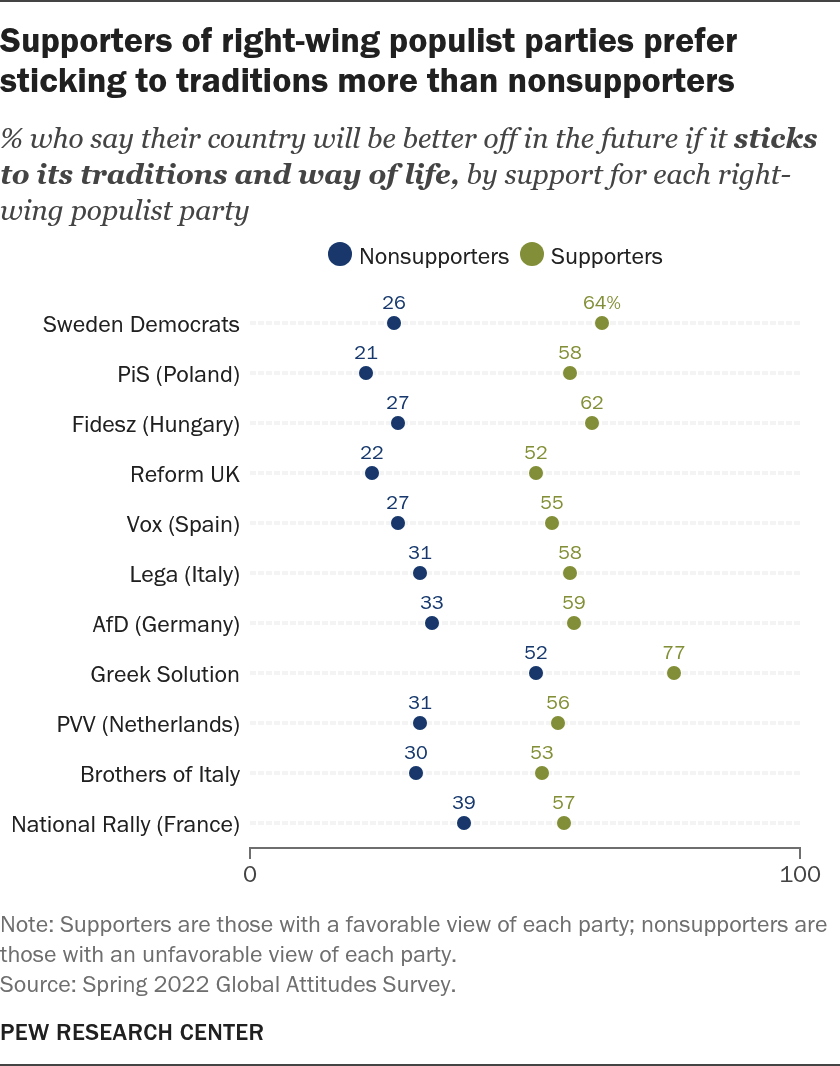
Supporters of right-wing populist parties prefer sticking to traditions more than nonsupporters
% who say their country will be better off in the future if it sticks to its traditions and way of life, by support for each right-wing populist party
Note: Supporters are those with a favorable view of each party; nonsupporters are those with an unfavorable view of each party.
Source: Spring 2022 Global Attitudes Survey.
PEW RESEARCH CENTER
Supporters of right-wing populist parties prefer sticking to traditions more than nonsupporters
% who say their country will be better off in the future if it sticks to its traditions and way of life, by support for each right-wing populist party
| Party | Supporters | Nonsupporters |
|---|---|---|
| Sweden Democrats | 64 | 26 |
| PiS (Poland) | 58 | 21 |
| Fidesz (Hungary) | 62 | 27 |
| Reform UK | 52 | 22 |
| Vox (Spain) | 55 | 27 |
| Lega (Italy) | 58 | 31 |
| AfD (Germany) | 59 | 33 |
| Greek Solution | 77 | 52 |
| PVV (Netherlands) | 56 | 31 |
| Brothers of Italy | 53 | 30 |
| National Rally (France) | 57 | 39 |
Note: Supporters are those with a favorable view of each party; nonsupporters are those with an unfavorable view of each party.
Source: Spring 2022 Global Attitudes Survey.
PEW RESEARCH CENTER
According to many scholars, including the political scientists Pippa Norris and Ronald Inglehart, right-wing populism has been fueled by a “cultural backlash” against the progressive social changes that have taken place in high-income countries over the past few decades.
These nations have experienced deepening cultural divides over issues such as women’s rights, LGBTQ+ rights, and racial and ethnic diversity.
In a 2022 survey, we posed a question that captures many of these cultural divisions. Respondents were asked if their country would be better off if it sticks to its traditions and way of life or if it is open to changing them. Overall, Europeans said their nation should embrace change.
However, substantial shares preferred sticking with traditions, and this view was especially common among those who support right-wing populist parties. For example, 64% of Swedes with a favorable view of the Sweden Democrats think their country would be better off keeping its traditions and way of life, compared with 26% among those who rate the party negatively.
Right-wing populists also tend to have a more exclusionary view of national identity. They are particularly likely to say that to truly be a part of their country’s nationality it is very important to speak the country’s language, to share its customs and traditions, and to have been born in the country.
Right-wing populists are especially likely to emphasize being born in their country as part of national identity
% who say that having been born in the country is very important to being truly [country nationality], by support for each right-wing populist party

Note: Only statistically significant differences are shown. Supporters are those with a favorable view of each party; nonsupporters are those with an unfavorable view of each party.
Source: Spring 2023 Global Attitudes Survey.
PEW RESEARCH CENTER
Right-wing populists are especially likely to emphasize being born in their country as part of national identity
% who say that having been born in the country is very important to being truly [country nationality], by support for each right-wing populist party
| Party | Supporters | Nonsupporters |
|---|---|---|
| Vox (Spain) | 55 | 25 |
| Reform UK | 32 | 9 |
| AfD (Germany) | 32 | 10 |
| PiS (Poland) | 58 | 41 |
| Fidesz (Hungary) | 40 | 23 |
| Greek Solution | 49 | 35 |
| Brothers of Italy | 36 | 22 |
| National Rally (France) | 28 | 14 |
| Lega (Italy) | 38 | 25 |
| Sweden Democrats | 7 | 2 |
Note: Only statistically significant differences are shown. Supporters are those with a favorable view of each party; nonsupporters are those with an unfavorable view of each party.
Source: Spring 2023 Global Attitudes Survey.
PEW RESEARCH CENTER
For example, roughly half or more of those with positive views of right-wing populist parties in Spain, Poland and Greece think it is very important to have been born in their country. This view is significantly less common among those who rate these parties negatively.
Right-wing populists also stand out for their views on social issues such as abortion and same-sex marriage. Even though right-wing populists typically say abortion should be legal in all or most cases, they are less likely than others to hold this view in some European countries. Similarly, most tend to support same sex-marriage, but they are less likely than others to support it.
Who Supports Right-Wing Populism?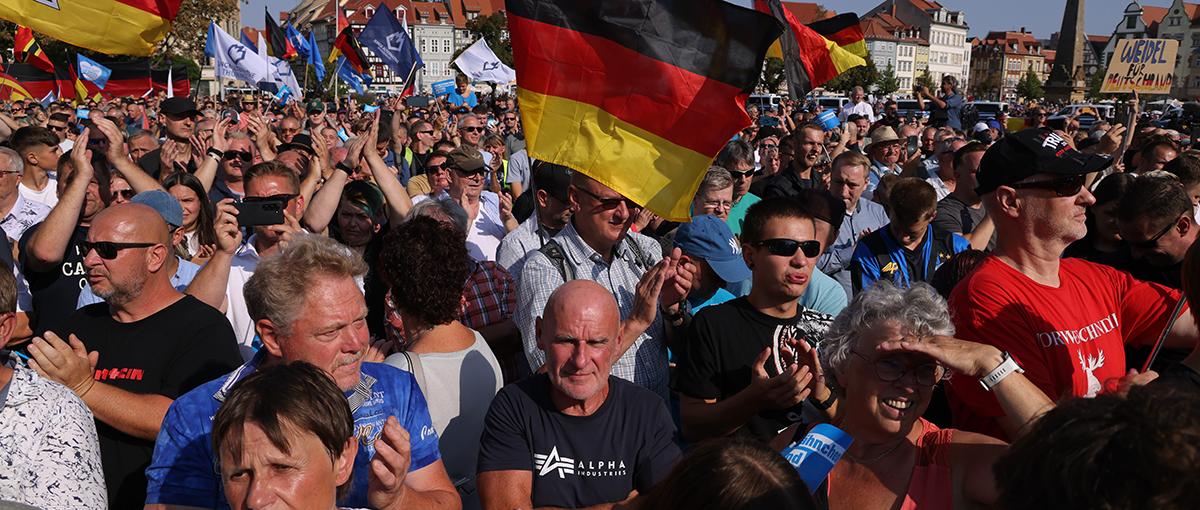 Supporters of the right-wing Alternative for Germany party wave flags at a campaign rally in Erfurt, Germany, on Aug. 31, 2024. (Sean Gallup/Getty Images)
Right-wing populists typically differ from others in their country on a few demographic factors, most notably education.
People with less education express more positive views about right-wing populist parties
% who have a favorable opinion of each right-wing populist party, by education

Note: Only statistically significant differences are shown.
Source: Spring 2025 Global Attitudes Survey.
PEW RESEARCH CENTER
People with less education express more positive views about right-wing populist parties
% who have a favorable opinion of each right-wing populist party, by education
| Party | More education | Less education |
|---|---|---|
| National Rally (France) | 22 | 43 |
| PVV (Netherlands) | 18 | 38 |
| Reform UK | 26 | 44 |
| Lega (Italy) | 16 | 32 |
| Fidesz (Hungary) | 33 | 47 |
| Brothers of Italy | 31 | 45 |
| Sweden Democrats | 19 | 33 |
| Greek Solution | 16 | 28 |
| PiS (Poland) | 23 | 34 |
| AfD (Germany) | 15 | 23 |
Note: Only statistically significant differences are shown.
Source: Spring 2025 Global Attitudes Survey.
PEW RESEARCH CENTER
Generally, those with less education hold right-wing populist parties in higher regard than those with more education.
Consider the Netherlands: Roughly four-in-ten people with a secondary education or less gave Geert Wilders’ Party for Freedom positive ratings, according to our 2025 survey. Among those with at least some postsecondary education, 18% saw the party favorably.
Still, across levels of educational attainment, no right-wing populist party received majority favorable marks in any of the European countries we surveyed in 2025.
Favorable views of these parties are sometimes related to other demographics such as gender, but we see these differences less frequently.
Where there are gender gaps, men are more supportive of these parties than women. For example, Swedish men tend to support the Sweden Democrats at a higher rate than women.
Other data suggests that right-wing populist party supporters can also be more religious than nonsupporters. For instance, those who say religion plays an important role in their personal life are also often more likely to hold a favorable view of many right-wing populist parties.
How Do Right-Wing Populists View Democracy? A voter steps out of a polling booth during first-round parliamentary elections in Le Touquet, France, on June 30, 2024. (Ludovic Marin/AFP via Getty Images)
In a 2023 Pew Research Center survey, we asked respondents in 24 nations whether certain types of governments would be good or bad ways to govern countries. Majorities in every place – including 10 European nations – described representative democracy as a good way of governing their country.
Among both those with favorable views of populist parties and unfavorable views of them, support for representative democracy was generally high.
However, supporters of right-wing populist parties were more likely than others to say that a system in which a strong leader can make decisions without interference from parliament or the courts was a good way of governing their country.
Supporters of right-wing populist parties tend to be more supportive of a system of government in which leaders act without interference from parliament or courts
% who say rule by a strong leader without interference from parliament or courts would be a good way of governing their country, by support for each right-wing populist party

Note: All differences are statistically significant. Supporters are those with a favorable view of each party; nonsupporters are those with an unfavorable view of each party. Full question wording: “A system in which a strong leader can make decisions without interference from [country-specific legislative body: e.g. parliament or Congress] or the courts.”
Source: Spring 2023 Global Attitudes Survey.
PEW RESEARCH CENTER
Supporters of right-wing populist parties tend to be more supportive of a system of government in which leaders act without interference from parliament or courts
% who say rule by a strong leader without interference from parliament or courts would be a good way of governing their country, by support for each right-wing populist party
| Party | Supporters | Nonsupporters |
|---|---|---|
| Reform UK | 48 | 25 |
| AfD (Germany) | 33 | 12 |
| Lega (Italy) | 30 | 15 |
| Brothers of Italy | 27 | 14 |
| PVV (Netherlands) | 22 | 9 |
| National Rally (France) | 21 | 8 |
| PiS (Poland) | 31 | 21 |
| Fidesz (Hungary) | 19 | 10 |
| Vox (Spain) | 22 | 14 |
| Greek Solution | 19 | 11 |
| Sweden Democrats | 10 | 3 |
Note: All differences are statistically significant. Supporters are those with a favorable view of each party; nonsupporters are those with an unfavorable view of each party. Full question wording: “A system in which a strong leader can make decisions without interference from [country-specific legislative body: e.g. parliament or Congress] or the courts.”
Source: Spring 2023 Global Attitudes Survey.
PEW RESEARCH CENTER
For example, British adults with a favorable view of Reform UK were nearly twice as likely as those with an unfavorable view of the party to say this system would be a good way of governing.
Those who support right-wing populist parties were also more likely to think military rule could be a good way to govern. Although it is worth noting that in most cases, fewer than a third of right-wing populists expressed support for either a strong leader model or military rule.
What About Right-Wing Populism Outside of Europe? A crowd surrounds former Brazilian President Jair Bolsonaro (right, in yellow) as he arrives at a rally in Sao Paulo on Feb. 25, 2024, to reject claims he plotted a coup with allies to remain in power after failing his 2022 reelection bid. (Miguel Schincariol/AFP via Getty Images)
Many of the forces that have driven support for right-wing populism in Europe are found in other regions as well. Over the past decade, varieties of right-wing populism have gained strength in nations across the globe.
In 2016, only months after the Brexit vote, Donald Trump won the U.S. presidency. In the decade since, his “Make America Great Again” movement has become the dominant force within the Republican Party, which has moved in a populist direction that looks very different from the pre-Trump GOP.
Across Latin America, right-wing populists have found electoral success, built on promises of economic reform and addressing crime rates. In 2019, Jair Bolsonaro and Nayib Bukele ascended to the presidencies of Brazil and El Salvador, respectively. While Bolsonaro failed to secure a second term, Bukele was overwhelmingly reelected. Populist Javier Milei became the president of Argentina in 2023.
In Asia, too, leaders that many have characterized as right-wing populists have won national elections, like Narendra Modi in India, Prabowo Subianto in Indonesia and Rodrigo Duterte in the Philippines.
In Australia, Pauline Hanson’s One Nation has seen a recent revival after an electoral decline in the 2000s.
And Turkish President Recep Tayyip Erdoğan’s religious populism and strongman rhetoric has helped him retain power since 2014.
About this researchThis Pew Research Center essay combines global public opinion data from various surveys we have conducted with election data retrieved from outside sources to examine the rise of right-wing populism and how right-wing populist parties have performed politically in Europe over the last decade.
Why did we do this?
Pew Research Center does research to help the public, media and decision-makers understand important topics. This analysis is part of our longstanding research on attitudes toward political, economic and cultural issues in Europe and around the world.
Learn more about Pew Research Center and our international surveys.
How did we do this?
The data for this essay comes from previous Pew Research Center Global Attitudes surveys, namely those conducted in spring 2026, spring 2025, spring 2024, spring 2023 and spring 2022.
Favorability toward political parties in France, Germany, Italy and the U.K. are from spring 2026. We interviewed a total of 4,027 people over the phone in these four countries from Feb. 9 to April 20, 2026. The surveys represent the views of each country’s full adult population.
Here are the favorability questions used for this analysis, along with responses, and the survey methodology.
We classified parties as populist using ratings from the 2024 Chapel Hill Expert Survey (CHES), the 2023 Populism and Political Parties Expert Survey (POPPA) and the 2023 PopuList. For more information, read our appendix on classifying European political parties.
AcknowledgmentsThis essay was written by Richard Wike, director of Global Attitudes research; Jonathan Schulman, research associate; Jordan Lippert, research analyst; Sofia Hernandez Ramones, research assistant; and Andrew Prozorovsky, research assistant. Chris Baranovski, lead engineer, editorial content, contributed to web development. Janakee Chavda, associate digital producer, produced the report for web. John Carlo Mandapat, information graphics designer, created the graphics. The essay was checked by Laura Clancy, research analyst; and Julia Armeli, research assistant. It was copy edited by Anna Jackson, editorial specialist; and Mia Hennen, editorial assistant. Jacob Poushter, associate director of Global Attitudes research, provided editorial guidance.
| # | Наименование новости | Тональность | Информативность | Дата публикации |
|---|---|---|---|---|
| 1 | Beyond Brexit—and Back to Europe | 0 | 9.17 | 23-06-2026 |
| 2 | Could the UK ever rejoin the EU? | 0 | 5 | 23-06-2026 |
| 3 | Brixton history: Brexit campaigning on the streets of Brixton in 2016 – photo feature | 0 | 9.48 | 02-07-2026 |
| 4 | Ten years after Brexit referendum shock, life in Spain goes on for Britons | 0 | 5 | 23-06-2026 |
| 5 | Can the American Right Find Its Way Back? | 0 | 6.4 | 17-11-2025 |
| 6 | The staggering beauty of Brexit | 10 | 1 | 23-06-2026 |
| 7 | A scenario for a Conservative comeback in Britain | 0 | 9.03 | 22-01-2026 |
| 8 | Britain is not ready to rejoin the EU | 0 | 7.23 | 18-06-2026 |
| 9 | British politicians are racing to the hard right | 0 | 12.49 | 10-06-2026 |
| 10 | Michael Goodwin: ‘Woke’ might be wounded — but the radical left is still infiltrating our politics | 0 | 6.82 | 15-08-2026 |