Просмотр новости
Найдите то, что Вас интересует
 Спутники
 РН
РН SpaceX
 Роскосмос
 NASA
NASA
СпутникиРНSpaceXРоскосмосNASAHydrogen-ready cleanliness is now essential for next-generation components in semiconductors, e-mobility, optics and aerospace. Manufacturers have shifted from removing bulk residues to eliminating submicrometre particulates and nanometre-scale films of organic, inorganic or ionic contamination that threaten performance and outgassing in vacuum or high-purity environments.
The post Hydrogen-ready cleanliness for next‑generation high-tech manufacturing appeared first on E-Mobility Engineering.
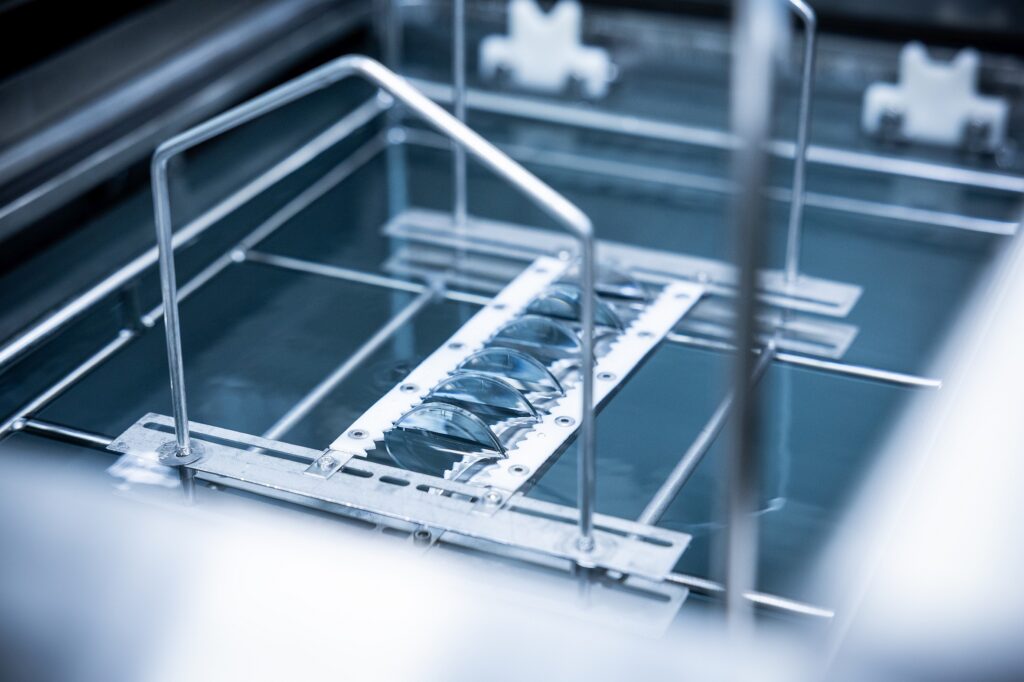 Precision optical components undergo multi-stage immersion cleaning to meet ultra-fine particulate and film cleanliness requirements for high-tech applications
 Hydrogen-ready cleanliness is now essential for next-generation components in semiconductors, e-mobility, optics and aerospace. Manufacturers have shifted from removing bulk residues to eliminating submicrometre particulates and nanometre-scale films of organic, inorganic or ionic contamination that threaten performance and outgassing in vacuum or high-purity environments.
This demands a systematic approach where engineers analyse part material, geometry and weight alongside contamination types to define targets under standards like EN ISO 14644-9 for particulates and VDI 2083, with film limits set by application-specific tests including mass spectrometry for outgassing rates and hydrogen-induced species.
Cleaning occurs in stages after machining, forming, grinding or polishing, using combined methods like steam degreasing, spray or high-pressure jets, immersion baths, ultrasonics, megasonics, pulsed pressure cleaning, injection flood washing and plasma to keep parts oil- and grease-free through complex geometries.
Modular vacuum systems with hydrocarbons, modified alcohols or aqueous media handle intermediate steps, while ultrasonic multi-bath lines with standardised modules for cleaning, rinsing, drying and handling suit high throughput or tight specs, allowing upgrades as needs grow.
Ecoclean’s High Purity Test Centre qualifies these processes in a Class 7 cleanroom with Class 6 zones, employing microscopy, residual gas analysis, UV and fluorescence to develop and validate full chains under production-like conditions.
What’s emerging is a clear trend that as components become smaller, more powerful and more sensitive, controlling surface purity down to the molecular scale is becoming as central to high-performance manufacturing as the mechanical design of the parts themselves.
Precision optical components undergo multi-stage immersion cleaning to meet ultra-fine particulate and film cleanliness requirements for high-tech applications.
Click here to read the latest issue of E-Mobility Engineering.| # | Наименование новости | Тональность | Информативность | Дата публикации |
|---|---|---|---|---|
| 1 | ACTHYVE Survey: Help Identify Industry User Needs for Hydrogen Technology Infrastructures | 0 | 6.18 | 22-07-2026 |
| 2 | Capture, storage, and re-use of liquid hydrogen boil-off for aviation and aerospace applications | 0 | 9.64 | 18-08-2026 |
| 3 | ACTHYVE Survey: Help Map Europe’s Technology Infrastructures for Hydrogen and CCU Innovation | 0 | 5.92 | 16-06-2026 |
| 4 | Battery debonding | 0 | 15.37 | 19-05-2026 |
| 5 | Chemists race to turn industrial waste into renewable resource | 0 | 6.89 | 06-08-2026 |
| 6 | New hydrogen breakthrough turns waste heat into clean fuel | 0 | 8.82 | 02-06-2026 |
| 7 | “Cannot be explained” – New ultra stainless steel stuns researchers | 0 | 8.77 | 10-05-2026 |
| 8 | The (re)centrality of electronic components in the era of energy and digital transition | 0 | 8.8 | 27-04-2026 |
| 9 | New process turns plastic waste into hydrogen fuel while trapping the carbon | 0 | 7.44 | 31-07-2026 |
| 10 | Shanghai Electric вводит в действие НИЦ технологий производства водорода на основе ПОМ | 0 | 0 | 17-03-2021 |