Просмотр новости
Найдите то, что Вас интересует
 Спутники
 РН
РН SpaceX
 Роскосмос
 NASA
NASA
СпутникиРНSpaceXРоскосмосNASAIn a mature and competitive industry, long-term success may depend less on constant growth and more on building a durable, adaptable business.
The post Redefining Success in Brewery Operations appeared first on Brewers Association.
Note: This post is the second in a series of three that explores the lifecycle of breweries from sunrise (brewery openings) to sunset (voluntary exit).
For decades now, the craft brewing industry has had a straightforward approach to discussing success: growth. More barrels brewed, more capacity built, larger distribution footprint, and more employees. The Brewers Association was part of that story, documenting and celebrating years of expansion.
But infinite growth is neither possible for an industry, nor is it desirable for every brewery. For many businesses, the goal is not to become substantially larger each year. It is to remain relevant, and to evolve with the times to become financially sound and valuable to the communities they serve.
Four Day Ray Brewing offers one such story. The brewpub is headquartered in Fishers, Indiana, and President/Owner Brian Graham describes success as something that “revolves around the community.” The brewery’s production over the past years reflects a business that has found steady footing, no longer in the rapid growth phase. From 2022 through 2025, production volume at Four Day Ray never changed by more than 10% annually in either direction.
And Four Day Ray is not alone. 14% of active breweries in 2025 maintained that same level of production consistency over that same four-year period. Looking just at 2024 to 2025 year-over-year volume change, 56% of breweries remained within plus or minus 10% growth band.
In a world where much of the craft beer airwaves are commandeered by openings and closings, this post explores the breweries that challenge the assumption that if a brewery isn’t moving “up and to the right,” that it is automatically a warning sign. In today’s market, steady production can also describe a brewery that is actively tweaking many other parts of its business to set itself up for long-term success.
What “Steady” Production Looks Like at Different ScalesOf course, a percentage-based definition of “steadiness” does not affect every brewery equally. For a brewery producing 100,000 barrels, volume would need to move by more than 10,000 barrels before it falls outside a plus-or-minus-10% range. At 300 barrels (roughly the median annual production for U.S. breweries) a shift of just over 30 barrels is enough to cross that threshold.
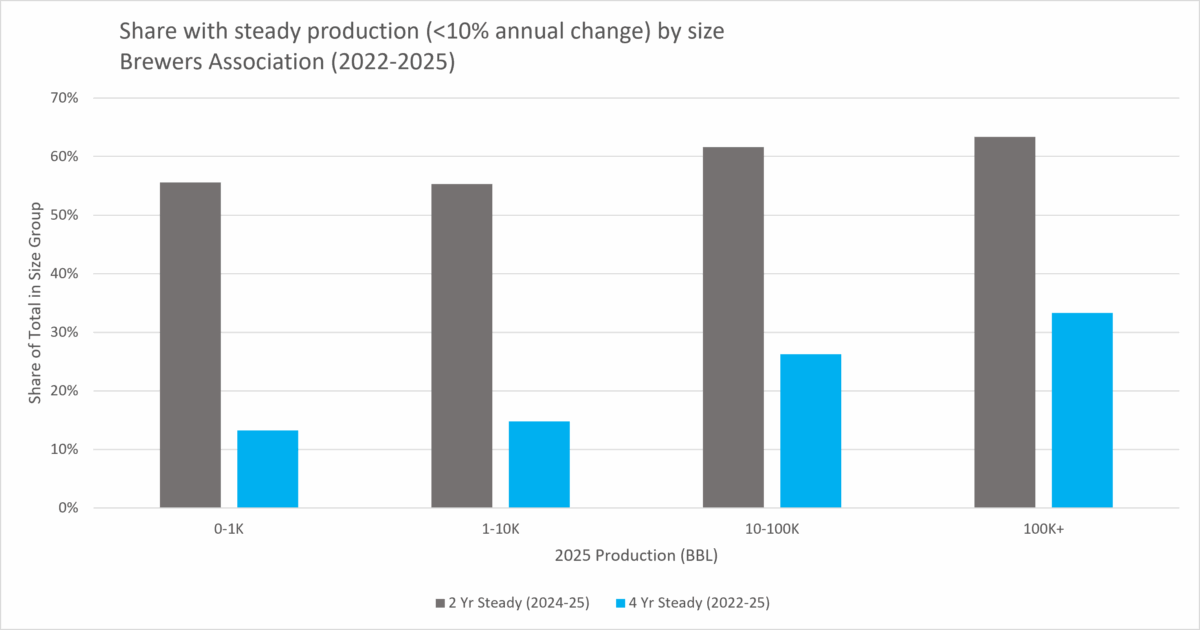
Larger breweries are more likely to appear steady by the measure of percentage change. Relatedly, breweries by type don’t look the same across this “steadiness” metric either.
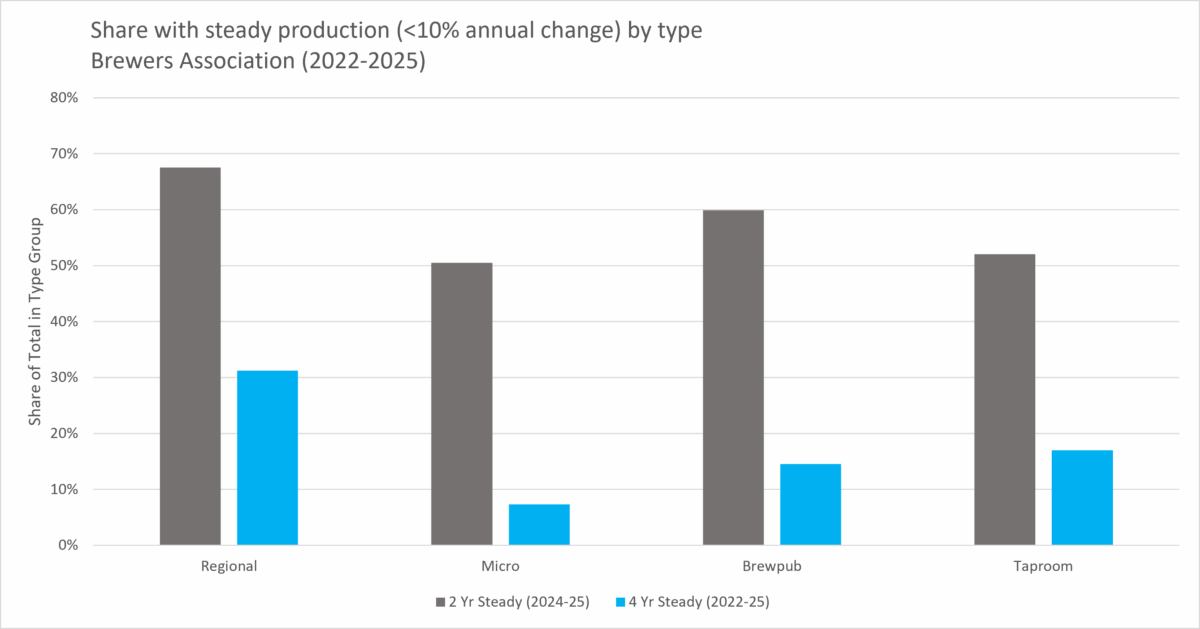
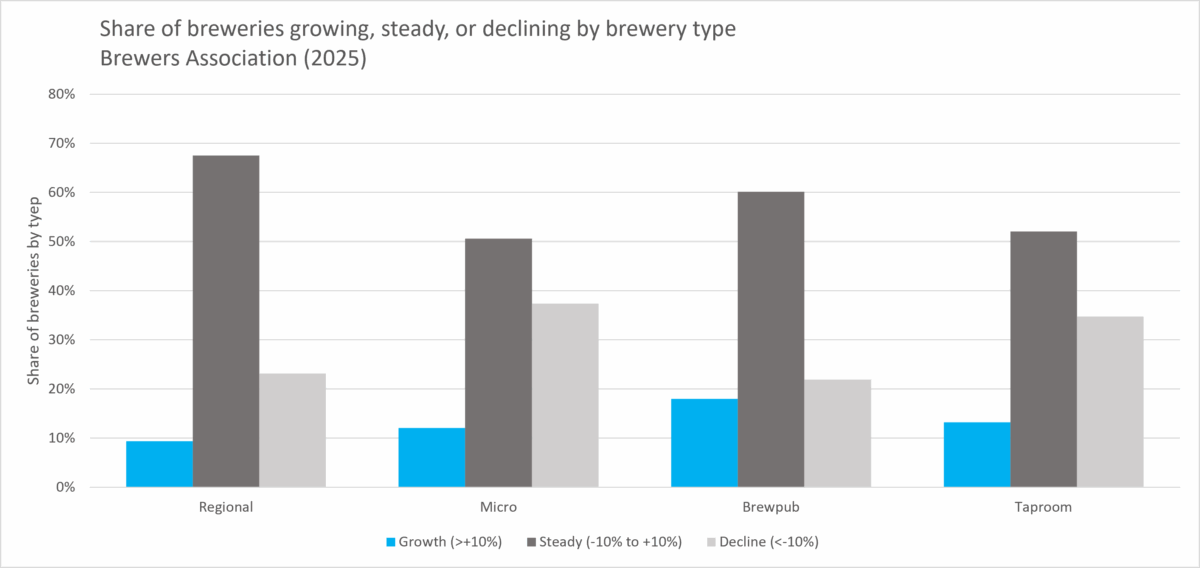
So, if we’re looking for other definitions of success beyond production growth, what could those be? Here are a few alternative ways of characterizing a successful brewery in 2026.
Production can remain stable while a brewery expands its physical presence. Four Day Ray, for example, expanded to a second location in Yorktown, Indiana in 2024 (eight years after their first brewpub opened). And it did so without a comparable increase in beer volume—in fact, Four Day Ray doesn’t have a brew system at the second location. The increased traffic and food spend from the second location has helped diversify revenue and provided a new market for the company to develop deep inroads with.
That reflects a larger shift in brewery openings. New brewing facilities opening are increasingly subsequent locations opened by existing breweries rather than entirely new brewing companies. For an established business, another taproom may offer access to a new neighborhood (or an entirely new market), a broader customer base, or additional hospitality revenue without requiring a major increase in beer production.
In this scenario, growth is not measured only by how much beer leaves the cellar, but may instead be tracked in customer visits or the number of occasions a brewery can serve.
A Different Product MixBreweries can also change what they produce without significantly altering total beer volume. Based on Brewery Industry Production Survey (BIPS) estimates, roughly one in four breweries today produces at least some beyond beer beverage, allowing businesses to meet consumers across more occasions and preferences.
Production data does not capture everything served across the bar, either. Four Day Ray, for example, holds a three-way liquor license and operates a full kitchen, giving customers, in Graham’s words, “more of a reason to stick around.” In many states where it’s legal for breweries to sell non-beer alcohol, owners will bring in other (sometimes local) spirits, wine, and non-alc products to be able to accommodate a more diverse range of consumers and occasions.
Granted, we’re not using production growth as a metric for success here, but if we were, we could see how the hospitality component matters. From 2024 to 2025, brewpubs recorded the smallest aggregate production decline among major craft brewery types (down -1.7% compared with a -4% decline for craft overall). A kitchen or broader beverage menu is in no way a guarantee of success, but it does give a brewery more ways to prolong the customer visit, or to serve different members of the same group who want different things.
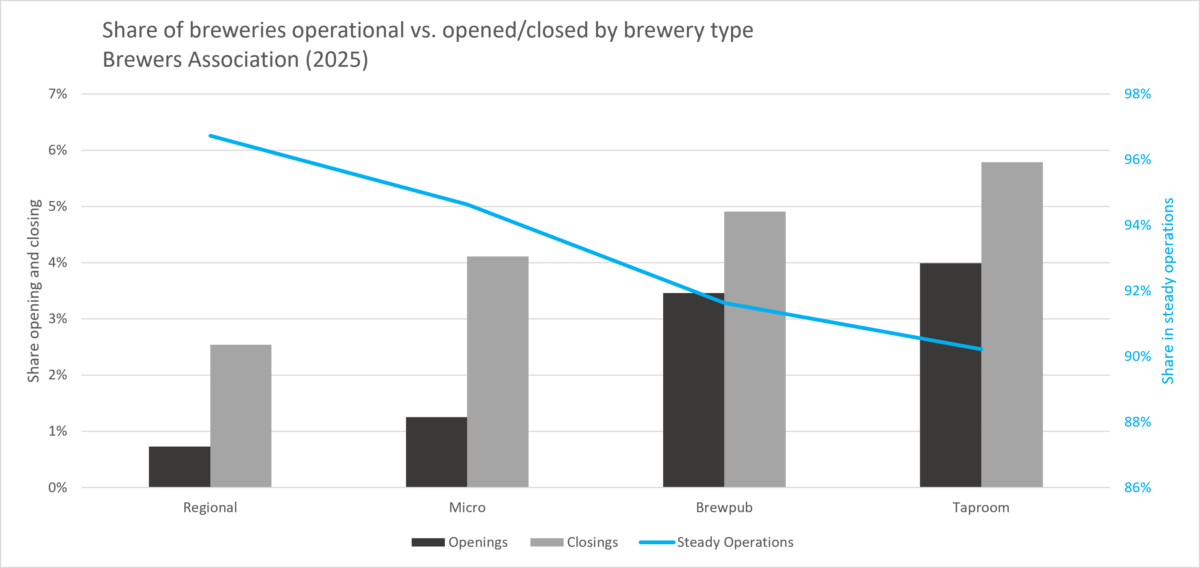 The Shift Toward Margin
For many steady-production breweries, the most important changes may be the least visible. They are happening in debt levels, staffing plans, procurement decisions, menu design, labor deployment, and the day-to-day discipline of running a solid business.
Four Day Ray, for example, has been deliberate about avoiding overextension and intentional about growth, whether referring to additions of stainless or employees. That approach aligns with their broader operating mentality of doing more with less, not as a temporary austerity measure, but as a core part of building a durable company.
The 2024 Brewers Association Financial Benchmarking Survey reported a median gross profit margin of 41% for breweries, down significantly from the 51% measured in 2019. Median net income in 2024 was 14%. The next survey (coming out in August 2026) will provide a useful view of how that figure has changed, but I wouldn’t be surprised if that median has climbed. In the past few years, less-profitable businesses have been forced to exit the market and I expect that the breweries that remain are those who have been able to prioritize profitability. Stay tuned to see if that pans out.
Ongoing EvolutionIn closing, I’d like to point out that all the options above are still quantifiable and aligned with how an MBA would think about progress. However, there are other metrics of success that are less tangible. A company that’s reached a steady state is one that may find it has more time to consider what it wants to be and the impact it wants to have on its community. It can mean a better life balance for owners and staff after years of expansion, or it can mean reinvestments in the local area rather than just directly back into the business.
In either case, a brewery in steady-state production is rarely a brewery in steady state overall. Consumer preferences continue to change, both in the products and in the hospitality experiences they seek. Breweries that remain open over the long term will evolve along with them.
The production line may stay relatively flat while locations, products, service models, and brewery operations continue changing. That is not necessarily stagnation. In a mature and competitive market, it may be one of the clearest signs that success just looks different than it used to.
How has your brewery redefined success over the past years? I’d love to hear from you. As always, feel free to contact me directly with any thoughts or questions.
Was this article helpful?
YesNo
| # | Наименование новости | Тональность | Информативность | Дата публикации |
|---|---|---|---|---|
| 1 | Brewery Visits Are Up. Wait, What? | 0 | 7.72 | 13-08-2026 |
| 2 | Quick Take: Injury Rates in Breweries | 0 | 8.55 | 14-07-2026 |
| 3 | Sunrise: Brewery Openings | 0 | 7.92 | 06-07-2026 |
| 4 | Cincy Light Vs. Cold Time: Two Lager Brands, Two Very Different Paths | 0 | 6.67 | 13-08-2026 |
| 5 | Era piwnej cierpliwości. Jak Browar Cieszyn odnajduje się w nowym świecie (WYWIAD) | 5 | 7 | 27-05-2026 |
| 6 | Why adaptability is pivotal in overcoming perpetual motion in modern business | 0 | 8.32 | 06-08-2026 |
| 7 | Product before brand, a cautionary swig | 0 | 8.07 | 03-08-2026 |
| 8 | Pro Tip: Six steps to creating an elite maintenance team | 5 | 7 | 09-06-2026 |
| 9 | Technology will keep evolving: Build teams that outlast the shift | 0 | 10.93 | 25-04-2026 |
| 10 | Wartość zamiast wolumenu. Kompania Piwowarska zmienia strategię sprzedaży | 0 | 8.75 | 27-08-2026 |