Просмотр новости
Найдите то, что Вас интересует
 Спутники
 РН
РН SpaceX
 Роскосмос
 NASA
NASA
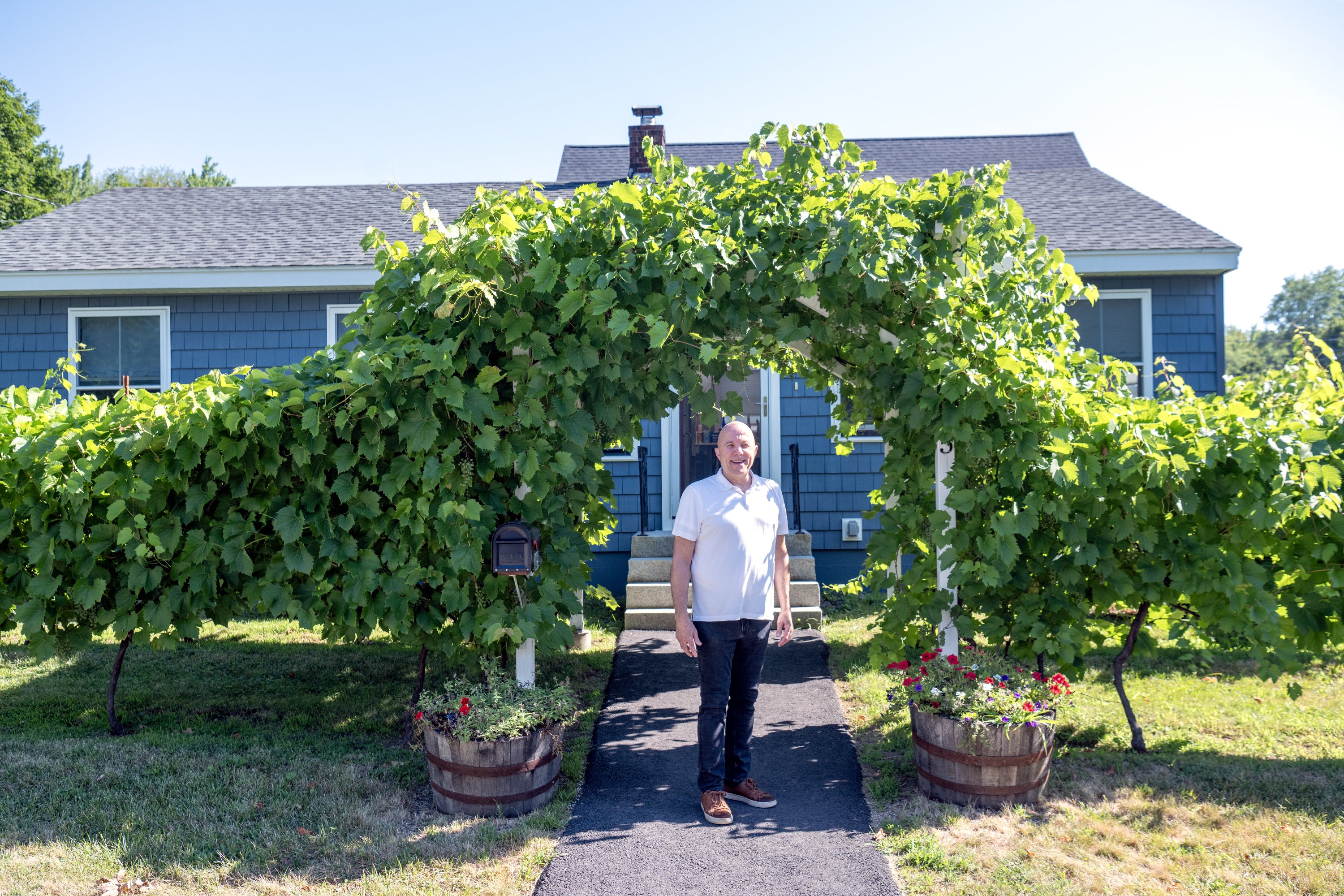
СпутникиРНSpaceXРоскосмосNASAGuy O'Connell has transformed an ordinary lawn into a flourishing micro-vineyard.
Some of us acquired puppies during the pandemic. Some of us learned to bake sourdough bread. Ambitious readers picked up “War and Peace” or “Middlemarch” to while away the hours. Candy salesman Guy O’Connell did none of those things.
Casting about for a hobby to occupy long days at home, in 2021 he planted a vineyard outside his attractive but otherwise unremarkable 1962 ranch home in Portland’s East Deering neighborhood.
O’Connell mailed away for 60 cold-hardy vines from a vineyard in New York — two red varieties and two whites. Evenings, weekends and on the occasional day off, he dug holes, installed trellises and nurtured the tender young plants. He enrolled in an online chemistry class at the University of California, Davis, a necessary prerequisite to the prestigious Winemaking Certificate Program at the university from which he later graduated.
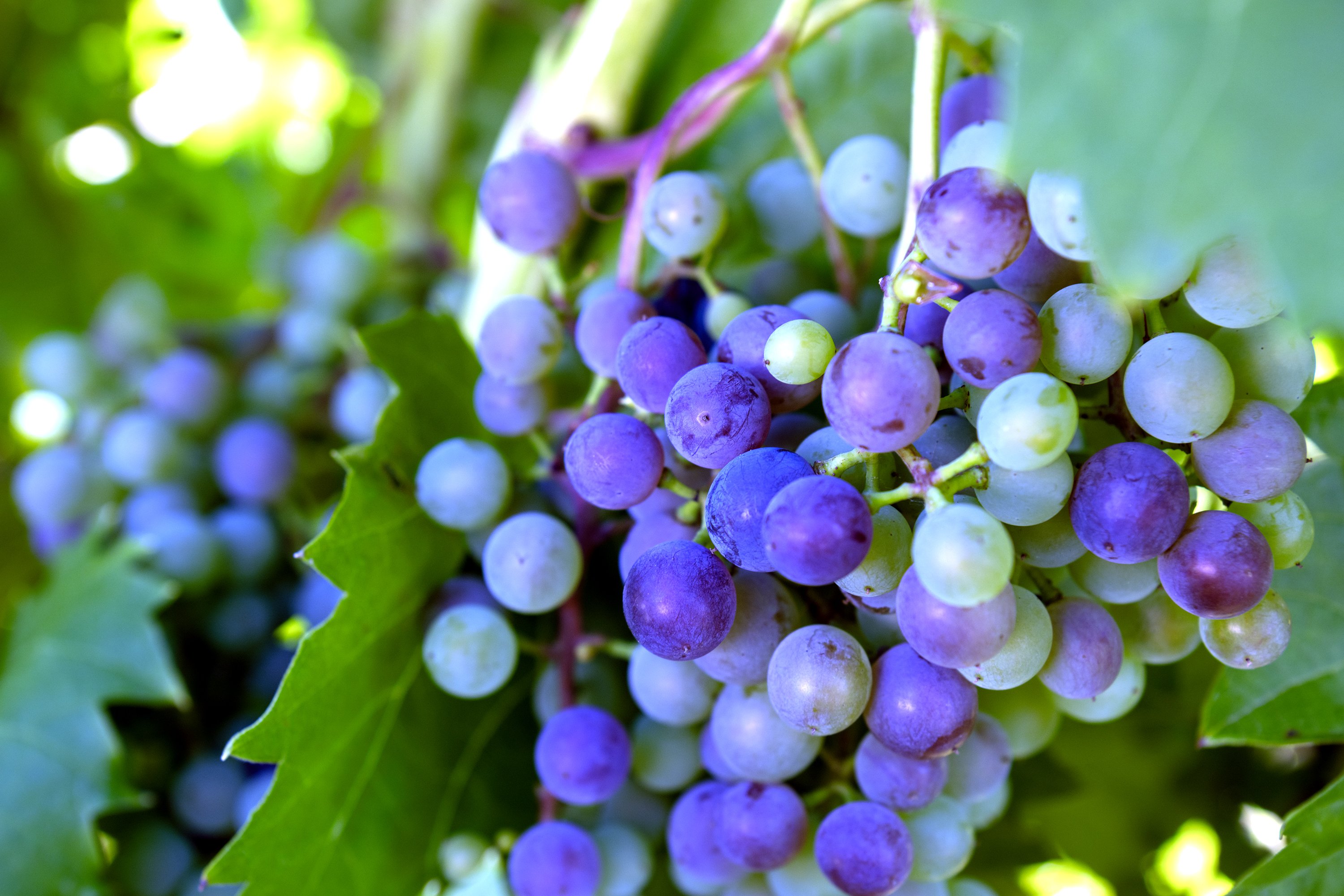 Frontenac grapes ripening in O’Connell’s yard will be ready to harvest by mid to late September. (Daryn Slover/Staff Photographer)<?xml version="1.0"?>
Purchase this image
Frontenac grapes ripening in O’Connell’s yard will be ready to harvest by mid to late September. (Daryn Slover/Staff Photographer)<?xml version="1.0"?>
Purchase this image
Today, his lush micro-vineyard covers almost every inch of his small front and side yards. In August the vines are loaded with grapes. More vines mass and twine atop the pergola he installed that frames his front door. In the basement, O’Connell has set up a lab of sorts, where he experiments with making the approachable, low-tannin wines he likes to drink. He dreams of someday opening a micro-winery in Portland.
For years, O’Connell, 64, had read deeply about wine and winemaking. As COVID took hold, he got to thinking: “When am I going to plunge in and try to do something? Then things just happened,” he said. “It gave me an outlet. It kept my mind occupied. Everything clicked.
“Kind of crazy, right?” the self-deprecating O’Connell added with a grin.
ROOTS OF AN IDEA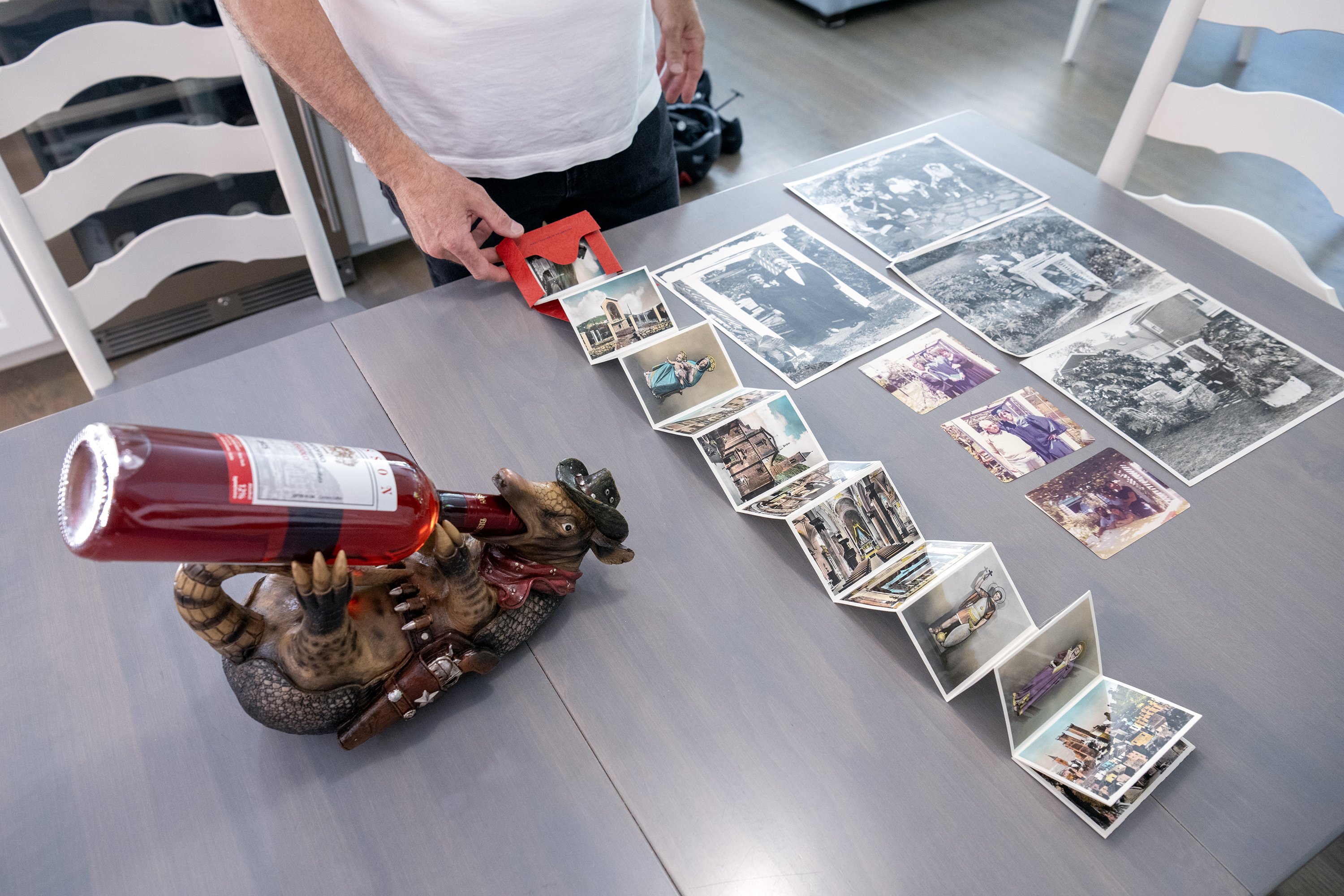 Guy O’Connell displays pictures of his grandparents, Gaetano and Anna Aceto Ciccarelli, on his dining room table. His grandfather, an Italian immigrant, inspired his own love of wine. The vintage concertina fold postcard folder is of his grandfather’s hometown, and the armadillo wine bottle holder was a gift from a Texas friend. (Daryn Slover/Staff Photographer) (Daryn Slover/Staff Photographer)<?xml version="1.0"?>
Purchase this image
Guy O’Connell displays pictures of his grandparents, Gaetano and Anna Aceto Ciccarelli, on his dining room table. His grandfather, an Italian immigrant, inspired his own love of wine. The vintage concertina fold postcard folder is of his grandfather’s hometown, and the armadillo wine bottle holder was a gift from a Texas friend. (Daryn Slover/Staff Photographer) (Daryn Slover/Staff Photographer)<?xml version="1.0"?>
Purchase this image
O’Connell and his two brothers grew up in the house where he now lives and cultivates his vineyard. He’s named for his maternal grandfather, Guy (Gaetano) Ciccarelli, who came to this country at age 16 from Abruzzi, Italy, and lived around the corner in “a beautiful slate house” when O’Connell was a boy.
He graduated from Portland High, went on to get an accounting degree from the University of Southern Maine, then a graduate degree in marketing from Plymouth State University. For most of his career, he has worked for the Original Gourmet Food Company, a job he describes with buoyant enthusiasm.
In 2000, he moved back in to his childhood home to help his mom, who’d been diagnosed with Alzheimer’s. She died in 2019. Two years later, he dug up the lawn and planted the vines.
There is little in O’Connell’s biography to suggest a passionate oenophile.
With the exception of his Grandfather Ciccarelli, who kept a beautiful garden and dabbled in winemaking, his family heritage doesn’t shout vintner. His brothers are beer drinkers. He jokes they inherited the genes from the Irish side of the family.
When O’Connell talks about flavors, he speaks plainly, mentioning “nail polish” to describe off-flavors he’s so far had the luck and skill to avoid, and critiquing his white blends simply: “I don’t think I’m there yet. I’ve still got work to do.”
He’s hardly the clichéd image of the career-changing hedge fund manager or tech bro who tastes a transcendent bottle in Bordeaux and returns home to spend millions on a vineyard. And until UC Davis, O’Connell had never studied science or horticulture. He certainly didn’t consider himself a gardener. “Trust me, I had no idea what I was doing.”
Asked if he has a green thumb, his answer is full of hesitation. “I never thought I did, but yeah, I come to find out I guess I do.”
EDUCATION OF A WINEMAKER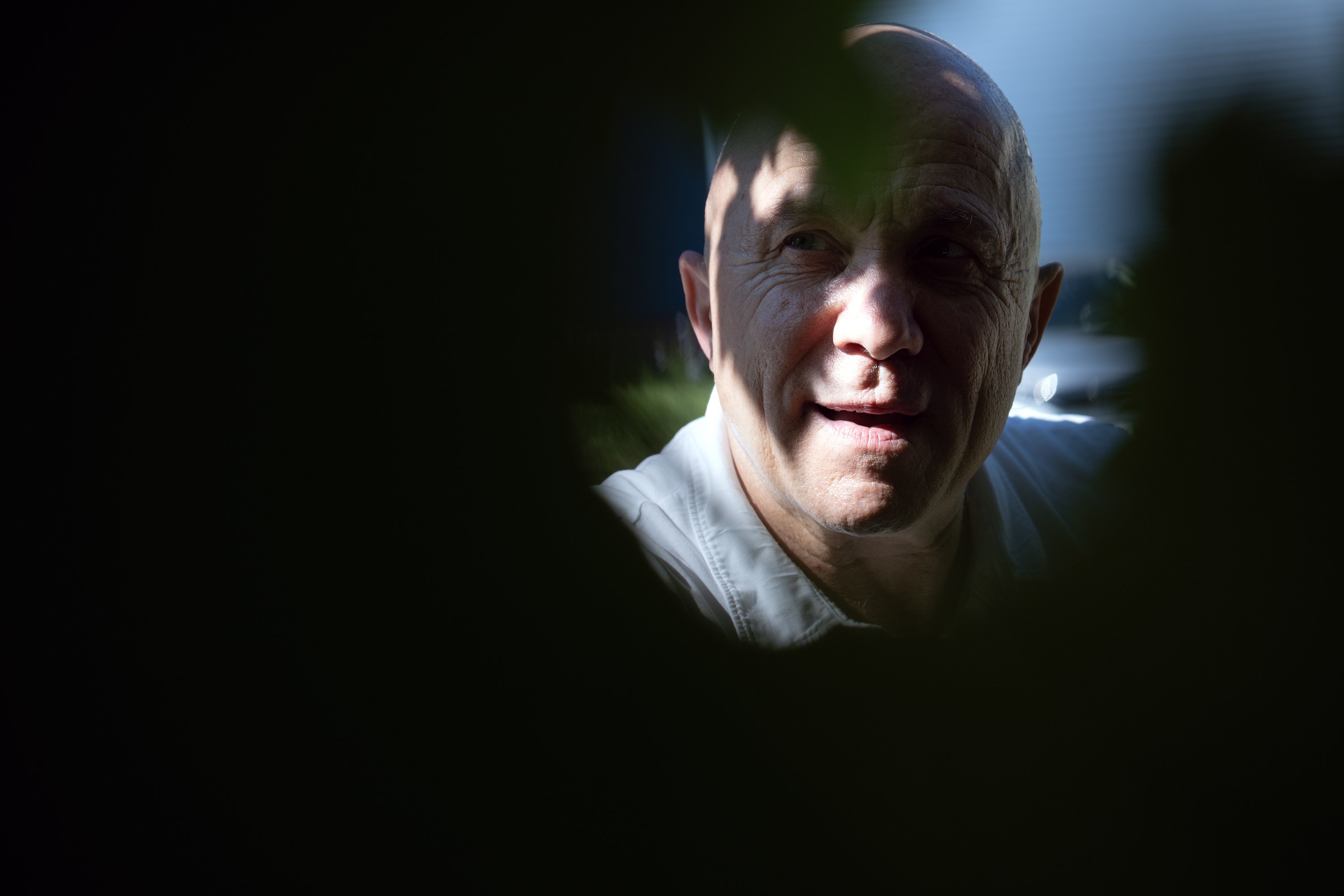 O’Connell seen through the lush grapevines that he grows outside his home. “I’m not a wine snob,” he said. “There are so many beautiful regions around the world. Just because you may have an affinity towards California and Napa Valley cabernet, there’s this whole other world. People been making wine for 2,000 years. C’mon.” (Daryn Slover/Staff Photographer)<?xml version="1.0"?>
Purchase this image
O’Connell seen through the lush grapevines that he grows outside his home. “I’m not a wine snob,” he said. “There are so many beautiful regions around the world. Just because you may have an affinity towards California and Napa Valley cabernet, there’s this whole other world. People been making wine for 2,000 years. C’mon.” (Daryn Slover/Staff Photographer)<?xml version="1.0"?>
Purchase this image
In the last five years, O’Connell has spent time and money pursuing viticulture and winemaking. He estimates the education alone cost him $10,000, to say nothing of the vines, trellising, crusher destemmer, hydraulic press, carboys and wine grape juice he’s purchased for blending. Altogether, he’s spent about $30,000 — with no guarantees.
“You don’t know the results,” he said. “You got to wait on Mother Nature and see if she is going to help.”
School, he says, was tough, especially the basic chemistry prerequisite. “I just barely got through that.” It took him another two years — 185 classroom hours plus study time — to earn his winemaking certificate in 2023. The classes ran on California time, so he was often attending virtual school until late in the evening.
These aren’t complaints. The course was eye-opening, O’Connell said. “It’s one of the premier schools. The professors are just so smart.” His classmates came from around the world, with equally various ambitions and situations: some were vineyard managers who wanted to get into the cellar, others were vineyard owners who wanted to educate themselves. Some oversaw hundreds of acres of vines, others thousands.
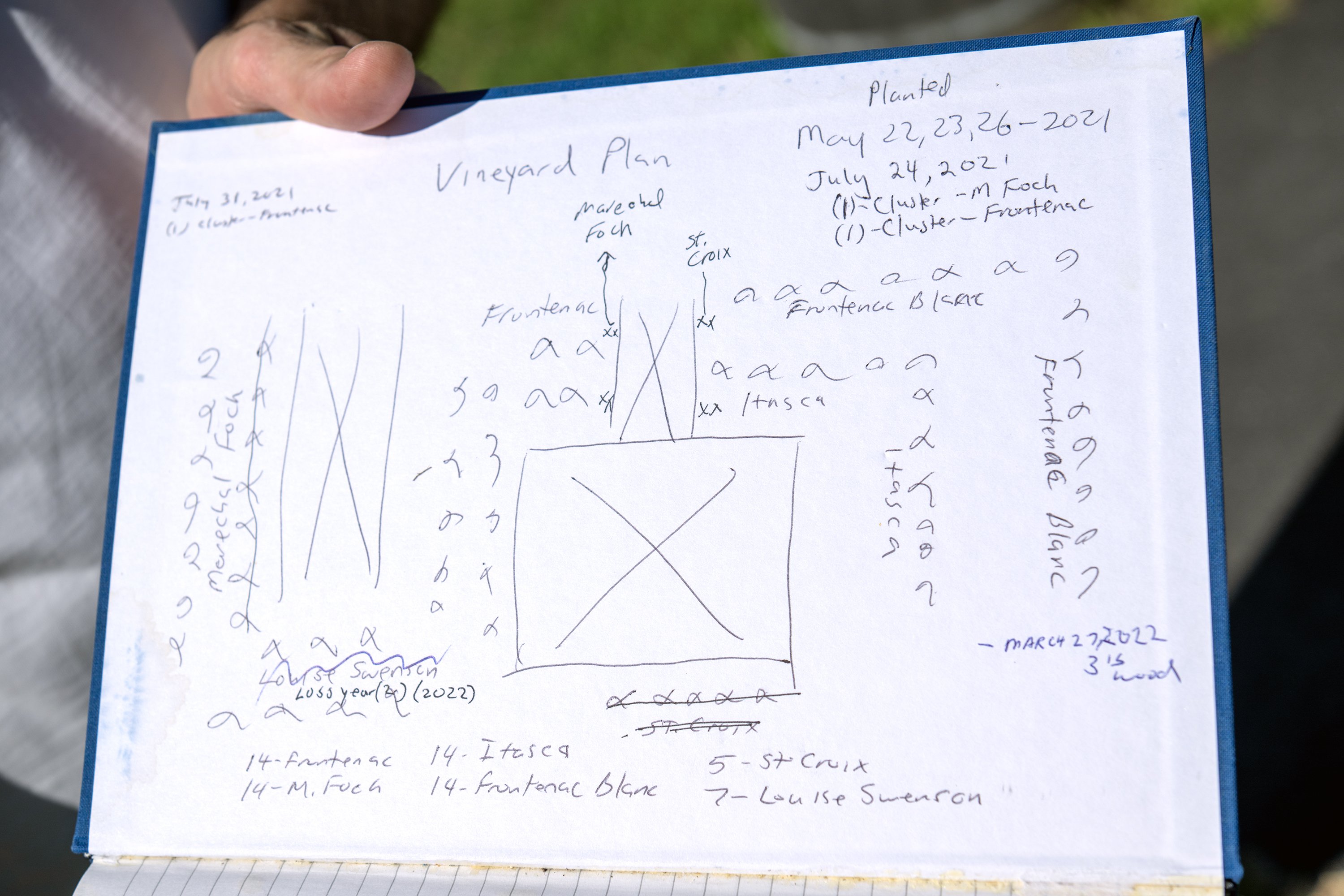 O’Connell planted the vines in 2021, according to the vineyard plan he’d drawn up. His first harvest was in 2024. (Daryn Slover/Staff Photographer)<?xml version="1.0"?>
Purchase this image
O’Connell planted the vines in 2021, according to the vineyard plan he’d drawn up. His first harvest was in 2024. (Daryn Slover/Staff Photographer)<?xml version="1.0"?>
Purchase this image
Concurrent with studying, O’Connell planted his vineyard of hybrid grapes, rows of Frontenac and Frontenac Blanc, Itasca and Maréchal Foch. He dug 12-by-12-inch holes for each mail-ordered vine, doing his best to plant the rows 8 to 10 feet apart, and the vines 6 to 8 feet apart. The neighbors, he joked, thought he was drilling for oil.
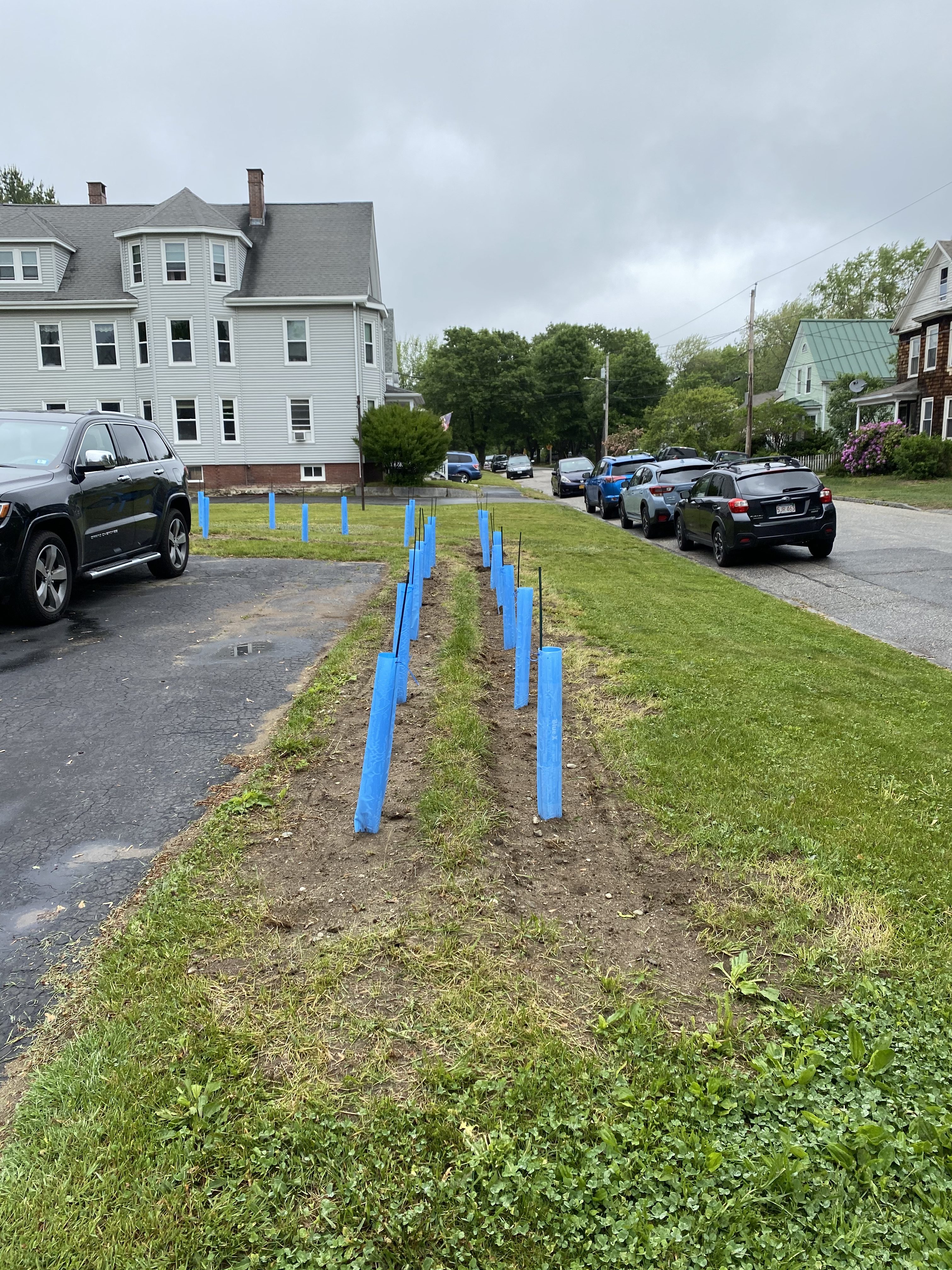 A corner of O’Connell’s yard just after the grape vines were planted in 2021. (Photo courtesy of Guy O’Connell)
“I only had what I could work with,” he said of his pocket-size lot, fretting that the rows on the northwest side of the house are too close together and block the sun.
To protect the tender young vines from browsing wildlife, he encased them in growth tubes. In the backyard, he also planted a row of St. Croix grapes. They failed to thrive, so he eventually dug them up and replanted them by the pergola.
For the next few years, O’Connell pruned (“more of an art than a science”), watered, “dropped” (or snipped off) grapes to redirect energy into the young rootstocks. And waited.
Two years ago, he got his first harvest, and now, five years on, the once ordinary suburban lawn has been transformed.
WON’T YOU BE MY NEIGHBOR?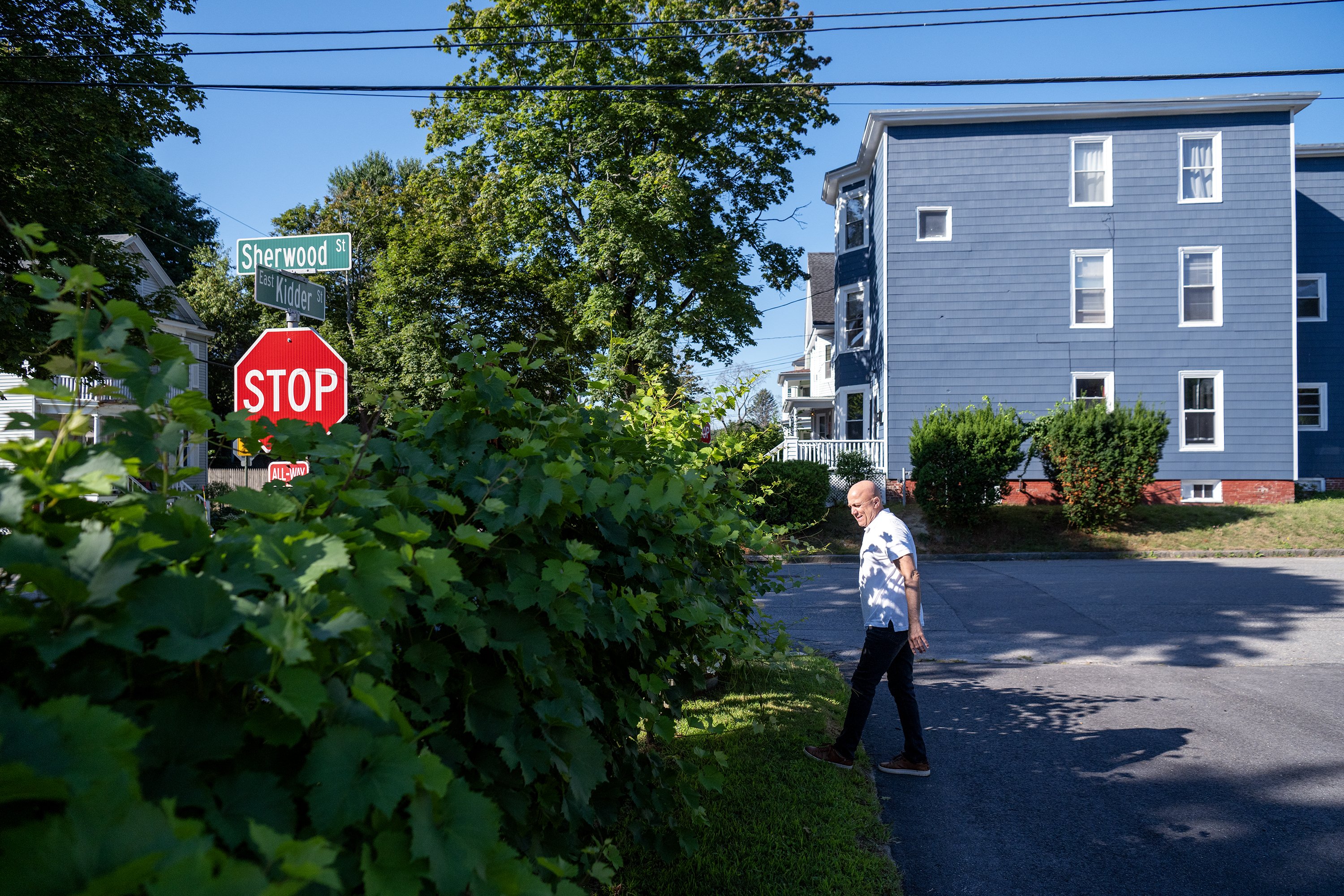 O’Connell checks on the grapevines in early August. Some of the grapes are already turning red. (Daryn Slover/Staff Photographer)<?xml version="1.0"?>
Purchase this image
O’Connell checks on the grapevines in early August. Some of the grapes are already turning red. (Daryn Slover/Staff Photographer)<?xml version="1.0"?>
Purchase this image
When his refractometer tells him the grapes are ripe, it’s time to harvest, an operation of a day or two around the third week of September. O’Connell sets up the manual crusher destemmer under a tent in the yard — make that the vineyard. His cousins and some friends come over to help pick. The journey from grape to glass has officially begun.
Last year, he harvested 264 pounds. He expects a higher yield this year, as much as 500-600 pounds, since he’s cut down a few trees that were blocking the sunlight from reaching the Itasca grapes. The weather has been good, “with the right amount of rain and the right amount of sunshine.” It takes 100 to 125 pounds of grapes to make 5 gallons, or 19 liters, of wine.
He’s considering throwing a harvest party, to test out his blends on the neighbors. Based on a casual survey of the surrounding blocks, and an unreliable sampling size, they feel 100 percent positive about the micro-vineyard in their midst.
“I think it’s amazing,” said Lisa Bowman, who has lived down the block for 17 years. “It’s just so neat.” She and her grandchildren have delighted in watching the vines develop over the years, observing as O’Connell trained them to grow in rows and wrapped individual ripening grape clusters with bags to protect them from birds and fungus.
Amy Gaidis, from nearby Oakley Street, said that Italy, home of her grandparents, is the first place she thinks of for grapes and wine. Also, California, Oregon, New Zealand… “I didn’t even realize that you could really grow grapes in this area.
“This is an old Italian neighborhood,” she went on, “so that’s awesome. There’s this sweet little Italian vine there, if you will.” She made a sinuous motion with her arm as though a vine were swaying gently in the breeze connecting the area’s heritage with O’Connell’s vineyard project.
“I got to get to know my neighbors now that I know they’re making wine,” Gaidis said with a laugh. “I got to go knock on his door.”
PROFESSIONAL’S PERSPECTIVE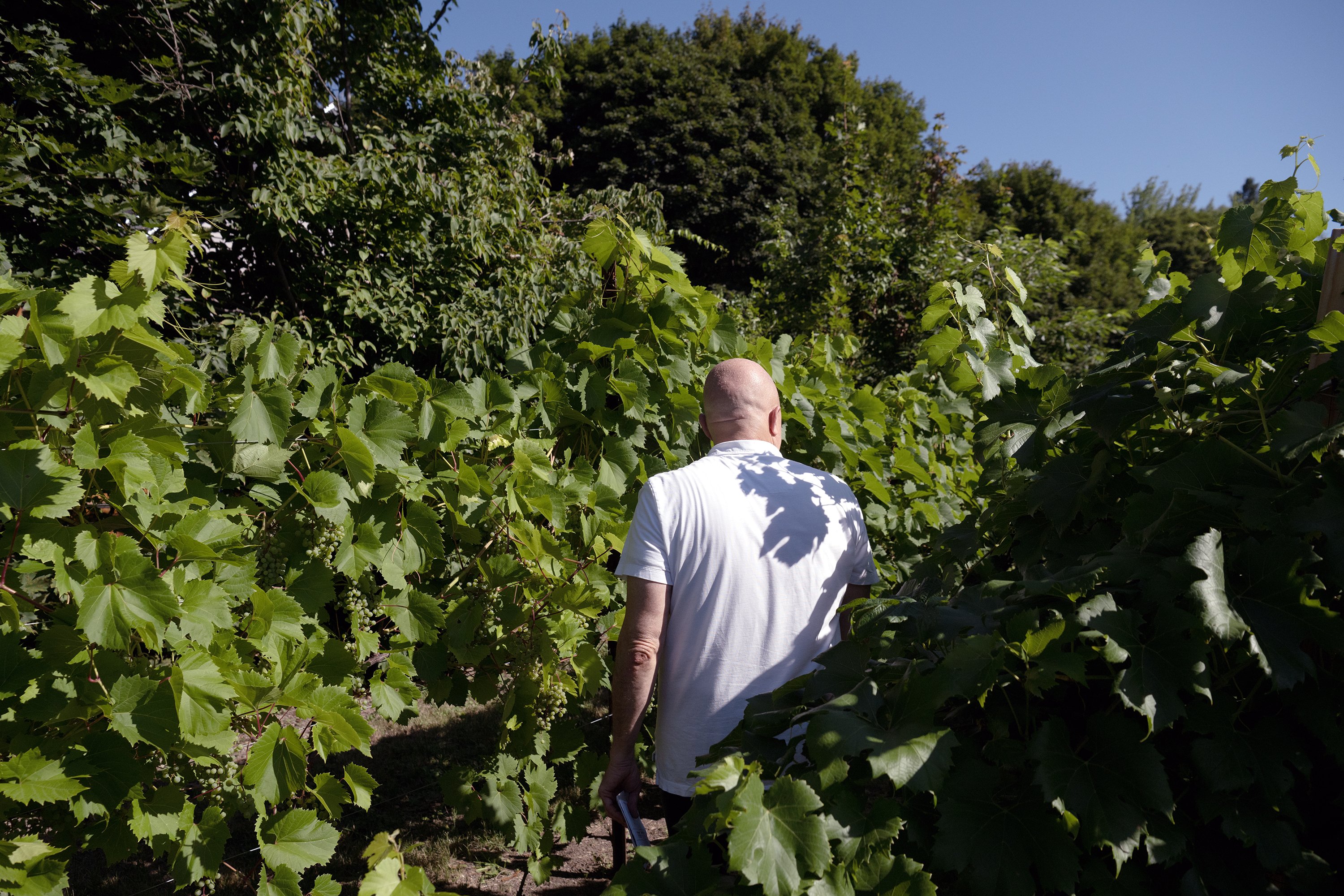 O’Connell amid his flourishing grapevines. “I really nurtured them in the beginning. I never thought I would get here. You look at them outside and they’re just so beautiful. Oh my God. ‘Cause they’re babies when you get them. They’re like twigs.”(Daryn Slover/Staff Photographer)<?xml version="1.0"?>
Purchase this image
O’Connell amid his flourishing grapevines. “I really nurtured them in the beginning. I never thought I would get here. You look at them outside and they’re just so beautiful. Oh my God. ‘Cause they’re babies when you get them. They’re like twigs.”(Daryn Slover/Staff Photographer)<?xml version="1.0"?>
Purchase this image
The fact that many Mainers don’t realize wine grapes can grow in Maine is among the several reasons Portland-based wine writer and educator Margot Mazur is excited to hear about O’Connell’s backyard vineyard.
“In France, no one would bat an eye at folks doing that in their front yard because in France folks know that their land is good land for grape-growing, right?” Mazur said. “Whereas in the United States, we don’t think about American wine (being) as good, as delicious, as quality as European wine, and we need to change that thinking. Our land is fantastic for growing all sorts of things. We should get excited about seeing what the opportunities are in our backyard.”
In the last 30 years or so, a handful of commercial wineries in Maine, like Cellardoor (Lincolnville) and Oyster River (Warren), have grown grapes and made wines, “so I’m not surprised,” Mazur said of O’Connell. “The surprising element is that this person has decided to do it right here in Portland on his lawn — which I think is great. We work with what we have.
“You know, wine is is kind of magical that way,” they said. “We folks in the industry call it getting bit by the wine bug. For a lot of people who are in this industry, there’s something more magical than just the agricultural product in the bottle. There’s this kind of, I don’t know, mystical cloud that envelops you and you become so excited about. It’s not just the grape. It’s the culture and the history. It’s the environmental aspect. There’s a feeling you are connected to something that has this unbroken line for generations and generations and generations and many, many hundreds of years. When you fall in love with wine, you fall really deeply.”
A FAMILY HERITAGE IN A FUTURE VINTAGE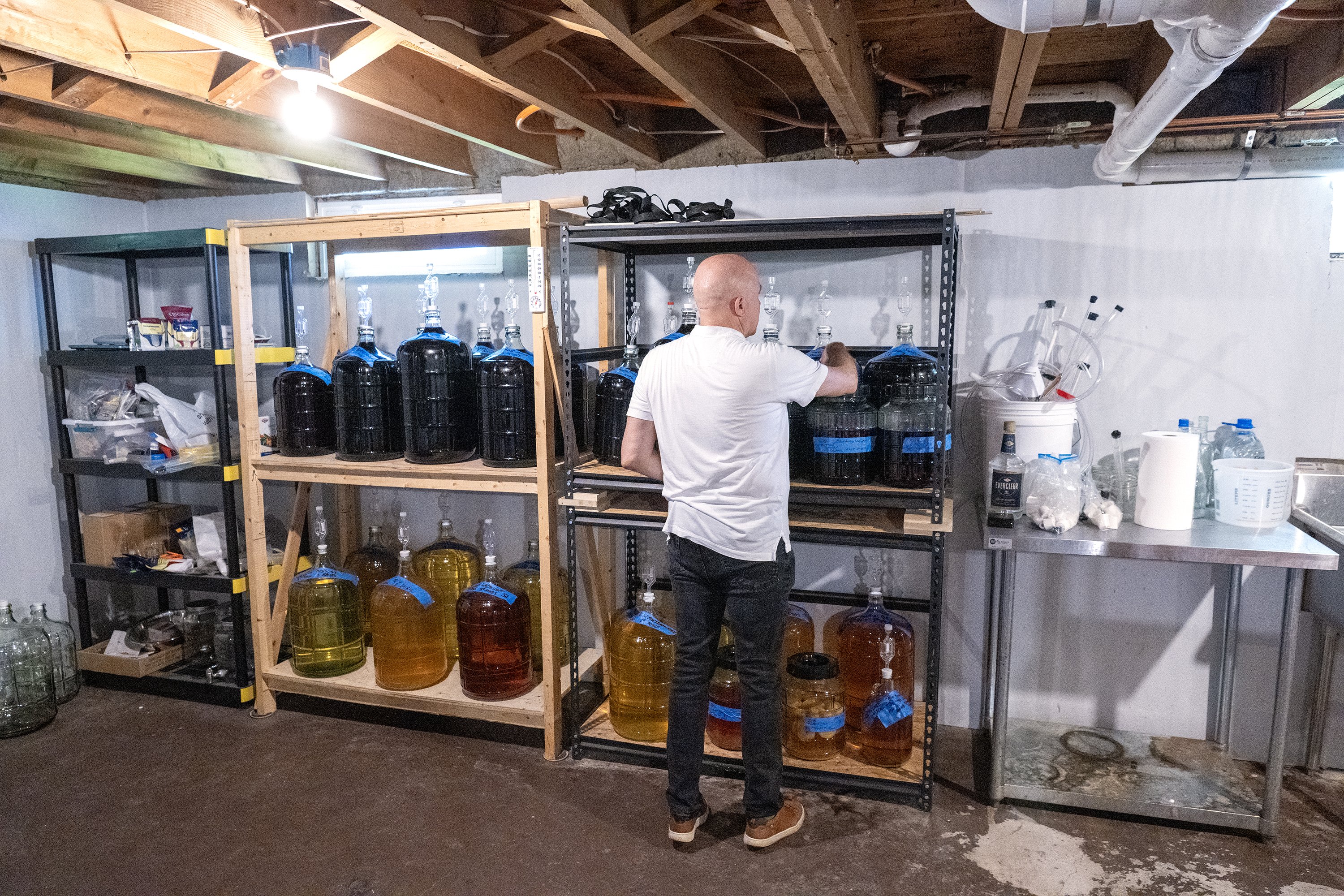 A corner of the basement in O’Connell’s home has become his tiny winery. (Daryn Slover/Staff Photographer)<?xml version="1.0"?>
Purchase this image
A corner of the basement in O’Connell’s home has become his tiny winery. (Daryn Slover/Staff Photographer)<?xml version="1.0"?>
Purchase this image
O’Connell talks fluidly about brix, balance, vertical shoot positioning systems and the process of making wine. But ask him why he’s growing grapes as opposed to, say, broccoli or radishes, and he’s stumped. “Oh my gosh. I don’t know.”
After a moment, he says that he thinks it’s about family heritage, watching his grandfather grow grapes, make wine and enjoy a glass with dinner, which to a small boy turned run-of-the-mill meals into feasts. “My family coming from Italy and the great wine tradition over there? I think some of that’s spilled onto me.”
He likes being outside. He likes that he needn’t bend down to harvest. He loves how the vines look in the fall when the leaves change colors. He appreciates a good glass himself: When he renovated his kitchen recently, he installed a wine refrigerator and wine shelves.
“It’s just fascinating that you can take fruit and make alcohol from it,” he said, his tone full of wonder.
There’s still so much to learn and do. He has never improved, or even tested, his soil and maybe it’s time to add nutrients. He’s considered using an organic spray and mail-ordering beneficial insects. A neighbor who is a graphic designer has offered to make wine labels, but first O’Connell needs to come up with a name for his operations.
Down in his lab, he’s been trying his hand this summer at ratafia, a traditional Italian liqueur made by macerating fruit in wine. Bottles sit on metal shelves, filled with fragrant mixes of his wines thus far, one combined with peaches, another strawberries, the third and fourth with, respectively, blueberries and black cherries.
O’Connell keeps binders with notes on his blends in progress. He documents dates, temperatures, brix, pH, fermentation, racking, egg white additions. On December 22, 2024, he added “125.0 ml #4007 Wyeast Malolactic Cultures Premium Liquid Yeast” to one of his blends.
“If anything went wrong, I can at least try to figure it out,” he said, reading his notes. “How did I get vinegar? Why does it smell like rotten eggs?”
He hasn’t yet bottled any wine. It’s all still a process of trial and error.
To help one day make a micro-winery, “my hope and dream,” a real possibility, an angel investor would be nice, he said with a smile. “It’s a lot of work and it’s a lot of risk. This is not for the faint of heart.”
Like many a modern vintner with far larger estates, O’Connell thinks statuary would give the place a little extra class. He’s got a spot picked out for a sculpture, over there between two thigh-high fig trees that he planted near the kitchen door. Not counting the driveway, that bitty section, plus the narrow strip behind the house, are the only patches of yard that aren’t flush with luxuriant vines and, per Robert Louis Stevenson, the promise of “bottled poetry.”
 By day, Guy O’Connell sells gourmet lollipops, Dubai chocolates and other treats to department stores and other retailers. In his free time, he grows grapes in his yard and experiments with making wine. He stores his crusher/destemmer in the garden shed, right behind the lawn mower. The petunias seen here are growing in what may be old wine barrels repurposed as planters. (Daryn Slover/Staff Photographer) <?xml version="1.0"?>
Purchase this image
By day, Guy O’Connell sells gourmet lollipops, Dubai chocolates and other treats to department stores and other retailers. In his free time, he grows grapes in his yard and experiments with making wine. He stores his crusher/destemmer in the garden shed, right behind the lawn mower. The petunias seen here are growing in what may be old wine barrels repurposed as planters. (Daryn Slover/Staff Photographer) <?xml version="1.0"?>
Purchase this image
| # | Наименование новости | Тональность | Информативность | Дата публикации |
|---|---|---|---|---|
| 1 | Scenes from Maine’s 6th annual Wild Blueberry Weekend | 0 | 35.91 | 03-08-2026 |
| 2 | Enjoy a side benefit of a Maine garden: The scent | 0 | 41.02 | 14-07-2026 |
| 3 | Maine farmers want Hannaford to buy more local produce. What’s the holdup? | 0 | 34.37 | 06-08-2026 |
| 4 | Maine farm nonprofit raising funds and food to feed the hungry | 0 | 33.87 | 28-07-2026 |
| 5 | По итогам года у нас будет 10 тысяч школ с инклюзивным образованием – Васильева | 0 | 0 | 10-12-2018 |
| 6 | Багаевская: Ночь 18 дек, Вт | 0 | 0 | 17-12-2018 |
| 7 | Спрос на перевозки из Китая и Казахстана в Беларусь вырос в 3 раза | 0 | 0 | 28-01-2025 |
| 8 | A Midcoast oyster sommelier reflects on joining ‘Oyster Society’ | 0 | 35.39 | 28-07-2026 |
| 9 | Thirsty for drought info? Quench your thirst with this central Maine guide | 0 | 37.73 | 05-08-2026 |
| 10 | What is coffee cupping? I tried it at a Portland roastery. | 0 | 37.2 | 07-08-2026 |


