Просмотр новости
Найдите то, что Вас интересует
 Спутники
 РН
РН SpaceX
 Роскосмос
 NASA
NASA
СпутникиРНSpaceXРоскосмосNASAFor the past several months, QuiX Quantum has been rolling out key pieces of what executives are calling the vendor’s universal photonic quantum computing architecture. That includes the Feed-Forward Control Unit (FFCU), an important hardware component that allows real-time measuring response, and its Photonic Assembly Control Unit (PACU), a standardized controller for its photonic quantum systems.
The technologies came together in the unveiling June 30 of QuiX’s Dedalo system architecture, which comes with multiple goals, from developing high-performance and error-corrected photonic qubits and fault-tolerant photonic quantum computers to ensuring the systems can easily fit and be deployed in quantum-classical hybrid HPC datacenters.
Fourteen days later, the seven-year-old Dutch company this week is announcing Carina, which is the first of its commercial photonic quantum computers and which sets the stage for the Dedalo architecture and its use of logical qubits.
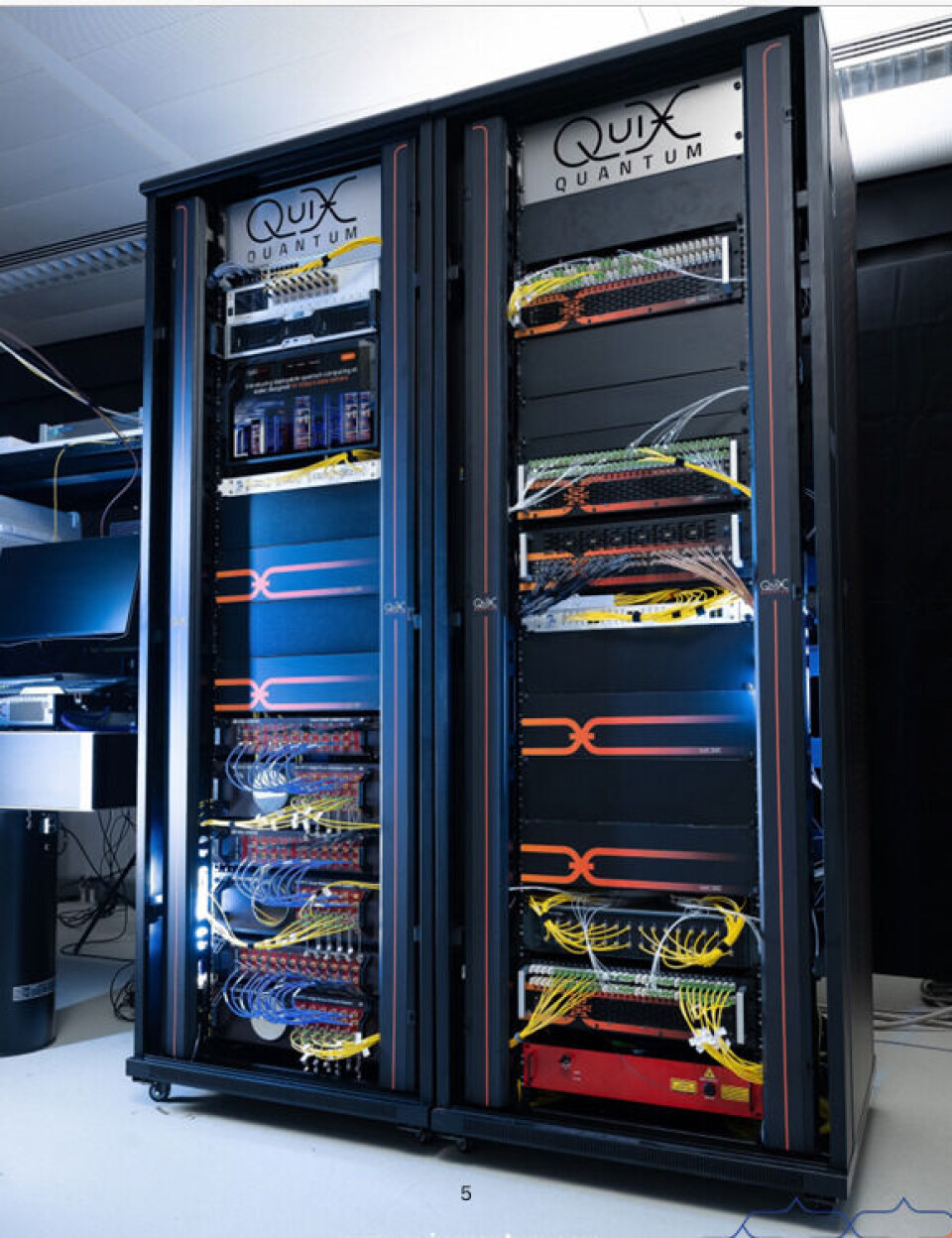
The Quix Carina system
Carina is the system that addresses both needs for universal photonic quantum computing and use in traditional datacenters, according to QuiX chief executive officer Stefan Hengesbach. The photonic quantum sector has been partitioned into architectures that can be quickly commercialized but don’t fit within the definition of universal, fault-tolerant computing, and others that can be scaled into the future but are difficult to deploy in working datacenters.
“Carina is bringing those two requirements together into a universal architecture for installation into real customer environments,” Hengesback said in a statement.
The development of quantum computing systems of multiple modalities – from superconducting and neutral atoms to trapped ions and photonics – has accelerated over the past several years, with the rise of generative and agentic AI more giving it a boost. Quantum systems right now are primarily accessible via the cloud, but the expectation is that they’ll quickly find their way into HPC datacenters, integrated with powerful classical systems, with quantum processing units (QPUs) becoming another accelerator, alongside CPUs, GPUs, and others.
QuiX is among a number of quantum companies – such as PsiQuantum, Photonic Inc., Quantum Computing Inc., and Quantum Pulse – that build qubits using photons, encoding information directly onto particles of light.
QuiX executive argue that with the Dedalo architecture, they’ve solved a number of the challenges that come with photonic quantum computing, from photon loss to error correction to the fact that photons can’t be stored, which means they need to be used immediately. Dedalo also is expected to deliver fault-tolerant photonic quantum computing. Among the solutions Dedalo will use are logical qubits comprising multiple physical qubits, a common error-correction technique in quantum computing.
Carina is showing some of the key building blocks to prove that a universal gate set can be implemented using photons at room temperature. With Dedalo, QuiX wants to create the blueprint for scaling the technology.
Starting with Carina, QuiX uses a measurement-based quantum computing (MBQC) to scale its systems to the point where they can address computations that classical systems can’t. Rather than running a computation through a sequence of quantum gates to a collection of qubits, a MBQC process starts by creating a cluster state of entangled qubits – a highly entangled resource state – and then pushing the computation through a sequence of single-qubit measurements, with each step dictating the next one. It’s called a feed-forward process.
MBQC fits photonic quantum computing well because photons are mobile and interact weakly with their surroundings, QuiX engineers wrote in a 13-page white paper about Carina. This makes them resistant to decoherence. That said, the weak interaction makes it difficult to directly implement deterministic two-qubit gates between photons.
“MBQC sidesteps this problem elegantly: the entanglement required for computation is built into the resource state through probabilistic entangling operations, which can be attempted repeatedly and heralded [confirmed], while the computational step itself – measurement – is something photonic systems perform natively and with very high efficiency,” the engineers wrote. “Furthermore, photons travel at the speed of light, which means the classical feed-forward operations required by MBQC can in principle be performed within the coherence time of the system, a constraint that is naturally manageable in integrated photonic architecture.”
They added that “the combination of intrinsic decoherence resistance, room-temperature operation, and measurement-native computation makes MBQC on photonics a uniquely credible path toward utility-scale quantum computing.”
The introduction of Carina comes a year after QuiX received about $17 million in Series A funding to develop and deliver the first single-photon-based universal quantum computer this year, with the next generation expected in 2027. It’s part of the European Union’s efforts to make the region a leader in quantum computing by 2030. Carina was developed as part of the Universal Photonic Quantum Computer project of the DLR Quantum Computing Initiative, an effort funded by the German Federal Minister of Research, Technology and Space.
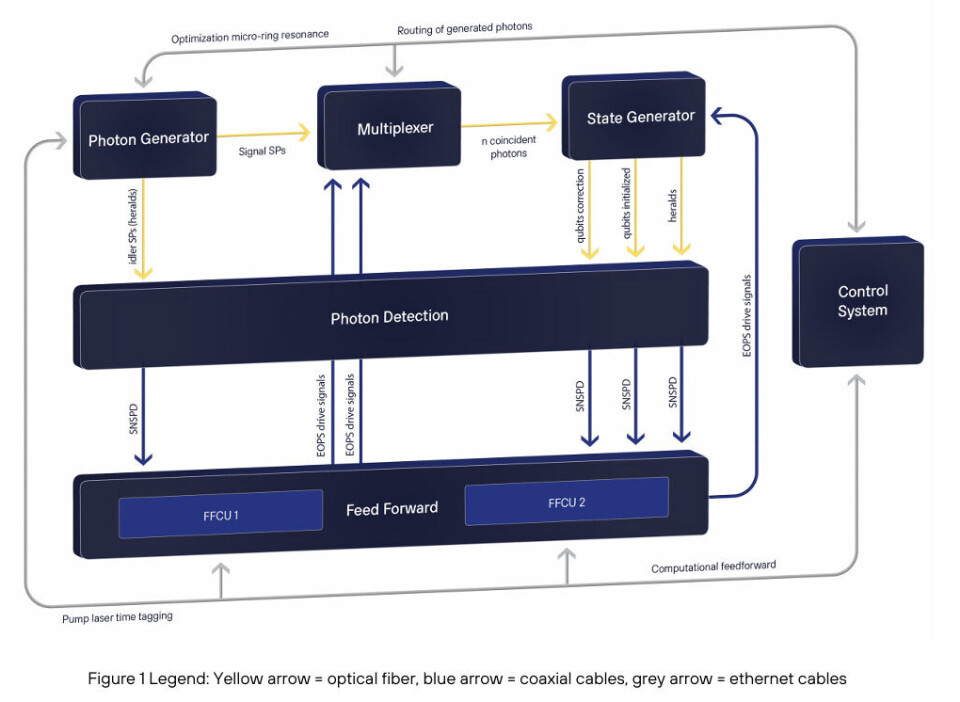
The system’s architecture includes a photon generator subsystem (the Carina photon generator chip is below) that creates a signal and idler photon pair – detecting the idler in each pair confirms (or heralds) the creation of the signal single photon – with the signal proton then running through a multiplexer subsystem, which includes an on-chip fast switching network and off-chip delay lines and is sued to select and route photons to output channels.
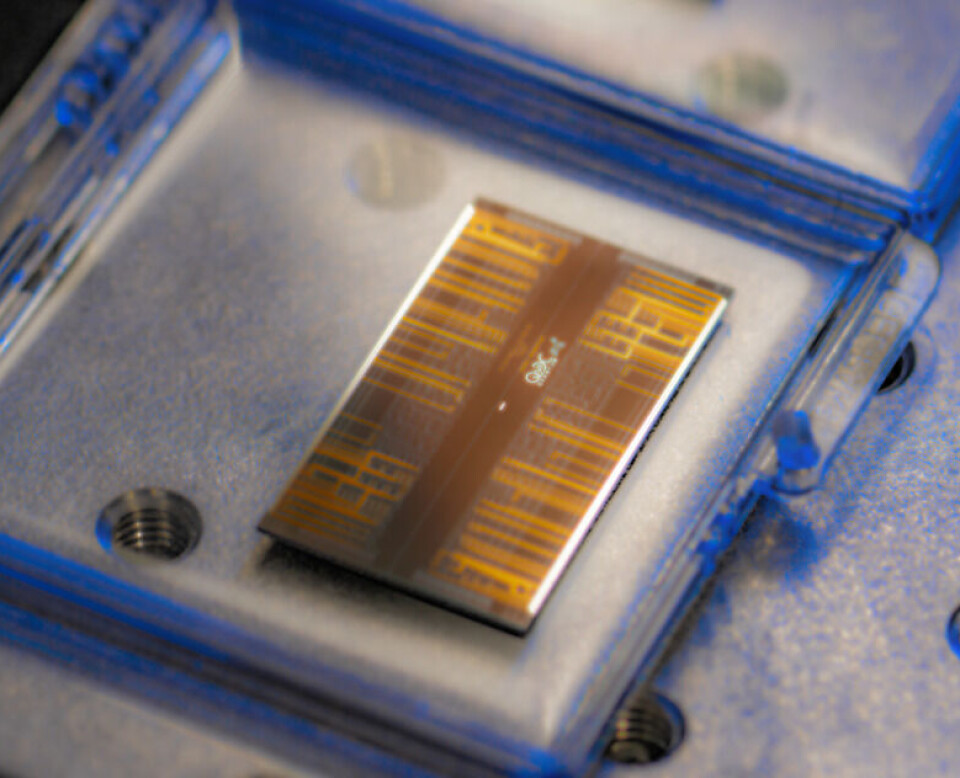
Carina photon generator chip
The photons then enter the state generator subsystem, which entangles the photons on-chip and generate a qubit cluster state. The next step is the photon detection subsystem, in which measurements are made to execute the user’s operation, and the detectors that measure the result of corrections are implemented.
The cabling for the Carina system
Lastly, the control subsystem allows for the universal gate set through the fast feed-forward capabilities. Carina’s PUCA and FCCU is seen below:
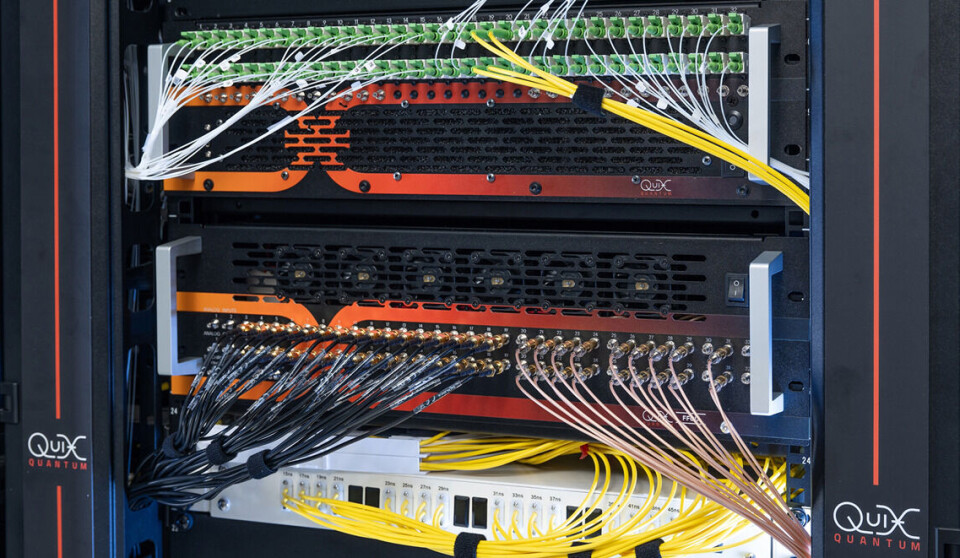
To ensure Carina and follow-on systems can be deployed in HPC and IT datacenters, Carina’s architecture includes hardware built on silicon-nitride photonic integrated circuits (PICs) that are CMOS-compatible, so it can be built via established semiconductor fabrication processes and facilities. This makes it easier to scale the quantum hardware.
The quantum computer also can run at room temperature, which means a more modular and power-efficient design and without the added costs that come with high-powered external cooling units more common with such modalities as superconducting. The Dedalo architecture is also compatible with existing telecommunications architectures, using standard fiber-optic network components.
The plan is to run established protocols and quantum algorithms on Carina, with the initial computations running on an emulator to work out sources of errors and test it with theoretical models. Through Carina, QuiX engineers will be able to reduce the errors in the system – including photon losses – for future versions of their computer, including Dedalo.
“Amongst the various quantum computing modalities, QuiX’s photonic quantum computing solution offers fascinating advantages such as native interconnectivity, that allows modularity and rapid scaling, low hardware overhead, thanks to favorable error correction schemes, and datacenter readiness, allowed by room temperature and telecom operation,” the engineers wrote in the white paper. “Photonics quantum computing, however, was lacking the demonstration of universality in an operating system. QuiX is well poised to achieve this milestone with Carina, designed to implement a universal gate set enabling any quantum operation.”
| # | Наименование новости | Тональность | Информативность | Дата публикации |
|---|---|---|---|---|
| 1 | QuiX Quantum Shows Off A Photonic Architecture For HPC Datacenters | 0 | 10 | 07-07-2026 |
| 2 | Quantum Pulse Does Industrial Light Magic To Deliver Massive Boost In Qubits | 0 | 10 | 17-06-2026 |
| 3 | Nvidia Brings The Power Of Open Source AI Models To Quantum Computing | 0 | 10 | 14-04-2026 |
| 4 | QuEra’s Libra Fault-Tolerant Quantum System Heading To Amazon Braket Service | 0 | 20 | 16-06-2026 |
| 5 | Росатом создал первый в России чип для квантового сжатого света | 8 | 7 | 02-07-2026 |
| 6 | Physicists create first room-temperature quantum material | 0 | 12.57 | 15-07-2026 |
| 7 | Microwaves Replace Lasers to Improve Trapped-ion Quantum Computers | 0 | 22.5 | 12-05-2026 |
| 8 | Quantum computing: Laser-optical system offers full control over 2,000 trapped Rydberg atoms | 5 | 7 | 07-07-2026 |
| 9 | Квантовый рывок России: ученые создали источник «сжатого» света, который есть лишь у единиц в мире | 7 | 7 | 02-07-2026 |
| 10 | A quantum metasurface breakthrough could finally close the terahertz gap | 0 | 8.31 | 31-05-2026 |