Просмотр новости
Найдите то, что Вас интересует
 Спутники
 РН
РН SpaceX
 Роскосмос
 NASA
NASA
СпутникиРНSpaceXРоскосмосNASAJuan Espinoza engineered a device to help ease physical demands on workers at citrus farms.
Mechanical engineer Juan Espinoza’s work in agriculture runs deep. In the 1990s, his parents immigrated to California from Mexico. With little formal education, the only work available to them at the time was picking crops such as almonds, grapes and roses. When Espinoza and his siblings reached working age — that was 15 for Espinoza — his parents required them to pick crops for at least one summer.
“They wanted to teach their children the value of a dollar,” he says. “They wanted us to aspire for more.” Espinoza would return to pick crops for several summers.
That experience inspired his work as an engineer. Improper picking can damage fruit, he had noticed, making it less valuable. Espinoza, now at California State University, Fresno, designed a device called an end effector for a citrus-harvesting machine. Found at the end of robotic arms, this device acts like mechanical hands. It includes both a gripper and a cutter. The cutter employs the specialized shears farmworkers use to cut stems. The gripper delicately grips the fruit. “It worked out beautifully,” he says. “I got to combine the things I learned in the classroom with my personal experience.”
The device could help farmers and workers alike. Working in California’s intense summer heat leaves laborers at risk of heat-related illnesses and injury, he notes. Farmers are also struggling to find laborers. Espinoza hopes his citrus harvester can help with worker shortages as well as ease the physical demands on farmworkers. In this interview, he shares his experiences with Science News Explores. (This interview has been edited for content and readability.)
What inspired your love for engineering?The spark to be an engineer started in high school. There’s a program called Project Lead the Way that teaches students engineering and STEM technology. [STEM stands for science, technology, engineering and math.] We had computer-driven tools called CNC machines in class and learned about robotics. Before that, I didn’t even know what engineering was. Once I got a taste of it, it captivated my interest.
Then my interest in mechanical engineering came from growing up around vehicles. I had a lot of older family members who were into the ‘90s Honda scene. They would buy older vehicles and fix them up. Paint them, install sound systems, swap engines — the whole nine yards. My cousins and I would all hang out and go to car meets together.
What was a big challenge that you faced?A big challenge for me was being a first-generation student. [A first-generation student is one who is in the first generation of their family to attend university.] Both of my older sisters started college, but neither of them finished due to starting families. I never had anybody in my family who knew how to navigate higher education. My parents and siblings would give me advice that came from the heart. They meant well, but they didn’t have the actual experience.
I had to figure it out on my own along the way. To some extent, that was better because I learned the hard way. That meant the lessons really stuck. If somebody is guiding you, you can become dependent on them to make decisions. You may not be able to confidently make decisions about what’s right for you. I had to be responsible for the mistakes that I made. I was better able to grasp those lessons because I had to struggle my way through.
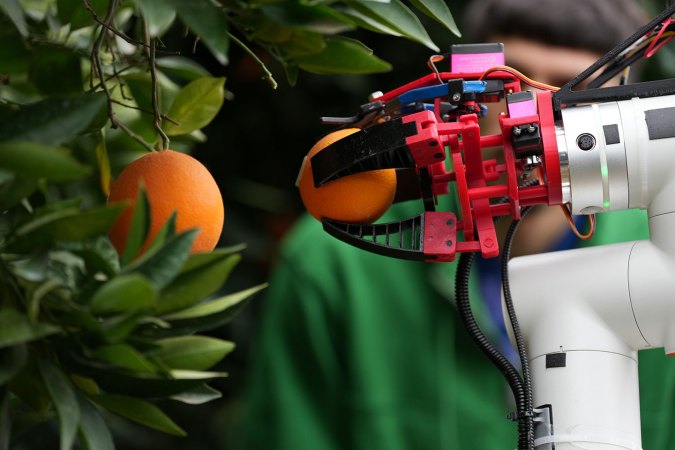 Espinoza’s citrus-picking device gently grasps the fruit with its clawlike gripper. A cutter then severs the stem right where it meets the fruit.J. Espinoza
How has agricultural tech changed since decades ago?
Espinoza’s citrus-picking device gently grasps the fruit with its clawlike gripper. A cutter then severs the stem right where it meets the fruit.J. Espinoza
How has agricultural tech changed since decades ago?
Historically, mechanical systems have been simple, robust and reliable. Unfortunately, that’s not how technology progresses. It tends to get more sophisticated and complex. Today, there are all kinds of technology that use sensors, GPS and automated controls. They’re these massive pieces of equipment that cost millions of dollars. You run into issues with not being able to repair your own equipment. The “right to repair” has been a huge topic across different sectors of tech. Did you know, when something breaks on your iPhone, you cannot buy or install an authentic Apple part directly as a consumer? You must either go through a third party or take it to Apple to fix.
In the past, repairing mechanical systems was very simple and straightforward. If something breaks, the farmer was the one to fix it. They had the tools and knowledge to service their equipment. Now, they can’t fix broken machines because they don’t have the right computer to hook up to them. They don’t have the special diagnostic tools or, in some cases, even permission. It needs to go through a licensed dealership that is authorized to repair it.
What’s next for you?Agricultural tech was never really a career aspiration of mine. I enjoy it and do it now because it adds to an industry that got me to where I am today. Thanks to agriculture, my parents could provide for us and I could get an education.
My passion, though, is in automobiles. I want to improve vehicles that see the hands of everyday people. I want to work on the Honda Civics and the Toyota Corollas of the world. Those base models that get everyday people to where they need to go. My long-term career goal is to improve the quality of life for the general population. I want to provide everyday people who earn a minimum wage with reliable vehicles that are inexpensive to fix.
aspirations: (v. aspire) The longterm hopes ad goals that drive or motivate someone to not only gain skills and experience but also to achieve challenging things.
3-D: Short for three-dimensional. This term is an adjective for something that has features that can be described in three dimensions — height, width and length.
agriculture: The growth of plants, animals or fungi for human needs, including food, fuel, chemicals and medicine.
citrus: A genus of flowering trees that tend to produce fruits with a juicy edible flesh. There are several main categories: oranges, mandarins, pummelos, grapefruits, lemons, citrons and limes.
consumer: (n.) Term for someone who buys something or uses something. (adj.) A person who uses goods and services that must be paid for.
crop: (in agriculture) A type of plant grown intentionally grown and nurtured by farmers, such as corn, coffee or tomatoes. Or the term could apply to the part of the plant harvested and sold by farmers.
engine: A machine designed to convert energy into useful mechanical motion. Sometimes an engine is called a motor. (in computer science) A computer program that performs a particular, narrow range of functions.
engineering: The field of research that uses math and science to solve practical problems. Someone who works in this field is known as an engineer.
family: A taxonomic group consisting of at least one genus of organisms.
fruit: A seed-containing reproductive organ in a plant.
generation: A group of individuals (in any species) born at about the same time or that are regarded as a single group. Your parents belong to one generation of your family, for example, and your grandparents to another. Similarly, you and everyone within a few years of your age across the planet are referred to as belonging to a particular generation of humans. The term also is sometimes extended to year classes of other animals or to types of inanimate objects (such as electronics or automobiles).
GPS: Abbreviation for global positioning system, which uses a device to calculate the position of individuals or things (in terms of latitude, longitude and elevation — or altitude) from any place on the ground or in the air. The device does this by comparing how long it takes signals from different satellites to reach it.
high school: A designation for grades nine through 12 in the U.S. system of compulsory public education. High-school graduates may apply to colleges for further, advanced education.
laborer: Another name for a worker.
mechanical: Having to do with the devices that move, including tools, engines and other machines (even, potentially, living machines); or something caused by the physical movement of another thing.
mechanical engineer: Someone trained in a research field that uses physics to study motion and the properties of materials to design, build and/or test devices.
navigate: To find one’s way through a landscape using visual cues, sensory information (like scents), magnetic information (like an internal compass) or other techniques.
physical: (adj.) A term for things that exist in the real world, as opposed to in memories or the imagination. It can also refer to properties of materials that are due to their size and non-chemical interactions (such as when one block slams with force into another). (in biology and medicine) The term can refer to the body, as in a physical exam or physical activity.
risk: The chance or mathematical likelihood that some bad thing might happen. For instance, exposure to radiation poses a risk of cancer. Or the hazard — or peril — itself. (For instance: Among cancer risks that the people faced were radiation and drinking water tainted with arsenic.)
robot: A machine that can sense its environment, process information and respond with specific actions. Some robots can act without any human input, while others are guided by a human.
sensor: A device that picks up information on physical or chemical conditions — such as temperature, barometric pressure, salinity, humidity, pH, light intensity or radiation — and stores or broadcasts that information. Scientists and engineers often rely on sensors to inform them of conditions that may change over time or that exist far from where a researcher can measure them directly. (in biology) The structure that an organism uses to sense attributes of its environment, such as heat, winds, chemicals, moisture, trauma or an attack by predators.
sibling: An offspring that shares the same parents (with its brother or sister).
sophisticated: A term for something that is advanced, complex and/or elegant.
STEM: An acronym (abbreviation made using the first letters of a term) for science, technology, engineering and math.
system: A network of parts that together work to achieve some function. For instance, the blood, vessels and heart are primary components of the human body's circulatory system. Similarly, trains, platforms, tracks, roadway signals and overpasses are among the potential components of a nation's railway system. System can even be applied to the processes or ideas that are part of some method or ordered set of procedures for getting a task done.
technology: The application of scientific knowledge for practical purposes, or the devices, processes and systems that result from those efforts.
third party: An agreement generally takes place between two individuals or groups. Each of these is considered a “party” to the agreement. When an additional person or group becomes involved in some way — but did not sign or verbally take part in the initial agreement, it becomes a so-called third party. In some instances, a third party may not even be known to one or more of the individuals who made the initial agreement.
tool: An object that a person or other animal makes or obtains and then uses to carry out some purpose such as reaching food, defending itself or grooming.
Aaron Tremper is the assistant editor for Science News Explores. He has a B.A. in English (with minors in creative writing and film production) from SUNY New Paltz and an M.A. in Journalism from the Craig Newmark Graduate School of Journalism’s Science and Health Reporting program. A former intern at Audubon magazine and Atlanta’s NPR station, WABE 90.1 FM, he has reported a wide range of science stories for radio, print, and digital media. His favorite reporting adventure? Tagging along with researchers studying bottlenose dolphins off of New York City and Long Island, NY.
| # | Наименование новости | Тональность | Информативность | Дата публикации |
|---|---|---|---|---|
| 1 | Rockin’ farm fields suck up tons of CO2 | 0 | 13.85 | 26-03-2026 |
| 2 | В Университете Иннополис создали "умный" бак для агробеспилотника | 0 | 0 | 19-09-2025 |
| 3 | В Смоленске создали манипулятор, вдвое повышающий эффективность труда на производстве | 0 | 0 | 08-10-2021 |
| 4 | Contenedores y diseño | 0 | 10 | 21-07-2026 |
| 5 | Забайкальские студенты создали многоцелевого робота для бойцов СВО | 0 | 0 | 09-04-2025 |
| 6 | Новосибирские студенты разработали прибор для безболезненных медицинских электростимуляций | 0 | 0 | 01-02-2021 |
| 7 | Дроны предложили использовать для повышения урожая | 0 | 10 | 22-07-2026 |
| 8 | В Перми создают робота для автоматизации уборки на животноводческих комплексах | 5 | 7 | 16-07-2026 |
| 9 | Smart clothing for blind travelers | 0 | 5 | 30-06-2026 |