Просмотр новости
Найдите то, что Вас интересует
 Спутники
 РН
РН SpaceX
 Роскосмос
 NASA
NASA
СпутникиРНSpaceXРоскосмосNASAObject detection powers transformative applications, from autonomous vehicles navigating city streets and security systems identifying threats in real time to retail analytics tracking inventory and medical imaging detecting tumors. But choosing the right model for your computer vision project can be challenging, especially with dozens of architectures claiming superiority across different metrics. In this guide, […]

The only Python IDE you need.

Object detection powers transformative applications, from autonomous vehicles navigating city streets and security systems identifying threats in real time to retail analytics tracking inventory and medical imaging detecting tumors. But choosing the right model for your computer vision project can be challenging, especially with dozens of architectures claiming superiority across different metrics.
In this guide, we’ll examine the top object detection models available in 2026, comparing their architectures, performance characteristics, and ideal use cases to help you determine which models are best suited to your applications.
Whether you’re building real-time video analytics, high-precision inspection systems, or resource-constrained edge applications, you’ll find clear guidance on which model best fits your requirements.
What is object detection?Object detection aims to identify and localize multiple objects within images or video frames. Unlike image classification, which only classifies the broad identity of an image, object detection identifies the objects in an image/video frame and their exact positions within it.
In a nutshell, object detection solves two interdependent problems:
This dual capability makes object detection more complex than classification alone, requiring models that can handle multiple objects of different sizes appearing anywhere in an image.
As with classification tasks, a simple accuracy metric is not sufficient to assess model performance. We need metrics of two types. Firstly, performance metrics that gauge the trade-off between incorrectly detecting objects (false positives) and not detecting objects at all in the image when they were present (false negatives). Secondly, we also need metrics to assess how long it will take our model to perform the task in question: We will call these compute efficiency metrics. Usually, the new architectures for object detection are benchmarked on the validation partition of the COCO dataset and run on T4 NVIDIA GPU hardware.
Here are the standard metrics used in the object detection community:
There are a few popular choices of datasets to evaluate the performance of object detection models. As mentioned above, the standard choice for benchmarking object detection is the COCO dataset, containing 80 object categories across 330,000 images. Naturally, there are a lot of other datasets, specialized for certain domains, such as self-driving cars, or certain scenarios, such as the detection of objects in cluttered environments. What is important to remember is that the values of object detection metrics, IoU, and mAP depend on the dataset they were evaluated on, so mAP@[50:95]=60.1 on the COCO dataset may not be directly transferable to your custom dataset. These metrics should always be re-evaluated on your dataset to define the baseline performance of the models on it.
Object detection algorithms and architecture familiesObject detection models fall into two different processing flows and two different architectural families.
Architectures CNN-basedExamples: Faster R-CNN, Mask R-CNN, Cascade R-CNN, YOLO
CNN-based detectors rely on convolutional layers to extract local features hierarchically across the image, traditionally using predefined anchor boxes as spatial priors for localizing objects. Spatial priors are predefined assumptions about where and what size objects are likely to appear in an image, giving the model a starting point for detection rather than searching randomly.
Transformer-basedExamples: RF-DETR, RT-DETR, D-FINE
Transformer-based detectors, inspired by advances in natural language processing, instead apply global self-attention mechanisms that allow the model to reason about relationships across the entire image simultaneously.
Specifically, transformer-based detectors use learned object queries and global self-attention, where each query is trained to correspond to at most one object, unlike CNN-based detectors, which build spatial understanding locally through convolutional layers with limited receptive fields.
However, in modern architectures, there exists a fusion of the two architectures: a CNN network can use self-attention modules in its architecture, such as YOLOv12 or YOLOv13, leading to cross-architectural designs.
Processing flows Two-stage detectorsExamples: Faster R-CNN, Mask R-CNN, Cascade R-CNN
The network makes two sequential passes, each with a distinct job:
Examples: YOLO series, SSD, RetinaNet, DETR
The network directly predicts class labels and bounding boxes from feature maps. It does everything in one forward pass. Usually, the following happens:
Furthermore, modern single-stage detectors have moved away from anchor-based designs entirely, predicting box coordinates directly from grid points and pixels, eliminating the need for dataset-specific anchor tuning altogether.
Historically, two-stage detectors offered better accuracy at the cost of speed, but modern single-stage detectors have largely closed this gap, achieving comparable or superior results while remaining significantly faster. Thus, we will focus on single-stage detectors only when evaluating the state-of-the-art models for practical applications.
Top object detection models in 2026Two-stage pipelines (Faster R-CNN, Mask R-CNN) are no longer competitive. The current frontier is defined by single-stage NMS-free transformer architectures and models of the YOLO family. Each model below excels in a specific deployment scenario.
Real-Time Detection Transformer · ICLR 2026
| Metric | Value |
|---|---|
| mAP50:95 (N) | 48.4 |
| mAP50:95 (M) | 54.7 |
| Latency (N) | 2.3 ms |
| Latency (M) | 4.4 ms |
| mAP50:95 (2XL) | 60.1 (COCO record) |
| Latency (2XL) | 21.8 ms |
The strongest real-time model available. RF-DETR uses DINOv2 to extract deeply rich, globally-aware feature representations of the input image, then uses deformable cross-attention in the detection head to efficiently query those features and predict bounding boxes without needing anchor boxes or NMS post-processing. The result is a model that’s simultaneously more accurate on complex scenes and faster at inference than the naive combination of those components would suggest. RF-DETR is the first real-time detector to break 60 mAP on MS COCO. Designed from the ground up for fine-tuning, DINOv2 pre-training on internet-scale data gives it unmatched domain adaptability across aerial imagery, medical scans, industrial inspection, and more. It comes in four sizes: Nano, Small, Medium, Large (plus XL/2XL under a PML license).
Strengths:
Limitations:
License: Apache 2.0 (N/S/M/L) · PML 1.0 (XL/2XL)
Repository: https://github.com/roboflow/rf-detr
Attention-centric YOLO · NeurIPS 2025
| Metric | Value |
|---|---|
| mAP50:95 (N) | 40.4 |
| mAP50:95 (M) | 52.5 |
| Latency (N) | 1.60 ms |
| Latency (M) | 4.27 ms |
| License | AGPL-3.0 |
YOLO12 is the first YOLO model to place attention mechanisms at the core rather than CNNs, matching CNN-based inference speeds while gaining the global context benefits of self-attention. Key innovations: Area attention (A²) divides feature maps into regions to reduce the quadratic cost of full self-attention; Residual ELAN (R-ELAN) stabilizes training of large attention blocks; FlashAttention reduces memory bottlenecks. It is deployable on NVIDIA Jetson, NVIDIA GPUs, and macOS.
A note on implementations. YOLO12 exists in two separate codebases, and the distinction matters in practice. The original authors (Tsinghua/University at Buffalo) actively maintain their own repository at sunsmarterjie/yolov12. In June 2025, they explicitly warned against using Ultralytics’ integration, stating it “is inefficient, requires more memory, and has unstable training” – issues they have fixed in their own repo. The training instability and memory criticisms often cited against YOLO12 are therefore criticisms of the Ultralytics port, not the model itself. Ultralytics’ recommendation to prefer YOLO26 over YOLO12 should be read with this context in mind: The comparison is partly against their own suboptimal implementation.
If you use YOLO12, install from the original repository rather than via pip install ultralytics.
Strengths:
Limitations:
License: AGPL-3.0 (open-source) · Enterprise license via Ultralytics for commercial use
Open-source repository: https://github.com/sunsmarterjie/yolov12
Ultralytics repository: https://github.com/ultralytics/ultralytics
Edge-first unified YOLO · September 2025
| Metric | Value |
|---|---|
| mAP50:95 range | 40.9–57.5 |
| Latency range | 1.7–11.8 ms |
| CPU gain vs. YOLO11 (nano) | +43% |
| Unified tasks | 5 |
Ultralytics’ flagship for 2025–2026. YOLO26 shifts focus from accuracy maximization toward deployment-oriented simplification: It removes NMS and distribution focal loss (DFL) for end-to-end inference, introduces the MuSGD optimizer for stable convergence, and adds progressive loss balancing (ProgLoss), which makes sure that the model doesn’t over-optimize one objective at the expense of others, and small-target-aware label assignment (STAL), which ensures extra attention to small objects. Five tasks are solved by this one YOLO26: detection, segmentation, pose estimation, oriented bounding boxes detection, and open-vocabulary detection and segmentation. It is explicitly designed for NVIDIA Jetson Orin/Xavier, Qualcomm Snapdragon AI, and ARM CPUs. Supports INT8 and FP16 quantization, plus ONNX, TensorRT, CoreML, and TFLite export.
Strengths:
Limitations:
License: AGPL-3.0 (open-source) · Enterprise license via Ultralytics for commercial/industrial use.
Repository: https://github.com/ultralytics/ultralytics
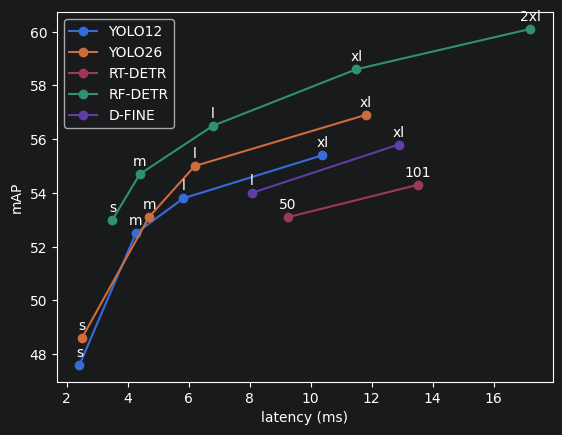
To give a comparison between the models, here are the exact benchmark values. All scores on MS COCO val2017. Latency was measured on an NVIDIA T4 GPU.
| Model | mAP50 | mAP50:95 | Latency | Params | Edge-ready | License |
|---|---|---|---|---|---|---|
| RF-DETR-N | 67.6 | 48.4 | 2.3 ms | 30.5 M | Server GPU | Apache 2.0 |
| RF-DETR-M | 73.6 | 54.7 | 4.4 ms | 33.7 M | Server GPU | Apache 2.0 |
| RF-DETR-2XL | 78.5 | 60.1 | 17.2 ms | 126.9 M | Server GPU | PML 1.0 |
| YOLO12-N | 56.7 | 40.4 | 1.6 ms | 2.5 M | ARM / Mobile / Jetson | AGPL-3.0 |
| YOLO12-L | 70.7 | 53.8 | 5.83 ms | 26.5 M | Jetson / TensorRT | AGPL-3.0 |
| YOLO26-N | — | 40.1 | 1.7 ms | 2.4 M | ARM / Mobile / Jetson | AGPL-3.0 |
| YOLO26-X | — | 56.9 | 11.8 ms | 55.7 M | Jetson / TensorRT | AGPL-3.0 |
Here is a visualization of the above results alongside additional modern object detection models for a more holistic comparison:
Occluded objects: RF-DETR (M/L) is the clear choice. Its DINOv2 backbone models global context across the full image, making it significantly better than CNN-based models at finding partially hidden objects.
Small objects: RF-DETR uses multi-scale feature extraction. YOLO26 also includes STAL (small-target-aware label assignment), making it competitive for small objects on edge hardware.
Edge / mobile / Jetson: YOLO26-N or YOLO12-N. YOLO26 is the Ultralytics recommendation for Jetson Orin/Xavier, Snapdragon AI, and ARM CPUs. It has 43% faster CPU inference than YOLO11n at comparable accuracy.
Custom domain / fine-tuning: RF-DETR by a significant margin. DINOv2 pre-training means it adapts to new domains (medical, aerial, and industrial) faster and with less data than any other model here.
| Model | License | Commercial use |
|---|---|---|
| RF-DETR (base) | Apache 2.0 | Free for all uses, including commercial products |
| RF-DETR XL/2XL | PML 1.0 | Contact Roboflow for commercial licensing |
| YOLO12 | AGPL-3.0 | Free for open source / personal use; commercial applications require an Ultralytics Enterprise license |
| YOLO26 | AGPL-3.0 | Free for open source / personal use; commercial applications require an Ultralytics Enterprise license |
# Install
pip install rfdetr

# Inference
from rfdetr import RFDETRBase
model = RFDETRBase()
detections = model.predict("image.jpg")

# Fine-tune on your dataset
model.train(dataset_dir="./my_dataset", epochs=50, batch_size=4)
YOLO26 / YOLO12 (via Ultralytics)
# Install
pip install ultralytics

# Inference — YOLO26
from ultralytics import YOLO
model = YOLO("yolo26n.pt")          # or yolo26s/m/l/x
results = model.predict("image.jpg")

# Inference — YOLO12
model = YOLO("yolo12n.pt")
results = model.predict("image.jpg")

# Export for edge (TensorRT / CoreML / ONNX)
model.export(format="engine")       # TensorRT for Jetson
model.export(format="coreml")       # Apple Silicon / iOS
model.export(format="tflite")       # Android / ARM
YOLO12 (use original open-source repo – not the Ultralytics integration)
# Install from the original authors' repo
conda create -n yolov12 python=3.11
conda activate yolov12
git clone https://github.com/sunsmarterjie/yolov12 && cd yolov12
pip install -r requirements.txt
pip install -e .

# Inference
from ultralytics import YOLO
model = YOLO("yolov12n.pt")         # or s/m/l/x
results = model("path/to/image.jpg")
results[0].show()

# Export for edge
model.export(format="engine", half=True)   # TensorRT FP16
model.export(format="onnx")                # ONNX for broad compatibility
RF-DETR – recommended for domain shift. Thanks to a DINOv2 backbone that is pre-trained on internet-scale data, fine-tuning requires less labeled data and converges faster. Use the rfdetr package with a COCO pre-trained checkpoint. Roboflow also offers a hosted fine-tuning UI.
YOLO26 / YOLO12 – easiest pipeline. Ultralytics’ training API is the most mature fine-tuning ecosystem. It supports YOLO-format and COCO-format datasets and has good documentation and an active community.
# Fine-tuning YOLO26 on a custom dataset (YOLO format)
from ultralytics import YOLO

model = YOLO("yolo26m.pt")          # start from pretrained weights
model.train(
    data="custom_dataset.yaml",     # path to your dataset config
    epochs=100,
    imgsz=640,
    batch=16,
    device=0,                       # GPU index; "cpu" for CPU
)
metrics = model.val()               # evaluate on validation set
Selecting an object detection model requires matching your specific requirements against each model’s strengths. The decision framework below maps common scenarios to optimal model choices.
| Your goal | Best choice | Runner-up |
|---|---|---|
| Highest accuracy, cloud deployment | RF-DETR M/XL | YOLO26-X |
| Edge / Jetson / mobile | YOLO26-N/S | YOLO12-N |
| Fine-tuning on a custom domain | RF-DETR | YOLO26 |
| Occluded / complex scenes | RF-DETR | YOLO26 |
| Research / benchmarking | YOLO12 | RF-DETR |
| Apache 2.0 + commercial use | RF-DETR (base) | YOLO26 |
| Multi-task (detect + segment + pose) | YOLO26 | RF-DETR (det+seg) |
Selecting an object detection architecture in 2026 is a strategic decision dictated by the specific requirements of the application and the available computational budget. Whether prioritizing the record-breaking accuracy of RF-DETR for complex scenes or the unmatched efficiency of the YOLO family for edge deployment, the choice must balance mAP requirements against real-time latency constraints.
The landscape of computer vision is rapidly shifting toward zero-shot detection frameworks that recognize novel objects without task-specific supervision. As foundation models increasingly integrate sophisticated image embedders like CLIP or DINOv2 into detection pipelines, the boundaries of high-precision detection on resource-constrained hardware will continue to expand. While transformer-based architectures are developing quickly, the YOLO family’s established ecosystem ensures it remains a cornerstone for real-time production environments.
To achieve the best results for your specific use case, we encourage you to experiment with the models and code samples provided in this guide. To that end, PyCharm provides the perfect ecosystem for experimentation with various open-source models via Code -> Insert HF Model interface. If you’d like to try this yourself, PyCharm Pro comes with a 30-day trial.
For a hands-on starting point, this tutorial shows how to build a live object detection app using TensorFlow and PyCharm Jupyter notebooks, then deploy it on a robot – covering everything from single-frame inference to a live web dashboard with annotated detections. Moreover, stay tuned for the next tutorial post, where we will discuss all three object detection models in action.
Discover more
| # | Наименование новости | Тональность | Информативность | Дата публикации |
|---|---|---|---|---|
| 1 | Flat-Earther and ‘CONVID’ denier dies after experiencing multiple COVID symptoms | 0 | 0 | 05-11-2021 |
| 2 | Глава МИД Украины созвонился с Рубио в преддверии годовщины спецоперации | 0 | 0 | 21-02-2025 |
| 3 | MON rozlicza poprzedników: pikniki wojskowe za PiS-u kosztowały ok. 2 mln zł. PKW ma już dokumenty | 0 | 0 | 14-08-2024 |
| 4 | Итак,друзья‼️ Ровно 7лет назад -в феврале 2018года, я преодолела свою ... | 0 | 0 | 21-02-2025 |
| 5 | 12.05.2024 г. в 16:30 на телефон АНО ПСО "ЛЕГИОН СПАС74" ... | 0 | 0 | 13-05-2024 |
| 6 | Erickson Breaks Ground on 84-Unit Expansion at Maris Grove Seniors Housing Community in Pennsylvania | 0 | 0 | 04-02-2020 |
| 7 | Best Python AI Frameworks in 2026 | 0 | 8.43 | 16-06-2026 |
| 8 | A Realistic Look At Gunshots | 0 | 0 | 08-08-2014 |
| 9 | Пушков рассказал, чем обернется для Германии избрание канцлером Мерца | 0 | 0 | 24-02-2025 |
| 10 | Разработка в Японии системы гиперзвукового оружия | 0 | 0 | 28-02-2020 |