Просмотр новости
Найдите то, что Вас интересует
 Спутники
 РН
РН SpaceX
 Роскосмос
 NASA
NASA
СпутникиРНSpaceXРоскосмосNASABackground Vegetation in historic urban districts is often treated as a secondary landscape element, despite its potential role in shaping social practice, place memory, and heritage experience. This study examines heritage-linked floristic elements in the Heart of Sharjah, United Arab Emirates, with a focus on the mid-twentieth century (1950–1965), to assess how vegetation functioned within everyday urban life and how it may be meaningfully integrated into contemporary heritage management. Methods A mixed-methods approach was employed, combining oral-history interviews, spatial reconstruction using historical imagery and GIS, and botanical verification based on authoritative regional flora sources. Results The results indicate that vegetation was deliberately embedded within the historic urban fabric, contributing to social interaction, microclimatic comfort, and collective memory rather than serving a purely decorative role. Analytically structured findings reveal that heritage vegetation is not a homogeneous category; instead, individual species exhibit differentiated value profiles across social, cultural, environmental, economic, and architectural dimensions. These profiles underscore the need for species-specific interpretation and management strategies. Conclusion The study demonstrates how triangulating cultural memory, spatial evidence, and botanical knowledge can support the development of a heritage flora guide that functions as both an interpretive and management instrument, that help maintain the heritage site authenticity. By foregrounding vegetation as a living heritage attribute, the proposed framework offers a transferable approach for integrating biocultural considerations into urban heritage conservation, particularly in arid and semi-arid contexts.
Urban heritage is usually seen through structures like streets, houses, monuments, and spatial layouts, but many historic districts are also influenced by living elements. Their ongoing presence or absence impacts authenticity, experience, and preservation efforts. Vegetation in heritage settings can function as an inherited record of past livelihoods and everyday practices (e.g., courtyard cultivation, shading strategies, craft uses), while also mediating how people feel, remember, and narrate place. This aligns with biocultural perspectives that treat cultural and biological components as interdependent, co-evolving parts of social–ecological systems (Gavin et al., 2015). It also supports ecosystem-services research that considers cultural ecosystem services, such as nonmaterial benefits like sense of place, identity, aesthetic enjoyment, and recreation, as valid contributors to human well-being (Daniel et al., 2012).
Another supporting evidence originates from environmental psychology: place attachment, such as the emotional, mental, and behavioral connection between individuals and locations, relies on interactions among people, psychological mechanisms, and characteristics of the environment, such as tangible features. (Scannell & Gifford, 2010). Reviews of place attachment indicate that these bonds can remain strong despite modernization and mobility, and that physical settings often serve as anchors for identity, continuity, and meaning (Lewicka, 2011). In historic districts, plant elements may therefore directly shape how heritage is experienced and valued, and they are relevant to integrity-oriented heritage management.
Despite this conceptual recognition, translating “heritage vegetation” into operational decisions remains difficult. First, plant assemblages in old towns often change through time due to shifting aesthetics, trade pathways, maintenance regimes, and redevelopment, making it challenging to distinguish historically rooted floristic elements from more recent ornamental introductions. Research on “heritage plants” and urban identity emphasizes that documenting such elements requires explicit criteria and careful attention to temporal change through the urbanization process (Abacıoğlu Gitmiş & Altunkasa, 2023). Second, spatial evidence is often fragmented. Historical imagery, archival materials, and oral histories may each provide partial signals; robust identification therefore benefits from triangulation and structured documentation approaches used in historical landscape element research (Bastian et al., 2013). Third, the credibility of any guide or inventory depends on verified taxonomy and curated plant data, particularly in regions where native and introduced floras coexist and misidentification can propagate quickly across planning and maintenance workflows (Alyammahi et al., 2023).
Vegetation also introduces practical management trade-offs that are especially acute in compact historic districts. Root growth in constrained planting spaces can conflict with pavements, curbs, and underground utilities, and synthesis work describes how damage emerges from interactions between limited rooting volumes, soil conditions, root architecture, and design choices (Randrup et al., 2001). More recent reviews reinforce that root damage remains a substantial urban concern and summarize hazards, drivers, and prevention/control measures across street-tree contexts (Shi et al., 2023). These conflicts matter in heritage cores where interventions may be constrained by conservation requirements, archaeological sensitivity, or limits on ground disturbance, increasing the value of preventive, evidence-based planting guidance over reactive maintenance (Randrup et al., 2001; Shi et al., 2023).
A further challenge is that planting decisions can have downstream ecological consequences. Cities are recognized as pathways and reservoirs for the spread of non-native species, and a recent systematic review and bibliometric synthesis highlights sustained research attention to invasive plants in urban environments and the need for decision tools that link invasion risk to planning practice (Boukita et al., 2025). Although invasiveness is context-dependent and must be evaluated regionally, the broader implication for heritage management is that plant selection can influence long-term ecological integrity, costs, and landscape character, thereby strengthening the case for locally grounded, defensible “recommended vs. avoid” lists within heritage precincts (Boukita et al., 2025).
In the Heart of Sharjah, these conceptual and operational issues converge: vegetation is embedded within a heritage urban fabric and may represent cultural continuity through household practices, shading, and material uses, as illustrated by historically documented gathering spaces associated with prominent trees such as the Rolla tree ( Figure 1), while also posing contemporary management risks through infrastructure conflict and inappropriate species substitutions. Heritage governance frameworks emphasize that conservation depends on identifying attributes that convey value, monitoring them, and maintaining integrity through coherent management systems (UNESCO World Heritage Centre, 2024). Within this logic, a heritage flora guide is not merely interpretive; it can be a management instrument that links cultural meaning, ecological suitability, and maintenance feasibility.
Accordingly, this study develops a structured, mixed-evidence approach to identify, document, and spatially map heritage-linked floristic elements in the Heart of Sharjah during the mid-twentieth century. Drawing on oral-history evidence, historical imagery and GIS-based georeferencing, and botanical verification using validated UAE flora resources, the paper contributes: (1) a replicable documentation workflow that integrates cultural memory with spatial and taxonomic evidence; (2) an evidence-backed basis for a heritage flora guide (inventory entries, mapped locations, and value/management notes); and (3) decision support for site managers by connecting heritage meaning with infrastructure risk and planting suitability. The remainder of the paper details the study context and methods, presents the documented and mapped floristic elements and associated values, and discusses implications for heritage authenticity, landscape management, and future work in UAE heritage districts.
The study was conducted in the Heart of Sharjah, a designated heritage district representing the historic urban core of Sharjah, United Arab Emirates. The area comprises traditional residential buildings, public spaces, and associated urban infrastructure that reflect pre-modern and early modern settlement patterns. The temporal scope of the study focuses on the period between 1950 and 1965, corresponding to the final phase of widespread traditional urban life before large-scale modernization and redevelopment. This period was selected because it is sufficiently recent to permit access to oral historical knowledge and visual archival materials, while also representing a period during which vegetation was closely integrated into everyday social practices, such as shading, gathering, and household use.
A mixed-methods research design was adopted to document heritage-linked floristic elements through the triangulation of cultural, spatial, and biological evidence. The methodological framework integrates oral history interviews, spatial analysis of historical imagery and GIS tools, and botanical verification using authoritative regional flora sources. This approach reflects established practices in documenting historical landscape elements and biocultural heritage, in which heritage value cannot be substantiated by a single data source but rather emerges from the convergence of multiple forms of evidence (Bastian et al., 2013; Gavin et al., 2015).
Oral history data were collected through semi-structured interviews with individuals who possessed direct or inherited knowledge of the Heart of Sharjah during the study period. Participants were selected using purposive sampling, prioritizing long-term residents, individuals with family ties to the area, and persons locally recognized for their knowledge of traditional urban life and practices. This sampling strategy is consistent with qualitative heritage research, where the aim is to capture culturally embedded knowledge and memory rather than statistical representativeness (Scannell & Gifford, 2010).
Interviews were conducted in the participants’ preferred language and focused on recollections of vegetation-related practices, remembered locations of prominent trees or plantings, social activities associated with shaded spaces, and perceived changes in vegetation over time. All interviews were audio-recorded with informed consent and subsequently transcribed for analysis. The transcripts were analyzed using thematic analysis, following an iterative coding process in which references to plant types, uses, locations, and meanings were first identified through open coding and then grouped into higher-level themes, such as social gathering, shade and microclimate regulation, material use, and symbolic significance. To enhance analytical credibility, emergent themes were cross-checked against spatial and visual evidence derived from historical imagery, thereby reducing reliance on single-source recollection and strengthening interpretive robustness (Lewicka, 2011).
Historical aerial photographs and archival images covering the study area and period were obtained from institutional and heritage archives. These materials provided visual evidence of vegetation presence, canopy extent, and spatial relationships between plant elements, buildings, and public spaces. The images were georeferenced using identifiable and stable urban features, such as street alignments and building footprints, and integrated into a geographic information system (QGIS software).
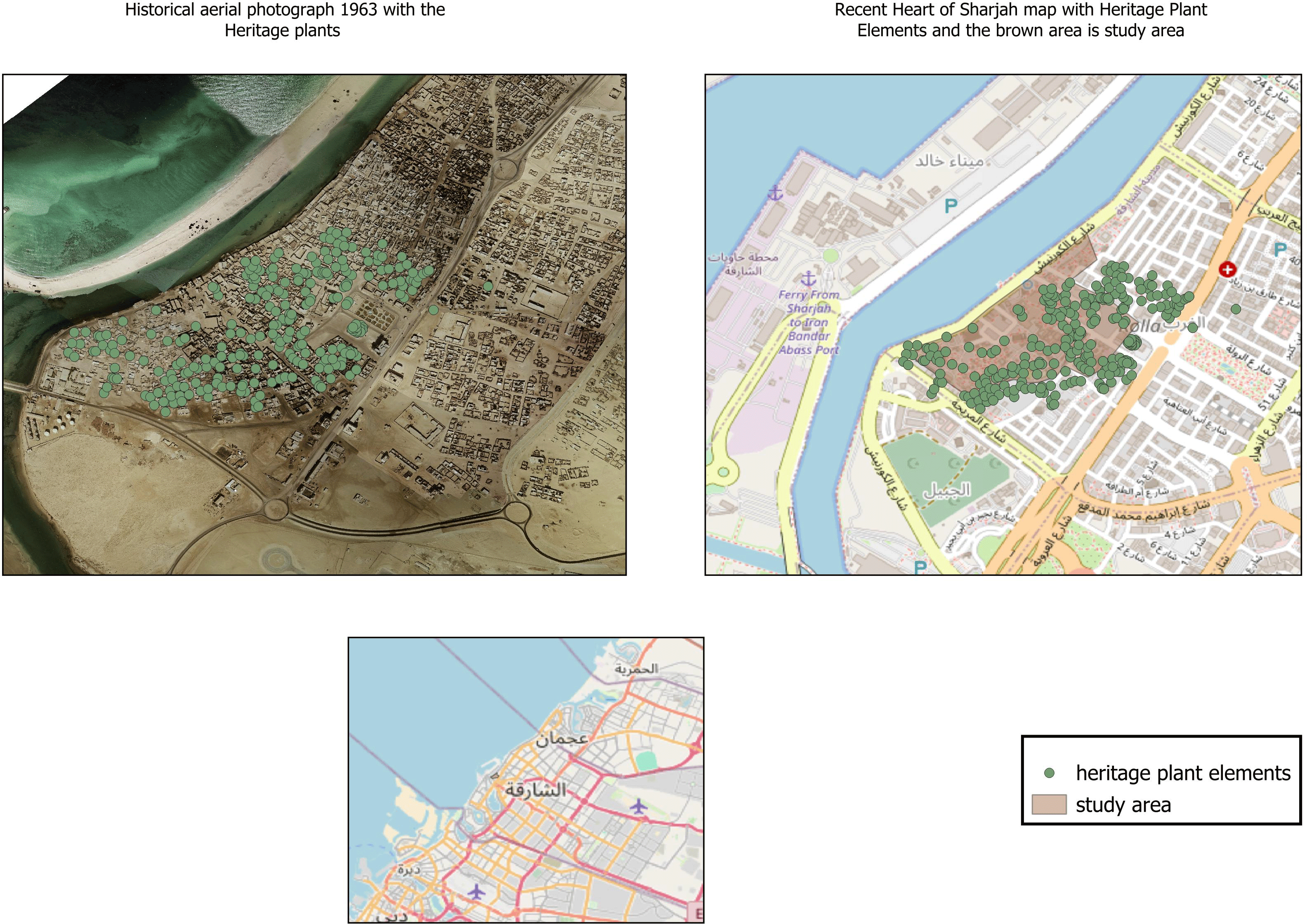
Vegetation features identified through oral histories and image interpretation were digitized as spatial features (figure 2), represented as points depending on the scale and clarity of the visual evidence. Each mapped feature was assigned a confidence level reflecting the degree of evidentiary support, distinguishing between features documented through oral testimony alone, visual confirmation alone, or convergent oral and visual evidence. This transparent treatment of uncertainty follows methodological principles commonly applied in historical landscape documentation and spatial reconstruction (Bastian et al., 2013).
Plant species referenced in interviews and identified through visual interpretation were verified using authoritative UAE flora resources, including curated national plant databases and peer-reviewed regional botanical literature (Alyammahi et al., 2023). Where precise species-level identification was uncertain due to image quality or incomplete recollection, taxa were conservatively recorded at the genus level to avoid misclassification. Verified plants were further categorized as native, long-established cultivated, or introduced ornamental, providing a basis for both heritage interpretation and management-oriented assessment.
Cultural, spatial, and botanical data were subsequently integrated to assess the heritage relevance of documented floristic elements. Heritage relevance was evaluated based on documented associations with social practices, repeated mention across independent sources, spatial prominence within the historic urban fabric, and evidence of continuity through time. Rather than assigning intrinsic value, this assessment focused on evidentiary support for heritage association, consistent with heritage management principles that emphasize attribute identification, documentation, and monitoring as prerequisites for conservation planning (UNESCO World Heritage Centre, 2024).
The verified and documented floristic elements were synthesized into a heritage flora guide designed to support practical application by site managers and heritage practitioners. The guide links plant identity with cultural associations, spatial context, and management considerations, including potential conflicts with infrastructure, maintenance requirements, and suitability for replacement or reintroduction. By framing vegetation as a managed heritage attribute rather than a decorative element, the methodological approach supports informed decision-making aligned with integrity-based heritage conservation frameworks and contributes to the operationalization of biocultural heritage concepts in urban heritage contexts (UNESCO World Heritage Centre, 2024).
Analysis of oral-history narratives and historical documentation indicates that vegetation in the Heart of Sharjah played a central role in structuring everyday social life during the mid-twentieth century. Respondents consistently described large trees and cultivated plants as essential components of household routines and communal interaction, particularly for providing shade, comfort, and gathering spaces. These functions extended beyond environmental regulation, embedding vegetation within social practices such as informal meetings, rest, and daily circulation.
Rather than serving as passive elements of the landscape, specific plant types were repeatedly associated with shared experiences and collective memory. Prominent trees functioned as recognizable landmarks and reference points within the urban fabric, reinforcing their cultural salience. The recurrence of these themes across independent oral accounts suggests that the social role of vegetation was systematic rather than incidental, supporting its interpretation as a heritage attribute rather than an ornamental addition.
Spatial reconstruction based on historical imagery and GIS analysis shows that heritage-linked floristic elements were closely integrated into the built environment of the Heart of Sharjah. Mapped vegetation features were typically located near residential structures, open courtyards, and informal public spaces, rather than being randomly distributed across the urban landscape. This spatial pattern corroborates oral testimonies describing vegetation as integral to everyday movement, social interaction, and microclimatic comfort.
Where convergence between oral-history evidence and visual documentation was possible, confidence in spatial attribution increased, reinforcing the interpretation that these elements occupied consistent and meaningful locations within the historic townscape. The spatial embedding of vegetation thus reflects deliberate placement aligned with social use and functional needs, further supporting its relevance for heritage documentation and management.
Heritage-linked floristic elements exhibited distinct value profiles across multiple dimensions, including social, cultural, environmental, economic, medical, and architectural relevance. Table 1 presents an illustrative value profile of selected floristic elements based on triangulated oral history evidence, historical documentation, and literature-supported associations.
Values are expressed on a three-point ordinal scale (1 = low relevance, 3 = high relevance) and represent an illustrative, evidence-informed synthesis derived from triangulated oral-history accounts, historical documentation, and literature-supported associations.
The palm tree emerges as a multi-functional heritage element, demonstrating consistently high relevance across all assessed value categories. Its role extended from social and cultural practices to economic use, medical applications, environmental regulation, and architectural integration, reflecting its deep entanglement with traditional urban life. In contrast, the Ghaf tree exhibits strong cultural, social, and environmental significance, whereas it contributes more selectively to economic and architectural functions.
These differentiated profiles highlight that heritage vegetation cannot be treated as a homogeneous category. Instead, individual species embody distinct constellations of meaning and utility, which must be recognized in heritage interpretation and management strategies. The value profiling approach, therefore, provides a structured means of articulating relative significance without implying quantitative precision.
The results indicate that heritage vegetation in the Heart of Sharjah carries layered meanings that intersect with cultural identity, social practices, and environmental functions. At the same time, oral accounts and spatial evidence point to emerging tensions between historically rooted vegetation patterns and contemporary urban conditions, including infrastructure constraints and changes in planting practices.
The differentiated value profiles presented in ( Table 1) suggest that management decisions should be species-specific rather than generic. Elements with high multi-dimensional relevance, such as the palm tree, warrant prioritization for conservation, appropriate reintroduction, and interpretive emphasis. Species with strong cultural but limited architectural or economic roles may require tailored strategies that preserve symbolic meaning while minimizing physical conflict with the built environment.
Together, these findings support the development of a heritage flora guide as a practical management instrument that links cultural meaning with ecological suitability and maintenance feasibility. By grounding management decisions in documented heritage values, such a guide can contribute to integrity-based conservation approaches while accommodating contemporary operational constraints.
The results demonstrate that vegetation in the Heart of Sharjah functioned as an active component of everyday urban life rather than as passive background greenery. Oral history evidence indicates that large trees and cultivated plants structured daily routines by providing shade, comfort, and spaces for social interaction, thereby reinforcing their role as socially embedded landscape elements. This finding aligns with broader research on place attachment, which emphasizes that physical features of the environment, particularly those repeatedly engaged through daily practices, serve as anchors for collective memory and identity (Scannell & Gifford, 2010; Lewicka, 2011).
Importantly, the recurrence of similar themes across independent accounts suggests that these roles were not idiosyncratic or anecdotal, but instead reflected shared social norms and spatial practices. In this sense, heritage vegetation contributed to what has been described as cultural ecosystem services, where nonmaterial benefits such as a sense of place and social cohesion emerge from sustained human–environment interactions (Daniel et al., 2012). By documenting these functions explicitly, the study strengthens the case for treating vegetation as a heritage attribute that contributes to the authenticity and lived experience of historic urban landscapes.
The spatial analysis reinforces the interpretation of vegetation as deliberately embedded within the historic urban fabric. Mapped floristic elements were consistently associated with residential structures, courtyards, and informal public spaces, corroborating oral testimonies that emphasized their role in everyday movement and gathering. Such spatial patterns indicate intentional placement aligned with functional and social needs, rather than incidental or decorative planting.
This convergence between spatial and oral evidence reflects methodological approaches in historical landscape research, in which the alignment of memory, visual documentation, and spatial reconstruction is used to infer meaningful landscape organization (Bastian et al., 2013). In the context of the Heart of Sharjah, the spatial embedding of vegetation supports an interpretation of the historic townscape as a socio-ecological system in which built form and plant elements co-evolved to mediate climate, social interaction, and daily life. Recognizing this integration is essential for avoiding heritage management approaches that isolate buildings from their living environmental context.
The value profiling presented in ( Table 1) highlights that heritage vegetation is not a homogeneous category but instead comprises elements with distinct constellations of social, cultural, environmental, and functional relevance. The palm tree, characterized by consistently high values across all assessed dimensions, exemplifies a multi-functional heritage element deeply embedded in traditional urban life, material culture, and spatial organization. Its prominence across social, economic, medical, environmental, and architectural domains underscores its role as both a cultural symbol and a practical resource.
In contrast, the Ghaf tree demonstrates strong cultural, social, and environmental significance while contributing more selectively to economic and architectural functions. This differentiation illustrates that heritage value does not require uniform relevance across all dimensions; rather, species may derive significance from particular roles that are socially or symbolically salient. Similar observations have been reported in studies of heritage vegetation elsewhere, where specific plant species act as identity markers despite limited utilitarian roles (Abacıoğlu Gitmiş & Altunkasa, 2023).
By articulating these differentiated value profiles, the study provides a structured means of comparing heritage-linked floristic elements without resorting to quantitative ranking. This approach supports nuanced interpretation and avoids reducing heritage significance to a single metric, aligning with biocultural perspectives that emphasize plural and context-dependent values (Gavin et al., 2015).
The findings have direct implications for contemporary heritage management in the Heart of Sharjah. The documented cultural and spatial significance of vegetation indicates that planting decisions cannot be treated as purely aesthetic or neutral. Instead, they shape how heritage is experienced, remembered, and maintained. The differentiated value profiles further suggest that management strategies should be species-specific rather than generic, prioritizing elements with high multi-dimensional relevance for conservation, appropriate reintroduction, and interpretive emphasis.
At the same time, the results point to emerging tensions between historically rooted vegetation patterns and contemporary urban conditions, including infrastructure constraints and changing planting practices. Such tensions echo findings from urban forestry research, which document conflicts between tree growth and built infrastructure when planting decisions are not informed by long-term spatial and functional considerations (Randrup et al., 2001; Shi et al., 2023). In heritage contexts, where interventions may be constrained by conservation requirements, these conflicts underscore the value of preventive, evidence-based guidance.
Within this framework, a heritage flora guide functions not merely as an interpretive tool but as a practical management instrument. By linking plant identity with cultural meaning, spatial context, and management considerations, the guide can support integrity-based conservation approaches advocated by heritage governance frameworks (UNESCO World Heritage Centre, 2024). Such an instrument also offers a mechanism for mediating between cultural authenticity and operational feasibility, particularly when decisions involve replacement planting or landscape rehabilitation.
This study contributes to heritage and landscape research by demonstrating how oral histories, spatial reconstruction, and botanical verification can be integrated to document heritage vegetation as a meaningful component of historic urban landscapes. Methodologically, the mixed-evidence approach advances documentation practice by making explicit how cultural meaning and spatial evidence can be combined to inform management decisions. Conceptually, the results reinforce biocultural perspectives that view heritage landscapes as living systems shaped by sustained human–environment interactions.
Several limitations should be acknowledged. The value profiling presented is illustrative and based on qualitative synthesis rather than quantitative measurement, and the number of documented floristic elements reflects the availability of historical and oral evidence rather than an exhaustive inventory. These constraints do not undermine the interpretive findings but highlight the need for transparency and cautious generalization. Future research could strengthen the framework by expanding the range of documented species, incorporating additional archival sources, or applying the approach comparatively across multiple heritage districts.
Despite these limitations, the analytical framework and findings are transferable to other historic urban contexts, particularly in arid and semi-arid regions where vegetation plays a critical role in mediating climate and social life. By foregrounding vegetation as a heritage attribute rather than a secondary landscape feature, the study offers a replicable pathway for integrating biocultural considerations into heritage documentation and management.
This study demonstrates that vegetation in the Heart of Sharjah functioned as an integral component of the historic urban landscape, shaping everyday social practices, place memory, and spatial organization rather than serving as a purely decorative element. Through the integration of oral-history evidence, spatial reconstruction, and botanical verification, the study shows that heritage-linked floristic elements were deliberately embedded within the urban fabric and carried differentiated cultural, social, environmental, and functional significance.
The analytically structured results highlight that heritage vegetation is not a homogeneous category. Instead, individual species exhibit distinct value profiles, reflecting their specific roles in traditional urban life. By articulating these differentiated profiles in a transparent and non-quantitative manner, the study provides a defensible basis for interpreting floristic elements as heritage attributes and for informing management decisions that are sensitive to both cultural meaning and contemporary operational constraints.
Methodologically, the study advances heritage documentation practice by demonstrating the value of triangulating cultural memory, spatial evidence, and botanical knowledge within a single framework. This approach supports the development of a heritage flora guide that functions not only as an interpretive resource but also as a practical management instrument aligned with integrity-based conservation principles. Although the analysis is constrained by the availability of historical and oral evidence, the framework is transferable to other historic urban contexts, particularly in arid regions where vegetation plays a critical role in mediating climate and social life.
Overall, the findings reinforce the importance of recognizing vegetation as a living heritage attribute and provide a structured pathway for integrating biocultural considerations into urban heritage conservation and landscape management.
The ethical approvals were obtained by Research Ethics Committee (REC), University of Sharjah (Reference No.: REC–25–09–11–05-PG). The written informed consent was obtained from all participants via a paper-based form. The consent statement clearly explains the research objectives, voluntary participation, anonymity, data confidentiality, and the right to withdraw at any time. Only participants who provided consent were able to proceed with the meeting.
The author(s) declared that no grants were involved in supporting this work.
© 2026 Alqahtani S et al. This is an open access article distributed under the terms of the Creative Commons Attribution License, which permits unrestricted use, distribution, and reproduction in any medium, provided the original work is properly cited.
Current Reviewer Status:
AWAITING PEER REVIEW
AWAITING PEER REVIEW
?
Key to Reviewer Statuses VIEW HIDE
ApprovedThe paper is scientifically sound in its current form and only minor, if any, improvements are suggested
Approved with reservations A number of small changes, sometimes more significant revisions are required to address specific details and improve the papers academic merit.
Not approvedFundamental flaws in the paper seriously undermine the findings and conclusions