Просмотр новости
Найдите то, что Вас интересует
 Спутники
 РН
РН SpaceX
 Роскосмос
 NASA
NASA
СпутникиРНSpaceXРоскосмосNASA
Back in 2007, Vermont’s Kyle Thomas recorded an album under his new moniker, King Tuff. It was called Was Dead—as in, King Tuff Was Dead—and Thomas cut it on a Tascam 388, an 8-track reel-to-reel recording and mixing machine. He’d traded in an Ibanez electric to buy the Tascam at a music store in Keene, New Hampshire, in 2003. (Thomas didn’t know it then, but at the same time, his garage-rock contemporaries Ty Segall and the Osees’ John Dwyer were experimenting with the same machines out on the west coast.) He stuck an SM57 on his amp, and hit record. No outboard gear, no processing. It was the heart of the lo-fi revival’s heyday. Thomas moved to Los Angeles, the heart of the genre’s new American boom, signed to Sub Pop, and released 2012’s King Tuff and 2014’s Black Moon Spell, both collections of unrepentant, gnarly garage-rock music. Then came 2018’s The Other and, in 2023, Smalltown Stardust. These were more manicured, high-fidelity endeavors. The arrangements were softer and slower. Production was clearer and more considered. When it came time to take the albums on tour, Thomas faltered. “When I would play the older songs that were more straightforward rock, it was just so much more fun,” he says. “I wanted to make a record with that in mind: What’s going to be fun to play live?”Moo, King Tuff’s seventh record, is what he came up with. Recorded before departing Los Angeles for good, Moo is Thomas’ return to the Tascam 388, and to the earworm musical dirt-baggery he first traded in. Opener “Twisted on a Train” announces this proudly. Its an A-major foot stomper, led by the perfectly muffled snap of Thomas’ guitar, that recounts a disturbed, weed-gummy-fueled train ride from Tucson to Los Angeles. The cheap-beers-on-the-beach groove of “Stairway to Nowhere” keeps the ball rolling while Thomas looks back on his years in L.A.: “I’m so tired of spinnin’ my wheels / Negative numbers, dead-end deals / Wined and dined in paradise.”“I really just wanted to get back to how I used to do things, more DIY,” Thomas says of the recording and release plan (Moo is coming out on his own record label). “I just feel more connected to the work that way, and I feel more connected to the fans if I’m actually giving them something that I made personally.” Vermont is a good place to do things yourself, surrounded by weavers and woodworkers instead of influencers and industry dependents: “It’s nice to be somewhere where not everyone’s trying to make it. I think cities trick people into thinking that you have to be there for shit to happen in your life, and I don’t think it’s true.”Kyle Thomas’ GearGuitars & Bass1995 Gibson SG Standard (with bolt headstock repair by Reuben Cox)Rickenbacker 660-12TP1968 Fender P bass
AmpsEarly-’60s brown-panel Fender Deluxe 6G3 Early-’80s Fender Super Champ
EffectsCeriatone CenturiaDunlop Cry Baby Q-ZoneVintage Mu-Tron PhaserMoog MF Delay
Recording EquipmentTascam 388Shure SM57Reconnecting with the Tascam made Thomas realize how important the machine is to his work. Maybe it’s the tone the Tascam imparts that endears him to it, or maybe it’s the particular workflow it demands. Regardless, working with the 8-track device, Thomas felt like himself again. He didn’t sing his vocals a hundred times and comp the best bits together, or overwork his guitar performances until they were flawless. There’s noises—hissing and buzzing and popping—plus other peculiarities and variances from one riff to the next. “It’s all about the performance and just capturing something, and not doing it to death. You can get good results doing things the new-school way,” he admits. “But you might feel sadder at the end.”So why did it take so long for Thomas to return to his beloved Tascam? “I finally got it fixed,” he shrugs. “That’s really all it was. It was broken.”Given his recording philosophies, it probably isn’t a surprise to hear that Thomas doesn’t like players who are “too good”: “It’s boring. I don’t think rock music should be perfect. I think rock music suffers when people make it on the computer and fix everything.” Wipers’ Greg Sage and Dead Moon’s Fred Cole are key inspirations for Thomas, alongside imperfect shredders like Jimmy Page and Jimi Hendrix. “I like shittier guitar players better than really good ones, usually, or guitar players that are rough around the edges,” he says. “They can be good, but they fuck up a lot.” The continued pull toward imperfection is, of course, colored by Thomas’ estimation of his own playing. “I’m not a slick guitar player, I’m not smooth,” he explains, then grins. “My hands are shaky. They’re like bald eagle talons.” The influence of more polished players like Tom Petty and Mike Campbell are in frame on Moo, too, especially courtesy of a Rickenbacker 660-12TP—Petty’s signature model—that Thomas acquired just before making the record.“I think rock music suffers when people make it on the computer and fix everything.”Thomas is an SG player first and foremost, and he’s played his beloved late-’90s Gibson SG Standard, named Jazijoo, for more than two decades. It’s been thrashed and colorfully decorated over the years, and its cracked headstock kept breaking until Reuben Cox, of L.A.’s Old Style Guitar Shop, put the problem to rest—by driving a bolt through the headstock, Frankenstein’s-monster style, to secure it. Because of its fragility, Jazijoo doesn’t come out on the road these days, but teamed up with a Mu-Tron Phaser that Thomas scored in a thrift store for five bucks in the early ’90s, it’s created the King Tuff sound. To round out that pairing on Moo, Thomas borrowed a brown-panel Fender Deluxe 6G3, which handled most of the guitar tones on the record, along with a small Supro combo and an early-’80s Fender Super Champ.Almost 20 years after Was Dead, Thomas is back living in the forests of Vermont. His neighbors don’t know or really give a shit about his music, and that’s a good thing. “It’s fucking paradise,” Thomas says, straight-faced, on a video call from a room in his home crammed with music gear. “Obviously L.A. is supposed to be paradise, and it is in some ways, but I don’t know. I really missed the seasons. I get ideas and feelings here that I just didn’t have out there. I do love L.A., but I’m a freak from the woods.”
You know it within seconds: those priceless “song within a song” solos, that impeccable phrasing (never too much or too little, with lots of space between notes), a subtle Bigsby shimmer at just the right moment, the evocative 12-string jangle, and an overall style that blends the sweet melodicism of George Harrison with the blues-rock grit of Keith Richards. All it takes is but one of those elements and you know you’re hearing Mike Campbell, who has, since his time as lead guitarist of Tom Petty and the Heartbreakers, established himself as one of the most identifiable guitarists in modern history.
“Well, I certainly know me when I hear me,” Campbell says with a laugh. “Honestly, I’m aware people say I have a recognizable style, and while it’s nice to hear that, it’s also nothing I planned on. I play the way I play. I just look at the song in front of me and say, ‘How can I enhance this?’”
He breaks down his approach thusly: “I’ll listen closely to the melody of a song, and I’ll try to emulate it on the guitar. Because the singing fits with the chords, the notes that I play should fit with those chords, too. I’ll use the singing voice and the melody as a spin-off point, but I try to stay within a certain range. I do like to improvise during solos, but it’s never to distract from the song. It’s what I’ve always done, and the players I respect—George Harrison, Jimmy Page, Keith Richards—all do that. Those are people I learned from.”
Campbell formed the Dirty Knobs as a side band back in 2000 with the idea that it would be simply that—a side band. One that offered him a relaxed, no-pressure space to work out songs away from the Heartbreakers, do a bit more singing, and let off some steam. Occasionally, he and the guys (guitarist Jason Sinay, bassist Lance Morrison, and fellow Heartbreaker drummer Steve Ferrone) would go play at a bar for fun. “I guess I thought, ‘If the Heartbreakers ever break up or if Tom quits, this is what I’ll do,’” he says.
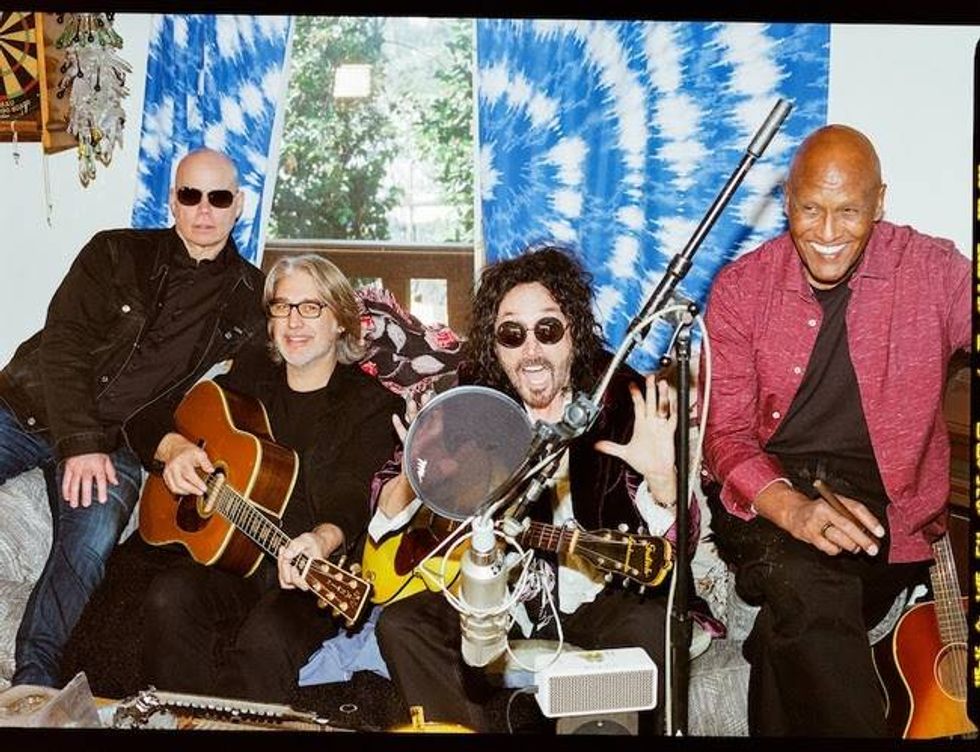 Mike Campbell & The Dirty Knobs’ Mission Of Mercy Out June 12Photo credit: Sheva Kafai
Guitars
Amp
Effects
Strings, Picks, & Cables
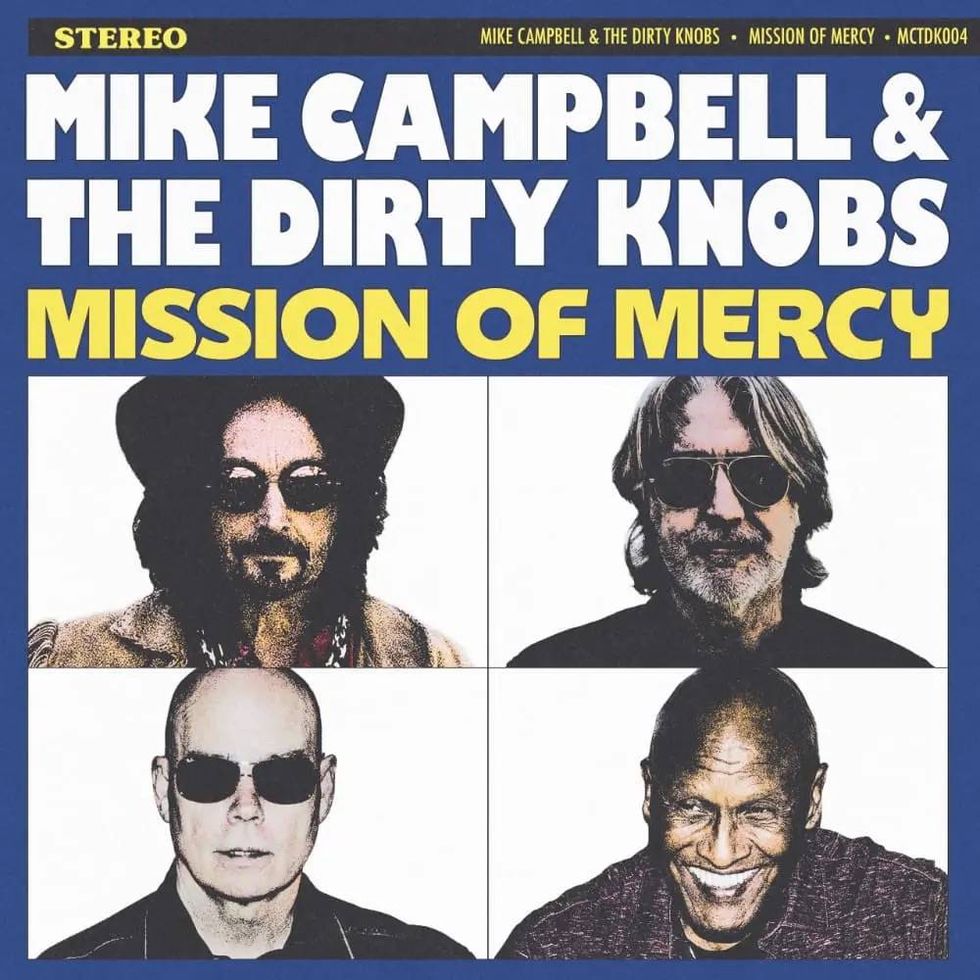
Following Petty’s tragic passing in 2017, Campbell joined Fleetwood Mac along with Neil Finn as replacements for Lindsey Buckingham, but after a 2018-19 world tour, he made the Dirty Knobs his main focus. In 2020, he finally wrangled the band into the studio to record an incredibly solid debut album, Wreckless Abandon, which he followed with two equally strong releases, 2022’s External Combustion and 2024’s Vagabonds, Virgins & Misfits. There have been several personnel changes over the years, but the current lineup—Morrison, Ferrone, and guitarist Chris Holt—recorded the band’s latest release, Mission of Mercy.
Much of the album is rooted in tough-minded rock—“Let Me Back in My Dreams,” “Vicious Hangover,” and “My Mama Told Me” are rude, untidy, and fun as hell, and the aptly named “Bongo Mania,” which, yes, features bongos a-plenty along with the luminous background vocals of the B-52s’ Kate Pierson, is a full-throttle knockout, brimming with Campbell’s sparky leads and solos. But there’s nostalgia and melancholy in the Americana ballad “More Than Gold” and the psychedelic title track, and the reflective opening cut, “No Regrets,” is a winning variation on the classic Heartbreakers sound. All told, it’s the strongest effort from the band—now billed as Mike Campbell & the Dirty Knobs—to date.
“I’m aware people say I have a recognizable style, and while it’s nice to hear that, it’s also nothing I planned on.”
A veteran of the album-rock era, Campbell co-wrote a number of Petty classics, including “Refugee,” “Here Comes My Girl” and “Runnin’ Down a Dream,” and he composed the music for Don Henley’s Grammy-winning hit, “The Boys of Summer” (a song Petty turned down, and later regretted). By his own account, it’s taken him a while to recalibrate his songwriting to suit the Dirty Knobs and his own vocal style, but with this album he’s starting to get the hang of it. Even so, he admits to some growing pains.
“It was daunting at first because Tom was so good, and I never had an ambition to sing or put my lyrics out front,” Campbell says. “I could just give him music and he would turn them into these great songs. I never worked at it. Also, Tom could be a little intimidating, because he was so good. But I started writing my own songs and recorded them in private, and slowly I got to singing. A lot of it was about building my confidence and feeling like I can do this. Being around Tom and watching how he would write words, I picked up a few tricks from him.”
Avoiding the obvious is one such skill, especially when it comes to wordplay. “Tom was kind of like Dylan in that way,” Campbell says. “He would set up a rhyme, and you’d think, ‘Oh, he’s going to use this word next,’ but he’d come up with something much cooler. I always thought that was something I’d like to emulate. Also, in the Heartbreakers, the songs’ characters were real and believable, and in most of our songs the characters may be lost or struggling or going through some kind of trauma, but there’s redemption at the end, like, ‘This is going to be okay.’ Tom had that element in his songs.”
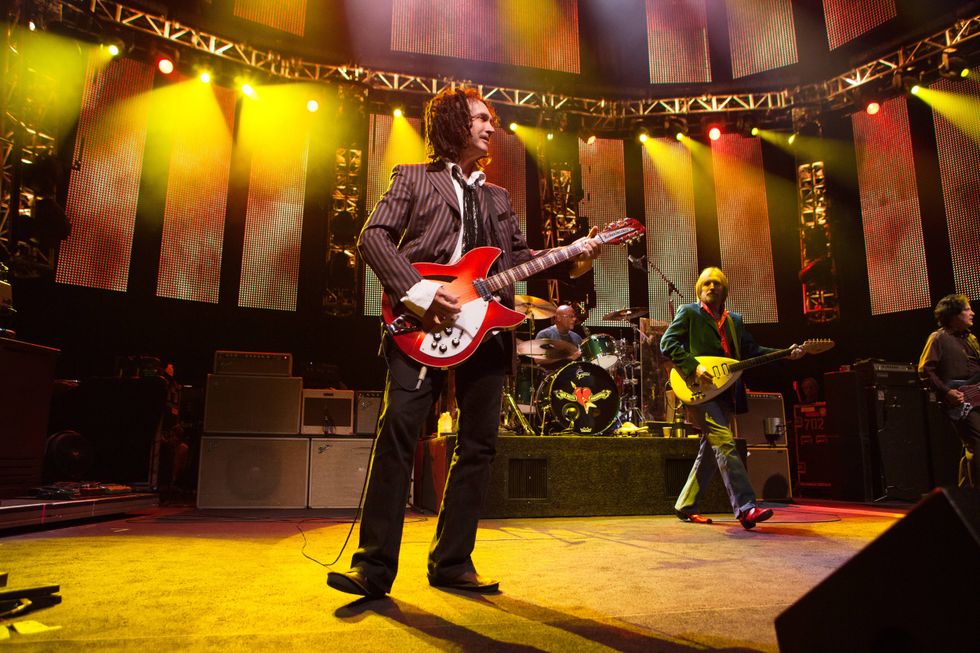
Campbell onstage in 2010 with Petty, the Heartbreakers, and trusty Rick 625/12
Photo by Tim Bugbee
It’s been nine years since Petty’s passing, but in some strange and beautiful ways, Campbell feels like he can summon his friend’s spirit whenever needed. “It’s all part of the grieving process,” he says. “Even though he’s gone, he’s still here and I feel like he’s sitting on my shoulder as I write. I’ll go, ‘Uh-huh, uh-huh, that’s not right. You can do better.’ So he’s around in my psyche.”
As musical partners, Campbell and Petty enjoyed an uncomplicated, intuitive musical bond. In most cases, Petty would come in and play a new song on acoustic guitar, and Campbell would immediately get to work on ways to enhance it. “I think that’s something I was pretty good at, or at least Tom always told me I was,” Campbell says. His manner of working with Chris Holt, who joined the Dirty Knobs in 2022, follows a similar pattern: “I’ll play a song and be like, ‘Here’s the rhythm and the chords,’ with no leads or guitar parts—those will be determined later.”
He laughs. “In a sense, I’ve become Tom and Chris has become me. He’ll interact with me, and if I like something, I’ll say, ‘Yeah, more of that.’ Or if I don’t like it, I’ll say, ‘You know that thing you did? Don’t do that anymore.’ But you know, he’s an incredible musician and I’m so fortunate to have him in the band. I can’t get over it—he sings great, he plays keyboards, and he’s so good on guitar.”
“I play the way I play. I just look at the song in front of me and say, ‘How can I enhance this?’”
So good, in fact, that Campbell now has to share Holt with the Eagles—the Dallas-born musician, who has toured with numerous big-name artists including Don Henley, was recruited by the veteran band to replace long-serving guitarist Steuart Smith in 2025. Campbell says the workaround hasn’t been too problematic.
“Chris came to me and said, ‘I’m going to play the Sphere [in Las Vegas], if that’s okay,’” he recalls. “I said, ‘As long as you don’t get in the way of our gigs, go for it.’ I think I moved our tour back a week or two to allow him to play a few Eagles gigs. The thing with Chris is, it’s great that he’s playing with the Eagles because he gets a lot of money. He gets to play those songs, but he doesn’t have much freedom—it’s pretty well-scripted music. With the Knobs, it’s like anything can happen. Chris loves the spontaneity and the unexpected. I’ll change the setlist in the middle of the show. I’ll just throw a song on—‘How about this one?’ Or ‘Chris, take a solo!’ He doesn’t get that in the Eagles.”
Campbell’s impetuous nature extends to the recording studio, as well. He points to the song “Vicious Hangover” as a one-take wonder that was written “totally live, in, like, two minutes,” and he raves about Holt’s wicked, off-the-cuff soloing. “How about this guy? He plays two solos, and they’re incredible. No matter what I ask of him, I feel like I can count on him to do something good.”
The sweeping, soaring solo on “No Regrets” is a full-glory blast of prime Campbell—set against a bed of chiming 12-string rhythms, it evokes the iconic splendor of his breathtaking lead break on “The Waiting.” To match the defiant tone of “Let Me Back in My Dreams”—it’s almost an extension of Petty’s “I Won’t Back Down”—he breaks out a hard-ass, thrill-laced solo, and doesn’t let up til he empties the tank. It sounds meticulously composed, but like so many of his leads, it’s a moment of unpremeditated wonder.
“I rarely work solos out,” Campbell says. “Even going back to ‘Breakdown,’ I didn’t work that one out. ‘Runnin’ Down a Dream,’ I didn’t work that out, either. It’s like, ‘Put the track up and let me play along.’ I just react to the music, and then I’ll try to emulate the melody so I know I’m in the game. Sometimes it’s a train wreck, but the next time it might be a beautiful thing that surprises me.”
A self-described “child of the ’60s,” Campbell drew inspiration from Brian Wilson for the dramatic title track, on which he consciously tried to mirror certain aspects of the late genius’ production approach. “It needed those sonics, with the background vocals and the odd chords in the middle,” he says. After recording basics with the band, he thought it was a little light on guitar, so he pulled out a wah pedal and added an end solo with a Fender Telecaster equipped with a B-Bender. “I just played it one time to give the song a little edge. It’s one of my favorite songs on the album. I hope people see it as a tribute to Brian Wilson. It wasn’t like I was trying to copy him or anything.”
“Even though [Petty]’s gone, he’s still here and I feel like he’s sitting on my shoulder as I write.”
Over the years, Campbell has amassed an enviable collection of guitars, but for Mission of Mercy, he relied on a small group of mid-’60s Teles, Strats, and Les Pauls, along with his treasured ’59 Les Paul ’burst. “I have guitars in the hallway, and occasionally we’ll go, ‘This might sound good with that one,’” he says. “Mostly we’re in a hurry, and I don’t want to waste time looking for guitars. It’s like, ‘Here, this one’s in tune. Play this one. Let’s get the track down.’”
Throughout the recording process, he found plenty of opportunities to strap on his 1963 Rickenbacker 625/12 12-string, the same guitar Petty borrowed for the cover of Damn the Torpedoes. “I just love the Rickenbacker 12-string,” Campbell says. “I can’t get away with putting some of it on an album.”
He briefly toyed with amp modeling, but he’s gone back to physical amplifiers, and in the studio he called upon a trusty Ampeg Rocket that he’s used since his Heartbreaker days. As for pedals, in addition to a Vox wah, he played through a Line 6 DL4 delay, an EHX POG2 Polyphonic Octave Generator, and a Way Huge Camel Toe Triple Overdrive MK II. “I don’t think they make the Camel Toes anymore,” he notes. “It’s got two overdrives—loud and louder.”
Campbell describes longtime confidante and co-producer George Drakoulias as “a big, lovable, and intelligent grizzly bear” who keeps things moving in the studio. “George knows how to put everybody in a good mood, and the main thing is, I trust him,” he says. “If I’m doing something that I’m not sure about, or maybe I am sure about it, he’ll say, ‘Maybe you should do that again,’ or ‘Maybe that bridge should come later in the song.’ He’s got great instincts and he knows me. He makes me feel comfortable with the microphone.”
One might assume that every item on the guitarist’s bucket list was checked off years ago, but who would imagine that the diehard rock and roller has secretly yearned to play with an orchestra? “It’s a dream I’ve had, and it’s finally come to the point in my life where it’s now or never,” he says. And so, following a summer tour with the Dirty Knobs, Campbell will join the Atlanta Symphony Orchestra for a performance of select Tom Petty and the Heartbreakers hits at Atlanta Symphony Hall this September.
“I have an orchestrator who’s writing out all the string parts for the high-point songs of my career with the Heartbreakers,” he says. “He’s writing parts for cellos and oboes and all that to present the songs in a more magnificent way as opposed to just a rock band. I love orchestra. I love Beethoven, Bach, Mozart—I’ve always listened to that stuff a lot. It’s exciting for me to finally realize an idea I had when I was younger. I’ll probably play a little guitar here and there in the show. I mean, I don’t know yet—we’re still formulating the idea. But some of the charts have been written, and they sound amazing.”
All of which raises the big question: What will he wear for his orchestral debut? Campbell laughs and says, “I don’t know if I should dress up or dress down. I might go against the grain and just go out in cut-offs and a ripped t-shirt.”
He pauses. “No, I’ll probably dress nice. I don’t want to let the people down.”
| # | Наименование новости | Тональность | Информативность | Дата публикации |
|---|---|---|---|---|
| 1 | Rig Rundown: Tyler Armstrong (The Band Feel) | 0 | 6.96 | 04-03-2026 |
| 2 | FU-Tone’s Mass Appeal | 0 | 8.06 | 01-05-2026 |
| 3 | José González: A Matter of Time | 0 | 8.99 | 04-05-2026 |
| 4 | Lamb of God’s Brutal Truth | 0 | 6.7 | 11-03-2026 |
| 5 | Recording Dojo: When Is a Record Done? | 0 | 6.7 | 07-03-2026 |
| 6 | Matteo Mancuso’s Wide-Open Road | 0 | 8.06 | 21-04-2026 |
| 7 | Jimmy “Scratch” James: Playing for His Ghosts | 0 | 7.47 | 21-05-2026 |
| 8 | Sunn O))) Celebrate the Beginner’s Mind | 0 | 6.79 | 13-04-2026 |
| 9 | Joe Pernice is Stepping Up to the Plate Again | 0 | 9.2 | 27-04-2026 |
| 10 | Cut Worms on their latest album, 'Transmitter' | 2 | 6 | 08-07-2026 |