Просмотр новости
Найдите то, что Вас интересует
 Спутники
 РН
РН SpaceX
 Роскосмос
 NASA
NASA
СпутникиРНSpaceXРоскосмосNASA
If you phone FU-Tone on a Sunday, there’s a decent chance company president Adam Reiver will be the one who picks up. Even after decades in the industry and building a global customer base, he hasn’t distanced himself from his clients—something that, in the age of AI chatbots, can still catch customers off guard.“People will call, and they go, ‘Oh my god, is this the guy in the video? Is this Adam? I can’t believe I’m talking to you,’” he tells Premier Guitar. “And I go, ‘I can’t believe I’m talking to you!’”That interaction captures something elemental about FU-Tone and Reiver: He’s one of us. “I'm just a guitar player like you, or some kid in Kansas, or the guy on the cover of Rolling Stone,” he says.This connection isn’t just a customer service quirk. It reveals a philosophy at the heart of his brand. From the early days of designing the EVH D-Tuna to the present, this approach has shaped FU-Tone into a tight-knit community of dedicated musicians from all walks of life.It also explains why so much of what Reiver builds and talks about centers on helping players take full control of their tone—not just upgrading their instruments, but understanding them.To fully grasp how deeply this mindset is embedded, it helps to look at Reiver’s own journey as a player. His story began at a moment when guitar culture ruled the world, during a shift from traditional sounds into more experimental territory.“It was around ’81 when I first really found the guitar,” he says. “And if you roll the clock back two or three years from there, it was basically, ‘Do you want a Strat, a Tele, or a Les Paul?’ And then off you go. I didn’t think modding and hot-rodding guitars were a thing.”Reiver was there at ground zero to witness the shift toward customized superstrats, the rise of early custom-shop brands like Jackson and Charvel, and brand-new horizons in playing technique. Not wasting any time, he jumped in headfirst, becoming fascinated with how he could change, improve, and completely reimagine his favorite instruments.“My first guitar was like a cheap, $200 Hondo Flying V,” he says with a touch of pride. “But by the time I was done with it, it had a Kahler in there. It had an Invader pickup in the bridge. It had a Mighty Mite triple-coil pickup in the neck. It was like, do anything you could do to just tinker and play with the guitar.”Just about everyone who’s played electric guitar for any amount of time is familiar with that unexplainable pull to hot-rod their favorite instrument. In Reiver’s case, however, it was more than curiosity. It was a new paradigm. The guitar was not a finished product. It was a platform.“The advent of FU-Tone was, ‘How do you make this guitar sound better?’”While other tinkerers of his era pursued those same goals by winding pickups, building guitars, and adding wild finishes, Reiver’s curiosity found its outlet in fabrication. Thanks to his high school’s metal shop, he wasn’t modifying existing parts—he was making new ones.“I was not a good student, except for that class,” he recalls with a laugh. “I got straight As in metal shop. I liked how you could fabricate parts from an idea in your head. Like, ‘How do we do this? How do we get this idea from here to there?’”That experience translated directly into how he would later develop products. Even before founding Floyd Upgrades—FU-Tone’s original name—his process was simple and immediate. Draw something, build it, test it, refine it. Still, Reiver admits he’s no machinist.“I know enough just to be dangerous, just to get myself in trouble. So I contracted with this guy who was a professional machinist. I would literally sketch something on the side of a box and say, ‘Can you make this?’ He would whip it up old-school and bring it back to my office.”This spirit of experimentation wasn’t just limited to those early years. That same trial-and-error approach still defines FU-Tone products today. Instead of designing in isolation, Reiver works through ideas with the instrument in hand, adjusting based on feel and response. And as with his in-house machinist, he doesn’t work alone.One of Reiver’s most celebrated “assistants” was Eddie Van Halen himself. Working in a small team alongside Eddie, he helped develop the EVH D-Tuna through a similar cycle of experimentation, providing locking-trem players access to instant drop-D riffage.“[That process] became a melting pot,” Reiver says. “It would be one of those side-of-the-box conversations. I would say, ‘Well, maybe we should angle it a little, make this longer, make that shorter, make this, do that.’ I would put it on a guitar, and [Ed] would monkey with it, and say, ‘No, no, no. Do this. Do that.’”Like Reiver, Van Halen used the guitar as a testing ground, emphasizing constant refinement in pursuit of maximizing tone. And their early success only signaled the start for Reiver.“You know, the advent of FU-Tone was, ‘How do you make this guitar sound better? How can you make this sustain more? How can you make it clearer? How can you make it louder?’ That’s where it came from.”With tone chasing now an obsession, Reiver turned his attention to a specific piece of hardware, one most players assumed Floyd Rose had already perfected: the tremolo. The way Reiver saw it, the point where the guitar strings terminate in the body was the most important piece of the tonal equation.“I don’t care if you play rock, metal, death metal, country, or pop—you want to have a good guitar tone.”“In the beginning, that was the biggest thing, and I started making one product, a 37 millimeter Big Block,” he says. “I was like, ‘Wow! It sustains way more, it sounds better, and it’s more articulate. Okay, I’ll do this.’ I invested $880 to make a run of the blocks, and said, ‘Well, worst-case scenario is I could just give them to my friends, or, you know, sell them online.’”In theory, the Big Block was exceedingly simple: a larger, heavier brass tremolo block designed to replace the smaller stock versions that came with most locking systems. With its increased mass, it maintained more string vibration, which translated into more sustain and articulation.The Big Block was a hit, and soon enough, some of the world’s most notorious tone-hound guitarists were spreading the Floyd Upgrades gospel. Reiver realized that if one overlooked component could make that much of an impact, there were probably others.Soon, he was manufacturing highly regarded double-locking tremolo replacement parts for the most popular trem models available. From titanium fine tuners to the little metal inserts found in each saddle, his theory about the effect of mass on tone proved correct, time and time again.But while he was gaining users, not everyone was a fan of the moniker: Floyd Upgrades.“A certain company didn’t like me using part of their name in my little company, and that’s fair enough,” Reiver acknowledges. “But the real blessing in disguise was that I became FU-Tone. And thank god I did, because I ended up going on to do so many other guitar parts and projects that have nothing to do with someone else’s brand.”With a new name over the office door, FU-Tone was free to innovate and expand much further into the electric guitar market.“FU-Tone encompasses a lot now,” Reiver says. “I make stop tail bridges. We make Tele parts. I make my own locking tremolos. We make guitars. We even make pickups.”This relentless expansion is about more than just product lines. From tiny titanium (or brass or copper) saddle inserts to full guitar builds, every FU-Tone offering still reflects Reiver’s original conviction: tone isn't tied to any single component, but to how everything works together. It’s what Reiver has characterized as the “FU-Tone vein of tone.”“I still pinch myself every day that I get to work with people I looked up to and tried to play like, and now I’m sitting in their living rooms.” But what is that tone? Reiver explains: “FU-Tone vein of tone means lots of sustain, clarity, and articulation. It’s considering the wood and essence of your guitar, your hands and your playing, and then moving far beyond that.”That idea shifts the conversation away from chasing specific gear and toward understanding how your instrument actually responds—where every material choice becomes another variable in the final sound. So what can you expect when you swap out your Ibanez Edge tremolo block for a brass or titanium one? What’s the tonal difference in the metals used in their Nancy Wilson-approved acoustic guitar bridge pins? Forever a gear nerd, Reiver’s always happy to explain.“Brass is big and warm and round. When you think of brass, think of Eddie Van Halen, Warren DeMartini, or a George Lynch-type of sound. Titanium has a lot of sustain, but with a certain level of clarity to it, almost like a layer of glass, with really nice note separation. And copper I find to be very similar to brass, with more of a scooped-out midsection.”From icons like Nuno Bettencourt and Slash to modern players like Lzzy Hale and Nita Strauss, countless A-listers have credited FU-Tone upgrades with having a meaningful impact on their signature sounds.But FU-Tone products aren’t just for stars. They’re for all guitar players, and they’re also very DIY-friendly. Reiver swears that if you give him a few minutes and watch one of the company’s detailed how-to YouTube videos, you’ll be customizing your favorite instrument in no time. “If you’ve never done any of this, it can seem very intimidating,” he says. “But if you have the ability to change your own strings, you can do this.”As a guitarist himself, Reiver knows firsthand how badly a trip to the local “expert” can go—which is exactly why he’s worked to democratize the process.“I’ll get a guy who will buy some parts and take them to his local guy,” Reiver explains, “and he’ll say the same thing [I always hear]: ‘My guy said…’ And I’m thinking, ‘Here it comes!’ I’ve even gotten on a Zoom with guys and walked them through it. And by the end, they’re better than ‘their guy.’ I tell them, ‘You’ll never pay someone else to do it again [laughs].’”Personal Zoom calls from a company president aren’t exactly standard practice in this industry. For Reiver, though, that’s the point—growth through relationships, not traditional marketing. “I have a handful of core guys that are all still dear friends to this day,” Reiver says. “But one of the guys who was there in the very beginning was Phil Collen from Def Leppard. After that, my phone would ring, and it would be some big artist, and they would say, ‘Phil has this on his guitar, and said to call you.’”That kind of connection establishes a level of trust that can’t be manufactured. And for Reiver and the FU-Tone team, it also shapes how those relationships develop.“These are not clients—they’re friends,” he says. “We’re at each other’s houses. We’re at each other’s events. It’s organic, and it’s real. I still pinch myself every day that I get to work with people I looked up to and tried to play like, and now I’m sitting in their living rooms.” He laughs. “But I play it totally cool.”With an artist roster that includes Gary Holt (Exodus, Slayer) and Michael Wilton (Queensrÿche), it might be easy to assume FU-Tone is strictly for shredders. But Reiver’s products have found traction with players across genres and styles, and though he’s a rocker himself, he’s consistently surprised by the range of sounds and approaches the broader FU-Tone community brings.“I’m not a big country fan, but I can tell you, those guys are the most badass musicians,” he says. “We’ll get the guys in Rascal Flatts, Jim Kimball from Reba [McEntire]’s band, Paul Sidoti from Taylor Swift’s band. I don’t care if you play rock, metal, death metal, country, or pop—you want to have a good guitar tone. I’ve been doing this for over 30 years, and that never gets old.”FU-Tone may operate on a global scale, but it’s still rooted in the same instinct that led a high school kid to start modifying a budget guitar—and the same belief that the best conversations about tone happen one player at a time. Which is why, if you happen to call on a Sunday, you just might end up talking tone with Adam Reiver.
From windmill-powered legends to digital revolutionaries—explore the pedalboards, rack systems, and signal chains that defined 2025, featuring Queens of the Stone Age, the Who, Linkin Park, Keith Urban, My Chemical Romance, and more.
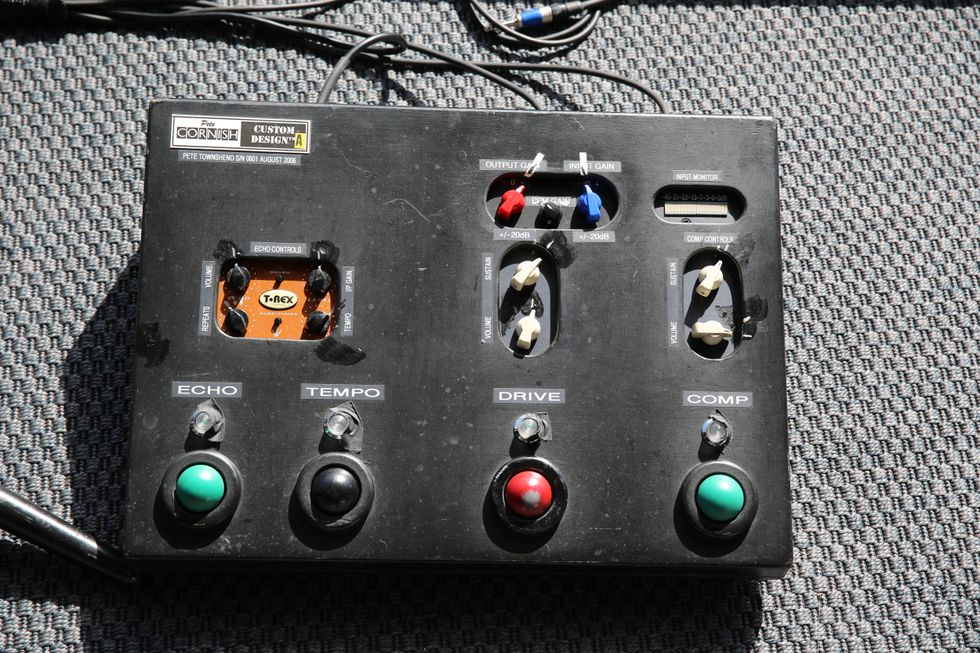
Pete Townshend’s Pedalboard
The legendary windmiller’s guitars run into a Pete Cornish AC Powered 3 Way Split box, then onto a very custom Cornish-built pedalboard. Inside are just three circuits, pulled from their enclosures and wired up by Cornish: a T-Rex Effects Replica, a Boss OD-1, and a Demeter Compulator. Tech Simon Law’s predecessor, lifelong Townshend tech Alan Rogan, had Cornish build two of these; the backup stays on hand in case of emergency. The board is also outfitted with a top-notch power supply and buffer circuit, plus the nifty “Dr. Who-style” footswitch buttons.
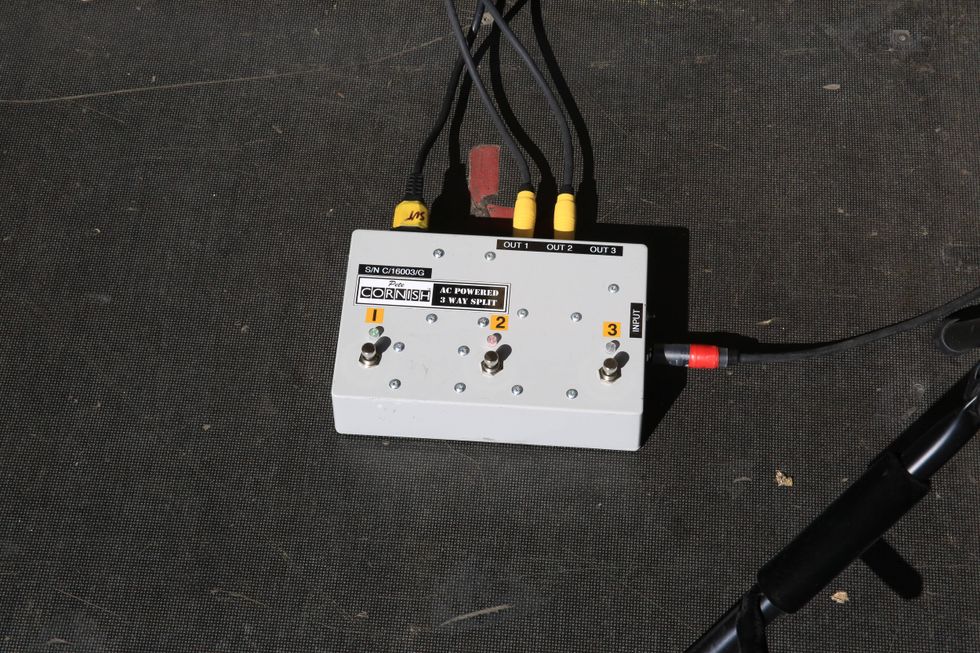
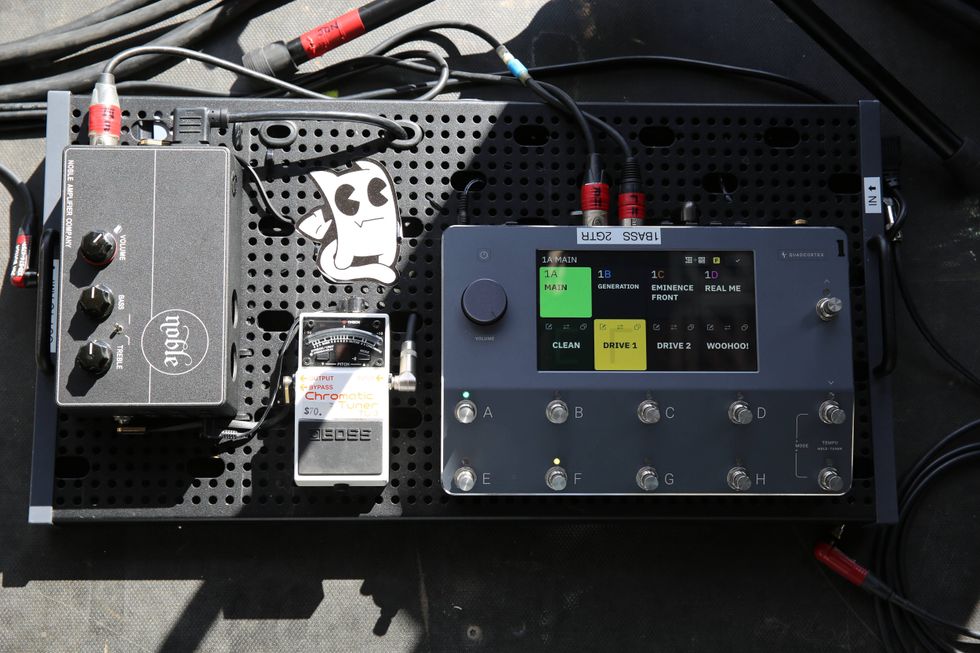
Jon Button’s Pedalboard
Button runs three signals to front of house: one from his Noble Preamp, and two from his Neural Quad Cortex. One of the Neural’s signals runs a stock Ampeg SVT model, and the other is an emulation of Pete Thorn’s Suhr SL68, plus four preset drive levels that Button can switch between as desired. Front of house blends the signals as they see fit.
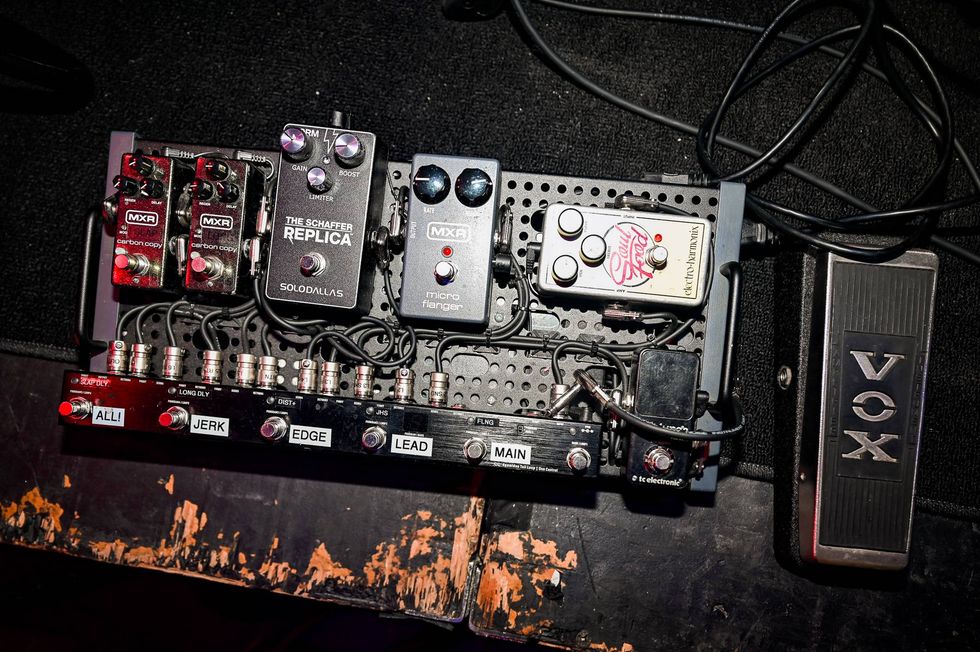
Declan Mehrtens’ Pedalboard
The jewel of Mehrtens’ board is his SoloDallas Schaffer Replica, famous for its recreation of Angus Young’s guitar tone. In addition, he runs a TC Electronic PolyTune 3 Noir, Electro-Harmonix Soul Food modded with LED diodes, MXR Micro Flanger, two MXR Carbon Copy Minis, and a Vox wah pedal. A switcher with six loops, built by Dave Friedman, manages the changes.
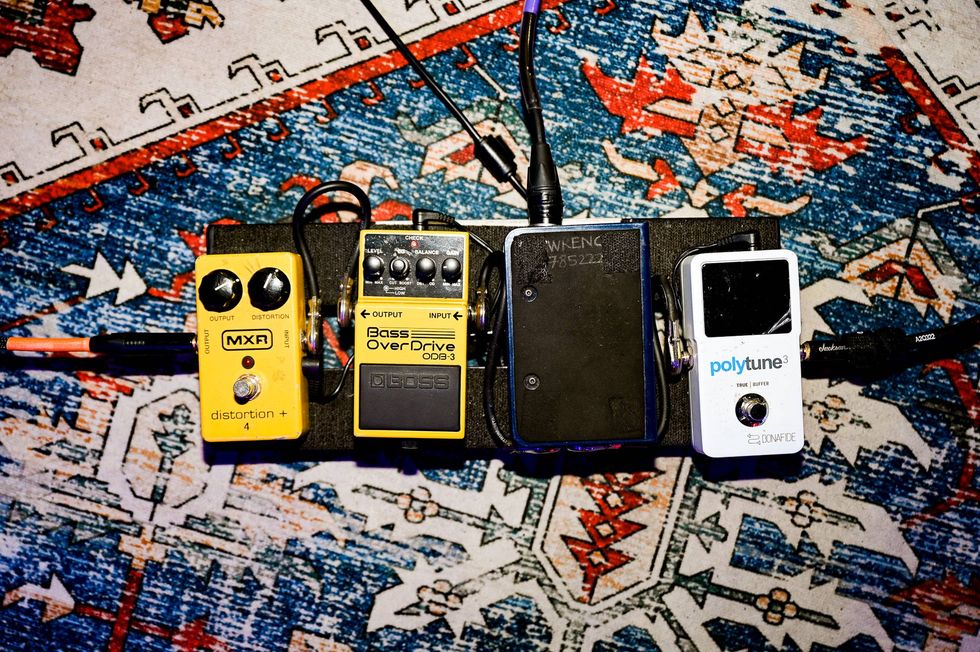
Gus Romer’s Pedalboard
Romer’s board, furnished with the help of Mehrtens, gets right to the point: It features a TC Electronic PolyTune 3, a Boss ODB-3, and an MXR Distortion+.
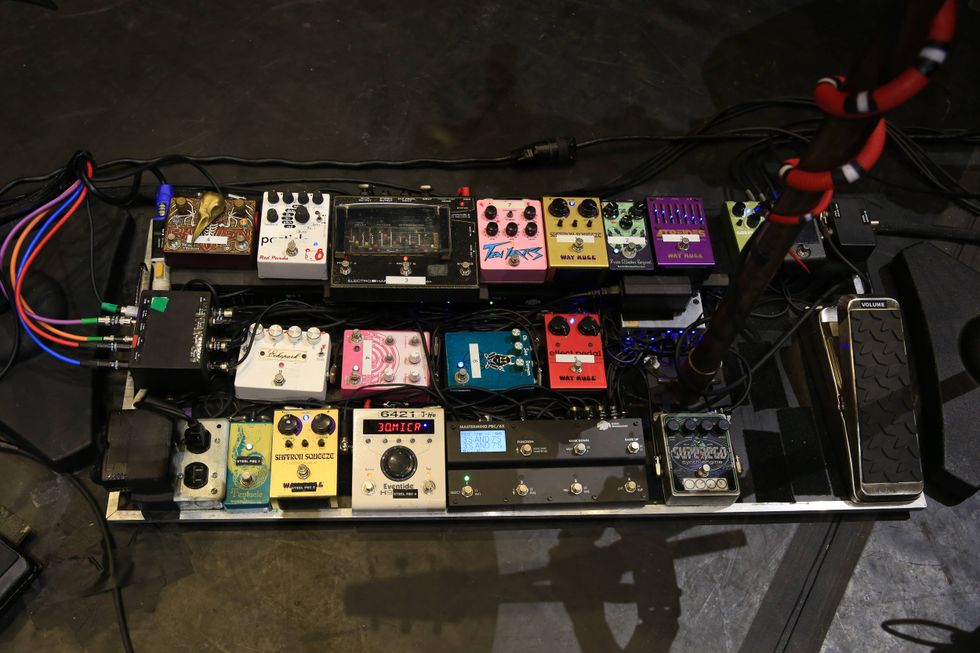
Troy Van Leeuwen’s Pedalboard
All of Van Leeuwen’s pedals go through loops, with a RJM Mastermind PBC/6X and Mastermind GT/16 handling the switching, and most processing done through a Fractal FM3 and a pair of Eventide H9s. Van Leeuwen designed the boards, and his tech Cody helped build and program it.
Across the two boards, there’s a pair of Electro-Harmonix Superegos and Way Huge Saffron Squeezes, plus Dunlop expression and volume pedals; EarthQuaker Devices Tentacle, Rainbow Machine, and Fuzz Master General; Way Huge Effect Pedal, Green Rhino, and Atreides; Echopark Echodriver; Ten Years Is A Decade; modified EHX Holiest Grail; and Dr. No Effects TVL Raven.
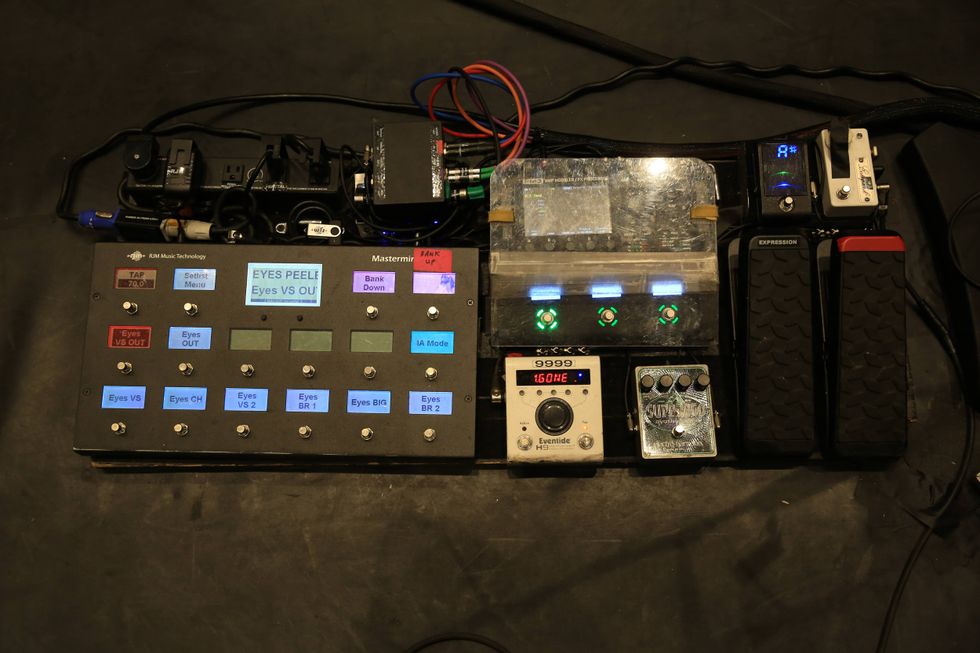
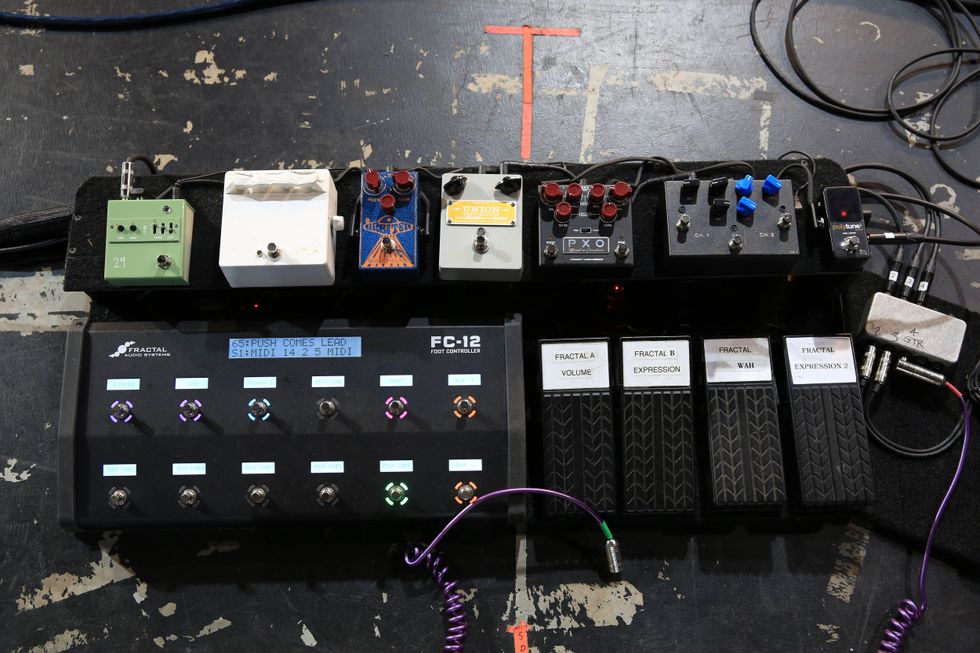
Dweezil Zappa’s Pedalboard and Rack
Zappa keeps a significant board at his feet, which he operates with a Fractal FC-12 controller. He runs his sound in stereo, with different effects going to each side, so he keeps volume pedals for each in front of him, plus a wah and expression pedal.
The row of pedals perched atop the board includes a TC Electronic Polytune 3 Noir, a Marshall-style prototype pedal, J. Rockett Audio Designs PXO, Union Tube and Transistor Lab, SoloDallas Orbiter, a Jext Telez White Pedal (to nab a specific tone for playing “Nanook Rubs It”), and a 29 Pedals FLWR.
In our 2013 Rig Rundown, Dweezil was using a Fractal Axe-Fx II, and this time around, he’s upgraded to the Axe-Fx III as the basis of his sound. Given the sonic territory covered in his shows, it simply became too unwieldy and expensive to tour an analog rig.
The brains of his show are held in a rack system. A couple of out-of-sight splitter boxes help with the complex stereo signal paths, as do a pair of Voodoo Lab HEX audio switchers. The Axe-Fx III lives on the top shelf, and just below it are an Eventide H90 and TC Electronic TC 2290 that go to both sides.
The next rack down runs only to the left side, and includes a BK Butler Tube Driver, DigiTech FreqOut, Red Panda Radius and Raster, Krozz Devices Airborn Analog Flanger, and a Paul Trombetta Design Tornita! fuzz.
The level below it runs to the right side, with a “Clown Vomit” fuzz, Chase Bliss Warped Vinyl, Korg FLG-1 Flanger, Chase Bliss Generation Loss, Goochfx Holy Cow, and another Red Panda Raster.
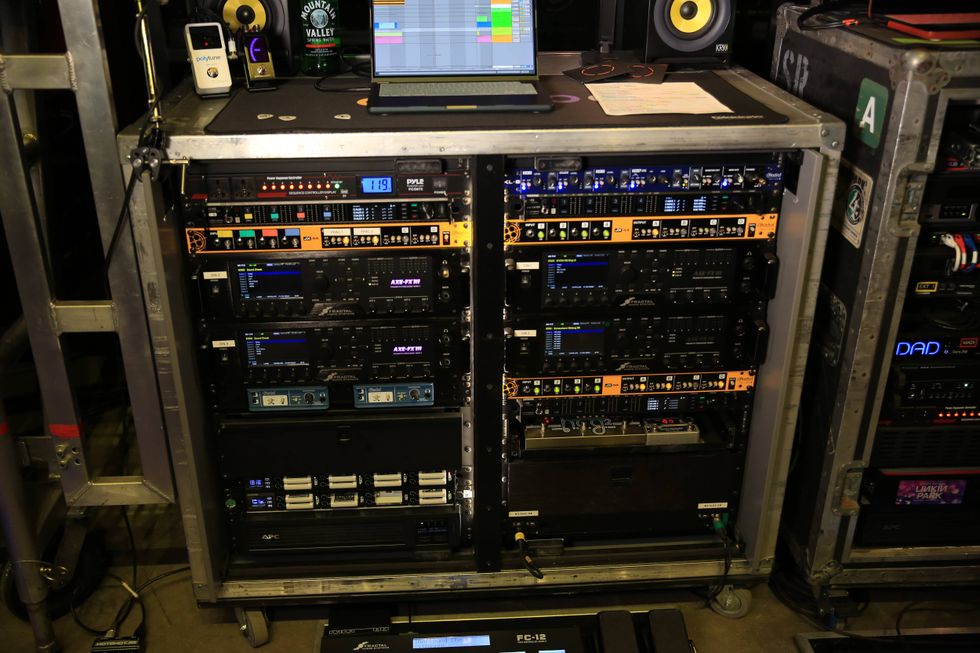
Mike Shinoda, Brad Delson, and Alex Feder’s Rack Systems
Brad Delson’s rig (used by touring member Alex Feder) lives on the left side of this rack, while Mike Shinoda’s takes up the right. They both feature a Radial KL-8, two Radial JX44s, two Shure AD4Qs, and two Fractal Axe-Fx III units. Shinoda’s setup also includes two Electro-Harmonix HOG2 pedals. The Fractals employ IRs that were captured by old FOH engineer Pooch, using a Randall cabinet.
MIDI handles all of the changes for the show, though there’s a Fractal FC-12 foot controller on hand for manual switching in case of emergency. Fred Carlton of Nerdmatics, who built the Linkin Park rig for the 2024-2025 run promoting From Zero, shared some information with us: “The backline gear consists of about 11 computers running Ableton, all receiving locator information from the main playback computers. We maintain redundant computer systems for Joe Hahn’s DJ rig, Mike Shinoda’s keyboard rig, the Audio FX rig, and the Playback system. Single-computer setups are used for both guitar rigs and the bass rig, as these stations only send MIDI patch changes and do not handle audio. Additional single-computer systems are in place at Monitor World, FOH, and within the Visual department.
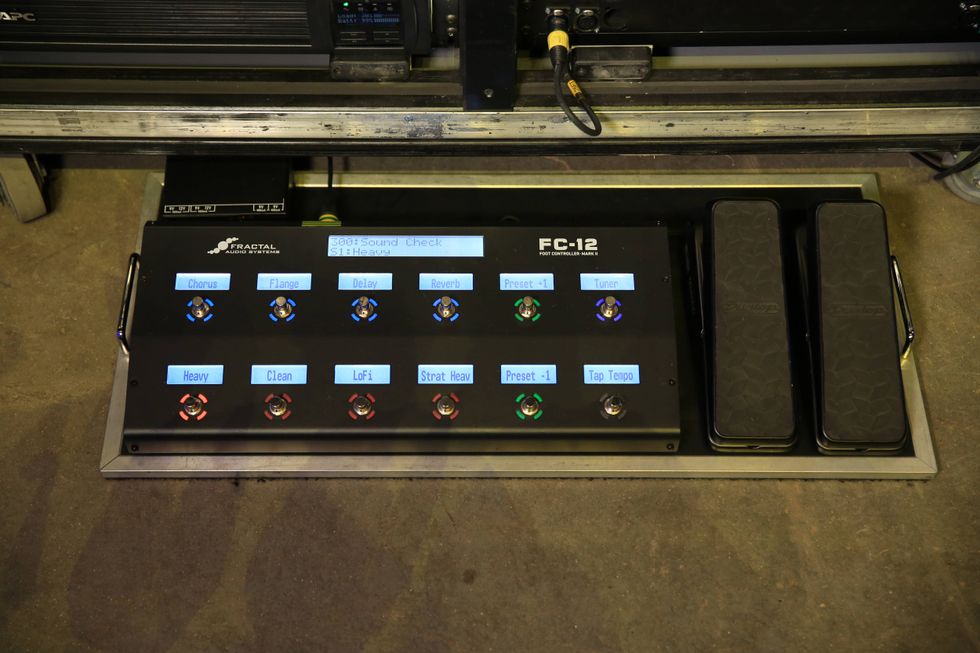
Each station carries an updated timeline of the show, allowing techs to insert automation data such as MIDI or timecode to control their systems. Once changes are made to the main Ableton session, we distribute updated .ALS files to all departments, enabling them to integrate their specific data into the new timeline. This workflow allows us to implement changes quickly while keeping all departments aligned. Having separate computers also gives each tech the ability to test their own system independently. In the event of losing RTP network connectivity, they can punt the show locally without relying on external automation.”
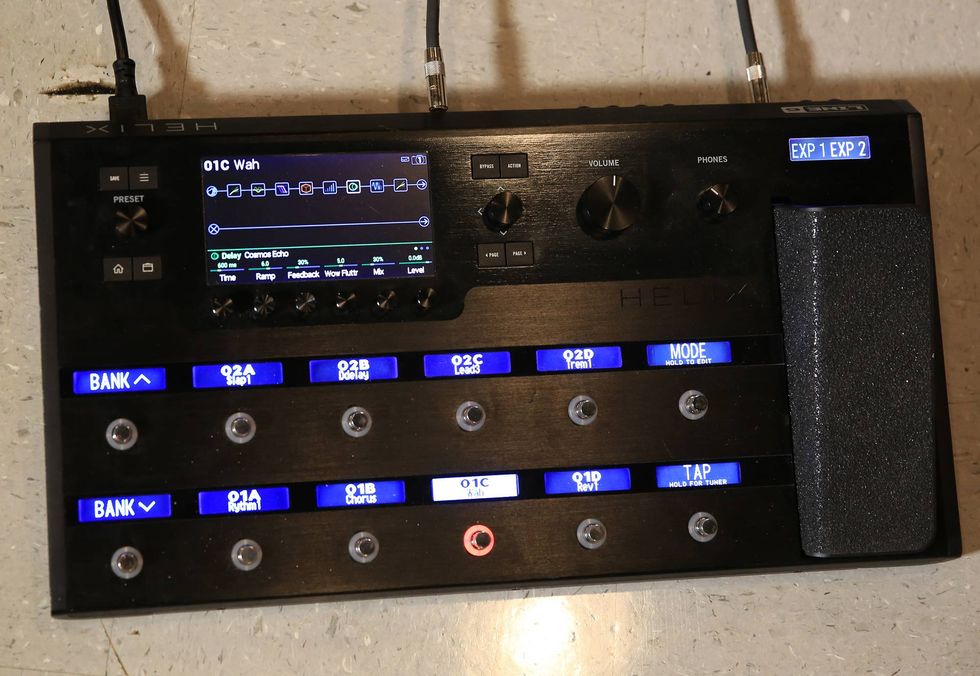
Duane Denison’s Pedalboard
Denison sets up this Line 6 Helix as a pedalboard, with tweaked versions of his favorite analog delay pedals programmed in. Among his go-to effects are reverb, slapback delay, tremolo, chorus, wah, longer delay, and what he calls a “wildcare effect,” which comes into play for “What If?”
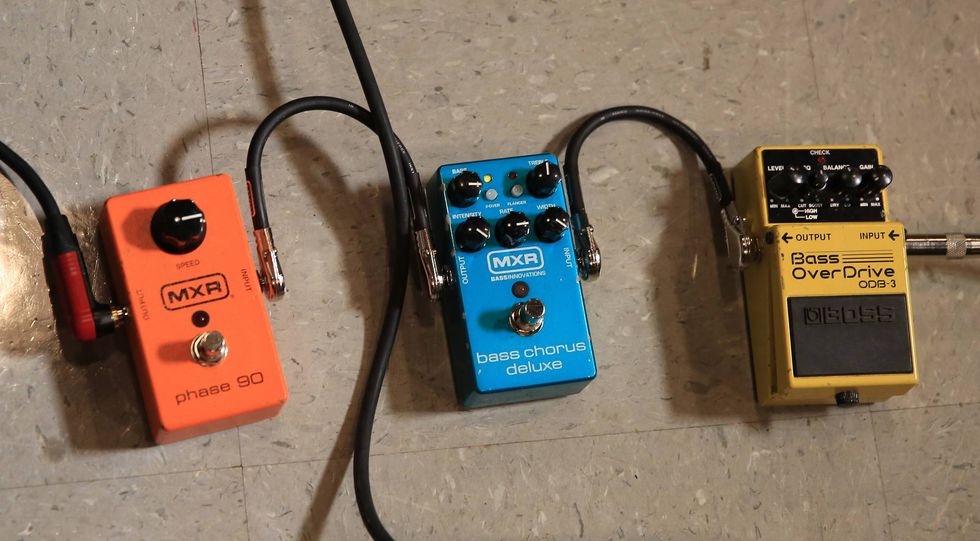
Dave Wm. Sims’ Pedalboard
No fancy floor unit for Sims. He’s got a Boss ODB-3, an MXR Bass Chorus Deluxe, and an MXR Phase 90, all of which are used sparingly throughout the set.
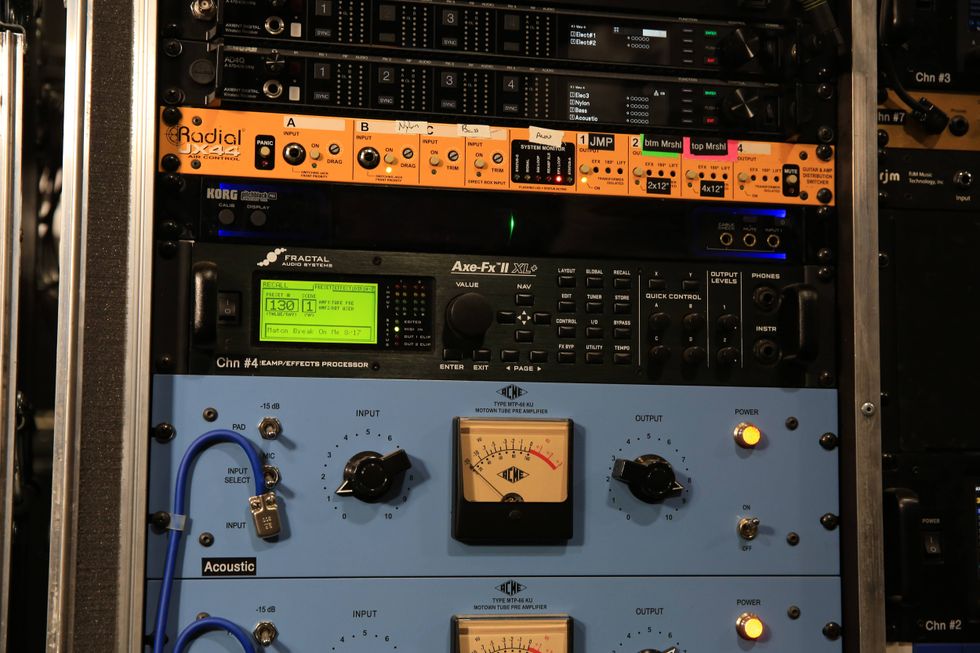
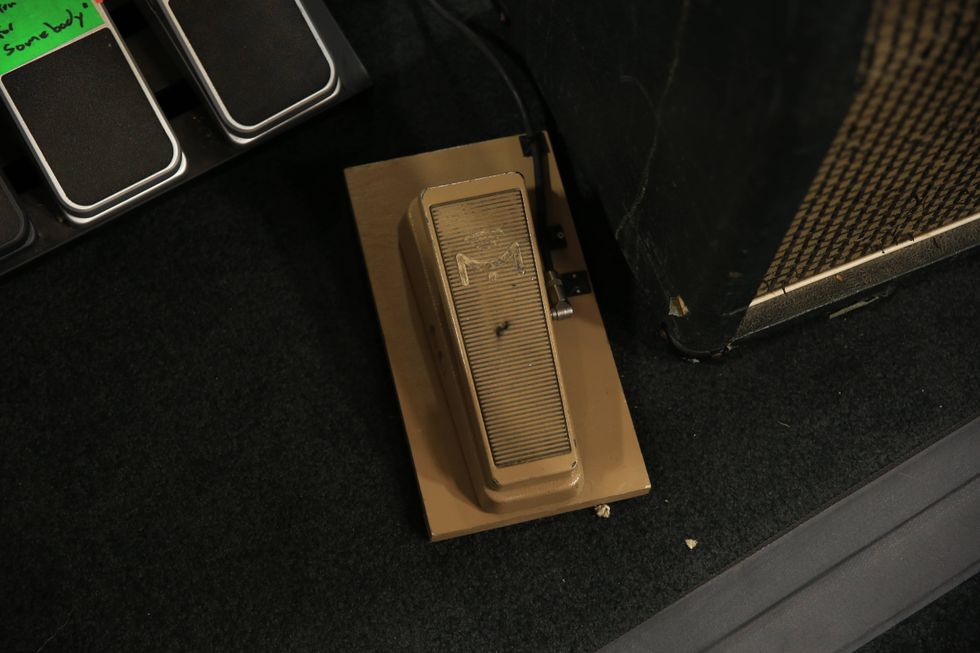
Keith Urban’s Pedalboard
Delays and modulation are all added to Urban’s tones after three mics capture the sound of his Marshall cab. Those signals hit this Fractal Axe-Fx II XL+, which tech Chris Miller controls offstage. A Mission Engineering expression is the only pedal Urban utilizes, which controls a model of a Cry Baby in the Fractal.
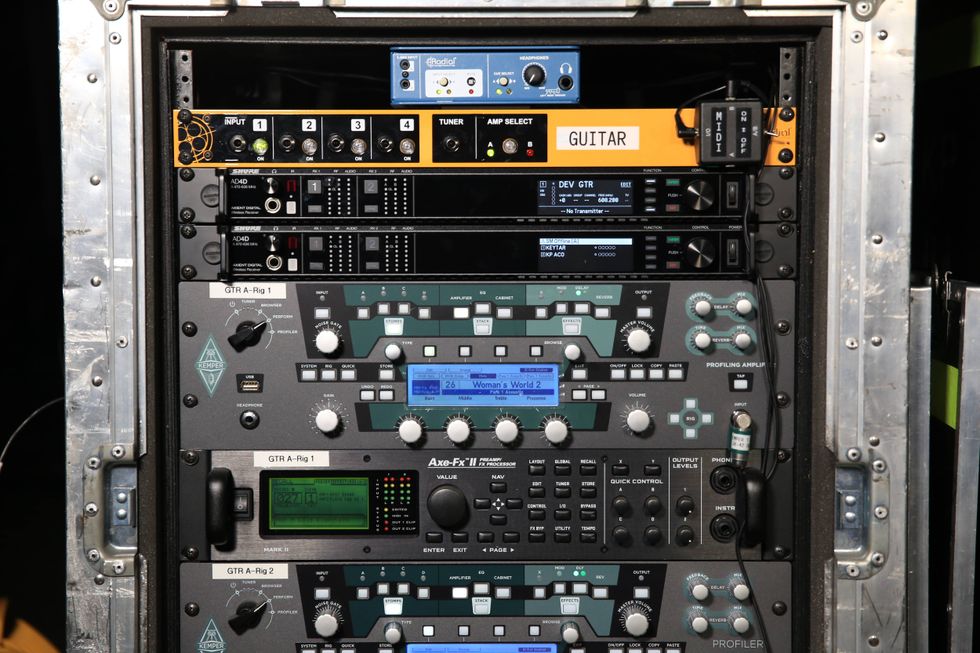
Devon Eisenbarger’s Rack Setup
Eisenbarger runs an all-digital rig, contained in this rack backstage. The key pieces are a Radial JX42, two Shure AD4Ds, a Kemper Profiling Amplifier, and a Fractal Axe-Fx. The Kemper runs a SELAH SOUNDS pack of profiles and impulse responses.
With no onstage monitors, Eisenbarger’s signal runs only to in-ear monitors and front of house.
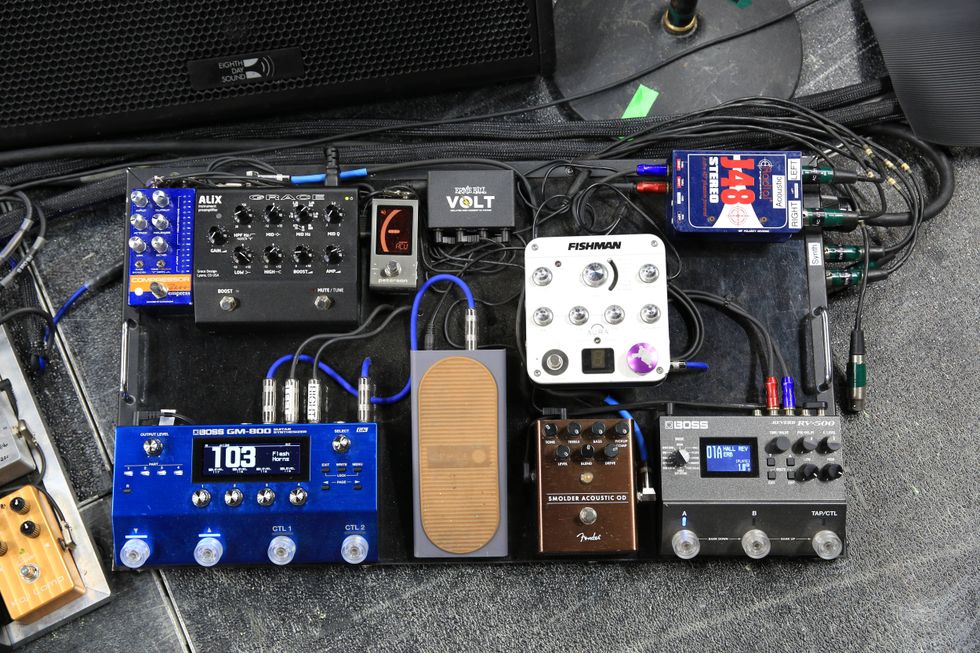
Steve Stevens’ Pedalboard
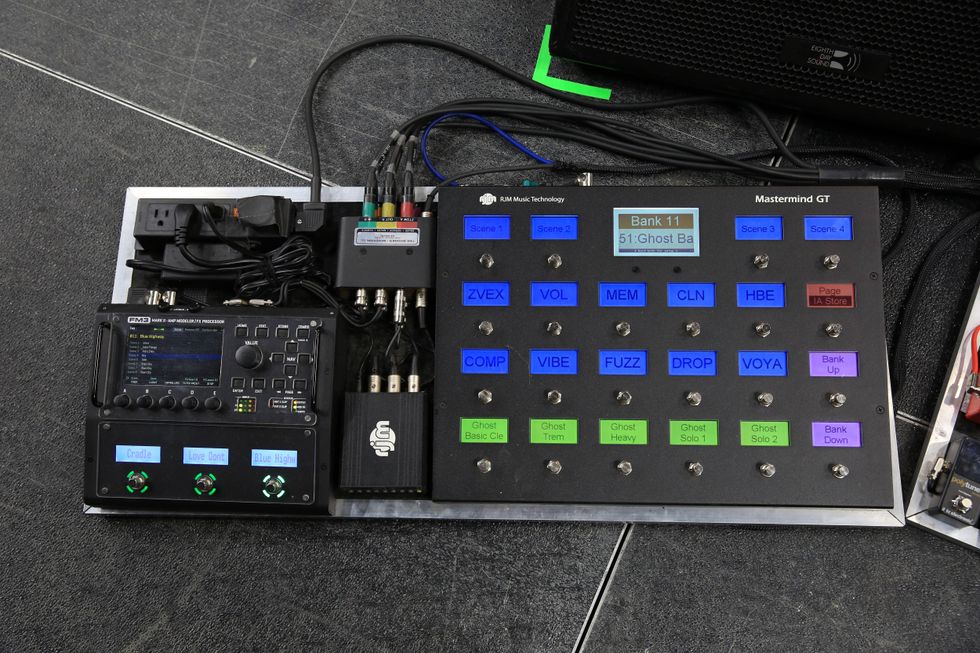
Stevens’ pedal playground is managed by an RJM Mastermind GT, which lives on its own board alongside a Fractal FM3 MK II. He orchestrates most of the changes himself, but tech Frank Falbo is ready to flip switches backstage in case Stevens is away from his board at a key moment.
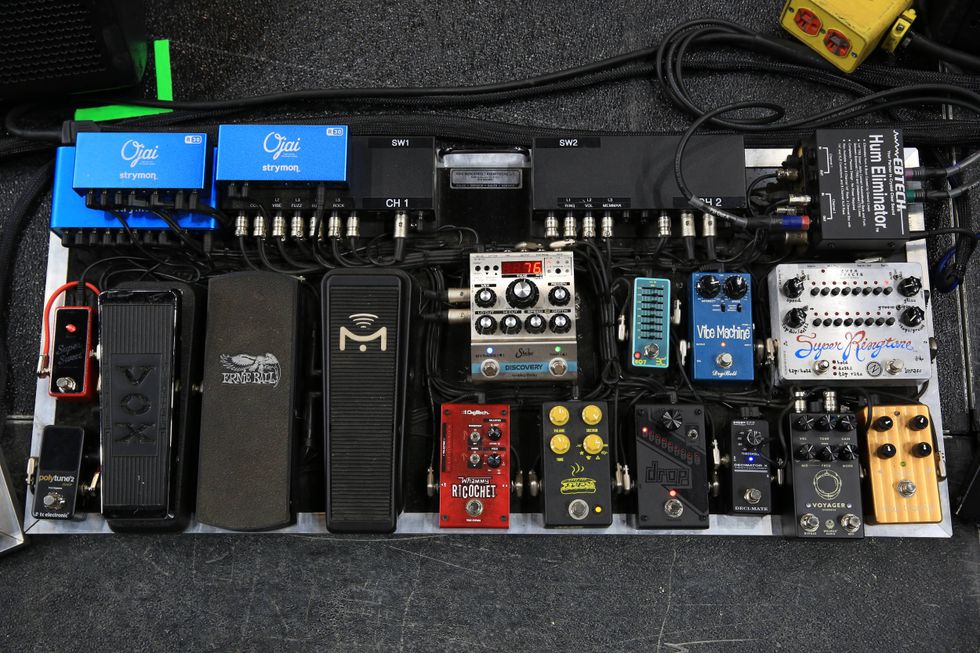
The center hub, built on a Tone Merchants board, carries a TC Electronic PolyTune2 Noir, Xotic Effects Super Sweet Booster, Vox wah, Ernie Ball volume pedal, Mission Engineering expression pedal, DigiTech Whammy Ricochet, Suhr Discovery, JHS Muffuletta, DigiTech Drop, ISP DECI-MATE, Walrus Voyager, Suhr Koji Comp, Zvex Super Ringtone, DryBell Vibe Machine, and Ammoon EX EQ7. An Ebtech Hum Eliminator, two Strymon Ojais, and a Strymon Zuma keep the wheels greased.
The board to the right carries a Boss RV-500, Fender Smolder Acoustic OD, Lehle Dual Expression, Boss GM-800, Empress Bass Compressor, Grace Design ALiX preamp, Fishman Aura, and a Peterson tuner. Utility boxes include an Ernie Ball Volt and a Radial J48.
Jessica Dobson’s Pedalboard
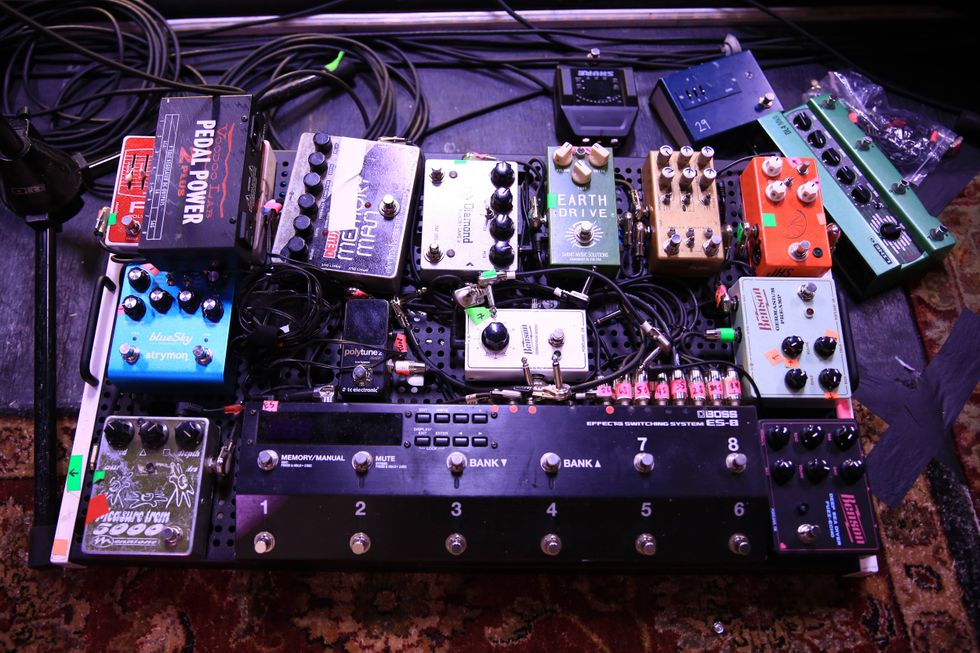
Dobson runs a busy board powered by a Voodoo Labs Pedal Power 2 Plus and operated via a Boss ES-8. There’s also her signature Benson Deep Sea Diver, plus a Benson Germanium Preamp, JHS Pulp N Peel, Sarno Music Solutions Earth Drive, Benson Germanium Boost, EHX Deluxe Memory Man, Strymon blueSky, EHX POG2, Chase Bliss Brothers Analog Gainstage, and Menatone Pleasure Trem 5000, plus a TC Electronic PolyTune 2 Noir.
MJ Lenderman’s Pedalboard
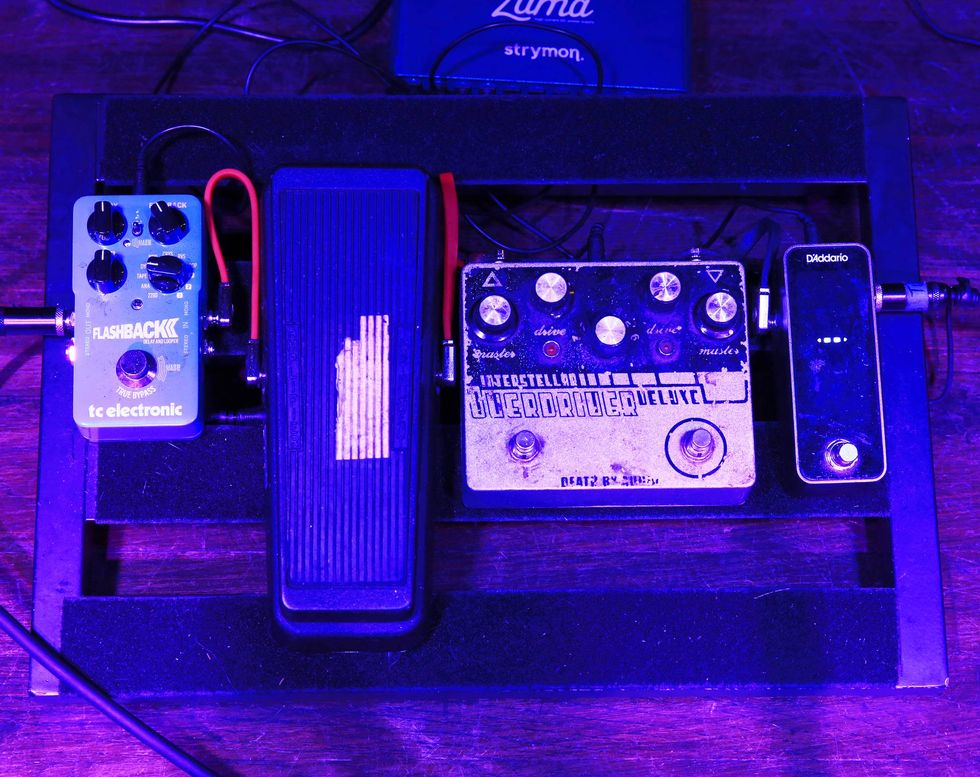
Lenderman’s clean, easy board has a D’Addario tuner, Death By Audio Interstellar Overdriver Deluxe, a Dunlop wah that he uses as a subtle filter, and a TC Electronic Flashback 2.
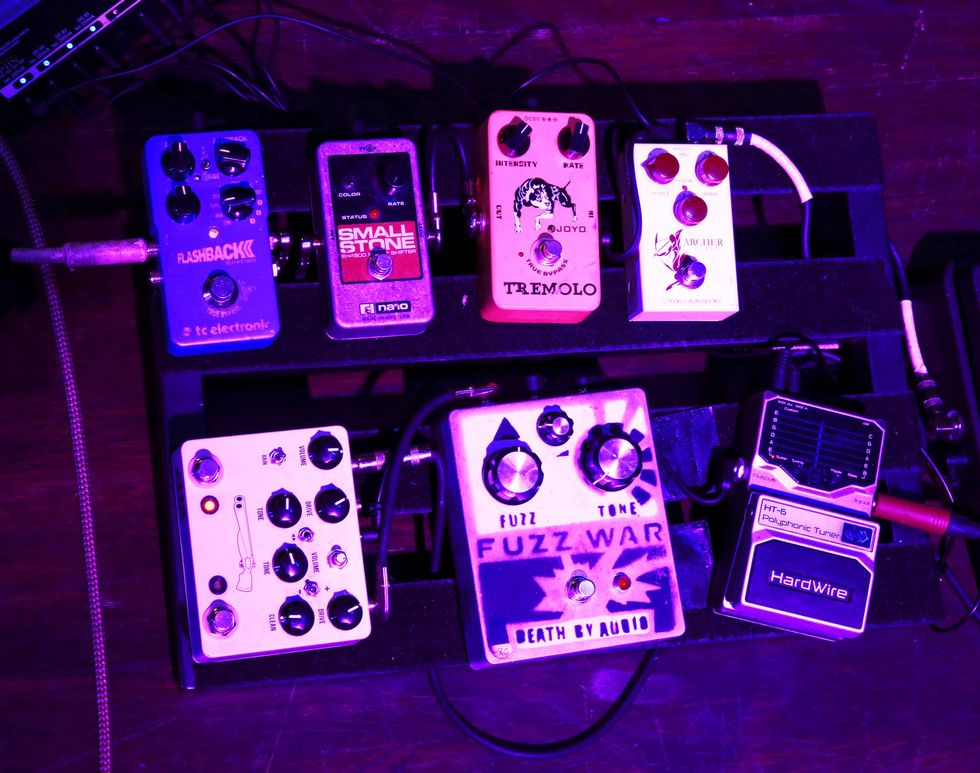
Jon Samuels’ Pedalboard
Samuels’ board, a hybrid of his own pedals and some borrowed units, carries a Hardwire HT-6 polyphonic tuner, Death By Audio Fuzz War, JHS Double Barrel, Dunlop wah, J. Rockett Archer Clean Boost, Joyo Tremolo, EHX Nano Small Stone, and TC Electronic Flashback 2.
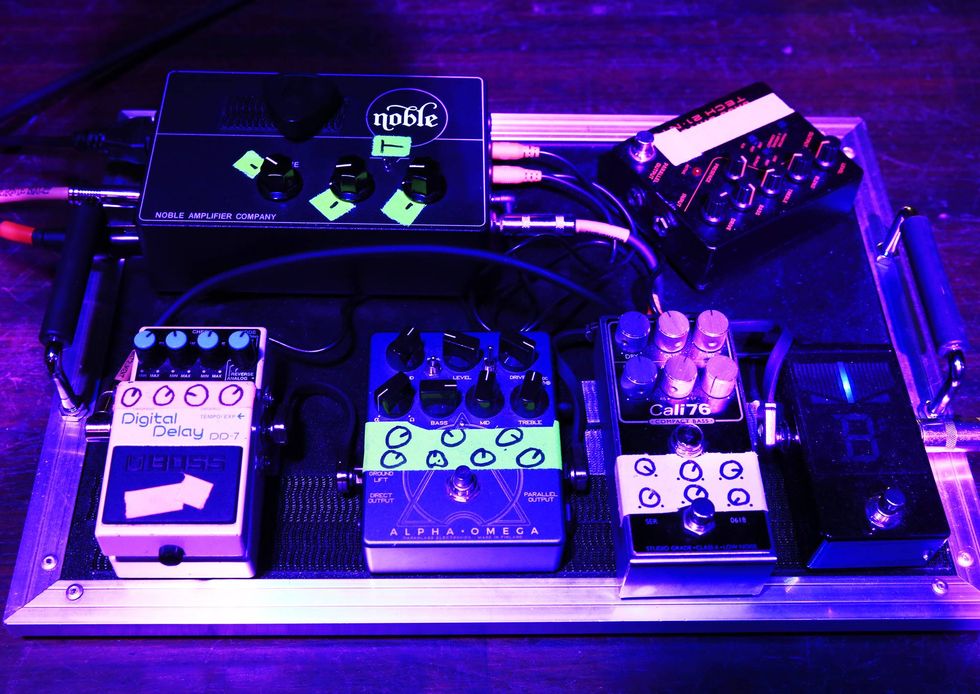
Landon George's Pedalboard
George packs a Korg Pitchblack tuner, Origin Effects Cali76 Compact Bass, Boss DD-7, Darkglass Electronics Alpha Omega, and a Noble Amplifier Company utility box—it’s a tube preamp, DI box, and power supply, all in one.
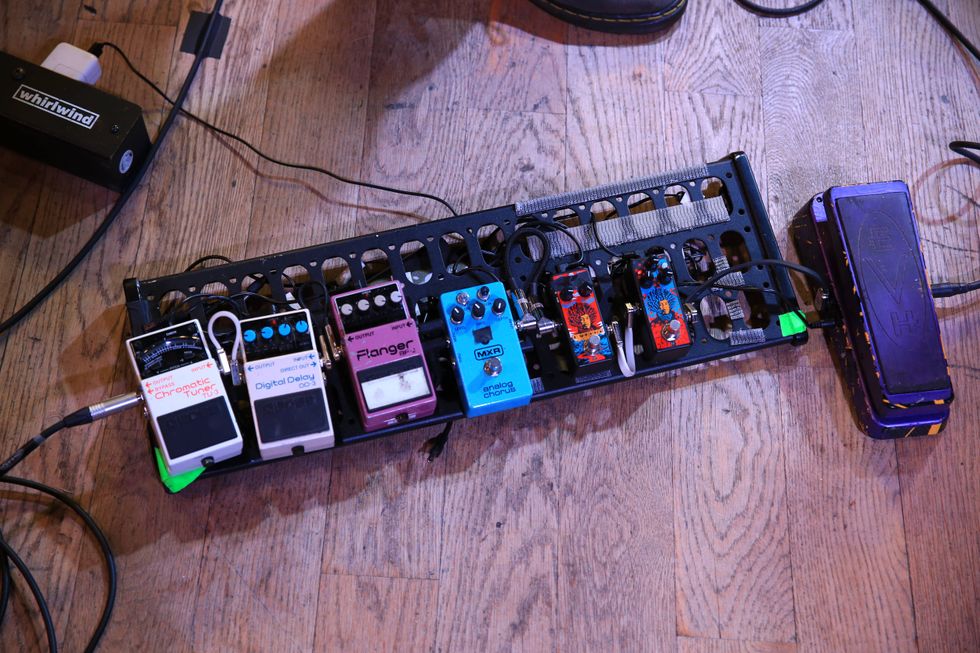
Orianthi’s Pedalboard
Orianthi’s playing does most of the heavy lifting, but this humble board contributes some muscle. There’s a Dunlop Cry Baby EVH wah, Dunlop Authentic Hendrix ’68 Shrine Series Octavio, Dunlop Authentic Hendrix ’68 Shrine Series Uni-Vibe, MXR Analog Chorus, Boss BF-2, Boss DD-3, and a Boss TU-3.
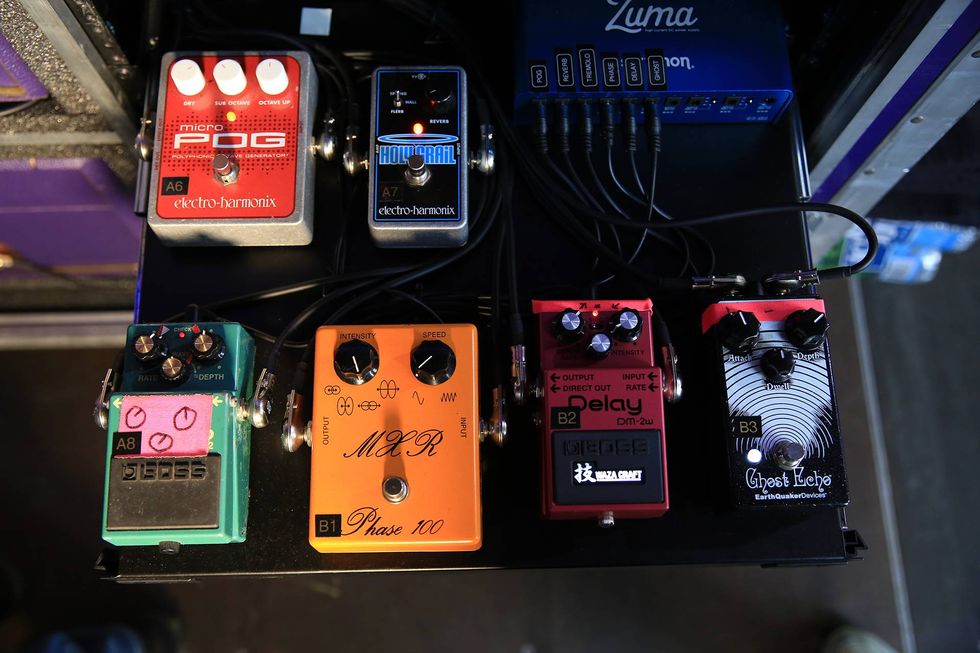
Frank Iero’s Rack
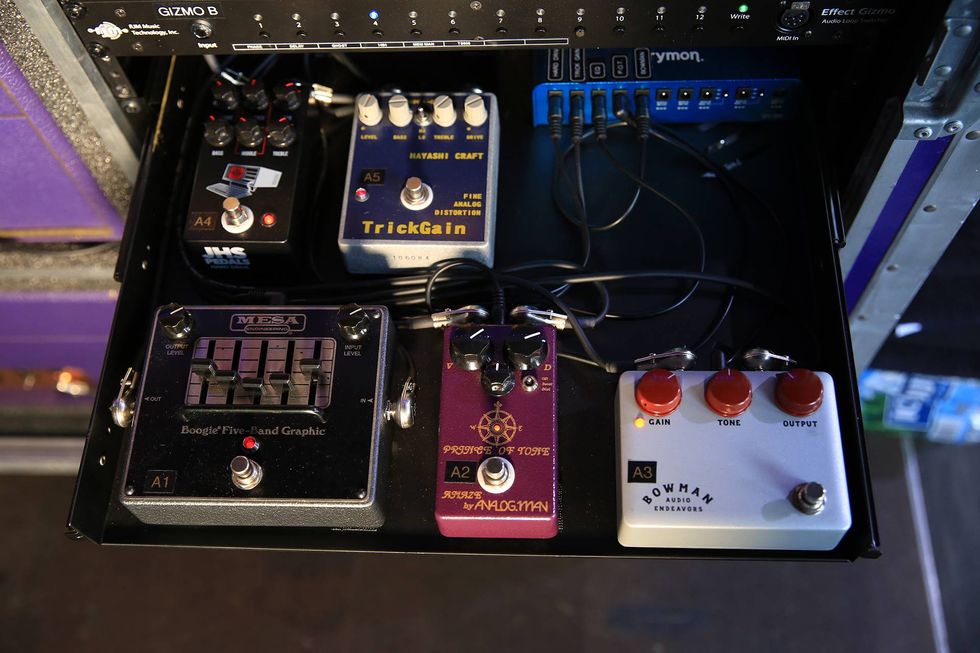
Iero’s backstage rig includes three main racks of effects, all powered by Strymon Zumas.
The first carries a Mesa Boogie 5-Band Graphic EQ, Amaze by Analogman Prince of Tone, Bowman Audio Endeavors Bowman Overdrive, JHS Hard Drive, and Hayashi Craft Trick Gain.
Drawer two is about modulation, and includes a Boss TR-2, MXR Phase 100, Boss DM-2W, EarthQuaker Devices Ghost Echo, EHX Micro POG, and EHX Holy Grail.
The last drawer bears a Jackson Audio Twin Twelve, EHX Deluxe Memory Man, Ibanez Tube Screamer Overdrive Pro, and Bowman Audio Bellyacher.
Ray Toro’s Rack
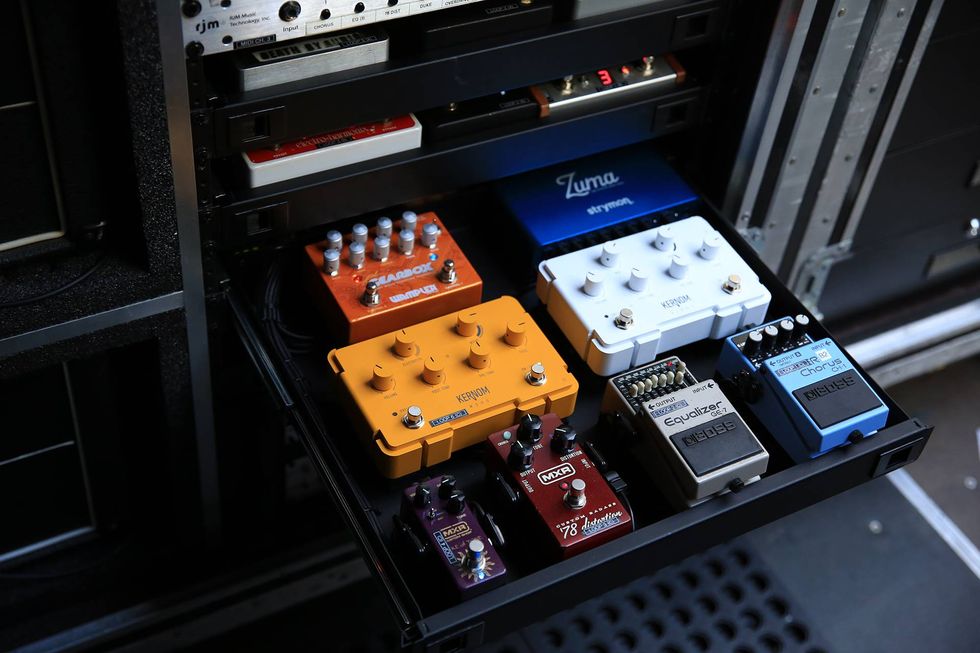
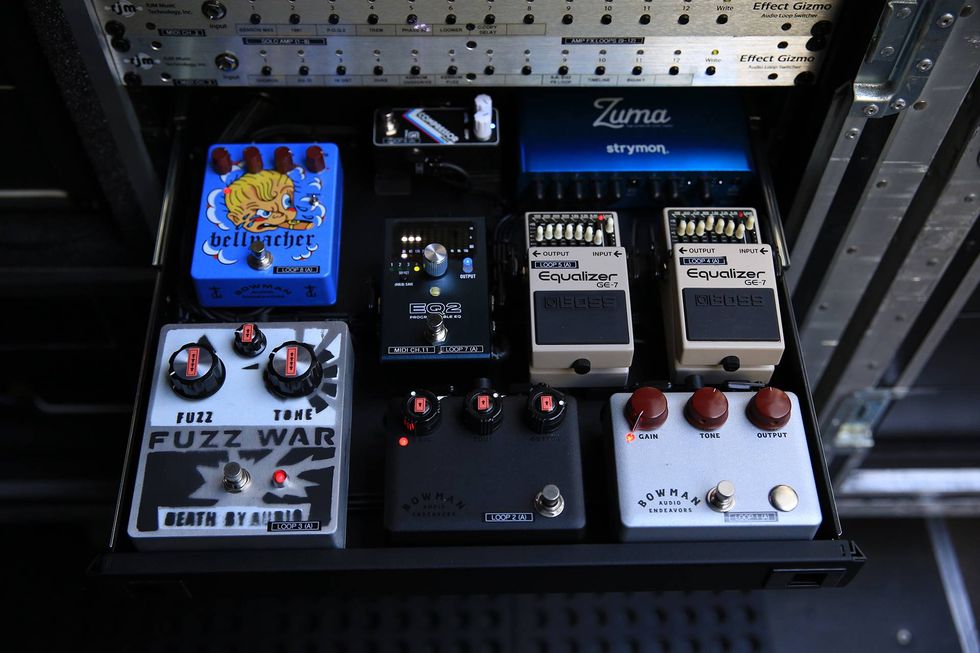
A Shure Axient wireless system sends Toro’s guitar’s signal to this system backstage, where it hits a Radial JX44 and a pair of RJM Effect Gizmos.
One drawer holds an MXR Duke of Tone, MXR Custom Badass ’78 Distortion, Boss GE-7, Boss CH-1, Kernom Moho, Kernom Ridge, and Wampler Gearbox.
In the next are two Boss GE-7s, two Bowman Overdrives, a Death by Audio Fuzz War, a Source Audio EQ2, a Bowman Bellyacher, and a Keeley Compressor Mini.
The third shelf is home to an EHX POG2, 1981 Inventions DRV, Chase Bliss Preamp MK II, Boss TR-2, MXR Carbon Copy, Keeley Loomer, and MXR EVH Phase 90.
A fourth level hosts a Strymon TimeLine, Strymon BigSky, and Source Audio EQ2.
Onstage at his feet, Toro’s pedalboard boasts a TC Electronic PolyTune, a custom RJM Mastermind PBC/6X, Ibanez TS808, Bowman Audio Bowman Overdrive, EHX Micro POG, Boss TR-2, MXR Carbon Copy, and Strymon BigSky. Strymon Zumas keep everything chugging along.
Mikey Way’s Pedals
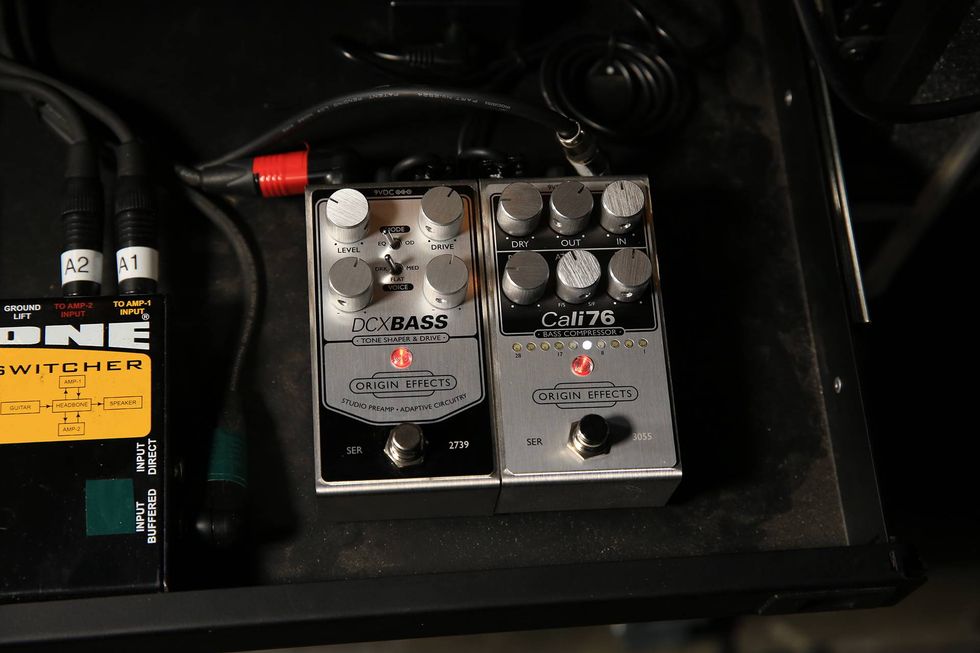
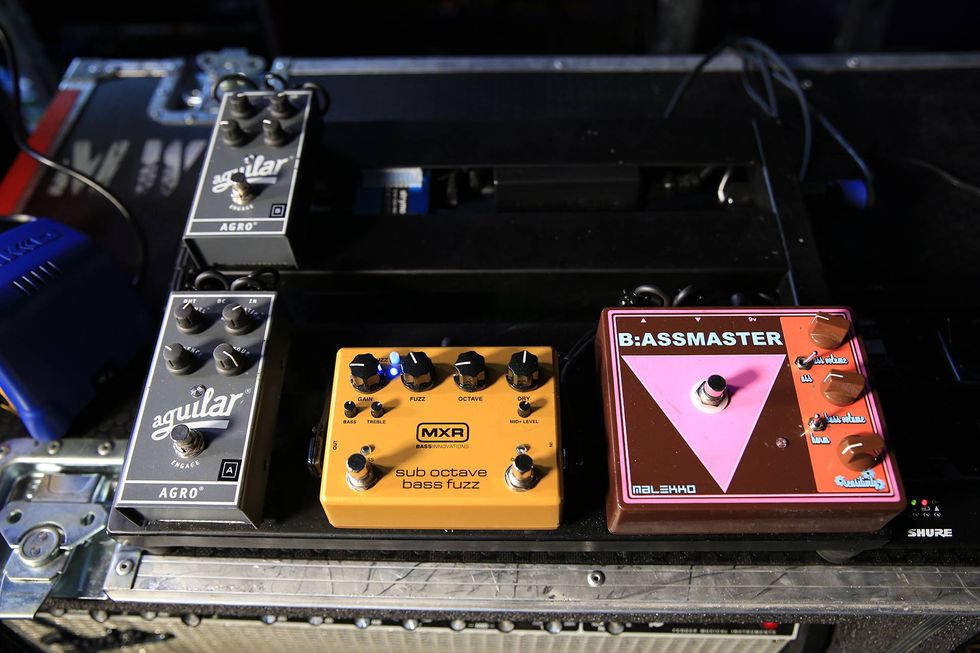
Way keeps things simple. Along with an Origin Effects DCX Bass and Cali76 set to push his Super Bassman, his setup includes a pair of Aguilar Agros, an MXR Sub Octave Bass Fuzz, and a Malekko B:assmaster.
Jim James’ Pedalboard
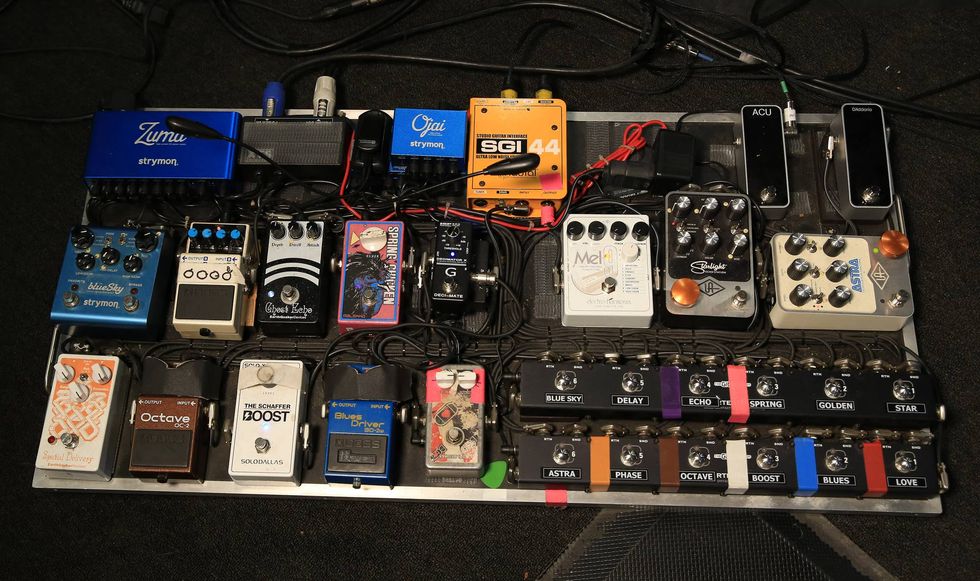
James’ board is built around a pair of GigRig QuarterMaster switching systems, which lets him navigate the stomps seen here: a Devi Ever US Fuzz, Boss BD-2w, SoloDallas Schaffer Boost, Boss OC-2, EarthQuaker Devices Spatial Delivery, Strymon blueSky, EQD Ghost Echo, Malekko Spring Chicken, ISP Deci-Mate, Electro-Harmonix Mel9, UA Starlight Echo Station, and UA Astra Modulation Machine. A D’Addario Chromatic Pedal Tuner duo keep things on pitch, a Strymon Zuma and Ojai pair handle the power, and a Radial SGI-44 line driver maintains clarity.
Carl Broemel’s Pedalboard
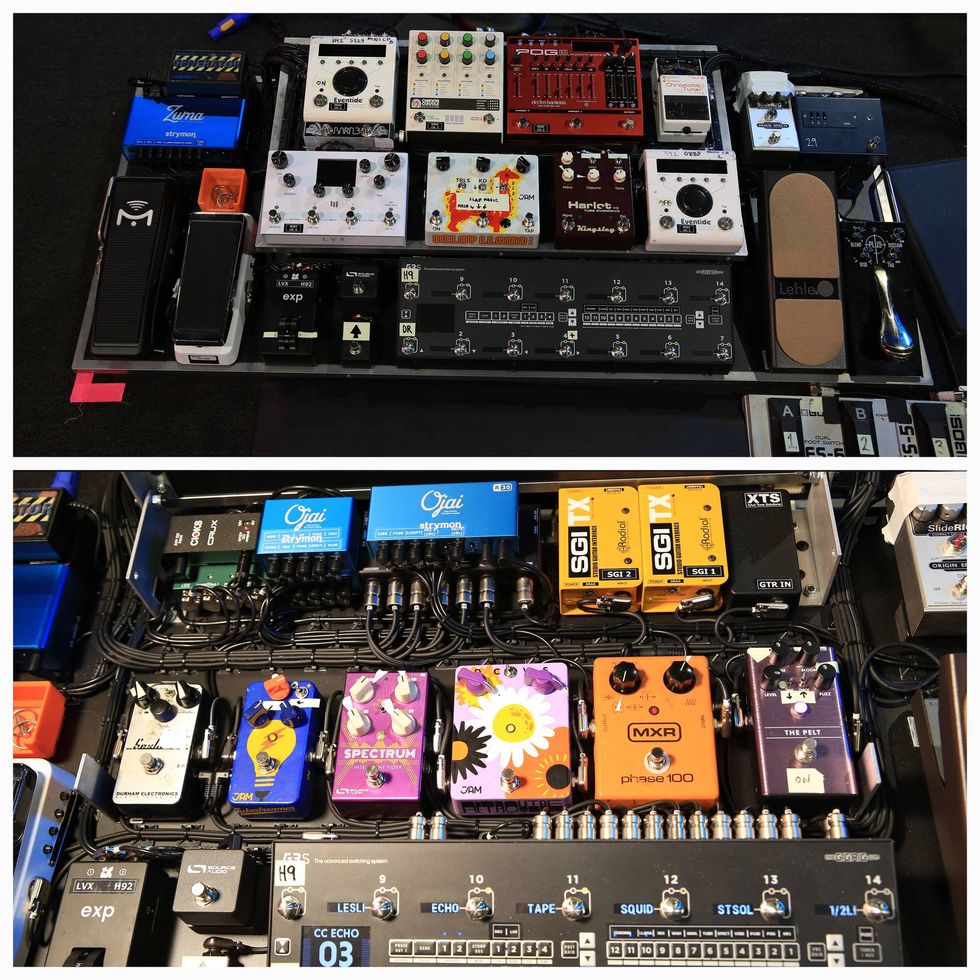
Broemel commissioned XAct Tone Solutions to build this double-decker board, which depends on a GigRig G3S switching system. From top to bottom (literally), it includes a Boss TU-3, Durham Electronics Sex Drive, JAM Pedals Tubedreamer, Source Audio Spectrum, JAM Retrovibe, MXR Phase 100, Fender The Pelt, Origin Effects SlideRIG, 29 Pedals EUNA, two Eventide H9s, Kingsley Harlot V3, JAM Delay Llama, Merix LVX, Hologram Chroma Console, and EHX POGIII. A wah and Mission Engineering expression pedal sit on the left side, while a Lehle volume pedal and Gamechanger Audio Plus hold down the right edge.
Utility units include two SGI TX interfaces, two Strymon Ojais and a Strymon Zuma, and a Cioks Crux.
Tom Blankenship’s Pedalboard
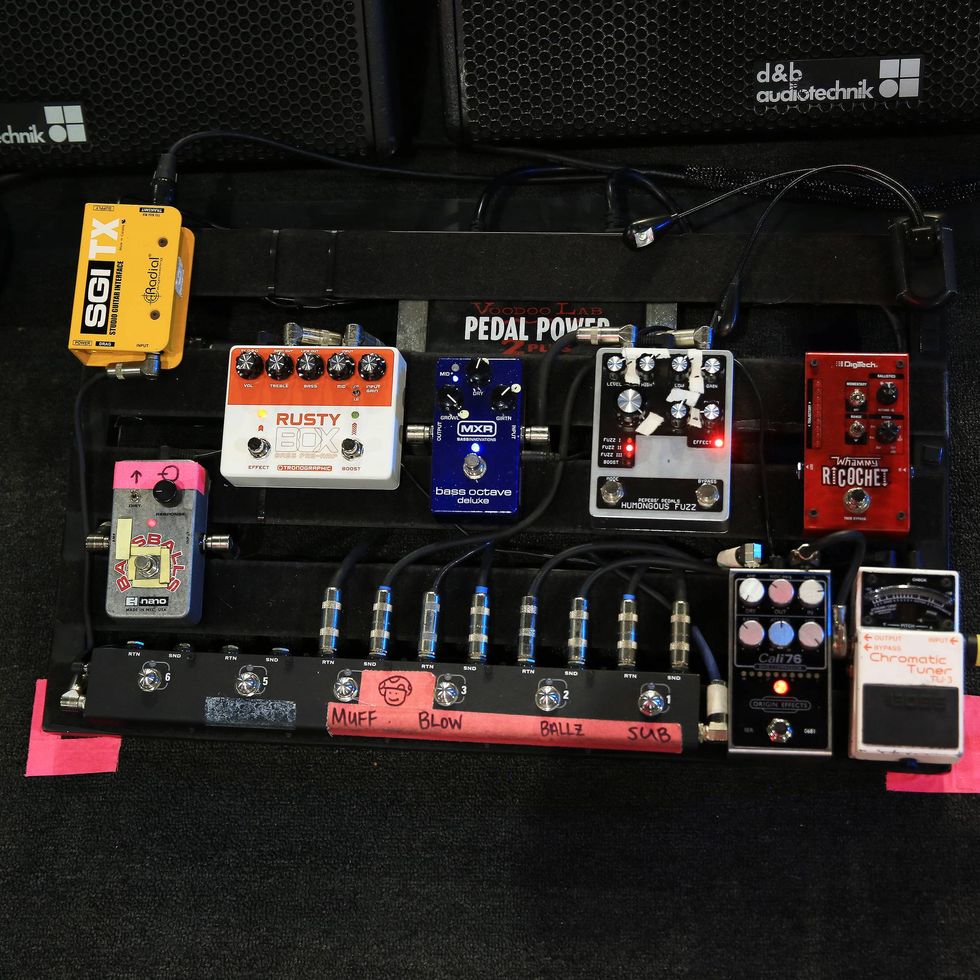
Like James, Blankenship uses a GigRig QuarterMaster to jump between his effects. After his Boss TU-3, that includes an Origin Effects Cali76, DigiTech Whammy Ricochet, Pepers’ Pedals Humongous Fuzz, MXR Bass Octave Deluxe, Tronographic Rusty Box, and EHX Bassballs Nano. A Voodoo Labs Pedal Power 2 Plus lights things up, and a Radial SGI TX keeps the signal squeaky clean.
| # | Наименование новости | Тональность | Информативность | Дата публикации |
|---|---|---|---|---|
| 1 | Question of the Month: Who's Your Favorite Independent Guitar Builder? | 0 | 8.42 | 03-03-2026 |
| 2 | Fender Master Builder Andy Hicks’ Winding Road | 0 | 8.8 | 09-03-2026 |
| 3 | Rig Rundown: Tyler Armstrong (The Band Feel) | 0 | 6.96 | 04-03-2026 |
| 4 | Fix the Tiny Gremlins Stealing Your Guitar’s Tone | 0 | 9.78 | 02-03-2026 |
| 5 | Aging With an Emperador | 0 | 6.96 | 20-02-2026 |
| 6 | Reverend Charger Jr. Review | 0 | 10.13 | 10-03-2026 |
| 7 | Mod Garage Tonewood Teardown: Fixing Up Your Bridge and Saddles | 0 | 5.3 | 06-03-2026 |
| 8 | Vintage Vault: How a Sunburst 1960 Gibson Les Paul Broke My Heart | 0 | 8.8 | 05-03-2026 |
| 9 | Rig Rundown: Russian Circles’ Mike Sullivan [2025] | 0 | 12.32 | 10-12-2025 |
| 10 | Santa Cruz Guitar Company’s Richard Hoover: 50 Years of Changing the Game | 0 | 10.94 | 28-05-2026 |